Market Snapshot
Middle bar: base-year value × (1 + CAGR), rounded to two decimals. This is a calculated illustration, not a separately researched annual estimate.
The Mexico bus and coach market size is estimated at USD 1,186.79 million in 2025 and is projected to reach USD 1,624.09 million by 2030, growing at a CAGR of 6.47% over 2026 – 2030. Retail registrations of new medium and heavy buses fall from 6,712 in 2025 to about 5,220 in 2026 and then recover to about 7,900 by 2030, a 3.31% annual rate, while the average value per bus rises from about USD 176,816 to USD 205,581 as electric and hybrid buses enter the mix.
Marqstats defines the market as the retail value of new buses and coaches above 3,857 kilograms gross vehicle weight sold to Mexican operators and public agencies, as registered in the Registro Administrativo de la Industria Automotriz de Vehículos Pesados (RAIAVP) published by the Instituto Nacional de Estadística y Geografía (INEGI) and reported monthly by the Asociación Mexicana de Distribuidores de Automotores (AMDA). It covers urban, suburban, personal-transport and intercity buses. Vans and minibuses below that weight, used imports, school conversions of trucks, and exports are excluded.
Urban and suburban buses account for 59.68% of 2025 value but 77.92% of units, diesel buses for 94.12% of value and urban concession and agency fleets for 44.06%. Central Mexico accounts for 40.00% of value, while the South and Southeast grows fastest at 7.09% a year as concession renewals and electric corridors spread beyond Mexico City.
Key Takeaways
Market Overview & Analysis
Report Summary
Marqstats sizes the Mexico bus and coach market as the retail value of new buses above 3,857 kilograms gross vehicle weight that enter service each year. That is the weight line used by INEGI for its heavy-vehicle register and by Norma Oficial Mexicana NOM-044-SEMARNAT-2017, which sets emission rules for diesel vehicles above that weight. The market has two application segments that the register reports separately: intercity coaches, called autobuses foráneos, and all other buses of classes 5 to 8, called autobuses resto, which cover urban, suburban, employee, tourist and school service.
The market sits above Mexico Passenger Car and Mexico Pickup Truck and does not overlap with them. Mexico Passenger Car covers M1 cars, sport utility vehicles and crossovers, and Mexico Pickup Truck covers 241,119 pickups valued at USD 7,154.34 million in 2025. INEGI counted 1,524,583 light vehicles sold in Mexico in 2025, so buses are a small unit market that behaves like capital equipment. AMDA reported 38,351 heavy vehicles sold at retail in 2025 in a table that leaves out intercity coaches, and adding the 1,482 coaches gives 39,833, of which the 6,712 buses are 16.85%.
Bus registrations in Mexico are volatile. AMDA counted 4,941 passenger buses in 2021 and 4,824 in 2022, of which 744 were coaches. Registrations then rose to about 8,443 in 2023, an AMDA gain of 862 units, or 10.21%, took the 2024 total to 9,310, and 2025 fell 27.91% to 6,712, with coaches down 7.1% and other buses down 32.1%. Marqstats estimates the market at USD 690.71 million in 2021, USD 704.75 million in 2022, USD 1,305.83 million in 2023 and USD 1,499.80 million in 2024, before a 20.87% fall to USD 1,186.79 million in 2025.
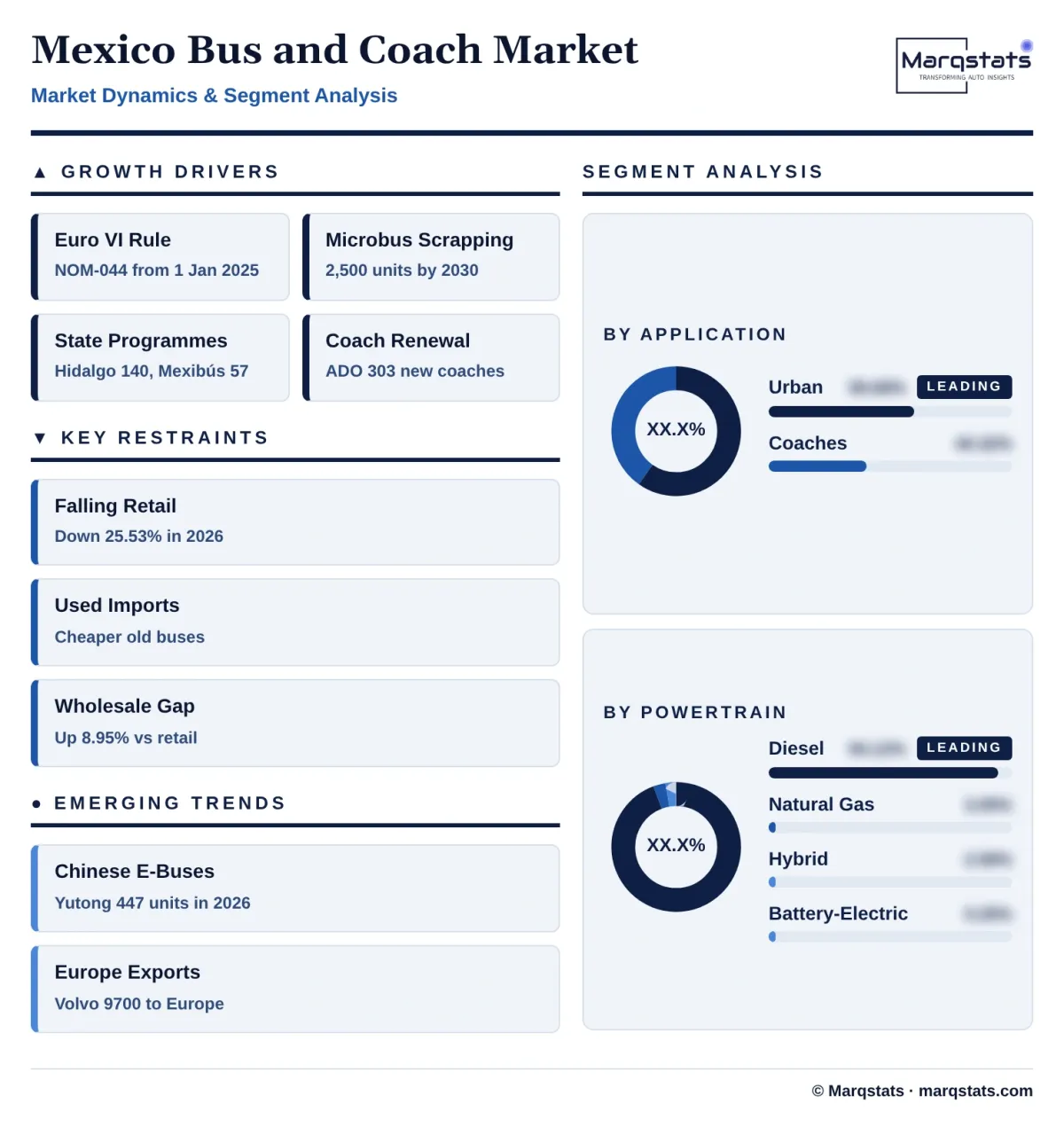
Policy is reshaping what is bought. From 1 January 2025 the updated NOM-044-SEMARNAT-2017 provisions phase out certification of heavy diesel vehicles with Euro V and EPA 2007 technology, so new diesel buses must carry Euro VI or EPA 2010 engines and exhaust treatment. Mexico City launched a programme in February 2026 to scrap more than 500 microbuses in 2026 and 2,500 by 2030, with a bonus of MXN 450,000 per unit and MXN 900,000 for an electric replacement, and Mexico City has written zero-emission requirements into its bus concession renewals.
The 2026 data change the shape of the forecast. Retail registrations of passenger buses were 3,937 in January to September 2026 against 5,287 a year earlier, and Marqstats estimates the full year at 5,220 buses, 22.23% below 2025. The forecast then recovers because the 2025 and 2026 volumes are well below the 9,310 buses of 2024, and by 2030 registrations of about 7,900 are still 15.15% below that peak. In pesos the 2025 market is about MXN 22.79 billion at the 2025 average rate of MXN 19.20 per US dollar.
Mexico Bus and Coach Market Size and Forecast
The Mexico bus and coach market grows from USD 1,186.79 million in 2025 to USD 1,624.09 million in 2030, a CAGR of 6.47%. Two forces pull in different directions. Registrations rise at 3.31% a year, from 6,712 to about 7,900 buses, a slow recovery that ends below the 2024 peak, and the average value per bus rises at 3.06% a year, from about USD 176,816 to USD 205,581, as coaches keep their share and electric buses, which Marqstats prices at about 2.10 times a diesel bus, grow from 0.12% to 10.76% of units.
The 2025 value is built from units and prices. Marqstats uses the INEGI register total of 6,712 buses, made up of 5,230 urban, suburban and personal-transport buses and 1,482 intercity coaches. Marqstats estimates an urban or suburban bus at about MXN 2.60 million, or USD 135,417, a mix of conventional Euro VI chassis with local bodies at roughly MXN 2.30 million, articulated and electric units at MXN 6 million or more, and midi buses at about MXN 1.10 million. Marqstats estimates a coach at about MXN 6.20 million, or USD 322,917, in line with the MXN 2,000 million that Mobility ADO announced in July 2025 for 303 new Platino and GL coaches, about MXN 6.60 million each. Prices are before sales tax and registration fees.
The base is checked against register volumes and purchase programmes. Retail registrations of 6,712 buses are 16.85% of the 39,833 heavy vehicles that AMDA and INEGI record at retail once coaches are added. Buses were only 2.29% of the 117,121 heavy vehicles produced in Mexico in January to September 2026, and the 2,678 buses produced in that period are fewer than the 3,937 registered at retail, so imported buses fill the difference. Public purchases give a second check: Hidalgo announced MXN 730 million for 140 buses in June 2026 and the State of Mexico reported more than MXN 200 million for 57 Mexibús Line 2 units in January 2026, both above the Marqstats urban average of MXN 2.60 million because they include articulated and electric units, charging and stations.
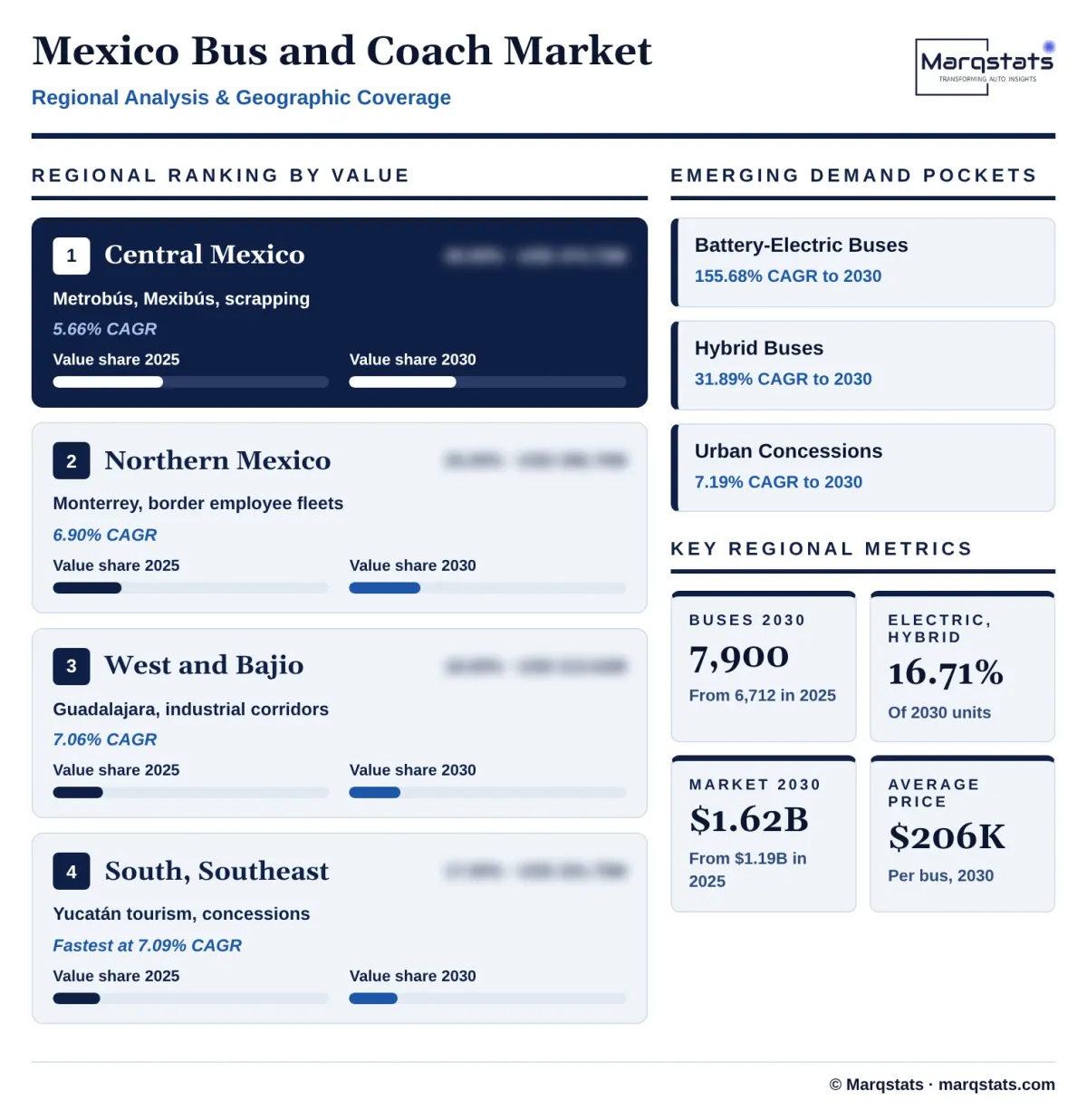
Electric and hybrid buses add value faster than volume. Marqstats expects electric buses to rise from 8 units in 2025 to 850 in 2030 and hybrid buses from 121 to 470, so their combined share of units grows from 1.92% to 16.71%. Priced at about 1.45 and 2.10 times a diesel bus, they lift their share of value to 27.24% in 2030, and electric buses grow from USD 2.93 million to USD 320.12 million.
Value moves in a V. Marqstats estimates USD 954.42 million in 2026, 19.58% below 2025, then growth of 16.42% in 2027, 15.15% in 2028, 12.96% in 2029 and 12.38% in 2030. Marqstats tracks four indicators to monitor the forecast: monthly AMDA and INEGI retail registrations of buses, ANPACT wholesale against retail, the pace of Mexico City microbus scrapping, and the number of Yutong, Volvo and Mercedes-Benz electric buses registered each quarter. All dollar values use the 2025 average rate of MXN 19.20 per US dollar held constant through 2030.
Market Dynamics
Key Drivers
Five forces support demand for new buses in Mexico even after two years of weak retail registrations.
- Euro VI makes old diesel buses uncompetitive. From 1 January 2025 the updated provisions of NOM-044-SEMARNAT-2017 phase out certification of heavy diesel vehicles with Euro V and EPA 2007 technology, so every new diesel bus above 3,857 kilograms must carry Euro VI or EPA 2010 technology. That lifts the price of a new diesel bus and moves the replacement decision for older units from optional to a matter of when.
- Mexico City is paying operators to scrap microbuses. The February 2026 programme plans to retire more than 500 microbuses in 2026 and 2,500 by 2030 with MXN 535 million budgeted for 2026, a bonus of MXN 450,000 per unit and MXN 900,000 for an electric replacement, and possible international financing of up to MXN 1.8 million per electric unit. Each scrapped microbus is replaced by a larger bus.
- State and city programmes keep ordering. Hidalgo announced MXN 730 million for 140 buses in June 2026, the State of Mexico put more than MXN 200 million into 57 Mexibús Line 2 units, including 15 electric buses and charging, in January 2026, and Metrobús in Mexico City presented the first fully electric biarticulated buses in June 2025.
- Intercity carriers renew fleets on a schedule. Mobility ADO announced MXN 2,000 million for 303 new Platino and GL coaches in July 2025, and Scania and Volvo Buses together supplied 95.88% of the 1,482 coaches registered that year, so carrier capital plans translate directly into orders for two suppliers.
- Registrations are low against history. At 6,712 in 2025 and about 5,220 in 2026, registrations are below the 9,310 of 2024 and the 8,443 of 2023, and a fleet that stopped renewing in 2025 and 2026 builds deferred demand that Marqstats expects to release from 2027 as financing and concession approvals clear.
Key Restraints
Four constraints explain why 2026 registrations are lower than 2025 and why the recovery is gradual.
- Retail demand is falling now. Retail registrations of passenger buses fell 27.9% in 2025 and a further 25.53% in January to September 2026, with diesel buses down 30.81%. Carriers and concessionaires delay purchases when rates are high, concession terms are uncertain and Euro VI buses cost more.
- Used heavy-vehicle imports undercut new buses. ANPACT said in 2022 that about 30 of every 100 heavy vehicles bought in Mexico were used imports more than 16 years old, and in October 2026 it asked the Secretaría de Hacienda y Crédito Público (SHCP) to publish reference prices for customs valuation of used heavy vehicles. Small operators that cannot finance a new bus buy an imported one.
- Clean diesel supply is uneven. ANPACT told the press in December 2024 that ultra-low-sulphur diesel was available in about 80% of major highway corridors and cities, while a 2021 industry study found availability had fallen from 81% in 2018 to 72.6%. Operators on routes without it risk damaging Euro VI exhaust treatment.
- The wholesale channel is out of step with retail. ANPACT reported bus wholesale up 8.95% in January to September 2026 while September wholesale fell 24.5% to 388 units and retail fell 25.53%, and its president said demand for buses remains the main challenge. Dealers and body builders that hold stock slow new orders.
Key Trends
Four shifts are changing which buses are built, financed and bought in Mexico.
- Chinese electric and hybrid buses win the first volumes. Yutong registered 220 electric buses and 227 hybrid buses in January to September 2026, against 6 electric and 95 hybrid buses in the same period of 2025, and Foton registrations fell from 205 to 3, so supplier ranks are changing within a single year.
- Europe becomes an export outlet for Mexican-built coaches. Volvo Buses México stopped exporting the 9700 coach to the United States in 2025 after about 16 years because of a new United States emission rule, and in March 2026 began exporting to Europe, with 30 units planned in 2026 and a target of 200 a year.
- New coach platforms enter local production. Volvo Buses México delivered the first Volvo 9800 built at Tultitlán to Ómnibus de México in September 2026 and plans about 100 further deliveries in the rest of 2026 and a similar number in early 2027, which shows carriers still commit to premium diesel coaches.
- Cities move from microbuses to corridor and articulated buses. Metrobús, Mexibús and the Hidalgo metropolitan system are replacing small concession vehicles with larger buses of 12 to 27 metres, which raises the average value per registered bus even when unit volumes are flat.
Strategic Implications
- For bus makers, the near-term question is channel stock, not demand. Wholesale rose 8.95% while retail fell 25.53% in January to September 2026, so makers that push more units into dealers before the 2027 recovery risk discounting, and makers with order books from state programmes should prioritise delivery slots for those buyers.
- For Scania and Volvo Buses, the intercity duopoly is secure but small. The two make up 95.88% of 1,482 coaches, so growth depends on carrier fleet cycles and on the new Volvo 9800 and Scania Nuväk platforms, and export outlets such as Volvo's European programme add volume that Mexican carriers cannot.
- For Chinese and European entrants in urban service, electric and hybrid buses are the opening. Electric and hybrid buses were 11.40% of registrations in January to September 2026, and Mexico City pays MXN 900,000 to scrap a microbus for an electric replacement, so a supplier with financing and charging packages can win without competing on diesel price.
- For lenders and lessors, the 2026 slump is a pricing window. Registrations that are 22.23% below 2025 and 43.93% below the 2024 peak leave operators with ageing fleets, and structured leases tied to scrapping bonuses reach buyers that banks decline.
- For component and service suppliers, Euro VI exhaust treatment, battery packs and charging equipment are the growth lines. Diesel buses fall to 82.28% of units by 2030, but they remain the bulk of the fleet, so aftertreatment and workshop service stay strong while electric content per bus rises.
Market Segmentation
Urban, suburban, employee and personal-transport buses of classes 5 to 8 account for 59.68% of 2025 value, USD 708.23 million, and 77.92% of units, 5,230 buses. The segment grows at 6.64% a year to USD 976.95 million. Mercedes-Benz Autobuses sold 2,547 of them, 48.70%, followed by International at 15.0%, Volkswagen Camiones y Buses at 13.1%, Foton at 6.8% and Yutong at 6.2% of the segment.
Intercity coaches account for 40.32% of 2025 value, USD 478.56 million, but only 22.08% of units, 1,482 coaches. The segment grows at 6.22% a year to USD 647.14 million. Scania sold 794 coaches, 53.58%, and Volvo Buses 627, 42.31%, while Mercedes-Benz Autobuses and MAN shared the remaining 61 units. Registrations fell 7.1% in 2025, far less than the 32.1% fall in other buses.
Diesel buses account for 94.12% of 2025 value, USD 1,117.05 million, and 95.32% of units. Value grows slowly, at 0.86% a year, to USD 1,165.68 million, while the share of value falls to 71.77%. In January to September 2026 diesel registrations fell 30.81% to 3,487 units, and every new diesel bus must now carry Euro VI or EPA 2010 technology.
Natural gas buses account for 3.05% of 2025 value, USD 36.18 million. Marqstats scales the 146 gas buses AMDA counted in January to September 2025 to 185 for the year. Registrations fell to 1 in the same period of 2026, and Marqstats expects only 80 buses by 2030, a -14.98% annual change, as operators choose electric over gas.
Hybrid buses account for 2.58% of 2025 value, USD 30.63 million, and grow at 31.89% a year to USD 122.22 million. Registrations rose from 95 to 227 in January to September 2026, all of them Yutong, and Marqstats expects about 470 hybrid buses in 2030 as operators use them on routes without charging.
Battery-electric buses account for 0.25% of 2025 value, USD 2.93 million, and grow fastest at 155.68% a year, to USD 320.12 million and 19.71% of value. Electric registrations rose from 6 to 222 in January to September 2026, and Marqstats expects 850 electric buses in 2030. The register counts buses sold at retail, so units delivered under fleet-provider contracts may be recorded differently from the deliveries tracked in Marqstats reports on Latin America electric buses.
Intercity carriers such as Mobility ADO, Grupo Estrella Blanca and Ómnibus de México buy coaches and account for 40.32% of 2025 value, USD 478.56 million. The segment grows at 6.22% a year to USD 647.14 million, and its buyers choose between two main suppliers.
Concessionaires, state agencies and bus rapid transit operators account for 44.06% of 2025 value, USD 522.84 million, and grow fastest among operator types, at 7.19% a year, to USD 739.71 million. Marqstats estimates they buy 70.00% of urban and suburban units in 2025 and 72.00% in 2030, driven by scrapping bonuses and corridor programmes.
Charter, tourism and employee-transport fleets account for 11.96% of 2025 value, USD 141.97 million, and grow at 4.56% a year to USD 177.46 million. Maquiladora and industrial-park employee transport in the North and tourist routes in the South and Southeast drive orders, mostly for conventional chassis.
School, university and institutional buses account for 3.66% of 2025 value, USD 43.42 million, and grow at 6.60% a year to USD 59.78 million. Lower-priced chassis and slower public budgets keep this the smallest segment.
By Geography
Central Mexico
Central Mexico, which covers Mexico City, the State of Mexico, Puebla, Hidalgo, Morelos, Tlaxcala and Querétaro, accounts for 40.00% of 2025 value, USD 474.72 million, and grows at 5.66% a year to USD 625.27 million. Metrobús, Mexibús and the scrapping of microbuses make it the largest buyer of urban buses. Registration shares overstate the region slightly because leasing firms register buses at corporate addresses in the State of Mexico, so Marqstats allocates value by where concession fleets operate.
Northern Mexico
Northern Mexico, which covers Nuevo León, Coahuila, Chihuahua, Tamaulipas, Sonora, Baja California and neighbouring states, accounts for 25.00% of 2025 value, USD 296.70 million, and grows at 6.90% a year to USD 414.14 million. Employee transport for border manufacturing and the Monterrey urban network drive orders, and the region is home to the Mercedes-Benz Autobuses plant at García, Nuevo León.
West and Bajio
The West and Bajio, which covers Jalisco, Guanajuato, Michoacán, Aguascalientes, Colima, Nayarit and Sinaloa, accounts for 18.00% of 2025 value, USD 213.62 million, and grows at 7.06% a year to USD 300.46 million. The Guadalajara metropolitan system, industrial corridors in Guanajuato and agricultural labour transport create steady demand for conventional and midi buses.
South and Southeast
The South and Southeast, which covers Veracruz, Oaxaca, Chiapas, Tabasco, Yucatán, Quintana Roo and neighbouring states, accounts for 17.00% of 2025 value, USD 201.75 million, and grows fastest, at 7.09% a year, to USD 284.22 million and 17.50% of the market. Tourism in the Yucatán peninsula and concession renewals in state capitals broaden demand beyond Mexico City.
How Competition Is Evolving
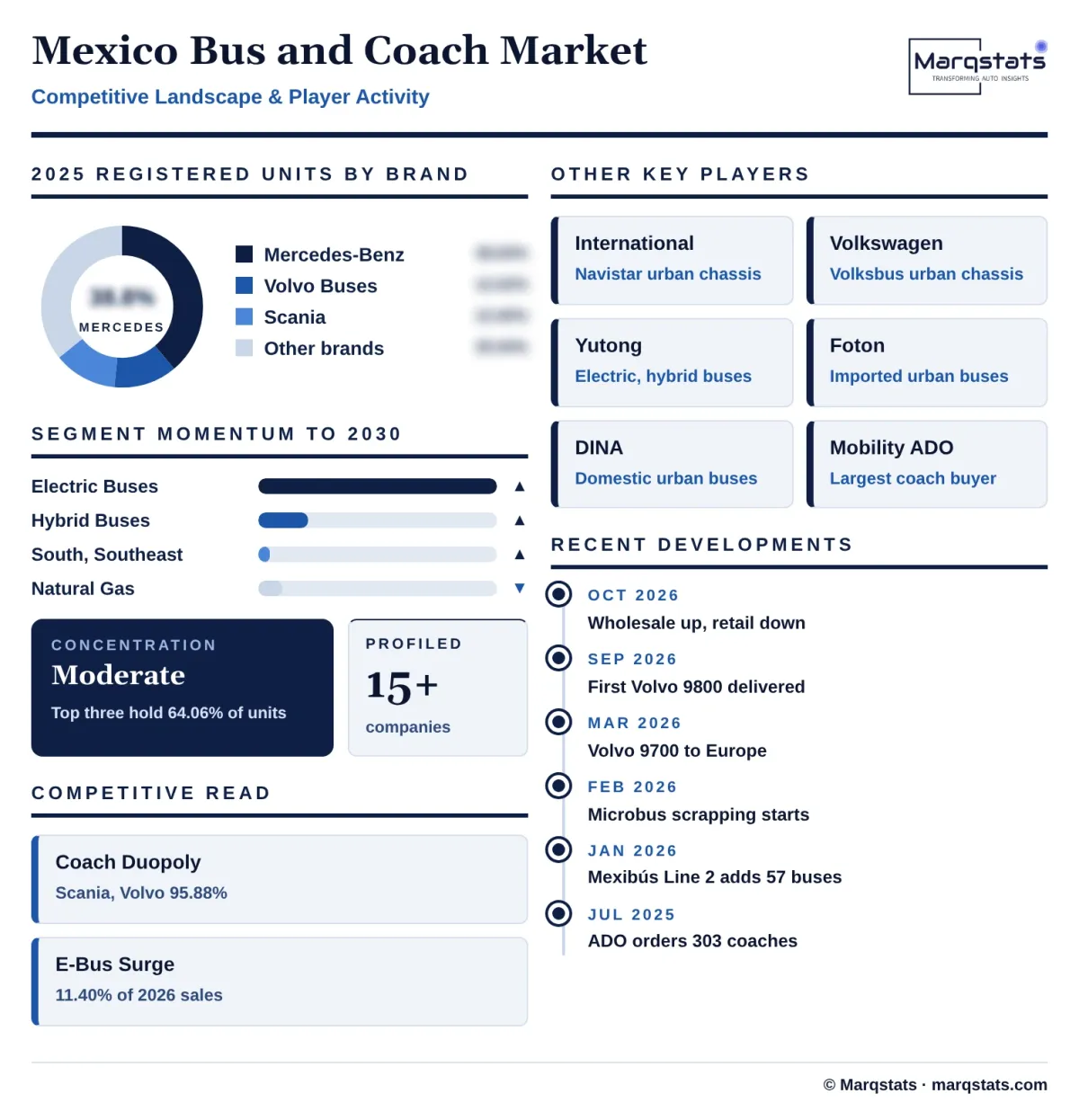
The Mexican bus market is moderately concentrated. Using INEGI register volumes reported by Revista TyT, Mercedes-Benz Autobuses sold 2,607 of 6,712 buses in 2025, 38.84%. Volvo Buses sold 847, 12.62%, Scania 846, 12.60%, International 785, 11.70%, and Volkswagen Camiones y Buses 685, 10.21%, so the top three make up 64.06% and the top five 85.97% of units. Marqstats computes a Herfindahl-Hirschman Index of about 2,131 on these 2025 unit shares.
The market splits into two structures. In intercity coaches Scania and Volvo Buses hold 53.58% and 42.31% of 1,482 units, a combined 95.88%, and buyers such as Mobility ADO and Grupo Estrella Blanca choose between them. In urban and suburban service Mercedes-Benz Autobuses holds 48.70% of 5,230 units and five more makers hold between 4% and 15% each, so there is real price competition.
Share is moving in 2026. In January to September 2026 Scania registrations fell 31.41% to 476 and Volvo Buses 28.66% to 483, International fell 20.38% to 543, Volkswagen Camiones y Buses 13.95% to 438 and Dina 10.43% to 146, according to AMDA. Yutong, by contrast, registered 447 electric and hybrid buses, and INEGI shows Mercedes-Benz Autobuses wholesale down 28.0% to 1,175 and Volvo Buses down 28.4% to 485.
Competition is shifting from price to financing and powertrain. Chinese makers offer electric buses with charging, and the Mexico City bonus of MXN 900,000 for electric replacements tilts urban tenders toward them, while European makers defend through local assembly at García and Tultitlán and through coach platforms such as the Volvo 9800 and the Scania Nuväk. Marqstats shares are by registered units, because makers do not report transaction prices.
Companies Covered
Companies covered in the report include:
Recent Market Activity
Table of Contents
Coverage & Segmentation
The study covers the Mexico bus and coach market, with 2025 as the base year, 2021 – 2025 as the historical period and 2026 – 2030 as the forecast period. It covers new buses and coaches above 3,857 kilograms gross vehicle weight sold at retail in Mexico, segmented by application, powertrain, operator type and region. Values are retail transaction values in US dollars before sales tax and registration fees, and peso figures use the 2025 average of MXN 19.20 per US dollar.
Vans and minibuses below 3,857 kilograms, used and grey-market imports, trucks and tractor heads, bodies and chassis sold separately for non-bus use, and exports are excluded, so this market does not overlap with Mexico Passenger Car, which covers M1 cars, sport utility vehicles and crossovers, or with Mexico Pickup Truck. Segment and regional splits are Marqstats estimates built on INEGI and AMDA registers, purchase programmes and price benchmarks. Live Marqstats reports on Latin America electric buses and Mexico electric trucks overlap in part, and their figures should not be added to this market.
