Market Snapshot
Middle bar: base-year value × (1 + CAGR), rounded to two decimals. This is a calculated illustration, not a separately researched annual estimate.
The Indonesia bus market is estimated at USD 345.99 million in 2025 and is projected to reach USD 608.33 million by 2030, a CAGR of 11.95% over 2026 – 2030. Wholesale bus deliveries rise from 4,541 to 6,400 units, and the average complete bus climbs from about USD 76,192 to USD 95,052.
Marqstats defines the market as the value of new buses delivered to Indonesian operators, counting the chassis at dealer list price and the bodywork built by the karoseri on top of it, or the complete electric bus, before value added tax. Hino, Mercedes-Benz, Mitsubishi Fuso, Isuzu and Scania chassis, Laksana, Adiputro, Tentrem and New Armada bodies, and BYD electric buses assembled by PT VKTR Teknologi Mobilitas Tbk are covered. Trucks, pickups, vans, microbuses and used buses are excluded.
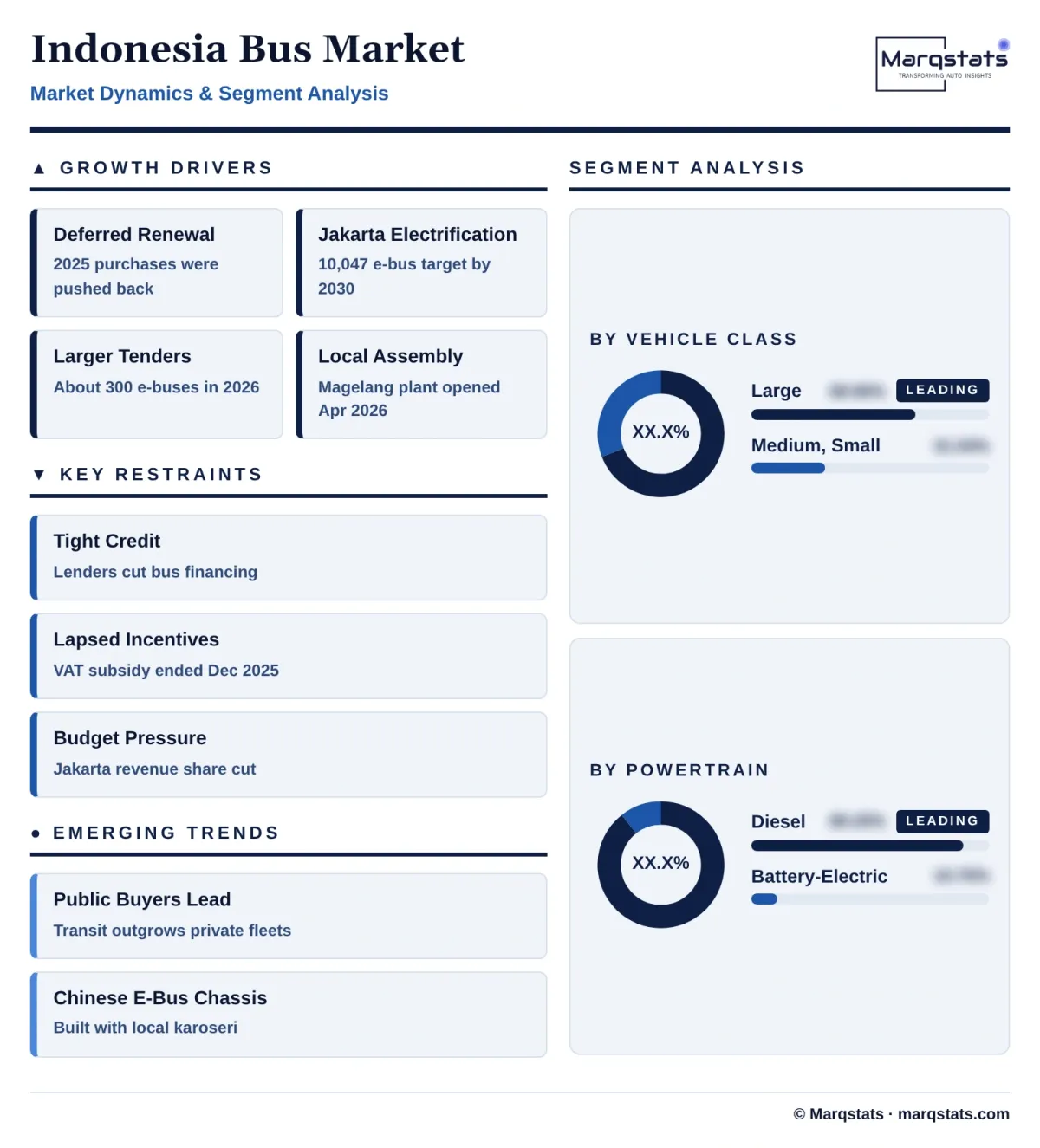
Large buses of 10 to 24 tonnes account for 68.96% of 2025 value and diesel buses for 89.25%, while Greater Jakarta holds 38.42% of value. Battery-electric buses are only 3.52% of 2025 units but 10.75% of value, and they grow at 33.83% a year to 26.24% of the market in 2030.
Key Takeaways
Market Overview & Analysis
Report Summary
Marqstats sizes the Indonesia bus market as the value of new buses that enter service each year. A bus here is a passenger vehicle built on a bus chassis of 5 tonnes gross vehicle weight and above, whether a large rear-engine coach, a front-engine regional bus, a medium bus for staff or school use, or a battery-electric transit bus. The chassis is counted at the dealer list price, the body at the price charged by the karoseri that builds it, and the electric bus as one complete vehicle.
The count starts from the Gabungan Industri Kendaraan Bermotor Indonesia (Gaikindo). The association recorded 4,541 bus chassis wholesaled in 2025, inside national wholesales of 803,687 vehicles. That national figure splits into 608,687 passenger cars and 195,000 commercial vehicles, and the commercial block is 107,008 pickups, 56,754 trucks, 4,541 buses and 26,697 vans, microbuses and other commercial vehicles. Marqstats counts only the buses, so the market never overlaps with the Indonesia pickup or truck reports.
Demand fell hard in 2025 after a sharp rise in 2023. Gaikindo wholesaled about 2,595 bus chassis in 2022, 6,227 in 2023, 5,641 in 2024 and 4,541 in 2025. PT Hino Motors Sales Indonesia put the 2025 drop at about 1,100 units, or 19.50%, and said that lending by banks and finance companies had tightened. The Asosiasi Karoseri Indonesia (Askarindo) told detikOto in May 2025 that bus demand was down about 30% and that factory shipments for January to April 2025 were 1,770 units, 204 fewer than a year earlier.
Public buyers now set the pace. The Governor of Jakarta, Pramono Anung Wibowo, committed in February 2026 to 10,000 additional Transjakarta buses by 2029, and the Jakarta Transportation Agency stated a target of 10,047 electric buses by 2030. By 27 April 2026 PT Transportasi Jakarta ran 500 electric buses, of which PT VKTR Teknologi Mobilitas Tbk had supplied 152. Private intercity and tourism operators, in contrast, extended fleet life while credit was tight.
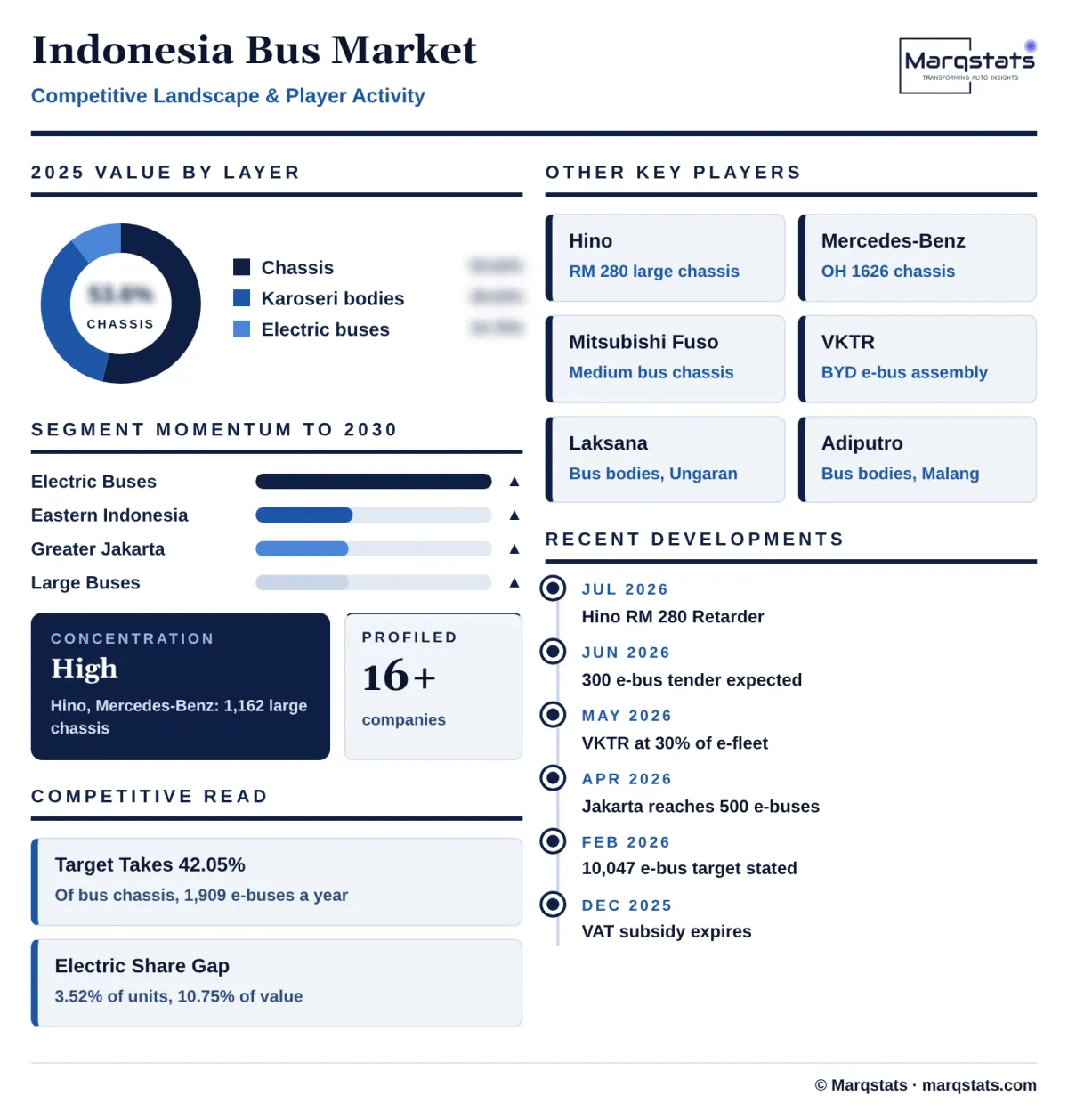
The market is valued at USD 345.99 million in 2025, equal to about IDR 5,701 billion at the 2025 average rate of IDR 16,476.85 per US dollar. Of that, chassis are 53.62%, karoseri bodies 35.63% and complete electric buses 10.75%. The split matters because the body is made by a different company from the chassis, in a different province, and it earns a different margin.
Indonesia Bus Market Size and Forecast
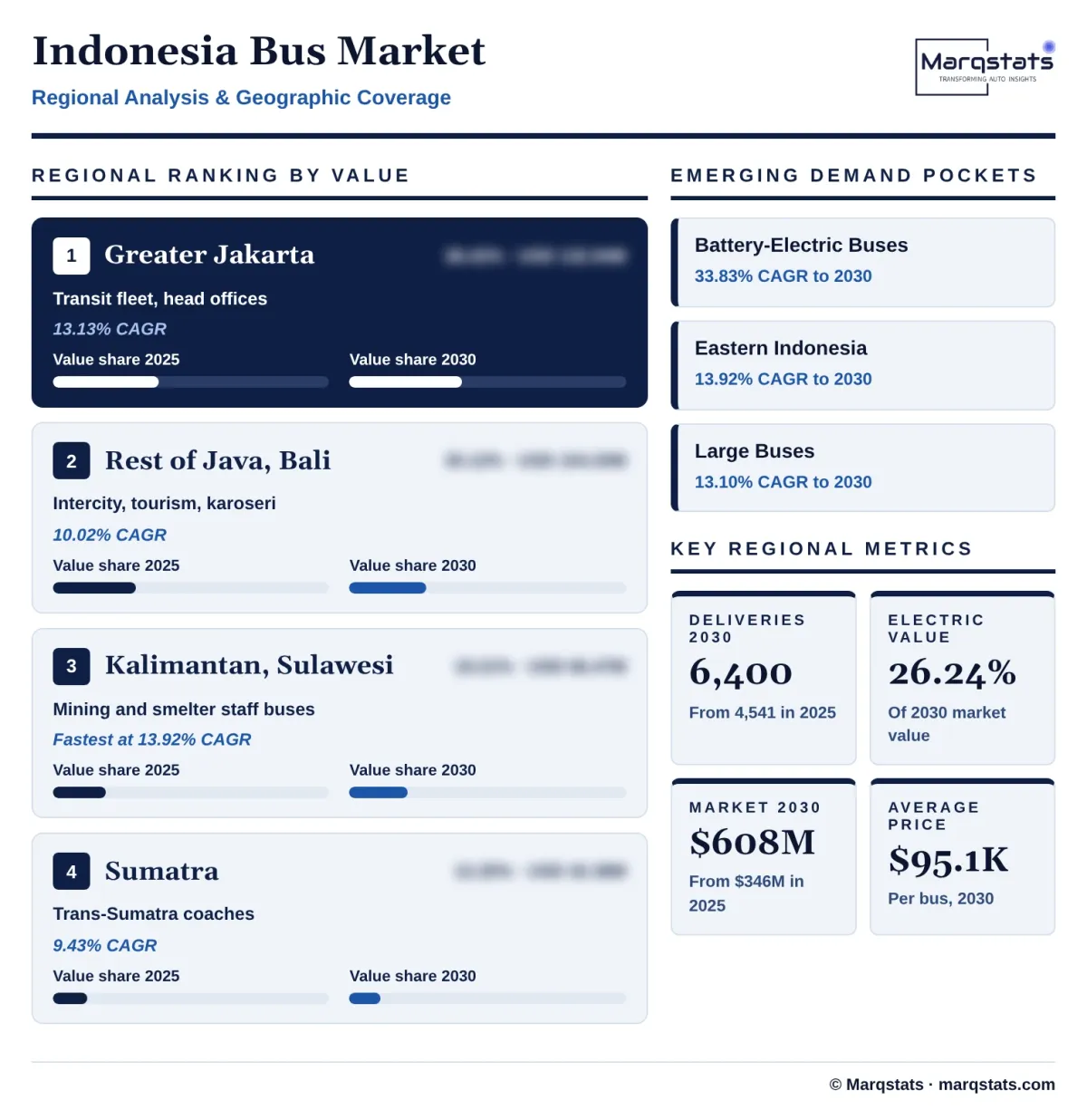
The Indonesia bus market grows from USD 345.99 million in 2025 to USD 608.33 million in 2030, a CAGR of 11.95%. Volume supplies 7.10% a year of that growth, from 4,541 to 6,400 buses, and the average value of a complete bus rises 4.52% a year, from about USD 76,192 to USD 95,052, because electric buses and large coaches take a larger share. Conventional buses return to 5,640 units in 2030, almost exactly the 5,641 recorded in 2024.
The 2025 value is built bottom-up from classes and prices. Marqstats estimates 1,740 conventional large buses at about IDR 1,157 million for the chassis and IDR 750 million for the body, 2,641 medium and small buses at IDR 395 million and IDR 275 million, and 160 electric buses at IDR 3,829 million each, all before value added tax. The chassis anchor is the Jakarta price list for Hino: the RM 280 ABS at about IDR 1.13 billion including taxes, the RK 280 STD at IDR 976.5 million and the AK 240 STD at IDR 800 million, which are about IDR 1.02 billion, IDR 880 million and IDR 721 million before the 11% value added tax.
The model is checked against body and electric bus prices. Laksana quoted about IDR 450 million for a standard 12 metre body, IDR 650 to 750 million for a high-deck body and more than IDR 1 billion for a sleeper body, which supports a blended large body of IDR 750 million, and medium bodies are set at about 61% of the standard 12 metre price. For electric buses, a Samuel Sekuritas analysis in June 2026 assumed IDR 268 billion of VKTR revenue on roughly 70 buses, or about IDR 3.83 billion a bus, which Marqstats uses as the 2025 complete-vehicle price.
The forecast has three parts. Conventional large buses grow from 1,740 to 2,100 units, a 3.83% CAGR, as intercity, tourism and mining fleets that deferred purchases in 2025 replace vehicles. Medium and small buses grow from 2,641 to 3,540, a 6.03% CAGR. Electric buses grow from 160 to 760 units. Conventional prices rise 3.00% a year in rupiah and electric bus prices fall 2.00% a year as local content rises, with the rupiah held at IDR 16,476.85 per US dollar throughout.
Marqstats tracks four indicators to monitor the forecast: monthly Gaikindo wholesale and retail counts for buses, the size and timing of Transjakarta tenders and the Jakarta budget after the cut in regional revenue sharing, the fate of local content rules that step up to 60% in 2027, and the order books of the karoseri, which Askarindo members report each quarter.
Market Dynamics
Key Drivers
Five forces are lifting bus demand in Indonesia from the 2025 low, and most of them are public rather than private.
- Fleet renewal has been deferred. Private operators extended replacement in 2025 while bank and finance company lending tightened, and the Asosiasi Karoseri Indonesia (Askarindo) said in mid-2026 that bus demand rose about 10% in the first half but had not recovered to 2024 levels. Deferred purchases of intercity, tourism and staff buses return as financing eases, which underpins the rebound from 4,541 units.
- Jakarta electrifies its transit fleet. The Governor of Jakarta committed in February 2026 to 10,000 additional Transjakarta buses by 2029, the Jakarta Transportation Agency stated a target of 10,047 electric buses by 2030 with half electric by 2027, and PT Transportasi Jakarta added 30 electric buses on 27 April 2026 to reach 500. Each complete electric bus is worth about twice a conventional large bus and about six times a medium one.
- Tenders are getting larger. A Samuel Sekuritas analysis of 26 June 2026 expected Transjakarta to tender about 300 electric buses in 2026, with PT VKTR Teknologi Mobilitas Tbk positioned to win 90 to 100 units with BYD at more than 40% local content. The Transjakarta programme of December 2024 had already placed 200 electric buses with Perum DAMRI, PT Bianglala Metropolitan and PT Sinar Jaya.
- Local assembly lowers the cost of electric buses. VKTR inaugurated its Magelang plant on 9 April 2026, and the Ministry of Industry ties import incentives to local content of 40% in 2026, 60% in 2027 and 80% by 2030, which pushes BYD, Skywell, Zhongtong and Golden Dragon toward Indonesian assembly with the karoseri.
- Industry and mining need staff buses. Delimajaya Group reported in November 2024 that, of its bus sales, 40% went to mining operations, 30% to private employee transport and 20% to tourism, so demand for staff buses is steadier than demand for tourism coaches.
Key Restraints
Four constraints keep the market below its 2023 peak and slow the shift to electric buses.
- Credit is tight. Hino Motors Sales Indonesia said on 27 February 2026 that tighter lending by banks and finance companies, linked to economic uncertainty, drove the 2025 drop, and that its own financing service held the decline to about 19% against about 25% without it. Operators that cannot reach that financing defer purchases.
- The electric incentives have lapsed. The 5% value added tax subsidy for electric buses at 20% to 40% local content and the duty-free import window ran to 31 December 2025, and Coordinating Minister Airlangga Hartarto said no new battery electric incentives were planned for 2026. Local content must reach 60% in 2027, which could stall assemblers without local battery integration.
- Jakarta budgets are under pressure. The Jakarta government said in February 2026 that it was working to stop a cut of IDR 15 trillion in central revenue sharing from disrupting the 2027 electric bus target, and a 50% electric fleet by 2027 would need thousands of buses within two years.
- Conventional buses are a long-life asset. Operators of intercity coaches can extend fleet life through rebuilds, so a stronger rupiah or cheaper credit shifts demand more than new routes do, and fleet renewal cycles make purchases lumpy.
Key Trends
Four shifts are changing who builds, buys and powers buses in Indonesia.
- Public transport becomes the growth buyer. Private intercity and tourism buyers shrank in 2025 while the Jakarta programme added electric buses, so the share of public transit buyers in the bus market rises every year to 2030.
- Chinese electric chassis enter through local assemblers. BYD buses are assembled by VKTR and Laksana, Skywell and Zhongtong buses serve Perum DAMRI, and SAG Golden Dragon buses serve PT Bianglala Metropolitan, so electric buses reach Indonesian roads through karoseri and assembly partners rather than direct imports.
- Premium chassis keep their niche. Hino launched the RM 280 ABS Retarder at GIIAS 2026 and Mercedes-Benz wholesaled 451 large 4x2 chassis in 2025, so retarder and safety content is spreading in the large coach segment.
- Electric routes widen beyond the core corridors. PT Transportasi Jakarta now runs electric buses on airport and suburban lines such as Blok M to Soekarno-Hatta and Cikarang to Cawang, which spreads depot and charging demand across Greater Jakarta.
Strategic Implications
- For chassis makers, the large-bus fight is decided by financing. Hino held a 76% share of bus sales in January 2024 according to its chief operating officer, and its in-house financing held the 2025 decline to about 19%, so rivals such as Mercedes-Benz, Mitsubishi Fuso and Scania need comparable lease and loan products to win operators who are waiting for cheaper credit.
- For electric bus suppliers, local content is the entry ticket. Import incentives require 40% local content in 2026 and 60% in 2027, so a supplier without a karoseri or assembly partner in Java faces higher prices than BYD, which already builds with VKTR and Laksana. Joint ventures with bodybuilders protect tender eligibility.
- For karoseri, mix is moving. Conventional bodies are priced at about IDR 750 million on a large bus, while an electric bus is sold as one vehicle at about IDR 3.83 billion, so bodybuilders that do not become assembly partners lose content as electric transit grows to 26.24% of value.
- For operators, timing the replacement matters. Conventional large buses return to 2024 volumes only by 2030, so operators that renew in 2026 buy ahead of the 3.00% annual price rise Marqstats assumes, and Transjakarta contractors can lock in supply before the 2026 tender crowds the order books.
- For financiers and investors, depot charging and long-term leases are the open space. Jakarta needs about 1,909 electric buses a year to meet its target and Marqstats expects 534, so leasing and charging platforms can fill the difference if budget cuts do not intervene.
Market Segmentation
Large buses of 10 to 24 tonnes, including 12 metre electric transit buses, account for 68.96% of 2025 value, USD 238.60 million, from 1,900 units, and grow at 13.10% a year to USD 441.46 million. Hino RM 280, RK 280 and AK 240 chassis, Mercedes-Benz OH 1626 and OF 1623 chassis, Mitsubishi Fuso and Scania chassis, and the BYD and Skywell electric buses serve intercity coaches, tourism charters and urban transit. The Hino and Mercedes-Benz 4x2 models alone wholesaled 1,162 units in 2025.
Medium and small buses of 5 to 10 tonnes account for 31.04% of 2025 value, USD 107.39 million, from 2,641 units, and grow at 9.22% a year to USD 166.87 million. They run on Hino 136 and 115 chassis, Hino GB 150 chassis, and Mitsubishi Fuso and Isuzu medium chassis, priced at about IDR 325 to 460 million before tax, and carry employee, school, institutional and short-haul passengers.
Diesel buses account for 89.25% of 2025 value, USD 308.81 million, and grow at 7.76% a year to USD 448.69 million, while their share falls to 73.76%. Euro 4 diesel chassis are the standard in the market, and compressed natural gas buses are a small part of the segment.
Battery-electric buses account for 10.75% of 2025 value, USD 37.18 million, from 160 units, and grow at 33.83% a year to USD 159.64 million and 26.24% of the market from 760 units. Transjakarta, Perum DAMRI and Sinar Jaya are the buyers, and the segment counts the same buses as the live Marqstats Indonesia Electric Commercial Vehicle report, so the two should not be added.
Intercity and tourism coaches account for 40.36% of 2025 value, USD 139.67 million, and grow at 12.55% a year to USD 252.29 million. This is the segment that deferred orders in 2025, and it carries the highest body value, with Laksana, Adiputro, Tentrem and New Armada sleeper and high-deck bodies priced up to IDR 1 billion or more.
Urban and BRT transit accounts for 25.00% of 2025 value, USD 86.49 million, and grows at 18.28% a year to USD 200.20 million and 32.91% of the market. It holds all electric buses, Transjakarta routes and the DAMRI fleet, and the Jakarta programme sets its pace.
Corporate, mining and staff shuttles account for 25.84% of 2025 value, USD 89.39 million, and grow at 5.32% a year to USD 115.83 million. Nickel, coal and smelter employers buy durable medium and large buses, and the segment is the steadiest source of orders for Delimajaya and other karoseri.
Institutional, school and other buses account for 8.80% of 2025 value, USD 30.44 million, and grow at 5.62% a year to USD 40.01 million. Government agencies, schools, hospitals and religious groups buy medium buses with simple bodies, so this is the lowest-value segment.
By Geography
Greater Jakarta (Jabodetabek)
Greater Jakarta accounts for 38.42% of 2025 value, USD 132.94 million, from about 1,453 buses, and grows at 13.13% a year to USD 246.35 million and 40.50% by 2030. Transjakarta, Perum DAMRI and PT Bianglala Metropolitan run the electric fleet from Jakarta depots, and Jakarta is also where operators and corporate buyers register buses, so registration shares overstate where buses spend their time.
Rest of Java and Bali
Rest of Java and Bali accounts for 30.12% of 2025 value, USD 104.20 million, from about 1,499 buses, and grows at 10.02% a year to USD 167.95 million. Central and East Java hold the intercity operators and the bus body clusters of Laksana, Adiputro, Tentrem and New Armada, and Bali is a tourism charter market.
Sumatra
Sumatra accounts for 12.25% of 2025 value, USD 42.38 million, from about 681 buses, and grows at 9.43% a year to USD 66.51 million. Long-distance coaches on the Trans-Sumatra corridor and DAMRI pioneer routes are the main buyers.
Kalimantan, Sulawesi and Eastern Indonesia
Kalimantan, Sulawesi and Eastern Indonesia account for 19.21% of 2025 value, USD 66.47 million, from about 908 buses, and grow fastest, at 13.92% a year, to USD 127.52 million and 20.96% by 2030. Coal and nickel employers, smelter towns and remote pioneer routes buy durable staff buses and medium coaches.
How Competition Is Evolving
The market is concentrated at the chassis layer and fragmented at the body layer. Chassis are 53.62% of 2025 value, bodies 35.63% and complete electric buses 10.75%. Gaikindo model data show Hino wholesaling 711 large 4x2 chassis and Mercedes-Benz 451 in 2025, a combined 1,162 units or 25.59% of all bus chassis, and Hino Motors Sales Indonesia stated a 76% share of bus sales in January 2024.
Hino leads with the RM 280 STD at 510 units in 2025, the RK 280 STD at 165 and the AK 240 STD at 36, and it launched the RM 280 ABS Retarder at GIIAS 2026. Its in-house financing service from the Indomobil group held the 2025 decline to about 19%, which is a competitive edge that rivals cannot match with product alone. Mercedes-Benz sells through PT Transforma Oto Prima, which handed 26 OH 1626 L chassis to PO MTrans in February 2025.
Mitsubishi Fuso, Isuzu and Scania compete for the rest. Scania is distributed by PT United Tractors Tbk and targets operators who add premium coaches, Mitsubishi Fuso and Isuzu supply medium chassis for staff and school buses, and other European makers add a few high-end coaches. Marqstats limits brand claims to the manufacturer statements and model rows above and describes the rest of the field by layer.
The electric layer is a separate contest. VKTR leads with 152 of 500 Transjakarta electric buses, about 30%, supplying BYD vehicles from Magelang, and Perum DAMRI runs Skywell and Zhongtong buses, PT Bianglala Metropolitan operates SAG Golden Dragon buses and PT Sinar Jaya operates BYD buses assembled by Laksana. The Jakarta programme rewards local content, so competition is about assembly partnerships as much as price.
Companies Covered
Companies covered in the report include:
Recent Market Activity
Table of Contents
Coverage & Segmentation
The study covers the Indonesia bus market, with 2025 as the base year, 2022 – 2025 as the historical period and 2026 – 2030 as the forecast period. It covers new buses built on chassis of 5 tonnes gross vehicle weight and above, and battery-electric transit buses, segmented by vehicle class, powertrain, end use and region. Values are chassis at dealer list price plus karoseri body, or the complete electric bus, before 11% value added tax and vehicle title fees, in US dollars at IDR 16,476.85.
Trucks (56,754 units), pickups (107,008 units) and the 26,697 vans, microbuses and other commercial vehicles that Gaikindo counts outside its bus class are excluded, as are used buses, bus exports and parts. Segment and regional splits are Marqstats estimates built on Gaikindo counts, price lists and tender data. The live Marqstats Indonesia Electric Commercial Vehicle report includes the same 160 electric buses and should not be added, and the Indonesia Pickup Truck and Indonesia Truck reports are disjoint.