Market Snapshot
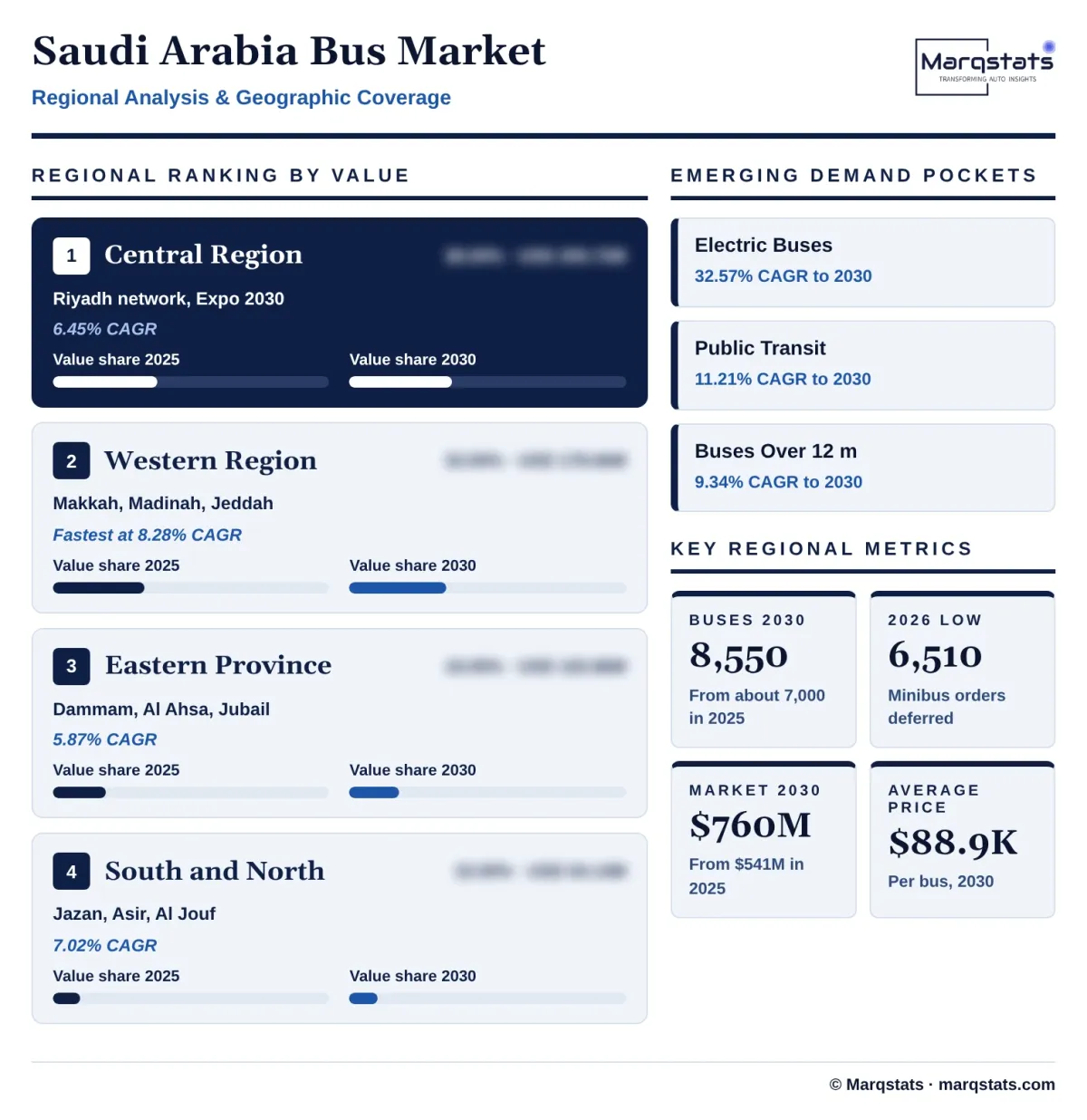
The Saudi Arabia bus market size is estimated at USD 541.38 million in 2025 and is projected to reach USD 759.98 million by 2030, growing at a CAGR of 7.02% over 2026 – 2030. Unit sales rise from about 7,000 to 8,550 buses, and the average value per bus climbs from about USD 77,340 to USD 88,887.
Marqstats defines the market as the wholesale value of new buses, coaches and minibuses with seating for ten or more persons including the driver, sold to buyers in Saudi Arabia, whether imported complete or bodied locally on imported chassis. Value is counted at the distributor invoice in US dollars, before 15% value added tax and dealer margins, and Saudi riyal figures use the fixed rate of SAR 3.75 per US dollar. Vans below ten seats, trucks, pickups, used buses and rail vehicles are excluded.
Buses of 7 to 12 metres account for 47.80% of 2025 value, intercity, tourism, Hajj and Umrah coaches for 30.86% and diesel buses for 71.81%. The Central Region, with Riyadh, holds 38.00% of value, while the Western Region, with Makkah, Madinah and Jeddah, grows fastest at 8.28% a year.
Key Takeaways
Market Overview & Analysis
Report Summary
Marqstats sizes the Saudi Arabia bus market as the wholesale value of new vehicles built to carry ten or more persons that enter the Saudi fleet each year. It counts minibuses of up to 7 metres, such as the 13-seat Toyota Hiace and the 23-seat Toyota Coaster, midi and standard buses of 7 to 12 metres, and coaches, articulated buses and double-deck buses above 12 metres, whether delivered complete or bodied in the Kingdom. It excludes vans under ten seats, passenger cars, pickups, trucks, ambulances and other special-purpose bodies, used buses and rail rolling stock.
Buses in Saudi Arabia are bought by five kinds of buyer with very different needs. Public operators run city networks, with the Saudi Public Transport Company (SAPTCO) reporting a fleet of 620 buses on 74 routes in its 2025 annual report, and the Riyadh network operating 842 buses made up of 421 Mercedes-Benz Citaro G, 179 Mercedes-Benz Citaro and 242 MAN Lion's City buses. School operators run another large group, with SAPTCO reporting 2,912 school transport buses in 2025 and the Tatweer Transportation Services Company reporting more than 13,000 buses and vehicles serving over 56,000 students at the start of the 2024 – 2025 school year.
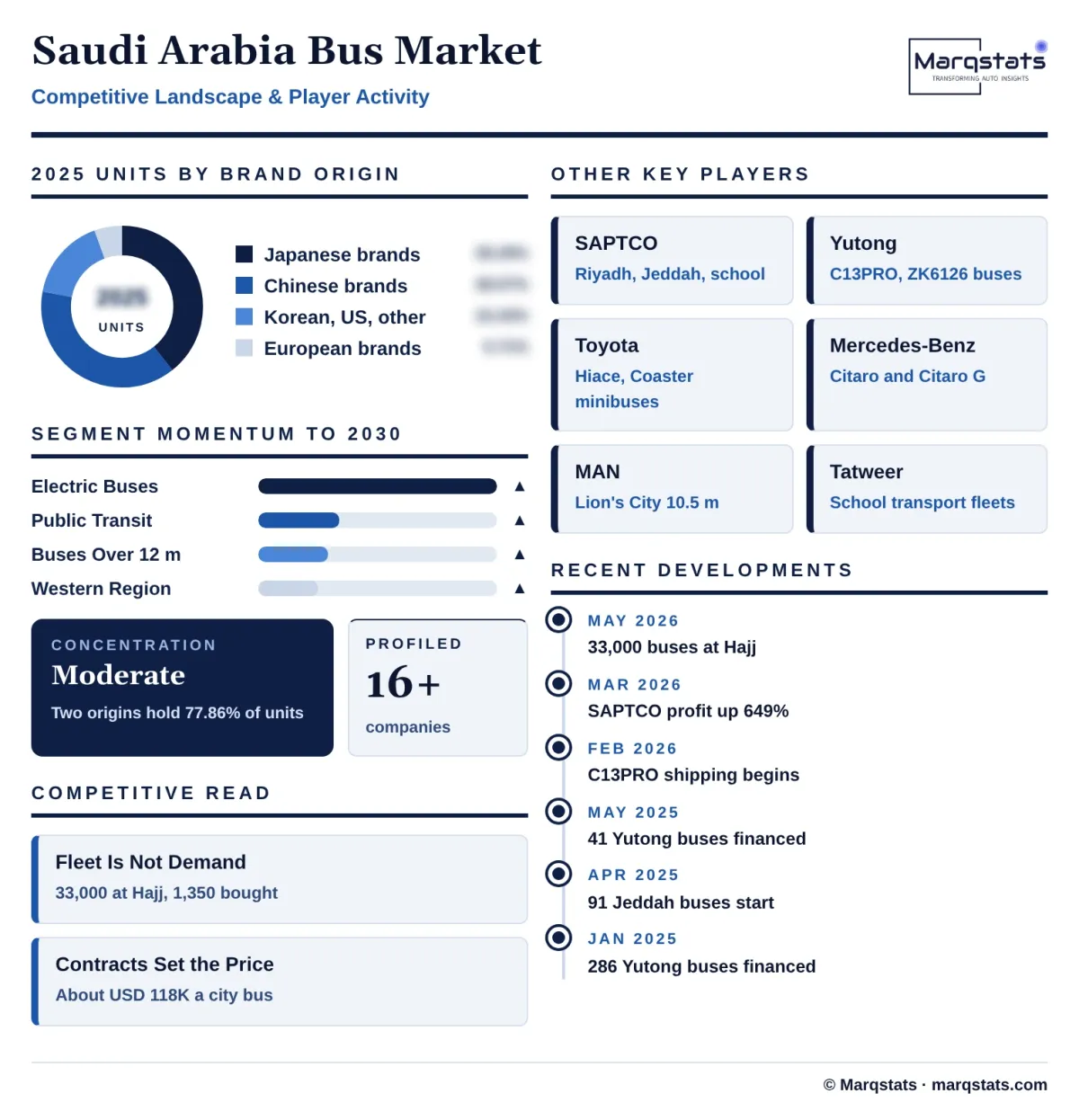
The market is also shaped by pilgrims. The Transport General Authority said in May 2026 that more than 33,000 buses and 5,000 taxis were deployed for Hajj, a fleet that dwarfs yearly sales. Most of that fleet is licensed, leased and reused season after season, so Marqstats counts only new purchases, which it estimates at about 1,350 intercity, tourism, Hajj and Umrah buses in 2025, and does not count fleet size as demand.
The market is smaller than a top-down view of fleet spending suggests. A bottom-up build from buyer groups gives about 7,000 buses at an average of about USD 77,340, and the result of USD 541.38 million equals 76.36% of the USD 709 million of imports reported under tariff heading 8702 in 2023. The average is held down by the 57.14% of units that are minibuses of up to 7 metres, which sell at about USD 41,305, against about USD 110,132 for buses of 7 to 12 metres and USD 180,538 for buses above 12 metres.
After 2025 the market passes through a soft year. Marqstats estimates 2026 unit sales at about 6,510, 7.00% lower than in 2025, and 2026 value at USD 528.09 million, 2.45% lower, because tracked Saudi light-vehicle sales fell 26.9% in the first eight months of 2026 and corporate buyers deferred Hiace-type minibuses, while public transit and tourism volumes held. Growth of 7.55% a year from 2026 to 2030 then takes the market to USD 759.98 million.
Saudi Arabia Bus Market Size and Forecast
The Saudi Arabia bus market grows from USD 541.38 million in 2025 to USD 759.98 million in 2030, a CAGR of 7.02%. Volume contributes most of the growth: unit sales rise at 4.08% a year, from about 7,000 to 8,550 buses, and the average value per bus rises at 2.82% a year, from about USD 77,340 to USD 88,887, as large buses and electric buses take a bigger share and prices drift up by 1.5% a year.
The 2025 value is built bottom-up from twelve buyer and size cells. Marqstats estimates 4,000 minibuses of up to 7 metres, 2,350 buses of 7 to 12 metres and 650 buses above 12 metres, valued at the distributor invoice before value added tax. Price benchmarks are the Toyota Hiace bus at SAR 145,705 to SAR 159,735 including VAT, or USD 33,787 to USD 37,040 before VAT, the Toyota Coaster at SAR 250,930 to SAR 260,590, or USD 58,187 to USD 60,427, and the Hyundai County at SAR 271,262, or USD 62,901.
Larger buses are priced from fleet financing. SAPTCO reported a murabaha facility with Riyad Bank on 13 January 2025 for 286 Yutong buses of the 2026 model year with a principal of SAR 127 million, about SAR 444,056 or USD 118,415 a bus, and a second facility on 27 May 2025 for 41 Yutong buses with a principal of SAR 17.7 million, about SAR 431,707 or USD 115,122 a bus. Because financing principal is a floor for an invoice price, Marqstats prices a 12 metre city bus at about USD 140,000 once European makes such as Mercedes-Benz and MAN are blended in.
The base is checked against customs data and public fleets. Saudi imports under tariff heading 8702, motor vehicles for ten or more persons, were USD 709 million in 2023, of which China supplied 48.00%, Japan 15.50%, the United States 10.70%, the United Arab Emirates 9.07%, India 5.05%, Germany 3.41% and Korea 3.30%. Marqstats expects the 2023 total to include the 550 Yutong coaches announced in February 2023 and the further 263 C13PRO coaches delivered to the Transport General Authority long-distance project in November 2023, and Marqstats estimates 2025 at 76.36% of that level.
Electric and gasoline buses move value in opposite directions. Marqstats expects battery-electric buses to rise from 58 units in 2025 to 255 in 2030, in line with the live Marqstats Middle East Electric Bus Market report, which puts Saudi deliveries at 58 buses in 2025 and a 34.44% CAGR, while gasoline minibuses hold at about 1,900 to 2,100 units. Electric buses are priced at about 4.0 times the average diesel bus in 2025, falling to 3.4 times by 2030.
Marqstats tracks five indicators to monitor the forecast: the contract awards and bus counts of public transit programmes in Riyadh, Jeddah, Makkah, Madinah and the regions; the SAPTCO and Tatweer school and intercity fleet renewals; Hajj and Umrah season licensing by the Transport General Authority; registrations of Toyota Hiace and Coaster models in a light-vehicle market that fell in 2026; and deliveries of electric buses against the 2030 level of 255.
Market Dynamics
Key Drivers
Five forces are lifting demand for new buses in Saudi Arabia, led by public transit contracts and pilgrim and event traffic.
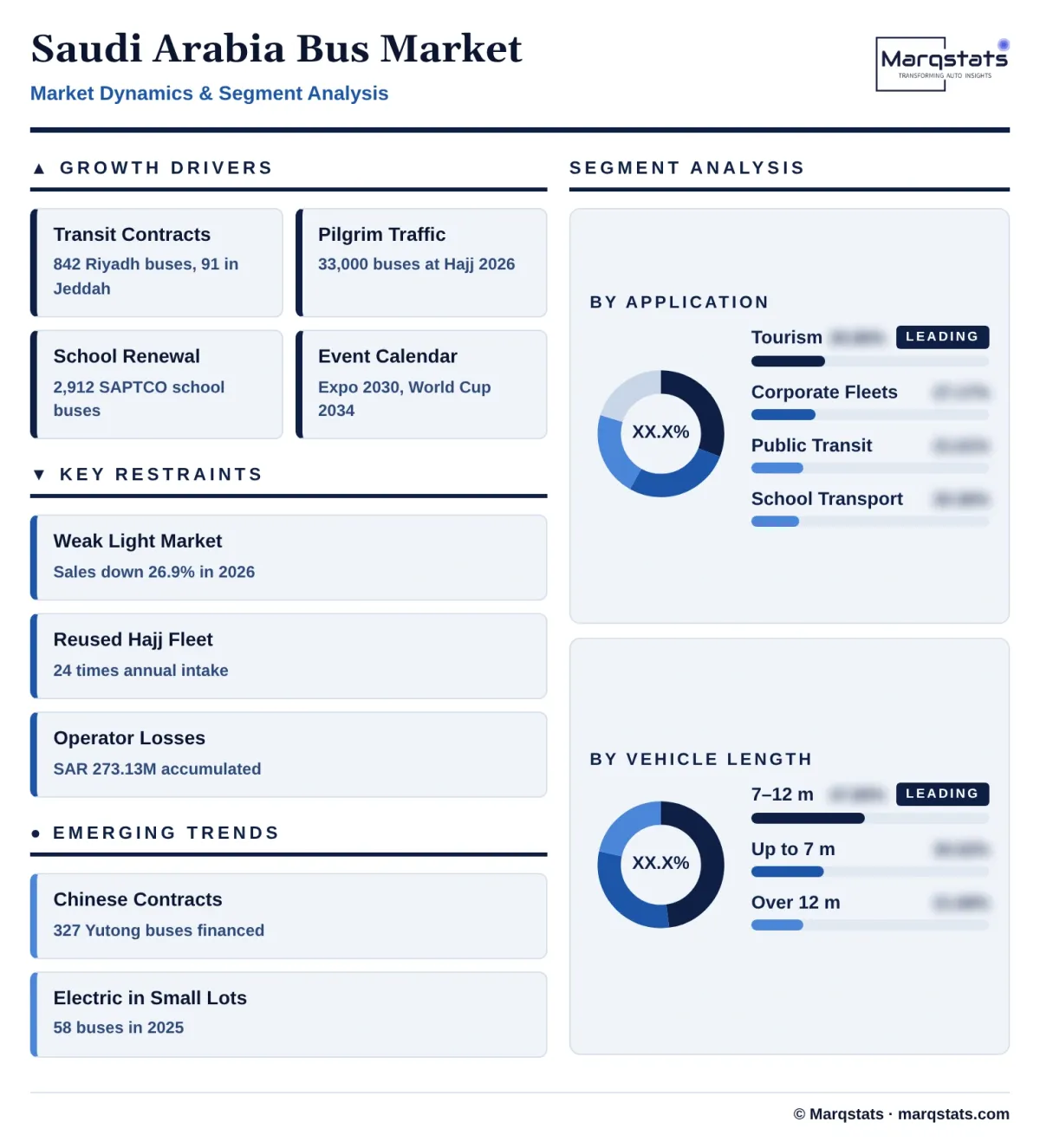
- Public transit contracts keep adding buses. SAPTCO operates the Riyadh network of 842 buses and began a new Jeddah phase on 1 April 2025 with 91 Yutong buses, 88 diesel at the Euro 5 standard and 3 electric, under a three-year contract with the Jeddah Transportation Company. Each new city contract needs a block of 12 metre buses, which is why public transit is the fastest-growing application.
- Pilgrim and intercity traffic renews coach fleets. The Transport General Authority reported more than 33,000 buses deployed for Hajj in May 2026, Yutong began shipping its C13PRO intercity coach to Saudi Arabia in February 2026, and the Transport General Authority long-distance project took 263 C13PRO coaches in November 2023. Operators replace the oldest coaches first, which sustains purchases above 12 metres.
- School transport needs steady replacement. Tatweer Transportation Services Company reported more than 13,000 buses and vehicles for over 56,000 students, including more than 16,000 students with disabilities, in August 2024, and SAPTCO reported 2,912 school transport buses in 2025. Marqstats estimates that renewal of these fleets adds about 1,600 buses a year in 2025.
- Fleet financing lowers the cost of buying. SAPTCO financed 327 Yutong buses through two Riyad Bank murabaha facilities in 2025, SAR 127 million and SAR 17.7 million, and reported net profit of SAR 113.27 million for 2025, up 649.39% on SAR 15.11 million, which improves its ability to borrow for further buses.
- Mega-events set delivery dates. Riyadh was confirmed as host of Expo 2030 in November 2023 and Saudi Arabia was confirmed as host of the 2034 FIFA World Cup in December 2024, so transit operators and event contractors must have fleets in place by the late 2020s, which supports the 2028 – 2030 growth in units.
Key Restraints
Four constraints slow bus purchases in 2026 and keep electric buses small.
- The light-vehicle market is contracting. Tracked Saudi light-vehicle sales fell 26.9% to 399,028 units in January to August 2026, and the Ministry of Commerce and the Saudi Standards, Metrology and Quality Organization (SASO) suspended light-vehicle imports from 29 manufacturers in June 2026. Minibuses of up to 7 metres share dealers, supply plans and buyers with that market, so Marqstats expects corporate minibus purchases to fall about 14% in 2026.
- Pilgrim fleets are reused, not bought. The 33,000-bus Hajj fleet is about 24 times the 1,350 new tourism and pilgrim buses bought in 2025, which means that a rise in pilgrim numbers is met mostly by longer seasons of use and by hired vehicles, not by orders. Purchases follow licence renewals, not visitor counts.
- Operator balance sheets limit orders. SAPTCO still carried accumulated losses of SAR 273.13 million, equal to 21.85% of its SAR 1.25 billion capital, at the end of 2025, even after profit rose to SAR 113.27 million, so large city fleets are bought in tranches of 40 to 290 buses and financed one facility at a time.
- Electric buses cost far more than diesel. A battery-electric 12 metre bus costs about USD 308,000 on Marqstats estimates, against about USD 118,000 per bus implied by SAPTCO financing for Yutong diesel buses, and SAPTCO reported only 10 electric buses in its fleet at the end of 2025, 3 in Jeddah and 7 in Tabuk. Riyadh still runs diesel buses, so electric volume remains small.
Key Trends
Four shifts are changing who buys buses in Saudi Arabia, what they pay for and how they pay.
- Chinese makers take the large city and coach orders. Yutong supplied 91 buses to Jeddah in 2025, was financed for 327 buses by SAPTCO in the same year and began shipping the C13PRO in 2026, while Mercedes-Benz and MAN supplied the original 842 Riyadh buses. Price is the reason: Marqstats estimates European brands at about USD 185,000 a bus in 2025, against about USD 105,956 for Chinese brands.
- Operators lease or finance instead of paying cash. Murabaha facilities, three-year service contracts such as the Jeddah phase and bundled maintenance move the purchase decision from the vehicle price to the monthly cost, which favours makers with local service networks.
- Electric buses arrive in city fleets in small lots. Jeddah took 3 electric buses in 2025 and SAPTCO disclosed an agreement to add electric double-deck buses in Jeddah from the second quarter of 2026, which Marqstats expects to lift electric deliveries from 58 in 2025 to 255 in 2030.
- Buyers prefer buses over 7 metres. Units above 7 metres rise from 3,000 to 4,010 between 2025 and 2030, a faster rate than minibuses, because contracts specify capacity per route and per school, and larger buses carry a higher value per unit.
Strategic Implications
- For bus makers, the winning position is a supplier that can bid on transit and school contracts in tranches. Public transit grows at 11.21% a year and school replacement adds about 1,600 buses, so makers with financing partners, Euro 5 or Euro 6 diesel engines and an electric option can win contracts that minibus importers cannot.
- For operators such as SAPTCO and the Tatweer Transportation Services Company, financing is the main lever. Murabaha facilities of SAR 127 million for 286 buses show that a bus order of roughly USD 118,000 a unit can be arranged in a single facility, and operators that stage orders across two or three years avoid a gap in fleet age.
- For importers of Toyota Hiace and Coaster minibuses, 2026 is a reset year. Light-vehicle sales fell 26.9% in the first eight months, so dealers should hold stock levels to institutional orders from hotels, hospitals, schools and contractors and rely on the 2027 recovery.
- For pilgrim transport operators, buying is a replacement decision. With about 24 times more buses in the season than are bought in a year, operators that renew 5 to 10% of a fleet yearly buy more than the market average and can negotiate better financing and service terms.
- For charging and energy suppliers, electric buses are a depot business. With 255 electric buses in 2030, charging contracts will be signed one depot at a time in Jeddah, Tabuk, Riyadh and Makkah, so suppliers need to price for small lots.
Market Segmentation
Minibuses of up to 7 metres account for 30.52% of 2025 value, USD 165.22 million, and 57.14% of units, and grow at 4.17% a year to USD 202.70 million. Marqstats estimates 4,000 units in 2025, led by the 13-seat Toyota Hiace bus and the 23-seat Toyota Coaster, with the Hyundai County and Mitsubishi Rosa as alternatives, bought by hotels, hospitals, contractors, schools and rental companies. The segment falls in 2026 and grows slowest, because it shares the weak light-vehicle market.
Buses of 7 to 12 metres account for 47.80% of 2025 value, USD 258.81 million, and grow at 7.63% a year to USD 373.87 million. The class includes 12 metre city buses such as the Mercedes-Benz Citaro and Yutong ZK6126 models, 10.5 metre buses such as the MAN Lion's City, midi school buses and 12 metre coaches. Marqstats estimates 2,350 units in 2025, at an average of about USD 110,132.
Buses above 12 metres account for 21.68% of 2025 value, USD 117.35 million, and grow fastest among length classes, at 9.34% a year, to USD 183.41 million and 24.13% of the market. The class covers 13 metre coaches such as the Yutong C13PRO, 18 metre articulated buses such as the Mercedes-Benz Citaro G and electric double-deck buses. Only 650 units were sold in 2025, but each is worth about USD 180,538.
Public transit accounts for 21.61% of 2025 value, USD 117.00 million, and grows fastest, at 11.21% a year, to USD 199.00 million and 26.18% of the market. It covers city and regional networks in Riyadh, Jeddah, Madinah, Makkah, the Eastern Province and the regions, run by SAPTCO and municipal companies, with about 830 buses sold in 2025 and 1,300 in 2030.
School and education transport accounts for 20.36% of 2025 value, USD 110.20 million, and grows slowest among applications, at 4.19% a year, to USD 135.33 million. About 1,600 buses are bought each year by SAPTCO, Tatweer Transportation Services Company contractors, private schools and universities, mostly minibuses and midi buses priced near USD 52,000 to USD 82,000.
Intercity, tourism, Hajj and Umrah transport accounts for 30.86% of 2025 value, USD 167.10 million, and grows at 7.48% a year to USD 239.71 million. It is the largest application by value, because coaches above 12 metres at about USD 170,000 make up a third of the units, but only about 1,350 buses are bought each year for a Hajj fleet of more than 33,000.
Corporate and commercial fleets account for 27.17% of 2025 value, USD 147.08 million, and 45.99% of units, and grow at 4.80% a year to USD 185.94 million. Hotels, hospitals, government bodies, contractors, giga-project developers and rental companies buy mostly the Toyota Hiace bus, which is why this application has the lowest value per unit of about USD 45,677.
Diesel buses account for 71.81% of 2025 value, USD 388.72 million, and 72.03% of units, and grow at 6.13% a year to USD 523.47 million while their value share falls to 68.88%. All large city buses and coaches are diesel, including the Euro 5 buses delivered to Jeddah in 2025, and diesel Hiace and Coaster models make up a large share of minibuses.
Gasoline buses account for 24.89% of 2025 value, USD 134.77 million, and 27.14% of units, and grow at 3.91% a year to USD 163.25 million. They are minibuses such as the gasoline Toyota Hiace bus, priced at SAR 145,705 against SAR 154,905 for the diesel manual version, and their appeal is low purchase price and cheap fuel.
Battery-electric buses account for 3.30% of 2025 value, USD 17.89 million, and 0.83% of units, and grow fastest, at 32.57% a year, to USD 73.26 million and 9.64% of the market. Marqstats counts 58 buses in 2025, aligned with the live Middle East Electric Bus report, rising to 255 in 2030, with Jeddah and Tabuk operating the first units.
By Geography
Central Region
The Central Region, with Riyadh, Qassim and Hail, accounts for 38.00% of 2025 value, USD 205.72 million, and grows at 6.45% a year to USD 281.19 million. Riyadh runs the largest city network in the Kingdom with 842 Mercedes-Benz and MAN buses, SAPTCO operates a further 47 buses in Qassim, and Expo 2030 gives the capital a fixed delivery date. Marqstats allocates value by where buses are based, not where head offices register them.
Western Region
The Western Region, with Makkah, Madinah, Jeddah, Taif and Tabuk, accounts for 33.00% of 2025 value, USD 178.66 million, and grows fastest, at 8.28% a year, to USD 265.99 million and 35.00% by 2030. Hajj and Umrah traffic, the Jeddah phase of 91 buses started in April 2025, SAPTCO fleets of 58 buses in Taif and 30 in Tabuk and Red Sea tourism projects all draw coaches and city buses to the region.
Eastern Province
The Eastern Province, with Dammam, Qatif, Al Ahsa, Jubail and Dhahran, accounts for 19.00% of 2025 value, USD 102.86 million, and grows at 5.87% a year to USD 136.80 million. SAPTCO operates 85 buses in the Eastern Province project and 41 in Al Ahsa, and oil, gas and petrochemical employers buy staff coaches under maintenance contracts, which makes demand steady but not fast-growing.
Southern and Northern Regions
The Southern and Northern Regions, covering Asir, Jazan, Najran, Al Baha, the Northern Borders and Al Jouf, account for 10.00% of 2025 value, USD 54.14 million, and grow at 7.02% a year to USD 76.00 million. SAPTCO runs 73 buses in Jazan, and school transport, intercity links and provincial city networks create steady demand for minibuses and midi buses over long distances.
How Competition Is Evolving
The market is moderately concentrated and split by size class. Marqstats estimates that Japanese brands hold 39.29% of 2025 units and 20.32% of value, Chinese brands 38.57% of units and 52.84% of value, European brands 5.71% of units and 13.67% of value, and Korean, American, Indian and other brands 16.43% of units and 13.17% of value, so the first two origins together hold 77.86% of volume. Groups are by brand headquarters, not by customs country of origin.
Japanese brands own the minibus layer. Toyota Motor Corporation sells the Hiace bus and the Coaster, Mitsubishi Fuso Truck and Bus Corporation sells the Rosa through Juffali Commercial Vehicles, and Isuzu Motors Limited and Nissan Motor Co., Ltd. sell smaller models. Japan supplied 15.50% of Saudi bus imports by value in 2023, and the Toyota list prices of SAR 145,705 to SAR 260,590 set the benchmark for every minibus buyer.
Chinese brands own the contract layer. Zhengzhou Yutong Bus Co., Ltd. announced a 550-bus order from Saudi Arabia in February 2023, delivered 263 C13PRO coaches in November 2023, supplied 91 buses to Jeddah in 2025 and began shipping the C13PRO in February 2026, while King Long, Higer and Golden Dragon sell smaller lots. China supplied 48.00% of 2023 imports by value, and Marqstats estimates its brands at 52.84% of 2025 value.
European brands own the premium layer. Mercedes-Benz supplied 600 of the 842 Riyadh buses, 421 Citaro G articulated buses and 179 Citaro buses, and MAN Truck and Bus supplied 242 Lion's City buses, with Scania and Volvo Buses selling coaches. European brands are small in volume, at 5.71% of units, but sell at about USD 185,000 a bus, and Germany supplied only 3.41% of imports by value in 2023.
Competition is shifting from price to contract terms. Operators choose between Chinese buses at about USD 118,000 financed through murabaha and European buses at much higher prices, so makers with local service workshops, spare-parts stock and a financing partner win repeat orders, as SAPTCO showed by financing 327 Yutong buses in 2025.
Companies Covered
Companies covered in the report include:
Recent Market Activity
Table of Contents
Coverage & Segmentation
The study covers the Saudi Arabia bus market, with 2025 as the base year, 2025 as the latest historical year and 2026 – 2030 as the forecast period. It covers new buses, coaches and minibuses with seating for ten or more persons including the driver, delivered complete or bodied in the Kingdom, segmented by vehicle length, application, propulsion and region. Values are wholesale values at the distributor invoice in US dollars, before 15% value added tax, customs duties and dealer margins, and riyal figures use the fixed rate of SAR 3.75 per US dollar.
Vans and minibuses below ten seats, passenger cars, pickups, trucks, ambulances and special-purpose bodies, used buses, bus bodies and chassis sold separately, rail and metro rolling stock, and passenger fare revenue are excluded. Segment and regional splits are Marqstats estimates built on public fleet counts, financing disclosures, customs values and list prices. The live Marqstats Middle East Electric Bus Market report is a broader parent whose Saudi figure of 58 electric buses in 2025 is a subset of this market and must not be added, and the Saudi Arabia Passenger Car, Heavy Truck and Pickup Vehicle reports cover separate vehicle classes whose figures should not be added to this one.