Market Snapshot
Middle bar: base-year value × (1 + CAGR), rounded to two decimals. This is a calculated illustration, not a separately researched annual estimate.
The Nigeria bus market size is estimated at USD 567.04 million in 2025 and is projected to reach USD 881.38 million by 2030, growing at a CAGR of 9.22% over 2026 – 2030. Marqstats estimates that about 54,000 buses of 10 seats or more were added to the national fleet in 2025, rising to about 64,000 in 2030 at 3.46% a year, while the average value per bus climbs from about USD 10,501 to USD 13,772 as new, CNG and electric buses take a larger share.
Marqstats defines the market as the value of buses and minibuses with 10 or more seats, including the driver, that enter Nigerian service in a year, whether bought as foreign-used units known locally as Tokunbo, imported new as complete buses, or assembled in Nigeria from imported kits. It covers the Toyota Hiace and Coaster class, Chinese and Korean midi-buses and full-size coaches and city buses, and excludes trucks, pickups, vans of fewer than 10 seats, tricycles, bus bodies sold separately and spare parts. Values use NGN 1,520.36 per USD, the 2025 average.
Buses of 10 to 19 seats account for 66.39% of 2025 value, used imports for 59.62% and petrol and diesel engines for 84.41%. The South-West is the largest zone, with 36.00% of value, and North-Central and FCT is the fastest growing, at 10.74% a year, as Lagos franchising, the CNG and electric programme and the July 2026 duty cut for mass-transit buses lift demand for new and cleaner vehicles.
Key Takeaways
Market Overview & Analysis
Report Summary
Marqstats sizes the Nigeria bus market as the value of buses with 10 or more seats, including the driver, that are added to the national fleet in a year. The market is valued at the first point of sale in Nigeria and counts three supply channels: foreign-used buses imported by traders, new buses cleared through customs by dealers and fleet owners, and buses assembled in Nigeria by licensed plants from imported kits.
Nigeria moves people by road more than by any other mode, and the bus is the mode. Lagos alone has about 75,000 commercial buses on its roads, according to LAMATA in May 2025, most of them privately owned danfo minibuses run by individual drivers under union control. Intercity travel depends on 14-seat to 18-seat minibuses and 40-seat to 60-seat coaches run by companies such as ABC Transport, Chisco, GUO and GIG Mobility. Rail and air carry a small share of passengers, so fleet growth tracks population, urban spread and road conditions more than tourism or income.
Used buses dominate units and new buses dominate customs records. Marqstats estimates that about 49,688 used buses entered service in 2025 at an average of about USD 6,804, mostly 14-seat to 18-seat minibuses from Europe, Japan and the United States cleared at Lagos ports. New imports recorded under HS 8702 were worth USD 190.58 million in 2025, up from USD 96.29 million in 2024, and about 1,200 buses were assembled in Nigeria at about USD 32,000 each.
Policy turned in 2026. From 1 July 2026 Nigeria cut the duty on fully built passenger vehicles from 70% to 40%, the new-vehicle levy from 20% to 10% and the used-vehicle levy from 15% to 5%, and reported that mass-transit buses are fully exempt from import duties, according to Channels TV. A Green Tax Surcharge also began on 1 July 2026. At the same time the federal Presidential Initiative on CNG and EV had converted more than 120,000 vehicles and placed 655 CNG buses by early September 2026, and LAMATA said on 2 October 2026 that it would work only with CNG or electric buses.
The market grew from an estimated USD 352.86 million in 2021 to USD 351.31 million in 2023 and USD 567.04 million in 2025, a 12.59% CAGR over 2021 – 2025. Growth in 2025 was 33.38%, driven by a doubling of customs-recorded new bus imports and by higher naira prices for every bus. Volume grew more slowly than value, from about 46,935 buses in 2021 to 54,000 in 2025.
Nigeria Bus Market Size and Forecast
The Nigeria bus market grows from USD 567.04 million in 2025 to USD 881.38 million in 2030, a CAGR of 9.22%. Marqstats expects value to outpace volume: bus additions grow at 3.46% a year, from about 54,000 to 64,000, while the average value per bus rises at 5.57% a year, from about USD 10,501 to USD 13,772, as new, assembled, CNG and electric buses take share from used petrol and diesel minibuses.
The 2025 value is built bottom-up from three channels and nine seat and channel cells. Used imports contribute USD 338.06 million from about 49,688 buses, of which about 47,300 are 10-seat to 19-seat minibuses at about USD 6,500, about 1,900 are 20-seat to 35-seat midi-buses at about USD 12,000 and about 488 are larger buses at about USD 16,000. New imports contribute USD 190.58 million from about 3,112 buses, and local assembly USD 38.40 million from about 1,200 buses.
The new-import figure is anchored on customs records. Nigeria reported HS 8702 imports of USD 91.46 million in 2021, USD 75.69 million in 2022, USD 80.07 million in 2023, USD 96.29 million in 2024 and USD 190.58 million in 2025. Marqstats converts these values into units using average prices by seat class, which gives about 1,450 buses of 10 to 19 seats at about USD 40,000, about 750 of 20 to 35 seats at about USD 62,000 and about 912 larger buses at about USD 94,384, so that the three classes sum exactly to the recorded value.
The used channel is sized from fleet replacement, because used buses do not appear at those prices in customs data. Lagos has about 75,000 commercial buses, and Marqstats estimates a national commercial bus parc of about 420,000 vehicles, with about 54,000 additions in 2025 from replacement and growth. Used imports of about 49,688 therefore supply the great majority of additions, and rising prices, not rising volume, explain most of the 2025 value gain.
Value grows by 33.38% in 2025 and then at between 8.85% and 9.61% a year to 2030. Marqstats tracks four indicators to monitor the forecast: monthly Nigerian Ports Authority vehicle throughput, which rose 42.5% to 103,375 units in the first half of 2026; the naira rate against the dollar; Lagos franchise awards under the Bus Industry Transition Programme; and the number of CNG and electric buses delivered under the Presidential Initiative.
Market Dynamics
Key Drivers
Five forces are pulling more buses into Nigerian fleets each year, even as the market stays tied to imported used minibuses.
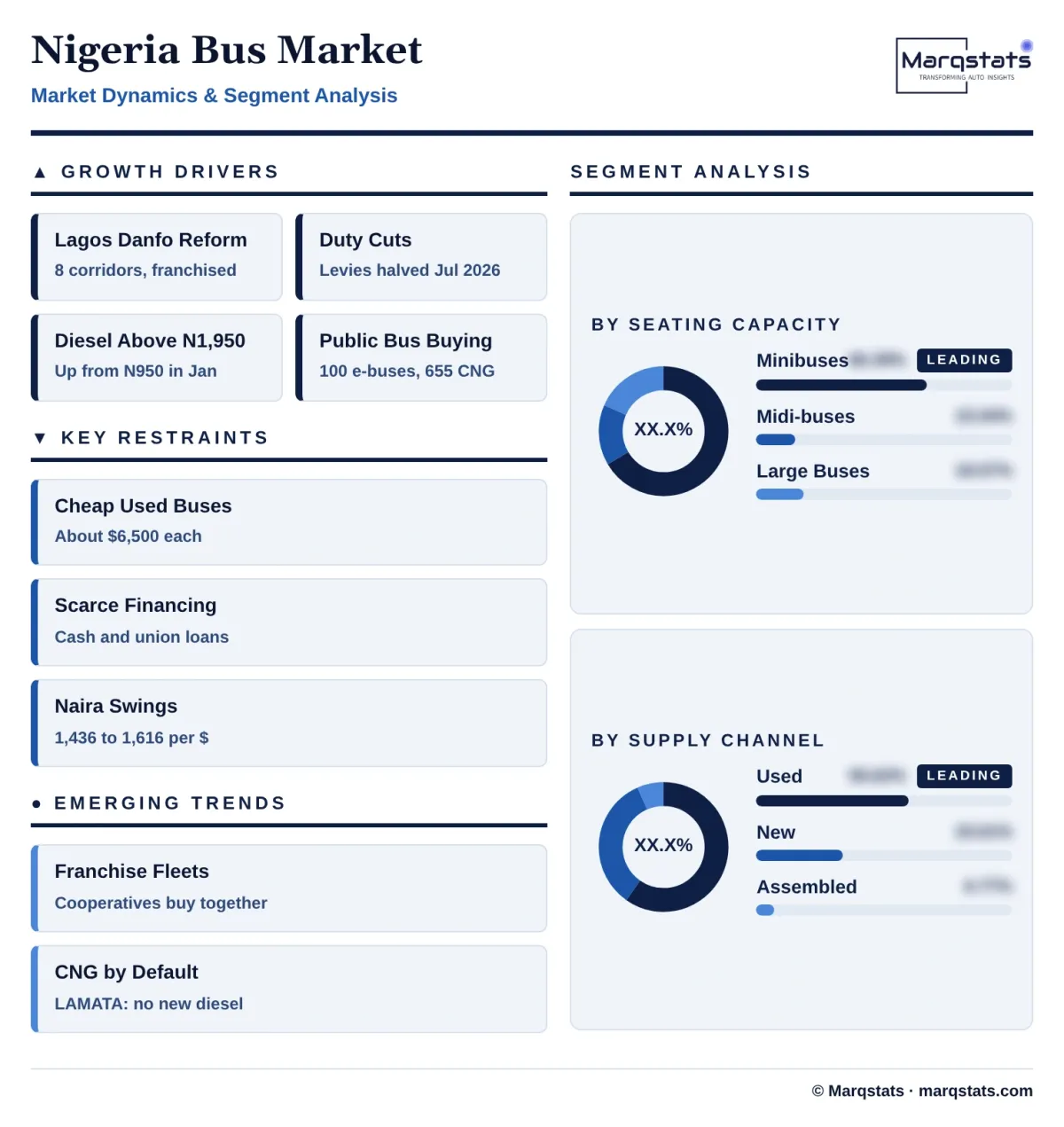
- Lagos is replacing its danfo fleet. The Bus Industry Transition Programme moves informal operators into a regulated franchise system on eight Quality Bus Corridors, with fully digital fares, and LAMATA says Lagos needs at least 15,000 regulated buses compared with just over 1,000 in its operating fleet in March 2025. Each franchise needs high-capacity buses that a danfo owner cannot supply alone.
- Duty cuts reduce the landed cost of buses. From 1 July 2026 the duty on fully built passenger vehicles fell from 70% to 40%, the new-vehicle levy from 20% to 10% and the used-vehicle levy from 15% to 5%, and mass-transit buses were reported as fully exempt from import duties. Lower landed costs help operators who buy imported new and used buses.
- Fuel costs favour CNG buses. Diesel cost about N950 a litre at the start of 2026 and between N1,950 and N2,100 by October, according to LAMATA, so a fleet owner who pays for fuel every day gains quickly from a CNG conversion or a factory CNG bus. The Presidential Initiative on CNG and EV had converted more than 120,000 vehicles by early September 2026.
- Public programmes buy electric and CNG buses directly. The federal government unveiled 100 Renewed Hope mass-transit electric buses in Abuja on 26 August 2026, with 37 delivered in the first phase, and LAMATA handed over 20 more CNG buses on 2 October 2026, lifting its CNG fleet from about 150.
- Population and travel costs keep demand for seats high. The National Bureau of Statistics recorded an average intercity bus fare of N9,607.24 in April 2026, up 21.6% on April 2025, and operators respond by buying larger buses to spread costs over more passengers.
Key Restraints
Four constraints hold back the value of the Nigeria bus market and keep most of it in low-priced used vehicles.
- Used buses are cheap and easy to get. A foreign-used 14-seat to 18-seat minibus costs about USD 6,500 at Marqstats estimates, less than one-sixth of a new import, and traders clear thousands of them each year at Lagos ports. Most small operators cannot finance a new bus, so the used channel keeps its majority of units.
- Financing is scarce and expensive. Few banks lend against a danfo or an intercity minibus, and bus owners usually rely on cash, union cooperatives or informal lenders. This limits how fast fleets move to new and larger buses, even where duty has fallen.
- Currency swings raise the price of imports. The naira averaged NGN 1,520.36 per dollar in 2025, with a range of NGN 1,436.02 to NGN 1,615.90 during the year, and every move changes the naira cost of a new import and of the spare parts that keep older buses running.
- Charging, gas stations and spares are limited. The national plan counts more than 90 CNG stations against a target of 1,000, and electric buses depend on depot charging that exists mainly in Abuja and Lagos, so operators outside these cities hesitate to buy gas or electric buses.
Key Trends
Four shifts are changing which buses Nigerian operators buy, how they fuel them and where they are assembled.
- Franchising replaces individual ownership. Lagos, backed by an agreement signed by LAMATA, NURTW and RTEAN after more than 30 months of talks, is moving operators into cooperatives that buy and run buses together. Larger purchases per buyer raise the share of 20-seat to 35-seat and larger buses.
- CNG becomes the default new fuel. LAMATA said on 2 October 2026 that it will no longer accept new diesel buses and will work only with CNG or electric buses, and the national programme had placed 655 CNG buses by early September 2026.
- Local assembly grows from a small base. Nigeria has almost 40 licensed assembly plants with installed capacity of more than 600,000 vehicles a year but output near 5% of capacity, according to NADDC in August 2026. The Nigeria First procurement framework tells public buyers to buy from approved local assemblers, which supports bus assembly.
- Electric buses move from pilots to fleets. Battery-electric buses grow from about 180 in 2025 to about 900 in 2030 at Marqstats estimates, led by Abuja and Lagos programmes, though high prices keep them to about 11.74% of 2030 value.
Strategic Implications
- For bus importers and dealers, the customs figure is only a third of value. Dealers who sell new imports should price against the used channel, which supplies 92.01% of units, and offer financing and warranties that a used minibus cannot match.
- For local assemblers, public procurement and franchise buyers are the route to scale. Plants that can supply 20-seat to 35-seat and larger buses with CNG options, and that are approved by NADDC, are best placed for government and LAMATA orders.
- For fleet operators and cooperatives, a CNG or electric bus pays back through fuel savings only if gas stations or chargers are on the route. Operators should pick corridors with supply before ordering and compare the saving with the price premium.
- For lenders and leasing companies, franchise cooperatives offer more predictable cash flows than individual danfo owners. A lender that finances a group of buses on one corridor can spread risk across routes and drivers.
- For policy makers, closing the gap between customs records and fleet additions would improve planning. Registering used imports by seat class, age and fuel would show how much of the fleet is replaced each year.
Market Segmentation
Buses of 10 to 19 seats account for 66.39% of 2025 value, USD 376.45 million, and grow at 6.50% a year to USD 515.85 million, while their share falls to 58.53% by 2030. This class holds the Toyota Hiace and similar 14-seat to 18-seat minibuses that serve as danfo, kia and intercity vehicles. About 49,250 were added in 2025, growing to 56,450 in 2030, and most are used imports at about USD 6,500. New imports of this class cost about USD 40,000.
Buses of 20 to 35 seats account for 15.04% of 2025 value, USD 85.30 million, and grow at 13.24% a year to USD 158.83 million and 18.02% by 2030. They include Coaster-class midi-buses and Chinese and Korean 25-seat to 32-seat buses used for staff transport, schools, church groups and short intercity routes. Marqstats estimates about 3,150 were added in 2025 and about 4,700 in 2030, at an average new price of about USD 62,000 in 2025.
Buses of more than 35 seats account for 18.57% of 2025 value, USD 105.29 million, and grow fastest, at 14.44% a year, to USD 206.70 million and 23.45% by 2030. They are city buses for regulated corridors and coaches for long-distance operators. About 1,600 were added in 2025, but the average new import price of about USD 94,384 gives this class a value far above its share of units.
Used imports account for 59.62% of 2025 value, USD 338.06 million, and 92.01% of units, and grow at 5.50% a year to USD 441.83 million and 50.13% by 2030. Traders buy minibuses in Europe, Japan and the United States and clear them at Lagos ports. The July 2026 cut in the used-vehicle levy from 15% to 5% lowers their cost, but ageing and a wish for warranties and CNG capability move buyers toward newer vehicles.
New imports account for 33.61% of 2025 value, USD 190.58 million, and 5.76% of units, and grow at 12.51% a year to USD 343.60 million and 38.98% by 2030. They are recorded under HS 8702 and are bought by transport companies, state agencies, schools and religious bodies. Customs-recorded value doubled in 2025 from USD 96.29 million to USD 190.58 million.
Locally assembled buses account for 6.77% of 2025 value, USD 38.40 million, and 2.22% of units, and grow fastest of the three channels, at 20.10% a year, to USD 95.95 million and 10.89% by 2030. Marqstats estimates that bus kits make up about 4% of the roughly 30,000 vehicles assembled in 2025. Public procurement under the Nigeria First framework and the draft National Automotive Industry Bill 2026 support the channel.
Petrol and diesel buses account for 84.41% of 2025 value, USD 478.64 million, and grow at 3.90% a year to USD 579.52 million, while their share falls to 65.75% by 2030. They remain the default for used minibuses and for operators outside the cities with gas or charging.
CNG and dual-fuel buses account for 11.46% of 2025 value, USD 65.00 million, and grow at 25.00% a year to USD 198.36 million and 22.51% by 2030. They include factory CNG buses and conversions of petrol buses, and they gain from diesel prices of between N1,950 and N2,100 a litre. Marqstats estimates about 1,250 were added in 2025 and about 3,600 in 2030.
Battery-electric buses account for 4.13% of 2025 value, USD 23.40 million, and grow at 34.63% a year to USD 103.50 million and 11.74% by 2030. Marqstats estimates about 180 were added in 2025 and about 900 in 2030. Programmes in Abuja and Lagos lead demand, and average prices of about USD 130,000 fall to about USD 115,000 as supply improves.
By Geography
South-West
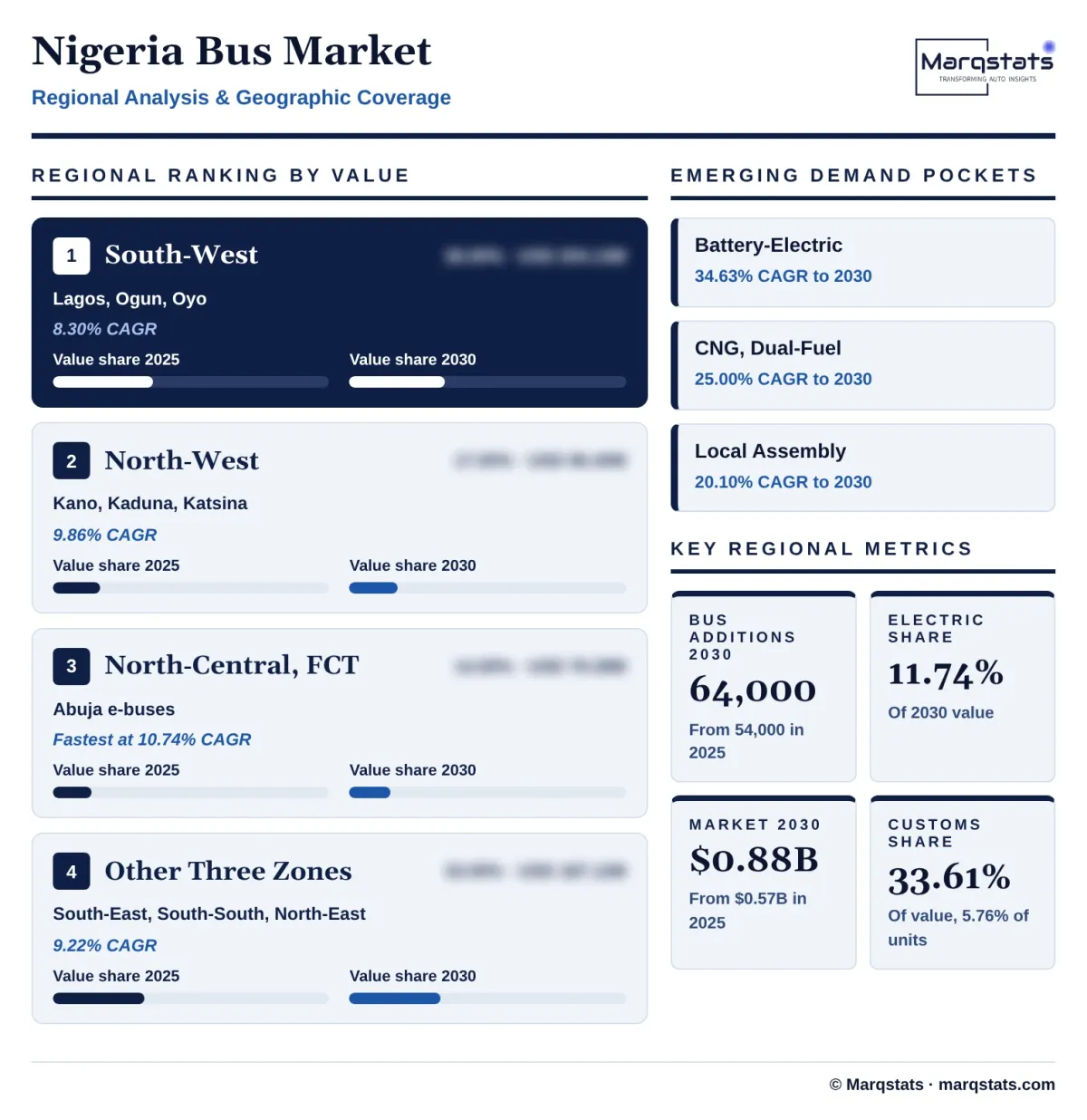
The South-West is the largest zone, with 36.00% of 2025 value, USD 204.13 million, and grows at 8.30% a year to USD 304.08 million and 34.50% by 2030. Lagos, with about 75,000 commercial buses, the Apapa and Tin Can ports where used buses are cleared, and Ogun and Oyo assembly and trade routes make the zone the centre of demand. Marqstats assigns buses to the zone where they operate, not where they clear customs.
North-West
The North-West accounts for 17.00% of 2025 value, USD 96.40 million, and grows at 9.86% a year to USD 154.24 million and 17.50% by 2030. Kano, Kaduna and Katsina are large transport hubs where 14-seat minibuses and midi-buses link cities and neighbouring countries, and Kano and Kaduna host assembly and bodybuilding activity.
North-Central and FCT
North-Central and FCT is the fastest-growing zone, at 10.74% a year, from 14.00% of value and USD 79.39 million in 2025 to USD 132.21 million and 15.00% by 2030. Abuja receives the federal electric buses, including the 100 Renewed Hope units unveiled on 26 August 2026, and the zone sits on interstate routes between the south and the north.
South-East
The South-East accounts for 13.00% of 2025 value, USD 73.71 million, and grows at 9.22% a year to USD 114.58 million and 13.00% by 2030. Onitsha and Nnewi trade networks move used buses and parts, and Innoson Vehicle Manufacturing assembles buses at Nnewi. GUO Transport runs a large intercity fleet from the zone.
South-South
The South-South accounts for 12.00% of 2025 value, USD 68.04 million, and grows at 9.22% a year to USD 105.77 million and 12.00% by 2030. Port Harcourt, Warri, Benin City and Uyo have oil-industry staff transport, intercity and urban minibus demand, and gas supply for CNG is closer than in much of the north.
North-East
The North-East accounts for 8.00% of 2025 value, USD 45.36 million, and grows at 9.22% a year to USD 70.51 million and 8.00% by 2030. Maiduguri, Bauchi and Yola depend on used minibuses and long-distance coaches, security conditions limit fleet growth, and humanitarian transport adds some demand for midi-buses.
How Competition Is Evolving
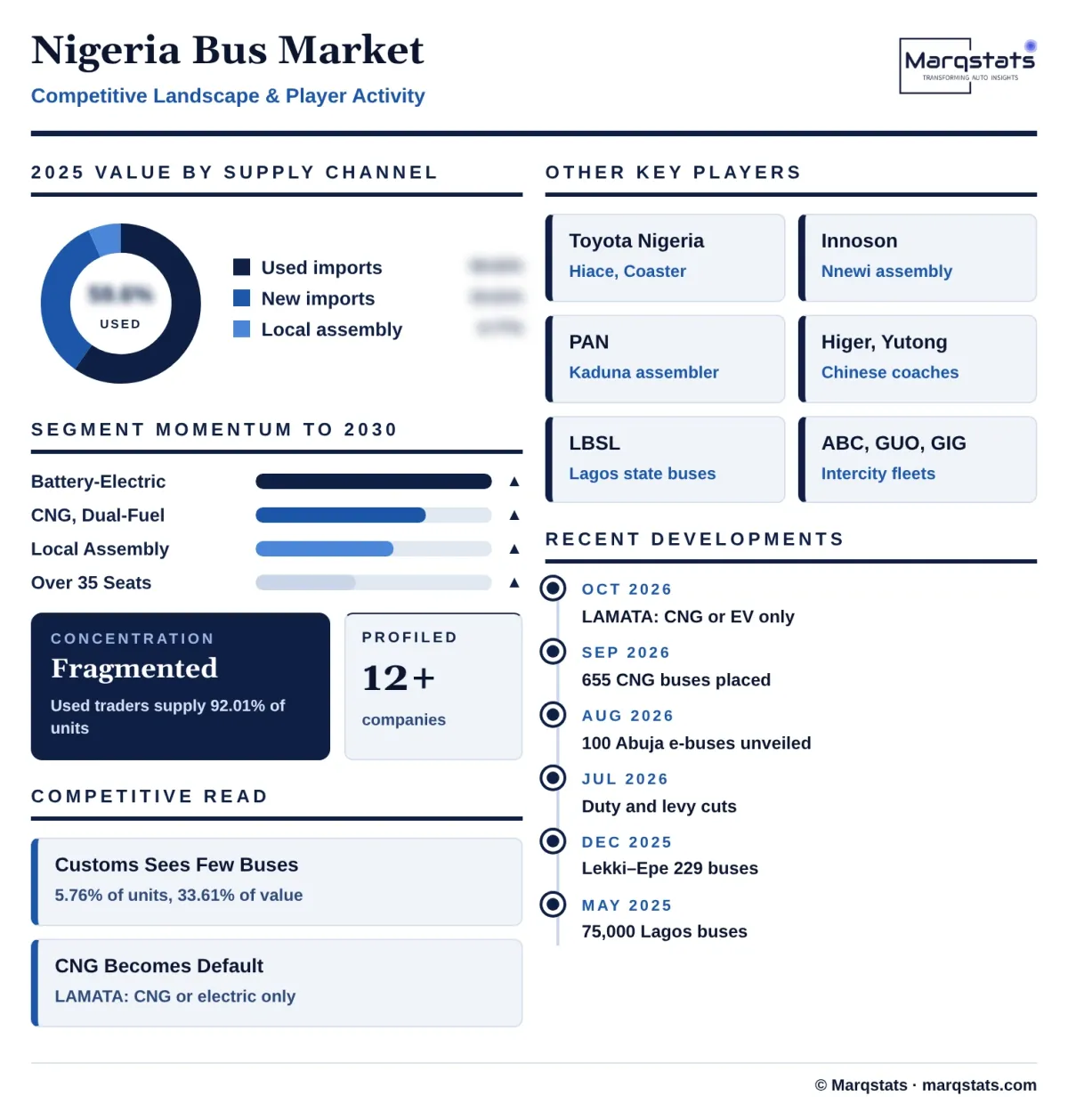
The market is highly fragmented. Marqstats estimates that used imports supply 92.01% of units and 59.62% of value through thousands of independent traders, so no company holds a double-digit share of units. In the new-bus segments, Toyota, Chinese brands and Innoson compete with dealers and traders who import on behalf of fleet owners.
Toyota leads in new minibuses and midi-buses. Toyota Nigeria, part of CFAO Mobility, sells the Hiace and Coaster, whose resale value keeps used prices for the same models high and supports the brand across the market. Higer, Yutong, King Long and other Chinese brands compete on price in 25-seat to 60-seat buses, and Peugeot Automobile Nigeria (PAN) is a licensed assembler in Kaduna.
Innoson Vehicle Manufacturing is the leading Nigerian-owned maker. Its Nnewi plant assembles minibuses and buses, and it supplies public and private buyers who want a local brand under the Nigeria First procurement framework. Locally assembled buses grow from USD 38.40 million to USD 95.95 million in Marqstats estimates, a 20.10% CAGR.
Operators shape demand more than sellers do. Lagos Bus Services Limited operates state-owned buses, ABC Transport, Chisco, GUO and GIG Mobility run large intercity fleets, and NURTW and RTEAN control most informal minibus supply. Franchising moves buying power from thousands of owners to a smaller number of cooperatives and operators.
Companies Covered
Companies covered in the report include:
Recent Market Activity
Table of Contents
Coverage & Segmentation
The study covers the Nigeria bus market, with 2025 as the base year, 2021 – 2025 as the historical period and 2026 – 2030 as the forecast period. It covers buses and minibuses with 10 or more seats, including the driver, entering service as used imports, new imports or locally assembled units, segmented by seating capacity, supply channel, powertrain and geopolitical zone across the South-West, North-West, North-Central and FCT, South-East, South-South and North-East.
Trucks and pickups, which fall under HS 8704 and are covered separately, vans and cars of fewer than 10 seats, tricycles, bus bodies and chassis sold apart, spare parts, financing and fares are excluded. The market does not overlap with the Nigeria CNG commercial vehicle market, which is sized on a retrofit-inclusive parc basis, or with the Nigeria used car market and the Africa electric commercial vehicle market, and their values should not be added to it.