Market Snapshot
The Japan bus market size is estimated at USD 1,204.72 million in 2025 and is projected to reach USD 1,465.17 million by 2030, growing at a CAGR of 3.99% over 2026 – 2030. Registrations of new buses rise from 9,906 to 10,600 a year, a 1.36% annual rate, while the average price per bus climbs from about USD 121,615 to USD 138,224, or from about JPY 18.19 million to JPY 20.68 million, as battery-electric and hybrid buses take a larger share of the mix.
Marqstats defines the market as the wholesale value of new buses with 11 or more seats registered for road use in Japan, whether large route and touring buses or small buses such as the Toyota Coaster and the Mitsubishi Fuso Rosa. Value is counted at the manufacturer wholesale price in US dollars, excluding consumption tax and before government subsidies. Trucks, kei vehicles, passenger vans, used buses, exports and bodies sold separately are excluded.
Large buses account for 70.19% of 2025 value, diesel and other combustion buses for 81.87% and route and intercity transit for 46.86%. Kanto accounts for 36.00% of value and also grows fastest among regions, at 5.12% a year, while battery-electric buses grow fastest among powertrains, at 14.68% a year from a small base.
Key Takeaways
Market Overview & Analysis
Report Summary
Marqstats sizes the Japan bus market as the wholesale value of new buses with 11 or more seats that enter the national fleet each year. It counts large route, intercity and touring buses, and small buses of 11 to 29 seats such as the Toyota Coaster, the Mitsubishi Fuso Rosa and similar models, whether they run on diesel, hybrid, battery-electric or fuel-cell power. Trucks, vans, kei vehicles and used buses are outside the scope.
The home market is a fraction of what Japanese plants produce. JAMA reports that bus production rose 18.40% to about 119,000 units in 2025 and exports rose 15.30% to about 114,000, while domestic new sales fell 1.90% to about 10,000. JADA recorded 9,906 new bus registrations in 2025 against 10,097 in 2024, down 1.89%, and the 2025 figure is still 36.47% below the 15,593 registered in 2017. The fleet in use fell 0.60% to about 208,000 buses, with an average age of 17.96 years in March 2025.
Labour, not demand for travel, sets the pace of purchases. Bus drivers in Japan fell from about 133,000 in 2010 to about 108,000 in 2022, 87% of bus operators reported a driver shortage in fiscal 2023, and the Nihon Bus Association has estimated a loss of about 3,000 drivers a year. The cap of 960 overtime hours a year for professional drivers, in force since April 2024 and known as the 2024 Problem, forced operators to cut timetables, and fewer routes mean fewer replacement buses.
Policy now tries to fill the gap from three directions. The Cabinet decided on 23 January 2026 to let bus drivers enter under the Specified Skilled Worker system with Japanese at level N4 instead of N3, after the Ministry of Land, Infrastructure, Transport and Tourism (MLIT) proposed the change in June 2025. The Ministry of the Environment funds zero-emission buses from a programme for taxis and buses with an annual budget reported at about JPY 40 billion, and the Digital Garden City plan set a goal of driverless Level 4 services at about 50 locations by fiscal 2025 and more than 100 by fiscal 2027.
Marqstats estimates that new bus registrations fell from 10,097 in 2024 to 9,906 in 2025 after a recovery from 5,480 in 2022. Value moved from an estimated USD 740.74 million in 2021 to USD 608.25 million in 2022, USD 962.34 million in 2023 and USD 1,191.11 million in 2024, then rose 1.14% to USD 1,204.72 million in 2025, equal to about JPY 180.23 billion at the 2025 average rate of JPY 149.6 per US dollar.
Japan Bus Market Size and Forecast
The Japan bus market grows from USD 1,204.72 million in 2025 to USD 1,465.17 million in 2030, a CAGR of 3.99%. Price contributes more than volume: registrations rise at 1.36% a year, from 9,906 to 10,600 buses, and the average value per bus rises at 2.59% a year, from about USD 121,615 to USD 138,224, as electric, hybrid and fuel-cell buses take a larger share and diesel prices drift up with costs.
The 2025 value is built bottom-up from units and prices by size and powertrain. Marqstats estimates 3,790 large buses and 6,116 small buses, with large diesel buses at about JPY 31.0 million, large hybrid buses at JPY 36.0 million, large battery-electric buses at JPY 48.0 million, small diesel buses at JPY 8.6 million and small battery-electric buses at JPY 20.0 million. Prices are wholesale values before consumption tax and subsidies, converted at JPY 149.6 per US dollar.
The price assumptions are tied to published list prices. Isuzu Motors Limited lists the 70-seat urban Erga EV at JPY 59,801,800 before tax, or JPY 65,781,980 with tax, and BYD Japan Co., Ltd. launched the K8 in Japan at JPY 38.5 million before tax, so Marqstats blends the two at about JPY 48.0 million for a large electric bus. Mitsubishi Fuso Truck and Bus Corporation priced its new 29-seat Rosa at JPY 9,038,000 with tax in May 2025, or about JPY 8.22 million before tax, which sits below the JPY 8.6 million Marqstats uses for the small diesel average because the Coaster and longer bodies cost more.
The unit base follows the registration series. JADA recorded 9,906 new buses in 2025 and JAMA recorded 3,876 large and 6,221 small buses in 2024, so Marqstats splits 2025 at 3,790 and 6,116. The first half of 2026 supports the near-term path: JADA counted 6,085 registrations in January to June 2026, up 8.02% from 5,633, even though January to March 2026 was down 16.20% at about 3,016 against 3,599, so Marqstats expects about 10,250 registrations in 2026.
Battery-electric and fuel-cell buses add value faster than volume. Marqstats expects battery-electric registrations to rise from 400 in 2025 to 1,060 in 2030, a 21.52% CAGR in units, and fuel-cell buses from 30 to 60, so their combined share of units grows from 4.34% to 10.57% and their share of value from 10.99% to 17.81%. Marqstats tracks four indicators: monthly JADA bus registrations, the size and rules of the Ministry of the Environment bus subsidy, the pace of the Specified Skilled Worker intake, and the delivery plans of ARCHION Inc., Isuzu and BYD Japan.
Market Dynamics
Key Drivers
Five forces keep Japanese operators buying new buses even as routes are cut and drivers become scarce.
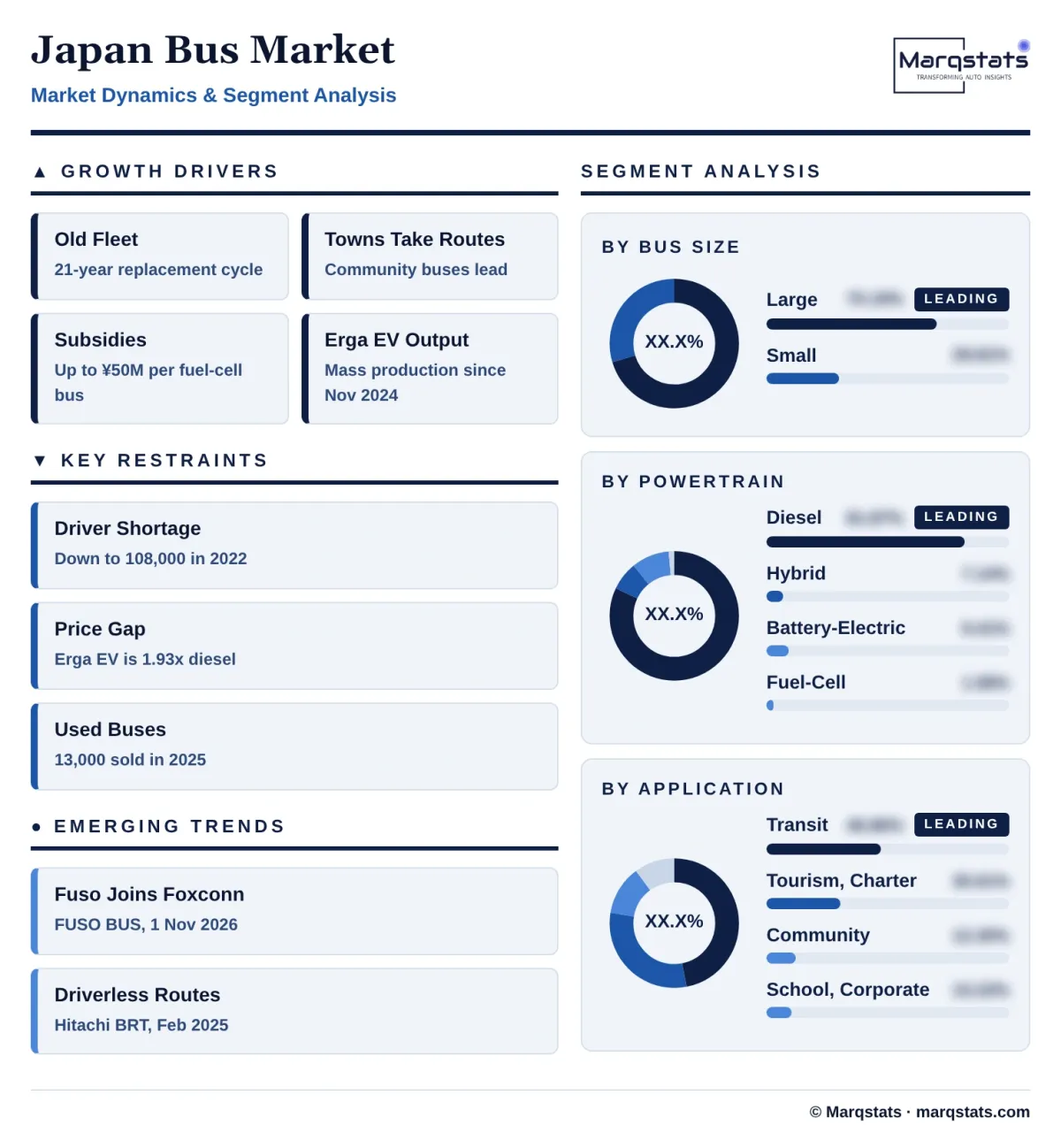
- An old fleet forces replacement. JAMA puts the fleet at about 208,000 buses with an average age of 17.96 years, and at the 9,906 registrations of 2025 it would take 21.0 years to replace every bus. Operators that defer purchases still run out of serviceable buses, which keeps the floor under registrations even when routes are cut.
- Municipalities take over withdrawn routes. With drivers down from about 133,000 in 2010 to about 108,000 in 2022, private operators drop routes they cannot staff, and towns fund small community buses and demand-responsive vehicles instead. Marqstats estimates that community and municipal buses grow at 6.26% a year, the fastest of any application.
- Subsidies narrow the electric price gap. The Ministry of the Environment programme for taxis and buses has an annual budget reported at about JPY 40 billion, and a subsidy of up to JPY 50 million applies to each fuel-cell bus. BYD Japan Co., Ltd. says it held about half of domestic electric bus sales in 2025, which shows how quickly subsidised buyers moved.
- Domestic electric buses now exist at scale. Isuzu Motors Limited began mass production of the Erga EV at the J-Bus Ltd. Utsunomiya plant in November 2024, and Keio Dentetsu Bus is moving from Chinese-made electric buses to domestic ones. Buyers that wanted a Japanese-built low-floor electric bus had no choice before 2024, and the choice now supports orders from Tokyo and Osaka operators.
- Registrations recovered in 2026. JADA counted 6,085 bus registrations in January to June 2026, up 8.02% from the same months of 2025, led by a strong April to June quarter, which indicates that replacement demand held through the driver shortage and that the 2025 dip was timing, not a lasting fall.
Key Restraints
Four constraints hold the market well below its earlier peak and slow the move to zero-emission buses.
- Driver shortages shrink the route network. The cap of 960 overtime hours a year for professional drivers took effect in April 2024, 87% of operators reported a shortage in fiscal 2023, and no bus or taxi driver had passed the Specified Skilled Worker test by the end of April 2025. Each cancelled route removes a replacement purchase, and the N4 easing decided by the Cabinet on 23 January 2026 will take years to add drivers.
- Electric buses cost far more than diesel. The Erga EV lists at JPY 59.8 million before tax, about 1.93 times the JPY 31.0 million Marqstats uses for a large diesel bus, and Toyo Keizai reported in September 2026 that subsidies are being cut. Operators with thin margins buy diesel or hybrid buses instead, which holds battery-electric buses to 10.00% of 2030 units.
- Used buses compete with new ones. JAMA reports about 13,000 used bus sales in 2025, up 16.5%, which is 1.31 times the 9,906 new registrations. Rural operators in particular buy depreciated buses from urban fleets instead of new chassis, which caps replacement demand outside Kanto and Kansai.
- Imported electric buses carry quality risk. MLIT ordered an inspection of more than 300 buses imported by EV Motors Japan Co., Ltd. in early September 2025, and the 40 on-demand units built for Osaka were suspended after repeated malfunctions. Earlier, the Hino Motors, Ltd. engine certification irregularities of 2022 delayed deliveries, so operators weigh reliability and parts supply as heavily as price.
Key Trends
Four shifts are changing who builds, who sells and how buses are driven in Japan.
- Domestic makers answer the import wave. Isuzu Motors Limited announced a cold-climate Erga EV with a pre-heater on 27 July 2026 for northern Japan, where heating drains batteries, and Keio Dentetsu Bus is switching from Chinese electric buses to the Erga EV. The domestic line-up now covers cold regions and suburban routes as well as city routes.
- Foreign brands settle in as members of the industry. BYD Japan Co., Ltd. announced membership of the Nihon Bus Association as a supporting member on 17 July 2026 and opened its sixth sales base, in Nagoya, after Sapporo, Yokohama, Kyoto, Osaka and Fukuoka, having passed 500 cumulative electric bus deliveries since its first Kyoto delivery in February 2015.
- Consolidation reshapes the supplier base. Hino Motors, Ltd. and Mitsubishi Fuso Truck and Bus Corporation came under ARCHION Inc. on 1 April 2026, and Mitsubishi Fuso and Hon Hai Technology Group announced the FUSO BUS joint venture on 26 October 2026. Isuzu and Hino still share J-Bus Ltd., so rivals now co-own a plant.
- Driverless buses move from trials to timetables. Eiheiji in Fukui gained the first Level 4 approval in May 2023, Iyotetsu Bus Group won Level 4 approval for a Matsuyama route in December 2024, and the Hitachi BRT began crew-on-board Level 4 service on 3 February 2025 after a permit of 18 December 2024.
Strategic Implications
- For bus makers, the home market rewards a full range rather than a single hit model. Large buyers want low-floor electric, hybrid and diesel buses from one supplier with one parts network, so ARCHION Inc., Isuzu Motors Limited and Toyota Motor Corporation should defend small and mid-size buses, where imports hold a smaller share, while they fund electric platforms for large buses.
- For foreign entrants, price alone does not win Japanese orders. BYD Japan Co., Ltd. earned its position with six sales bases, subsidy eligibility and an industry association seat, and an entrant that cannot offer parts within days and a full domestic type approval will face the inspection risk that followed the EV Motors Japan Co., Ltd. buses.
- For operators, the cheapest way to meet a driver shortage may be a smaller bus. A route that runs below capacity with a full-size bus can move to a 29-seat vehicle at about a quarter of the price per unit, and subsidy applications that combine electric buses with disaster-power use lower the net cost.
- For municipalities and lenders, community buses are the growth segment and also the most fragile buyers. Towns depend on national funding, so lessors and lenders that finance vehicles over eight to ten years can win business that manufacturers cannot reach directly.
- For suppliers of parts and service, the long life of Japanese buses and the weight of used-bus trade mean steady aftermarket demand for brakes, axles and rebuilt engines, plus new demand for high-voltage battery technicians at regional depots.
Market Segmentation
Large buses account for 70.19% of 2025 value, USD 845.59 million, and grow at 4.01% a year to USD 1,029.47 million. Marqstats estimates 3,790 units in 2025, rising to 4,200, led by the Isuzu Erga, Hino Blue Ribbon, Mitsubishi Fuso Aero Star and Aero Queen and Isuzu Gala, and bought by city transit bureaus, regional railway bus arms and touring companies.
Small buses of 11 to 29 seats account for 29.81% of 2025 value, USD 359.13 million, and grow at 3.94% a year to USD 435.70 million. Marqstats estimates 6,116 units in 2025, rising to 6,400, which is 61.74% of units but only 29.81% of value because a Toyota Coaster or Mitsubishi Fuso Rosa costs about a quarter as much as a large route bus.
Diesel and other combustion buses account for 81.87% of 2025 value, USD 986.27 million, and grow slowly, at 1.51% a year, to USD 1,063.22 million, while their share of value falls to 72.57%. They make up 91.42% of 2025 units and still 82.35% in 2030, because highway coaches, small buses and rural fleets lack the range, charging access or budget for electric buses.
Hybrid buses account for 7.14% of 2025 value, USD 86.03 million, and grow at 10.38% a year to USD 140.98 million. Marqstats estimates 420 units in 2025 and 750 in 2030, mostly Hino and Mitsubishi Fuso route buses that cut fuel use without charging infrastructure and suit operators that cannot yet buy electric.
Battery-electric buses account for 9.41% of 2025 value, USD 113.37 million, and grow fastest, at 14.68% a year, to USD 224.87 million and 15.35% of the market. Marqstats estimates 400 units in 2025, including the 150 shuttles ordered by Osaka Metro for Expo 2025, and 1,060 in 2030 as the Erga EV, the BYD K8 and J6 and Fuso electric models reach more depots.
Fuel-cell buses account for 1.58% of 2025 value, USD 19.05 million, and grow at 13.64% a year to USD 36.10 million. Marqstats estimates 30 units in 2025 and 60 in 2030, almost all Toyota Sora buses for Tokyo, where 135 fuel-cell buses were running at the end of fiscal 2024 and Tokyo targets about 300 by fiscal 2030.
Route and intercity transit accounts for 46.86% of 2025 value, USD 564.49 million, and grows at 4.15% a year to USD 691.82 million. It covers city bus bureaus such as the Tokyo Metropolitan Bureau of Transportation, private railway bus arms such as Keio Dentetsu Bus and Nankai Rinkan Bus, and highway express operators, and it holds most large electric buses.
Tourism and charter accounts for 30.61% of 2025 value, USD 368.81 million, and grows at 4.34% a year to USD 456.17 million. High-deck touring coaches cost the most per seat, so a unit share of 23.00% turns into a value share of 30.61%, and charter operators buy from cash flow, which ties orders to sightseeing demand.
Community and municipal use accounts for 12.30% of 2025 value, USD 148.17 million, and grows fastest among applications, at 6.26% a year, to USD 200.71 million. Towns buy small buses and demand-responsive vehicles to replace withdrawn private routes, and the application's share of units rises from 21.00% to 23.50%.
School, corporate and hotel shuttles account for 10.23% of 2025 value, USD 123.25 million, and fall at 1.13% a year to USD 116.47 million. Fewer pupils, remote work and the move of shuttle routes to public contracts cut private purchases, and the unit share falls from 16.01% to 12.50%.
By Geography
Kanto
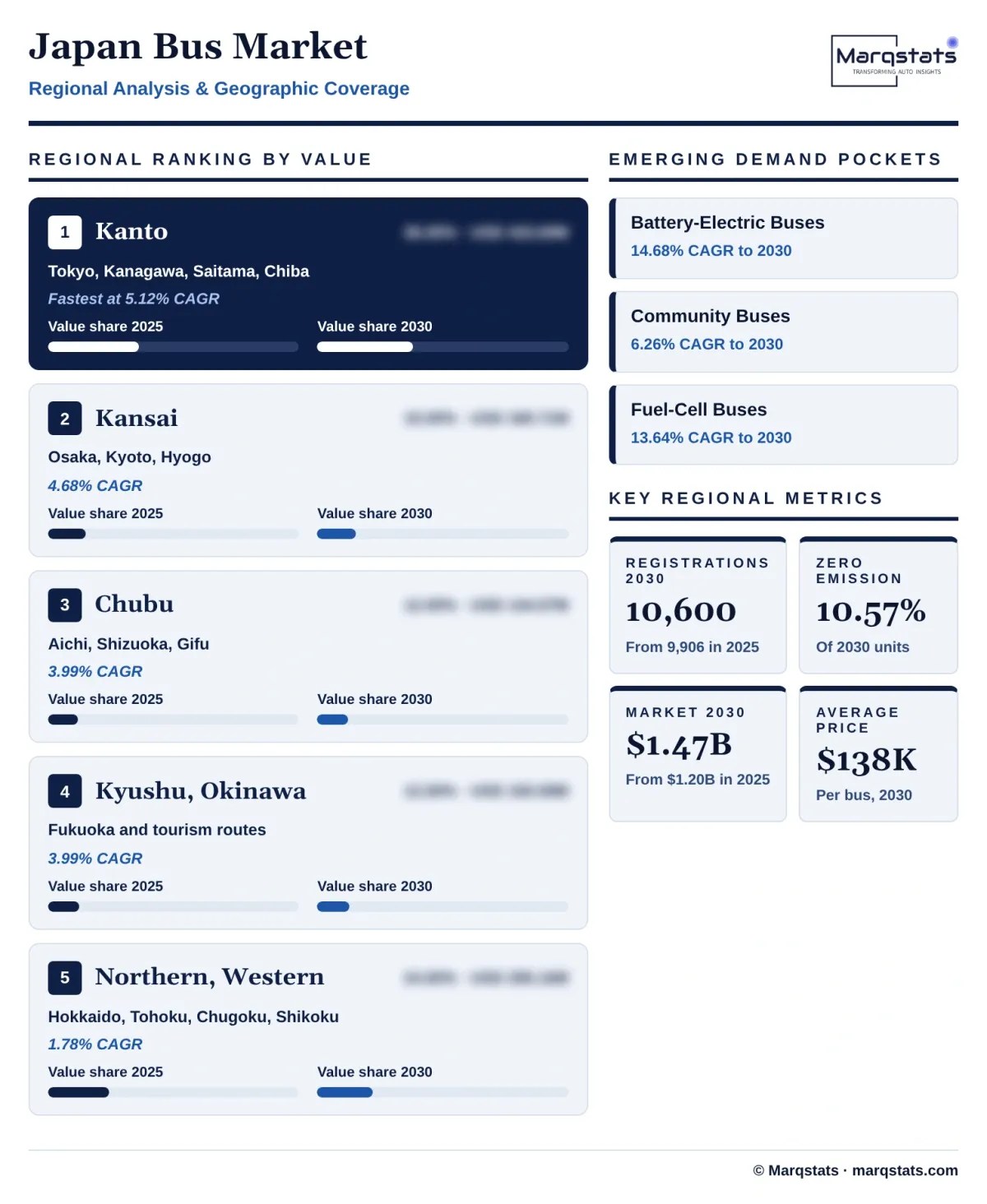
Kanto accounts for 36.00% of 2025 value, USD 433.69 million, and grows fastest, at 5.12% a year, to USD 556.76 million and 38.00% by 2030. Tokyo, Kanagawa, Saitama and Chiba hold the largest route networks, the Tokyo Metropolitan Bureau of Transportation put Erga EV buses into service in 2025, and Tokyo runs the largest fuel-cell bus fleet, so electric and hydrogen buses concentrate here.
Kansai
Kansai accounts for 15.00% of 2025 value, USD 180.71 million, and grows at 4.68% a year to USD 227.10 million. Osaka Metro ordered 150 electric shuttles for Expo 2025, Hankyu Bus took delivery of Erga EV buses, and Nankai Rinkan Bus runs six BYD K8 buses on the Koyasan route, so the region mixes domestic and imported electric buses.
Chubu
Chubu accounts for 12.00% of 2025 value, USD 144.57 million, and grows at 3.99% a year to USD 175.82 million. BYD Japan Co., Ltd. opened its Nagoya sales base to serve the region, Enshu Railway in Shizuoka runs K8 buses, and manufacturing towns in Aichi and Shizuoka buy commuter and shuttle buses.
Kyushu and Okinawa
Kyushu and Okinawa account for 12.50% of 2025 value, USD 150.59 million, and grow at 3.99% a year to USD 183.15 million. BYD Japan Co., Ltd. has a base in Fukuoka, and tourism to Okinawa and Kyushu supports charter purchases.
Hokkaido, Tohoku, Chugoku and Shikoku
Hokkaido, Tohoku, Chugoku and Shikoku account for 24.50% of 2025 value, USD 295.16 million, and grow slowest, at 1.78% a year, to USD 322.34 million. Rural depopulation, long vehicle lives and winter heating loads hold back new purchases, although Iyotetsu Bus Group in Matsuyama runs Level 4 services and Isuzu's cold-climate Erga EV targets this region.
How Competition Is Evolving
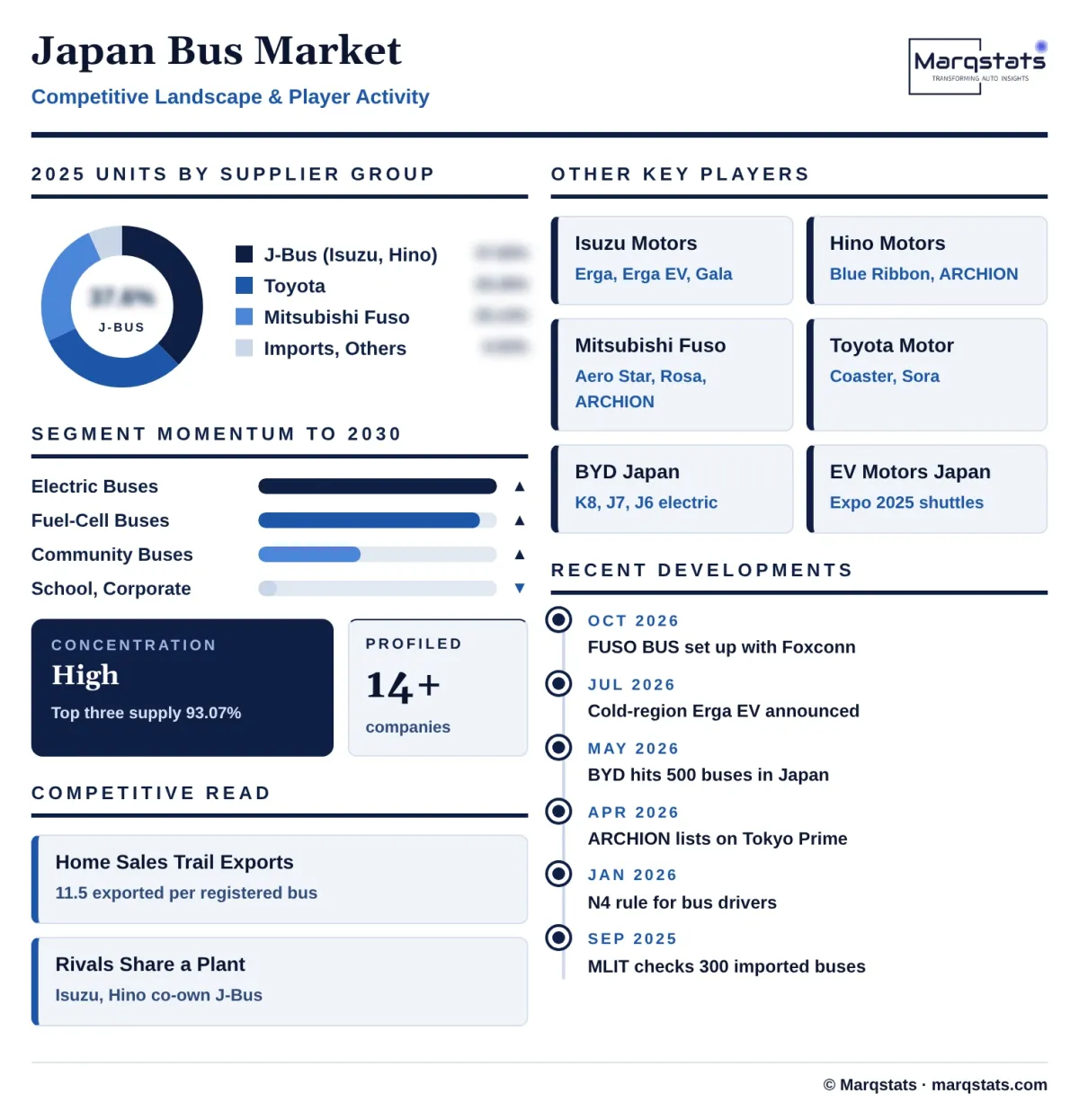
The market is highly concentrated in supply and open in electric. Marqstats estimates that J-Bus Ltd. products from Isuzu and Hino delivered about 37.65% of 2025 units, Toyota Motor Corporation about 30.28%, Mitsubishi Fuso Truck and Bus Corporation about 25.14% and imports and others about 6.93%, so the top three supplied 93.07%. The estimates rest on the Coaster being the volume leader in small buses and J-Bus Ltd. being the domestic builder of large route and touring buses.
Hino and Fuso now sit under one holding company. ARCHION Inc. became their parent on 1 April 2026, listed on the Tokyo Stock Exchange Prime Market under code 543A, with Toyota Motor Corporation and Daimler Truck AG each targeting 25% and Karl Deppen as chief executive. The Japan Fair Trade Commission cleared the deal on 26 February 2026 subject to conditions, and the first shared products announced on 26 August 2026 were medium-duty trucks, not buses.
Isuzu and Hino co-own the large-bus plant. J-Bus Ltd. builds route buses at Utsunomiya, and Isuzu markets the Erga EV there while Hino sells the same bus as the Blue Ribbon Z EV, so competition on price happens between owners of the same factory. Isuzu also owns UD Trucks Corporation, which it acquired in 2021.
Imports compete in electric and in niche products, and the pressure is on price and service. BYD Japan Co., Ltd. has delivered more than 500 electric buses since 2015 with the J6, J7 and K8, EV Motors Japan Co., Ltd. supplied 150 shuttles for Expo 2025 but faced a MLIT inspection of more than 300 imported buses in September 2025, and Mitsubishi Fuso and Hon Hai Technology Group formed FUSO BUS to build electric and diesel buses at Toyama with Japan-specific vehicles from 2027.
Companies Covered
Companies covered in the report include:
Recent Market Activity
Table of Contents
Coverage & Segmentation
The study covers the Japan bus market, with 2025 as the base year, 2021 – 2025 as the historical period and 2026 – 2030 as the forecast period. It covers new buses with 11 or more seats registered in Japan, segmented by bus size, powertrain, application and region. Values are wholesale values in US dollars, excluding consumption tax and before subsidies, and yen figures use the 2025 average of JPY 149.6 per US dollar.
Trucks, kei vehicles, passenger vans with fewer than 11 seats, used buses, bus exports, bus bodies sold separately and trolley systems are excluded, and bus production of about 119,000 units is a reconciliation point that is never added to the domestic total. Segment and regional splits are Marqstats estimates built on registration series, list prices and operator disclosures. The live Marqstats report on Japan hydrogen fuel cell trucks and buses is a related study whose figures should not be added to this market.
