Market Snapshot
The Spain passenger car market size is estimated at USD 37,704.06 million in 2025 and is projected to reach USD 47,704.34 million by 2030, growing at a CAGR of 4.82% over 2026 – 2030. Registrations of new cars rise from 1,148,650 to 1,338,000 units, a 3.10% annual rate, while the average value per car climbs from about USD 32,825 to USD 35,653 as plug-in and electric cars take a larger share.
Marqstats defines the market as the retail value of new passenger cars of category M1, including four-wheel-drive cars, registered for the first time in Spain, whether bought by private individuals, companies and renting providers or rental fleets. Value is counted at the consumer transaction price including value added tax and registration tax, net of dealer discounts and before government purchase incentives, converted at EUR 1 = USD 1.13. Light commercial vehicles, trucks, buses, motorcycles and used cars are excluded.
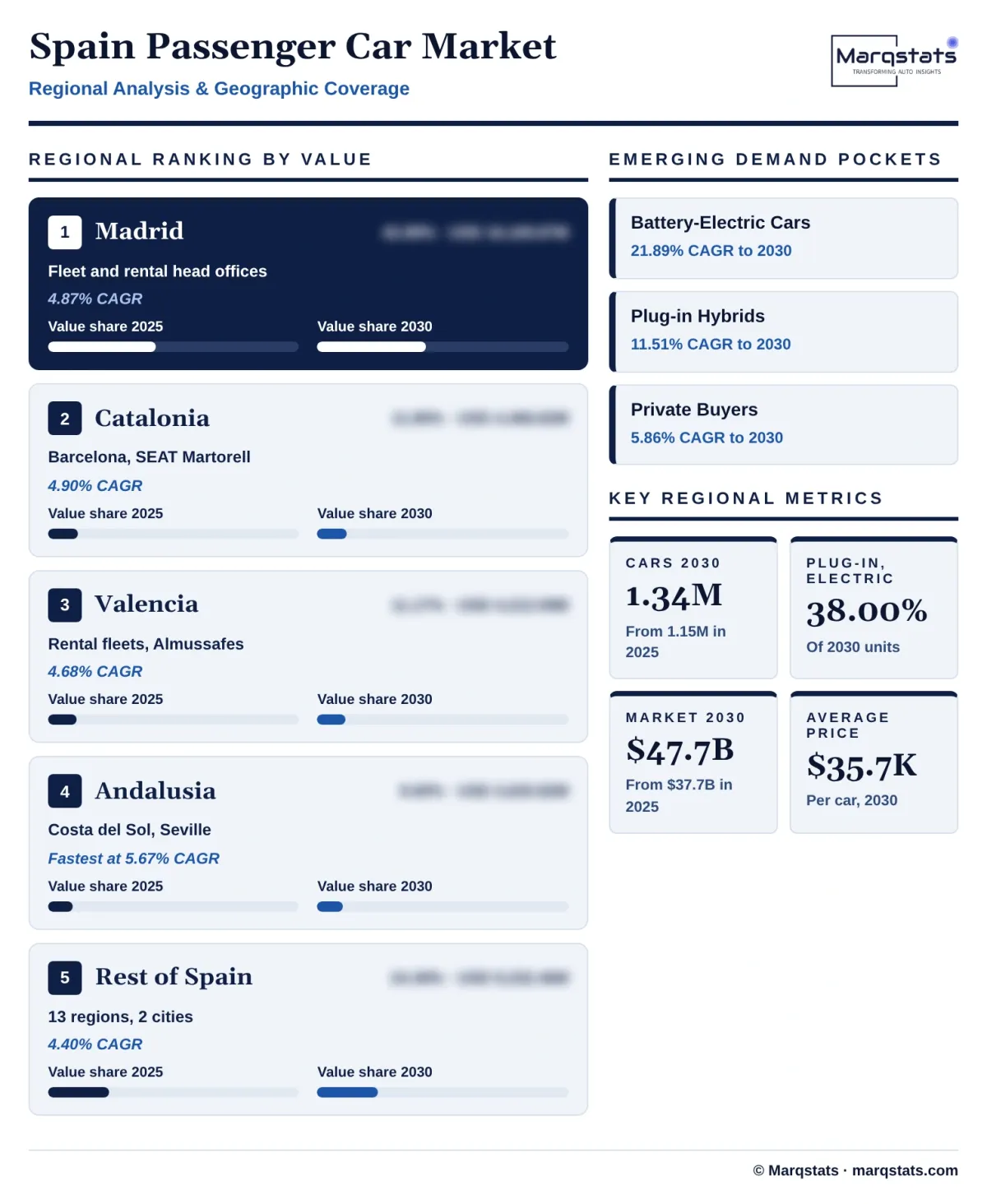
Hybrid cars of the HEV and MHEV types account for 42.61% of 2025 value, private buyers for 47.68% and the Community of Madrid for 42.89%. Battery-electric cars grow fastest, at 21.89% a year, and lift plug-in and electric cars from 19.64% of units in 2025 to 38.00% in 2030.
Key Takeaways
Market Overview & Analysis
Report Summary
Marqstats sizes the Spain passenger car market as the retail value of new category M1 cars registered for the first time in the country each year. It counts petrol, diesel, non-plug-in hybrid, liquefied petroleum gas and compressed natural gas, plug-in hybrid and battery-electric cars sold to private buyers, companies and renting providers and rental fleets. The count follows the passenger car and four-wheel-drive series published by the Spanish Association of Automobile and Truck Manufacturers (ANFAC), the Spanish Association of Car and Truck Dealers (Faconauto) and the Spanish National Association of Vehicle Sales and Repair Services (Ganvam).
Spain is a recovering market inside a manufacturing country. Registrations reached 1,148,650 cars in 2025, up 12.9%, the fifth year in a row above one million and still below the 2019 level of about 1.259 million. The country built 1,810,331 passenger cars in 2025, 5.7% fewer than in 2024, and exported 85.8% of all vehicle output, so domestic demand is the part of the car business that grew while the export side contracted by 8.2% to 1,950,103 vehicles.
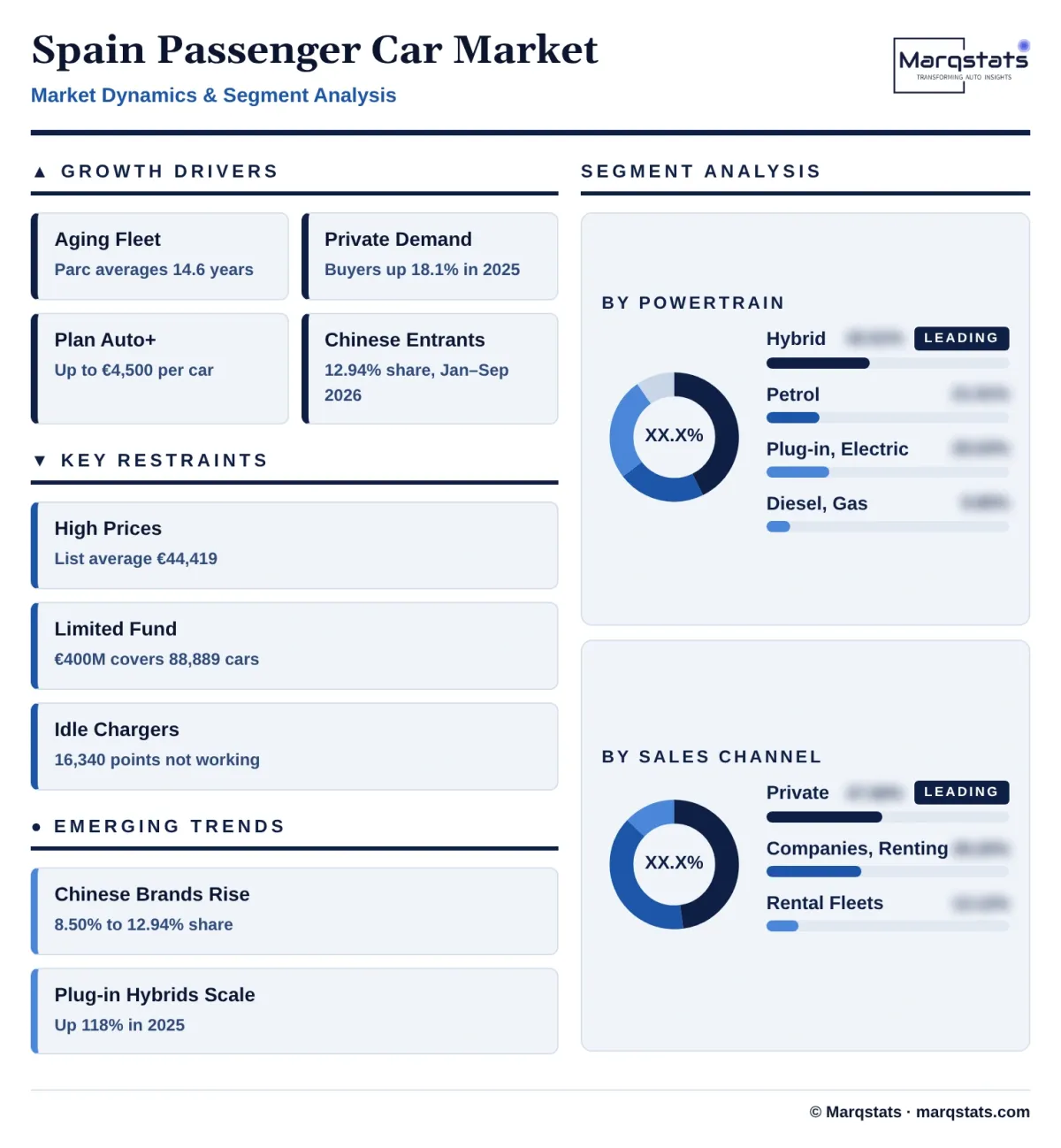
Demand is held up by an old fleet. The Instituto de Estudios de Automoción put the average age of the vehicle parc at 14.6 years in 2025, against 12.7 years in 2019, and about 62% of vehicles on the road are older than ten years. Prices work against replacement: the average list price of a new car on the coches.com platform reached EUR 44,419 in 2025, up 5.6% on 2024 and 45.6% above 2019, according to the Ganvam and coches.com barometer. Marqstats sizes the market on transaction values instead, which are lower because registrations are dominated by compact models.
The powertrain mix changed fast in 2025. ANFAC counted 225,617 battery-electric and plug-in hybrid cars, up 94.6% and equal to 19.6% of registrations, against 11.4% in 2024, and battery-electric cars passed 100,000 units for the first time. Non-plug-in hybrids still outsell them by a factor of about 2.1, while petrol cars fell to 27.7% of registrations and diesel to 5.5%.
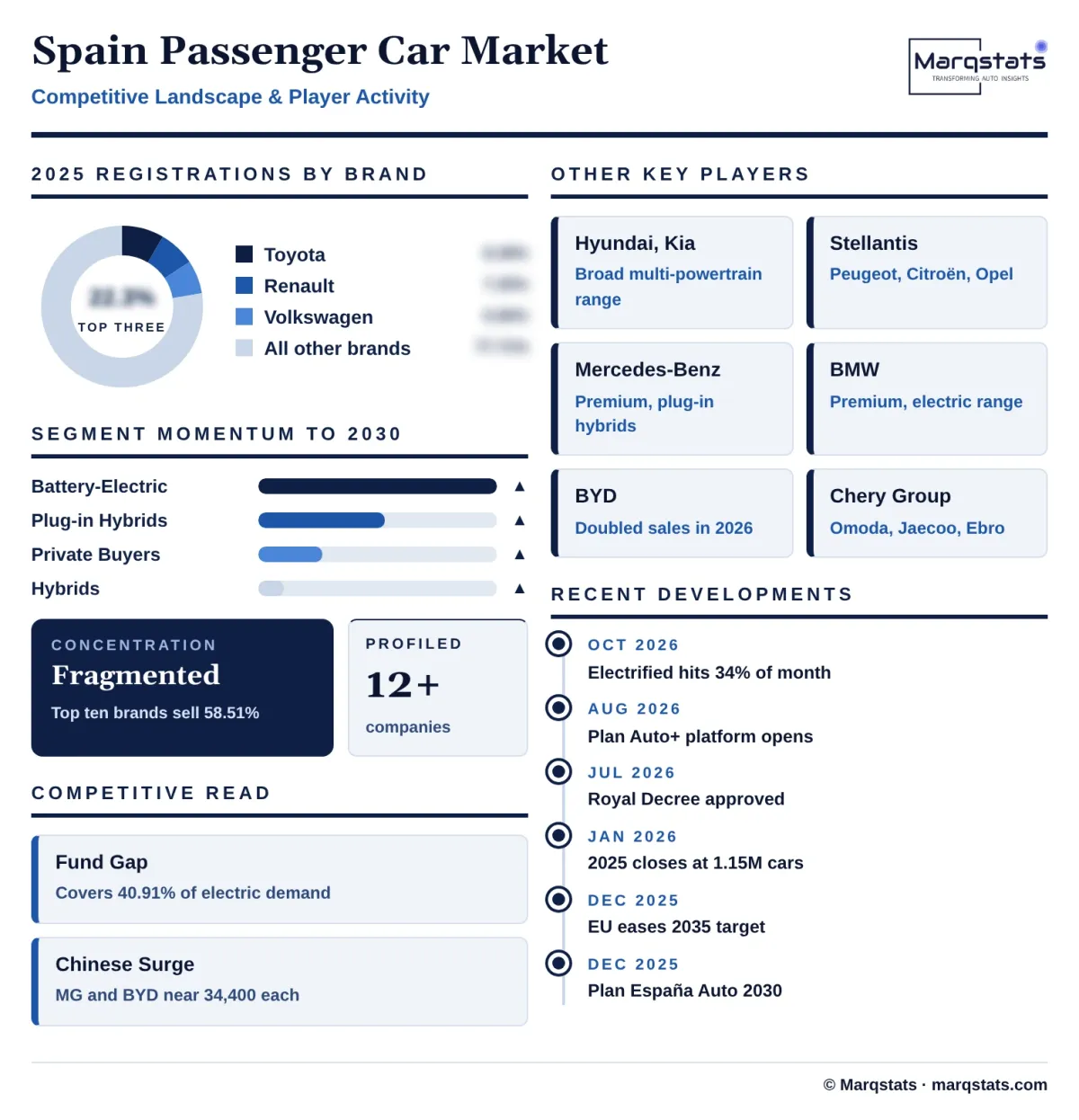
Policy moved from the old MOVES programme to Plan Auto+. The government presented the Plan España Auto 2030 on 3 December 2025, and the Council of Ministers approved the Royal Decree for Plan Auto+ on 22 July 2026, retroactive to 1 January 2026. Electrified cars rose to 34% of September 2026 registrations, up from 21% at the start of the year, after the application platform opened in late August.
Spain Passenger Car Market Size and Forecast
The Spain passenger car market grows from USD 37,704.06 million in 2025 to USD 47,704.34 million in 2030, a CAGR of 4.82%. Registrations rise at 3.10% a year, from 1,148,650 to 1,338,000 cars, and the average value per car rises at 1.67% a year, from about USD 32,825 to USD 35,653, because plug-in hybrids and battery-electric cars replace cheaper petrol cars.
The 2025 value is built bottom-up from registrations and prices. Marqstats starts from ANFAC registrations of 1,148,650 cars and splits them by powertrain: 317,782 petrol, 63,097 diesel, 482,000 hybrid, 60,154 liquefied petroleum gas and compressed natural gas, 124,190 plug-in hybrid and 101,427 battery-electric cars. Prices are Marqstats estimates of consumer transaction prices including value added tax and registration tax: about EUR 23,000 for a petrol car, EUR 33,500 for diesel, EUR 29,500 for a hybrid, EUR 19,500 for a gas car, EUR 41,500 for a plug-in hybrid and EUR 33,500 for a battery-electric car. The result is EUR 33.37 billion, or USD 37,704.06 million at EUR 1 = USD 1.13.
The base is checked against published prices and registrations. The Ganvam and coches.com barometer lists an average price of EUR 39,288 for petrol, EUR 37,375 for full hybrid, EUR 47,413 for battery-electric and EUR 55,469 for plug-in hybrid cars in 2025, which are dealer catalogue averages across every trim and include premium models. Registrations are weighted toward the Dacia Sandero at 38,548 units, the Renault Clio at 27,104 and the MG ZS at 23,731, so Marqstats transaction prices sit below catalogue averages, with a 2025 average of about EUR 29,048 per car.
Registrations rise more slowly than value. Marqstats estimates 1,229,000 cars in 2026, up 7.00%, built from 912,059 registrations in January – September 2026, up 6.7%, and a fourth quarter about 8% above the roughly 293,900 cars of the fourth quarter of 2025, which Marqstats derives from ANFAC nine-month and full-year totals, as the Plan Auto+ platform clears its backlog. Growth then slows to 1,338,000 cars in 2030 as the fleet renewal effect fades and the aid fund is spent. ANFAC expects 2026 to exceed 1.2 million cars, Faconauto expects close to 1.25 million, and the 2019 level of 1.259 million is regained in 2027 on this path.
Plug-in and electric cars add value faster than volume. Marqstats expects battery-electric registrations to rise from 101,427 in 2025 to 294,360 in 2030 and plug-in hybrids from 124,190 to 214,080, so their combined share of units grows from 19.64% to 38.00% and their share of value from 25.63% to 42.70%. Battery-electric prices fall about 1.5% a year as models below EUR 25,000 arrive, which holds back the value effect.
Marqstats tracks four indicators to monitor the forecast: monthly ANFAC registrations by powertrain and channel, the remaining balance of the Plan Auto+ fund and any successor scheme, the average CO2 emissions of new cars, which were 103 grams per kilometre in 2025, and the share of Chinese-owned brands in registrations.
Market Dynamics
Key Drivers
Five forces are lifting new car registrations in Spain after the 2025 recovery.
- An old fleet forces replacement. The average age of the Spanish parc rose to 14.6 years in 2025 from 12.7 years in 2019, and ANFAC warned that the average would exceed 15 years. With about 62% of vehicles older than ten years, the pool of cars due for replacement is far larger than the 1,148,650 registrations of 2025.
- Private demand has recovered. Private buyers registered 539,642 cars in 2025, up 18.1%, and companies registered 418,574, up 12.0%. In September 2026 private registrations rose 13.5% to 51,713 and company registrations 8.4% to 39,509, so the recovery is led by households and not only by fleets.
- Plan Auto+ lowers the price of a plug. The Royal Decree approved on 22 July 2026 allocates EUR 400 million, up to EUR 4,500 per passenger car and up to EUR 6,000 for self-employed workers and small companies, retroactive to 1 January 2026, and electrified cars climbed from 21% of registrations at the start of the year to 34% in September 2026.
- The DGT environmental label rewards electrified cars. The Dirección General de Tráfico gives the ECO label to non-plug-in hybrids and gas cars and the CERO label to battery-electric cars and plug-in hybrids with at least 40 kilometres of electric range, and low emission zones, required in municipalities of more than 50,000 inhabitants, offer them access and parking advantages.
- New brands cut the entry price. Chinese brands reached 12.94% of registrations in January – September 2026, up from 8.50% a year earlier, led by MG and BYD Company Limited at about 34,400 cars each, and the government expects a wave of electric models below EUR 25,000, which widens the range of cars a private buyer can afford.
Key Restraints
Five constraints keep volumes below the 2019 level and slow the shift to plug-in cars.
- New cars are expensive. The average dealer list price reached EUR 44,419 in 2025, 5.6% higher than in 2024 and 45.6% higher than before the pandemic, and Spain registers about 1.9 used cars for every new car, so many households buy a car that is already on the road.
- The incentive fund is limited. Plan Auto+ holds EUR 400 million, enough for 88,889 cars at the maximum rate of EUR 4,500, against 217,298 electrified cars registered in the first nine months of 2026, and the sector expected the money to run out in September or October while the government expected it to last until year end.
- Charging is uneven. ANFAC counted 53,072 public charging points at the end of 2025, up 37%, but 16,340 installed points were not operational, about 70% of public points deliver 22 kilowatts or less, and only 5,151 points offer 150 kilowatts or more.
- Rental fleets are volatile. Rental companies registered 190,434 cars in 2025, up 2.3%, but their September 2026 registrations fell 16.6% to 2,636, and in June 2026 they bought 30,844 cars, 24.02% of that month, against 2.81% in September, so rental buying follows tourism timing.
- European rules are softening. On 17 December 2025 the European Commission proposed to relax the 2035 target for new car CO2 from 100% to 90% and to allow banking and borrowing of credits between 2030 and 2032, which lowers the pressure on car makers to push plug-in cars in Spain after 2027.
Key Trends
Four shifts are changing which cars Spanish buyers choose and who sells them.
- Chinese brands move from niche to mainstream. The MG ZS was the third best-selling model in Spain in 2025 with 23,731 units, and Chinese-owned brands, including Ebro, partly owned by Chery Automobile Co., Ltd., held 16.8% of registrations in January – September 2026 on the widest definition, up 65.5% year on year.
- Plug-in hybrids scale with the hybrid habit. Buyers who chose ECO-label hybrids now step up to plug-in hybrids that qualify for the CERO label, and plug-in hybrid registrations rose about 118% in 2025 across all vehicle types.
- Central aid replaces regional grants. Plan Auto+ is managed by the central government, not the regions, and rewards final assembly in the European Union, with an extra share of the aid for batteries made in the European Union, which favours cars built in Spain.
- Spanish plants shift to small electric cars. The SEAT and Volkswagen plants in Martorell and Navarra plan 148,700 electric vehicles in 2026 and 400,000 in 2027, and the European Commission proposed a new M1E category for small electric cars up to 4.2 metres long.
Strategic Implications
- For car makers, the 2026 gain in electrified share is partly aid-driven, so launch plans should hold the retail price of battery-electric cars below the EUR 35,000 threshold that earns the larger aid weighting, and treat 2027 as a test of demand without the fund.
- For importers and Chinese entrants, the opening is the EUR 18,000 to EUR 30,000 range where hybrids and plug-in hybrids from MG, BYD and Chery brands compete with Toyota and Renault, and the registered-in-Madrid effect means dealer and renting partnerships matter as much as showrooms.
- For dealers and renting providers, private demand is growing faster than fleet demand, so stock mix should tilt toward ECO-label hybrids for households and toward battery-electric cars for companies with a 10-vehicle aid ceiling.
- For suppliers and charging investors, the ANFAC barometer shows 16,340 installed but idle points, so the return is in switching on existing points and adding 150 kilowatt stations on intercity corridors, not in counting new sockets.
- For lenders and investors, the Plan Auto+ coverage gap is the main swing in the forecast. A successor scheme would lift the 2027 electrified share above the Marqstats path, while an unfunded 2027 would hold it close to the 2026 level.
Market Segmentation
Petrol cars account for 21.91% of 2025 value, USD 8,259.15 million, and shrink at 7.41% a year to USD 5,619.32 million and 11.78% of the market. Petrol was 27.7% of registrations in 2025, about 317,782 cars, led by compact models such as the Dacia Sandero, Renault Clio, SEAT Ibiza and SEAT Arona.
Diesel cars account for 6.33% of 2025 value, USD 2,388.54 million, and are flat at 0.06% a year to USD 2,395.51 million. Diesel fell to 5.5% of registrations in 2025, about 63,097 cars, and the high average price of about EUR 33,500 reflects large sport utility vehicles and premium models that keep the segment in value terms.
Non-plug-in and mild hybrid cars lead with 42.61% of 2025 value, USD 16,067.47 million, and grow at 2.35% a year to USD 18,047.80 million. Marqstats estimates about 482,000 cars in 2025 (41.96% of units), carried by Toyota Motor Corporation, Hyundai Motor Group and Renault Group models with the ECO label, with growth slowing as plug-in cars take the next buyer.
Cars running on liquefied petroleum gas or compressed natural gas account for 3.52% of 2025 value, USD 1,325.49 million, and edge down at 0.84% a year to USD 1,270.46 million. About 60,154 cars were registered, mostly bi-fuel Dacia and Renault models at the lowest average price of about EUR 19,500, and the segment holds the ECO label.
Plug-in hybrids account for 15.45% of 2025 value, USD 5,823.89 million, and grow at 11.51% a year to USD 10,039.28 million and 21.04% of the market. Marqstats derives 124,190 passenger car units in 2025 from the ANFAC electrified total of 225,617 less 101,427 battery-electric cars, and expects 214,080 units in 2030 as Chinese brands and premium makers widen the offer.
Battery-electric cars account for 10.18% of 2025 value, USD 3,839.52 million, and grow fastest, at 21.89% a year, to USD 10,331.97 million and 21.66% of the market. Units rise from 101,427 to 294,360 as Plan Auto+, cheaper models and car CO2 targets lift sales, even though catalogue prices already fell 4.6% in 2025.
Private buyers account for 47.68% of 2025 value, USD 17,976.19 million, and grow at 5.86% a year to USD 23,893.20 million and 50.08% of the market. They registered 539,642 cars in 2025, 46.98% of units, up 18.1%, and respond most to Plan Auto+, which in September 2026 accounted for 65% of electrified sales according to Faconauto.
Companies, self-employed buyers and renting providers account for 39.20% of 2025 value, USD 14,779.85 million, and grow at 4.21% a year to USD 18,163.66 million. They registered 418,574 cars in 2025, 36.44% of units, up 12.0%, and Marqstats assumes a price about 6% above the private average because company cars skew toward larger and electrified models.
Rental companies account for 13.12% of 2025 value, USD 4,948.02 million, and grow slowest, at 2.68% a year, to USD 5,647.48 million. They registered 190,434 cars in 2025, 16.58% of units, up 2.3%, buy compact petrol and hybrid cars at fleet discounts that Marqstats puts about 22% below the private average price, and concentrate purchases before the summer tourist season.
By Geography
Community of Madrid
The Community of Madrid accounts for 42.89% of 2025 value, USD 16,169.87 million, and grows at 4.87% a year to USD 20,512.87 million and 43.00% by 2030. It recorded 492,613 registrations in 2025, and 400,524 in January – September 2026, 43.9% of the total, because fleet, renting and rental companies register vehicles at their head offices. Madrid is therefore a measure of corporate purchasing, and Marqstats allocates value by registration, as ANFAC and the tax agency report it.
Catalonia
Catalonia accounts for 11.85% of 2025 value, USD 4,468.82 million, and grows at 4.90% a year to USD 5,676.82 million. It recorded 136,142 registrations in 2025 and 107,658 in January – September 2026, up 9.8%, and the SEAT plant at Martorell, the Barcelona low emission zone and a dense private market support steady demand for electrified cars.
Valencian Community
The Valencian Community accounts for 11.17% of 2025 value, USD 4,212.09 million, and grows at 4.68% a year to USD 5,295.18 million. It recorded 128,321 registrations in 2025, helped by Mediterranean rental fleets and by replacement of vehicles damaged in the October 2024 floods, and it is the home of the Ford Almussafes plant.
Andalusia
Andalusia accounts for 9.60% of 2025 value, USD 3,620.82 million, and grows fastest among the named regions, at 5.67% a year, to USD 4,770.43 million. It recorded 110,308 registrations in 2025, and its registrations rose 14.4% to 90,558 in January – September 2026 as private buyers and tourism fleets in the Costa del Sol and Seville renewed cars.
Rest of Spain
The other thirteen autonomous communities and the two autonomous cities account for 24.49% of 2025 value, USD 9,232.46 million, and grow at 4.40% a year to USD 11,449.04 million. The Canary Islands, with 54,608 registrations in 2025, Galicia, the Basque Country and the Balearic Islands lead this group, and an older parc keeps replacement demand steady in rural areas.
How Competition Is Evolving
The market is fragmented, with no brand above 8.38% of registrations. Toyota led in 2025 with 96,290 cars, followed by Renault with 83,308, Volkswagen with 76,545, Hyundai with 68,568 and SEAT with 66,142. The top three brands account for 22.30% of registrations and the top ten, including Dacia, Kia, Peugeot, Mercedes-Benz and BMW, for 58.51%.
Value brands and hybrid specialists share the volume. Renault Group sold 149,096 cars across the Renault and Dacia brands, 12.98% of the market, and the Dacia Sandero, at 38,548 units, was the best-selling model. Hyundai Motor Group sold 130,276 cars across Hyundai and Kia, 11.34%, with the Hyundai Tucson at 21,974 units, while Toyota sold hybrids, with the Corolla at 20,833 units.
Chinese brands are the main challenger. MG, a brand of SAIC Motor Corporation Limited, placed the ZS third overall with 23,731 units in 2025. In January – September 2026 MG registered about 34,400 cars, down 2.5%, BYD Company Limited about 34,400, roughly double the year before, Ebro 20,088, about triple, and Leapmotor 6,133, so Chinese brands took 12.94% of registrations on one definition and 16.8% on a wider definition that counts all brands with Chinese ownership.
Competition is shifting from list price to access to incentives. Plan Auto+ rewards final assembly and batteries made in the European Union, which favours Stellantis, the Volkswagen Group and Renault Group cars built in Spain or nearby, while importers of cars built in China compete on price and equipment and on dealer networks that can handle the application platform opened in late August 2026.
Companies Covered
Companies covered in the report include:
Recent Market Activity
Table of Contents
Coverage & Segmentation
The study covers the Spain passenger car market, with 2025 as the base year, 2021 – 2025 as the historical period and 2026 – 2030 as the forecast period. It covers new category M1 passenger cars, including four-wheel-drive cars, registered for the first time in Spain, segmented by powertrain, sales channel and region. Values are consumer transaction values including value added tax and registration tax, net of dealer discounts and before government incentives, converted at the 2025 average rate of EUR 1 = USD 1.13.
Light commercial vehicles of 185,056 units, industrial vehicles of 30,989 units, buses and coaches of 4,400 units, motorcycles and used cars are excluded, so passenger cars are 83.90% of the four registered vehicle categories. Segment and regional splits are Marqstats estimates built on ANFAC registrations, price benchmarks and registration records. Live Marqstats reports on the Spain plug-in hybrid electric vehicle, Spain used car and Spain connected car markets overlap this market and their figures should not be added to it. The plug-in hybrid report counts 130,567 plug-in hybrids, which matches the ANFAC count across all vehicle categories, while this analysis counts 124,190 passenger cars.