Market Snapshot
The Kenya passenger car market size is estimated at USD 1,631.66 million in 2025 and is projected to reach USD 2,181.35 million by 2030, growing at a CAGR of 5.98% over 2026 – 2030. Registrations rise from about 91,300 to 106,000 cars a year, a 3.03% annual rate.
Marqstats defines the market as the retail transaction value of saloon cars and station wagons, including hatchbacks, estates, multi-purpose vehicles, crossovers and sport utility vehicles, registered for the first time in Kenya each year. It counts used cars imported under the eight-year rule and new cars sold by franchise dealers, valued at the price the buyer pays including import duty, excise duty, value added tax and dealer margin. Pickups, vans, trucks, buses, minibuses, matatus, motorcycles and three-wheelers are excluded.
SUVs and crossovers account for 60.22% of 2025 value, petrol cars for 82.20% and private households for 71.76%. Used and other imports supply 98.91% of registered cars, and new cars sold by franchise dealers supply only 1.09%. The Nairobi Metropolitan Region accounts for 60.00% of value, and the Rift Valley grows fastest, at 6.85% a year.
Key Takeaways
Market Overview & Analysis
Report Summary
Marqstats sizes the Kenya passenger car market as the retail transaction value of saloon cars and station wagons registered for the first time each year. The National Transport and Safety Authority (NTSA) and the Kenya National Bureau of Statistics (KNBS) record two body types for passenger cars. Saloon cars are three-box sedans. Station wagons are a wide class that covers estates, multi-purpose vehicles, five-door hatchbacks, crossovers and sport utility vehicles, so the statistical convention differs from the way manufacturers classify the same cars. Pickups, panel vans, lorries, buses, minibuses and matatus are separate commercial categories, and dual-cab pickups that carry families are excluded.
The market is an import market. Japan supplies about 80% of the vehicles Kenya imports, according to The Star in December 2025, with the United Arab Emirates, the United Kingdom, Thailand, Singapore and South Africa making up the rest. KNBS recorded imports of 72,482 vehicles in 2024 against 70,275 in 2023, and customs value of passenger motor vehicles of KES 75,212 million in 2025, up 18.85% from KES 63,283 million in 2024, which is about USD 581.64 million at the 2025 average rate of KES 129.31 per US dollar. Marqstats counts the value at the retail price, which it estimates at 2.81 times the customs value once duties, taxes, logistics and dealer margins are added.
Registration data show how small the new-car channel is. KMIA franchise dealers sold 13,583 new vehicles in 2025, up 19.65% from 11,352 in 2024. Trucks accounted for 5,496, pickups for 3,242, buses for 2,675, heavy-duty trucks for 963, station wagons for 963 and saloon cars for 31. Passenger cars therefore made up 994 units, or 7.32% of KMIA sales, while NTSA registrations of station wagons alone ran at 42,808 in the first half of 2026. Marqstats treats the gap as used and other imports, which include cars cleared by independent importers, cars from importers outside KMIA and re-registered units.
The rules that govern the used-car flow changed in 2025 and 2026. KRA replaced its 2019 Current Retail Selling Price (CRSP) list with a revised list covering more than 5,200 models, effective 1 July 2025. The Kenya Bureau of Standards (KEBS) added a document check by Quality Inspection Services Inc. Japan (QISJ) on 8 July 2025, and its notice of 13 November 2025 limited entry from 1 January 2026 to right-hand-drive vehicles first registered on or after 1 January 2019. Kenya launched its National Electric Mobility Policy on 3 February 2026, with 24,754 electric vehicles of all types registered by the end of December 2025.
Marqstats measures the 2025 base from registrations, not from the headline of any one body. Total vehicle registrations were 107,499 in 2021, 99,365 in 2022 and 119,205 in 2023, and the Economic Survey 2026 reported 142,994 for 2025, up 1.6% on 2024, besides 241,763 motorcycles and 10,478 three-wheelers. Station wagons registered rose from 61,711 in 2023 to 64,204 in 2024, up 4.0%, while saloon registrations fell 15.9% in 2024. From these anchors and the NTSA monthly series, Marqstats estimates 86,000 station wagons and 5,300 saloon cars registered in 2025, 91,300 passenger cars in all, worth KES 210.99 billion or USD 1,631.66 million.
Kenya Passenger Car Market Size and Forecast
The Kenya passenger car market grows from USD 1,631.66 million in 2025 to USD 2,181.35 million in 2030, a CAGR of 5.98%. Price contributes more than volume: registrations rise at 3.03% a year, from about 91,300 to 106,000 cars, while the average value per car rises at 2.86% a year, from about USD 17,871 to USD 20,579, or KES 2,311 thousand to KES 2,661 thousand at a constant KES 129.31 per US dollar.
The 2025 value is built bottom-up from classes and prices. Marqstats estimates about 25,500 compact hatchbacks and small wagons at KES 1.28 million each, 22,000 estates and multi-purpose vehicles at KES 1.85 million, 38,500 SUVs and crossovers at KES 3.30 million and 5,300 saloon cars at KES 2.00 million, prices that include import duty, excise duty, value added tax and dealer margin. A typical compact car sits inside the 2019 and 2020 price band of KES 1.10 million to KES 1.90 million that Croton Motors lists for a Toyota Vitz, and the weighted average of KES 2.31 million sits below the average of KES 2.5 million that The Star quoted for used cars in December 2025.
The base is checked against customs value. KNBS recorded imports of passenger motor vehicles of KES 55,453 million in 2021, KES 52,170 million in 2022, KES 54,851 million in 2023, KES 63,283 million in 2024 and KES 75,212 million in 2025, a 7.92% compound rise since 2021. Divided by 91,300 registrations, the 2025 figure gives a customs value of about KES 824 thousand a car, or USD 6,371, which fits the range of Japanese auction prices plus freight for five- and six-year-old cars. The retail value of KES 210.99 billion is 2.81 times that customs value.
Hybrid and electric cars add value faster than volume. Marqstats expects hybrid registrations to rise from 11,870 in 2025 to 23,320 in 2030 and battery-electric and plug-in cars from 180 to 1,590, so their combined share of registrations grows from 13.20% to 23.50%. Hybrids are priced at about 1.18 times and electric cars at about 2.10 times a petrol car of the same class, which lifts their share of value to 27.45%.
Marqstats tracks five indicators to monitor the forecast: NTSA monthly registrations of station wagons and saloon cars, the arrival schedule of car carriers at the Port of Mombasa, KRA changes to the CRSP list, the yearly roll-forward of the KEBS age cutoff and the exchange rate against the US dollar. A move of the shilling by 10% would change the dollar value of the market by the same amount without changing the number of cars.
Market Dynamics
Key Drivers
Five forces keep demand for registered passenger cars growing even as the rules for importing them tighten.
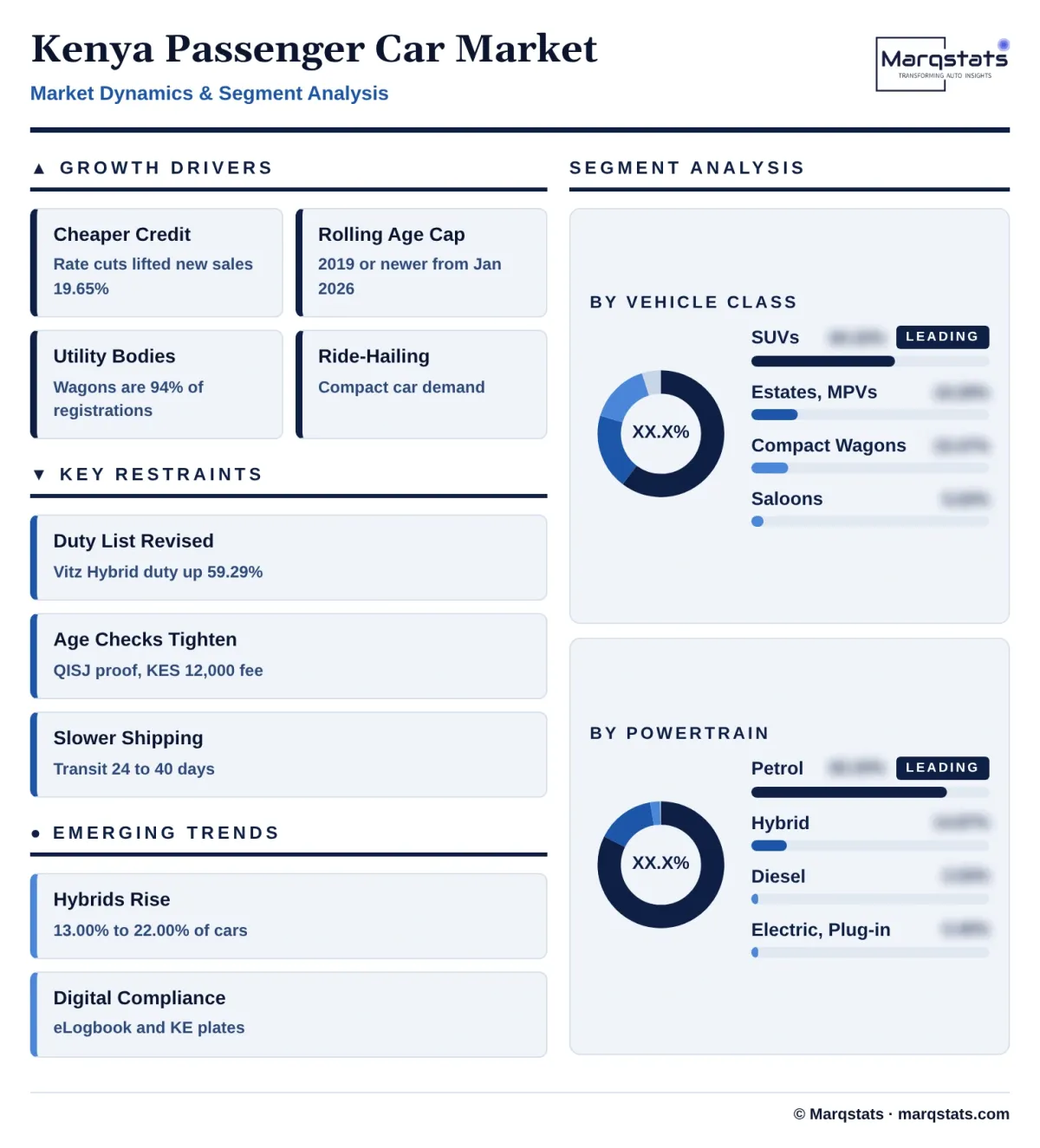
- Cheaper credit reopens the buying pool. The Central Bank of Kenya lowered its policy rate from 11.25% in January 2025 to 8.75% in March 2026, and lower borrowing costs helped KMIA franchise dealers lift new vehicle sales 19.65% to 13,583 units in 2025 and a further 23% to 7,819 in the first half of 2026. Importers advertise up to 70% financing on imported cars, so the same easing reaches the buyer of a five-year-old Toyota Fielder or Mazda CX-5 who borrows from a bank or a savings and credit cooperative.
- A rolling age cap renews demand every year. The KEBS notice of 13 November 2025 limited imports from 1 January 2026 to cars first registered on or after 1 January 2019, so importers raced the 31 December 2025 deadline: eight car carriers carrying more than 4,700 cars were due at Mombasa within about 10 days, and NTSA recorded 7,656 station wagons registered in December 2025 against 4,639 in November, a 65.04% rise. Each January the eligible pool resets to newer cars, which keeps replacement demand running.
- Buyers want utility bodies. Station wagons made up 94.19% of Marqstats registrations in 2025, and NTSA recorded 6,717 station wagons against 373 saloon cars in June 2026. Compact crossovers and estates serve commuting on weekdays and rural trips at weekends, which is why SUVs and crossovers are projected to rise from 42.16% to 47.17% of registrations by 2030.
- Ride-hailing and taxi work sustains small-car demand. Operators on app-based platforms buy compact hatchbacks and small wagons such as the Toyota Vitz, Mazda Demio and Honda Fit that satisfy platform age rules, and Marqstats estimates 18,000 cars, 19.72% of 2025 registrations, went to ride-hailing and taxi work, rising to 24,000 by 2030.
- Fuel prices favour hybrids. Japanese hybrids such as the Toyota Fielder Hybrid and Vitz Hybrid are widely available among 2019 and newer used cars, and buyers trade a higher purchase price for lower fuel bills. Marqstats estimates hybrids at 13.00% of 2025 registrations and 22.00% in 2030 without any purchase subsidy.
Key Restraints
Four constraints slow the market and push buyers toward newer, dearer cars.
- Valuation rules raise the duty bill. KRA bases duty on the CRSP list, not on the invoice, and the revised list that took effect on 1 July 2025 covers more than 5,200 models against about 3,000 before. Duty reported for a Toyota Vitz Hybrid rose from KES 319,501 to KES 508,927, up 59.29%, and for a diesel Mazda Demio from KES 244,000 to KES 564,000, up 131.15%, which moves many buyers to a smaller or older car.
- The age cap tightens each January and adds checks. Cars first registered in 2018 or earlier were locked out from 1 January 2026, and since 8 July 2025 QISJ also verifies the documents that prove a car age. A car without a certificate of roadworthiness can be validated for KES 12,000 a unit in about four days, a cost that falls on the importer and passes to the buyer.
- Shipping is slower and dearer. The average transit time from Mombasa to key global ports rose from 24 days to 40 days because of Red Sea disruption and routing around the Cape of Good Hope, according to The Star in December 2025, and importers describe a delivery time of at least 90 days from Japan. Slower pipelines make importers hold more stock and make them sensitive to deadline rushes.
- Policy risk hangs over prices. The High Court temporarily suspended the new CRSP list shortly before it took effect, the Finance Bill 2024 proposed a motor vehicle circulation tax that was dropped after protests, and the Finance Bill 2026 published on 30 April 2026 proposes 50% excise duty on classic vehicles that are at least 30 years old and worth at least KES 10 million. Importers cannot price stock confidently when duty bases can change within a year.
Key Trends
Four shifts are changing which cars Kenyans buy and how they are cleared, registered and financed.
- Hybrids move from niche to mainstream. Marqstats estimates hybrid registrations at 11,870 in 2025 and 23,320 in 2030, a share of 13.00% rising to 22.00%, because the Japanese fleet of 2019 and newer cars that feeds Kenya contains more hybrids every year.
- Compliance goes digital. QISJ verification began on 8 July 2025, NTSA introduced the electronic registration certificate (eLogbook) in June 2026, and NTSA began issuing plates in the KE series in August 2026 as the KD series ran out, so ownership records, collateral checks and age proof can be matched electronically.
- SUVs and crossovers pull ahead. Their share of registrations rises from 42.16% to 47.17% in Marqstats estimates, as the eligible 2019 and newer pool is rich in Mazda CX-5, Toyota RAV4 and Harrier, Honda Vezel and Subaru Forester models.
- Local passenger-car assembly stays marginal. CFAO Mobility took a 98% stake in Kenya Vehicle Manufacturers (KVM) at Thika after approval by the Competition Authority of Kenya in July 2024, and the authority put assembly shares at Simba Corporation Associated Vehicle Assemblers 41.1%, Isuzu East Africa 40.1% and KVM about 13%, and Simba Corporation announced on 10 June 2026 a KES 1 billion electric vehicle assembly line at its Mombasa plant that starts with passenger cars, but a new-car channel of 994 units cannot carry the tooling of a car plant at scale.
Strategic Implications
- For used-car importers and yards, the rolling cutoff is a working-capital problem more than a legal one. Each January the buyable pool moves a year newer and dearer, and the CRSP list sets duty on the list value of the car, so margin depends on buying models that sit low on the CRSP list relative to their auction price and on clearing them before the December rush, not on chasing the cheapest invoice.
- For franchise dealers and manufacturers, the addressable new-car market is below 1,000 passenger cars a year, so the case for a new nameplate rests on aftersales, certified pre-owned programmes and fleet contracts. Dealers that wrap warranties and service plans around late-model used cars reach the 99% of buyers that new-car sales ignore.
- For banks and savings and credit cooperatives, the data show where the volume is: private households buy about seven registered cars in ten, and ride-hailing operators about one in five. Lenders that accept a QISJ certificate, an eLogbook record and a hybrid battery check as collateral evidence can lend against a car whose age and ownership are verifiable.
- For electric-vehicle entrants, the passenger-car opening is narrow. The National Electric Mobility Policy of 3 February 2026 sits beside incentives that favour buses, motorcycles and batteries, and cars compete with used Japanese hybrids on price, so the practical entry route is captive fleets such as ride-hailing pools, airport transfers and corporate fleets that can build their own depot charging.
- For parts, tyre and service providers, a fleet that is mostly Japanese cars aged five to eight years means steady demand for hybrid battery service, suspension, brake and tyre replacement, and for diagnostic tools that read Japanese-market control units.
Market Segmentation
Compact hatchbacks and small wagons account for 15.47% of 2025 value, USD 252.42 million, and grow at 3.65% a year to USD 301.99 million. Marqstats estimates about 25,500 units in 2025, led by the Toyota Vitz, Passo and Aqua, Mazda Demio, Honda Fit and Nissan Note that ride-hailing operators and first-time buyers favour. Their unit share eases from 27.93% to 25.94% as buyers trade up.
Estates and multi-purpose vehicles account for 19.29% of 2025 value, USD 314.75 million, and grow at 3.56% a year to USD 374.91 million. About 22,000 units were registered in 2025, including the Toyota Fielder, Axio wagon, Probox and Succeed, Sienta and Noah family vans, which serve households, small traders and school transport.
SUVs and crossovers account for 60.22% of 2025 value, USD 982.52 million, and grow fastest among classes, at 7.81% a year, to USD 1,430.67 million and 65.59% of the market. About 38,500 units were registered in 2025, including the Mazda CX-5, Toyota RAV4 and Harrier, Subaru Forester, Honda Vezel and Toyota Land Cruiser Prado, bought by households that value ground clearance and by corporate users.
Saloon cars account for 5.02% of 2025 value, USD 81.97 million, and decline at 2.08% a year to USD 73.78 million. About 5,300 units were registered in 2025, mainly the Toyota Premio and Allion, Nissan Sylphy and executive models from Mercedes-Benz, as the NTSA series showing 373 saloon cars against 6,717 station wagons in June 2026 confirms the shift.
Petrol cars account for 82.20% of 2025 value, USD 1,341.25 million, and grow at 2.84% a year to USD 1,542.53 million, while their share of registrations falls from 84.80% to 75.00%. Nationwide parts supply, technician familiarity and the lowest purchase price keep this the base of the market.
Hybrid electric cars account for 14.87% of 2025 value, USD 242.65 million, and grow at 17.08% a year to USD 533.92 million and 24.48% of the market. Marqstats estimates 11,870 hybrid registrations in 2025, mostly self-charging Toyota and Honda models, rising to 23,320 in 2030 with no purchase subsidy.
Diesel cars account for 2.53% of 2025 value, USD 41.21 million, and slip at 0.54% a year to USD 40.11 million. Marqstats estimates about 1,830 units in 2025, concentrated in diesel SUVs such as the Mazda CX-5 and Toyota Land Cruiser Prado, because the Japanese 2019 and newer pool is mostly petrol and hybrid.
Battery-electric and plug-in cars account for 0.40% of 2025 value, USD 6.55 million, and grow at 58.14% a year to USD 64.79 million from a very small base of about 180 units. Kenya registered 24,754 electric vehicles of all types by the end of December 2025, most of them motorcycles, and Marqstats expects passenger cars to reach 1,590 units a year by 2030 through fleet buyers.
New cars account for 2.45% of 2025 value, USD 39.97 million, and grow at 7.47% a year to USD 57.30 million. KMIA members sold 994 new passenger cars in 2025, 963 station wagons and 31 saloon cars, rising to about 1,300 units by 2030 in Marqstats estimates at an average price of about KES 5.2 million rising to KES 5.7 million.
Used and other imports account for 97.55% of 2025 value, USD 1,591.69 million, and grow at 5.94% a year to USD 2,124.05 million. They supply 90,306 registered cars in 2025, 98.91% of units, and about 80% of them come from Japan, with the rest from the United Arab Emirates, the United Kingdom, Thailand, Singapore and South Africa.
Private households account for 71.76% of 2025 value, USD 1,170.98 million, and grow at 5.59% a year to USD 1,536.62 million. Marqstats estimates 63,800 cars, 69.87% of units, bought mostly with bank or cooperative loans in the KES 1.2 million to KES 2.8 million range.
Ride-hailing and taxi operators account for 11.14% of 2025 value, USD 181.70 million, and grow at 9.32% a year to USD 283.68 million. They buy about 18,000 cars, 19.72% of units, concentrated in compact hatchbacks and small wagons with low running costs, and replace them quickly because of heavy daily mileage.
Corporate and institutional fleets account for 17.10% of 2025 value, USD 278.98 million, and grow at 5.29% a year to USD 361.05 million. They buy about 9,500 cars, 10.41% of units, and are the main buyers of new cars with warranties, along with parastatals, diplomatic missions and non-governmental organisations.
By Geography
Nairobi Metropolitan Region
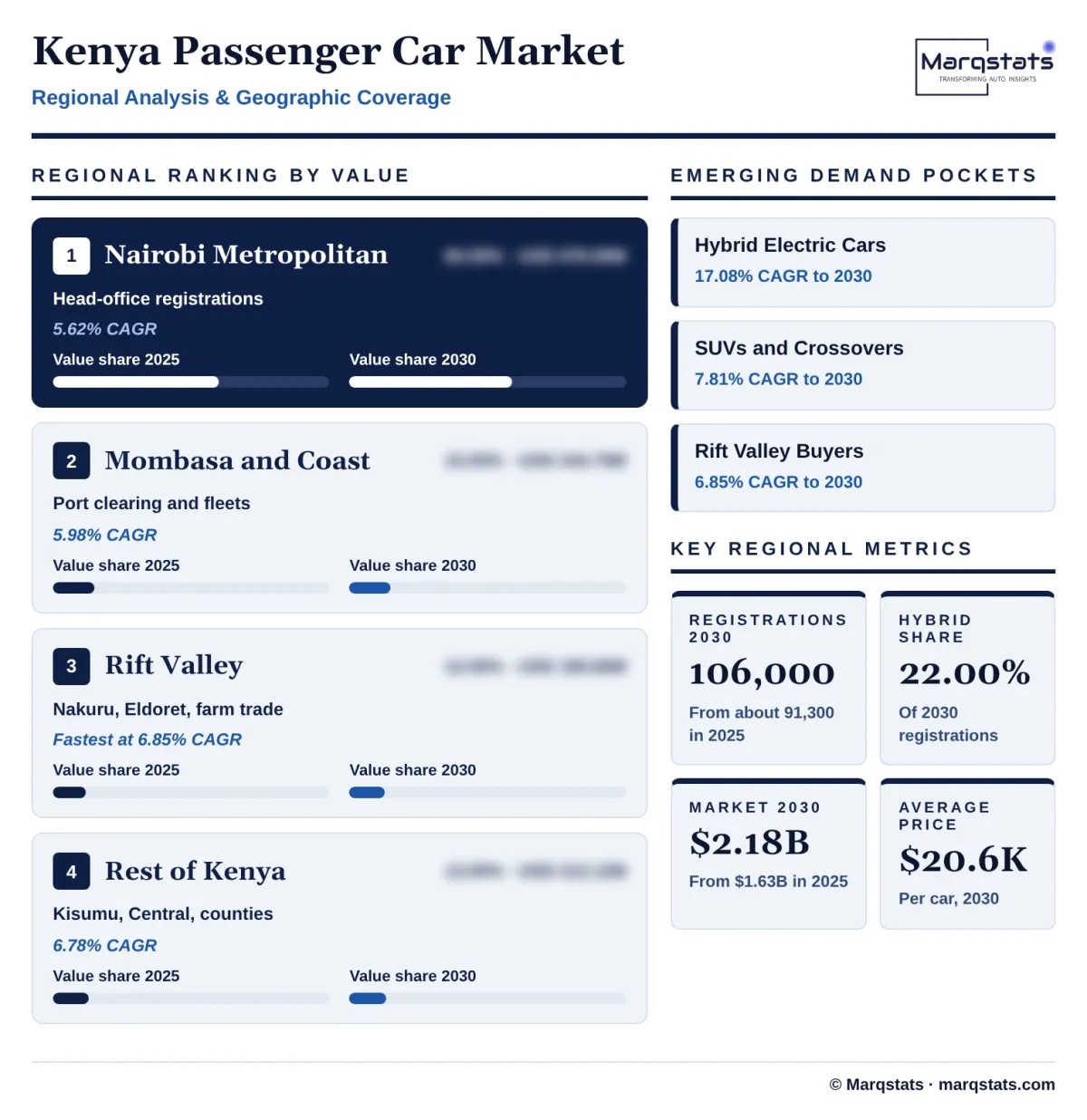
The Nairobi Metropolitan Region, which covers Nairobi, Kiambu, Machakos and Kajiado, accounts for 60.00% of 2025 value, USD 978.99 million, and grows at 5.62% a year to USD 1,287.00 million and 59.00% by 2030. Marqstats allocates value by place of registration, as lenders do, and registration overstates local use because banks, lessors and ride-hailing fleet owners register cars at Nairobi head offices even when the cars work elsewhere.
Mombasa and the Coast
Mombasa and the Coast account for 15.00% of 2025 value, USD 244.75 million, and grow at 5.98% a year to USD 327.20 million. The Port of Mombasa is where used cars are discharged, cleared and first sold, and its car-carrier berths handle the December rush, which gives the region a trading role larger than its population share and tourism and logistics fleets that renew steadily.
Rift Valley
The Rift Valley, including Nakuru and Uasin Gishu around Eldoret, accounts for 12.00% of 2025 value, USD 195.80 million, and grows fastest, at 6.85% a year, to USD 272.67 million and 12.50% by 2030. Agribusiness managers, transit commerce on the Northern Corridor and growing tertiary towns buy SUVs and crossovers suited to farm and highway use.
Rest of Kenya
The rest of Kenya, including Kisumu and the Lake Basin, the Central highlands and the northern and eastern counties, accounts for 13.00% of 2025 value, USD 212.12 million, and grows at 6.78% a year to USD 294.48 million. County governments, development agencies and rural traders buy utility crossovers, and buyers often purchase through Nairobi or Mombasa dealers before registering locally.
How Competition Is Evolving
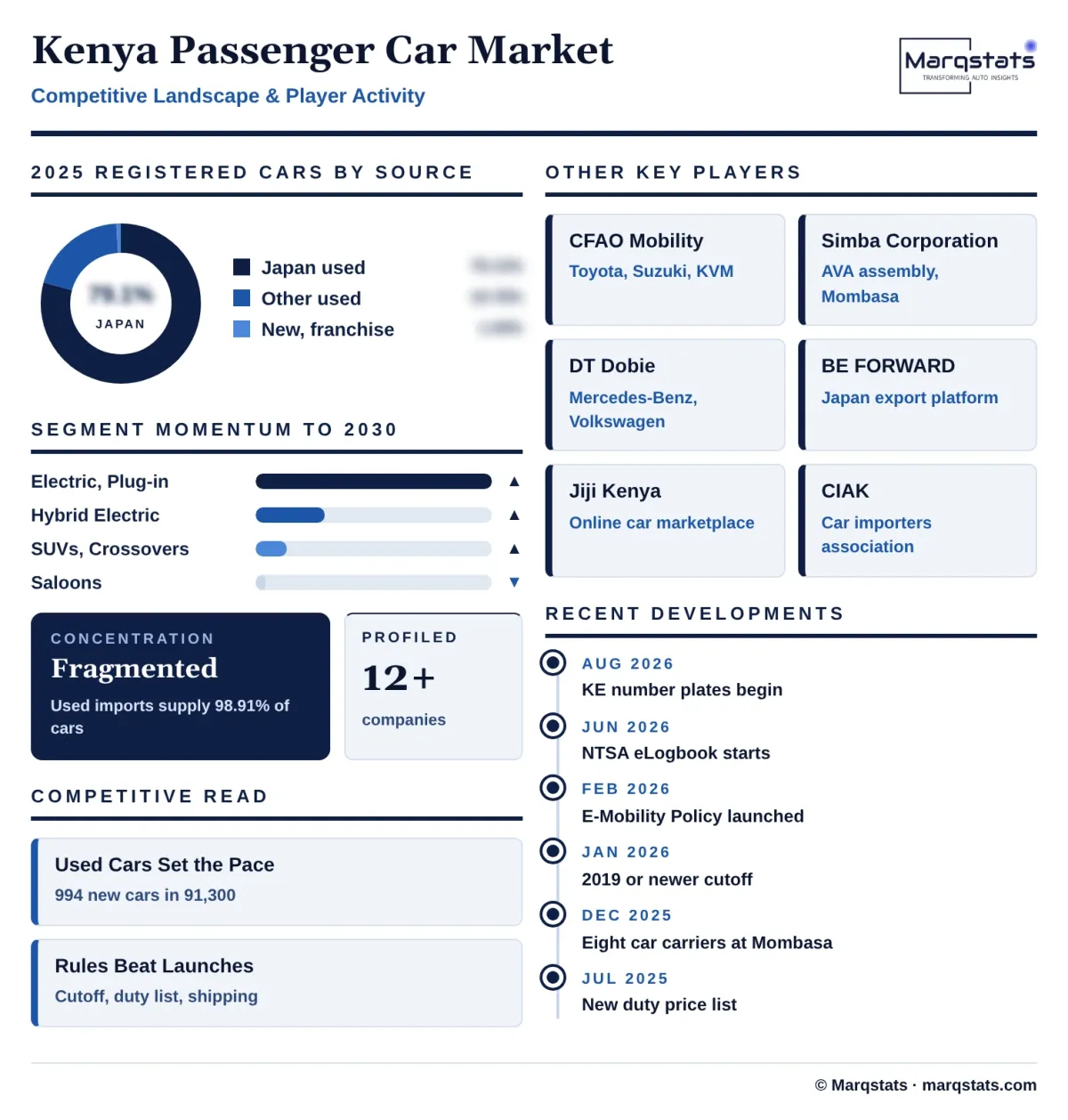
The market is fragmented and is organised by supply route, not by brand. Marqstats estimates that of 91,300 cars registered in 2025, about 72,245 (79.13%) were used cars from Japan, about 18,061 (19.78%) were used cars from other origins or other sources, and 994 (1.09%) were new cars reported by KMIA members. No single dealer, brand or importer holds a share that can be sourced, and Marqstats states shares only where a registry supports them.
Two tiers compete. The franchise tier is led by CFAO Mobility Kenya, which distributes Toyota and Suzuki vehicles and took 98% of Kenya Vehicle Manufacturers in a deal valued at KES 1 billion that the Competition Authority of Kenya approved in July 2024, by Simba Corporation, which owns Associated Vehicle Assemblers in Mombasa, by DT Dobie, which distributes Mercedes-Benz and Volkswagen cars, and by Isuzu East Africa, whose 6,494 units in 2025 were mostly pickups, trucks and buses. This tier sells to corporate fleets, diplomatic missions and high-income buyers.
The independent tier handles most of the volume. Members of the Car Importers Association of Kenya buy through Japanese auctions and export platforms such as BE FORWARD, SBT Japan and Japanese Car Trade, ship through the Port of Mombasa and sell through yards and online marketplaces such as Jiji Kenya and Peach Cars. The association chairman, Peter Otieno, said in December 2025 that members had placed orders from October and were not under pressure from the deadline, and importers have met the deadline for about ten years.
Competition is shifting from price to proof. Buyers and lenders now ask for a certificate of roadworthiness, a QISJ age check, an eLogbook record and a service history, so importers that document their cars and dealers that add warranties win the buyers who would once have bought on price alone. Marqstats expects the organised tier to gain share of value gradually, but the used-import route will still supply 98.91% of registered cars in 2025 and 98.77% in 2030.
Companies Covered
Companies covered in the report include:
Recent Market Activity
Table of Contents
Coverage & Segmentation
The study covers the Kenya passenger car market, with 2025 as the base year, 2021 – 2025 as the historical period and 2026 – 2030 as the forecast period. It covers saloon cars and station wagons, including hatchbacks, estates, multi-purpose vehicles, crossovers and sport utility vehicles, registered for the first time in Kenya, whether new from franchise dealers or imported used under the eight-year rule. The market is segmented by vehicle class, powertrain, vehicle condition, end user and region. Values are retail transaction values in US dollars including import duty, excise duty, value added tax and dealer margin, and Kenyan shilling figures use the 2025 average of KES 129.31 per US dollar.
Pickups, panel vans, lorries, buses, minibuses and matatus, motorcycles, three-wheelers and trailers are excluded, as are vehicle parts, leasing and rental revenue and vehicle resales between Kenyan owners. The commercial vehicle categories belong to the Kenya truck and Kenya matatu markets, and Marqstats has sized electric buses in its live Kenya electric bus report, so those figures should not be added to this market. Live Marqstats reports on the Kenya two-wheeler and three-wheeler markets cover other vehicle types. Segment and regional splits are Marqstats estimates built on registrations, customs values, dealer prices and import data.