Market Snapshot
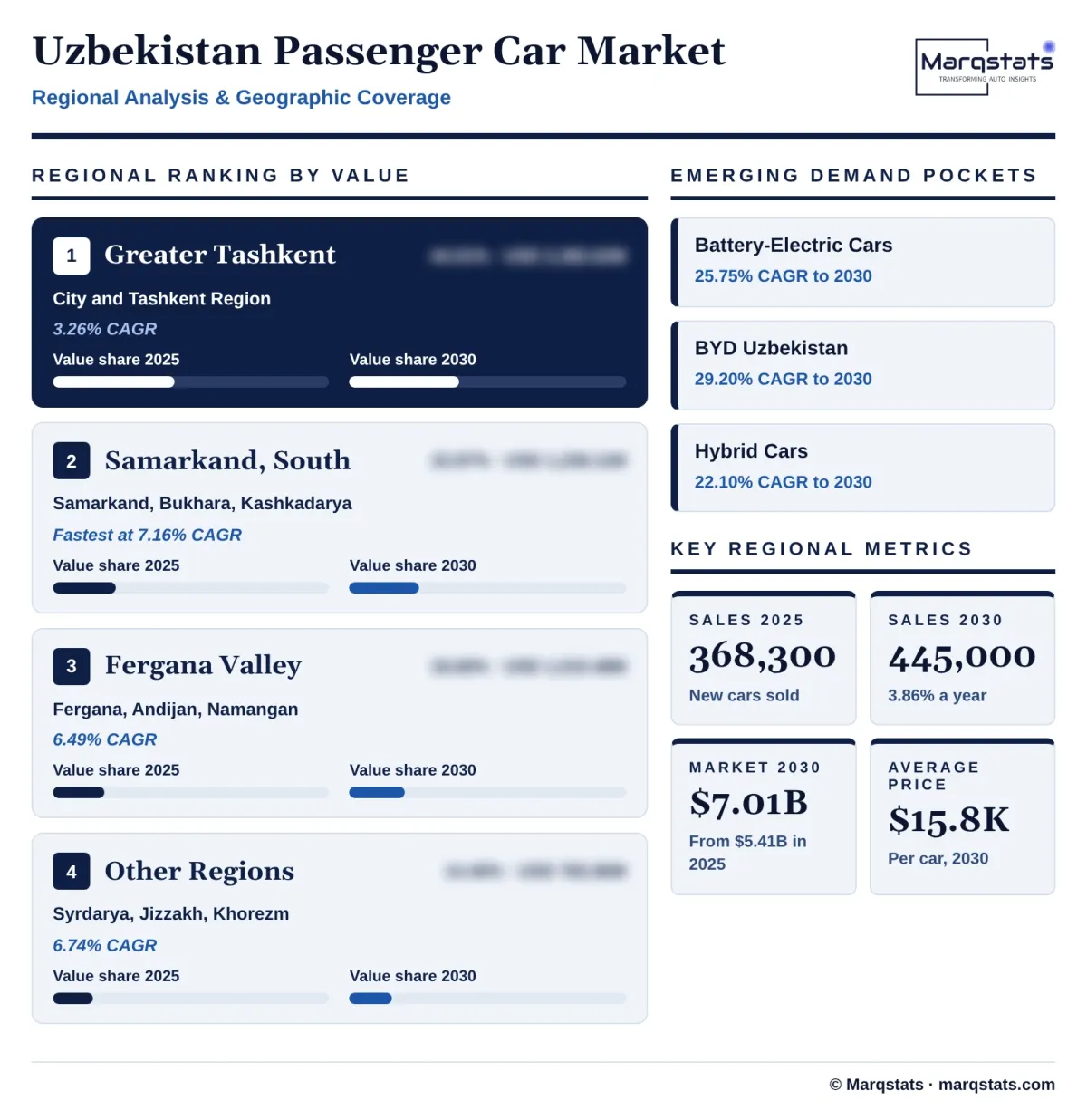
The Uzbekistan passenger car market size is estimated at USD 5,414.07 million in 2025 and is projected to reach USD 7,014.41 million by 2030, growing at a CAGR of 5.32% over 2026 – 2030. New car sales rise from 368,300 to 445,000 units, a 3.86% annual rate, while about 21.95% of passenger-car output never reaches a domestic buyer.
Marqstats defines the market as new passenger cars sold to end customers in Uzbekistan through dealers, whether assembled by UzAuto Motors, ADM Jizzakh or BYD Auto Uzbekistan or imported fully built, valued at the retail price paid in US dollars. Special passenger cars such as the Chevrolet Labo, used cars, light commercial vehicles and exports are excluded. Value uses the 2025 average rate of UZS 12,718 per US dollar, equal to about UZS 0.00 trillion in 2025.
Chevrolet-brand cars built by UzAuto Motors account for 68.86% of 2025 units and 60.95% of value, internal combustion cars for 85.15% of units and Greater Tashkent for 44.01% of value. Battery-electric cars grow fastest, at 25.75% a year in value, and imported new cars gain share as buyers move toward Chinese models.
Key Takeaways
Market Overview & Analysis
Report Summary
Uzbekistan has built a car industry larger than its car market. In 2025 the National Statistics Committee of the Republic of Uzbekistan reported 457,883 passenger cars built, up 6.7%, while the Center for Economic Research and Reforms (CERR) counted nearly 370,000 new passenger cars sold, up 5.2%, of which more than 315,000 were locally built and about 53,300 were imported. The gap between the two series is the thesis of this analysis: output is rising faster than domestic demand, ADM Jizzakh and BYD Auto Uzbekistan are taking volume from Chevrolet, and imported electric cars are changing the price ladder.
Marqstats sizes the market at the retail layer, on the CERR definition of new passenger cars sold in Uzbekistan, domestic and foreign made. It counts 368,300 cars in 2025, built from the sum of the two reported components, and values them at retail prices in US dollars. It excludes the Labo and Wuling N111 special passenger cars (54,301 built in 2025), vans and light commercial vehicles, used cars, which CERR reports at about 52,000 a month in the secondary market, and exports. Used cars and wholesale shipments to dealers are separate layers and are not added to this market.
The analysis is written for four readers. Manufacturers and licensors such as General Motors Company, Kia Corporation, Chery Automobile Co., Ltd., Great Wall Motor Company Limited and BYD Company Limited can judge how much of Uzbek output is sold at home. Importers and dealers can see which price bands Chinese electric cars are entering. Lenders and fleet buyers can price residual risk against a market where list prices are being cut. Component suppliers and investors can size local demand separately from export-led production.
Uzbekistan Passenger Car Market Size and Forecast
The Uzbekistan passenger car market grows from USD 5,414.07 million in 2025 to USD 7,014.41 million in 2030, a CAGR of 5.32%. Volume grows at 3.86% a year, from 368,300 to 445,000 cars, and the average retail price rises at 1.41% a year, from about USD 14,700 to USD 15,763, because battery-electric and hybrid cars, ADM Jizzakh crossovers and BYD models replace low-priced Cobalt and Onix sales. The gap between the two rates is a mix effect, not inflation: Marqstats holds each model at its 2025 price in US dollars.
The 2025 base is built bottom-up from sales and prices. CERR reported more than 315,000 locally built and about 53,300 imported new passenger cars, and Marqstats uses 315,000 and 53,300, giving 368,300. Marqstats estimates 253,600 Chevrolet cars from UzAuto Motors at an average of about USD 13,009, 41,400 Kia, Chery and Haval cars assembled by ADM Jizzakh at about USD 18,171, 20,000 BYD cars at USD 17,500 and 53,300 imported cars at USD 19,000, which gives USD 5,414.07 million at UZS 12,718 per dollar. Model prices follow dealer lists: in April 2026 the Cobalt started at UZS 146.4 million (USD 11,511), the Onix at UZS 176.9 million (USD 13,909) and the Tracker at UZS 220.9 million (USD 17,369).
The Chevrolet volume is fitted to model-level sales. UzAuto Motors sold 127,200 Cobalt, 106,000 Damas, 37,900 Tracker and 33,600 Onix in 2024, and market trackers show 2025 changes of +1.0%, +2.7%, +19.9% and -1.9%, which gives about 128,500, 108,900, 45,400 and 33,000. Those four models alone sum to about 315,800 cars, as much as the whole CERR domestic count, before adding about 61,400 cars assembled by ADM Jizzakh and BYD Auto Uzbekistan. Marqstats therefore infers that most Damas microvans are registered as light commercial vehicles and sit outside the CERR passenger count, and it carries 46,700 Damas passenger registrations and other Chevrolet models as a residual.
The import layer is checked against customs data. The Customs Committee recorded 79,822 passenger cars imported in 2025, worth USD 1.17 billion, or about USD 14,658 each, against about 53,300 imported cars sold through dealers. The difference of about 26,500 cars is consistent with individual imports of electric cars that enter the used market, and with transit. Marqstats prices dealer-sold imports at USD 19,000 retail, about 1.30 times the customs value, to cover freight, recycling fees, dealer margin and finance.
The 2030 forecast of 445,000 cars is well below the output that installed plants could build because it follows household demand, not plant output. Domestic sales rise to 352,000 cars and imports to 93,000. Value dips 0.84% in 2026 to USD 5,368.65 million as 2026 new-car sales fall to 357,000, then grows between 5.89% and 7.98% a year. Marqstats tracks four indicators: monthly CERR new-car counts, Customs Committee import data by fuel type, Stat.uz output by model, and dealer list-price changes.
Market Dynamics
Key Drivers
Five forces keep demand for new passenger cars growing in Uzbekistan even as the largest brand loses volume.
- The private fleet keeps growing. The National Statistics Committee counted 4,725,900 privately owned vehicles on 1 October 2025, up 415,300 in a year, of which 92.9% were light vehicles. New sales of 368,300 cars equal 8.39% of that light-vehicle fleet each year, so replacement and first purchases both support volume.
- Electric cars face no customs duty. Presidential Decree PQ-443 of 19 December 2022 exempts electric and hybrid cars from customs duty until 1 January 2030. Electric cars rose from 32% to 71% of passenger car imports in 2025, and Customs Committee data show 23,079 electric cars worth USD 309.3 million imported in January – April 2026, almost four times the 5,863 of a year earlier.
- Chinese suppliers have cut prices. Passenger car imports grew 7.1% to 79,822 units in 2025 while their value fell about 8% to USD 1.17 billion, about USD 14,658 a car, and electric cars imported in January – April 2026 averaged about USD 13,400. More than 90% of imports in January – September 2025 came from China.
- Local assembly is widening. BYD Auto Uzbekistan built 20,200 cars in 2025, more than five times the 4,004 of 2024, Haval built 9,344 against 3,315, Chery 9,354 (+32%) and Kia 26,317 (+19.3%). BYD plans 40,000 cars in 2026 and 200,000 by 2030 with a further USD 200 million of investment.
- Manufacturers are using price and credit to move stock. UzAuto Motors offers the Cobalt with 50% down and the balance over 11 months at no extra charge, and ran a campaign from 3 August to 10 September 2026 with up to UZS 15 million off the Cobalt and Damas and up to UZS 45 million off the Captiva.
Key Restraints
Four constraints hold sales growth below the pace of output and slow the shift to electric cars.
- Prices are high against household income. The Chevrolet Cobalt started at UZS 146.4 million in April 2026, about USD 11,511, the Onix at UZS 176.9 million and the Tracker at UZS 220.9 million, and UzAuto Motors limits its August 2026 discounts to buyers who pay the full price, so cars bought with commercial bank loans do not qualify.
- Domestic sales are weakening. UzAuto Motors sold 40,936 Cobalt in the first half of 2026, 39% fewer than the 67,580 of a year earlier, while production rose 13.5% to 82,951. CERR counted 30,600 new cars in August 2026, down 18.6% on August 2025, with locally built cars 7,000 below a year earlier.
- Recycling fees tax electric cars. From 1 May 2025 the fee on electric cars up to three years old rose from 30 to 120 base calculation units, up to UZS 45 million or about USD 3,540, and cars older than three years pay 210 units, UZS 78.75 million or about USD 6,190, which adds to the landed cost of imports.
- Electric demand sits in one city. Tashkent city bought about 29,000 of the 40,700 electric cars sold in 2025, 71%, and CERR reported that its overall passenger car sales fell in 2025, so national electric adoption depends on the charging and service network spreading to other regions.
Key Trends
Four shifts are changing who builds, imports and sells passenger cars in Uzbekistan.
- Imports move to electric and hybrid cars. Customs data for January – February 2026 show 9,698 electric cars against 1,556 a year earlier and 1,249 hybrids against 70, while gasoline imports rose only from 2,746 to 2,988; the 8M26 electric import count reached 54,826, up nearly 90%.
- Chevrolet cedes share to other makers. The Chevrolet brand held 83.2% of the locally tracked new vehicle market in 2025 against 87.9% in 2024, and UzAuto Motors as a manufacturer held 52.1% of 57,512 vehicles in January – February 2026 against 55.9% in January – April 2025.
- Output outruns domestic sales. Stat.uz reported 263,731 passenger cars built in January – July 2026, 22,600 more than a year earlier, while customs data show automobile exports of USD 195.3 million in January – August 2026, up 9.1%, and Cobalt sales of 16,370 units in Kazakhstan in the first half.
- Assembly shifts to battery-electric and hybrid models. BYD Auto Uzbekistan began Yuan Up production in early 2026 after selling 6,800 in 2025, and plans about 10 new models by 2030.
Strategic Implications
- For Chevrolet and General Motors Company, the question is whether to build for export or for local demand. Output of 403,582 cars against 315,000 sold at home means plants are running for stock and Kazakhstan, so new capacity should wait for sell-through data.
- For ADM Jizzakh and Chinese licensors, the opening is the middle price band between the Cobalt and the imported crossover. Kia, Chery and Haval sales grew 32%, about 50% and 2.7 times in 2025, and a local crossover priced under the imports wins the buyer who rejects both.
- For importers and dealers, the electric car is now an entry-level product at about USD 13,400 customs value, and margin depends on recycling-fee treatment and after-sales networks outside Tashkent, which buys 71% of electric cars today.
- For lenders and fleet buyers, list-price cuts and full-payment-only discounts signal residual risk on ICE sedans. Underwrite on cash discount spreads, not on list price, until the secondary market clears.
- For component suppliers and investors, production data overstates domestic demand by about a fifth. Size localisation on the sold volume of 315,000 plus export contracts, not on the 457,883 built.
Market Segmentation
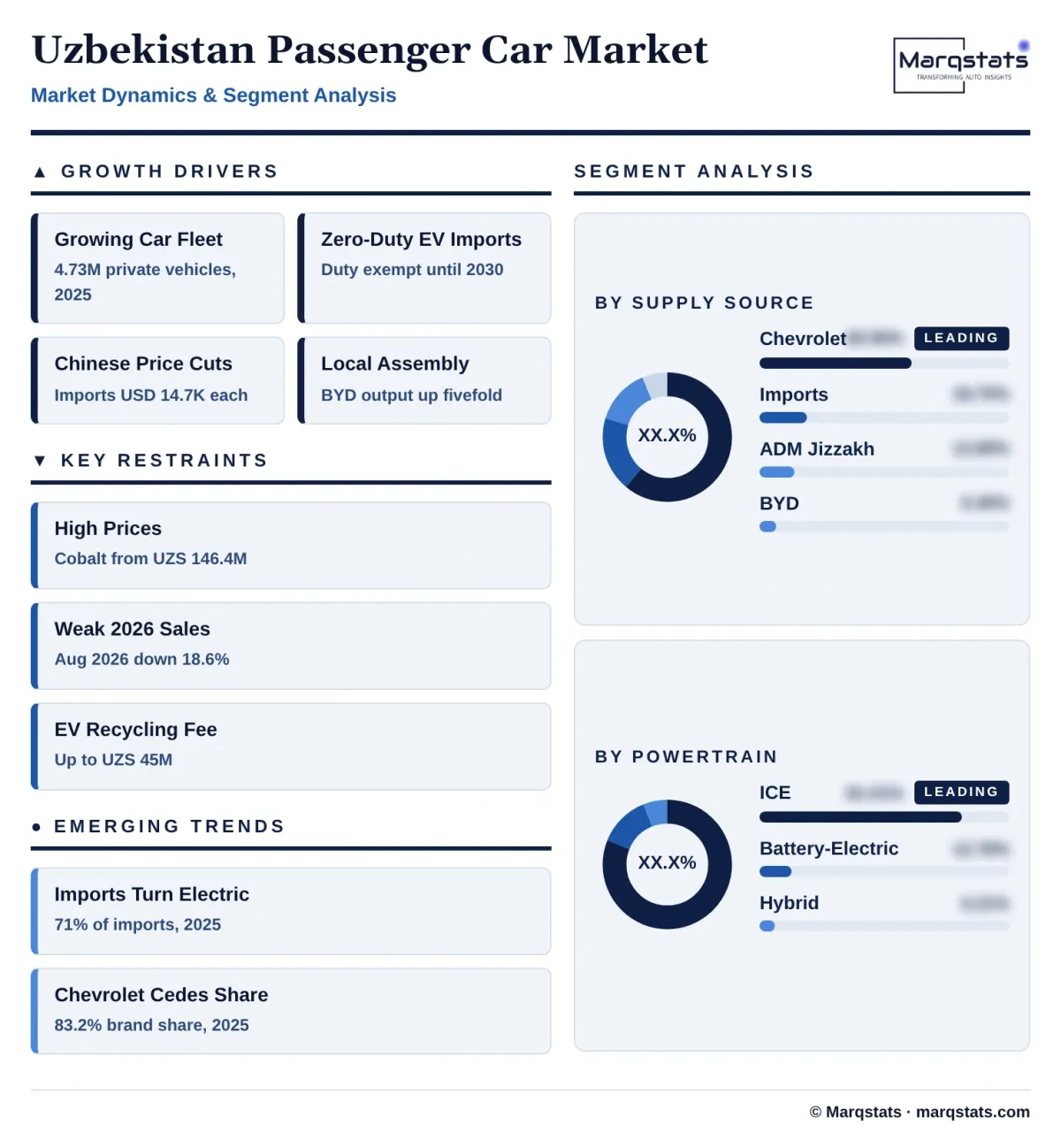
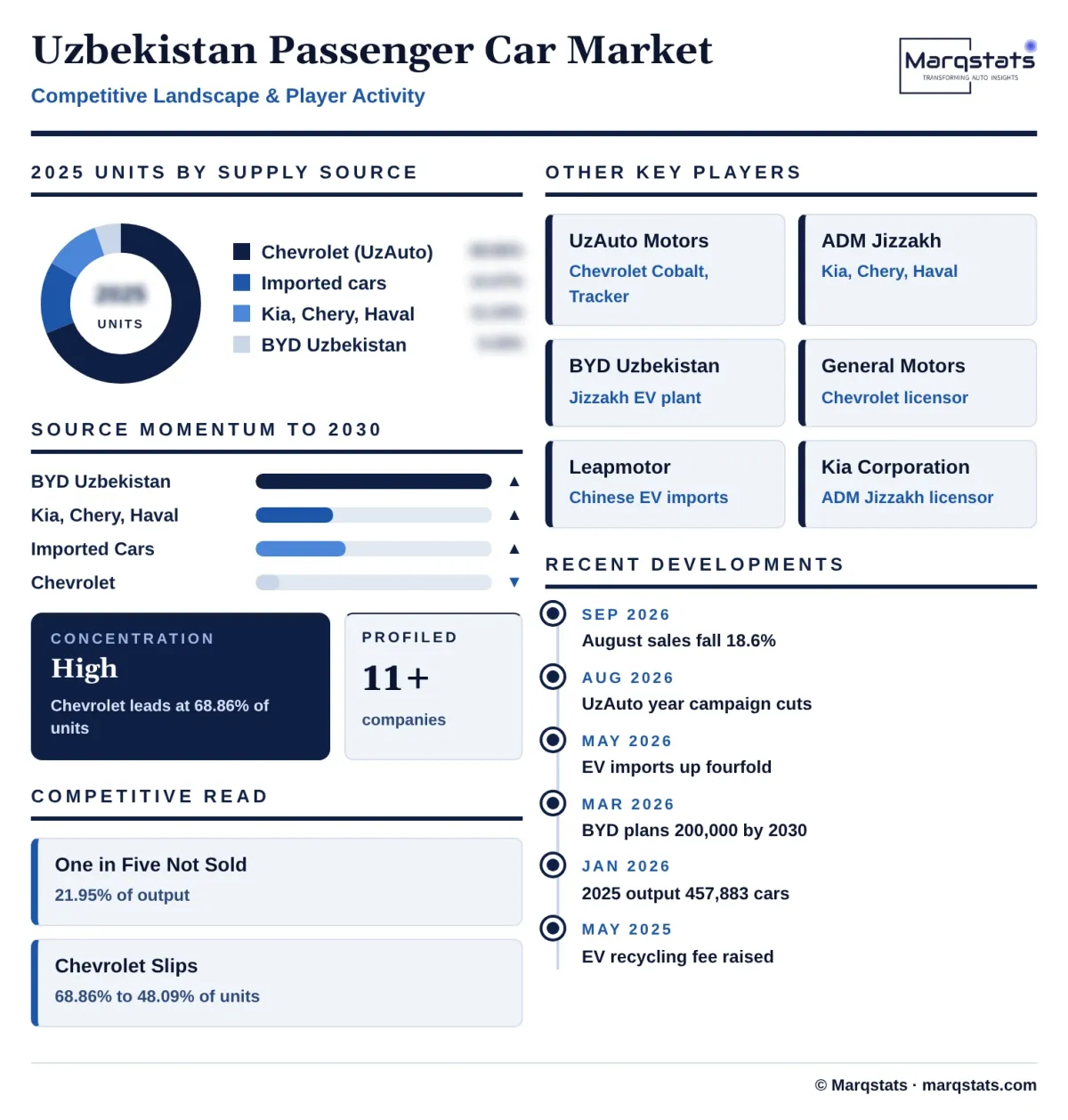
Chevrolet cars built by UzAuto Motors account for 68.86% of 2025 units, 253,600 cars, and 60.95% of value, USD 3,299.09 million. They are the only segment that shrinks, at 2.99% a year in value, to USD 2,834.63 million and 48.09% of units by 2030. The Cobalt, Tracker, Onix and the Damas and Captiva residual make up the group, and Cobalt volume falls from about 128,500 to 100,000.
Imported new cars sold through dealers account for 14.47% of 2025 units, 53,300 cars, and 18.70% of value, USD 1,012.70 million, rising to USD 1,720.49 million and 20.90% of units in 2030, a 11.18% value CAGR. Chinese electric cars supply most of the growth, and imports rise despite lower unit prices.
The ADM Jizzakh brands account for 11.24% of 2025 units, 41,400 cars, and 13.89% of value, USD 752.28 million. ADM sold 25,538 Kia, 11,312 Chery and 9,141 Haval cars in 2025 (45,991 in all, including some imported Kia models). The group grows 9.78% a year to USD 1,199.29 million and 14.83% of units.
BYD Auto Uzbekistan accounts for 5.43% of 2025 units, 20,000 cars, and 6.46% of value, USD 350.00 million, and is the fastest-growing source at 29.20% a year, reaching USD 1,260.00 million and 16.18% of units in 2030. The Jizzakh plant built 20,200 cars in 2025 and targets 40,000 in 2026.
Gasoline and diesel cars account for 85.15% of 2025 units, 313,600 cars, and 81.01% of value, USD 4,386.17 million. They fall 2.19% a year in value to USD 3,926.41 million and 62.70% of units by 2030, as electric cars take the entry segment from the Cobalt and Onix.
Battery-electric cars account for 11.05% of 2025 units, 40,700 cars, and 12.78% of value, USD 691.90 million. CERR reported 40,700 sales in 2025, up 35%. The segment grows 25.75% a year to USD 2,176.00 million and 28.76% of units, supported by the duty exemption to 2030.
Hybrid cars account for 3.80% of 2025 units, 14,000 cars, and 6.21% of value, USD 336.00 million, on a Marqstats estimate built from BYD plug-in output and hybrid imports. Hybrid imports rose from 70 to 1,249 units in January – February 2026. The segment grows 22.10% a year to USD 912.00 million.
By Geography
Greater Tashkent
Greater Tashkent, the city and Tashkent Region, accounts for 44.01% of 2025 value, USD 2,382.62 million, and 147,320 cars, and grows 3.26% a year to USD 2,796.60 million and 39.86% by 2030. Tashkent city bought 71% of the electric cars sold, yet CERR reported falling city passenger car sales in 2025 while Tashkent Region grew 36%. Fleet and corporate buyers register vehicles at head offices, so Marqstats allocates by registration, as lenders do.
Samarkand, Bukhara and the South
Samarkand, Bukhara and the southern provinces account for 22.87% of 2025 value, USD 1,238.11 million, and grow fastest, at 7.16% a year, to USD 1,749.27 million and 24.94%. Kashkadarya sales rose 21% in 2025 and Samarkand was among the regions that followed Tashkent city in electric car purchases.
Fergana Valley
The Fergana Valley, Fergana, Andijan and Namangan, accounts for 18.66% of 2025 value, USD 1,010.48 million, and grows 6.49% a year to USD 1,383.74 million. Namangan sales rose 26% in 2025, and the valley is the densest rural market, where the Cobalt and Damas remain the working choice.
Other Regions
Syrdarya, Jizzakh, Navoi, Khorezm and Karakalpakstan account for 14.46% of 2025 value, USD 782.86 million, and grow 6.74% a year to USD 1,084.80 million. Syrdarya recorded the fastest 2025 growth, 45%, while Navoi and Khorezm declined. Jizzakh hosts the ADM Jizzakh and BYD plants.
How Competition Is Evolving
The market is highly concentrated but the leader is losing share. Marqstats estimates Chevrolet cars from UzAuto Motors at 68.86% of 2025 units, imported cars at 14.47%, ADM Jizzakh brands at 11.24% and BYD at 5.43%, so the top three sources hold 94.57%. By 2030 Chevrolet falls to 48.09% and imports and BYD together rise to 37.08%. Brand and manufacturer shares differ: Chevrolet brand reached 83.2% of locally tracked vehicles in 2025, but UzAuto Motors as a plant operator held 52.1% in January – February 2026 because the manufacturer table reports Khorezm Auto separately, at 27.2% of the same vehicles.
Competition runs on price, financing and electrification. UzAuto Motors cuts list prices and offers instalments, ADM Jizzakh competes on crossovers, and BYD and importers compete on electric range at about USD 13,400 customs value. Non-UzAuto assemblers built 65,215 cars in 2025, 14.24% of national output, up from about 36,500 a year earlier, a rise of roughly 79%.
Structure follows industrial policy. General Motors Company licenses the Chevrolet platforms built at UzAuto Motors, while Kia Corporation, Chery Automobile Co., Ltd. and Great Wall Motor Company Limited supply ADM Jizzakh, and BYD Company Limited owns the Jizzakh electric plant. Duty-free electric imports until 1 January 2030 mean any assembler must beat the landed price of a Chinese electric car.
The gap between output and sales shapes strategy. With 403,582 cars built and 315,000 sold at home, plants depend on Kazakhstan and other export markets, and local sales weakness in 2026 raises the cost of each unsold unit.
Companies Covered
Companies covered in the report include:
Recent Market Activity
Table of Contents
Coverage & Segmentation
The study covers the Uzbekistan passenger car market, with 2025 as the base year, 2021 – 2025 as the historical period and 2026 – 2030 as the forecast period. It covers new passenger cars sold to end customers through dealers, whether assembled in Uzbekistan or imported fully built, segmented by supply source, powertrain and region. Values are retail prices in US dollars, converted at the 2025 average of UZS 12,718 per US dollar, and the forecast holds model prices at 2025 levels so that changes in value come from volume and mix.
Special passenger cars such as the Chevrolet Labo, microvans registered as light commercial vehicles, vans, pickups, buses, used cars, exports and wholesale shipments to dealers are excluded. Units are the sum of the CERR domestic and imported counts, and the supply-source, powertrain and regional splits are Marqstats estimates built on Stat.uz output, CERR sales, Customs Committee imports and dealer price lists. 11 profiled companies and seven segments across two dimensions and four regions are covered.