Market Snapshot
Middle bar: base-year value × (1 + CAGR), rounded to two decimals. This is a calculated illustration, not a separately researched annual estimate.
The Southeast Asia electric pickup market size is estimated at USD 34.82 million in 2025 and is projected to reach USD 533.60 million by 2030, growing at a CAGR of 72.61% over 2026 – 2030. Annual sales of factory-built plug-in pickups rise from about 1,180 units to 18,000, a 72.46% annual rate, as Toyota and Isuzu start selling battery-electric versions of the region's best-selling one-tonne pickups from their Thai plants.
Marqstats defines the market as the value of new factory-built pickups that can be charged from the grid, battery-electric (BEV), plug-in hybrid (PHEV) and range-extended electric (REEV), sold in Thailand, the Philippines, Malaysia, Indonesia and the rest of ASEAN, at average transaction prices excluding VAT. Conventional and 48 V hybrids, diesel pickups, cab-over micro-trucks and vans, aftermarket conversions and pickups built in the region for export outside ASEAN are excluded. Prices are converted at THB 33.74 and PHP 57.50 per USD, the 2025 annual averages used across Marqstats reports.
Battery-electric pickups account for an estimated 67.15% of 2025 value, private and lifestyle buyers for 62.01% and Thailand for 59.68%. The study segments the market by powertrain, buyer type and country.
Key Takeaways
Market Overview & Analysis
Report Summary
Marqstats sizes the Southeast Asia electric pickup market as the value of new plug-in pickups sold to buyers in ASEAN. In 2025 about 1,180 were sold: about 745 in Thailand, 340 in the Philippines, 30 in Malaysia and 65 in Indonesia and the rest of the region, worth an estimated USD 34.82 million at average transaction prices excluding VAT.
The pickup is the region's working vehicle. Thailand is Asia's pickup factory, building 893,921 one-tonne pickups in 2025 and exporting 728,219 of them, and pickups have long been the country's best-selling vehicle type. In the Philippines, Malaysia and Indonesia, Thai-built double-cabs serve farms, contractors, mining camps and families, while cheaper cab-over micro-trucks carry urban freight.
Electric pickups arrived late. Thailand's first commercial battery-electric pickup, the Riddara RD6 from Zhejiang Geely Holding Group, went on sale in October 2024 from THB 899,000, and the Federation of Thai Industries counted no battery-electric pickup sales in 2024 and 726 in 2025. Riddara reported about 1,000 sales in 2025, a company figure that includes orders not yet registered. Changan's Deepal Hunter K50 range-extended pickup went on sale in April 2025 at THB 1.099 million, and BYD's Shark 6 plug-in hybrid launched in the Philippines in March 2025.
Everything before 2025 was concept and demonstration activity. Toyota showed a Hilux Revo BEV concept in Bangkok in December 2022, but no electric pickup was sold in volume in the region before late 2024. Marqstats therefore treats 2025 as the first full year of the market rather than reconstructing an earlier sales series.
Regional assembly is the turning point. Isuzu began series production of the D-Max EV at its Samrong plant in April 2025, first for the United Kingdom and Europe, and Toyota premiered the battery-electric ninth-generation Hilux in Bangkok on 10 November 2025. Thai production of battery-electric double-cabs reached 555 units in 2025. Marqstats expects these plants to supply most electric pickups sold in Southeast Asia by 2030.
Rules shape which pickups count and what they cost. In Thailand, single-cab and space-cab pickups are registered as personal trucks and double-cabs as passenger vehicles, and battery-electric vehicles pay much lower annual road tax. In the Philippines, the Electric Vehicle Industry Development Act of 2022 gives EVs green plates and exemption from number-coding, and in Indonesia battery-electric vehicles pay no luxury goods sales tax when they meet local content rules. These differences explain why the same truck sells in very different volumes across the region.
The supply side is being rebuilt around Thailand. Toyota, Isuzu, Mitsubishi, Ford and Nissan already build diesel pickups there for global markets, and electric versions are being added to the same lines. Chinese brands have entered with imported trucks but face EV 3.5 obligations to build locally, which Marqstats expects to push Riddara and others toward Thai assembly before 2028.
Buyers decide on cost, not image. A diesel double-cab costs about THB 850,000 in Thailand, a Riddara RD6 starts at a similar price, and a ladder-frame BEV costs THB 1.45 to 1.59 million before subsidy. For a pickup driven 30,000 km a year, the fuel saving of an electric truck is large, but the higher price, insurance and uncertain resale value mean the case is strongest for high-mileage fleets.
Southeast Asia Electric Pickup Market Size and Forecast
The Southeast Asia electric pickup market grows from USD 34.82 million in 2025 to USD 533.60 million in 2030, a CAGR of 72.61%. Marqstats estimates USD 126.97 million in 2026, USD 206.86 million in 2027, USD 301.71 million in 2028 and USD 411.58 million in 2029. Annual sales rise from about 1,180 units in 2025 to 4,300 in 2026, 7,000 in 2027, 10,200 in 2028, 13,900 in 2029 and 18,000 in 2030.
2026 is the step change. Riddara targets 3,000 to 5,000 Thai sales in 2026 and recorded a record 409 registrations in July 2026, Isuzu began domestic D-Max EV sales in March and Toyota started regional Hilux BEV sales in April, so Marqstats expects sales to more than triple to about 4,300 units, about 3,300 of them in Thailand.
Battery-electric pickups remain the core of the market. BEV value rises from USD 23.38 million and about 841 units in 2025 to USD 383.50 million and about 13,000 units in 2030, a 74.98% CAGR, and their share of value rises from 67.15% to 71.87% as ladder-frame models from Toyota and Isuzu add to the unibody RD6.
Penetration stays low even in 2030. Thailand's 12,500 electric pickups in 2030 would be about 8% of the roughly 152,000 one-tonne pickups the Marqstats Thailand Pickup Truck report expects to be sold that year, up from about 0.5% in 2025. Diesel remains the default for most fleets, and the electric market grows by taking the first slices of a very large base.
Prices move in opposite directions by powertrain. Marqstats estimates the average battery-electric pickup price, excluding VAT, rises from about USD 27,800 in 2025 to USD 29,500 in 2030 because the mix shifts to costlier ladder-frame trucks, while plug-in hybrid prices fall from USD 33,900 to USD 31,000 and range-extended prices from USD 30,400 to USD 27,500 as Chinese brands localise.
Marqstats tracks four indicators to monitor the forecast: monthly battery-electric pickup sales published by the Federation of Thai Industries, the final terms of Thailand's proposed vehicle replacement programme, Riddara's decision on a Thai assembly plant, and Philippine and Malaysian launch dates and prices for the Hilux BEV and D-Max EV.
The country mix shifts toward Thailand. Thailand's share of value rises from 59.68% to 68.90% as locally built BEVs arrive first in their home market, Malaysia's rises from 2.47% to 7.29% after the Hilux BEV launch, and the Philippines' share falls from 32.39% to 17.03% because its plug-in hybrid market grows more slowly.
Buyer mix moves toward fleets. Private and lifestyle buyers fall from 62.01% to 45.00% of value, SME and commercial fleets rise from 29.98% to 42.00% and government, institutional and industrial buyers from 8.01% to 13.00%, as payload-rated ladder-frame BEVs and fleet electrification rules reach the market.
Growth slows as the base widens. Annual growth in value falls from about 265% in 2026 to about 30% in 2030, because 2025 sales were concentrated in a few months of a single brand and the market enters a steadier phase once the main Japanese models are on sale across the region.
Market Dynamics
Key Drivers
Five forces are opening the pickup segment to plug-in powertrains across Southeast Asia.
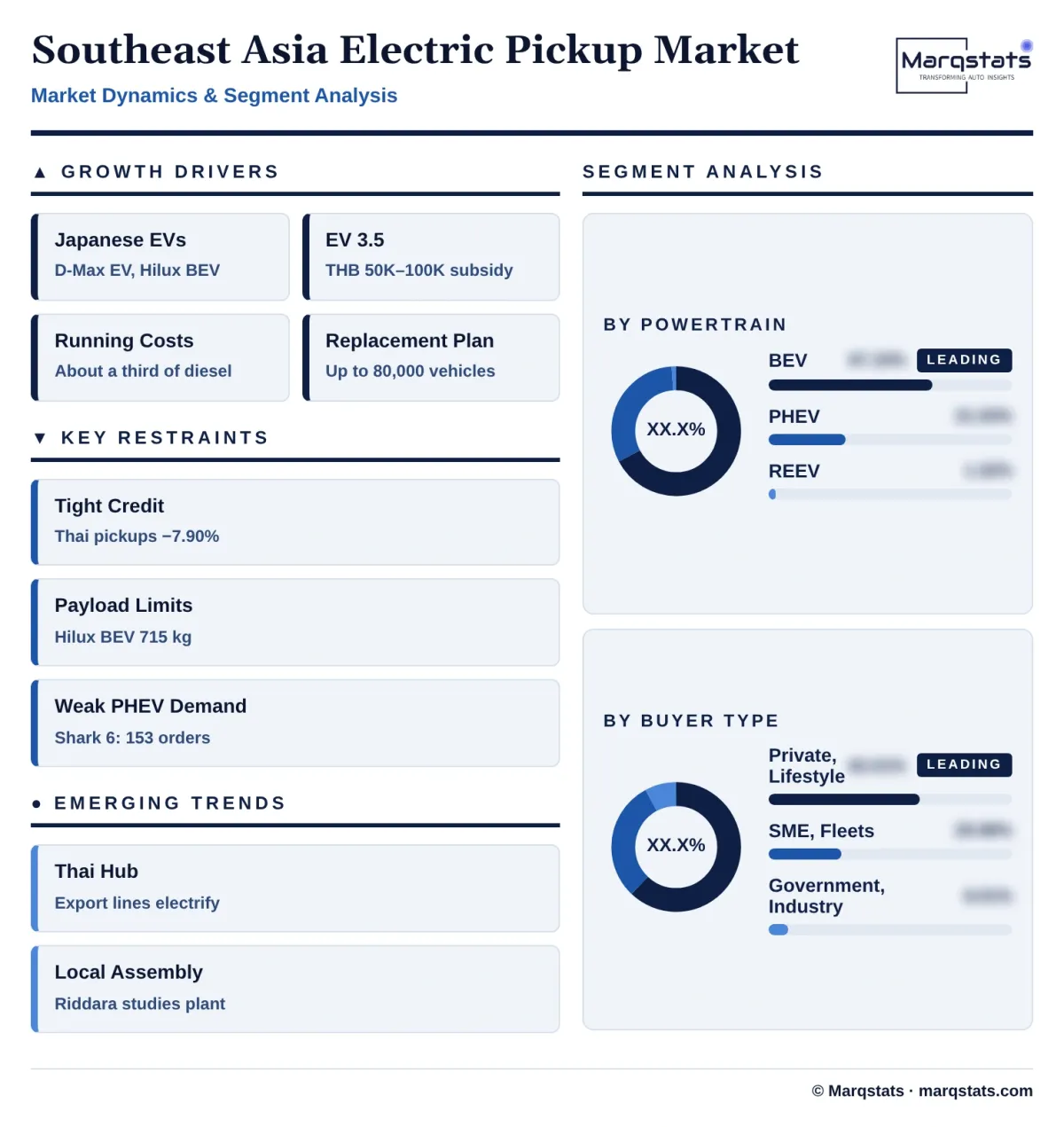
- Japanese pickups go electric. Isuzu's D-Max EV, with a 66.9 kWh battery, 331 km NEDC range, permanent four-wheel drive and a 140 kW, 325 Nm dual-motor drive, went on sale in Thailand on 23 March 2026 at THB 1.591 million, and Toyota's Hilux BEV, with a 59.2 kWh battery and 144 kW from front and rear eAxles, followed in Malaysia from RM 226,300. Buyers who would not consider an unfamiliar brand can now buy an electric version of the truck they already own.
- Thai subsidies and excise relief. Thailand's EV 3.5 package, approved in November 2023 for 2024 to 2027, pays THB 50,000 to 100,000 for electric pickups priced up to THB 2 million with at least 50 kWh of battery, and pairs the subsidy with local production obligations of two locally built EVs for each imported EV in 2026 and three in 2027.
- Low running costs for high-mileage users. A pickup driving 30,000 km a year on depot charging at about THB 4.20 per kWh spends roughly a third of what a diesel double-cab spends on fuel. The savings are largest for contractors, distributors and government fleets that drive daily on fixed routes.
- A new vehicle replacement programme. In July 2026 Thailand was studying a THB 24 billion programme, about USD 714 million, to replace up to 80,000 older vehicles with EVs, with pickups expected to be included, in response to weak domestic demand and tight lending.
- Range extenders remove charging anxiety. The Deepal Hunter K50 pairs a 31.18 kWh battery with a 2.0-litre petrol generator for about 131 to 145 km of electric driving and more than 1,000 km in total, which suits provincial buyers without home or depot charging.
- Corporate fleet targets. Logistics, energy and mining companies with emissions targets are adding electric pickups to service fleets, and the Philippine EV Industry Development Act requires a share of corporate and government fleets to be electric, which favours trucks with full payload ratings.
Key Restraints
Five constraints keep electric pickups below 1% of the region's largest market.
- Tight credit. High household debt and strict bank lending cut Thai one-tonne pickup production for the domestic market by 7.90% in 2025 to 165,702 units, and Isuzu expected a flat market of about 140,000 units in 2026. Electric pickups cost more than diesel ones, so loan rejections hit them hardest.
- Payload and towing trade-offs. Battery packs add weight and the first electric pickups carry less than diesel trucks; the Hilux BEV sold in Malaysia is rated for up to 715 kg of payload, against about one tonne for diesel versions, which matters to farmers and builders who routinely overload.
- Price premiums on the trucks fleets buy. At THB 1.45 to 1.59 million, ladder-frame BEVs cost far more than a diesel double-cab at around THB 850,000, so their five-year cost advantage depends on high mileage and the EV 3.5 subsidy.
- Thin charging away from cities. Public DC charging is concentrated in Bangkok, Metro Manila, Klang Valley and Jakarta, while pickups are used most in provinces, plantations and mining areas.
- Weak plug-in hybrid demand in Thailand. BYD cancelled the Shark 6 in Thailand in August 2025 after only 153 orders at about THB 1.699 million, showing that Thai buyers will not pay a large premium for a plug-in hybrid pickup without a subsidy.
- Unproven resale values. Electric pickups have been on sale in volume only since 2025, so there is no used-vehicle price history, and lenders and fleet buyers value them cautiously.
Key Trends
Four shifts are changing who builds electric pickups and how they are sold.
- Thailand as the regional and export hub. Isuzu builds the D-Max EV at Samrong for Thailand, the United Kingdom, Europe, Norway and Australia, Toyota builds the new Hilux in Thailand for regional markets, and Thailand's Board of Investment approved THB 1.49 billion in October 2026 for Toyota to build 3,000 hydrogen fuel cell Hilux a year at Ban Pho from December 2027.
- Chinese brands consider local assembly. Riddara said in February 2026 that it was studying a Thai plant to support its 3,000 to 5,000 unit target and sales in Laos, Myanmar, the Philippines and Malaysia, following Changan's plant in Rayong.
- Commercial variants for SMEs. Riddara launched the RD6 Econ in Laos and the Philippines in October 2025, a BEV work version with a 1,765 mm bed and 1,235 kg loading capacity, and brought it to Thailand in November 2025.
- Vehicle-to-load as a selling point. Electric pickups offer exportable power from the bed, about 6 kW on the RD6, which contractors, campers and emergency services use in place of generators.
- Multiple powertrains on one platform. Toyota offers the new Hilux with diesel, 48 V hybrid, battery-electric and, from 2027, fuel cell versions, and Riddara sells the RD6 as a BEV and a plug-in hybrid in other markets, so manufacturers can shift production between powertrains as demand changes.
Strategic Implications
- For Japanese pickup makers, the electric version protects the brand rather than replacing diesel. Toyota and Isuzu should price and finance their BEVs for fleet buyers with fixed routes and depot charging, where five-year savings are clearest, while keeping diesel and hybrid pickups for the rest of the market.
- For Chinese entrants, Thailand's offset rules make local assembly the price of staying in the market. Brands that import pickups under EV 3.5 must build two or three EVs locally for each import, and a Thai plant also opens the Philippines, Malaysia and Laos.
- For fleets and SMEs, electric pickups pay where mileage is high and routes are predictable. Delivery, utilities, estate maintenance and government fleets that return to a depot each night can capture the running cost saving without depending on public charging.
- For lenders and leasing companies, residual value is the open question. With no used electric pickup market yet, finance companies that offer battery guarantees or buyback programmes can win buyers that banks currently turn away.
- For governments, pickups are the lever on rural emissions. Thailand's EV 3.5 subsidy, the Philippine EV Industry Development Act and Malaysia's diesel subsidy reform each touch pickups differently; including pickups explicitly in vehicle replacement programmes would speed the shift more than general EV incentives have.
- For component and charging suppliers, pickups need different products. Durable battery packs protected inside ladder frames, 11 kW AC and 50 to 150 kW DC charging at depots, and service networks in provincial towns are the gaps that will decide how fast electric pickups move beyond city buyers.
Market Segmentation
Battery-electric pickups account for 67.15% of 2025 value, USD 23.38 million and about 841 units, rising to USD 383.50 million and about 13,000 units by 2030, a 74.98% CAGR, while their share rises to 71.87%. The Riddara RD6 accounted for most 2025 sales; the Isuzu D-Max EV and Toyota Hilux BEV lead growth from 2026.
Plug-in hybrid pickups account for 31.53% of 2025 value, USD 10.98 million and about 324 units, almost all BYD Shark 6 sales in the Philippines, rising to USD 111.60 million and about 3,600 units by 2030, a 59.01% CAGR, while their share falls to 20.91% because Thai buyers have not adopted them.
Range-extended pickups account for 1.32% of 2025 value, USD 0.46 million and about 15 units, and grow fastest, at 142.40% a year, to USD 38.50 million, about 1,400 units and 7.22% of the market by 2030, led by the Deepal Hunter K50 built by Changan.
Private owners using pickups as family, leisure and personal business vehicles account for 62.01% of 2025 value, USD 21.59 million, and grow at 61.90% a year to USD 240.12 million, while their share falls to 45.00% as fleet buying grows.
Small businesses, contractors, distributors and leasing fleets account for 29.98% of 2025 value, USD 10.44 million, and grow at 84.65% a year to USD 224.11 million and 42.00% of 2030 value, as ladder-frame BEVs with full payload ratings and commercial variants such as the RD6 Econ reach the market.
Government agencies, utilities, mining and plantation operators and other institutional fleets account for 8.01% of 2025 value, USD 2.79 million, and grow at 90.16% a year to USD 69.37 million and 13.00% of the market by 2030, driven by fleet electrification rules and corporate emissions targets.
By Geography
Thailand
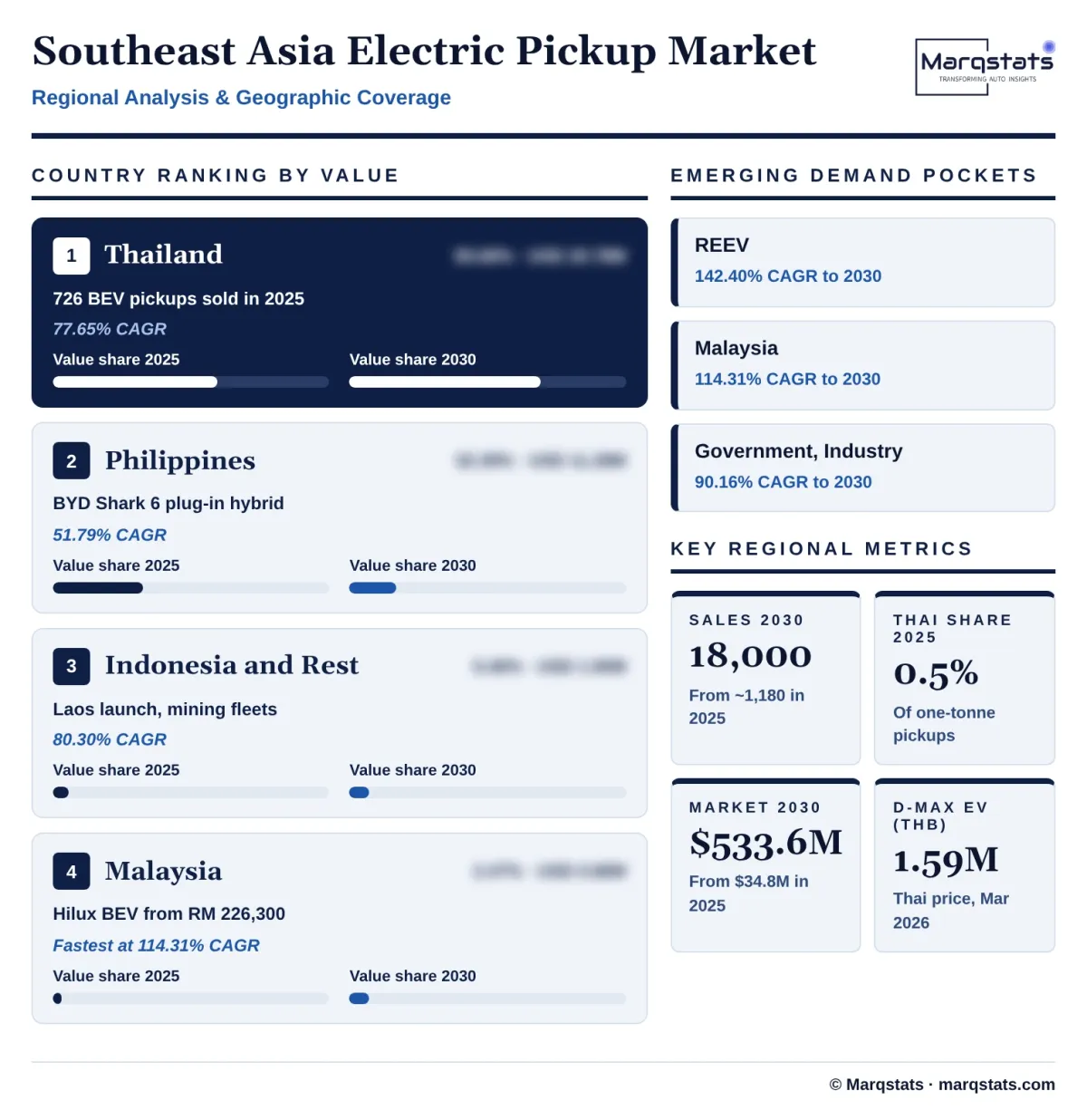
Thailand is the largest market, with 59.68% of 2025 value, USD 20.78 million and about 745 units, rising to USD 367.64 million and about 12,500 units by 2030, a 77.65% CAGR, and 68.90% of the market. The Federation of Thai Industries counted 726 battery-electric pickups sold in 2025, the Riddara RD6 led, and Isuzu and Toyota add locally built BEVs from 2026.
Philippines
The Philippines accounts for 32.39% of 2025 value, USD 11.28 million and about 340 units, and grows at 51.79% a year to USD 90.88 million by 2030, when its share falls to 17.03%. Plug-in hybrids, led by the BYD Shark 6 from PHP 2.098 million, dominate because charging is sparse outside Metro Manila; electrified vehicles of all types reached 58,905 sales in 2025.
Malaysia
Malaysia accounts for 2.47% of 2025 value, USD 0.86 million and about 30 units, and grows fastest, at 114.31% a year, to USD 38.88 million and 7.29% of 2030 value. Toyota launched the Hilux BEV from RM 226,300 in April 2026 with import duty and excise waived, and the end of blanket diesel subsidies in Peninsular Malaysia in June 2024 raised fleet fuel costs.
Indonesia and Rest of Southeast Asia
Indonesia, Laos, Myanmar, Cambodia and Vietnam account for 5.46% of 2025 value, USD 1.90 million and about 65 units, and grow at 80.30% a year to USD 36.20 million and 6.78% of the market by 2030. Riddara launched the RD6 Econ in Laos in October 2025, while Indonesian demand comes from mining and plantation fleets rather than the cab-over micro-trucks that dominate its light commercial sales.
How Competition Is Evolving
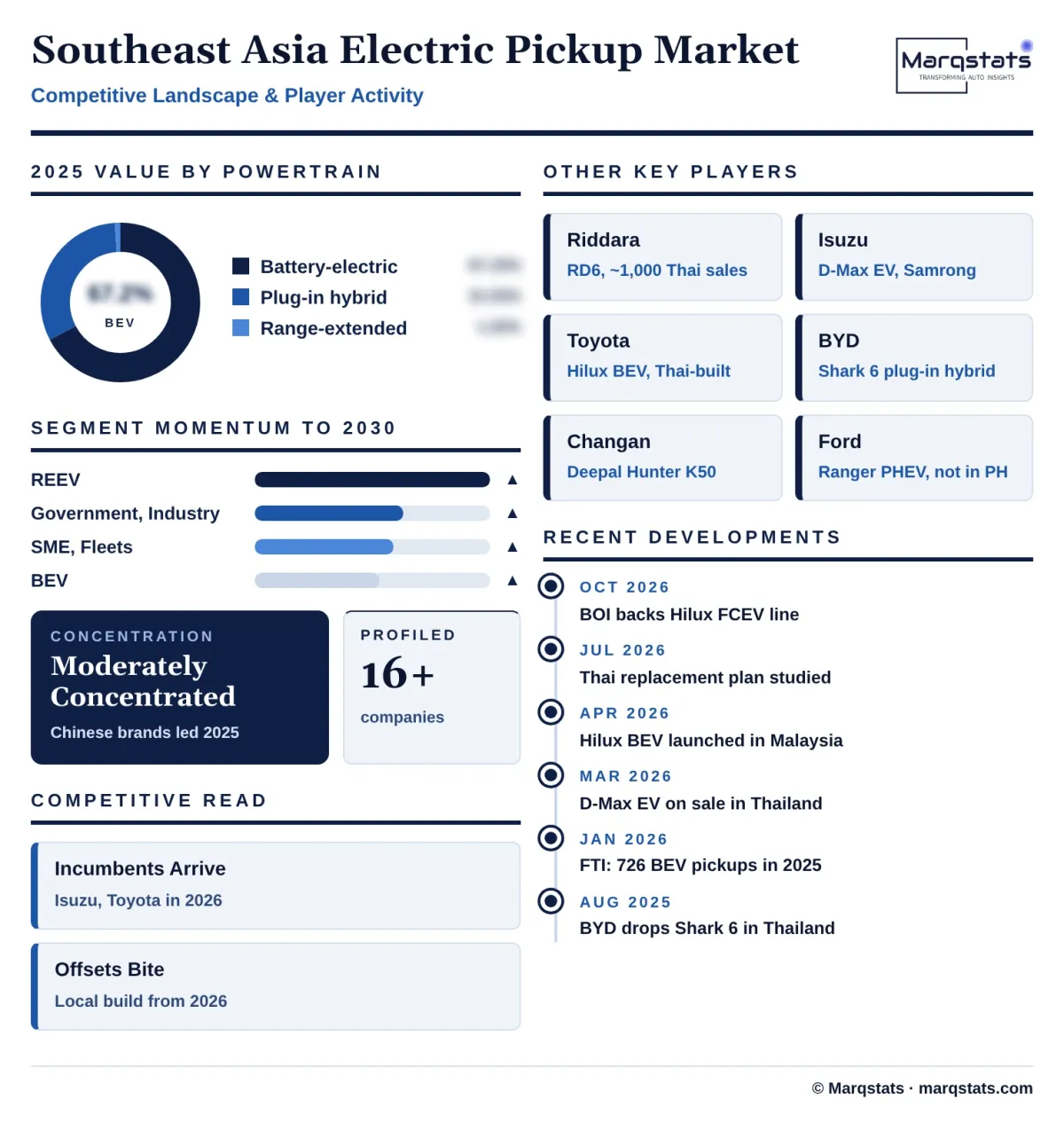
The Southeast Asia electric pickup market is moderately concentrated and changing hands. In 2025 a handful of Chinese brands supplied almost all sales: Riddara with the RD6 in Thailand, BYD with the Shark 6 in the Philippines and Changan with the Deepal Hunter K50. From 2026, Isuzu and Toyota, which together dominate diesel pickup sales, enter with battery-electric versions of the D-Max and Hilux.
Two product approaches compete. Riddara's RD6 uses a unibody platform with independent rear suspension and passenger-car refinement, priced close to a diesel double-cab, while Isuzu and Toyota keep ladder frames, leaf springs and four-wheel drive that match how pickups are used in farms, mines and construction.
Three powertrains compete for different buyers. Battery-electric pickups suit urban SMEs and fleets with depot charging, plug-in hybrids suit buyers who want long range, and range extenders offer electric driving with a petrol generator for provinces without charging.
Thai production capacity is the strategic asset. Toyota's Ban Pho and Samrong plants and Isuzu's Samrong plant build pickups for more than 100 export markets, so the brands that electrify those lines can supply the region at lower cost than importers once EV 3.5 offset obligations apply.
Barriers to entry are distribution and service. Pickup buyers in provinces expect dealers, parts and resale value; Riddara had 17 combined showrooms and service centres in Thailand in early 2026, while Toyota and Isuzu have national networks built over decades.
Price cuts signal the contest ahead. Riddara has cut its Thai prices since launch and widened its range with the RD6 Econ, while Isuzu priced the D-Max EV as a single fully equipped double-cab, so Chinese brands compete on price and choice and Japanese brands on durability, dealer reach and resale value.
Hybrids are a parallel battleground. Toyota sells 48 V hybrid Hilux models, Ford builds a Ranger plug-in hybrid in South Africa that it has not yet brought to the Philippines, and BYD's Shark 6 competes in the Philippines from PHP 2.098 million. Mild hybrids are outside this market, but they compete for the same buyers and slow the move to plug-in pickups.
Companies Covered
Companies covered in the report include:
Recent Market Activity
Table of Contents
Coverage & Segmentation
The study covers the Southeast Asia electric pickup market, with 2025 as the base year and 2026 – 2030 as the forecast period. Commercial sales began only in late 2024, so no earlier sales series is estimated. Values are in US dollars at average transaction prices excluding VAT, with prices converted at THB 33.74 and PHP 57.50 per USD, the 2025 annual averages. Volumes are new vehicle sales. The market is segmented by powertrain, buyer type and country.
Conventional and 48 V mild hybrid pickups, diesel and petrol pickups, cab-over micro-trucks and panel vans, aftermarket electric conversions, hydrogen fuel cell pickups and pickups built in Southeast Asia for export outside ASEAN are excluded. Thai electric pickups are part of the powertrain split in the Marqstats Thailand Pickup Truck report, which values the whole Thai pickup market at a different exchange rate, and the two figures should not be added together. Unit, price, buyer and country splits are Marqstats estimates built on industry association data, company disclosures and price lists.