Market Snapshot
Middle bar: base-year value × (1 + CAGR), rounded to two decimals. This is a calculated illustration, not a separately researched annual estimate.
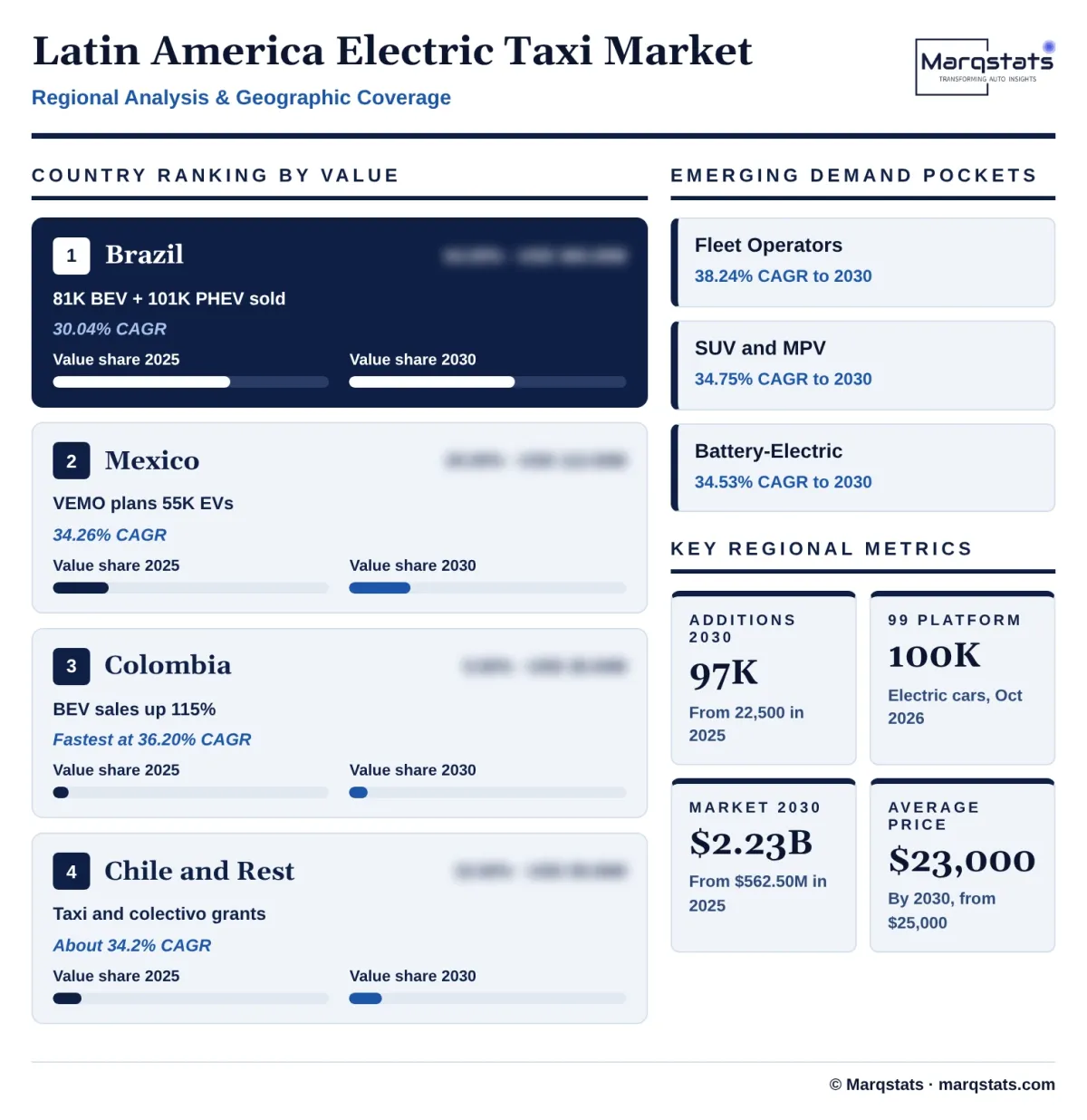
The Latin America electric taxi market size is estimated at USD 562.50 million in 2025 and is projected to reach USD 2,231.00 million by 2030, growing at a CAGR of 31.73% over 2026 – 2030. Annual additions of plug-in vehicles to paid passenger service rise from about 22,500 to 97,000, a 33.94% annual rate, while the average transaction price eases from about USD 25,000 to USD 23,000 per vehicle.
Marqstats defines the market as the transaction value, excluding VAT and registration fees, of new battery-electric (BEV) and plug-in hybrid (PHEV) cars that enter full-time paid passenger service in Latin America each year: licensed metered taxis and Chilean colectivos, cars bought by drivers who work full time on ride-hailing platforms such as 99, Uber, DiDi, inDrive and Cabify, and cars bought by fleet operators, rental and leasing companies that place them with platform drivers. The 2025 base therefore mixes two legal regimes: concession-based taxis and privately registered ride-hailing cars. Non-plug-in hybrids, petrol, ethanol and CNG cars, electric motorcycles and mototaxis, buses and vans, used vehicles, fares and charging revenue are excluded.
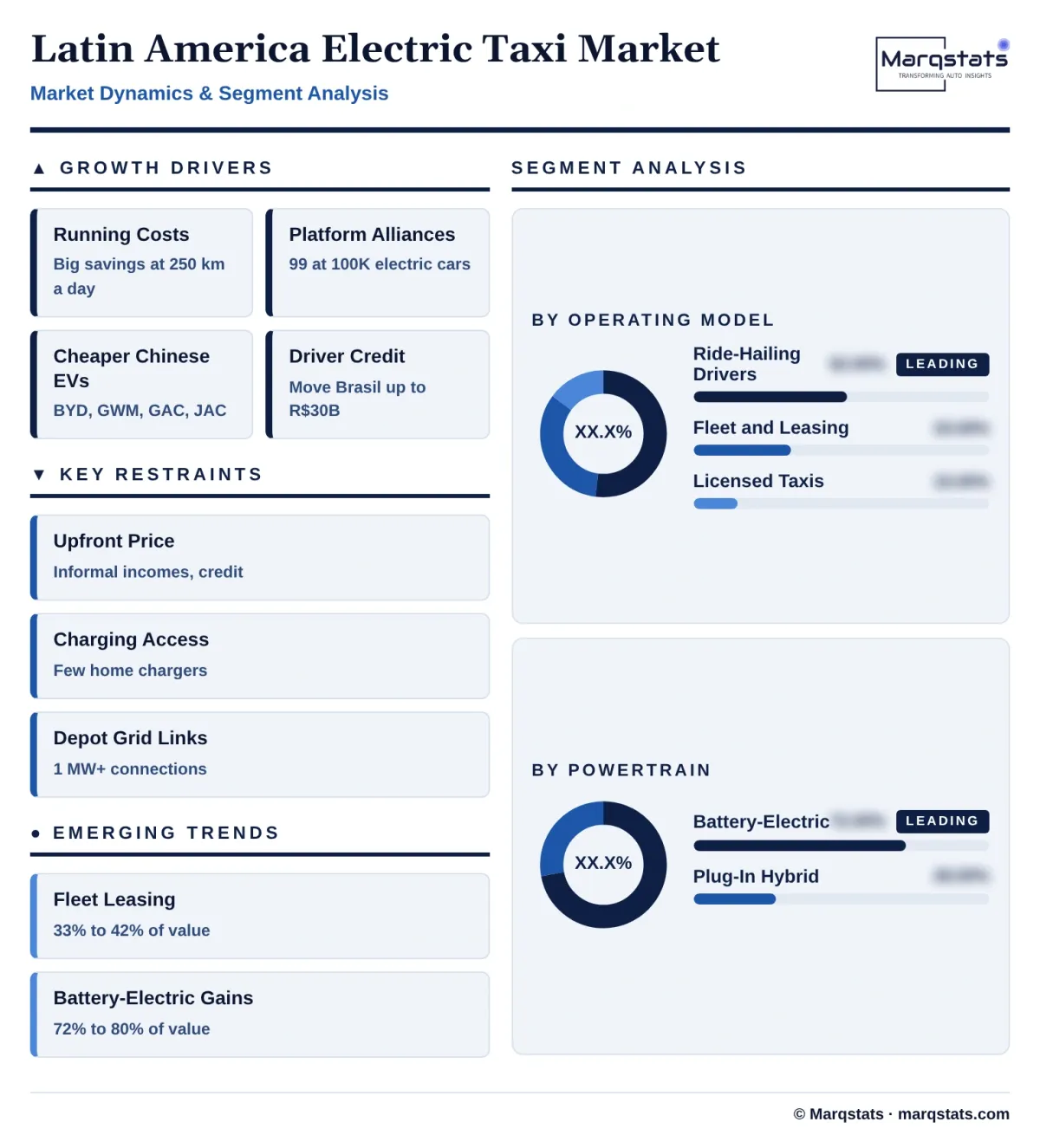
Driver-owned ride-hailing cars account for an estimated 52.00% of 2025 value, fleet and leasing operators for 33.00% and licensed taxis and colectivos for 15.00%. Battery-electric cars account for 72.00% of value. Brazil accounts for 64.00% of 2025 value and Mexico for 20.00%. The study segments the market by operating model, powertrain, body type and country.
Key Takeaways
Market Overview & Analysis
Report Summary
Marqstats sizes the Latin America electric taxi market as the transaction value of new battery-electric and plug-in hybrid cars that enter full-time paid passenger service each year. In 2025 about 22,500 such vehicles were added across the region, worth an estimated USD 562.50 million at an average transaction price of about USD 25,000, excluding VAT and registration fees.
Paid point-to-point rides in Latin America are now mostly booked through apps. Brazil's 99 and Uber, DiDi in Mexico, Colombia, Chile and Peru, inDrive and Cabify compete with metered taxis in every large city. Taxis remain regulated by city concessions and permits, with fixed liveries, taximeters and maximum vehicle ages, while ride-hailing cars are private vehicles registered by individual drivers or by rental and fleet companies. Marqstats covers both because buyers, models, financing and charging needs are the same: high-mileage cars that run 50,000 to 90,000 km a year.
Electric cars entered paid service through taxis first and ride-hailing later. Bogotá's BYD electric taxi pilot, running for about ten years, and early programmes in Santiago and Montevideo showed that electric cars could handle taxi duty cycles. Scale came when Chinese makers launched affordable electric hatchbacks and sedans in the region from 2023 and platforms built alliances with carmakers, banks, rental companies and charging operators to put drivers into them. The 99-led Aliança pela Mobilidade Sustentável grew from 23 companies in mid-2025 to 32 by September 2026.
The economics favour plug-in cars for drivers who work long shifts. A petrol or ethanol car covering 250 km a day can spend USD 15 to USD 25 a day on fuel, while an electric car charged at home or at a depot spends USD 4 to USD 8, and maintenance costs are lower because there are no oil changes, clutches or exhaust systems. Marqstats estimates that a full-time driver recovers the price premium of an electric car over a comparable combustion car in about 18 to 30 months, depending on fuel prices, daily distance and access to home charging.
The market grew from about 1,900 vehicles worth USD 57.95 million in 2021 to 3,800 in 2022, 7,400 in 2023 and 13,000 in 2024, worth USD 344.50 million, a 76.51% CAGR in value over 2021 – 2025. Marqstats expects about 37,000 additions worth USD 906.50 million in 2026, helped by Brazil's driver credit programme and record plug-in sales in Brazil and Mexico.
Regulation differs between taxis and ride-hailing. In Brazil, ride-hailing is regulated as private paid transport under Federal Law 13.640 of 2018, with rules set by cities, while taxi drivers hold municipal permits and can buy new cars free of IPI and, in many states, ICMS. In Mexico City, taxi concessions are regulated by the Ministry of Mobility, taxis must be replaced after 10 years, and electric cars are exempt from Hoy No Circula and the new car tax. In Chile, Law 21.553 regulates app transport companies, while taxis and colectivos need registration in the national public transport register. In Colombia, taxis keep their municipal quota when owners switch to electric cars.
Vehicle choice reflects long working days. Drivers favour compact hatchbacks and sedans with lithium iron phosphate batteries of 40 to 60 kWh, real urban ranges of 300 to 400 km and DC charging of 60 kW or more, so that one charge covers a full shift. Plug-in hybrids such as the BYD King and Song Pro are popular in Brazil because they can run long intercity trips. The purpose-built BYD D1, developed with DiDi, is used mainly by fleet operators in Mexico.
Latin America Electric Taxi Market Size and Forecast
The Latin America electric taxi market grows from USD 562.50 million in 2025 to USD 2,231.00 million in 2030, a CAGR of 31.73%. Marqstats expects about 52,000 additions worth USD 1,248.00 million in 2027, 67,000 worth USD 1,581.20 million in 2028 and 82,000 worth USD 1,910.60 million in 2029, before reaching 97,000 vehicles in 2030.
Volume grows faster than value because prices fall. The average transaction price eases from about USD 25,000 in 2025 to USD 23,000 in 2030 as battery packs get cheaper, local assembly in Brazil replaces imports and competition among BYD, GWM, Chery, GAC, JAC, Dongfeng and Renault increases. Brazil's R$ 150,000 price ceiling for Move Brasil financing, about USD 26,930 at BRL 5.57 per US dollar, also steers drivers toward compact models.
Penetration drives the forecast. Marqstats estimates that about 7.9% of Brazil's 2025 plug-in sales and about 14% of Mexico's went into paid passenger service. The forecast assumes the number of plug-in cars sold in the region more than doubles by 2030 while the share entering paid service rises slightly, as fleet operators and credit programmes reach more drivers.
The forecast is most sensitive to Brazilian volume and to price. Each 1,000 vehicles moves the 2025 market by about USD 25.00 million, and each USD 1,000 change in the average price moves it by about USD 22.50 million. Marqstats tracks four indicators to monitor the forecast: electrified car counts reported by 99, Uber and DiDi, Move Brasil approvals, Brazilian import tariffs and kit quotas, and VEMO fleet and charger additions in Mexico.
The mix changes over the forecast. Fleet and leasing operators rise from 33.00% to 42.00% of value, battery-electric cars from 72.00% to 80.00% and SUVs and MPVs from 25.00% to 28.00%. Brazil remains the largest country, but its share falls from 64.00% to 60.00% as Mexico rises to 22.00% and Colombia to 6.50%.
Registries do not split new cars by commercial use, so the base is a Marqstats construction. Marqstats combined national plug-in sales with platform disclosures, Move Brasil approvals, taxi programme counts and fleet operator announcements to estimate how many new plug-in cars went into full-time paid service in each country, and the split between taxis and ride-hailing carries more uncertainty than the regional total.
Market Dynamics
Key Drivers
Five forces are pushing taxi and ride-hailing drivers across Latin America into battery-electric and plug-in hybrid cars.
- Lower running costs for high-mileage drivers. Drivers covering 200 to 300 km a day spend far less on electricity than on petrol, ethanol or CNG, and pay less for maintenance, so plug-in cars pay back faster in paid service than in private use.
- Platform alliances and driver incentives. The 99-led Aliança pela Mobilidade Sustentável brings carmakers, banks, rental companies and charging operators together to offer discounts, financing and charging to drivers, and platforms offer electric-only categories such as 99electric-Pro, which operates in five Brazilian cities.
- Cheaper Chinese electric cars. BYD, GWM, Chery, GAC, JAC and Dongfeng sell electric hatchbacks and sedans in Brazil, Mexico, Colombia and Chile at prices close to well-equipped combustion cars, and offer long battery warranties that matter to high-mileage drivers.
- Credit aimed at drivers. Brazil's Move Brasil – Táxi e Aplicativos offers up to R$ 30 billion of BNDES-backed credit to taxi and app drivers for new flex, hybrid and electric cars, and banks such as Santander and Banco do Brasil have built products around platform income.
- Local incentives for taxis and electric cars. Mexico City pays up to MXN 200,000 to taxi concessionaires who replace old taxis with electric cars, Chile co-finances electric taxis and colectivos, Colombia caps VAT on electric vehicles at 5% and exempts them from driving restrictions under Law 1964 of 2019, and São Paulo exempts electric cars from its rodízio.
- Rising fuel and maintenance costs. Petrol and ethanol prices, and the high maintenance costs of combustion cars that run 60,000 km or more a year, make lower running costs the main reason drivers switch.
Key Restraints
Four constraints slow the switch from petrol, ethanol and CNG cars to plug-in vehicles in paid passenger service.
- Upfront price and credit. Even with falling prices, electric cars cost more than entry-level combustion cars, and many drivers have informal incomes that banks find hard to assess.
- Charging access. Many drivers live in apartments or informal housing without a parking space, so they depend on public fast chargers that may be busy, far from their routes or expensive at peak times.
- Grid connections for fleet depots. Fleet operators need medium-voltage connections of 1 MW or more for large depots, and utility upgrades can take many months in São Paulo, Mexico City and Bogotá.
- Residual value and insurance. Used-car prices for high-mileage electric cars are still uncertain, and some insurers charge more for electric cars in commercial use, which raises the monthly cost for drivers and lessors.
Key Trends
Four shifts are changing how electric taxis and ride-hailing cars are bought, financed and charged in Latin America.
- Rent-to-own and subscription models. Rental companies and fleet operators lease electric cars to drivers by the week or month, with maintenance, insurance and charging included, so drivers can start without a down payment.
- Fleet-owned charging hubs. Operators such as VEMO build dedicated fast-charging sites for drivers, with security, rest areas and maintenance, and VEMO had more than 1,400 connectors in 18 Mexican states in early 2026.
- Local assembly in Brazil. Rising tariffs on fully built imports and the end of the zero-tariff kit quota after 2026 push carmakers to assemble in Brazil, led by BYD in Camaçari.
- Electric-only service categories. Platforms are creating premium categories reserved for electric cars, such as 99electric-Pro, which give drivers more trips or higher fares and make electric cars more attractive.
Strategic Implications
- For carmakers, driver finance and durability decide sales. Long battery warranties, models priced under Move Brasil's R$ 150,000 ceiling, local spare parts and partnerships with platforms and lenders matter more than features.
- For fleet operators and rental companies, charging and utilisation decide returns. Double-shift rostering, depot charging at off-peak tariffs and maintenance programmes keep cars on the road for 70,000 to 90,000 km a year.
- For platforms, electric cars cut driver costs and emissions at the same time. Alliances with carmakers, banks and charging companies, electric-only categories and data on driver earnings help drivers qualify for credit.
- For lenders, platform income is the repayment source. Credit models that use trip histories and income from apps, as Move Brasil now allows, can extend finance to drivers who cannot document formal incomes.
- For cities, taxi programmes need more scale. Replacement programmes that reach only dozens of taxis a year will leave metered taxis behind ride-hailing cars, while larger grants, concession rules and charging at taxi ranks could speed up the change.
- For charging operators, drivers are the anchor customer. Fast-charging hubs near airports, bus terminals and dense neighbourhoods, with prices for drivers and off-peak tariffs, can reach high utilisation because taxi and ride-hailing cars charge every day.
Market Segmentation
Cars bought by individual drivers who work full time on ride-hailing platforms account for 52.00% of 2025 value, USD 292.50 million and about 11,700 vehicles, rising to USD 1,026.26 million by 2030, a 28.54% CAGR, while their share falls to 46.00%. Brazil dominates this segment, where drivers buy compact electric hatchbacks and plug-in hybrids on credit.
Cars bought by fleet operators, rental and leasing companies and placed with platform drivers account for 33.00% of 2025 value, USD 185.62 million, and grow fastest, at 38.24% a year, to USD 937.02 million and 42.00% of the market by 2030, led by VEMO in Mexico and rental companies such as Movida and Unidas in Brazil.
Metered taxis and shared colectivos replaced under city concessions account for 15.00% of 2025 value, USD 84.38 million, rising to USD 267.72 million by 2030, a 25.98% CAGR, while their share falls to 12.00%. Mexico City, Bogotá, Medellín, Santiago and Montevideo lead.
Battery-electric cars account for 72.00% of 2025 value, USD 405.00 million, and grow at 34.53% a year to USD 1,784.80 million and 80.00% of the market by 2030, because drivers who cover long daily distances in cities save most with them.
Plug-in hybrids account for 28.00% of 2025 value, USD 157.50 million, rising to USD 446.20 million by 2030, a 23.15% CAGR, while their share falls to 20.00%. They are used mainly by Brazilian drivers on intercity and airport routes and by drivers without reliable home charging.
Compact electric hatchbacks such as the BYD Dolphin Mini and Dolphin account for 40.00% of 2025 value, USD 225.00 million, rising to USD 803.16 million by 2030, a 28.98% CAGR, while their share falls to 36.00%.
Sedans, the traditional taxi body, account for 35.00% of 2025 value, USD 196.88 million, and grow at 32.47% a year to USD 803.16 million and 36.00% of the market by 2030, led by models such as the GAC Aion ES, Dongfeng S50 EV and BYD King.
SUVs and MPVs, including the purpose-built BYD D1, account for 25.00% of 2025 value, USD 140.62 million, and grow fastest, at 34.75% a year, to USD 624.68 million and 28.00% of the market by 2030, as premium ride-hailing categories and accessible taxis ask for more space.
By Geography
Brazil
Brazil is the largest market, with 64.00% of 2025 value, USD 360.00 million and about 14,400 vehicles, rising to USD 1,338.60 million by 2030, a 30.04% CAGR, while its share falls to 60.00%. Brazil registered 80,178 battery-electric and 101,364 plug-in hybrid light vehicles in 2025, and the 99 platform alone reached 100,000 electric cars in October 2026, present in 194 municipalities. Move Brasil – Táxi e Aplicativos had approved R$ 2.2 billion of credit for 21,720 drivers by the end of July 2026, and taxi drivers also benefit from federal and state tax exemptions on new cars. São Paulo, Brasília and Belo Horizonte are the largest city markets for electrified cars, and São Paulo exempts electric cars from its rodízio driving restriction.
Mexico
Mexico accounts for 20.00% of 2025 value, USD 112.50 million and about 4,500 vehicles, and grows at 34.26% a year to USD 490.82 million and 22.00% of the market by 2030. Mexico sold 17,332 battery-electric and 8,491 plug-in hybrid cars in January to October 2025, with Mexico City the largest state market. VEMO's plan to add about 55,000 electric vehicles by 2030 and Mexico City's taxi replacement grants support growth, while electric cars are exempt from the Hoy No Circula restrictions. Fleet operators place cars with Uber and DiDi drivers on double shifts and charge them at dedicated hubs, which gives Mexico the highest share of fleet-owned vehicles in the region.
Colombia
Colombia accounts for 5.50% of 2025 value, USD 30.94 million, and grows fastest, at 36.20% a year, to USD 145.01 million and 6.50% of the market by 2030. Colombia registered 19,724 battery-electric vehicles in 2025, up 115%, and Law 1964 of 2019 caps VAT on electric vehicles at 5%, exempts them from pico y placa and allows lower vehicle taxes. Bogotá extended its electric taxi pilot in 2023 and aims to convert its whole taxi fleet to electric by 2035.
Chile
Chile accounts for 4.50% of 2025 value, USD 25.31 million, rising to USD 100.39 million by 2030, a 31.73% CAGR. The Mi Taxi Eléctrico programme co-finances electric taxis and colectivos with up to CLP 15 million to CLP 16 million per vehicle, plus a home charger, and more than 250 electric vehicles were working in public small transport by mid-2025. Ride-hailing drivers in Santiago add most of the volume.
Rest of Latin America
Peru, Uruguay, Costa Rica, Ecuador, Argentina and other countries account for 6.00% of 2025 value, USD 33.75 million, rising to USD 156.17 million by 2030, a 35.85% CAGR. Uruguay has supported electric taxis since the late 2010s, including a USD 5,000 grant per vehicle for taxi, remise and app-car permit holders in 2022 – 2023, and Costa Rica's tax exemptions for electric cars support ride-hailing adoption in San José.
How Competition Is Evolving
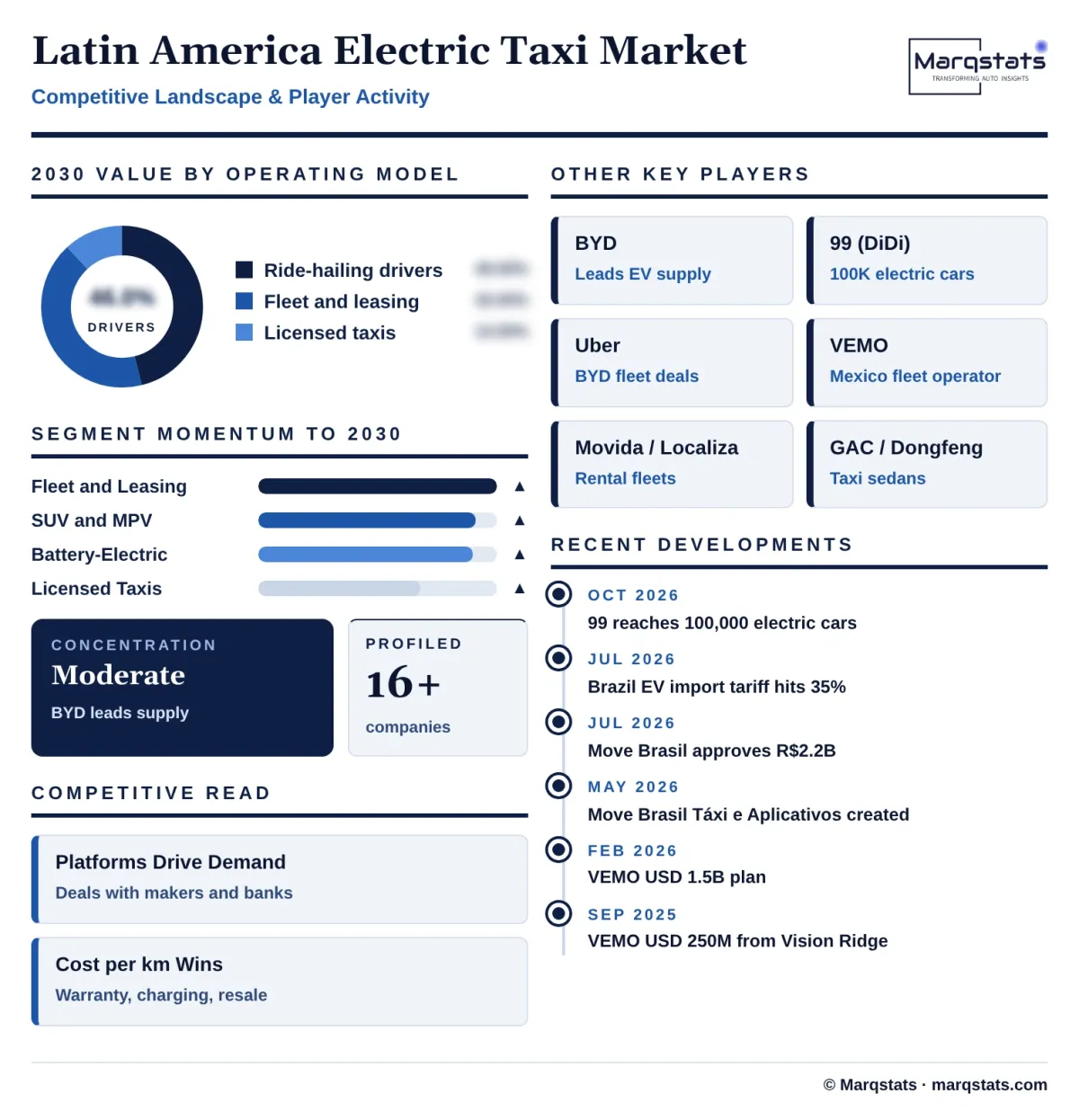
The Latin America electric taxi market is moderately concentrated on the supply side. BYD supplies the largest share of electric cars in paid service in Brazil and Mexico, followed by GWM, Chery, GAC, JAC, Dongfeng, Renault and Nissan, while demand is spread across tens of thousands of individual drivers and a few large fleet operators.
Platforms shape demand without owning cars. 99, Uber and DiDi avoid holding vehicles on their balance sheets and instead negotiate discounts with carmakers, financing with banks and charging with energy companies, and offer drivers electric-only categories and incentives.
Fleet operators and rental companies are the second channel. VEMO in Mexico and Movida, Unidas, Localiza and smaller rental companies in Brazil buy electric cars in volume and lease them to drivers, competing on weekly rates, uptime and charging access.
Competition is moving to total cost per km. Battery warranties of up to 500,000 km, maintenance packages, guaranteed resale values and charging bundles are becoming more important than the list price, and makers with local assembly and spare parts will gain share as tariffs rise.
Charging companies are part of the competition. Raízen, Enel X Way, EzVolt, Tupi Mobilidade and VEMO's Watts network offer drivers discounted fast charging, and the alliance led by 99 aims to connect more than 1,500 chargers on a single platform, so access to cheap charging is becoming part of what platforms and fleets offer drivers.
Companies Covered
Companies covered in the report include:
Recent Market Activity
Table of Contents
Coverage & Segmentation
The study covers the Latin America electric taxi market, with 2025 as the base year, 2021 – 2025 as the historical period and 2026 – 2030 as the forecast period. Values are in US dollars at transaction prices excluding VAT and registration fees, converted at 2025 average exchange rates, including BRL 5.57 per US dollar, and volumes are annual additions of new plug-in cars to full-time paid passenger service. The market is segmented by operating model, powertrain, body type and country.
The market combines licensed taxis and colectivos with cars used full time on ride-hailing platforms; private cars used for occasional trips, non-plug-in hybrids, petrol, ethanol and CNG cars, electric motorcycles and mototaxis, buses and vans, used vehicles, fares and charging revenue are excluded. These vehicles are also counted in the Marqstats Brazil Electric Vehicle and Colombia Electric Vehicle studies, and purpose-built taxis such as the BYD D1 sold in the region are also counted in the Marqstats Global Electric Purpose-Built Taxi study, so the figures should not be added. Operating model, powertrain, body type and country splits are Marqstats estimates built on registration data, platform disclosures, programme data, fleet operator announcements and price benchmarks.