Market Snapshot
Middle bar: base-year value × (1 + CAGR), rounded to two decimals. This is a calculated illustration, not a separately researched annual estimate.
The global electric pickup truck market size is estimated at USD 10,600.00 million in 2025 and is projected to reach USD 27,120.00 million by 2030, growing at a CAGR of 20.67% over 2026 – 2030. Deliveries rise from about 186,000 vehicles to 565,000, a 24.88% annual rate, while the average transaction price falls from about USD 57,000 to USD 48,000 as mid-size plug-in hybrids from China replace high-priced full-size battery-electric trucks as the main source of growth.
Marqstats defines the market as the transaction value of new pickup trucks with a battery-electric, plug-in hybrid or extended-range electric powertrain, sold to private buyers and fleets. It covers full-size, mid-size and compact pickups with an open cargo bed. Mild and full hybrids that cannot be charged from the grid, electric vans and chassis cabs, aftermarket electric conversions, charging equipment and financing are excluded.
Battery-electric pickups account for an estimated 74.53% of 2025 value and full-size trucks for 66.98%. North America accounts for 64.76% of 2025 value and China for 20.66%. The study segments the market by powertrain, size class, end use and region.
Key Takeaways
Market Overview & Analysis
Report Summary
Marqstats sizes the electric pickup truck market as the transaction value of new pickups with a battery-electric, plug-in hybrid or extended-range electric powertrain. In 2025 about 186,000 such pickups were delivered worldwide, worth an estimated USD 10,600.00 million at an average transaction price of about USD 57,000.
The market grew quickly from a small base. Marqstats estimates about 18,500 electric pickups were delivered in 2021, worth USD 1,150.00 million, rising to 52,000 in 2022, 108,000 in 2023 and 165,000 in 2024, worth USD 11,800.00 million. Value fell in 2025 to USD 10,600.00 million even though volume grew 12.73%, because high-priced full-size battery-electric trucks lost sales in the United States while lower-priced plug-in hybrids from China grew.
Pickups are harder to electrify than cars. They carry heavy loads and tow trailers, and a large battery adds weight that reduces payload. The battery-electric Ford F-150 Lightning used a battery of up to 131 kWh, and the Chevrolet Silverado EV a battery of about 205 kWh. When towing a large trailer, energy use per mile can more than double, cutting highway range by around two thirds and forcing drivers to unhitch at charging stations that are not designed for trailers.
Carmakers have responded with smaller batteries and engines. Extended-range pickups use a battery for daily driving and an engine that only generates electricity, such as the Ram 1500 extended-range truck with a 92 kWh battery and a 3.6-litre V6 generator, claimed to give about 690 miles of combined range and 14,000 lb of towing. Plug-in hybrids such as the BYD Shark 6 and Ford Ranger PHEV use smaller batteries of around 12 to 30 kWh with an engine that can drive the wheels, keeping towing capacity of up to 3,500 kg.
The market is splitting by region. In North America, sales of full-size battery-electric pickups fell in 2025 after the federal clean vehicle credit ended on 30 September 2025, and carmakers wrote down billions of dollars of investment. In China, Australia, Latin America and parts of Europe, mid-size plug-in hybrid and battery-electric pickups, mostly from Chinese brands, are growing quickly. Plug-in hybrid and extended-range trucks rose from under 10% of deliveries before 2024 to an estimated 38.71% in 2025.
Three groups compete. North American carmakers Ford, General Motors and Stellantis are moving from battery-electric to extended-range and hybrid trucks. Battery-electric specialists Tesla and Rivian are adjusting production to lower demand. Chinese carmakers BYD, Great Wall Motor, Geely, Chery, Changan, JAC and SAIC Maxus are expanding exports of lower-priced plug-in hybrid and battery-electric pickups.
Prices vary widely by region. Full-size battery-electric pickups in North America often sell for USD 60,000 to more than USD 90,000, while Chinese battery-electric work pickups such as the Chery Rely R08 EV start at about USD 18,000 and plug-in hybrid pickups such as the BYD Shark 6 sell for about AUD 58,000 in Australia. As the mix shifts towards lower-priced mid-size models, the global average price falls even though North American extended-range trucks remain expensive.
Global Electric Pickup Truck Market Size and Forecast
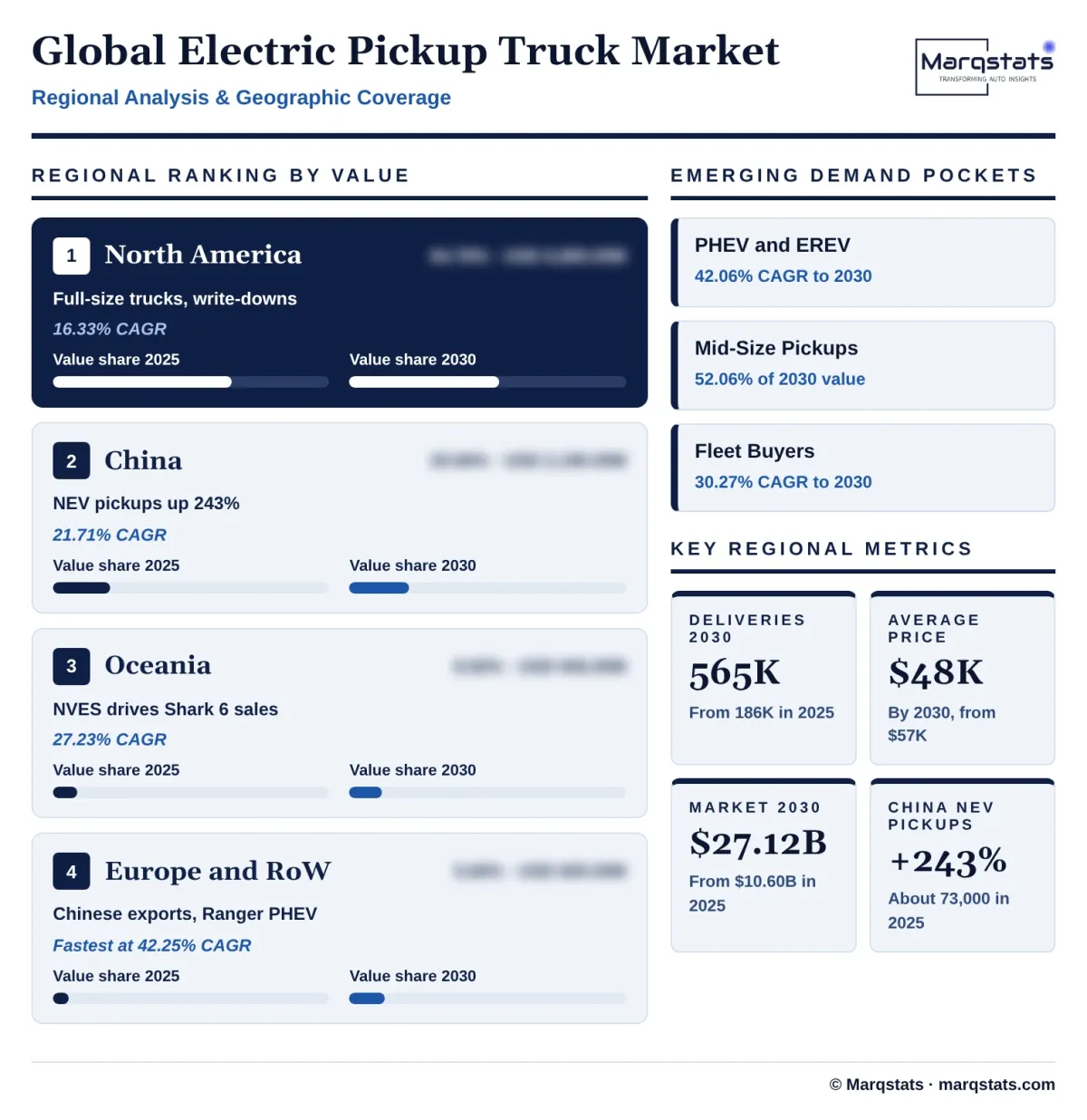
The global electric pickup truck market grows from USD 10,600.00 million in 2025 to USD 27,120.00 million in 2030, a CAGR of 20.67%. Marqstats expects deliveries of about 245,000 worth USD 13,230.00 million in 2026, 335,000 worth USD 17,420.00 million in 2027, 440,000 worth USD 21,900.00 million in 2028 and 505,000 worth USD 24,640.00 million in 2029, reaching 565,000 worth USD 27,120.00 million in 2030.
Volume grows faster than value. Deliveries grow at 24.88% a year and value at 20.67%, because the average transaction price falls from about USD 57,000 to USD 48,000 as lower-priced mid-size pickups from China take a larger share and high-priced full-size battery-electric trucks lose share.
The powertrain mix changes. Battery-electric pickups fall from 61.29% of deliveries in 2025 to 44.25% in 2030, while plug-in hybrid and extended-range pickups rise from 38.71% to 55.75%. In value terms, battery-electric pickups grow from USD 7,900.00 million to USD 11,500.00 million, a 7.80% CAGR, and plug-in hybrid and extended-range pickups from USD 2,700.00 million to USD 15,620.00 million, a 42.06% CAGR.
The regional mix changes too. North America's share of deliveries falls from 43.01% to 34.51% and its share of value from 64.76% to 53.93%. China's share of deliveries rises slightly from 39.25% to 39.82%, Oceania's from 11.29% to 13.27%, and Europe and the rest of the world from 6.45% to 12.39%.
Fleet economics differ by use. Marqstats estimates that over five years and 100,000 miles without heavy towing, a full-size battery-electric pickup costs about USD 65,300 to own, against USD 58,800 for a full-size diesel truck and USD 49,800 for a mid-size plug-in hybrid. With regular heavy towing and public fast charging, the battery-electric truck costs about USD 87,400, against USD 78,800 for diesel and USD 66,200 for the plug-in hybrid. These figures explain why fleets favour plug-in hybrids for mixed use.
Marqstats tracks four indicators to monitor the forecast: Chinese pickup exports, sales of extended-range pickups in North America, light commercial vehicle emission limits in Australia and Europe, and battery prices. Faster launches of extended-range trucks in North America or stricter emission limits would lift deliveries above the forecast, while new trade barriers on Chinese pickups would slow growth outside China.
Size class and end use also shift. Mid-size and compact pickups rise from 33.02% to 52.06% of value as Chinese plug-in hybrids and the Ford Ranger PHEV grow, and Ford plans an affordable mid-size electric pickup for 2027. Commercial and fleet buyers rise from 30.00% to 43.99% of value as lower-priced work pickups and mobile power features make electrified pickups useful on job sites, farms and in municipal fleets.
Market Dynamics
Key Drivers
Five forces are expanding sales of electrified pickup trucks outside the United States.
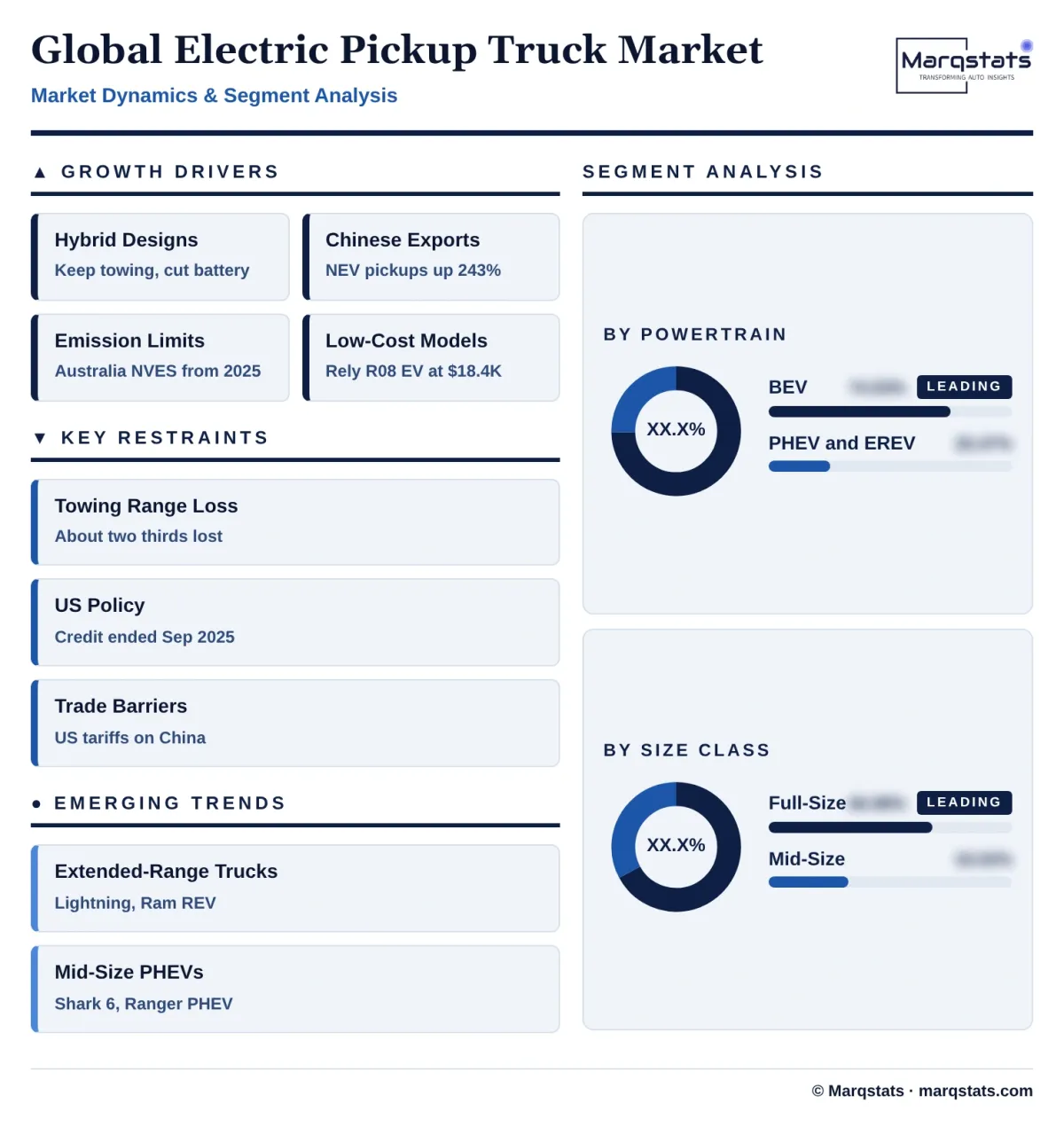
- Hybrid designs solve the towing problem. Plug-in hybrid and extended-range pickups keep towing capacity and long range while using a smaller battery, making electrified pickups practical for work and leisure towing.
- Chinese exports are growing. China sold about 73,000 new energy pickups in 2025, up 243%, and exported about 300,000 pickups of all types, about half its total sales. BYD sold 39,466 pickups in 2025, mostly overseas.
- Emission standards cover light commercial vehicles. Australia's New Vehicle Efficiency Standard sets falling CO2 limits for utes and vans from July 2025, and European CO2 rules for vans push carmakers to sell electrified pickups.
- Low-cost models widen the market. Chery launched the battery-electric Rely R08 EV in China in January 2026 from RMB 127,800, about USD 18,370, and Ford plans an affordable mid-size electric pickup for 2027.
- Fleets use pickups as mobile power. Electrified pickups can power tools and equipment on job sites, and models such as the Ram extended-range truck offer onboard power outlets of up to 7.2 kW.
Key Restraints
Four constraints limit how fast pickups can move to electric power.
- Range loss when towing. A full-size battery-electric pickup can lose around two thirds of its highway range when towing a large trailer, and few charging stations allow vehicles with trailers to pull through.
- US policy changes. The USD 7,500 federal clean vehicle credit ended on 30 September 2025, and the Environmental Protection Agency repealed vehicle greenhouse gas standards in February 2026, reducing both buyer incentives and regulatory pressure in the largest pickup market.
- Weight limits in Europe. Pickups up to 3,500 kg gross weight can be driven on a standard car licence, but a heavy battery reduces payload, and heavier vehicles may face commercial vehicle rules such as tachographs and lower speed limits.
- Trade barriers. High US tariffs on Chinese vehicles keep Chinese electric pickups out of the United States, and other markets may raise duties as imports grow.
Key Trends
Four shifts are changing which electric pickups are built and who buys them.
- Extended-range trucks replace battery-only full-size pickups. Ford is replacing the battery-only F-150 Lightning with an extended-range version, and Ram's extended-range truck now carries the 1500 REV name after the battery-only model was cancelled.
- Mid-size plug-in hybrids lead outside North America. The BYD Shark 6, Ford Ranger PHEV, Great Wall Motor Poer hybrids and Geely Radar models target buyers who need towing and payload with lower running costs.
- Lithium iron phosphate batteries cut costs. Chinese pickups and Ford's planned mid-size electric pickup use lithium iron phosphate cells, which are cheaper and longer lasting than nickel-based cells.
- Chinese brands localise production. Chinese carmakers are setting up assembly in Thailand, Brazil and other markets to reduce import duties and shipping costs.
Strategic Implications
- For North American carmakers, extended-range designs protect the profit pool. Extended-range and hybrid full-size trucks let carmakers keep towing capability and margins while lowering battery cost and weight.
- For Chinese carmakers, export markets are the opportunity. Mid-size plug-in hybrid pickups priced below diesel competitors can win share in Australia, Latin America, the Middle East, Africa and Southeast Asia, where US tariffs do not apply.
- For fleets, duty cycle decides the powertrain. Battery-electric pickups suit predictable urban routes with depot charging, while plug-in hybrids and extended-range trucks suit mixed use and regular towing.
- For battery suppliers, smaller packs change demand. A shift from 130 to 200 kWh packs to 12 to 92 kWh packs reduces battery demand per pickup but increases the number of vehicles that use one.
- For regulators, weight rules affect adoption. Allowing heavier electrified light commercial vehicles on standard licences without commercial vehicle restrictions would help battery-electric pickups compete in Europe.
- For investors, the shift changes where value sits. North American full-size trucks still carry the highest prices, but the fastest growth in units and value comes from mid-size plug-in hybrids sold in markets outside the United States, where Chinese carmakers have a cost advantage of several thousand dollars per vehicle.
Market Segmentation
Battery-electric pickups account for 74.53% of 2025 value, USD 7,900.00 million and about 114,000 vehicles, and grow at 7.80% a year to USD 11,500.00 million, 42.40% of value by 2030. North American full-size trucks such as the Ford F-150 Lightning, Chevrolet Silverado EV, GMC Sierra EV, Tesla Cybertruck and Rivian R1T dominated 2025 value, while lower-priced Chinese models such as the Chery Rely R08 EV and Geely Radar pickups add volume.
Plug-in hybrid and extended-range pickups account for 25.47% of 2025 value, USD 2,700.00 million and about 72,000 vehicles, and grow fastest, at 42.06% a year, to USD 15,620.00 million and 57.60% of value by 2030. The BYD Shark 6, Ford Ranger PHEV, Great Wall Motor plug-in hybrids and the Ram 1500 extended-range truck lead this segment.
Full-size pickups account for 66.98% of 2025 value, USD 7,100.00 million, and grow at 12.86% a year to USD 13,000.00 million and 47.94% of value by 2030, as North American carmakers move from battery-electric to extended-range designs.
Mid-size and compact pickups account for 33.02% of 2025 value, USD 3,500.00 million, and grow at 32.18% a year to USD 14,120.00 million and 52.06% of value by 2030, led by Chinese plug-in hybrid and battery-electric models and the Ford Ranger PHEV.
Private and lifestyle buyers account for 70.00% of 2025 value, USD 7,420.00 million, and grow at 15.41% a year to USD 15,190.00 million, 56.01% of value by 2030.
Commercial and fleet buyers account for 30.00% of 2025 value, USD 3,180.00 million, and grow at 30.27% a year to USD 11,930.00 million and 43.99% of value by 2030, as lower-priced work pickups and plug-in hybrids that keep towing capacity reach business fleets.
By Geography
North America
North America is the largest market by value, with an estimated 64.76% of 2025 value, USD 6,865.00 million and about 80,000 vehicles, rising to USD 14,625.00 million by 2030, a 16.33% CAGR, while its share falls to 53.93%. Ford sold 27,307 F-150 Lightning trucks in the United States in 2025 before ending battery-only production in December 2025 and taking a USD 19.5 billion charge. General Motors sold 11,275 Silverado EVs and 7,996 Sierra EVs in the United States, recorded about USD 6 billion of electric vehicle charges in the fourth quarter of 2025 and moved its Orion plant to petrol trucks and SUVs. Tesla Cybertruck US sales fell 48% to 20,237, and fell further to 3,519 in the first quarter of 2026. Growth comes from extended-range trucks from Ford and Ram and from new lower-priced models.
China
China accounts for an estimated 20.66% of 2025 value, USD 2,190.00 million and about 73,000 vehicles, and grows at 21.71% a year to USD 5,850.00 million and 21.57% of value by 2030. New energy pickup sales rose 243% in 2025 to about 73,000, about 12% of the 589,000 pickups sold. Great Wall Motor remains the largest pickup maker, BYD sold 39,466 pickups, mostly for export, and Geely Radar led new energy pickup sales in December 2025. Chery entered with the Rely R08 EV in January 2026.
Oceania
Australia and New Zealand account for an estimated 8.92% of 2025 value, USD 945.00 million and about 21,000 vehicles, and grow at 27.23% a year to USD 3,150.00 million and 11.62% of value by 2030. Australia's New Vehicle Efficiency Standard, in force from 1 July 2025, sets light commercial vehicle limits of 210 g CO2/km for 2025, 150 g/km for 2027 and 110 g/km for 2029, with penalties starting at AUD 50 per g/km. The BYD Shark 6 sold 18,073 units in Australia in its first year and was BYD's best-selling model there.
Europe and Rest of World
Europe, Latin America, the Middle East, Africa and Southeast Asia account for an estimated 5.66% of 2025 value, USD 600.00 million and about 12,000 vehicles, and grow fastest, at 42.25% a year, to USD 3,495.00 million and 12.89% of value by 2030. Plug-in hybrid pickups such as the Ford Ranger PHEV suit Europe's 3,500 kg weight limit for light commercial vehicles, and Chinese brands are expanding in Mexico, Brazil, South Africa, Thailand and the Gulf.
How Competition Is Evolving
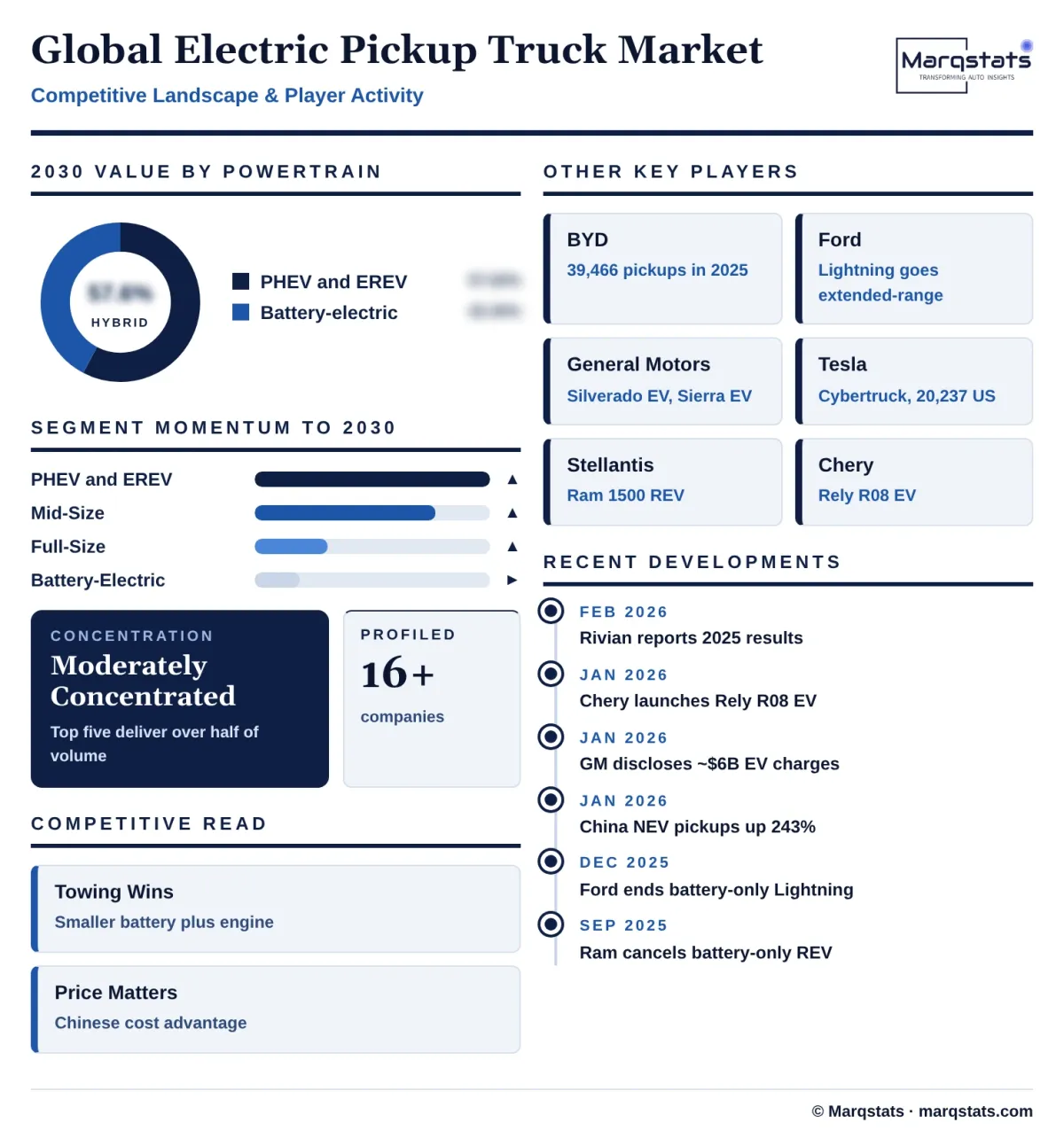
The electric pickup truck market is moderately concentrated. BYD, Ford, Tesla, General Motors and Rivian delivered more than half of 2025 volume, while Great Wall Motor, Geely Radar, Changan, JAC, SAIC Maxus, Zhengzhou Nissan and Chery make up most of the rest.
North American carmakers are restructuring. Ford announced in December 2025 a USD 19.5 billion charge, ended production of the battery-only F-150 Lightning and cancelled its next-generation full-size electric truck, while keeping plans for a mid-size electric pickup in 2027. General Motors recorded about USD 6 billion of electric vehicle charges in the fourth quarter of 2025, on top of a USD 1.6 billion charge in October 2025, but continues to build the Silverado EV and Sierra EV. Stellantis cancelled the battery-only Ram 1500 REV in September 2025 and moved the REV name to its extended-range truck.
Battery-electric specialists are adjusting. Tesla launched a lower-priced Cybertruck trim in 2026 after sales fell, and Rivian, which delivered 42,247 vehicles in 2025 and earned USD 1.56 billion from software and services, is focusing on its smaller R2 model.
Chinese carmakers are expanding abroad. BYD sells the Shark 6 in Australia, Mexico, Brazil and other markets, and Great Wall Motor, Geely Radar, Changan and Chery are adding plug-in hybrid and battery-electric pickups for export. Competition will be decided by price, towing capability and access to markets without high tariffs.
Traditional pickup makers outside China are moving more slowly. Toyota and Isuzu, which lead diesel pickup sales in Australia, Thailand and other markets, have shown or announced electrified versions of the Hilux and D-Max, but their volumes remain small compared with Chinese plug-in hybrid pickups. Their response will decide how much of the mid-size market Chinese brands can win in markets such as Australia, Thailand and South Africa.
Companies Covered
Companies covered in the report include:
Recent Market Activity
Table of Contents
Coverage & Segmentation
The study covers the global electric pickup truck market, with 2025 as the base year, 2021 – 2025 as the historical period and 2026 – 2030 as the forecast period. Values are in US dollars at transaction prices, and volumes are new vehicle deliveries. The market is segmented by powertrain, size class, end use and region.
Mild and full hybrids that cannot be charged from the grid, electric vans and chassis cabs, aftermarket electric conversions, charging equipment, batteries sold separately and financing are excluded. Value splits by powertrain, size class, end use and region are Marqstats estimates built on delivery data, model prices and company disclosures.