Market Snapshot
Middle bar: base-year value × (1 + CAGR), rounded to two decimals. This is a calculated illustration, not a separately researched annual estimate.
The global electric purpose-built taxi market size is estimated at USD 400.71 million in 2025 and is projected to reach USD 434.60 million by 2030, growing at a CAGR of 1.64% over 2026 – 2030. Annual deliveries fall from about 24,416 vehicles to 18,450, while the average ex-factory price rises from about USD 16,412 to USD 23,556 as the mix moves from low-cost Chinese ride-hailing sedans to London-style cabs and electric taxi vans.
Marqstats defines the market as the ex-factory value of battery-electric and range-extended electric taxis that are driven by a human and engineered or factory-built specifically for paid passenger service: the CaoCao 60 and other Chinese ride-hailing models, the LEVC TX and its successor, the BYD D1, and the Kia PV5 Taxi and wheelchair-accessible variants. Retail electric cars used as taxis, aftermarket conversions of retail vans, non-plug-in hybrid taxis such as the Toyota JPN Taxi and driverless robotaxis are excluded.
Ride-hailing sedans account for an estimated 72.94% of 2025 value and China for 72.42%. Wheelchair-accessible taxis account for 24.60% of 2025 value and rise to 45.21% by 2030. The study segments the market by vehicle type, accessibility, ownership and region.
Key Takeaways
Market Overview & Analysis
Report Summary
Marqstats sizes the electric purpose-built taxi market as the ex-factory value of new electric taxis with a human driver that are designed or factory-configured only for paid passenger service. In 2025 about 24,416 vehicles were delivered worldwide, worth an estimated USD 400.71 million at an average ex-factory price of about USD 16,412.
Most of the world's taxis are ordinary cars. Fleets and drivers buy retail saloons, hatchbacks and MPVs, add a meter, a roof sign and a livery, and use them until they wear out. A purpose-built taxi starts from a different brief: a hard-wearing cabin, a large rear door opening, a flat floor or ramp, a battery built for 300,000 km or more, fleet telematics and, in many cities, a body that meets taxi licensing rules on turning circle, headroom and wheelchair access.
Three product families make up the market. Chinese ride-hailing sedans such as the CaoCao 60 and the BYD D1, developed by or with ride-hailing platforms, combine low prices with battery swapping or long-life lithium iron phosphate cells. London-style cabs, today the range-extended LEVC TX, meet Transport for London's conditions of fitness with a 25-foot turning circle and a wheelchair ramp. Electric taxi vans and MPVs, led by the Kia PV5 Taxi and its wheelchair-accessible version, use purpose-built commercial platforms with sliding doors and low floors.
China supplies most vehicles but little of the value per car. CaoCao Mobility, controlled by Geely, sold 15,346 vehicles to third parties in 2025, up from 8,004 in 2024, for vehicle sales revenue of RMB 1.418 billion, and ran more than 38,000 of its own purpose-built vehicles in 31 cities at the end of 2025. At about RMB 92,400 per vehicle, a CaoCao 60 sells for less than a fifth of the price of a London cab.
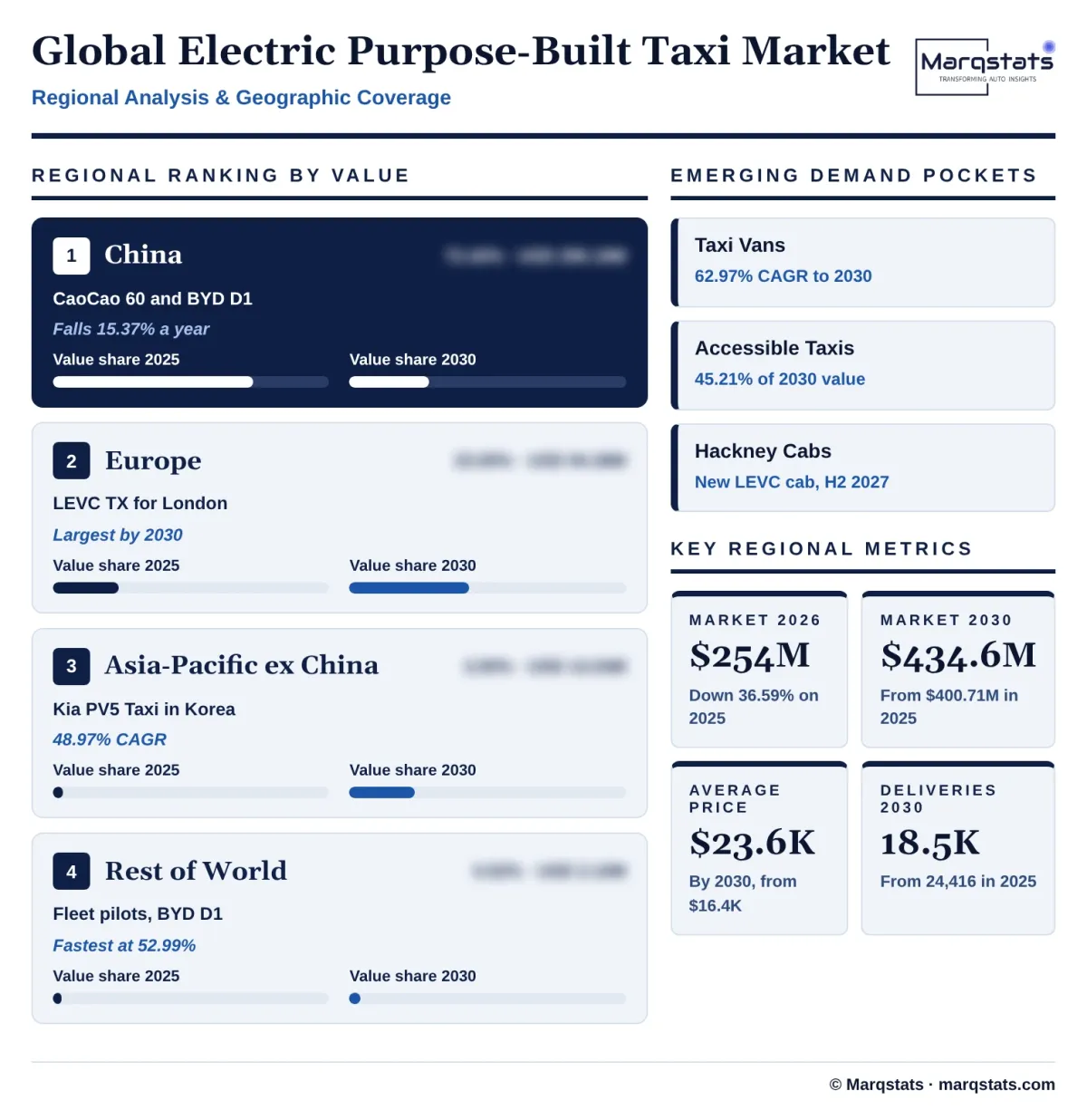
The market fell from about USD 386.40 million in 2021 to USD 309.45 million in 2023 as the first wave of BYD D1 deliveries to DiDi drivers faded, then recovered to USD 338.38 million in 2024 and USD 400.71 million in 2025 as CaoCao sales nearly doubled and the Kia PV5 Taxi went on sale in Korea. Marqstats expects about 12,620 deliveries worth USD 254.08 million in 2026.
Regulation shapes vehicle design in each market. Transport for London licenses only taxis that meet its conditions of fitness, which set the turning circle, headroom, door and wheelchair access, and requires every newly licensed taxi to be zero emission capable, so the LEVC TX has been the only new cab available in London since Dynamo left the market in 2022. Chinese cities license ride-hailing vehicles through local transport permits with rules on vehicle size, price and powertrain, and many now require new ride-hailing vehicles to be electric. South Korea supports electric taxis through national and local purchase subsidies, and European cities set taxi rules locally, which favours factory-backed taxi packages that can be adapted city by city.
London shows how licensing decides demand. Transport for London counted 14,659 licensed taxis in July 2024, of which 8,543 were zero emission capable, up from 8,238 in February 2024, and the share keeps rising as older diesel cabs reach their age limits. LEVC reached 7,000 global TX sales in May 2022 and 12,216 by July 2026, about 1,250 a year, of which Marqstats estimates about nine in ten stay in the UK.
Global Electric Purpose-Built Taxi Market Size and Forecast
The global electric purpose-built taxi market grows from USD 400.71 million in 2025 to USD 434.60 million in 2030, a CAGR of 1.64%. Marqstats expects about 12,750 deliveries worth USD 241.64 million in 2027, 15,300 worth USD 352.45 million in 2028 and 16,950 worth USD 396.12 million in 2029, before reaching 18,450 vehicles in 2030.
Two supply gaps create a trough. In China, CaoCao's vehicle sales revenue fell from RMB 743.6 million in the first half of 2025 to RMB 295.2 million in the first half of 2026 as competition increased and the company widened its range to Zeekr, Galaxy and methanol models, while its spending on property, plant and equipment fell from RMB 234.0 million to RMB 154.0 million as it bought fewer new vehicles. In the UK, final assembly of the LEVC TX ends in September 2026 and the next-generation cab launches in the second half of 2027, leaving London buyers with run-out stock for about a year.
Prices rise as the mix changes. The average ex-factory price is about USD 18,900 in 2024 and USD 16,412 in 2025, when cheap Chinese sedans are at their peak share, then rises to USD 20,133 in 2026 and USD 23,556 in 2030. Marqstats prices the CaoCao 60 at about USD 12,850 ex-factory in 2025, the LEVC TX at about USD 72,600, the Kia PV5 Taxi at about USD 27,000 and the next-generation London cab at about USD 80,000.
Running costs explain why fleets still choose purpose-built vehicles. A taxi in London, Shanghai or Seoul covers 60,000 to 100,000 km a year, three to six times a private car, so battery life, door and seat durability and the cost of downtime matter more than the purchase price. Battery-swappable sedans in China change packs in minutes rather than charging for an hour, and the PV5 carries a 10-year, 200,000 km battery warranty, extendable to 260,000 km.
Marqstats tracks four indicators to monitor the forecast: CaoCao vehicle sales revenue and fleet size in its half-year results, London taxi licensing figures published weekly by Transport for London, Kia PV5 taxi registrations in Korea and Europe, and the launch timing and price of the next-generation LEVC cab.
The mix of vehicles changes over the forecast. Taxi MPVs and vans rise from 3.50% to 37.14% of value and wheelchair-accessible taxis from 24.60% to 45.21%, while ride-hailing sedans fall from 72.94% to 30.65%. Europe overtakes China as the largest region by 2030 with 43.26% of value, Asia-Pacific outside China rises to 23.70% and the rest of the world to 4.05%.
Volume in China stabilises at a lower level. Marqstats expects CaoCao and other Chinese suppliers to deliver about 9,000 to 10,500 purpose-built ride-hailing sedans a year from 2027, compared with 22,446 in 2025, at prices falling from about USD 12,850 to USD 12,000, as the remaining demand comes from replacement of existing platform fleets and drivers who value battery swapping.
Market Dynamics
Key Drivers
Five forces support demand for electric taxis designed from the start for paid passenger service.
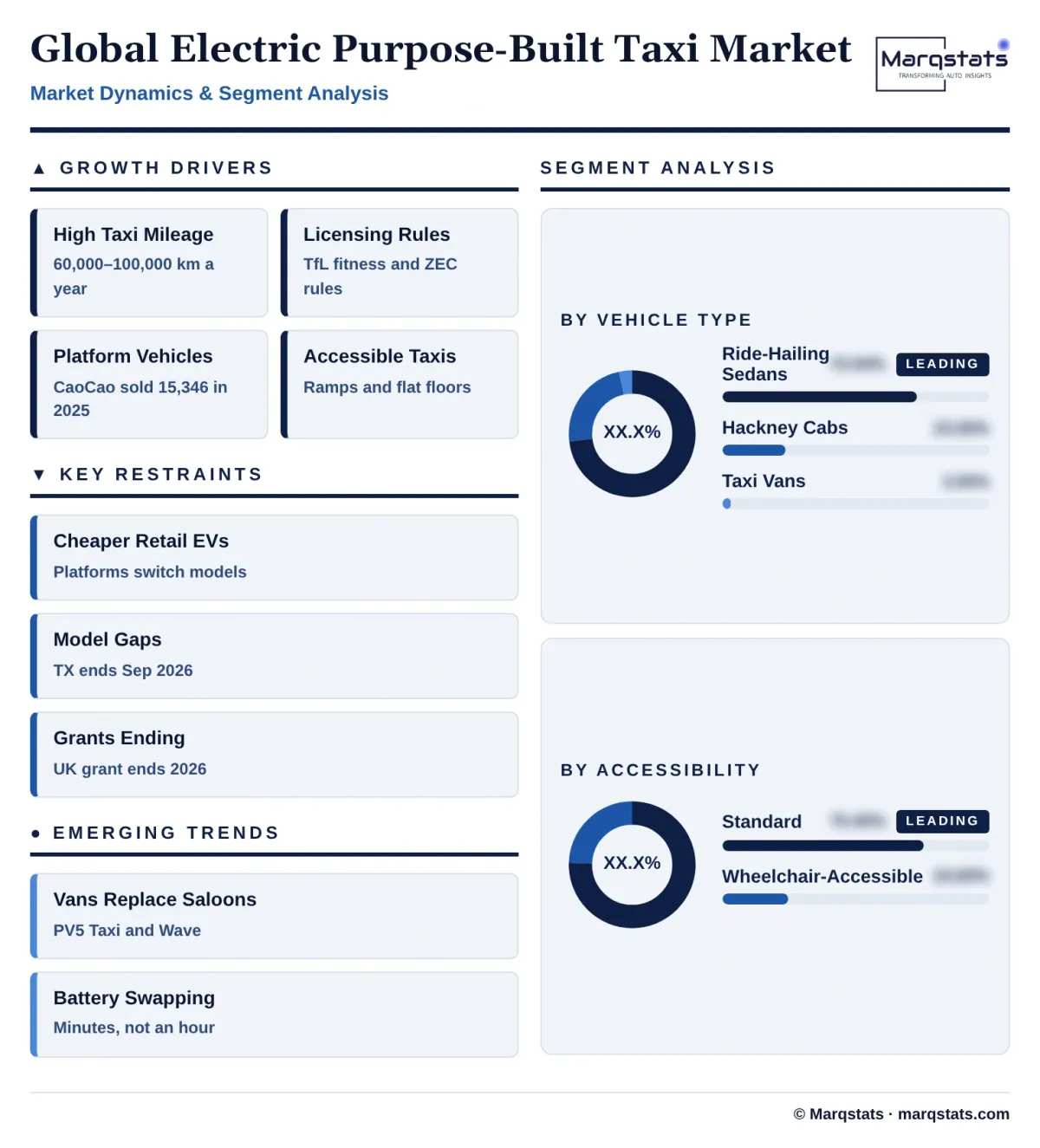
- High mileage rewards electric drive. Taxis run 60,000 to 100,000 km a year, so savings on fuel and maintenance repay a higher purchase price faster than in private cars, and purpose-built batteries are specified for the full duty life.
- Licensing rules require specific vehicles. Transport for London only licenses taxis that meet its conditions of fitness, including a tight turning circle and wheelchair access, and since January 2018 every taxi licensed for the first time in London must be zero emission capable, which today means the LEVC TX.
- Ride-hailing platforms want low-cost, durable cars. CaoCao, controlled by Geely, designs its own vehicles to cut cost per km, and sold 15,346 to third-party drivers and fleets in 2025 on top of its own fleet of more than 38,000.
- Accessible transport needs. Cities and national governments fund wheelchair-accessible taxis for disabled and elderly passengers, and the Kia PV5 Wave taxi and the LEVC TX both meet these needs with ramps and flat floors.
- New commercial EV platforms lower cost. Kia's PV5, the first model on its Platform Beyond Vehicle architecture, offers a factory taxi version with a 71.2 kWh battery and 358 km range from KRW 45.9 million, far below the price of a London cab.
- Platform fleets need replacement. CaoCao's fleet of more than 42,000 purpose-built vehicles in mid-2026 will need replacing over the next five years, supporting a base of demand even as new purchases slow.
Key Restraints
Four constraints are cutting volumes in 2026 and 2027 before new models arrive.
- Retail electric cars are cheaper. Platforms and drivers can buy mass-market electric saloons and MPVs at prices close to or below purpose-built models, and CaoCao itself now sells Zeekr and Galaxy models alongside its own vehicles.
- Model gaps. With LEVC TX assembly ending in September 2026 and its successor due in the second half of 2027, London has only run-out stock for about a year, and fleets delay replacement until the new cab arrives.
- Subsidies are ending. The UK plug-in taxi grant fell from GBP 7,500 to GBP 6,000 and then GBP 4,000 and is set to end in 2026, raising the net price of a London cab for owner-drivers.
- Robotaxis draw investment. CaoCao targets 100,000 purpose-built robotaxis by 2030, and its spending on new human-driven vehicles is falling as investment moves to driverless fleets.
Key Trends
Four shifts are changing which purpose-built taxis are bought and by whom.
- Platforms building their own cars. CaoCao designs vehicles with Geely and sells them to drivers and fleets that work on its platform, making the ride-hailing company a vehicle supplier as well as an operator.
- Battery swapping for taxis. Chinese purpose-built ride-hailing sedans are designed for battery swap stations, which cut charging downtime for drivers who share vehicles across shifts.
- Vans replacing saloons. Electric MPVs and vans with sliding doors and low floors, such as the Kia PV5 Taxi, take share from saloons because they carry more passengers and luggage and can be specified with wheelchair ramps.
- Factory taxi packages for Europe. Conversion specialists such as INTAX now offer reversible taxi packages for the PV5, with meter wiring, roof sign mounts and emergency alarms, giving European fleets a factory-backed electric taxi van.
Strategic Implications
- For vehicle makers, purpose-built taxis are a premium niche rather than a volume market. Accessible cabs and taxi vans command three to six times the price of a ride-hailing sedan, and buyers pay for durability, licensing compliance and accessibility rather than performance.
- For ride-hailing platforms, owning vehicle design is now optional. CaoCao's falling vehicle sales show that platforms can switch to cheaper retail electric cars once those cars are durable enough, keeping purpose-built designs for robotaxis.
- For London taxi drivers and fleets, timing matters. Buying run-out TX stock or waiting for the next-generation cab in the second half of 2027 changes the cost of a vehicle by thousands of pounds, especially as the plug-in taxi grant ends.
- For city regulators, licensing rules create the market. Turning circle, accessibility and zero emission rules decide which vehicles can be licensed, so the rules adopted for the next decade will decide which makers can compete.
- For component suppliers, taxi duty cycles need specific parts. Long-life lithium iron phosphate batteries, durable door mechanisms, wheelchair ramps and fleet telematics are the parts that separate a purpose-built taxi from a retail car.
- For investors, the 2026 trough is temporary. Value recovers at 14.36% a year from 2026 to 2030 as the next-generation LEVC cab and electric taxi vans arrive, but the market is unlikely to return to the volumes of 2025 because China's platforms have moved on to retail cars and robotaxis.
Market Segmentation
Purpose-built ride-hailing sedans, led by the CaoCao 60 and the BYD D1, account for 72.94% of 2025 value, USD 292.29 million and about 22,600 vehicles, and fall at 14.54% a year to USD 133.20 million and 30.65% of 2030 value as platforms buy cheaper retail electric cars.
London-style cabs, today the LEVC TX, account for 23.55% of 2025 value, USD 94.38 million and about 1,300 vehicles, and grow at 8.21% a year to USD 140.00 million and 32.21% of 2030 value once the next-generation cab arrives in the second half of 2027.
Electric taxi MPVs and vans, led by the Kia PV5 Taxi and PV5 Wave, account for 3.50% of 2025 value, USD 14.04 million, and grow fastest, at 62.97% a year, to USD 161.40 million and 37.14% of 2030 value, the largest type by then.
Taxis without wheelchair access account for 75.40% of 2025 value, USD 302.12 million, and fall at 4.65% a year to USD 238.11 million and 54.79% of 2030 value, tracking the decline of Chinese ride-hailing sedans.
Wheelchair-accessible taxis, including every LEVC TX and the PV5 Wave, account for 24.60% of 2025 value, USD 98.59 million, and grow at 14.79% a year to USD 196.49 million and 45.21% of 2030 value.
Vehicles bought by owner-drivers, taxi companies and fleet operators account for 79.42% of 2025 value, USD 318.24 million, and grow at 2.96% a year to USD 368.20 million and 84.72% of 2030 value.
Vehicles bought by ride-hailing platforms for their own fleets, led by CaoCao, account for 20.58% of 2025 value, USD 82.47 million, and fall at 4.24% a year to USD 66.40 million and 15.28% of 2030 value as platform investment moves to robotaxis.
By Geography
China
China is the largest market, with 72.42% of 2025 value, USD 290.19 million and about 22,446 vehicles, but falls at 15.37% a year to USD 126.00 million and 28.99% of 2030 value. CaoCao sold 15,346 vehicles to third parties in 2025 and added its own fleet vehicles, ending the year with more than 38,000 purpose-built vehicles in 31 cities and over 42,000 by mid-2026, but its vehicle sales revenue fell 60.3% in the first half of 2026.
Europe
Europe accounts for 23.55% of 2025 value, USD 94.38 million and about 1,300 vehicles, almost all LEVC TX cabs for London, and grows at 14.78% a year to USD 188.00 million and 43.26% of 2030 value, the largest region by then. The next-generation LEVC cab from the second half of 2027 and electric taxi vans such as the PV5 drive growth, after a dip in 2026 and 2027.
Asia-Pacific excluding China
Asia-Pacific outside China accounts for 3.50% of 2025 value, USD 14.04 million and about 520 vehicles, and grows at 48.97% a year to USD 103.00 million and 23.70% of 2030 value. South Korea leads through the Kia PV5 Taxi and PV5 Wave, launched with the PV5 in June 2025, and Japan follows as taxi operators test electric vans.
Rest of World
The Americas, the Middle East and Africa account for 0.52% of 2025 value, USD 2.10 million and about 150 vehicles, and grow fastest, at 52.99% a year, to USD 17.60 million and 4.05% of 2030 value. Mexico City fleet operator VEMO ordered 1,000 BYD D1s in 2022, but most taxis in the region are retail electric cars, which are outside this market.
How Competition Is Evolving
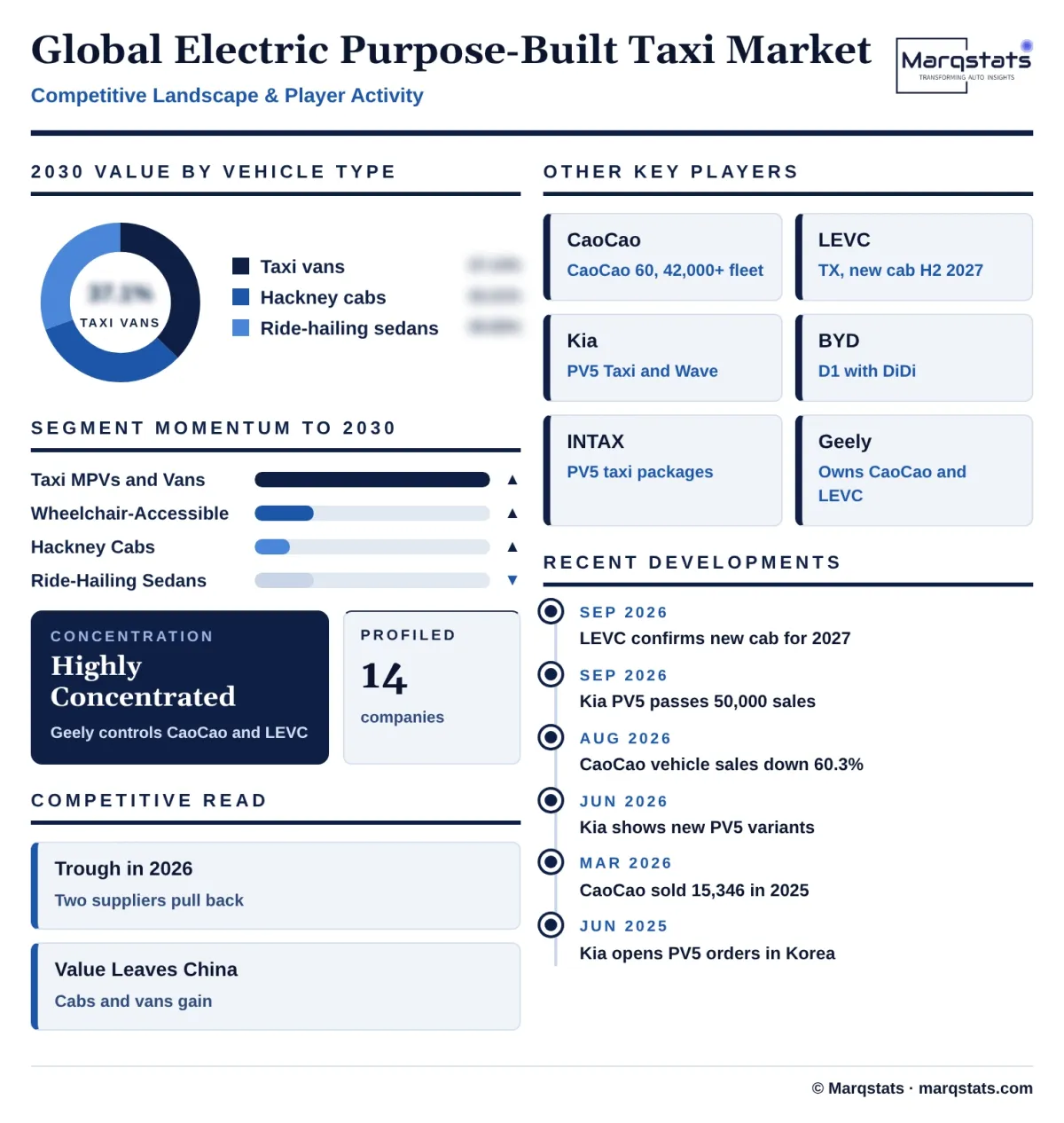
The electric purpose-built taxi market is highly concentrated. Geely controls the two largest suppliers, CaoCao in China and LEVC in the UK, and together they deliver most of the market's value; Kia is the third major supplier through the PV5 Taxi, and BYD supplies the D1.
Two business models compete. Platform-led suppliers such as CaoCao design vehicles for their own ride-hailing service and sell them to drivers and fleets on the platform. Vehicle makers such as LEVC and Kia sell through dealers to owner-drivers, taxi companies and public fleets, and compete on licensing compliance, accessibility and durability.
Conversion specialists fill gaps. Firms such as INTAX in Germany add taxi equipment to factory vehicles, and accessible-vehicle converters adapt vans for wheelchair users, giving taxi fleets options without a new vehicle programme.
Competition will be decided by price per km and licensing. Suppliers that combine low running costs, long battery warranties and approval under city taxi rules will win replacement cycles as fleets move from combustion and hybrid taxis.
Geely's position is unique. Through CaoCao it designs and operates ride-hailing vehicles in China, and through LEVC it builds the London cab, investing more than GBP 1 billion in LEVC since 2013. Kia's PV5, with more than 53,000 sales of all versions by July 2026, gives the market its first high-volume electric taxi van, and its Taxi and Wave versions compete directly with London-style cabs for accessible taxi fleets outside the UK.
Companies Covered
Companies covered in the report include:
Recent Market Activity
Table of Contents
Coverage & Segmentation
The study covers the global electric purpose-built taxi market, with 2025 as the base year, 2021 – 2025 as the historical period and 2026 – 2030 as the forecast period. Values are in US dollars at ex-factory prices converted at 2025 average exchange rates of CNY 7.19, KRW 1,420 and USD 1.32 per pound, and volumes are annual deliveries. The market is segmented by vehicle type, accessibility, ownership and region.
Retail electric cars used as taxis or for ride-hailing, aftermarket taxi packages fitted to retail vehicles other than factory-backed programmes, non-plug-in hybrid taxis such as the Toyota JPN Taxi, used vehicles, driverless robotaxis and fare revenue are excluded. Driverless purpose-built vehicles are covered in the Marqstats Global Purpose-Built Robotaxi Vehicle report, and the two markets should not be added together. Segment and regional splits are Marqstats estimates built on company results, licensing data, price lists and delivery announcements.