Market Snapshot
Middle bar: base-year value × (1 + CAGR), rounded to two decimals. This is a calculated illustration, not a separately researched annual estimate.
The South Korea used car export market reached a record USD 8,860.00 million in 2025, up about 75% in a year, and is projected to reach USD 9,015.88 million by 2030, a CAGR of 0.35%, on export volumes of 885,313 vehicles in 2025 and 882,920 by 2030. The flat five-year rate conceals a sharp cycle, because the Russian route closed and the Middle East route was disrupted in early 2026, so that export value is forecast to fall 35.38% to USD 5,725.00 million in 2026 before recovering at 9% to 18% a year from 2027.
Market size and forecast figures are generated using Marqstats' proprietary estimation framework, updated as of October 2026. The 2025 value is anchored to the official used car export value reported by the trade ministry, and the unit series to national trade statistics, and the forecast is most sensitive to the timing of the Middle East shipping recovery and to Russian import rules that affect Central Asian re-exports.
The market covers used passenger cars, SUVs, MPVs and light vans exported from South Korea, irrespective of the original brand, measured at declared export value, which is close to free-on-board value. It excludes buses, trucks, damaged vehicles, parts and the revenue earned by export agents, platforms and logistics providers. Central Asia is the largest destination region at 45.71% of 2025 value, SUVs and crossovers account for 69.18% of value and the Middle East is the largest destination region by volume at 33.89% of units.
Used cars became a pillar of Korean automobile exports in 2025, rising to 12.3% of a record USD 72 billion in total automobile exports from 7.2% a year earlier, while new car exports fell 4% to USD 63.11 billion. A weaker won, better brand recognition for Hyundai and Kia models in emerging markets and lower container freight rates supported the expansion, and Kyrgyzstan alone took about USD 3.2 billion of Korean used vehicles, more than double its 2024 level.
Key Takeaways
Market Overview & Analysis
Report Summary
South Korea exports used cars through a fragmented network of small export dealers that source vehicles from auctions, dealers and rental fleet disposals, clear them through bonded export areas and ship them in containers or on car carriers. Incheon is the centre of the trade, handling about 628,000 used cars in 2025, or 71.1% of port-based exports, with the Songdo used car export complex hosting hundreds of exporters. Buyers assess accident and flood history, odometer credibility, maintenance records, corrosion and specification, and the commercial outcome depends on payment reliability, days in inventory, freight and destination charges as much as on the selling price.
Official statistics measure the market in two ways that do not reconcile exactly. The trade ministry reported used car exports of about USD 8.9 billion in 2025, up 75.1%, while a national unit series attributed to the Korea International Trade Association counts 885,313 vehicles in 2025, up 41.0% from 627,875 in 2024, after 638,723 in 2023 and 404,653 in 2022. Customs data for January to November 2025 report a narrower passenger vehicle basket of 640,148 combustion-engine cars, 12,866 hybrids and 1,350 electric cars, so destination volumes from customs data are not independently verified against the national unit series.
The South Korea used car export market size is a Marqstats estimate that uses the official value for 2025, at USD 8,860.00 million, and the national unit series, which together imply an average export value of about USD 10,008 per vehicle. Destination, fuel, body type and age splits are allocated from customs destination data and trade reporting, and the 2026 to 2030 forecast is built destination by destination from route conditions, import rules and price trends.
South Korea Used Car Export Market Size and Forecast
Value is the anchor series for the South Korea used car export market, and volume follows the national trade unit series, with the average export value per vehicle rising from about USD 10,008 in 2025 to USD 10,211 in 2030. Exports fall from 885,313 vehicles in 2025 to 609,044 in 2026 and recover to 882,920 by 2030, a compound annual change of -0.05%, while export value moves from USD 8,860.00 million to USD 9,015.88 million at 0.35% a year, an absolute increase of USD 155.88 million.
The annual path runs through 609,044 vehicles and USD 5,725.00 million in 2026, 720,502 vehicles and USD 6,765.16 million in 2027 and 780,338 vehicles and USD 7,521.93 million in 2028. It continues to 832,553 vehicles and USD 8,253.96 million in 2029 before reaching 882,920 vehicles and USD 9,015.88 million in 2030, and value growth slows from 18.17% in 2027 to 9.23% in 2030 as the recovery matures.
The 2026 trough is consistent with industry expectations that full-year exports will return to about 600,000 units, the level of 2024, after a 28.7% decline in the first four months and a 24.8% fall in Incheon volumes to about 331,000 vehicles in January to August. Value falls more than volume in 2026 because the high-value Central Asian and Russian routes contract most, and the average value per vehicle declines to about USD 9,400 before recovering as hybrid exports and longer-haul markets lift the mix.
Two Corridors Closed in 2026 Reverse a Record Year
The 2026 reversal in the Korean used car export market reflects the near-simultaneous disruption of its two largest corridors. The first was the Russian corridor, which supplied Russia directly and through Kyrgyzstan and Kazakhstan, and which weakened after Russia raised its recycling fee on imported vehicles in December 2025 and tightened registration of vehicles imported through third countries. Exports to Russia and through Central Asian bypass routes fell by up to 60% in January 2026, after a surge of pre-fee shipments in late 2025 had inflated the record year.
The second was the Middle East corridor, which accounts for roughly one-third of Korean used car exports and runs mainly through Incheon. After the conflict involving the United States and Iran began on 28 February 2026, shipping through the Strait of Hormuz was disrupted for about four months, exports to the Middle East fell 68.5% from 14,294 vehicles in January and February to 4,508 in March and April and shipments to the United Arab Emirates fell 93.6%. Freight on the Middle East route rose to about USD 4,816 per TEU, around four times the pre-war rate, and retroactive surcharges of USD 7,250 per container added more than KRW 3.5 million to the cost of each vehicle shipped three to a container.
Inventory built up at the source of the trade. About 20,000 vehicles were held at the Songdo export complex in Incheon, affecting an estimated 1,600 businesses, and exporters carried financing costs on vehicles they could not ship. Central Asia value accordingly falls from USD 4,050.00 million in 2025 to USD 2,332.80 million in 2026 and Middle East value from USD 2,000.00 million to USD 1,248.00 million, while Latin America and other markets rise to USD 906.40 million as exporters redirect stock.
Destinations, Re-Export Hubs and Route Economics
Korean used car exports flow to a small number of hub markets that re-export much of what they import. Kyrgyzstan received about 130,000 Korean used cars in 2025, valued at about USD 3.2 billion and more than double its 2024 value, and served as a gateway for vehicles that moved on to Russia and other CIS markets. Libya received 119,519 vehicles in January to November 2025 and acts as a re-export hub for North Africa, and the United Arab Emirates received 45,719 vehicles in the same period, much of it for onward sale across the Gulf, East Africa and Central Asia.
The declared destination therefore differs from the market of final use, and partner-country import records capture only part of the flow when vehicles are re-exported from free zones. For January to November 2025, the leading destinations by value were Kyrgyzstan at USD 2.62 billion, Russia at USD 909.8 million, Kazakhstan at USD 664.6 million, the United Arab Emirates at USD 337.2 million and Türkiye at USD 264 million, while Türkiye ranked third by volume at 93,615 vehicles because it buys older, lower-value cars.
Freight costs and container availability decide which routes are profitable. Container shipping made Korean used car exports competitive after car carrier capacity tightened from 2021, and in the first quarter of 2025 containers carried about 130,000 of the 166,000 used cars shipped from Incheon, or 78%, as the cost of a 20-foot container fell from about USD 6,800 in 2022 to about USD 2,100 by April 2025. When freight rates rose again in 2026, the low-value routes to Türkiye, North Africa and the Middle East lost margin first.
Exporter Economics, Clearance and Tax
The cost of an exported vehicle covers purchase or auction price, buyer fees, inspection and history checks, reconditioning, domestic transport, storage, deregistration, customs brokerage, documents, port handling, financing, bank and foreign exchange fees and, where the seller bears them, ocean freight and insurance. In an illustrative transaction, a vehicle bought for KRW 10 million with KRW 1.05 million of other local costs and 45 days of financing at 8% earns a contribution of about KRW 1.45 million before overhead, tax and claims when sold for USD 9,000 at KRW 1,400 per dollar, and a KRW 100 strengthening of the won reduces that contribution by KRW 900,000.
Export clearance requires deregistration of the vehicle, entry into a bonded area and an export declaration, after which the vehicle must normally be shipped within 30 days of the declaration's acceptance. Qualifying exports are zero-rated for value added tax, but a National Tax Service ruling of 24 February 2026 denied the special recycled resource input credit in a specified transaction involving a vehicle exported within one year of manufacture, so exporters cannot assume that every purchase qualifies for input tax recovery.
Export controls add compliance risk on the CIS routes. Korea expanded its catch-all export controls for Russia and Belarus in February 2024, and customs enforcement against false destinations and vehicle specifications continued in 2026, so exporters must check the item, destination, end user and end use rather than relying on an intermediate destination. Platforms add their own terms, with Autowini charging USD 100 each for selected optional documents and its escrow terms from April 2026 specifying cancellation charges of 20% of the FOB price, with a minimum of USD 500.
Market Dynamics
Key Drivers
Five factors support the recovery of the South Korea used car export market from 2027.
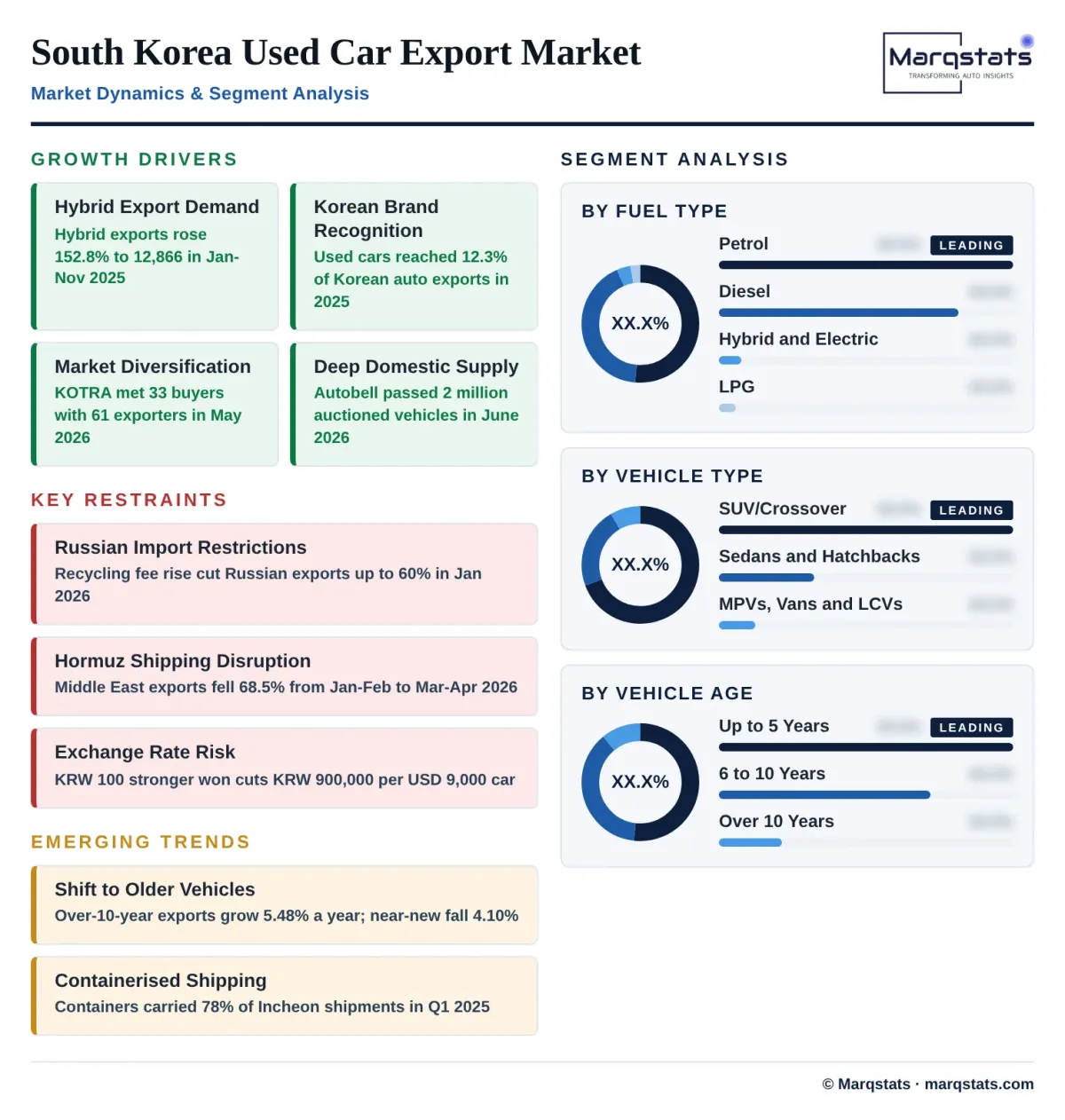
- Brand recognition for Korean vehicles. Better quality perceptions of Hyundai and Kia models in emerging markets lifted used car exports to 12.3% of Korean automobile exports in 2025, and residual demand for Korean SUVs remains strong across Central Asia and the Middle East.
- Competitive currency and pricing. A weaker won made Korean used cars cheaper in dollar terms in 2025, and the average export value of about USD 10,008 per vehicle undercuts comparable Japanese and European used imports in many markets.
- Demand for hybrid vehicles. Hybrid exports rose 152.8% to 12,866 in January to November 2025, and hybrid and electric vehicles grow at 26.84% a year to USD 1,104.98 million by 2030.
- Market diversification. KOTRA brought 33 buyers from Georgia, Cambodia, Colombia, the Dominican Republic, Chile, Jordan and Egypt to meet 61 Korean exporters in May 2026, supporting growth of 13.52% a year in Latin America and other markets.
- Deep domestic supply. Hyundai Glovis passed 2 million cumulative auctioned vehicles in June 2026, with about 150,000 a year through four auction centres, and rental fleet disposals provide steady export supply.
Key Restraints
Four constraints limit growth, most of them outside the control of Korean exporters.
- Russian import restrictions. Russia's higher recycling fee and its checks on vehicles registered through third countries reduce Russian demand, and Russia's share of export value falls from 10.84% in 2025 to 5.33% by 2030.
- Middle East shipping disruption. The Hormuz disruption cut exports to the Middle East by 68.5% between early 2026 and March to April, and freight on the route rose to about four times the pre-war level.
- Exchange rate risk. A KRW 100 strengthening against the dollar removes KRW 900,000 of contribution on an illustrative USD 9,000 vehicle, so currency movements can turn profitable routes unprofitable.
- Compliance and tax risk. Export controls on Russia and Belarus, customs enforcement against false destinations and the February 2026 tax ruling on near-new vehicles raise compliance costs for small exporters.
Key Trends
Four trends are reshaping the structure of Korean used car exports.
- Shift toward older and mid-age vehicles. Vehicles aged six to ten years grow at 4.04% a year and those over ten years at 5.48%, while near-new exports decline at 4.10% a year as Russian demand falls.
- Containerised shipping. Containers carried 78% of used cars shipped from Incheon in the first quarter of 2025, giving small exporters flexible capacity but exposing them to container freight cycles.
- Digital marketplaces and escrow. Platforms such as Autowini, which reports buyers in more than 141 countries, combine listings, payment protection and shipping services that reduce search and payment risk for overseas buyers.
- Auction-linked export sourcing. About 30% of successful bids at a Lotte Rental auction in 2025 were for export, and auction operators extend inspection and logistics services to export buyers.
Strategic Implications
- Route diversification. Exporters that build buyer networks in Latin America, Africa and the Caucasus reduce dependence on the Russian and Middle East corridors that drove the 2026 contraction.
- Hybrid sourcing capability. Exporters that secure hybrid supply and battery condition documentation capture the fastest-growing segment, rising to 12.26% of export value by 2030.
- Working capital discipline. Exporters that limit days in inventory and hedge currency exposure protect contribution margins that a delayed shipment or a stronger won can erase.
- Compliance systems. Documented end-user checks and accurate destination declarations protect exporters from penalties under export controls and customs enforcement.
Market Segmentation
Petrol vehicles are the largest fuel segment at USD 4,551.02 million, or 51.37% of 2025 value, from 475,613 vehicles, and decline at 0.80% a year to USD 4,372.96 million by 2030. Petrol SUVs and sedans sell in every destination region, and the segment's share of value falls to 48.50% as hybrids gain ground.
Diesel vehicles account for USD 3,715.57 million, or 41.94% of 2025 value, from 322,330 vehicles, and decline at 2.27% a year to USD 3,312.11 million by 2030. Diesel SUVs carry high average values of about USD 11,527 and were concentrated on the Central Asian and Russian routes that weaken in 2026.
LPG vehicles account for USD 256.79 million, or 2.90% of 2025 value, from 70,016 vehicles, and decline at 2.54% a year to USD 225.83 million by 2030. Former taxis and rental sedans running on LPG sell mainly to the Middle East at an average of about USD 3,668.
Hybrid and electric vehicles account for USD 336.62 million, or 3.80% of 2025 value, from 17,354 vehicles, and are the fastest-growing segment at 26.84% a year to USD 1,104.98 million by 2030. Hybrid exports rose sharply in 2025, while used electric car exports fell 28.2% to 1,350 in January to November, because battery condition, charging compatibility and shipping acceptance remain barriers.
SUVs and crossovers are the dominant vehicle type at USD 6,129.18 million, or 69.18% of 2025 value, from 446,432 vehicles, and grow at 0.55% a year to USD 6,298.44 million by 2030. Korean SUVs command the highest prices in Central Asia, Russia and the Gulf, averaging about USD 13,729 in 2025.
Sedans and hatchbacks account for USD 1,977.22 million, or 22.32% of 2025 value, from 344,124 vehicles, and decline at 0.84% a year to USD 1,895.49 million by 2030. Older sedans sell mainly to the Middle East, North Africa and Türkiye at an average of about USD 5,746.
MPVs, vans and light commercial vehicles account for USD 753.60 million, or 8.51% of 2025 value, from 94,757 vehicles, and grow at 1.75% a year to USD 821.95 million by 2030. Passenger vans and multipurpose vehicles serve taxi, shuttle and small business buyers in Africa, Latin America and Central Asia.
Vehicles up to five years old account for USD 4,584.52 million, or 51.74% of 2025 value, from 193,178 vehicles, and decline at 4.10% a year to USD 3,719.00 million by 2030. Near-new vehicles averaging about USD 23,732 were in demand on the Russian and Central Asian routes, and both import restrictions and the 2026 tax ruling weigh on the segment.
Vehicles aged six to ten years account for USD 3,295.89 million, or 37.20% of 2025 value, from 390,641 vehicles, and grow at 4.04% a year to USD 4,018.11 million by 2030, becoming the largest age segment by value. Mid-age vehicles offer the price and reliability that buyers in the Middle East, Africa and Latin America seek.
Vehicles over ten years old account for USD 979.59 million, or 11.06% of 2025 value, from 301,494 vehicles, and are the fastest-growing age segment at 5.48% a year to USD 1,278.77 million by 2030. Low-value older vehicles averaging about USD 3,249 sell to markets with few age limits on imports, where demand responds most to price.
By Geography
Central Asia
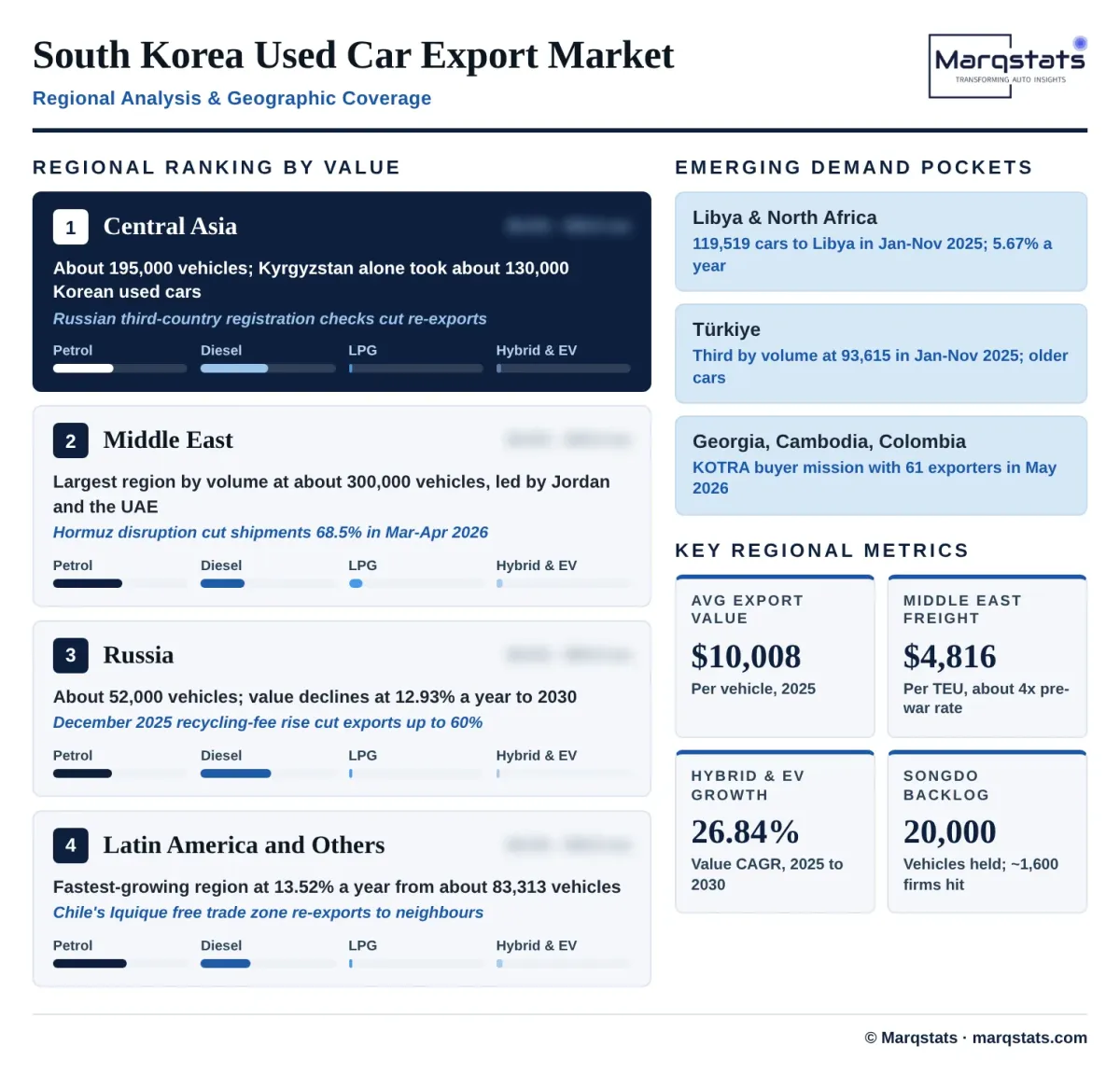
Central Asia is the largest destination region in the Korean used car export market at USD 4,050.00 million, or 45.71% of 2025 value, from about 195,000 vehicles, but declines at 4.12% a year to USD 3,281.69 million by 2030. Kyrgyzstan and Kazakhstan led the region, and Russian restrictions on vehicles registered through third countries reduce re-export demand from 2026.
Russia
Russia accounts for USD 960.00 million, or 10.84% of 2025 value, from about 52,000 vehicles, and declines at 12.93% a year to USD 480.31 million by 2030. The December 2025 increase in Russia's recycling fee and payment difficulties under sanctions cut direct exports by up to 60% in January 2026.
Middle East
The Middle East accounts for USD 2,000.00 million, or 22.57% of 2025 value, and is the largest destination region by volume at about 300,000 vehicles, or 33.89% of units. Value falls to USD 1,248.00 million in 2026 during the Hormuz disruption before recovering to USD 2,412.08 million by 2030 at 3.82% a year, led by Jordan, the United Arab Emirates and Syria, where demand rose after the civil war ended in December 2024.
North Africa
North Africa accounts for USD 650.00 million, or 7.34% of 2025 value, from about 140,000 vehicles, and grows at 5.67% a year to USD 856.43 million by 2030. Libya, which took 119,519 Korean used cars in January to November 2025, is the main hub and re-exports vehicles to neighbouring markets, and Egypt is a target for market development.
Türkiye and Europe
Türkiye and Europe account for USD 400.00 million, or 4.51% of 2025 value, from about 115,000 vehicles, and grow at 3.58% a year to USD 476.88 million by 2030. Türkiye ranked third among destinations by volume in January to November 2025, at 93,615 vehicles, but buys older vehicles at low average values.
Latin America and Other Markets
Latin America and other markets account for USD 800.00 million, or 9.03% of 2025 value, from about 83,313 vehicles, and are the fastest-growing destination region at 13.52% a year to USD 1,508.49 million by 2030. Chile, where the Iquique free trade zone handles re-exports to neighbouring countries, Colombia, the Dominican Republic, Georgia, Cambodia and sub-Saharan African markets form the region.
How Competition Is Evolving
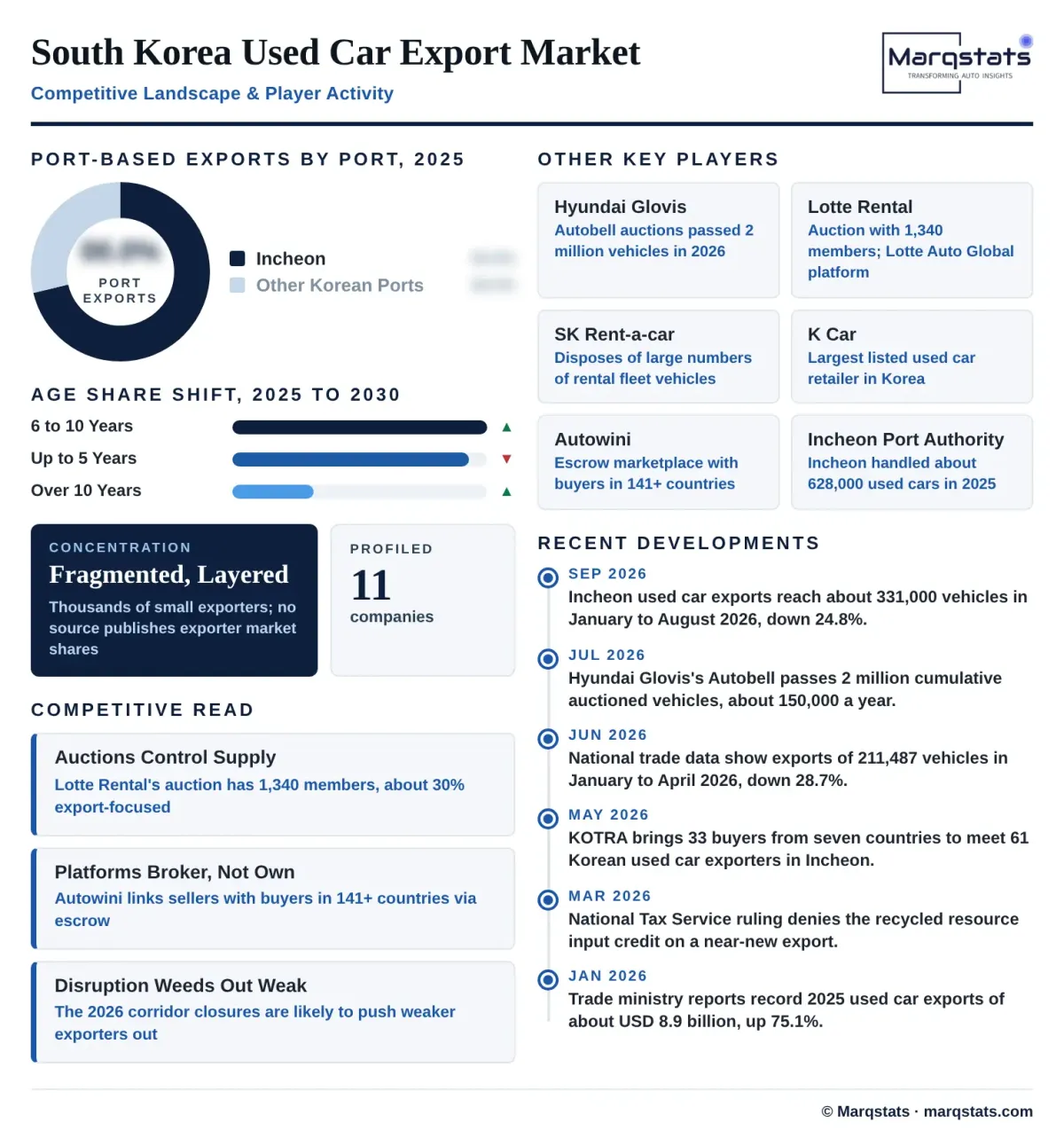
The South Korea used car export market is fragmented. Thousands of small and medium-sized exporters and brokers buy vehicles at auction or from dealers and sell them to overseas dealers, often using local language skills and destination networks, while larger groups provide auctions, inspection, digital marketplaces and logistics. No source publishes exporter market shares, and auction volumes or platform activity cannot be read as export market share because platforms often broker sales rather than own the inventory.
Auction operators and fleet owners control much of the supply. Hyundai Glovis operates the Autobell auction network, which passed 2 million cumulative auctioned vehicles in June 2026, and offers inspection and export logistics, while Lotte Rental operates an auction with 1,340 member firms, about 30% of them export-focused, and the Lotte Auto Global export platform. SK Rent-a-car and other rental companies dispose of large numbers of fleet vehicles, and K Car is the largest listed used car retailer in the domestic market.
Digital marketplaces and logistics providers shape how vehicles reach buyers. Autowini connects Korean sellers with buyers in more than 141 countries and offers escrow payment protection, while car carriers such as Hyundai Glovis and EUKOR Car Carriers and container lines such as Sinokor Merchant Marine and HMM carry the vehicles. Competition turns on sourcing speed, inspection quality, payment security, freight cost and destination compliance, and the 2026 disruption is likely to push weaker exporters out of the market.
Companies Covered
Companies covered in the report include:
Recent Market Activity
Table of Contents
Coverage & Segmentation
Coverage spans used passenger cars, SUVs, MPVs and light vans exported from South Korea, segmented by fuel type, vehicle type and vehicle age and by six destination regions. The base year is 2025, the historical period runs from 2021 to 2025 and the forecast period from 2026 to 2030. Value is expressed in USD million at declared export value, close to free-on-board value, and volume is expressed in vehicles exported, following the national trade unit series.
Buses, trucks, damaged vehicles, parts and the revenue of export agents, platforms and logistics providers are excluded from the market definition. The estimate draws on trade ministry export releases, national trade and customs statistics, port authority data, tax and customs rulings and company announcements, and eleven companies and organisations are profiled.