Market Snapshot
The South Africa electric vehicle market size is estimated at USD 284.61 million in 2025 and is projected to reach USD 1,663.31 million by 2030, growing at a CAGR of 42.35% over 2026 – 2030. Plug-in sales rise from about 5,698 to 42,000 vehicles a year, with plug-in hybrids the larger powertrain.
Marqstats defines the market as the retail value, including VAT and duties, of new plug-in electric vehicles sold in South Africa: battery-electric vehicles and plug-in hybrids, passenger cars and light commercial vehicles up to 3,500 kg. It counts brands reporting to the National Association of Automobile Manufacturers of South Africa (naamsa) and brands that do not, such as BYD until February 2026, Geely and Dongfeng. Conventional hybrids, electric buses and trucks, used imports and two-wheelers are excluded.
Plug-in hybrids account for 63.64% of 2025 value and 66.87% of units, passenger cars for 94.30% of value and vehicles priced above R1 million for 53.29%. Gauteng accounts for 50.00% of value because lessors and fleets register there, while KwaZulu-Natal and the rest of the country grow fastest as charging spreads along the N3 and N1.
Key Takeaways
Market Overview & Analysis
Report Summary
Marqstats sizes the South Africa electric vehicle market as the retail value of new plug-in electric vehicles sold each year, counted at the dealer including 15% VAT, customs duty and ad valorem excise duty. The core is two powertrains: battery-electric vehicles that run only on a traction battery, and plug-in hybrids that combine a rechargeable battery with a petrol engine. Conventional hybrids such as the Toyota Corolla Cross Hybrid, which cannot be charged from the grid, are excluded even though naamsa counts them inside its new energy vehicle total.
The distinction matters because the headline numbers mix the two. naamsa reported 16,703 new energy vehicles in 2025, and its earlier year-end tally of 16,716 put them at 2.8% of the 596,818 new vehicles sold. Only 3,898 of the 16,703, or 23.34%, were plug-ins. The rest were conventional hybrids, led by the Corolla Cross Hybrid built by Toyota South Africa Motors at Prospecton in Durban. A page that quotes the new energy vehicle total as the electric vehicle market overstates the plug-in market more than four times.
Plug-in sales also changed shape in 2025. naamsa recorded battery-electric sales of 1,088, down 13.4% from 1,257 in 2024, and plug-in hybrid sales of 2,810, up from 738, so plug-in hybrids outsold battery-electric vehicles for the first time. The best-selling reported battery-electric passenger models were the Volvo EX30 with 112 units, down from 406 in 2024, the Mercedes-Benz EQE with 102 and the MINI Aceman with 79, all priced near or above R800,000.
The reported series is incomplete. BYD Auto South Africa, which entered the market in 2023, did not report to naamsa until March 2026, and Geely and Dongfeng still do not. When BYD first reported, it sold 589 vehicles in March 2026, including 239 Dolphin Surf, 130 Sealion 6 and 94 Shark bakkies, and its 316 battery-electric sales made up most of a national record of 389 that month. Marqstats therefore adds an estimate of 1,800 unreported plug-ins to the 2025 base: about 800 battery-electric and 1,000 plug-in hybrids.
On that basis the market grew from an estimated USD 17.30 million in 2021, when about 269 plug-ins were sold, to USD 40.13 million in 2022, USD 82.93 million in 2023 and USD 153.74 million in 2024, then rose 85.12% to USD 284.61 million in 2025. Momentum continued into 2026: naamsa recorded 9,541 plug-ins in the first eight months, 6,919 plug-in hybrids and 2,622 battery-electric vehicles, already 2.45 times the reported 2025 total.
South Africa Electric Vehicle Market Size and Forecast
The South Africa electric vehicle market grows from USD 284.61 million in 2025 to USD 1,663.31 million in 2030, a CAGR of 42.35%. Volume drives the growth: plug-in sales rise at 49.11% a year, from about 5,698 to 42,000 vehicles, while the average retail price falls at 4.54% a year, from about USD 49,949 to USD 39,603, in constant 2025 prices, as Chinese brands bring plug-in hybrids and small battery-electric cars below R500,000.
The 2025 value is built from units and prices. Marqstats counts 1,888 battery-electric vehicles at an average of about R980,000 and 3,810 plug-in hybrids at about R850,000, which gives ZAR 5,088.83 million, or USD 284.61 million at the 2025 average rate of ZAR 17.88 per US dollar. The battery-electric average blends the reported premium mix, where most models listed in early 2026 cost more than R800,000 and the Porsche Taycan Turbo GT reached R5.88 million, with lower-priced BYD models. The plug-in hybrid average blends the locally built BMW X3 30e with Chinese models priced between about R440,000 and R700,000.
2026 is the year of the step change. Marqstats expects about 16,400 plug-ins in 2026, 11,800 plug-in hybrids and 4,600 battery-electric vehicles, worth USD 776.65 million. Of these, about 15,100 are expected in naamsa releases, extending the first eight months at a slightly faster monthly pace, and about 1,300 come from BYD in January and February and from brands that still do not report. Annual growth then slows, to 31.34% in 2027 and 14.54% in 2030, as the low base effect fades.
Prices fall in constant terms. Marqstats assumes the average battery-electric price drops from about R980,000 in 2025 to R720,000 by 2030 and the average plug-in hybrid price from R850,000 to R700,000. The BYD Atto 2 plug-in hybrid, launched on 11 June 2026 at R439,900, and the R339,900 Dolphin Surf and Geely E2 show where volume is moving. Battery-electric vehicles reach 40.48% of 2030 units, so the mix still leans to plug-in hybrids.
Marqstats tracks four indicators to monitor the forecast: monthly naamsa plug-in sales and any change in which brands report, Treasury decisions on the 25% customs duty for battery-electric vehicles, the number of public chargers on the N1, N2 and N3, and the price of the cheapest plug-in hybrid SUVs against petrol rivals.
Market Dynamics
Key Drivers
Five forces are lifting plug-in sales in South Africa even though buyers receive no purchase incentive.
- Chinese brands have reset prices. In early 2026 the cheapest battery-electric car on sale was the BYD Dolphin Surf at R339,900, followed by the Dayun Yuehu S5 at R399,900 and the Dongfeng Box at R460,000, against a market where most models listed earlier cost more than R800,000. The Dolphin Surf sold 239 units in March 2026, more than the Hyundai Alcazar and Honda Fit petrol cars.
- Plug-in hybrids remove range anxiety. A plug-in hybrid charges at home for daily commuting and switches to petrol on the N1 or N3, so buyers who worry about load-shedding and long distances can still cut fuel costs. Reported plug-in hybrid sales rose from 738 in 2024 to 2,810 in 2025 and reached 6,919 in the first eight months of 2026.
- Local manufacturing incentives are in force. From 1 March 2026 manufacturers can deduct 150% of qualifying investment in buildings and machinery used to produce electric and hydrogen-powered vehicles. BMW Group South Africa builds the X3 plug-in hybrid at Rosslyn and Ford Motor Company of Southern Africa builds the Ranger plug-in hybrid at Silverton, mainly for export.
- Off-grid charging is spreading. Zero Carbon Charge switched on its first solar-and-battery stations on the N3 at Reitz Interchange, Exit 107, and Tugela, Exit 207, on 19 – 20 May 2026, with three DC fast chargers and two AC units at each site. The company is backed by R100 million from the Development Bank of Southern Africa and plans 60 stations by the end of 2027.
- More brands and more models compete. Chinese brands on sale grew from 8 in 2024 to 22 by June 2026, and BYD, Chery, Jaecoo, Omoda, GWM, Geely, Changan and Dongfeng all sell plug-in models, while the TechCentral price list counted 46 distinct battery-electric models in February 2026.
Key Restraints
Four constraints keep plug-in vehicles below 3% of new sales and slow the move from hybrids to battery-electric cars.
- Battery-electric vehicles pay higher import duty. Imported electric vehicles pay 25% customs duty, while petrol and diesel cars from the European Union pay 18%, and electric vehicles also pay ad valorem excise duty and VAT. Zero Carbon Charge asked Finance Minister Enoch Godongwana in February 2026 to align the two rates, but the gap remains.
- There are no purchase incentives. The Electric Vehicles White Paper of December 2023 supports production first, and the 150% allowance applies to factories, not buyers, so a private buyer pays the full retail price and finance houses apply cautious residual values to electric vehicles.
- Public charging is thin. South Africa had about 650 public charging stations in mid-2026, for a country of 1.2 million square kilometres, and BYD said in June 2026 that its promised 200 to 300 Flash charging stations had not yet been built.
- Official sales data are incomplete. Geely and Dongfeng do not report to naamsa and BYD began only in March 2026, so dealers, lenders and charging investors work from a series that missed about a third of plug-in sales in 2025.
Key Trends
Four shifts are changing which plug-in vehicles are sold, how they are counted and where they are charged.
- Plug-in hybrids outsell battery-electric vehicles. Plug-in hybrids made up 36.5% and battery-electric vehicles 13.8% of new energy vehicle sales in the first eight months of 2026, and the gap widens as the BYD Atto 2 plug-in hybrid and Chery and Jaecoo plug-in SUVs reach R440,000 to R700,000.
- Electric bakkies enter the market. The BYD Shark plug-in hybrid bakkie, priced at R989,900, sold 94 units in March 2026 and 108 in April 2026, the first plug-in model in the segment that leads South African light commercial sales.
- Charging moves off the grid. Off-grid solar stations on the N3 and depot charging for the 120 BYD buses of Golden Arrow Bus Services in Cape Town show that operators can avoid grid delays by building their own supply.
- Local assembly of electric vehicles begins with buses. The Paruk Group ordered 100 MAN Lion's Explorer E electric buses in October 2025, with chassis built at Pinetown and bodies at Olifantsfontein, which shows that electric vehicles can be built locally once orders are large enough.
Strategic Implications
- For Chinese brands, the winning product is a plug-in hybrid SUV below R700,000 or a small battery-electric car below R400,000. These price points account for most of the growth to 2030, and brands that report to naamsa gain credibility with fleet buyers and lenders who check the official series.
- For premium brands, the battery-electric segment above R1 million no longer sets the pace. BMW, Mercedes-Benz, Volvo and Porsche keep high-value buyers, but their share of value falls, so locally built plug-in hybrids such as the X3 matter more than imported luxury battery-electric models.
- For fleet operators and lessors, plug-in hybrid and electric bakkies are the first practical step. A fleet registered in Gauteng can charge at depots and on the N3, and buyers that lease now gain operating data before the residual-value curves used by finance houses settle.
- For charging investors, demand grows faster than the network. Plug-in sales of about 42,000 a year by 2030 against about 650 public stations in 2026 leave room for highway sites on the N1 and N2 and for depot charging, and off-grid designs avoid the wait for grid connections.
- For policy makers, the duty gap and the data gap are the two levers. Aligning the 25% battery-electric duty with the 18% rate would narrow the price gap, and requiring all brands to report sales would give the market a full count.
Market Segmentation
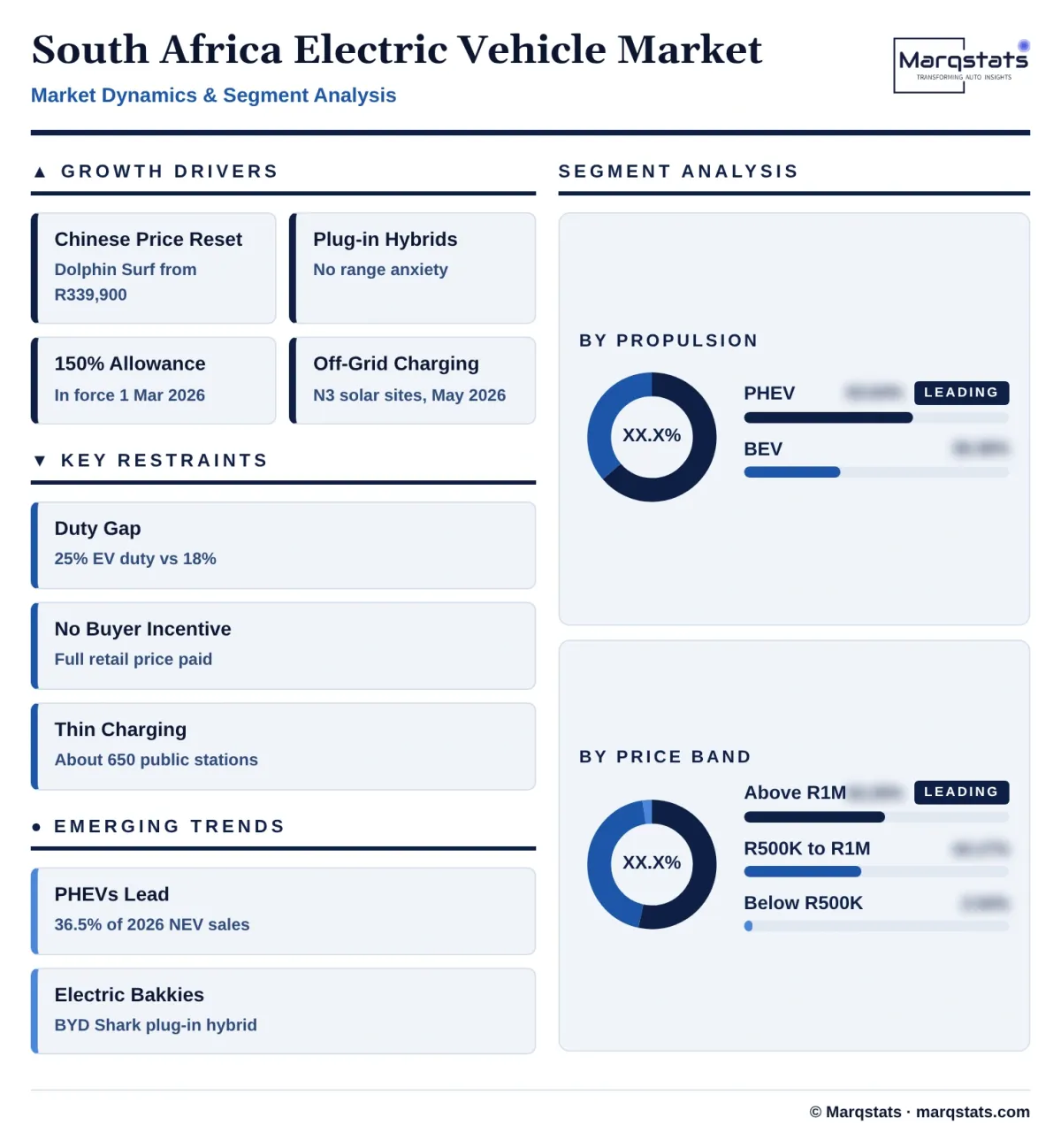
Plug-in hybrids account for 63.64% of 2025 value, USD 181.13 million, and 66.87% of units, about 3,810 vehicles, and grow at 40.13% a year to USD 978.75 million and about 25,000 vehicles by 2030. naamsa reported 2,810 plug-in hybrids in 2025, and Marqstats adds about 1,000 BYD Sealion 6 and Shark units that were not reported. The BMW X3 30e, Chery Tiggo plug-in hybrids, the Jaecoo J7 and Haval H6 lead this segment, and the share of plug-in hybrids in units falls only slightly, to 59.52% by 2030.
Battery-electric vehicles account for 36.36% of 2025 value, USD 103.48 million, and grow faster, at 45.92% a year, to USD 684.56 million and 41.16% of value by 2030. Units rise from about 1,888 to 17,000. In 2025 the reported mix was premium, with the Volvo EX30, Mercedes-Benz EQE and MINI Aceman leading, but from 2026 the BYD Dolphin Surf, Geely E2, Dongfeng Box and Chery Q bring battery-electric cars below R500,000.
Passenger cars, including hatchbacks, sedans and SUVs, account for 94.30% of 2025 value, USD 268.40 million, and about 5,376 units, and grow at 41.56% a year to USD 1,525.73 million. naamsa recorded 1,018 battery-electric passenger cars and 2,808 plug-in hybrid passenger cars in 2025, so cars carry almost all of the reported market.
Light commercial vehicles, including bakkies and vans up to 3,500 kg, account for 5.70% of 2025 value, USD 16.21 million, and about 322 units, and grow fastest, at 53.37% a year, to USD 137.58 million and about 3,000 units by 2030. The reported 2025 count was only 72 units, mostly electric vans, so the BYD Shark plug-in hybrid bakkie carries the segment, and further plug-in bakkies are expected from Chinese brands and from Ford if it releases the locally built Ranger plug-in hybrid in South Africa.
Vehicles priced below R500,000 account for 2.54% of 2025 value, USD 7.22 million, and about 350 units, and grow fastest, at 112.07% a year, to USD 309.71 million and 18.62% of value by 2030. The BYD Dolphin Surf from R339,900, the Geely E2 from R339,900 and the BYD Atto 2 plug-in hybrid at R439,900 define this band, and Marqstats expects about 14,000 vehicles a year in it by 2030.
Vehicles priced between R500,000 and R1 million account for 44.17% of 2025 value, USD 125.70 million, and grow at 44.56% a year to USD 793.63 million, becoming the largest band by value at 47.71% in 2030. Chinese plug-in hybrid SUVs, the BYD Atto 3 and Dolphin, the Volvo EX30 and the GWM Ora 03 compete here, close to the price of mid-size petrol SUVs.
Vehicles priced above R1 million account for 53.29% of 2025 value, USD 151.69 million, the largest band in 2025, and grow at 29.85% a year to USD 559.97 million, while their share falls to 33.67%. BMW, Mercedes-Benz, Porsche, Audi and Volvo sell battery-electric and plug-in hybrid SUVs and sedans here, including the BMW iX, the Mercedes-Benz EQE and EQS and the Porsche Taycan.
By Geography
Gauteng
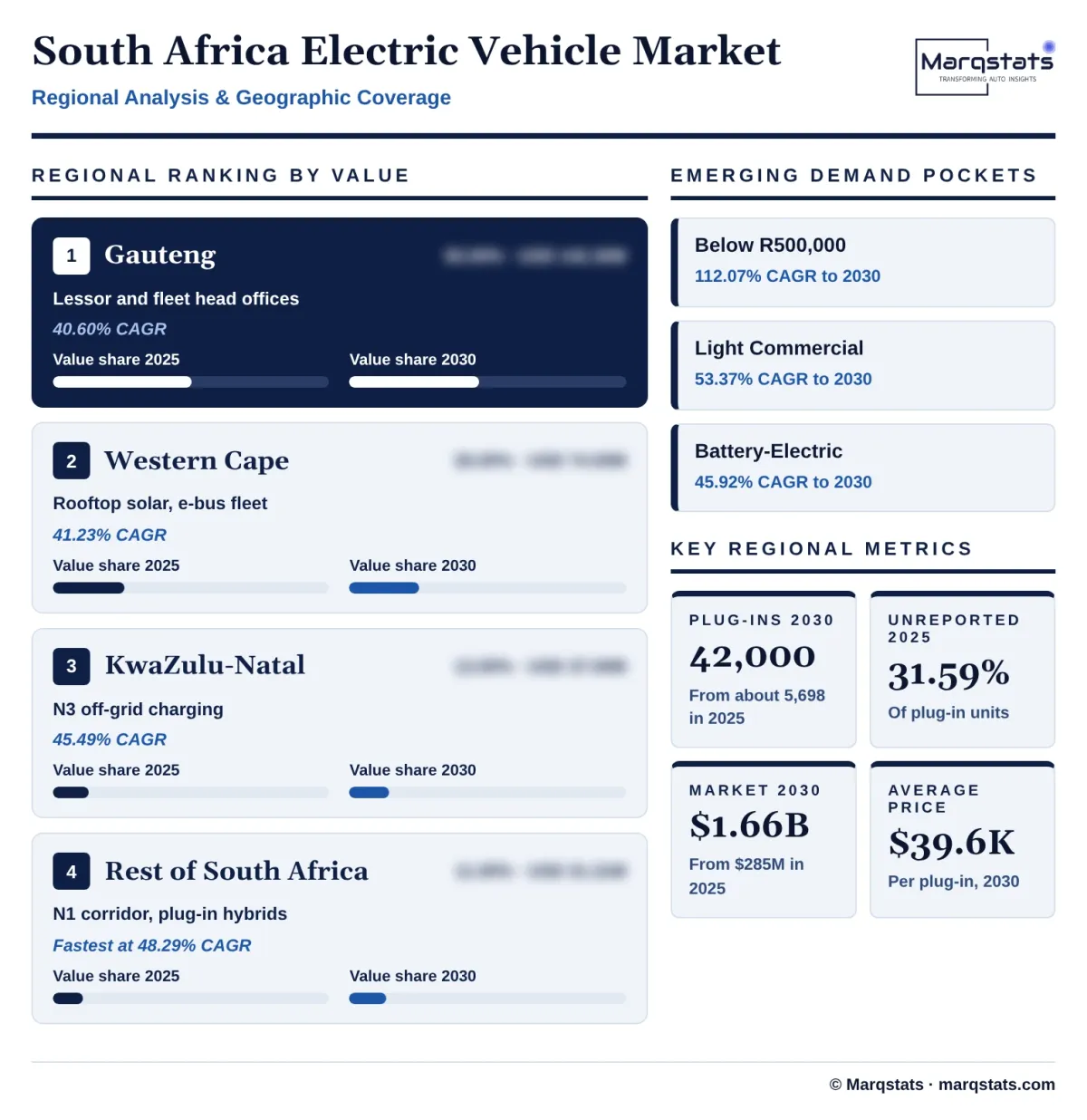
Gauteng accounts for 50.00% of 2025 value, USD 142.30 million, and grows at 40.60% a year to USD 781.75 million and 47.00% by 2030. Johannesburg and Tshwane hold the head offices of banks, lessors and fleet owners, so many vehicles that operate elsewhere are registered there, and the province has the densest dealer and charging networks. BMW at Rosslyn and Ford at Silverton build plug-in hybrids in Tshwane.
Western Cape
Western Cape accounts for 26.00% of 2025 value, USD 74.00 million, and grows at 41.23% a year to USD 415.83 million. Cape Town has high rooftop solar use, which lets owners charge at home during load-shedding, and Golden Arrow Bus Services runs the country's largest electric bus fleet there, so private buyers see electric vehicles in daily use.
KwaZulu-Natal
KwaZulu-Natal accounts for 13.00% of 2025 value, USD 37.00 million, and grows at 45.49% a year to USD 241.18 million and 14.50% by 2030. The N3 between Johannesburg and Durban now has off-grid solar charging at Tugela, and Durban holds the Port of Durban, the main port for imported vehicles, and the Toyota plant at Prospecton.
Rest of South Africa
The Eastern Cape, Free State, Mpumalanga, North West, Limpopo and Northern Cape account for 11.00% of 2025 value, USD 31.31 million, and grow fastest, at 48.29% a year, to USD 224.55 million and 13.50% by 2030. Long distances on the N1 through the Karoo held back battery-electric cars, so plug-in hybrids lead here, and new stations planned on the N1 open the region to battery-electric travel.
How Competition Is Evolving
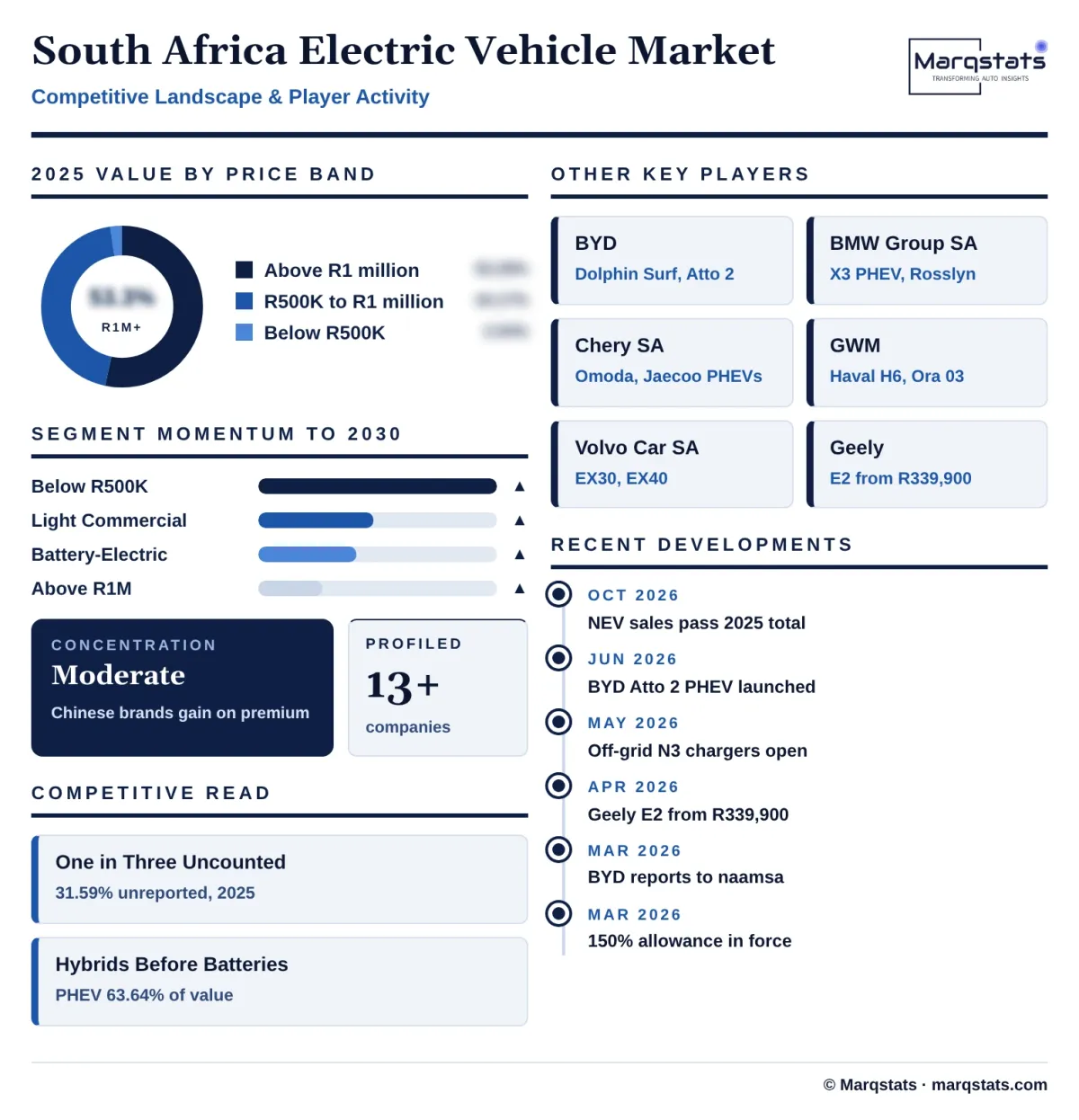
The market is moderately concentrated and is moving from premium European brands to Chinese brands. In 2025 the reported battery-electric list was led by the Volvo EX30, the Mercedes-Benz EQE and the MINI Aceman, while plug-in hybrid sales were led by the locally built BMW X3 30e and Chinese plug-in hybrid SUVs from Chery, Jaecoo and Haval. Because BYD did not report until March 2026 and Geely and Dongfeng still do not, Marqstats describes competition by price band rather than by brand share.
BYD Auto South Africa is the largest new-energy-only brand. Its first reported month, March 2026, showed 589 sales, including 239 Dolphin Surf, 130 Sealion 6, 94 Shark and 72 Sealion 5, and in June 2026 it launched the Atto 2 plug-in hybrid at R439,900. Steve Chang of BYD Auto South Africa said in June 2026 that a local factory depends on volume: “You cannot put up a factory when you're only doing a few hundred cars in a month.”
Chery South Africa, with the Omoda, Jaecoo and Jetour brands, and Great Wall Motors with Haval and Ora, compete with plug-in hybrid SUVs between about R500,000 and R800,000, and Chery plans the Q as an accessible battery-electric model. Geely returned with the E2 from R339,900 in April 2026, and Dongfeng sells the Box from R459,000. Chery is also taking over the Nissan plant at Rosslyn to build Jetour models from 2027, which would add a second Chinese-owned assembly base near the BMW plant.
Premium brands hold the value end. BMW Group South Africa, Mercedes-Benz South Africa, Volvo Car South Africa and Porsche sell most vehicles above R1 million, and BMW builds the X3 plug-in hybrid at Rosslyn. Competition is shifting from technology to price, finance and charging access, so brands that bundle home chargers, roaming and lease packages win fleet buyers.
Companies Covered
Companies covered in the report include:
Recent Market Activity
Table of Contents
Coverage & Segmentation
The study covers the South Africa electric vehicle market, with 2025 as the base year, 2021 – 2025 as the historical period and 2026 – 2030 as the forecast period. It covers new battery-electric vehicles and plug-in hybrids, passenger cars and light commercial vehicles up to 3,500 kg, sold by brands that report to naamsa and by brands that do not, segmented by propulsion, vehicle type, price band and region. Values are retail values including VAT, customs duty and ad valorem excise duty, in US dollars at the 2025 average of ZAR 17.88 per US dollar, in constant 2025 prices.
Conventional hybrids, mild hybrids, range-extended vehicles counted separately by brands, electric buses, medium and heavy electric trucks, two- and three-wheelers, used and grey imports, charging equipment and services are excluded. Live Marqstats pages on the South Africa hybrid and plug-in hybrid vehicle market and the South Africa electric bus market overlap this market only in plug-in hybrids and not at all in buses, and the South Africa Chinese automotive brands page covers all Chinese passenger cars; their figures should not be added to this market.