Market Snapshot
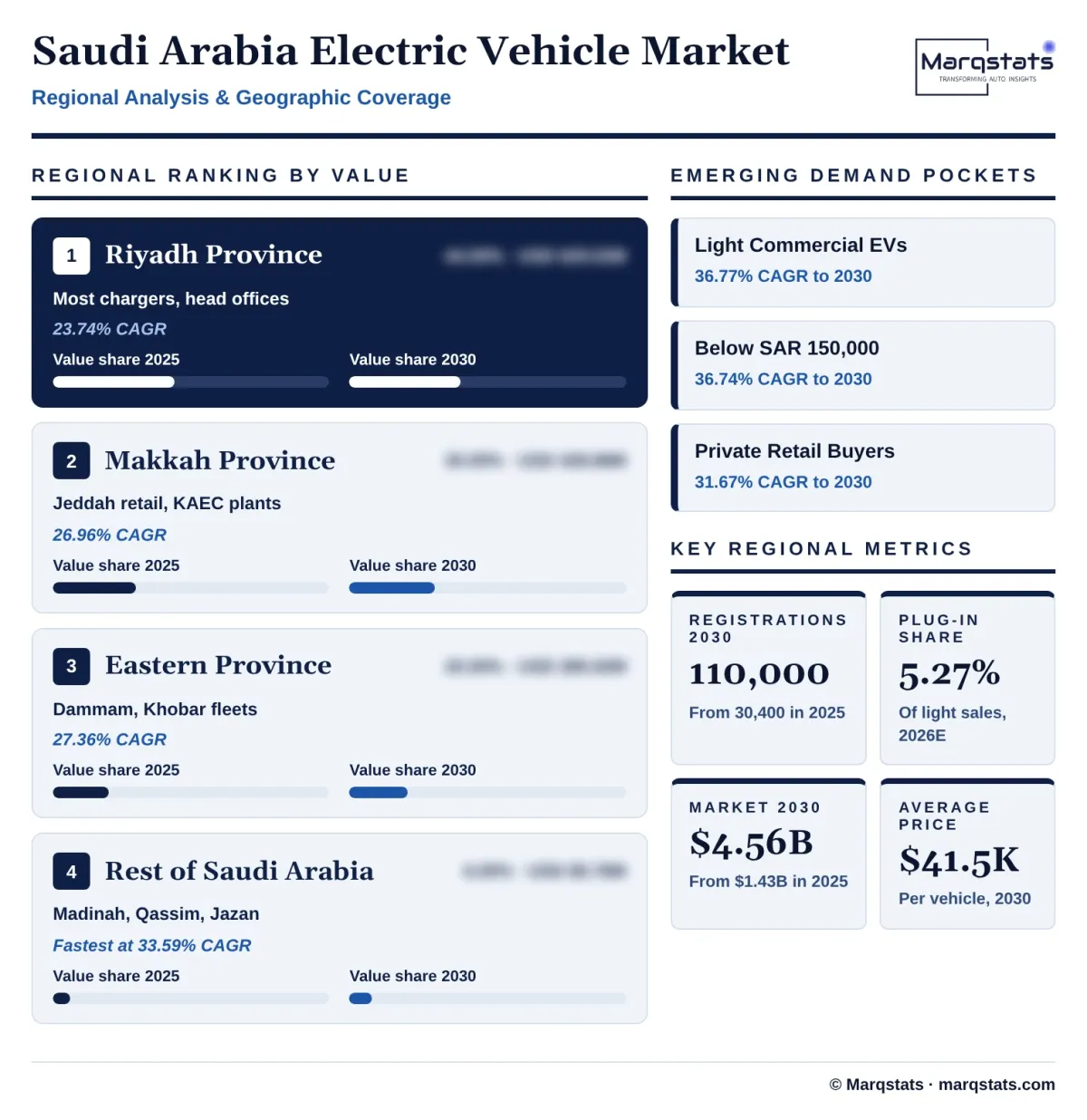
The Saudi Arabia electric vehicle market size is estimated at USD 1,429.60 million in 2025 and is projected to reach USD 4,562.80 million by 2030, growing at a CAGR of 26.13% over 2026 – 2030. New battery-electric and plug-in hybrid registrations rise from about 30,400 to 110,000 vehicles, and their share of light-vehicle sales climbs from 3.55%.
Marqstats defines the market as the retail transaction value, including 15% value added tax, of new battery-electric vehicles (BEVs) and plug-in hybrid electric vehicles (PHEVs) of up to 3.5 tonnes registered in Saudi Arabia each year. It covers passenger cars, SUVs and light vans and pickups, whether imported or assembled at the Lucid Group plant in King Abdullah Economic City, and counts sales to private buyers, government bodies, corporate fleets, rental firms and ride-hailing operators. Conventional hybrids without a plug, buses, medium and heavy trucks, two-wheelers, used vehicles and charging equipment are excluded.
Battery-electric vehicles account for 71.29% of 2025 value, SUVs and crossovers for 56.04% and private retail buyers for 43.74%. Riyadh Province accounts for 44.00% of value, while the Rest of Saudi Arabia grows fastest from a small base at 33.59% a year as highway charging reaches secondary cities.
Key Takeaways
Market Overview & Analysis
Report Summary
Marqstats sizes the Saudi Arabia electric vehicle market as the retail value of new plug-in light vehicles registered in the Kingdom each year. The count covers battery-electric vehicles, which run only on a battery and electric motor, and plug-in hybrids, which pair a charging socket and battery with a petrol engine. Value is the price paid by the buyer including 15% value added tax, converted at the fixed rate of SAR 3.75 per US dollar. On this basis the market was worth USD 1,429.60 million, or about SAR 5,361.00 million, in 2025.
There is no single published count of Saudi plug-in sales, so the base is reconciled from regional and national anchors. The International Energy Agency (IEA) reported in its Global EV Outlook 2026, published in May 2026, that about 75,000 electric cars were sold in the Middle East in 2025, more than 40% above 2024, that the United Arab Emirates held almost half of regional sales and that Qatar and Saudi Arabia together made up nearly 45%, about 33,750 vehicles. Marqstats allocates about 3,350 of those to Qatar, which leaves about 30,400 Saudi registrations, or 40.53% of the regional total.
The count is consistent with the national series. The Roland Berger EV Charging Index 2025, released in October 2025, reported that Saudi electric vehicle sales rose nearly tenfold in 2024 to more than 11,000 units, so the 2025 base implies growth of about 171.43%, in line with the IEA statement that Saudi Arabia and Qatar grew particularly quickly. Tracked new light-vehicle sales, including pickups and vans, reached 857,247 in 2025, the highest in ten years, so plug-in vehicles took 3.55% of the total.
Supply is led by imports. When regional sales began to scale in 2020, Tesla, Inc. models held about half of Middle East electric car sales; the IEA put Tesla at about 15% in 2025 and BYD Company Limited, which entered the region in 2022, at about 60%. In Saudi Arabia BYD is sold by Al-Futtaim Electric Mobility Company, Tesla opened its first Riyadh showroom and service centre on 10 April 2025, and Lucid Group, Inc. assembles the Lucid Air from kits at its AMP-2 plant in King Abdullah Economic City for government and retail buyers.
The state is building a domestic industry ahead of demand. The Public Investment Fund (PIF) holds the majority of Lucid, owns Ceer Motors jointly with Hon Hai Precision Industry Co., Ltd. (Foxconn), and holds 70% of Hyundai Motor Manufacturing Middle East, whose 50,000-vehicle plant broke ground on 14 May 2025. The Electric Vehicle Infrastructure Company (EVIQ), owned by PIF and the Saudi Electricity Company, targets 5,000 fast chargers at 1,000 locations by 2030. Marqstats treats these as the conditions for growth after 2026, not as demand in their own right.
Saudi Arabia Electric Vehicle Market Size and Forecast
The Saudi Arabia electric vehicle market grows from USD 1,429.60 million in 2025 to USD 4,562.80 million in 2030, a CAGR of 26.13%, and passes USD 2,722.90 million in 2028. Volume drives the growth: registrations rise at 29.33% a year, from about 30,400 to 110,000, while the average value per vehicle falls at 2.48% a year, from about USD 47,026 to USD 41,480, as cheaper Chinese-brand models and Saudi-built vehicles widen the market.
The 2025 value is built from units and prices. Marqstats estimates about 19,600 battery-electric vehicles at an average of USD 52,000 including value added tax, about SAR 195,000, and about 10,800 plug-in hybrids at USD 38,000, about SAR 142,500. The battery-electric average reflects a mix that runs from BYD Atto 3 and Seal models through the Tesla Model Y to the Lucid Air and Porsche Taycan, while plug-in hybrids are led by BYD models, the BYD Shark pickup and premium European plug-in SUVs.
The forecast year by year is USD 1,524.60 million in 2026, USD 1,988.25 million in 2027, USD 2,722.90 million in 2028, USD 3,631.00 million in 2029 and USD 4,562.80 million in 2030. 2026 is the slowest year, with value up 6.65% and units up 8.55%, because the wider Saudi light-vehicle market contracted sharply and showroom prices fell 10% to 15% in early 2026. Growth accelerates from 2027 as Ceer, Hyundai Motor Manufacturing Middle East and Lucid add Saudi-built supply and as EVIQ moves charging onto the highways.
Battery-electric vehicles gain share. Marqstats expects battery-electric registrations to rise from 19,600 to 79,200 and plug-in hybrids from 10,800 to 30,800, so battery-electric vehicles move from 64.47% to 72.00% of units. The plug-in hybrid stays relevant for families who drive between cities, but the arrival of Saudi-built battery-electric models and fast chargers on the Riyadh to Dammam and Riyadh to Jeddah roads favours the full-electric car.
By 2030 the 110,000 registrations equal 12.83% of the 2025 light-vehicle total. That is short of the target for 30% of vehicles in Riyadh to be electric by 2030, which refers to the vehicle fleet and would need a much faster replacement rate than the Saudi market has shown. Marqstats tracks four indicators to monitor the forecast: monthly light-vehicle registrations and the brand mix of Chinese importers, the start of regular production at Ceer and Hyundai Motor Manufacturing Middle East, EVIQ station openings on intercity highways, and government fleet orders placed with Lucid and Ceer.
Market Dynamics
Key Drivers
Five forces lift Saudi demand for plug-in vehicles, and most of them act on supply, price and access rather than on fuel savings.
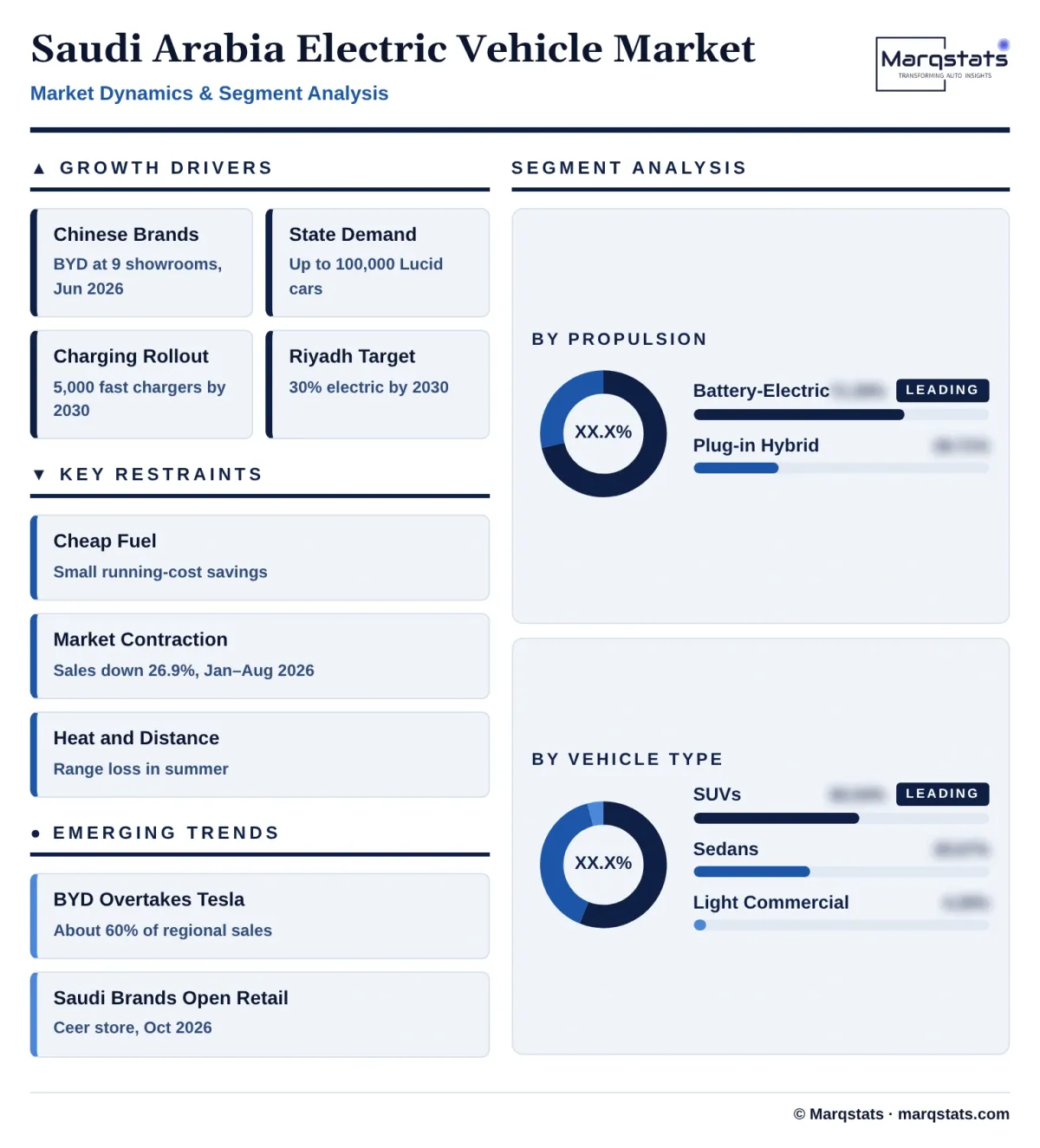
- Chinese brands widen choice and lower prices. BYD Company Limited held about 60% of Middle East electric car sales in 2025, according to the IEA, and Al-Futtaim BYD opened its ninth Saudi showroom in Jazan in June 2026, against three in 2025, with a stated aim of a fivefold network by the end of 2026. Wider dealer coverage brings plug-in models within reach of buyers outside Riyadh and Jeddah, and Haval and Jetour, which grew 48% and 22.6% in the first half of 2026, bring further Chinese plug-in hybrid and electric ranges into showrooms.
- State ownership creates captive demand. The Government of Saudi Arabia agreed to buy up to 100,000 vehicles from Lucid Group over ten years, and PIF, which holds the majority of Lucid, also owns Ceer Motors and 70% of Hyundai Motor Manufacturing Middle East. Ministries, PIF portfolio companies and giga-projects therefore act as anchor buyers for Saudi-built electric vehicles, which reduces the demand risk on local plants.
- Charging coverage is growing from a low base. EVIQ, owned by PIF and the Saudi Electricity Company, said in November 2025 that it expected 60 stations by the end of 2025, with 20 operating in Riyadh, 7 in Jeddah and 5 in Dammam, and that 2026 would focus on highways. Its 2030 target is 5,000 fast chargers at 1,000 locations, and agreements with Al-Futtaim Electric Mobility, the Roads General Authority and property developers place chargers where buyers already go.
- Riyadh sets a fleet target. The Royal Commission for Riyadh City has set a goal for 30% of vehicles in the capital to be electric by 2030, as part of a plan to halve emissions in the city, and this guides public procurement, parking and building rules. A city target is not a sales mandate, but it pushes government bodies, taxi and ride-hailing operators and real estate developers to plan for electric vehicles.
- Home electricity is cheap. The Saudi Electricity Company charges households SAR 0.18 per kWh for the first 6,000 kWh a month, so most villa owners can charge overnight for a few riyals. Detached houses with private parking are common in Saudi cities, which makes home charging easier than in apartment-based markets.
Key Restraints
Four constraints keep plug-in vehicles a small share of Saudi sales and shape which buyers move first.
- Fuel is cheap, so savings are small. Saudi Aramco sets regulated pump prices that remain among the lowest in the world, and a private owner driving 20,000 kilometres a year saves far less by switching to electric than a driver in Europe or East Asia. Without a purchase subsidy, the case for a private buyer rests on price, technology and status rather than running costs.
- The wider car market is contracting in 2026. Tracked light-vehicle sales fell 26.9% in January to August 2026, with August down 38.5%, and in June 2026 the Ministry of Commerce and the Saudi Standards, Metrology and Quality Organization (SASO) suspended light-vehicle imports from 29 manufacturers that had not filed 2026 supply plans. Electric vehicles gain share in this market but buyers delay purchases and dealers cut prices on petrol stock.
- Heat and long distances raise range concerns. Summer temperatures above 45°C reduce usable range when the air conditioning and battery cooling run, and intercity trips such as the 950 kilometre run from Riyadh to Jeddah need fast chargers that only began to appear on highways in 2026. This keeps plug-in hybrids in demand among families that travel between cities.
- Resale values and service capacity are untested. Used electric vehicles have little trading history in Saudi Arabia, so lenders and lessors set cautious residual values, and franchised workshops trained for high-voltage systems are concentrated in Riyadh, Jeddah and Dammam. Buyers outside the three main cities face longer repair times.
Key Trends
Four shifts are changing who sells electric vehicles in Saudi Arabia, at what price and through which channel.
- Chinese brands replace Tesla as the volume leader. Tesla held about half of regional electric car sales in 2020 and about 15% in 2025, while BYD reached about 60%, according to the IEA. In Saudi Arabia the shift is reinforced by plug-in hybrids from BYD, Haval and other Chinese brands, which suit buyers who are not ready for a battery-only car.
- Saudi brands open retail. Ceer Motors revealed the Exobot sedan and SUV in September 2026 and opened its first mobile store at Bujairi Terrace in Diriyah, Riyadh, on 8 October 2026, with further stores planned in Riyadh, Jeddah and Dammam and permanent Ceer Centers in Riyadh, Jeddah and Khobar. Regular production is planned for the first quarter of 2027.
- Charging moves onto the highways. EVIQ opened highway sites at SASCO stations and said 2026 would focus on the Jeddah to Madinah, Riyadh to Dammam and Riyadh to Qassim corridors, while Tesla installed Superchargers in its first Saudi cities after its April 2025 launch.
- Fleets and rental firms test electric vehicles. Rental companies, ride-hailing platforms and corporate fleets add plug-in vehicles to meet sustainability targets and Riyadh rules, and Lucid offers electric vehicles through rental partners, which lets drivers try electric cars before buying.
Strategic Implications
- For importers and Chinese brands, the 2026 contraction is an opening rather than a pause. Buyers are trading down from Japanese and Korean petrol models, and a plug-in range priced below SAR 150,000 with a dealer in Jazan, Tabuk or Hail reaches buyers that Tesla and Lucid do not serve. Network breadth, not model count, decides share.
- For Saudi-built brands, government and fleet orders will carry the first two years. Ceer and Hyundai Motor Manufacturing Middle East start production into a market where Chinese imports already set the price, so early volume depends on PIF portfolio companies, ministries and rental fleets, while retail buyers judge the cars on price against BYD.
- For distributors and dealer groups, high-voltage service capacity is the bottleneck to plan for. Workshops in Riyadh, Jeddah and Dammam need certified technicians and battery diagnostic tools before the first large group of plug-in vehicles leaves warranty, and dealers that train staff early can win service contracts from fleets.
- For lenders and lessors, cautious residual values are the main barrier to private demand. Banks and finance companies that back residual values with battery health checks or manufacturer buy-back terms can lower monthly payments and widen the buyer base beyond high-income households.
- For charging operators and property developers, the share of plug-in hybrids matters. About a third of plug-in vehicles sold in 2025 can also run on petrol, so their owners charge at home and use public chargers less often, and public sites should be planned around battery-electric fleets, taxis and highway travel.
Market Segmentation
Battery-electric vehicles account for 71.29% of 2025 value, USD 1,019.20 million, and grow at 27.87% a year to USD 3,484.80 million and 76.37% of the market. Marqstats estimates about 19,600 units in 2025, led by BYD, Tesla and Lucid, with premium German and Korean models making up most of the rest. Saudi-built models from Lucid, Ceer and Hyundai Motor Manufacturing Middle East lift the unit count to about 79,200 in 2030, while the average price falls from about USD 52,000 to USD 44,000.
Plug-in hybrids account for 28.71% of 2025 value, USD 410.40 million, and grow at 21.31% a year to USD 1,078.00 million, while their share falls to 23.63%. About 10,800 units were registered in 2025, mainly BYD models, the BYD Shark pickup, Chinese-brand SUVs and plug-in versions of premium European SUVs. Plug-in hybrids appeal to buyers who drive long distances between cities and want a petrol engine as back-up.
Sedans and hatchbacks account for 39.67% of 2025 value, USD 567.17 million, and grow at 20.49% a year to USD 1,440.61 million. The Lucid Air, Tesla Model 3, BYD Seal and Porsche Taycan dominate, and the Ceer Exobot sedan joins the segment after production starts in 2027.
SUVs and crossovers account for 56.04% of 2025 value, USD 801.14 million, and grow at 28.70% a year to USD 2,828.83 million and 62.00% of the market. Saudi buyers prefer high driving positions and large cabins, and models such as the Tesla Model Y, BYD Sealion 7, BYD Atto 3, Lucid Gravity and Chinese plug-in hybrid SUVs make this the largest body type.
Light vans and pickups up to 3.5 tonnes account for 4.29% of 2025 value, USD 61.29 million, and grow fastest, at 36.77% a year, to USD 293.36 million. About 1,500 units were registered in 2025, mostly plug-in hybrid pickups and electric delivery vans used by logistics, utility and giga-project fleets, and the segment reaches about 8,000 units by 2030.
Vehicles priced below SAR 150,000 including tax account for 24.41% of 2025 value, USD 348.99 million, and grow fastest, at 36.74% a year, to USD 1,668.35 million and 36.56% of the market. Chinese compact SUVs and plug-in hybrids fill this band, which is where most of the 2026 growth comes from.
Vehicles priced from SAR 150,000 to 250,000 account for 42.98% of 2025 value, USD 614.37 million, and grow at 24.93% a year to USD 1,869.71 million. The Tesla Model Y and Model 3, the BYD Seal and Sealion 7 and Korean electric SUVs compete in this band.
Vehicles priced above SAR 250,000 account for 32.61% of 2025 value, USD 466.24 million, and grow at 17.06% a year to USD 1,024.74 million, while their share falls to 22.46%. The Lucid Air and Gravity, Porsche Taycan, Mercedes-Benz EQ models, BMW iX and Tesla Cybertruck make up most of this band, and government orders keep it larger than in most markets.
Private buyers account for 43.74% of 2025 value, USD 625.26 million, and grow fastest among buyer types, at 31.67% a year, to USD 2,474.89 million and 54.24% of the market. Villa owners with home charging and high-income households in Riyadh, Jeddah and Khobar buy first, and cheaper Chinese models widen the base after 2026.
Government bodies and corporate fleets account for 40.40% of 2025 value, USD 577.61 million, and grow at 16.88% a year to USD 1,259.94 million. Ministries, PIF portfolio companies and giga-projects such as NEOM and Red Sea Global buy Lucid vehicles and other premium electric cars, and are the natural first buyers for Ceer.
Rental, leasing and ride-hailing operators account for 15.86% of 2025 value, USD 226.73 million, and grow at 29.57% a year to USD 827.97 million. Car rental firms, operating lessors and ride-hailing fleets in Riyadh add plug-in vehicles to meet city rules and sustainability targets.
By Geography
Riyadh Province
Riyadh Province accounts for 44.00% of 2025 value, USD 629.02 million, and grows at 23.74% a year to USD 1,825.12 million, while its share eases to 40.00% by 2030. The capital has the most chargers, with 20 EVIQ stations operating by November 2025, the first Tesla and Ceer stores, government head offices and the 30% electric vehicle target, and fleets registered in Riyadh also run in other provinces.
Makkah Province (Jeddah, Makkah, KAEC)
Makkah Province accounts for 30.00% of 2025 value, USD 428.88 million, and grows at 26.96% a year to USD 1,414.47 million and 31.00% by 2030. Jeddah is the second retail market, King Abdullah Economic City hosts the Lucid, Ceer and Hyundai plants, and the Jeddah to Madinah highway is one of the first EVIQ corridors.
Eastern Province
The Eastern Province accounts for 20.00% of 2025 value, USD 285.92 million, and grows at 27.36% a year to USD 958.19 million. Dammam, Khobar and Dhahran have high incomes and large corporate fleets, and the Riyadh to Dammam road and the causeway to Bahrain make the province a test for highway charging.
Rest of Saudi Arabia
The Rest of Saudi Arabia, including Madinah, Qassim, Asir, Tabuk, Hail and Jazan, accounts for 6.00% of 2025 value, USD 85.78 million, and grows fastest, at 33.59% a year, to USD 365.02 million and 8.00% by 2030. BYD showrooms in cities such as Jazan and highway chargers to Qassim and Madinah open these markets, although long distances and few workshops keep adoption behind the main cities.
How Competition Is Evolving
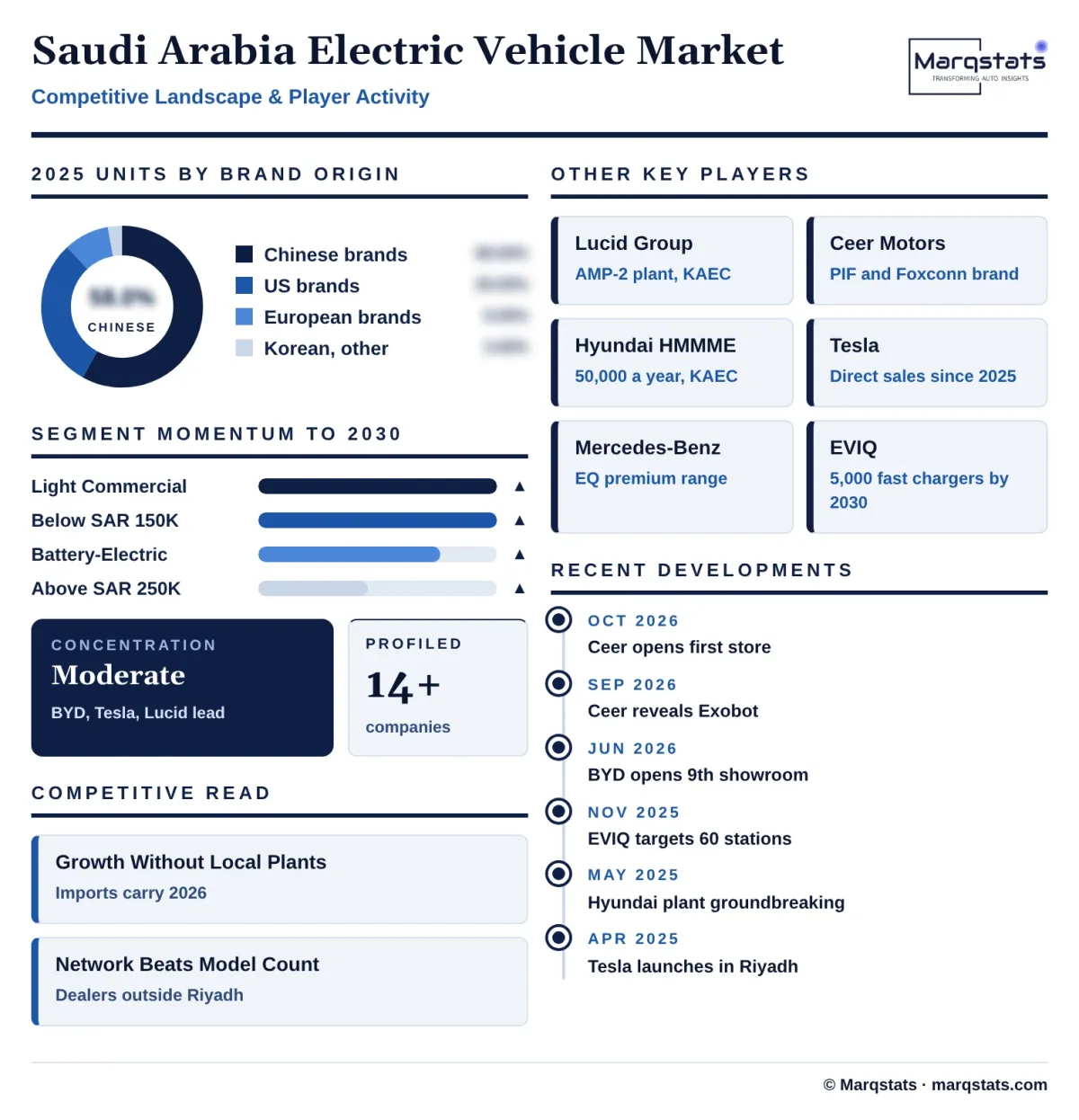
The market is concentrated around a few brands, led by Chinese importers. Marqstats estimates that Chinese brands supplied about 58.00% of 2025 plug-in registrations, US brands Tesla and Lucid about 30.00%, European premium brands about 9.00% and Korean, Japanese and other brands about 3.00%. The estimate is consistent with the IEA statement that BYD held about 60% and Tesla about 15% of Middle East electric car sales in 2025, adjusted for the larger weight of Lucid and plug-in hybrids in Saudi Arabia.
BYD Company Limited is the volume leader. Al-Futtaim Electric Mobility Company sells its battery-electric and plug-in hybrid ranges and grew the network from three showrooms in 2025 to nine by June 2026, and signed an agreement with EVIQ in January 2025 to install fast chargers at its sites. Tesla, Inc. entered directly on 10 April 2025 with a Riyadh showroom and service centre, followed by Jeddah, and sells the Model 3, Model Y and Cybertruck.
Lucid Group, Inc. is the only brand that builds electric vehicles in Saudi Arabia today. Its AMP-2 plant in King Abdullah Economic City assembles vehicles from kits and is being expanded toward a reported 150,000 vehicles a year of full production, and the Government of Saudi Arabia agreement to buy up to 100,000 vehicles over ten years gives it a base of fleet demand. Ceer Motors and Hyundai Motor Manufacturing Middle East join from 2026 and 2027, which turns a market of importers into one where state-backed local brands compete with Chinese imports.
Premium European and Korean brands compete on technology and brand loyalty. Mercedes-Benz Group AG, BMW AG, Porsche AG, Hyundai Motor Company and Kia Corporation sell battery-electric models through long-standing Saudi distributors, while Geely, Zeekr and other Chinese brands expand in the middle of the market. Competition is moving from price to network, finance and service, and brands that combine dealer reach, charging partnerships and residual-value support win fleet orders.
Companies Covered
Companies covered in the report include:
Recent Market Activity
Table of Contents
Coverage & Segmentation
The study covers the Saudi Arabia electric vehicle market, with 2025 as the base year, 2023 – 2025 as the historical period and 2026 – 2030 as the forecast period. It covers new battery-electric and plug-in hybrid light vehicles of up to 3.5 tonnes registered in the Kingdom, segmented by propulsion, vehicle type, price band, buyer type and region. Values are retail transaction values including 15% value added tax, in US dollars at the fixed rate of SAR 3.75 per US dollar.
Conventional and mild hybrids without a charging socket, range-extended commercial vehicles above 3.5 tonnes, electric buses, medium and heavy trucks, two-wheelers, used and re-exported vehicles, and charging hardware and services are excluded. The 2025 count of 30,400 registrations is the same count used in the Marqstats Saudi Arabia EV Charging Station report, which sizes chargers and charging revenue and is not additive to this market. Live Marqstats reports on Saudi Arabia Electric Vehicle Manufacturing (factory-gate output, including exports, on a narrower domestic-sales count) and Saudi Arabia EV Financing and Leasing (financed value) measure different layers of the same vehicles and should not be added to this market.