Market Snapshot
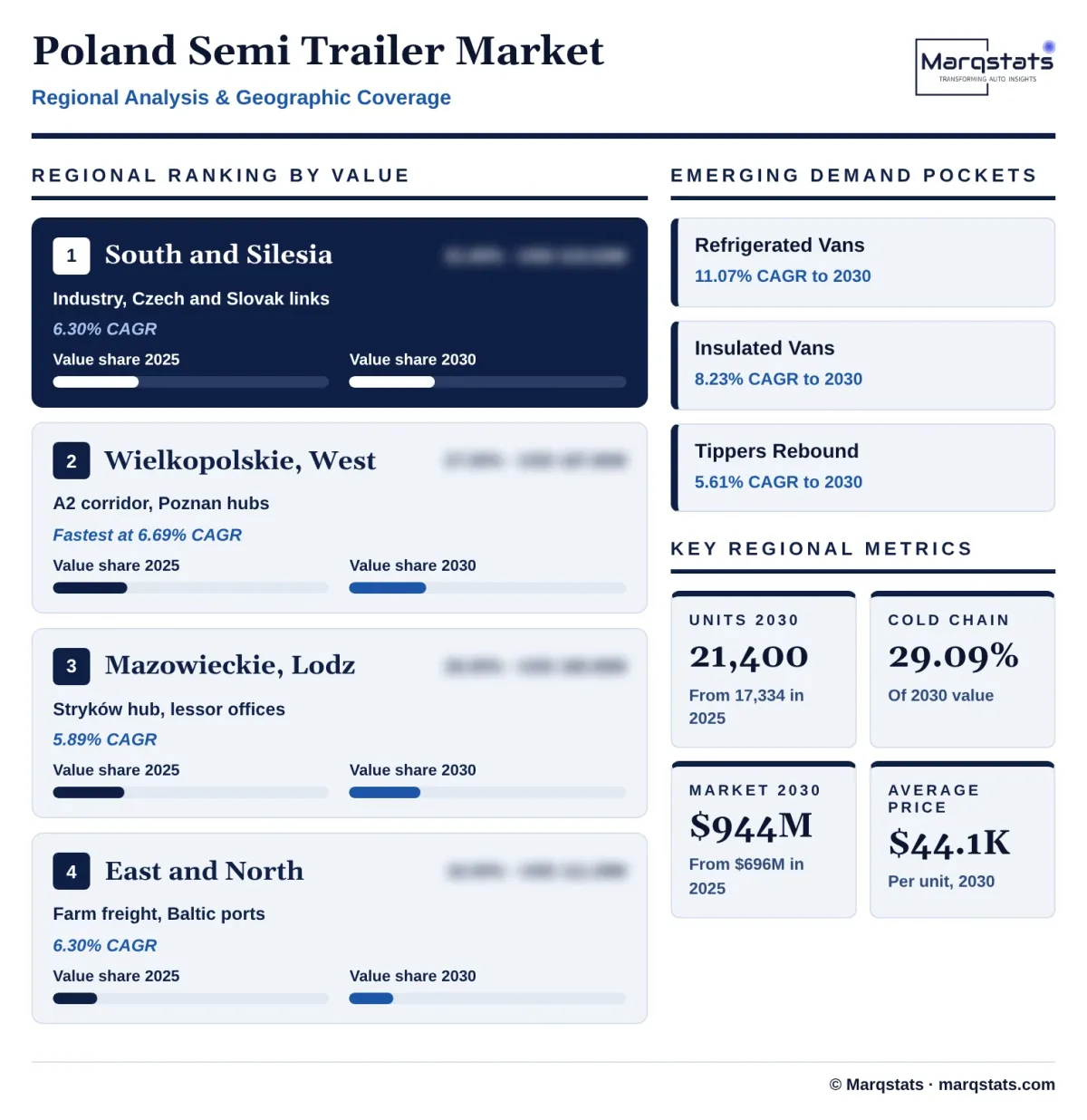
The Poland semi trailer market size is estimated at USD 695.57 million in 2025 and is projected to reach USD 943.96 million by 2030, growing at a CAGR of 6.30% over 2026 – 2030. Registrations of new heavy semi-trailers rise from 17,334 to about 21,400 units, a 4.30% annual rate, while the average ex-factory value per semi-trailer climbs from about USD 40,127 to USD 44,110 as insulated and refrigerated bodies take a larger share.
Marqstats defines the market as the ex-factory value, net of VAT, of new semi-trailers above 3.5 tonnes gross vehicle weight (category O4) registered for the first time in Poland, as counted by the Polish Automotive Industry Association (PZPM) from the Central Register of Vehicles and Drivers (CEPiK). Heavy drawbar trailers (2,566 in 2025), light and agricultural trailers, bodies mounted on rigid trucks and used imports are excluded. Values use EUR 1 = USD 1.13 and USD 1 = PLN 3.7553, the 2025 averages.
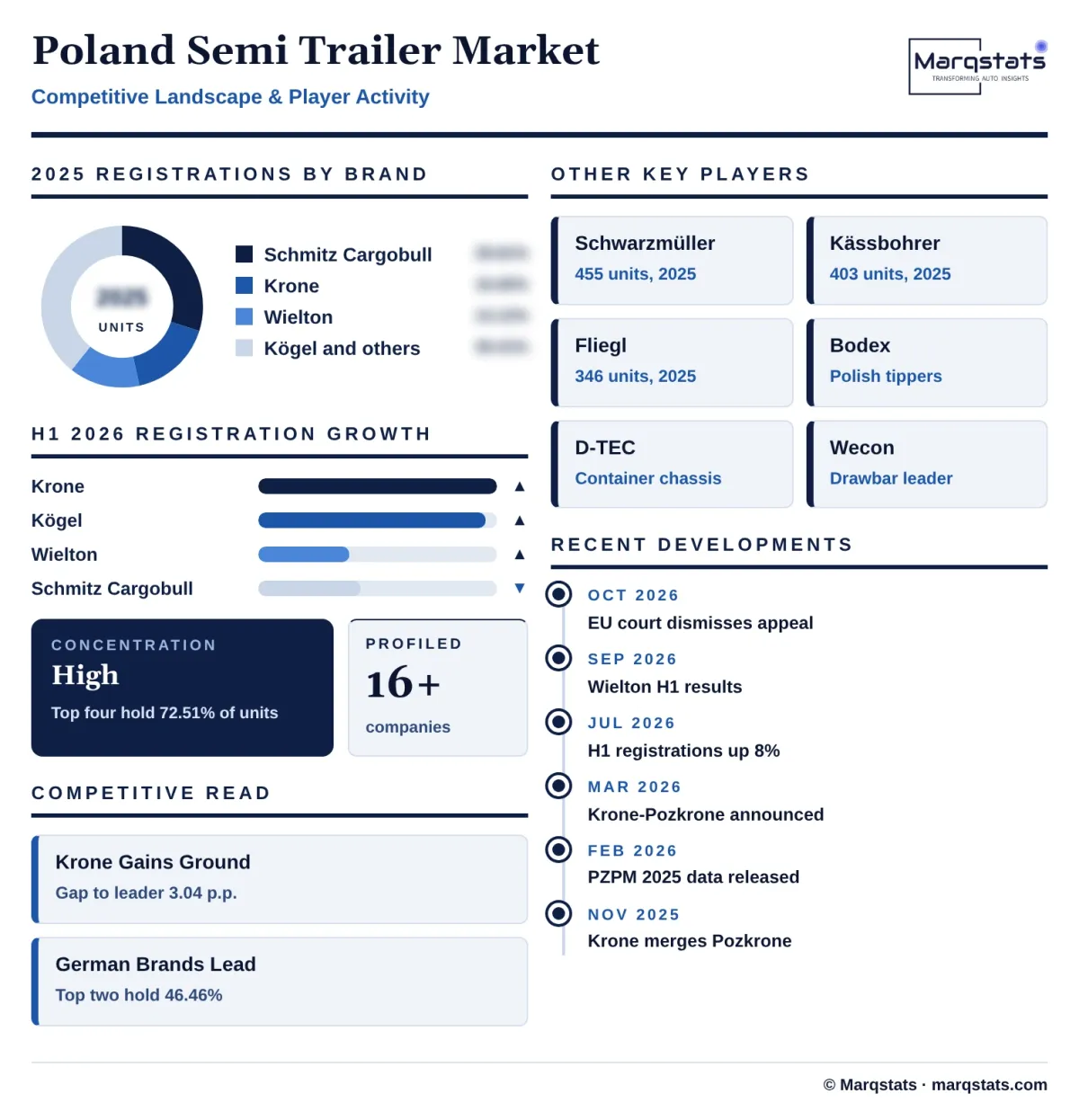
Curtainsider and universal semi-trailers account for 40.28% of 2025 value and box vans, led by insulated and refrigerated bodies, for 31.59%. Temperature-controlled bodies grow fastest, at 9.67% a year. Schmitz Cargobull, Krone, Wielton and Kögel registered 72.51% of 2025 units, and registrations climbed from a low of 15,664 in 2024 to 17,334 in 2025.
Key Takeaways
Market Overview & Analysis
Report Summary
Marqstats sizes the Poland semi trailer market as the ex-factory value, net of VAT, of new heavy semi-trailers registered for the first time each year. A semi-trailer rests part of its weight on the tractor unit through a fifth wheel, which separates it from the drawbar trailer that a rigid truck tows. The study counts category O4 semi-trailers above 3.5 tonnes gross vehicle weight, from curtainsiders and box vans to tippers, tankers, low-loaders, container chassis and silo bodies.
Poland is the largest road freight market in the European Union. Eurostat reported on 31 July 2026 that EU road freight reached 1,886 billion tonne-kilometres in 2025, and that Poland alone performed 381.0 billion, or 20.2%, ahead of Germany at 14.7%, Spain at 14.5%, France at 9.2% and Italy at 8.6%. That volume is moved by a fleet of tractor and semi-trailer combinations whose trailers are renewed on a five to seven year cycle, which makes registrations a direct read on carrier confidence.
Registrations swung sharply. PZPM data show new semi-trailers above 3.5 tonnes at 14,727 in 2020, 29,286 in 2021, 25,386 in 2022, 23,454 in 2023 and 15,664 in 2024, a fall of 46.51% from the 2021 peak, before a recovery to 17,334 in 2025. Marqstats attributes the 2021 spike to post-pandemic replacement and the 2024 low to high financing costs and weak freight rates.
The 2025 count sits inside a ladder. PZPM and the trade journal Samochody Specjalne reported 19,900 heavy trailers and semi-trailers in 2025, up 12.2%, made up of 17,334 semi-trailers and 2,566 heavy drawbar trailers, which grew 23.48% from 2,078. Marqstats counts only the semi-trailers, because drawbar trailers pair with rigid trucks, serve different routes and are priced and financed differently. Light and agricultural trailers, which are most of the trailer register by number, are also excluded.
Value follows from volume and mix. At the ex-factory prices and body mix described below, Marqstats estimates the 2025 market at USD 695.57 million, equal to about PLN 2,612.07 million at USD 1 = PLN 3.7553, or an average of about EUR 35,511 per semi-trailer. The market was moving up in 2026: PZPM data reported by Fleet.com.pl showed 9,770 heavy semi-trailers in the first half, up 8%, and September 2026 registrations of 1,787 semi-trailers were 22.4% above September 2025.
Poland Semi Trailer Market Size and Forecast
The Poland semi trailer market grows from USD 695.57 million in 2025 to USD 943.96 million in 2030, a CAGR of 6.30%. Volume supplies most of the growth: registrations rise at 4.30% a year from 17,334 to about 21,400 units, and the average value per semi-trailer rises at 1.91% a year, from about USD 40,127 to USD 44,110, as refrigerated and insulated vans and higher specifications take a larger share.
The 2025 value is built bottom-up from registrations and prices. PZPM counted 8,405 curtainsider and universal semi-trailers, 4,537 box vans (1,981 insulated, 1,224 refrigerated and 1,332 general-purpose), 2,094 tippers, 349 tankers and 278 low-loaders, which leaves 1,671 container chassis, silo and other bodies. Marqstats applies ex-factory prices of about EUR 29,500 for a curtainsider or universal body, EUR 39,000 for an insulated van, EUR 62,000 for a refrigerated van, EUR 31,000 for a dry van, EUR 38,000 for a tipper, EUR 56,000 for a tanker, EUR 68,000 for a low-loader and EUR 33,000 for the remaining bodies, converted at EUR 1 = USD 1.13.
The prices are checked against 2026 dealer listings and company results. Listed curtainsiders on Autoline Polska ranged from EUR 24,990 for a Kögel SN 24 to EUR 31,100 for a Schmitz Cargobull Varios with a load-securing box, a Schmitz Cargobull Standard curtainsider at PLN 125,046 to PLN 128,568 and a steel 28 cubic metre Schmitz Cargobull tipper at PLN 155,900 net. Wielton, the Polish manufacturer, reported group revenue of PLN 1,180.3 million on 8,577 vehicles in the first half of 2026, about PLN 137,600 a vehicle, and Schmitz Cargobull reported revenue of EUR 2.16 billion on production of 42,353 units in the year to March 2025, which includes parts, service and truck bodies.
The forecast assumes a front-loaded recovery. Marqstats expects about 18,780 registrations in 2026, a rise of 8.34%, and a value of USD 770.27 million, because the first half of 2026 ran 8% ahead of the first half of 2025 and September ran 22.4% ahead. Growth then slows to 2.20% in 2030 as the replacement wave of 2021 vehicles has been served. Registrations of about 21,400 in 2030 stay below the 29,286 of 2021 and the 25,386 of 2022, because Marqstats expects fleet owners to keep trailers longer and to buy fewer of them per tractor.
Price contributes 1.91% a year. Regulation (EU) 2024/1610 pushes buyers towards aerodynamic skirts, lighter chassis and tyre pressure systems, refrigerated bodies carry the highest prices in the range, and wage and steel costs add to every body. Marqstats tracks four indicators to monitor the forecast: monthly PZPM registrations of semi-trailers, the results of Schmitz Cargobull, Krone and Wielton, the diesel and toll cost per kilometre for Polish hauliers, and the schedule of Regulation (EU) 2024/1610 reporting for the 2030 period.
Market Dynamics
Key Drivers
Five forces are lifting demand for new semi-trailers in Poland as the market recovers from its 2024 low.
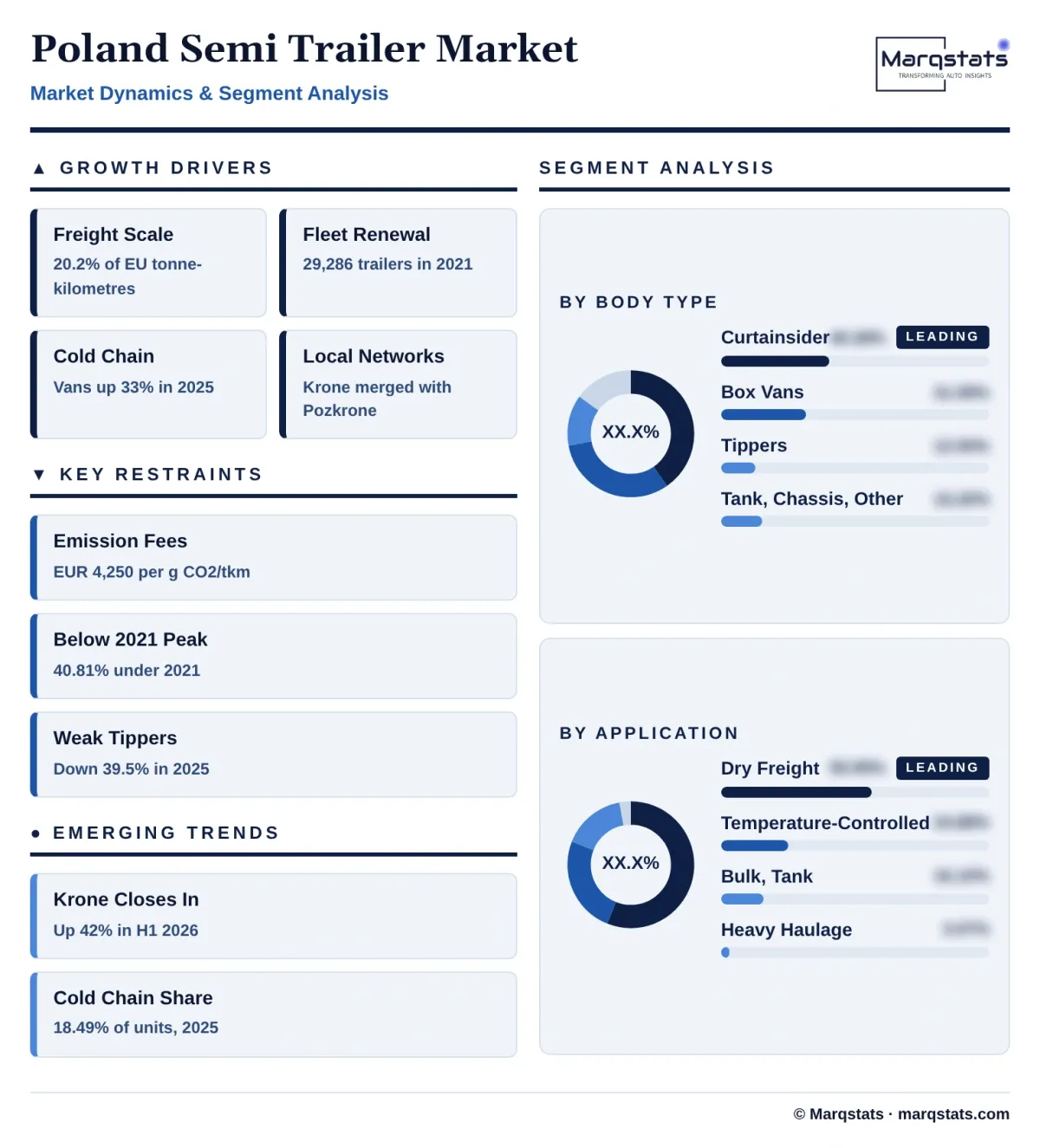
- Poland is Europe's largest road freight market. Polish carriers performed 381.0 billion tonne-kilometres in 2025, 20.2% of the EU total of 1,886 billion according to Eurostat, and every tonne-kilometre needs a tractor and a semi-trailer, so a fleet of this size must be renewed continuously.
- Replacement of the 2021 and 2022 vintage begins. PZPM counted 29,286 semi-trailers in 2021 and 25,386 in 2022, and and Marqstats assumes fleet cycles of five to seven years, so the first of those trailers reach the point where leasing terms end and residual values fall in 2026 and 2027, which supports registrations above the 2024 trough of 15,664.
- Demand for cold chain capacity is rising. Insulated vans grew with 1,981 registrations and refrigerated vans with 1,224 in 2025, and box vans as a group rose 33% to 4,537, as Polish hauliers carry chilled and frozen food, dairy and pharmaceuticals to Western Europe and need bodies with higher specifications than a curtainsider.
- Manufacturers and rental firms are building local networks. Krone merged with its Polish partner Pozkrone on 21 November 2025 and launched Krone Fleet Polska for rental and service, Schmitz Cargobull sells through EWT Truck and Trailer, and Wielton, with 14.6% of Polish trailer and semi-trailer sales in the first half of 2026, builds in Poland, so supply, finance and service are close to the buyer.
- Registrations are already recovering. PZPM data reported on 10 July 2026 showed 9,770 heavy semi-trailers in the first half, up 8%, and the September 2026 registration of 1,787 semi-trailers was 22.4% above the year before, so the base year was a trough and the recovery continues.
Key Restraints
Four constraints keep registrations well below the 2021 peak and slow the move to costlier equipment.
- Emission rules raise prices and add risk. Regulation (EU) 2024/1610 sets a 10% CO2 reduction target for semi-trailers and 7.5% for trailers from the 2030 reporting period, with a fee of EUR 4,250 per gram of CO2 per tonne-kilometre, and Kögel put its own exposure at up to EUR 64 million a year, so makers pass on aerodynamic and weight-saving costs that small hauliers resist.
- The market is far below its peak. Registrations of 17,334 in 2025 are 40.81% below the 29,286 of 2021, and Polish carriers face high financing costs, toll charges on the German and Polish networks and rate pressure from Western European shippers, which keeps fleet expansion cautious.
- Construction demand is weak. Tipper semi-trailers fell 39.5% to 2,094 in 2025 and tankers fell 39.3% to 349, with Bodex down 43.4% to 259 and Kempf down 49.9% to 210, so the segments tied to domestic building and chemicals pull the total down while freight bodies grow.
- Low-cost imports and used trailers compete. Buyers can compare German, Polish and other brands online, dealer listings show new curtainsiders from EUR 24,990, and a large used market gives small hauliers a cheaper route than a new body with a full specification.
Key Trends
Four shifts are changing which semi-trailers Polish fleets buy and who sells them.
- Manufacturers integrate sales, rental and service. Krone completed its takeover of Pozkrone on 21 November 2025, announced it on 4 March 2026 and plans a spare parts warehouse at Tarnowo Podgórne, and in the first half of 2026 its registrations rose 42% to 2,125 as it closed on Schmitz Cargobull.
- Cold chain bodies take share. Insulated and refrigerated vans were 18.49% of 2025 registrations and grow to 21.50% of 2030 registrations on Marqstats estimates, as retail chains and food exporters move more product by road.
- Wielton recovers at home. The Polish manufacturer sold 2,398 vehicles in Poland in the first half of 2026, up 10.4%, took 14.6% of the Polish market and cut its net loss to PLN 43.6 million from PLN 107.6 million.
- Specifications move towards aerodynamics and weight saving. Fleet buyers ask for side skirts, rear flaps, lighter axles and tyre pressure monitoring ahead of the 2030 reporting period, and electric axles such as SAF-Holland TRAKr and ZF are tested on a small number of trailers.
Strategic Implications
- For trailer makers, the contest in curtainsiders is decided on delivery time, finance and service, not on price. The gap between the two largest brands narrowed to 3.04 percentage points of units in the first half of 2026, and Krone has shown that owning the sales and rental network is a faster route to share than adding dealers.
- For entrants, temperature-controlled bodies, lightweight tippers and intermodal chassis are the segments where a specialist can win. Refrigerated vans carry about EUR 62,000 each against EUR 29,500 for a curtainsider, and grow at 11.07% a year, so one refrigerated sale is worth about two curtainsiders.
- For hauliers, the main decision is timing. The 2021 and 2022 vintages reach replacement age while specifications are about to change, so fleets that order lightweight, aerodynamic trailers in 2026 and 2027 avoid being left with high-emission stock when the 2030 fee applies.
- For lessors and financiers, the 2024 low shows how fast registrations fall when freight rates and interest rates move together. Residual value assumptions for curtainsiders should reflect a 40.81% drop in volume between 2021 and 2025, and the registration data are concentrated at lessor head offices, so regional views need care.
- For component suppliers, axles, suspension, tyre monitoring and telematics are specified by body makers on every trailer, so supplier volumes follow the registrations of the four largest brands, which account for 72.51% of the market.
Market Segmentation
Curtainsider and universal semi-trailers account for 40.28% of 2025 value, USD 280.19 million, and grow at 5.52% a year to USD 366.53 million. PZPM counted 8,405 units in 2025, up 30.2% from 6,453, led by Schmitz Cargobull, Wielton and Kögel and priced at about EUR 29,500 ex-factory. This is the body type that serves international general cargo.
Box vans account for 31.59% of 2025 value, USD 219.71 million, and grow at 8.19% a year to USD 325.69 million and 34.50% of the market. PZPM counted 4,537 vans in 2025, up 33% from 3,410, made up of 1,981 insulated, 1,224 refrigerated and 1,332 general-purpose vans. Marqstats expects 5,950 vans in 2030.
Tippers account for 12.93% of 2025 value, USD 89.92 million, and grow at 5.61% a year to USD 118.14 million. Registrations fell 39.5% from 3,459 to 2,094 in 2025, and the share of tippers dropped from 22.08% to 12.08%. Marqstats expects a partial recovery to about 2,550 units by 2030 as public works spending returns.
Tankers account for 3.17% of 2025 value, USD 22.08 million, and grow at 4.37% a year to USD 27.35 million. Registrations fell 39.30% from 575 to 349 in 2025, and the segment is served by specialist makers such as Feldbinder, Magyar, BC-LDS and Spitzer Silo.
Low-loaders account for 3.07% of 2025 value, USD 21.36 million, and grow at 4.97% a year to USD 27.22 million. PZPM counted 278 units in 2025, down 15%, bought for construction machinery and heavy haulage at prices near EUR 68,000.
Container chassis, silo and other bodies account for 8.96% of 2025 value, USD 62.31 million, and grow at 4.87% a year to USD 79.03 million. The segment is the balance of 1,671 semi-trailers after the named body types, and includes D-TEC chassis (250 units), silo trailers, walking-floor bodies and car transporters.
General freight and intermodal use accounts for 55.95% of 2025 value, USD 389.16 million, and grows at 5.00% a year to USD 496.66 million. It covers curtainsiders, dry vans, container chassis and other general-purpose bodies used by international hauliers and logistics operators.
Temperature-controlled transport accounts for 24.88% of 2025 value, USD 173.05 million, and grows fastest, at 9.67% a year, to USD 274.59 million and 29.09% of the market. It covers insulated and refrigerated vans for food, dairy and pharmaceutical freight.
Bulk, construction and tank use accounts for 16.10% of 2025 value, USD 112.00 million, and grows at 5.37% a year to USD 145.49 million. Tippers and tankers serve quarries, building sites and chemical and fuel distribution, and the segment is the most exposed to domestic investment.
Heavy haulage accounts for 3.07% of 2025 value, USD 21.36 million, and grows at 4.97% a year to USD 27.22 million. Low-loaders carry construction machinery, wind and energy components and are bought by specialist carriers.
By Geography
Mazowieckie and Lodzkie
Mazowieckie and Lodzkie account for 26.00% of 2025 value, USD 180.85 million, and grow at 5.89% a year to USD 240.71 million. Registration records overstate Warsaw because bank-owned and independent lessors register trailers at their head offices, so Marqstats allocates part of the registered volume to the operating base of the carrier, around the Stryków logistics hub and the A1 and A2 junction. These shares are Marqstats estimates.
Wielkopolskie, Lubuskie and Zachodniopomorskie
Wielkopolskie, Lubuskie and Zachodniopomorskie account for 27.00% of 2025 value, USD 187.80 million, and grow fastest, at 6.69% a year, to USD 259.59 million. The A2 corridor from Poznań to the German border is home to large international carriers and to the Krone and Pozkrone network at Tarnowo Podgórne. These shares are Marqstats estimates.
Dolnoslaskie, Opolskie, Slaskie and Malopolskie
Dolnoslaskie, Opolskie, Slaskie and Malopolskie account for 31.00% of 2025 value, USD 215.63 million, and grow at 6.30% a year to USD 292.63 million. The region links Polish industry to Germany, the Czech Republic and Slovakia, and its industrial and construction freight draws most of the tipper demand. These shares are Marqstats estimates.
Eastern and Northern Poland
Eastern and Northern Poland account for 16.00% of 2025 value, USD 111.29 million, and grow at 6.30% a year to USD 151.03 million. Agricultural logistics, the Baltic ports and the border with Lithuania, Belarus and Ukraine draw curtainsiders, tippers and grain bodies. These shares are Marqstats estimates.
How Competition Is Evolving
The market is highly concentrated and led by German brands. PZPM data reported by Samochody Specjalne show Schmitz Cargobull with 5,167 registrations in 2025 (29.81%), Krone with 2,887 (16.66%), Wielton with 2,447 (14.12%) and Kögel with 2,068 (11.93%), a combined 72.51% of units. Schwarzmüller (455), Kässbohrer (403), Fliegl (346), Bodex (259), D-TEC (250), Berger (230), Kempf (210), Zasław (173) and Feber (154) follow, and the rest of the market is split among more than a dozen makers.
Krone is closing on Schmitz Cargobull. In the first half of 2026 Schmitz Cargobull registered 2,422 heavy semi-trailers, down 18%, and Krone 2,125, up 42%, while Wielton registered 1,647, up 16%, and Kögel 1,499, up 40%. On a base of 9,770 units, Schmitz Cargobull held 24.79%, Krone 21.75%, Wielton 16.86% and Kögel 15.34%, so the gap between the two leaders fell from 13.15 to 3.04 percentage points.
Wielton is the only large Polish maker. The Wieluń group sold 2,398 vehicles in Poland in the first half of 2026, up 10.4%, a 14.6% share of Polish trailer and semi-trailer sales, and reported group revenue of PLN 1,180.3 million, an EBITDA of PLN 17.4 million and a net loss of PLN 43.6 million. In drawbar trailers, which are outside the scope, Wecon registered 772 units and Wielton 514 in 2025.
Competition has moved from price to service. Schmitz Cargobull reported 25% of the European trailer market and revenue of EUR 2.16 billion in the year to March 2025, Krone has integrated Pozkrone, and Kögel's 2025 growth of 13.7% in Poland shows that buyers will move between brands when delivery and finance terms differ. Specialist makers of tankers, tippers and chassis keep their positions in narrow segments.
Companies Covered
Companies covered in the report include:
Recent Market Activity
Table of Contents
Coverage & Segmentation
The study covers the Poland semi trailer market, with 2025 as the base year, 2021 – 2025 as the historical period and 2026 – 2030 as the forecast period. It covers new semi-trailers above 3.5 tonnes gross vehicle weight (category O4) registered for the first time in Poland, segmented by body type, application and region. Values are ex-factory prices net of VAT, converted at EUR 1 = USD 1.13 and USD 1 = PLN 3.7553, the 2025 averages.
Heavy drawbar trailers (2,566 in 2025), light and agricultural trailers, bodies mounted on rigid trucks, used semi-trailers and tractor units are excluded. The 19,900 heavy trailers and semi-trailers reported by PZPM for 2025 include the 2,566 drawbar trailers, and Marqstats counts only the 17,334 semi-trailers. Segment and regional splits are Marqstats estimates. Live Marqstats reports on tipper trailers and on skeletal and container chassis trailers are global and broader, and their figures should not be added to this market.