Market Snapshot
The Brazil heavy truck market size is estimated at USD 11,406.87 million in 2025 and is projected to reach USD 16,014.00 million by 2030, growing at a CAGR of 7.02% over 2026 – 2030. Registrations of trucks above 16 tonnes fall from 86,654 in 2025 to about 81,500 in 2026 and then rise to 100,000 in 2030, a 2.91% annual rate from the 2025 base, while the average transaction value per truck climbs from about USD 131,637 to USD 160,140 in nominal terms at a constant BRL 5.57 per US dollar.
Marqstats defines the market as the value of new rigid chassis-cabs and tractor units of 16 tonnes gross vehicle weight and above that are registered in Brazil, which the National Association of Motor Vehicle Manufacturers (ANFAVEA) reports as semi-heavy and heavy trucks. Value is counted at the transaction price of the chassis-cab or tractor, with taxes embedded, at BRL 5.57 per US dollar. Cargo bodies, trailers and road implements, buses, pickups, vans and medium, light and semi-light trucks are excluded.
Heavy tractor units account for 60.44% of 2025 value, diesel trucks for 99.09% and agribusiness and bulk haulage for 40.17%. The Southeast holds 33.00% of value, while the Center-West, where the grain corridors of Mato Grosso, Goiás and Mato Grosso do Sul concentrate fleet turnover, grows fastest at 8.68% a year.
Key Takeaways
Market Overview & Analysis
Report Summary
Marqstats sizes the Brazil heavy truck market as the value of new rigid chassis-cabs and tractor units of 16 tonnes gross vehicle weight and above registered in Brazil each year. The boundary follows the trade statistics: ANFAVEA starts its semi-heavy class at 15 tonnes and its heavy class above it, and the chassis that fill the semi-heavy class, such as the Mercedes-Benz Atego 1719, the Volkswagen Constellation 17.210 and the Volvo VM range, are 16 to 17 tonne vehicles that truck makers such as DAF Caminhões Brasil report as the market above 16 tonnes. Pickups, vans, buses and medium, light and semi-light trucks are excluded.
ANFAVEA registered 113,477 trucks in 2025, down 9.2% from 124,933, while the National Federation of Automotive Vehicle Distribution (FENABRAVE) counted 110,873, down 8.65% from 121,373. Marqstats sizes the market from the ANFAVEA classes, which put heavy trucks at 49,981 units, down 20.5%, and semi-heavy trucks at 36,673. Together they make 86,654 units, or 76.36% of the ANFAVEA total, and the remaining 26,823 are medium, light and semi-light trucks. The 2024 base of about 97,700 is consistent with Volvo reporting 23,185 units at a 23.7% share of the segment.
The 2025 contraction came from the price of money. The Selic rate stood at 15% a year, ANFAVEA said in January 2026, and was cut only in steps to 14.25% by June 2026, and the Move Brasil documents place the typical market rate for heavy vehicles at roughly 18% to 23% a year. Tractors cost close to R$ 1 million, so a rise in financing cost bites harder here than in cars. ANFAVEA attributed the decline mainly to high interest rates and said some buyers postponed purchases to 2026, and the road implement market, which follows tractor sales, fell 19.9% to 71,000 units.
Policy then changed the shape of 2026. Move Brasil, run through the Brazilian Development Bank (BNDES), offered financing at roughly 11% to 14% a year with terms of up to 60 months for fleet companies and up to 120 months for autonomous drivers in its second phase. ANFAVEA nonetheless recorded 80,900 truck registrations in January to September 2026, 3.8% below 2025, and its outlook of 7 October 2026 puts trucks and buses 6.5% lower for the year. Marqstats counts 2026 as a pause and 2027 as the first year in which lower rates, not subsidy, carry the volume.
The base year is built bottom-up. Marqstats multiplies registrations by class with transaction prices to reach USD 11,406.87 million, equal to R$ 63.54 billion at BRL 5.57 per US dollar, the 2025 average. The average truck is worth about USD 131,637, or R$ 733,218, a figure that brings together R$ 960,000 tractors, R$ 720,000 heavy rigids and R$ 480,000 to R$ 520,000 semi-heavy trucks. Scania Banco reported 2,010 trucks financed for R$ 2 billion in Move Brasil 2, about R$ 995,000 a truck including implements and buses, which supports the top of this range.
Brazil Heavy Truck Market Size and Forecast
The Brazil heavy truck market grows from USD 11,406.87 million in 2025 to USD 16,014.00 million in 2030, a CAGR of 7.02%. The path is not smooth. Value dips 2.86% to USD 11,080.96 million in 2026 because registrations fall 5.95% to about 81,500 trucks, then grows between 8.75% and 10.61% a year from 2027 as units rebound 6.13% in 2027 and then 4% to 6% a year.
Price contributes more than volume. Registrations rise 2.91% a year from 86,654 in 2025 to 100,000 in 2030, which is still only 2.39% above the 2024 level of about 97,700, and the average value per truck rises 4.00% a year as nominal transaction prices increase about 4% a year at a constant BRL 5.57 per US dollar, in line with the 4% inflation assumption ANFAVEA published with its 2026 outlook.
The 2025 value is built bottom-up from classes and prices. Marqstats estimates 40,000 heavy tractor units at about R$ 960,000 each, 9,981 heavy rigid trucks at R$ 720,000, 28,000 semi-heavy rigid trucks at R$ 480,000 and 8,673 semi-heavy tractor units at R$ 520,000. The tractor price is anchored on the Fundação Instituto de Pesquisas Econômicas (FIPE) zero-kilometre value of R$ 1,223,100 for the Volvo FH 540 6x4 in October 2026, reduced for the 2025 price level, for lower-powered 6x2 and 4x2 tractors and for dealer discounts. Move Brasil gives a second check: R$ 9.7 billion financed more than 15,600 trucks, about R$ 622,000 a truck, including used and medium trucks and part-financed purchases.
Gas and electric trucks add value faster than volume. Marqstats expects gas and biomethane trucks to rise from 600 units in 2025 to 3,000 in 2030 and battery-electric trucks from 20 to 300, so their combined share of units grows from 0.72% to 3.30%. Gas trucks are priced at about 1.25 times and electric trucks at about 2.10 times a diesel truck of the same class, which lifts their share of value to 4.33% in 2030. The electric trucks are a small part of the 368 battery-electric trucks of all weights registered in Brazil in 2025.
Marqstats tracks four indicators to monitor the forecast: the Selic rate and the cost of Finame and consortium credit for trucks, monthly ANFAVEA and FENABRAVE registrations of heavy and semi-heavy trucks, any successor to Move Brasil after the filing window closed on 28 August 2026, and grain, iron ore and pulp freight volumes on the BR-163, BR-364 and Arco Norte corridors.
Market Dynamics
Key Drivers
Five forces are lifting demand for heavy trucks in Brazil even as the 2025 downturn and the end of subsidised credit make 2026 a pause year.
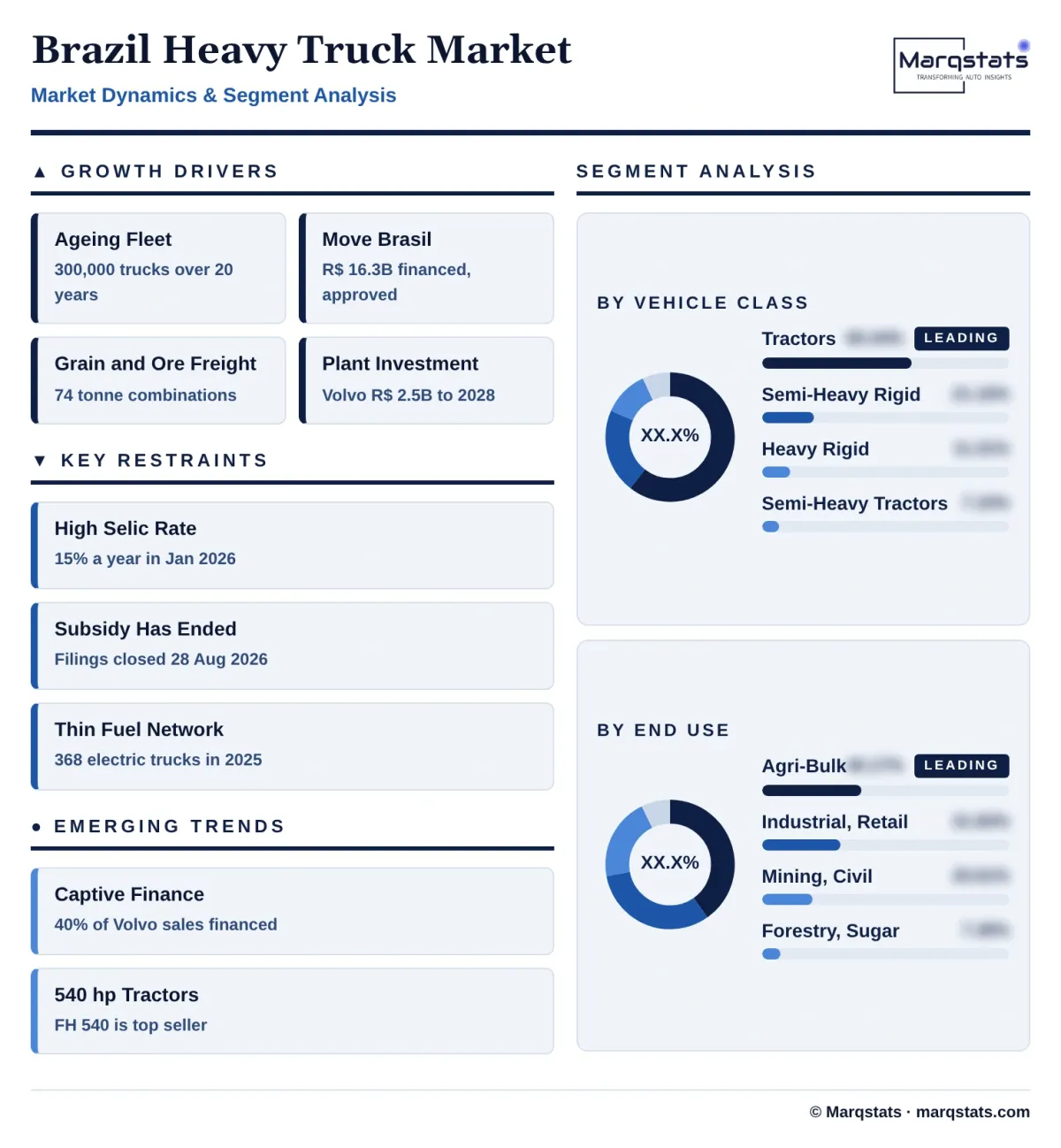
- Fleet age forces replacement. About 300,000 trucks older than 20 years remain in circulation in Brazil, according to coverage of Move Brasil 2, and the Move Brasil rules offer extra benefits for scrapping a truck older than 20 years. Every year of deferred purchases adds to the stock of overdue replacements, so the 2025 fall of 20.5% in heavy trucks creates demand that returns when credit eases.
- Subsidised credit pulls demand forward. Move Brasil financed R$ 9.7 billion for more than 15,600 trucks in its first phase and approved R$ 6.6 billion within five days of the second phase opening on 29 May 2026, at rates of roughly 11% to 14% a year against 18% or more without it. Even with the program closed, the lending habit it created, and the 60 to 120 month terms, set a new reference for what a fleet owner expects to pay.
- Agribusiness and mining keep the long-haul fleet working. Soy, corn, sugar and cotton move well over 1,000 kilometres from Mato Grosso, Goiás and the MATOPIBA states to ports at Santos, Paranaguá, Itaqui and Barcarena, and iron ore trucks work in Minas Gerais and Pará. These routes use 6x4 tractors with 9-axle combinations of up to 74 tonnes, which wear fastest and are the first to be replaced.
- Emissions standards already sit in the price base. The PROCONVE P8 standard, equal to Euro VI and adopted under CONAMA Resolution 490/2018, applies to new trucks since 1 January 2023, and BNDES lends only against P8 trucks with local content. Finance rules therefore reward the new truck over the old one and favour the six assemblers with domestic plants.
- Manufacturers are investing in capacity and services. Volvo announced R$ 2.5 billion for 2026 to 2028 on 11 February 2026, the largest amount since it started producing trucks in Curitiba in 1979, and DAF is spending R$ 950 million on its Ponta Grossa plant to 2029. Captive banks keep volume moving: about 40% of Volvo vehicles sold in Brazil in 2025 were financed by Volvo Financial Services, and PACCAR Financial accounted for 54% of DAF sales.
Key Restraints
Four constraints hold the market below its 2024 level and keep the 2026 recovery dependent on credit.
- Interest rates remain the main brake. The Selic rate stood at 15% a year in January 2026, the Monetary Policy Committee (Copom) had cut it only to 14.25% by 17 June 2026 against ANFAVEA expectation of 12.25% by year end, and unsubsidised truck loans were quoted at about 18% a year. A tractor costing more than R$ 1 million turns a three-point rate difference into tens of thousands of reais in annual interest, which is why registrations fell 20.5% in the heavy class in 2025.
- The subsidy has ended. Move Brasil 2 accepted filings until 28 August 2026 and contract notices until 28 September 2026, and trade press reported on 2 July 2026 that the Move Brasil 2 money for companies had run out. ANFAVEA president Igor Calvet said in October 2026 that September was probably the last month of relief and that the decline would grow again from October. Volvo expects the Brazilian truck market to shrink by up to 10% in 2026.
- Old trucks stay in service because the used market is active. Volvo sold a record 2,669 used trucks in 2025, the highest in 29 years, and about 300,000 trucks older than 20 years remain in circulation, while Move Brasil lets only autonomous drivers and cooperative members finance used trucks built from 2012. A buyer who can keep a paid-off tractor for two more years often does, which stretches replacement cycles.
- Alternative fuels lack infrastructure. Gas and electric heavy trucks need filling stations and megawatt chargers along interstate corridors that do not exist, and the 368 battery-electric trucks registered in Brazil in 2025, all weights, were 23.1% fewer than the 480 of 2024. Heavy models are limited to port and yard trials, which caps the pace of the shift to cleaner trucks.
Key Trends
Four shifts are changing how heavy trucks are financed, specified and sold in Brazil.
- Credit moves from bank loans to programme lending and consortia. Banco Volvo issued R$ 5.5 billion of new financing in 2025, 55% as consumer credit (CDC) and 45% as Finame, and Consórcio Volvo sold R$ 2.6 billion of credit letters, so captive banks and pooled-purchase schemes are replacing open-market loans.
- Fleet owners move to 540 horsepower and connected tractors. The Volvo FH 540 was the best-selling heavy truck for the seventh year in a row with 5,403 units, the FH 460 sold 3,613, the DAF XF 530 sold 3,480 and the Scania R 460 sold 2,599, so buyers pay for engine output, automated gearboxes and connected-vehicle services on long-haul routes.
- Service contracts follow the truck. Volvo reports 55,000 active service plans, up 10%, and 22,000 Volvo Connect contracts, and the other groups sell similar uptime packages, which makes aftermarket revenue a larger part of each sale.
- Local assembly expands. DAF is spending R$ 950 million at Ponta Grossa, Volvo R$ 2.5 billion across its Brazilian plants, and BNDES finance rules require domestic manufacture, so imports of fully built European and Chinese trucks stay marginal.
Strategic Implications
- For truck makers, the practical lesson of 2026 is to plan around the credit calendar. Orders followed Move Brasil openings and closings, so production schedules in Curitiba, Resende, São Bernardo do Campo, Ponta Grossa and Sete Lagoas should assume a weaker last quarter of 2026 and a recovery that depends on the Selic path.
- For fleet owners and independent drivers, the best time to replace a tractor is when financing cost, not freight rate, is lowest. A truck financed at about 11% to 13% instead of 18% saves a large share of the interest bill, and owners who missed the 28 August 2026 filing window should secure Finame pre-approval and consortium credit letters before the next rate decision.
- For financiers, captive banks have an advantage because they can bundle service plans and insurance. Volvo Financial Services, Scania Banco and PACCAR Financial together finance a large part of heavy truck sales, while independent banks should price semi-heavy rigid trucks, where residual values are steadier.
- For gas and electric suppliers, the market is small and slow. About 600 gas trucks in 2025 and 3,000 in 2030 on Marqstats assumptions mean that filling stations for biomethane should be placed at sugarcane mills and grain terminals where an anchor shipper can commit volume.
- For parts and service providers, a fleet that includes 300,000 trucks older than 20 years and a new-truck market that fell 11% in 2025 means strong demand for rebuilt axles, brakes, tyres and workshop capacity, and for telematics that extend the life of ageing tractors.
Market Segmentation
Heavy tractor units of 40 tonnes combined weight and above account for 60.44% of 2025 value, USD 6,894.07 million, and grow 7.58% a year to USD 9,934.92 million. Marqstats estimates about 40,000 units in 2025, 80.03% of the ANFAVEA heavy class, led by the Volvo FH 540, FH 460 and FH 500, the DAF XF 530 and XF 480, the Scania R 460 and the Iveco S-Way. They pull 6x4 combinations of up to 74 tonnes on grain and fuel routes.
Heavy rigid trucks, mainly 6x4 and 8x4 tippers, mixers and logging chassis, account for 11.31% of 2025 value, USD 1,290.18 million, and grow 5.85% a year to USD 1,714.18 million. About 9,981 units were registered in 2025, bought by mining firms, quarries, civil contractors and pulp producers, and demand follows project cycles more than freight rates.
Semi-heavy rigid chassis-cabs, mainly 4x2 and 6x2 trucks of 16 to 26 tonnes, account for 21.15% of 2025 value, USD 2,412.93 million, and grow 6.81% a year to USD 3,355.03 million. About 28,000 units were registered in 2025, led by the Volvo VM 290 at 4,320, the Mercedes-Benz Atego 1719 at 3,331, the Atego 2429 at 3,176 and the Volkswagen Constellation 17.210 and 26.260 at 3,036 and 2,974. Volkswagen reports more than 40% of the semi-heavy class.
Semi-heavy tractor units for combinations below 40 tonnes account for 7.10% of 2025 value, USD 809.69 million, and grow 4.52% a year to USD 1,009.87 million. About 8,673 units were registered in 2025, used for regional distribution, parcel and food freight, and value growth is the slowest of the four classes as buyers step up to 6x2 and 6x4 tractors for longer combinations.
Diesel trucks account for 99.09% of 2025 value, USD 11,302.82 million, and grow 6.27% a year to USD 15,320.08 million, while their share of value falls to 95.67%. Euro VI equivalent P8 engines of 13 litres and above, running on low-sulphur S10 diesel and urea (ARLA 32), remain the standard.
Gas and biomethane trucks account for 0.86% of 2025 value, USD 98.53 million, and grow 43.24% a year to USD 594.11 million and 3.71% of the market. Marqstats expects about 3,000 gas trucks a year by 2030, mostly tractors supplied by Scania and Iveco to shippers with dedicated routes and access to biomethane from sugarcane and landfill plants, and sees filling stations as the limit.
Battery-electric heavy trucks account for 0.05% of 2025 value, USD 5.52 million, and grow 78.42% a year to USD 99.81 million and 0.62% of the market. About 20 units are estimated in 2025, within the 368 battery-electric trucks of all weights recorded, and they are limited to port drayage, yard and short industrial routes, as the live Marqstats Brazil Electric Truck analysis also finds.
Agribusiness and bulk haulage account for 40.17% of 2025 value, USD 4,582.09 million, and grow 7.53% a year to USD 6,587.54 million. Grain, oilseed, sugar, cotton and fertiliser flows from the Center-West and MATOPIBA to Santos, Paranaguá, Itaqui and Barcarena need high-horsepower 6x4 tractors with long combinations.
Industrial, retail and parcel distribution account for 31.83% of 2025 value, USD 3,630.73 million, and grow 6.32% a year to USD 4,932.81 million. Semi-heavy rigids, 6x2 tractors and refrigerated trucks supply manufacturing clusters in the Southeast and South and consumer markets, and this end use holds the largest share of units.
Mining, construction and infrastructure account for 20.61% of 2025 value, USD 2,351.24 million, and grow 7.50% a year to USD 3,376.12 million. Iron ore trucks in Minas Gerais and Pará, quarries and public works buy 8x4 and 6x4 rigids, and Volvo reported market shares of 44% in mining in 2024.
Forestry, pulp and sugar-energy account for 7.39% of 2025 value, USD 842.81 million, and grow 5.80% a year to USD 1,117.53 million. Log and cane transport in Mato Grosso do Sul, Paraná, Bahia and São Paulo uses heavy rigids and tractors with special traffic authorisations, and Volvo reported shares of 61% in forestry and 29% in sugarcane in 2024.
By Geography
Southeast
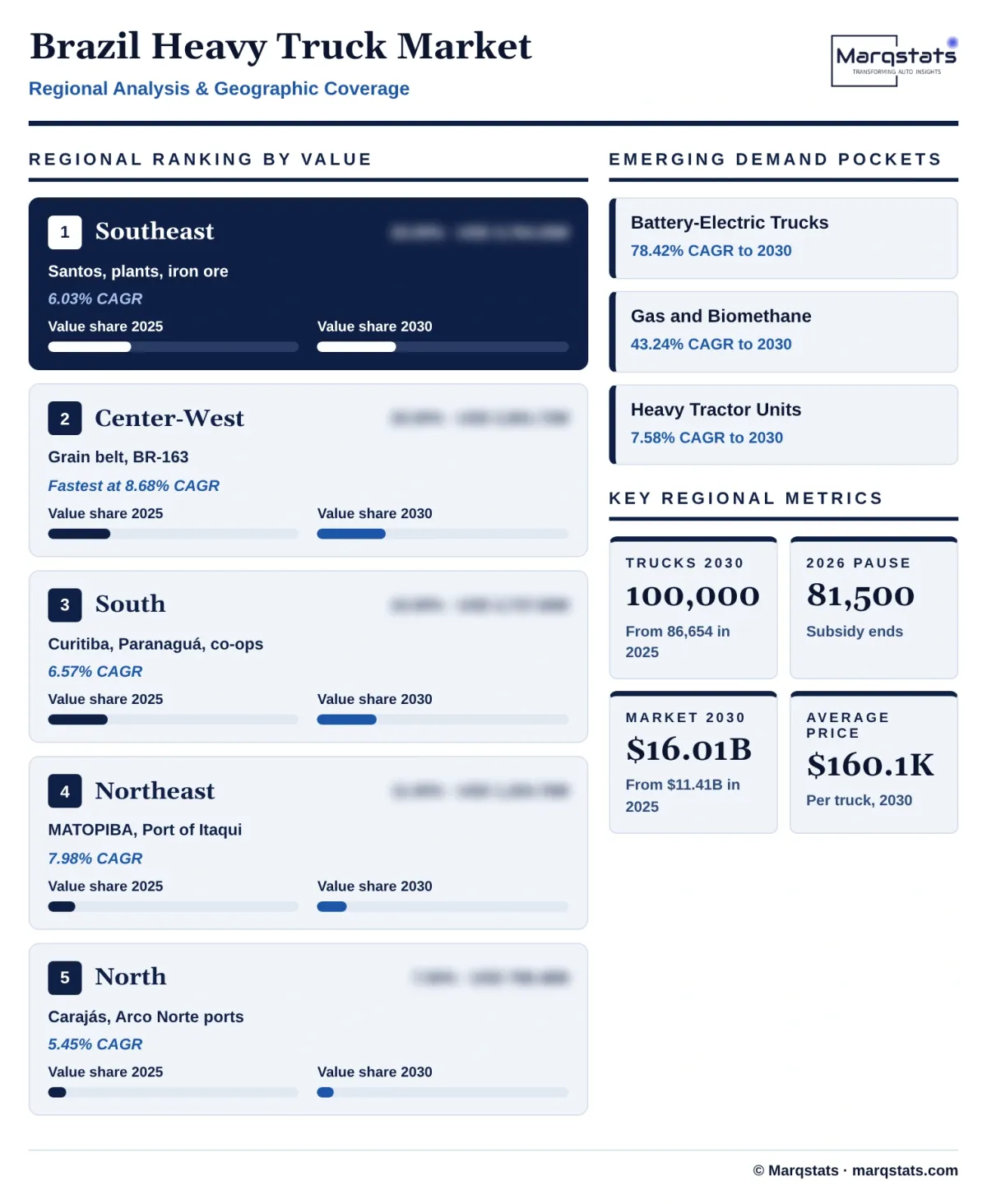
The Southeast accounts for 33.00% of 2025 value, USD 3,764.26 million, and grows 6.03% a year to USD 5,044.41 million and 31.50% by 2030. São Paulo is the freight hub for the Port of Santos, Minas Gerais supplies iron ore trucks, and four of the six assemblers build in the region. Registration shares overstate the region because leased and rented trucks are registered in Minas Gerais, São Paulo and Paraná, which apply a 1% property-tax rate to rental companies, even when the trucks work in the Center-West.
Center-West
The Center-West accounts for 25.00% of 2025 value, USD 2,851.72 million, and grows fastest, at 8.68% a year, to USD 4,323.78 million and 27.00% by 2030. Mato Grosso, Goiás and Mato Grosso do Sul run the highest utilisation in the country, with grain moved on the BR-163 toward the Tapajós river ports and Arco Norte terminals, and fleet replacement here drives manufacturer volume more than any other region.
South
The South accounts for 24.00% of 2025 value, USD 2,737.65 million, and grows 6.57% a year to USD 3,763.29 million. Paraná hosts the Volvo plant in Curitiba and the DAF plant in Ponta Grossa, the Port of Paranaguá exports grain on the BR-277, and agricultural cooperatives and meat processors in Paraná, Santa Catarina and Rio Grande do Sul run captive fleets.
Northeast
The Northeast accounts for 11.00% of 2025 value, USD 1,254.76 million, and grows 7.98% a year to USD 1,841.61 million. The MATOPIBA frontier across western Bahia, southern Maranhão, Tocantins and Piauí sends grain to the Port of Itaqui, and biofuel and cement freight add to demand for tractors and tippers.
North
The North accounts for 7.00% of 2025 value, USD 798.48 million, and grows 5.45% a year to USD 1,040.91 million. The Carajás mining complex in Pará and grain barge terminals at Barcarena and on the Tapajós sustain a specialised fleet of heavy rigids and tractors, but the region has the thinnest dealer and workshop network.
How Competition Is Evolving
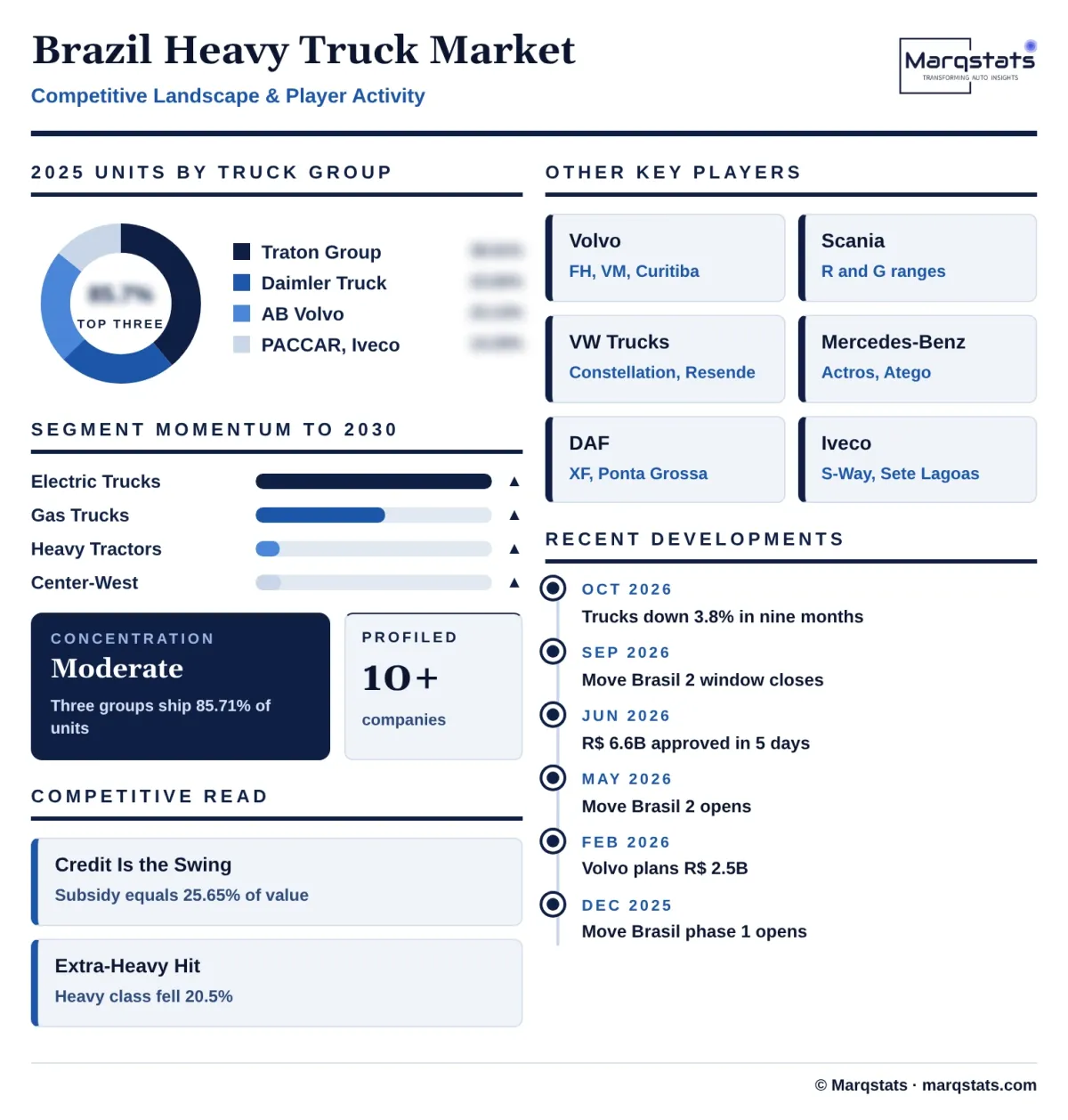
The market is moderately concentrated, with six truck makers and a Herfindahl-Hirschman index of about 1,996 on Marqstats unit estimates. By group, Marqstats estimates the Traton Group, with Volkswagen Caminhões e Ônibus and Scania, at 38.91% of 2025 units, Daimler Truck, with Mercedes-Benz do Brasil, at 23.66%, AB Volvo at 23.14%, and PACCAR with DAF and Iveco Group together at 14.29%. The anchor is Volvo, whose 20,053 trucks above 16 tonnes were 23% of the segment according to FENABRAVE data.
Volvo leads the heavy end and Volkswagen leads the semi-heavy end. The Volvo FH 540 was the best-selling heavy truck for the seventh year in a row with 5,403 units, followed by the FH 460 with 3,613, and the Volvo VM 290 led the semi-heavy class with 4,320. Volkswagen Caminhões e Ônibus reports more than 40% of the semi-heavy class and placed six models in its top ten, led by the Constellation 17.210, while the Mercedes-Benz Atego 1719 and 2429 sold 3,331 and 3,176 trucks. Sixteen models account for 54.73% of the market, so a few platforms set prices.
Scania and DAF lost the most in 2025 because they sell almost only extra-heavy trucks. FENABRAVE counted Scania at 13,116 trucks, down 31.4%, and DAF at 7,482, down 22.2%, against falls of 18.4% for Volvo and 1.9% for Iveco, while Mercedes-Benz grew 3.4% and Volkswagen fell 3.4%. DAF's share of the segment fell from 9.9% in 2024 to about 8.63% in 2025, which explains why it is spending R$ 950 million at Ponta Grossa to widen its range.
Competition has moved from price to financing and uptime. About 40% of Volvo vehicles sold in Brazil were financed by Volvo Financial Services, PACCAR Financial supplied 54% of DAF sales, Scania Banco filed R$ 2 billion of proposals in Move Brasil 2 for 2,010 trucks, and every group sells service contracts. Foton, the largest Chinese truck brand, registered 1,023 trucks of all weights in 2025, 0.92% of the truck market, and BNDES finance requires Brazilian manufacture and P8 compliance, which keeps imported heavy trucks marginal.
Companies Covered
Companies covered in the report include:
Recent Market Activity
Table of Contents
Coverage & Segmentation
The study covers the Brazil heavy truck market, with 2025 as the base year, 2021 – 2025 as the historical period and 2026 – 2030 as the forecast period. It covers new rigid chassis-cabs and tractor units of 16 tonnes gross vehicle weight and above, equal to the ANFAVEA semi-heavy and heavy classes, segmented by vehicle class, powertrain, end use and region. Values are transaction prices of the chassis-cab or tractor with taxes embedded, in US dollars at BRL 5.57 per US dollar, the 2025 average, and reais figures use the same rate.
Cargo bodies, trailers and road implements, buses, pickups, vans, and medium, light and semi-light trucks are excluded, as are used trucks and rebuilt vehicles. The ANFAVEA total of 113,477 trucks in 2025 splits into 49,981 heavy trucks, 36,673 semi-heavy trucks and 26,823 medium, light and semi-light trucks, so this market is 76.36% of the unit total. FENABRAVE registrations in 2025 were 2,689,179 across automobiles (1,996,531), light commercial vehicles (552,931), trucks (110,873) and buses (28,844), and Marqstats studies of Brazil passenger cars, light commercial vehicles, pickups and buses are disjoint from this one and should not be added. The live Marqstats Brazil Electric Truck analysis counts 368 battery-electric trucks of all weights, of which about 20 are heavy and are included here, and should not be added. Segment and regional splits are Marqstats estimates.