Market Snapshot
The Saudi Arabia heavy truck market size is estimated at USD 1,243.60 million in 2025 and is projected to reach USD 1,760.05 million by 2030, growing at a CAGR of 7.19% over 2026 – 2030. New heavy trucks rise from about 16,800 to 22,300 a year, a 5.83% annual rate, while the average value per truck climbs from about USD 74,024 to USD 78,926.
Marqstats defines the market as the value of new goods trucks above 16 tonnes gross vehicle weight sold in Saudi Arabia, whether imported fully built, imported as knocked-down kits or assembled locally. It covers tractor heads, heavy rigid cargo trucks and chassis-cabs, tippers and mixers, and specialist chassis. Value is counted at the importer or assembler gate in US dollars, before 15% value added tax and registration. Pickups, vans, medium trucks of 3.5 to 16 tonnes, buses, off-road mining machines and used trucks are excluded.
Tractor heads account for 46.70% of 2025 value, European brands for 58.55% and logistics and distribution for 41.44%. The Central Region, which includes Riyadh, holds 36.00% of value, while the Western Region grows fastest at 8.40% a year as the Red Sea coast, Jeddah and the ports draw heavy fleets.
Key Takeaways
Market Overview & Analysis
Report Summary
Marqstats sizes the Saudi Arabia heavy truck market as the value of new goods trucks above 16 tonnes gross vehicle weight sold each year, the N3 category under the type-approval system used in the Kingdom. It counts tractor heads for semi-trailers, heavy rigid cargo trucks and chassis-cabs, tippers and mixers, and specialist chassis for tankers, cranes, concrete pumps and similar bodies. It follows trucks wherever they are built, whether imported fully built, imported as knocked-down kits or assembled in Jeddah or at King Abdullah Economic City.
The category is small inside a very large installed base. The Transport General Authority said on 14 March 2026 that the Kingdom has over 500,000 trucks of all classes and 18,500 licensed companies. At about 16,800 new heavy trucks in 2025, annual additions equal 3.36% of that base, so the pace of renewal depends far more on rules for retiring old trucks than on how many trucks the economy needs. The Organisation Internationale des Constructeurs d'Automobiles reported 100,556 commercial vehicles sold in Saudi Arabia in 2025, of which the live Marqstats Saudi Arabia Pickup Vehicle Market covers 70,732 pickups, so heavy trucks equal 16.71% of that commercial total.
Customs data show where heavy trucks come from. Global Trade Atlas figures reported by the Japan External Trade Organization show that in 2025 Saudi Arabia imported 4,892 trucks of 20 tonnes and above from China, the largest source and a figure that fell from 2024, and 20,061 trucks of 5 to under 20 tonnes from Japan, about 2.2 times the 2024 level, plus 1,858 such trucks from China, up 82.7%. The 5 to 20 tonne band mixes medium trucks, which Marqstats excludes, with heavy rigid trucks of 16 to 20 tonnes, which it includes.
Policy changed in three steps during 2026. The Transport General Authority extended the 22-year truck age limit twice, a Saudi Standards, Metrology and Quality Organization notice issued on 2 June 2026 required knocked-down parts packages for heavy complete vehicles from 1 July 2026, and on 13 October 2026 the authority removed the fixed fleet ceiling for qualifying businesses that move their own goods. Each step shifts demand from one buyer or one supply route to another rather than changing total need.
The 2025 market is valued at SAR 4,663.50 million, equal to USD 1,243.60 million at the fixed rate of SAR 3.75 per US dollar. Marqstats treats 2025 as the base year, builds the forecast for 2026 to 2030 from units and prices by class, and expects the first year of the forecast to be the weakest, at USD 1,230.01 million, 1.09% below 2025, before volumes recover as the age-limit extensions lapse and own-account fleets grow.
Saudi Arabia Heavy Truck Market Size and Forecast
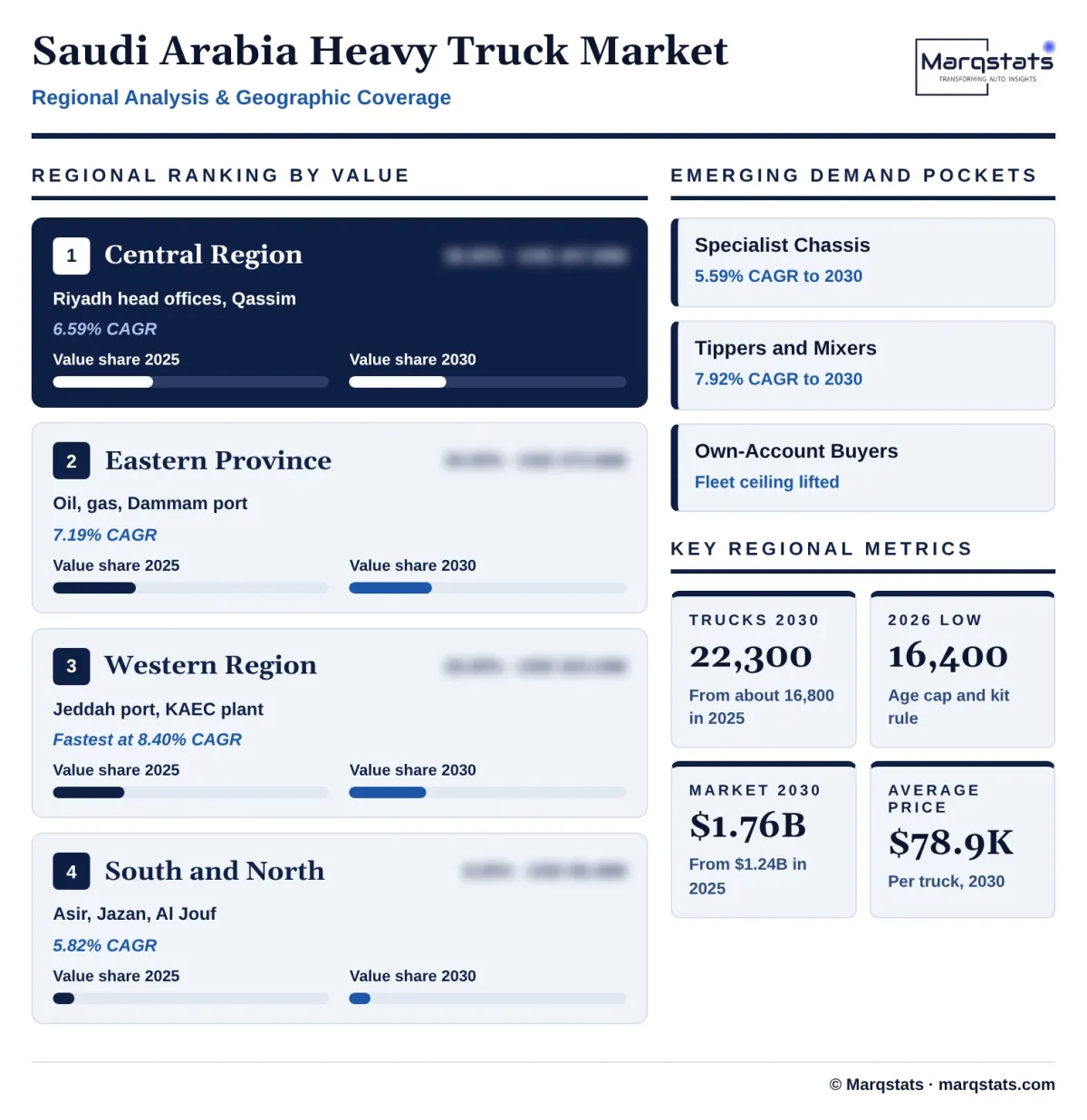
The Saudi Arabia heavy truck market grows from USD 1,243.60 million in 2025 to USD 1,760.05 million in 2030, a CAGR of 7.19%. Volume contributes most of the growth: new heavy trucks rise at 5.83% a year, from about 16,800 to 22,300, and the average value per truck rises at 1.29% a year, from about USD 74,024 to USD 78,926, as tractor heads gain share and prices rise with emissions and electronics content.
The 2025 value is built bottom-up from classes and prices. Marqstats estimates about 6,600 tractor heads at about USD 88,000 each, 4,200 heavy rigid cargo trucks and chassis-cabs at USD 64,000, 4,300 tippers and mixers at USD 60,000 and 1,700 specialist chassis at USD 80,000. Prices are importer or assembler gate values for the chassis-cab or tractor, before bodies, 15% value added tax and registration, and the blend of European and Chinese models explains why the average truck, at about USD 74,024, is far above the cost of a Chinese chassis alone.
The unit base is cross-checked by origin. Chinese brands account for 5,452 trucks, made up of the 4,892 trucks of 20 tonnes and above that Global Trade Atlas shows entering from China plus an estimated 560 of the 1,858 Chinese trucks in the 5 to 20 tonne band. Japanese brands account for 3,700, with about 3,000 in the 16 to 20 tonne slice of the 20,061 Japanese trucks in the 5 to 20 tonne band (14.95%) and about 700 above 20 tonnes. European brands, estimated at 6,500, are anchored on dealer deliveries and fleet orders, and Korean, Indian, American and other brands make up the remaining 1,148. Valued at origin prices, the four groups sum to the same USD 1,243.60 million as the class build.
The forecast is shaped by two dates. Units fall 2.38% to 16,400 in 2026 because the age-limit extensions delay renewal and the knocked-down parts rule from 1 July 2026 slows imports of complete Chinese trucks while assemblers set up. They then rise 7.32% in 2027, as the cap of 26 March 2027 approaches, and grow at 8.14% to 8.25% a year in 2028 to 2030, reaching 22,300 trucks and USD 1,760.05 million in 2030.
Marqstats tracks five indicators to monitor the forecast: further extensions of the 22-year limit beyond 26 March 2027, the number of heavy models registered under the knocked-down parts rule, announced fleet orders from logistics operators and contractors, the status of the Saudi Standards, Metrology and Quality Organization heavy-duty emissions standard now at draft stage, and production announcements from the Jeddah and King Abdullah Economic City plants.
Market Dynamics
Key Drivers
Five forces are lifting demand for new heavy trucks in Saudi Arabia even as the rules for importing and operating them change.
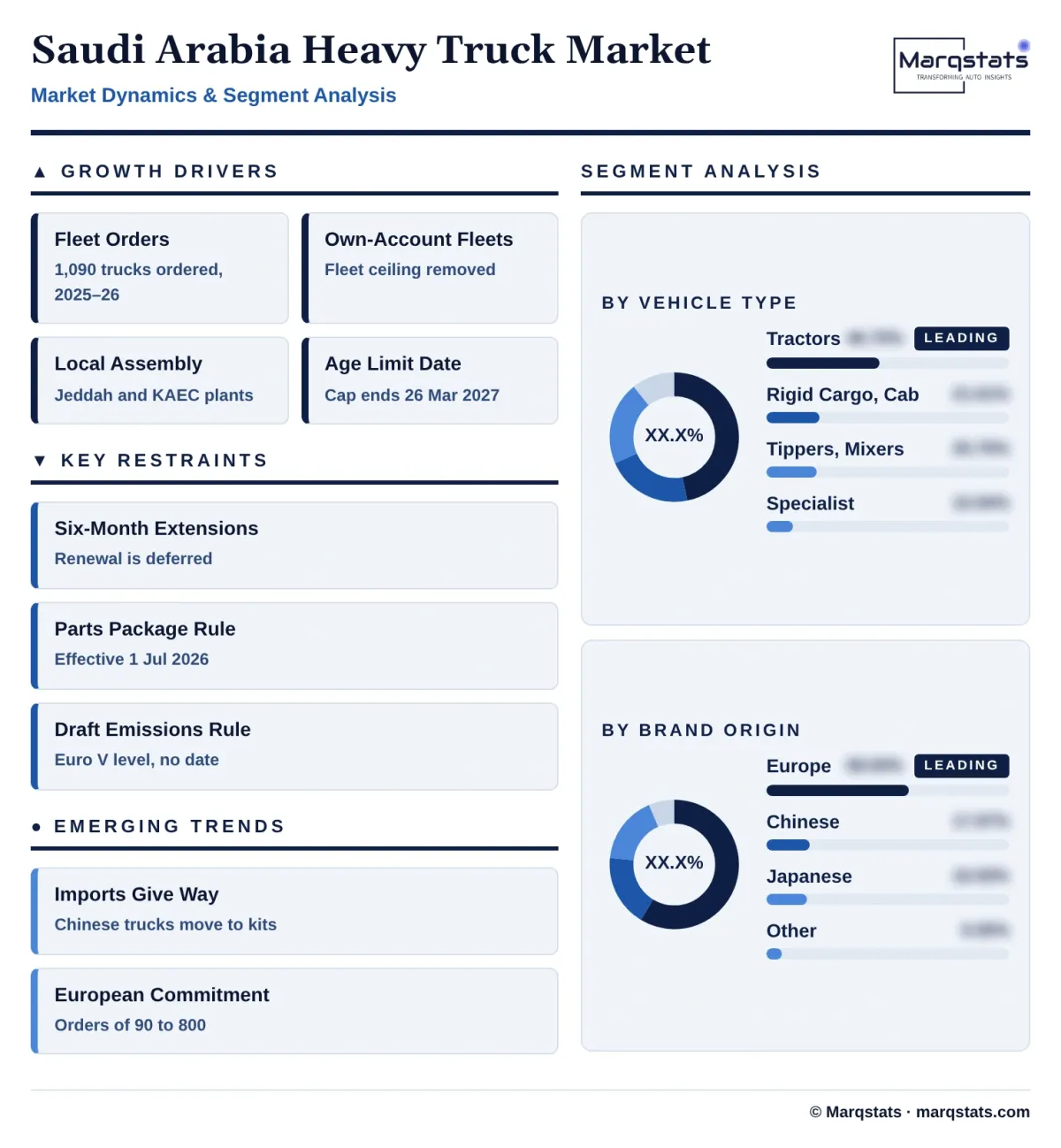
- Fleet orders are large and recent. Al Bassami Holding Company agreed to buy 800 Scania trucks through Al Olayan GCC on 31 October 2025, Haif Company contracted 200 Mercedes-Benz trucks from Juffali Commercial Vehicles on 12 December 2025, and Saudi Transport and Investment Company ordered 90 MAN truck heads on 7 April 2026. Together they total 1,090 trucks, equal to 6.49% of 2025 volume.
- Own-account fleets are now free to grow. On 13 October 2026 the Transport General Authority removed the fixed fleet ceiling for qualifying businesses that move their own goods in construction, agriculture, manufacturing and distribution. Companies must show that added heavy trucks are needed for their business, but they no longer face a set maximum, which opens a direct buying route that bypasses contract carriers.
- Local assembly shortens supply. The National Automotive Industries plant in Jeddah assembled its first FUSO FJ in August 2025 and its first Actros Pro Cab in January 2026, and the Arabian Vehicles and Trucks Industry plant at King Abdullah Economic City, which earned the Saudi-Made label in 2025, delivered Volvo FH Aero tractors to Momentum Logistics in Dammam in September 2025.
- The age limit forces renewal at its end date. The 22-year limit on freight trucks now runs to 26 March 2027 and is counted from manufacture, so trucks built before 26 March 2005 meet the cap then unless the authority extends again. Operators with pre-2005 fleets must either plan purchases or rely on another extension.
- A very large, licensed freight sector sustains demand. The Transport General Authority counts over 500,000 trucks and 18,500 licensed companies, and the Kingdom's construction, industrial and port programmes keep contractors such as Haif Company buying tippers, mixers and tractors. New heavy trucks add only 3.36% a year to that base, so a small change in how many old trucks are retired moves the market more than any change in freight demand.
Key Restraints
Four constraints slow replacement and make the timing of orders depend on regulation as much as on demand.
- Six-month age-limit extensions delay replacement. The authority extended the limit to 25 September 2026, reported on 2 April 2026, and again to 26 March 2027 on 29 September 2026, so fleet owners can keep trucks of up to 22 years running and postpone purchases until each deadline is close.
- The knocked-down parts rule raises the entry cost for complete imports. The Saudi Standards, Metrology and Quality Organization notice 2026-07, issued on 2 June 2026 and effective 1 July 2026, requires heavy complete vehicles to be supplied with a parts package for chassis, cab and powertrain filed with the organisation, plus Arabic manuals and training videos, or customs clearance is denied. Importers of Chinese and other complete trucks must restructure supply.
- The heavy-duty emissions standard is still a draft. The draft Saudi standard for heavy-duty engines is set at the Euro V level and carries no effective date, so Marqstats expects makers to hold back engine and after-treatment changes until a final date is set, and buyers to delay orders for models that may change.
- Compliance deadlines absorb management time. On 2 April 2026 the authority extended to August 2026 the deadlines for reclassifying private registrations as public for heavy-goods activities and for professional driver cards, which adds administrative cost for smaller operators before they commit to new trucks.
Key Trends
Four shifts are changing who builds, imports and buys heavy trucks in the Kingdom.
- Complete imports give way to assembly. Chinese trucks of 20 tonnes and above fell in 2025 while the 5 to 20 tonne band from China rose 82.7%, and the July 2026 rule requires knocked-down packages, which moves volume towards kit assembly.
- European makers commit to the Kingdom. Scania, Mercedes-Benz and MAN each announced orders of 90 to 800 trucks in the seven months to April 2026, and Mercedes-Benz Trucks and Volvo Trucks assemble locally.
- Own-account buyers join the market. After the ceiling was lifted on 13 October 2026, construction, agriculture, manufacturing and distribution companies can build fleets of their own rather than hire contract carriers.
- Japanese medium trucks grow into the heavy band. Imports of 5 to under 20 tonne trucks from Japan were about 2.2 times higher in 2025, and Marqstats estimates about 3,000 of them were heavy rigid trucks of 16 to 20 tonnes.
Strategic Implications
- For truck makers, the practical route is local assembly with a registered knocked-down package. The notice effective 1 July 2026 and the Saudi-Made label favour makers that assemble in Jeddah or at King Abdullah Economic City, and complete-truck importers that file a package early keep access to customs clearance.
- For fleet operators and contractors, the age limit is a purchasing calendar. Operators with trucks built before March 2005 should plan replacement before 26 March 2027 and tender early, because European makers have already booked large orders and lead times lengthen when the cap approaches.
- For own-account businesses, the 13 October 2026 change makes ownership a real alternative to hiring carriers, but financing, fuel, maintenance and insurance still weigh against outsourcing, so businesses should compare cost per tonne-kilometre before buying.
- For financiers and lessors, the weakness of 2026 and the rebound of 2027 are predictable from the calendar. Lessors that hold residual value risk on 20-year-old trucks should price for another extension and for a possible stop.
- For parts and service providers, a fleet that keeps trucks of up to 22 years in service means steady demand for axles, brakes, tyres and cooling parts, and the Euro V emissions standard will create service work as engines change.
Market Segmentation
Tractor heads for semi-trailers account for 46.70% of 2025 value, USD 580.80 million, and grow at 7.33% a year to USD 827.20 million and 47.00% of the market. Marqstats estimates about 6,600 units in 2025, rising to 8,800, as long-haul and port logistics operators renew fleets with Mercedes-Benz Actros, Volvo FH Aero, Scania and MAN tractors and with Chinese 6x4 tractors.
Heavy rigid cargo trucks and chassis-cabs account for 21.61% of 2025 value, USD 268.80 million, and grow at 6.99% a year to USD 376.75 million. About 4,200 units were added in 2025, including Japanese 16 to 20 tonne trucks and European rigid models, used for distribution, building materials and fitted with curtain-side, box and flatbed bodies.
Tippers and mixers account for 20.75% of 2025 value, USD 258.00 million, and grow at 7.92% a year to USD 377.60 million. About 4,300 units were added in 2025, mostly 8x4 and 6x4 chassis from Chinese makers such as Sinotruk and SHACMAN, bought by contractors for earthmoving, aggregates and concrete.
Specialist chassis account for 10.94% of 2025 value, USD 136.00 million, and grow at 5.59% a year to USD 178.50 million. They carry tankers, cranes, concrete pumps, fire appliances and refrigerated bodies, and command higher chassis prices of about USD 80,000 because of reinforced frames, power take-offs and axle configurations.
European brands account for 38.70% of 2025 units, 6,500 trucks, and 58.55% of value, USD 728.00 million, growing at 6.96% a year to USD 1,019.12 million. Mercedes-Benz Trucks, Volvo Trucks, Scania and MAN sell mostly tractors and premium rigid trucks, and large orders in the year to April 2026 total 1,090 trucks.
Chinese brands account for 32.45% of 2025 units, 5,452 trucks, and 17.97% of value, USD 223.53 million, growing at 8.59% a year to USD 337.50 million. Marqstats expects Sinotruk, SHACMAN and other Chinese makers to supply most tippers and mixers, where price per tonne of payload decides orders, and they must now supply knocked-down packages.
Japanese brands account for 22.02% of 2025 units, 3,700 trucks, and 16.93% of value, USD 210.60 million, growing at 4.45% a year to USD 261.88 million. Isuzu, Hino and FUSO are the main Japanese names in 16 to 20 tonne rigid trucks, where reliability and service networks matter more than price.
Other brands account for 6.83% of 2025 units, 1,148 trucks, and 6.55% of value, USD 81.47 million, growing at 11.68% a year to USD 141.55 million. Korean, Indian and American models are niche choices for specific fleets and projects.
Logistics and distribution account for 41.44% of 2025 value, USD 515.28 million, and grow at 7.99% a year to USD 756.86 million and 43.00% of the market. Contract carriers such as Momentum Logistics, Al Bassami Holding Company and Saudi Transport and Investment Company buy tractors for port, intercity and last-mile freight.
Construction and infrastructure account for 33.36% of 2025 value, USD 414.91 million, and grow at 6.80% a year to USD 576.53 million. Contractors such as Haif Company buy tippers, mixers and heavy rigid trucks for civil works, housing and industrial projects.
Oil, gas, mining and industrial users account for 17.58% of 2025 value, USD 218.61 million, and grow at 6.46% a year to USD 298.94 million. They buy specialist chassis and heavy 8x4 trucks for tankers, water haulage, ore and petrochemical products, usually under long maintenance contracts.
Municipal, utility and other uses account for 7.62% of 2025 value, USD 94.80 million, and grow at 6.14% a year to USD 127.72 million. Waste collection, water, fire and public works fleets buy specialist chassis through tenders.
By Geography
Central Region
The Central Region, with Riyadh, Qassim and Hail, accounts for 36.00% of 2025 value, USD 447.69 million, and grows at 6.59% a year to USD 616.03 million. Registration at head offices in Riyadh overstates the capital, because carriers register trucks where their licence sits while the trucks work on corridors to Dammam and Jeddah. Marqstats allocates value by where trucks are based and bought.
Eastern Province
The Eastern Province, with Dammam, Jubail, Al Ahsa and Ras Al Khair, accounts for 30.00% of 2025 value, USD 373.08 million, and grows at 7.19% a year to USD 528.01 million. Oil, gas, petrochemical and port haulage keep specialist chassis and tractors in demand, and Dammam was where Volvo FH Aero tractors were handed over to Momentum Logistics in September 2025.
Western Region
The Western Region, with Jeddah, Makkah, Madinah, Yanbu and Tabuk, accounts for 26.00% of 2025 value, USD 323.34 million, and grows fastest, at 8.40% a year, to USD 484.01 million and 27.50% by 2030. Jeddah port cargo, the assembly plants in Jeddah and at King Abdullah Economic City, and Red Sea projects draw heavy fleets.
Southern and Northern Regions
The Southern and Northern Regions, covering Asir, Jazan, Najran, the Northern Borders and Al Jouf, account for 8.00% of 2025 value, USD 99.49 million, and grow at 5.82% a year to USD 132.00 million. Demand is steady but small, tied to road building, mining and border trade, and regional dealers cover long distances.
How Competition Is Evolving
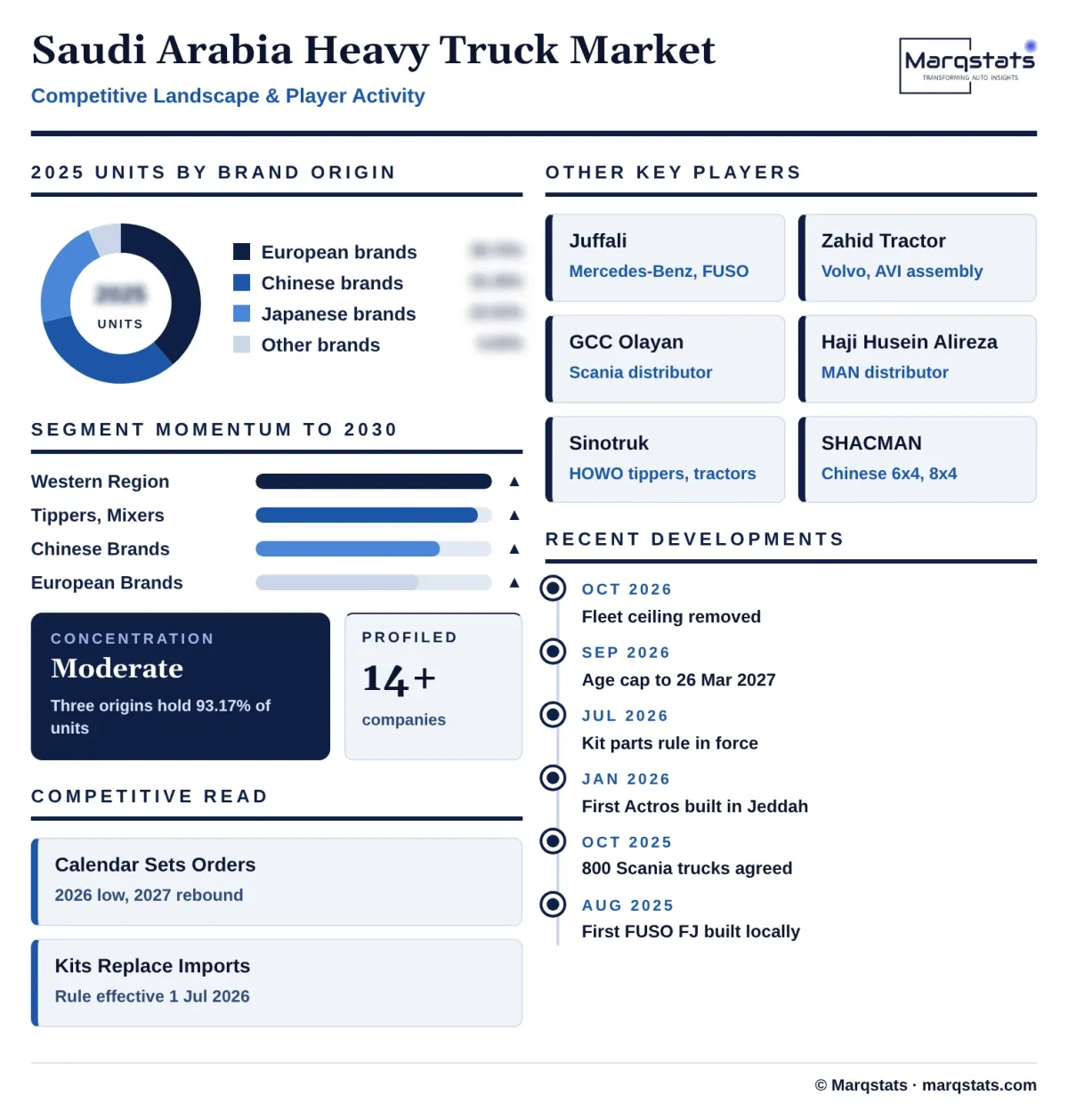
The market is moderately fragmented and split between three groups of origin. Marqstats estimates that European brands hold 38.70% of 2025 units, Chinese brands 32.45%, Japanese brands 22.02% and all other brands 6.83%, so the first three groups together account for 93.17% of volume. European makers lead on value, with 58.55%, because their tractors sell at about USD 112,000, against about USD 41,000 for Chinese trucks.
European competition is organised around distributors that also build locally. Juffali Commercial Vehicles sells Mercedes-Benz trucks and FUSO through the National Automotive Industries plant in Jeddah, Zahid Tractor sells Volvo Trucks assembled by the Arabian Vehicles and Trucks Industry at King Abdullah Economic City, Al Olayan GCC sells Scania, and Haji Husein Alireza sells MAN. Large buyers sign multi-hundred-truck agreements that include maintenance, as in the 200 trucks for Haif Company and the 800 for Al Bassami Holding Company.
Chinese makers compete on price and payload in tippers, mixers and 6x4 tractors. Trucks of 20 tonnes and above from China were the largest imported group in 2025 but declined, while the 5 to 20 tonne band from China rose 82.7%. The rule effective 1 July 2026 turns the contest into one about who can file a compliant knocked-down package and support it with Arabic manuals and local technician training.
Japanese makers compete in the 16 to 20 tonne rigid segment, where service matters. Isuzu, Hino and FUSO sell on reliability and spare-parts access, and FUSO's local assembly of the FJ in Jeddah from August 2025 shows that Japanese brands under Daimler Truck are also moving to local content.
Competition is shifting from price to access. The 22-year age limit, the knocked-down parts rule and the fleet ceiling removal each change who can buy and from whom, so makers with local assembly, financing and workshop coverage are better placed than importers of complete trucks.
Companies Covered
Companies covered in the report include:
Recent Market Activity
Table of Contents
Coverage & Segmentation
The study covers the Saudi Arabia heavy truck market, with 2025 as the base year, 2021 – 2025 as the historical period and 2026 – 2030 as the forecast period. It covers new goods trucks above 16 tonnes gross vehicle weight, imported fully built, imported as knocked-down kits or assembled locally, segmented by vehicle type, brand origin, end use and region. Values are importer or assembler gate values in US dollars, before 15% value added tax and registration, and riyal figures use the fixed rate of SAR 3.75 per US dollar.
Pickups, vans, medium trucks of 3.5 to 16 tonnes, buses, trailers and bodies sold separately, off-road mining and construction machines and used trucks are excluded. Segment and regional splits are Marqstats estimates built on customs entries by weight band, plant disclosures, announced fleet orders and price benchmarks. The live Marqstats Saudi Arabia Pickup Vehicle Market covers 70,732 pickups and the Saudi Arabia Commercial Vehicle Leasing Market covers lease revenue, so neither should be added to this market.
