Market Snapshot
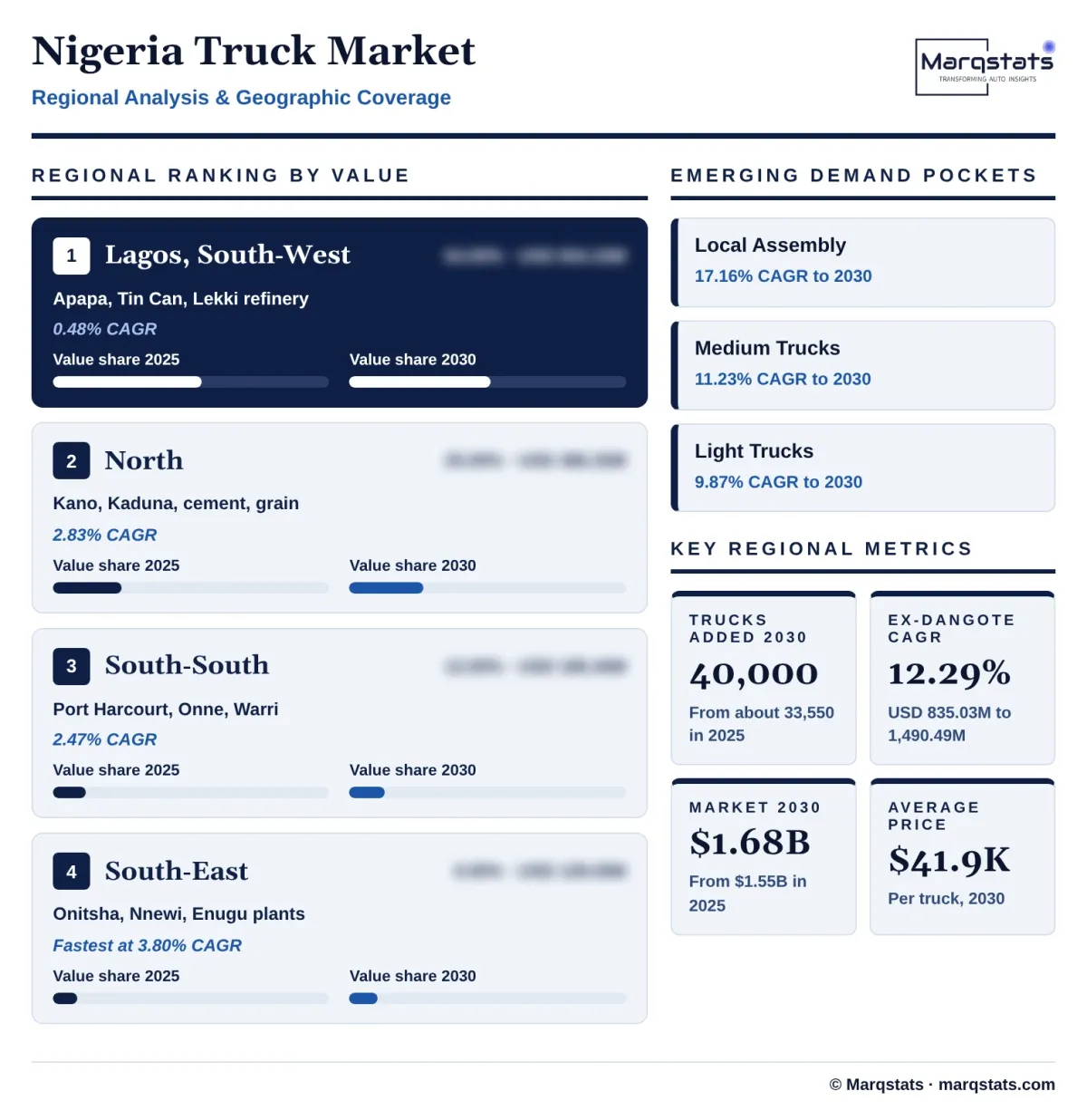
The Nigeria truck market size is estimated at USD 1,545.03 million in 2025 and is projected to reach USD 1,675.49 million by 2030, growing at a CAGR of 1.63% over 2026 – 2030. Annual additions rise from about 33,550 to 40,000 trucks, a 3.58% annual rate, while the average value per truck falls from about USD 46,050 to USD 41,890 as the heavy imported fleet bought by Dangote Group in 2025 gives way to more local assembly and more light and medium trucks. Excluding Dangote Group, the market grows from USD 835.03 million to USD 1,490.49 million, a CAGR of 12.29%.
Marqstats defines the market as the value of new and foreign-used goods trucks added to Nigeria each year: light trucks up to 3.5 tonnes, medium trucks of 3.5 to 16 tonnes and heavy trucks and tractor heads above 16 tonnes. Value is counted at the point of first sale in Nigeria, which is the ex-factory price for locally assembled trucks and the landed, duty-paid and cleared price for imported trucks, whether new or foreign-used. Pickups, vans, buses, tricycles, trailers, tractors, construction machinery and spare parts are excluded.
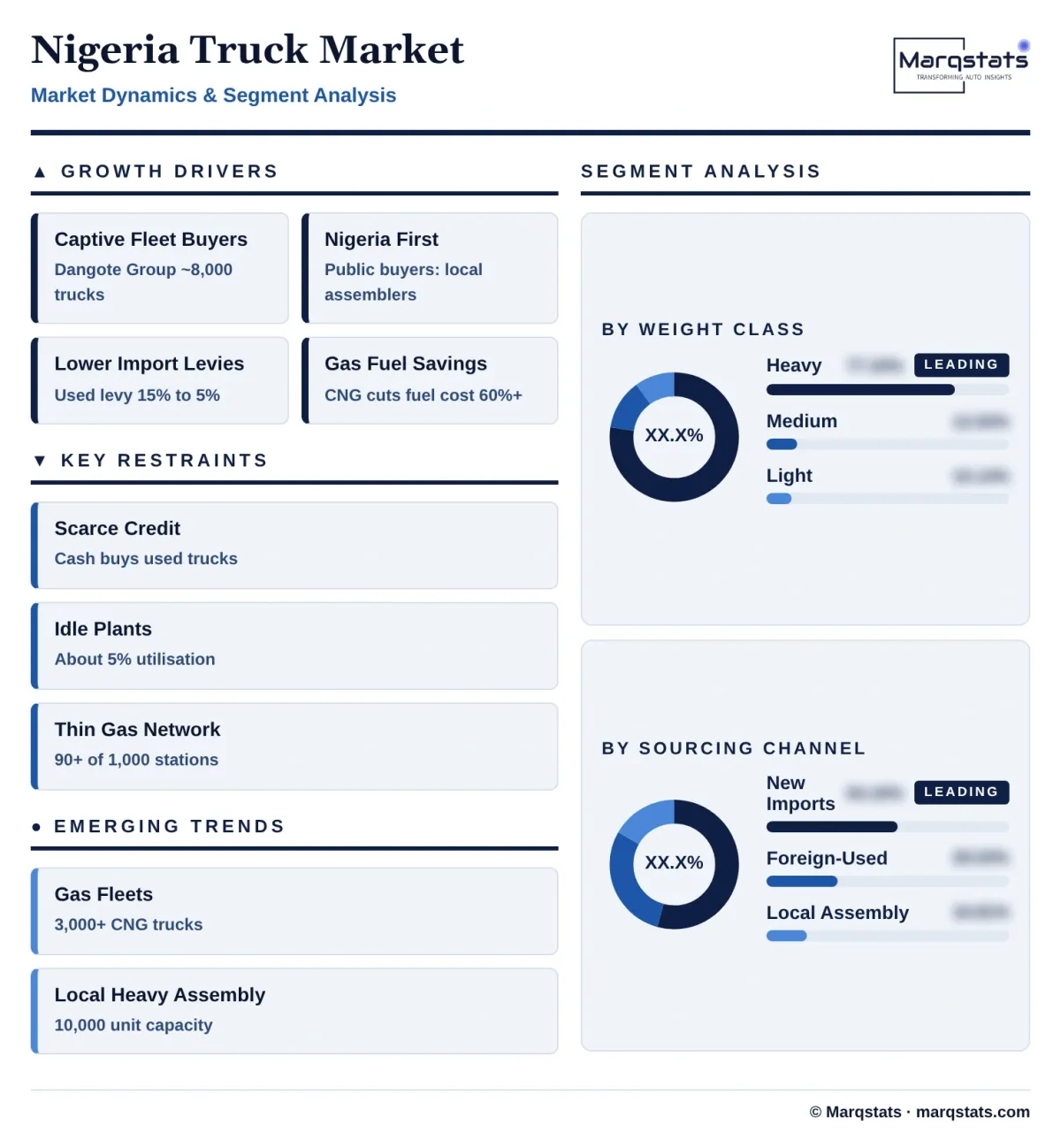
Heavy trucks account for 77.33% of 2025 value, new imports for 54.16% and diesel and other fuels for 60.52%. Lagos and the South-West account for 54.00% of value. Local assembly is the fastest-growing channel, at 17.16% a year, as the Nigeria First procurement framework, import duty changes and a stronger naira reshape what fleets buy.
Key Takeaways
Market Overview & Analysis
Report Summary
Marqstats sizes the Nigeria truck market as the value of goods trucks added to the national fleet in a year, whether they are assembled in Nigeria from imported kits, bought new as complete trucks or brought in as foreign-used units, known locally as Tokunbo trucks. The market is valued at the first point of sale in Nigeria and counts light, medium and heavy trucks and tractor heads on diesel, compressed natural gas (CNG) and dual-fuel engines.
Nigeria moves most of its goods by road, and its fleet is old. Port-to-hinterland haulage from Apapa, Tin Can and Onne, cement and fuel distribution, agricultural trade from the North and market trade through Onitsha and Kano all depend on trucks, and most independent operators run aged vehicles bought used. Marqstats estimates that about 18,500 of the 33,550 trucks added in 2025 were foreign-used units, and that these cost on average about USD 24,240 each landed and cleared, less than half the average of about USD 49,940 for a locally assembled truck.
2025 was unusual because of one buyer. In August 2025 Dangote Refinery reported importing 4,000 natural-gas trucks through Apapa, a programme it valued at N720 billion, about USD 469.89 million, and in September 2025 Dangote said a further 6,000 dry-cargo trucks were being added, taking its fleet to about 10,250 by the end of November. Dangote Cement separately reported more than 3,000 full CNG trucks and more than 1,000 dual-fuel trucks in service, with about 1,900 more mono-fuel trucks expected in 2026 and 2027. Marqstats estimates that about 8,000 of these trucks arrived in calendar 2025.
Policy is pushing toward local assembly. The National Automotive Design and Development Council (NADDC) says nearly 40 licensed plants have installed capacity above 600,000 vehicles a year but produce only about 5% of it. In May 2026 the Bureau of Public Procurement and NADDC signed the Nigeria First framework, under which public buyers may purchase vehicles only from NADDC-approved local assemblers unless they obtain a waiver. In July 2026 the Federal Government cut the import levies on new and used vehicles and the duty on fully built passenger cars, and exempted mass transit buses and electric vehicles from import duty.
Marqstats estimates that the market was worth about USD 770 million in 2021, fell to about USD 690 million in 2023 when the naira lost value and import costs rose, and recovered to about USD 745 million in 2024 before the Dangote fleet build lifted 2025 to USD 1,545.03 million. At the fixed rate of NGN 1,520 per USD, the 2025 market equals about NGN 2.35 trillion.
Nigeria Truck Market Size and Forecast
The Nigeria truck market is USD 1,545.03 million in 2025 and is projected to reach USD 1,675.49 million in 2030, a CAGR of 1.63%. Marqstats expects the market to fall 6.59% to USD 1,443.28 million in 2026 and to USD 1,390.90 million in 2027 as the Dangote fleet build tapers, then to grow 2.60% in 2028, 7.75% in 2029 and 8.96% in 2030 as local assembly, used imports and light and medium trucks recover. Annual additions follow a similar path: about 33,550 trucks in 2025, 33,480 in 2026, 33,830 in 2027, 35,180 in 2028, 37,400 in 2029 and 40,000 in 2030, a unit CAGR of 3.58%.
The 2025 value is built from four supply channels. Marqstats estimates 18,500 foreign-used trucks at an average landed price of about USD 24,240, worth USD 448.50 million; 5,200 locally assembled trucks at about USD 49,940, worth USD 259.70 million; about 1,850 other new imported trucks at about USD 68,560, worth USD 126.83 million; and about 8,000 Dangote Group trucks at about USD 88,750, worth USD 710.00 million. The Dangote price reflects the stated programme value of about USD 469.89 million for 4,000 gas-powered fuel trucks, or about USD 117,500 each including tanker equipment, and an estimated USD 60,000 for each dry-cargo truck.
The base is checked against trade data. The National Bureau of Statistics recorded N2.66 trillion of imported industrial transport equipment in 2025, about USD 1,750 million at NGN 1,520 per USD, and the first half of 2026 reached N1.39 trillion against N975.18 billion a year earlier. Trucks, buses, tractors and special vehicles all sit in that category, so Marqstats sizes trucks at a level that leaves room for buses and other vehicles after the local assembly uplift. Nigerian ports handled 72,568 imported vehicles of all kinds in the first half of 2025 and 103,375 in the first half of 2026, an increase of 42.5%.
Excluding Dangote Group, the market grows from USD 835.03 million and about 25,550 trucks in 2025 to USD 1,490.49 million and about 37,500 trucks in 2030. That is a value CAGR of 12.29% and a unit CAGR of 7.98%. Three things drive it: a more stable naira, which averaged about NGN 1,520 per USD in 2025 and has since strengthened; lower import levies on used vehicles from July 2026; and the Nigeria First framework, which gives local assemblers a protected public customer.
Marqstats tracks four indicators to monitor the forecast: monthly Customs and Nigerian Ports Authority vehicle import counts, NADDC reports on assembly output and plant utilisation, further orders from large captive fleets such as Dangote Group and NNPC Limited, and the pace of new CNG refuelling stations against the 1,000 planned by the Presidential Initiative on CNG.
Market Dynamics
Key Drivers
Five forces are shaping how many trucks Nigeria adds each year and where they come from.
- Large industrial buyers are building captive fleets. Dangote Group alone brought in about 8,000 trucks in 2025 and Dangote Cement reports more than 3,000 full-CNG and 1,000 dual-fuel trucks in service. Marqstats expects the group to keep adding about 2,500 trucks a year by 2030, and other cement, fuel and commodity shippers to follow.
- Local assembly now has a protected public customer. Under the Nigeria First framework signed by the Bureau of Public Procurement and NADDC in May 2026, public buyers may buy vehicles only from NADDC-approved local assemblers unless they obtain a waiver. With plants running at about 5% of installed capacity, even modest public orders lift local output sharply.
- Lower import levies and a steadier naira reduce landed costs. From July 2026 the new-vehicle levy fell from 20% to 10% and the used-vehicle levy from 15% to 5%, and the naira, which averaged about NGN 1,520 per USD in 2025, has since strengthened. Both help importers of foreign-used trucks, which remain the largest channel.
- Gas fuel offers operators a cheaper way to run heavy trucks. Dangote Cement reports that CNG trucks deliver more than 60% fuel cost reduction and dual-fuel trucks about 25%. The Presidential Initiative on CNG reports more than 120,000 vehicles converted, more than 90 refuelling stations and more than USD 2 billion secured.
- An old fleet needs steady replacement. Most independent hauliers run trucks that were already used when imported, so replacement demand continues through the cycle, and freight growth from cement, agriculture, fuel and port traffic adds new trucks on top.
Key Restraints
Four constraints keep the market dependent on used imports and large captive fleet buyers.
- Credit is scarce. Most independent operators buy with cash or informal loans, which pushes them toward cheaper foreign-used trucks and limits sales of new locally assembled trucks. Marqstats estimates that formal financing reaches only a small minority of truck buyers.
- Assembly plants are mostly idle. NADDC says nearly 40 licensed plants hold more than 600,000 vehicles a year of capacity but produce about 5% of it, because imported used trucks are cheaper, kits must be imported, and few buyers can finance new trucks.
- Gas infrastructure is thin. The Presidential Initiative on CNG counts more than 90 refuelling stations against 1,000 planned, so gas trucks outside Dangote Group routes face limited fuel access, and operators of mixed duty cycles keep to diesel.
- Import costs and clearance times add to prices. Duties, levies, port charges and clearing fees raise the landed price of imported trucks, and the Green Tax Surcharge began on 1 July 2026, adding another cost for importers.
Key Trends
Four shifts are changing how trucks are sourced, fuelled and financed.
- Gas trucks move from pilots to fleets. Dangote Cement reports more than 3,000 full-CNG and more than 1,000 dual-fuel trucks in service and expects about 1,900 more mono-fuel trucks in 2026 and 2027, which makes it the first large Nigerian shipper to move a heavy fleet to gas.
- Chinese brands lead new heavy trucks. Sinotruk, Shacman, JAC, Foton and other Chinese makers supply most new heavy trucks and tractor heads, either as complete trucks or as kits assembled in Nigeria, because they cost far less than European and Japanese trucks.
- Local assembly is shifting toward heavier trucks. Dangote Sinotruk West Africa has said it can build 10,000 trucks a year, and Innoson in Nnewi builds heavy CNG trucks, which points to more kit-built heavy trucks as public procurement rules take effect.
- Imports are becoming more visible in the data. Vehicle imports through Nigerian ports rose 42.5% in the first half of 2026 and SONCAP clearing moved to the National Single Window in March 2026, which should make truck imports easier to track and to value.
Strategic Implications
- For truck makers and importers, the safest growth lies in light and medium trucks and in local assembly partnerships. Light and medium trucks grow at 9.87% and 11.23% a year, and a partner on the NADDC approved list can bid for public orders under the Nigeria First framework.
- For large shippers, a captive fleet can be cheaper than hiring haulage. Dangote Group has shown that one buyer can bring in thousands of trucks in a year, and its gas conversion programme gives other cement, fuel and commodity shippers a template to follow.
- For used truck importers, the lower used-vehicle levy and a steadier naira improve margins, but buyers will move to local assembly once financing is available, so importers should build finance and warranty offers now.
- For banks and leasing companies, local assembly and gas trucks are the credit opportunity. A financed local truck sold to a contracted shipper is easier to underwrite than an aged used truck, and public procurement gives lenders a stable customer.
- For CNG station and conversion investors, truck corridors matter more than city networks. Gas trucks need fuel on the routes between Lagos, Kano, Onitsha and Port Harcourt, and stations placed along them can rely on contracted fleets.
Market Segmentation
Heavy trucks and tractor heads account for 77.33% of 2025 value, USD 1,194.80 million, and fall 1.73% a year to USD 1,095.04 million and 65.36% by 2030. About 15,850 heavy trucks were added in 2025, including all of the Dangote Group fleet, and about 15,100 are expected in 2030. Marqstats estimates an average price of about USD 75,380 in 2025 and about USD 72,520 in 2030. Heavy trucks serve port haulage, cement, fuel, coal and long-distance trade, and most new ones are Chinese brands.
Medium trucks account for 12.53% of 2025 value, USD 193.65 million, and grow at 11.23% a year to USD 329.71 million and 19.68% by 2030. Volume rises from about 6,650 to 9,600 trucks, and the average price from about USD 29,120 to USD 34,340. These two-axle rigid trucks serve distribution, building materials and agriculture, and are the main category where foreign-used and locally assembled trucks compete directly.
Light trucks account for 10.14% of 2025 value, USD 156.58 million, and grow at 9.87% a year to USD 250.74 million and 14.96% by 2030. Volume rises from about 11,050 to 15,300 trucks at average prices of about USD 14,170 and USD 16,390. They serve urban distribution and small traders, are the easiest class to assemble locally, and are mostly bought used or as locally assembled Chinese models.
New complete trucks brought into Nigeria account for 54.16% of 2025 value, USD 836.83 million, because that channel includes Dangote Group. Value falls 10.83% a year to USD 471.90 million and 28.16% by 2030 as the fleet build tapers. Marqstats estimates about 9,850 trucks in 2025, of which about 8,000 were Dangote Group, and about 6,200 in 2030.
Foreign-used trucks, known as Tokunbo, account for 29.03% of 2025 value, USD 448.50 million, and grow at 7.04% a year to USD 630.29 million and 37.62% by 2030. Volume rises from about 18,500 to 23,400 trucks, and the average landed price from about USD 24,240 to USD 26,940. Lower used-vehicle levies and a steadier naira support the channel, and cash buyers keep it dominant outside captive fleets.
Trucks assembled in Nigeria from imported kits account for 16.81% of 2025 value, USD 259.70 million, and grow fastest, at 17.16% a year, to USD 573.30 million and 34.22% by 2030. Volume rises from about 5,200 to 10,400 trucks, a 14.87% annual rate. Dangote Sinotruk West Africa, ANAMMCO, Innoson and Lanre Shittu Motors are the main assemblers, and the Nigeria First framework gives them a protected public customer.
Diesel trucks, with a very small number of petrol and electric trucks, account for 60.52% of 2025 value, USD 935.03 million, and grow at 7.45% a year to USD 1,339.18 million and 79.93% by 2030. Volume rises from about 27,300 to 35,562 trucks. Diesel stays dominant because used imports and light and medium trucks are almost all diesel and gas fuel is hard to find outside main corridors.
Gas-powered trucks account for 39.48% of 2025 value, USD 610.00 million, because Dangote Group bought about 6,000 of the roughly 6,250 gas trucks added in 2025. Value falls 11.23% a year to USD 336.31 million and 20.07% by 2030 as that fleet build tapers, but outside Dangote Group gas trucks rise from about 250 to about 2,100 as more shippers and assemblers offer them.
By Geography
Lagos and South-West
Lagos and the South-West account for 54.00% of 2025 value, USD 834.33 million, and grow at 0.48% a year to USD 854.50 million and 51.00% by 2030. The region holds Apapa and Tin Can ports, the Lekki refinery, Dangote Sinotruk West Africa in Lagos and the main used-truck dealer yards. Registrations overstate the region because fleet owners register trucks in Lagos at customs clearance even when they work upcountry, so Marqstats allocates by where trucks operate.
North
The North, made up of the North-West, North-Central and North-East, accounts for 25.00% of 2025 value, USD 386.25 million, and grows at 2.83% a year to USD 444.00 million and 26.50% by 2030. Kano and Kaduna trade routes, cement and mining haulage, grain and livestock movement and federal procurement in Abuja drive demand, and the Presidential Initiative on CNG is extending refuelling along northern corridors.
South-South
The South-South accounts for 12.00% of 2025 value, USD 185.40 million, and grows at 2.47% a year to USD 209.44 million and 12.50% by 2030. Port Harcourt, Onne and Warri oil and gas logistics and the Niger Delta port complexes support demand for heavy trucks and tractor heads.
South-East
The South-East accounts for 9.00% of 2025 value, USD 139.05 million, and is the fastest-growing region, at 3.80% a year, reaching USD 167.55 million and 10.00% by 2030. Onitsha and Nnewi trade corridors, ANAMMCO in Enugu and Innoson in Nnewi anchor local assembly, and the Nigeria First framework should lift output from these plants.
How Competition Is Evolving
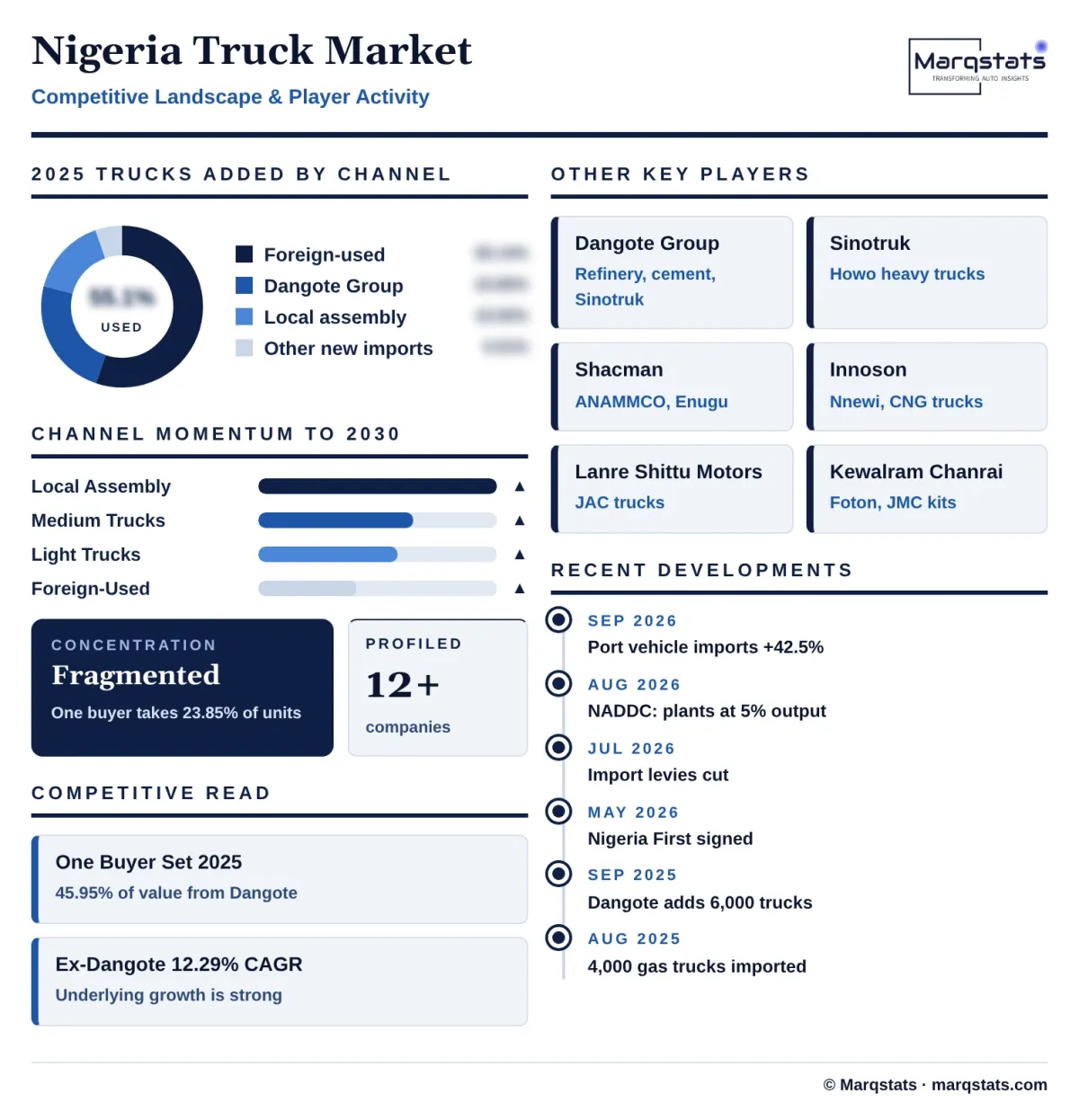
The market is fragmented outside a few captive buyers. Marqstats estimates that foreign-used trucks passing through hundreds of dealers account for about 55.14% of 2025 volume, locally assembled trucks for 15.50% and new imported trucks for 29.36%, and that one buyer, Dangote Group, accounts for 23.85% of all trucks added. Competition is therefore about channel and price more than about brand.
Chinese makers lead new heavy trucks. Sinotruk, through Dangote Sinotruk West Africa, and Shacman, assembled by ANAMMCO in Enugu, lead new heavy trucks and tractor heads, with JAC and Foton strong in light and medium classes. Chinese trucks sell for far less than European and Japanese trucks, which is why fleets favour them for heavy haulage.
Local assemblers compete on policy access. Dangote Sinotruk West Africa has said it can build 10,000 trucks a year. ANAMMCO in Enugu, Innoson Vehicle Manufacturing in Nnewi and Lanre Shittu Motors, which assembles JAC trucks, compete for public orders, and Kewalram Chanrai Group assembles Foton and JMC trucks from kits. Under the Nigeria First framework only NADDC-approved assemblers can supply public buyers without a waiver.
Used truck importers compete on landed cost and speed. Their advantage is price, about USD 24,240 for an average used truck against about USD 49,940 for a locally assembled one, and the July 2026 cut in the used-vehicle levy from 15% to 5% widens it. Their weakness is that operators have no warranty or dealer finance, which local assemblers and Chinese brands can offer.
Shippers are becoming competitors to dealers. Dangote Group and NNPC Limited buy trucks directly from makers, run their own fleets and in Dangote Group's case build their own refuelling stations, so any maker that wants share in heavy trucks must win contracts with them.
Companies Covered
Companies covered in the report include:
Recent Market Activity
Table of Contents
Coverage & Segmentation
The study covers the Nigeria truck market, with 2025 as the base year, 2021 – 2025 as the historical period and 2026 – 2030 as the forecast period. It covers goods trucks and tractor heads added to the Nigerian fleet each year, new and foreign-used, locally assembled and imported, segmented by weight class, sourcing channel, fuel and region. Values are in US dollars at the first point of sale in Nigeria, converted at NGN 1,520 per USD, the approximate 2025 annual average rate.
Pickups, vans, passenger buses and minibuses, three-wheelers, trailers, agricultural tractors, construction machinery and spare parts are excluded. Compressed natural gas trucks are counted here as annual additions; the Marqstats Nigeria CNG Commercial Vehicle Market counts the operating parc of CNG commercial vehicles, including buses and converted vehicles, so the two should not be added, and buses are sized separately in the Marqstats Nigeria bus analysis.