Market Snapshot
The China light-duty truck market size is estimated at USD 29,085.82 million in 2025 and is projected to reach USD 36,036.04 million by 2030, growing at a CAGR of 4.38% over 2026 – 2030. Wholesale volume rises from about 2,024,000 to 2,315,000 trucks, a 2.72% annual rate, while the average value per truck climbs from about USD 14,370 to USD 15,566 as battery-electric trucks take a larger share of the mix.
Marqstats defines the market as the wholesale value of new light trucks of 1.8 to 6 tonnes gross vehicle weight sold by Chinese manufacturers, covering complete cargo trucks, chassis-cabs, small and mini trucks and pickups, for domestic delivery and export. It follows the light truck series compiled from China Association of Automobile Manufacturers (CAAM) wholesale data, such as the Foton Aumark and Forland, JAC Shuailing, Changan Kaicheng, Great Wall Poer and Farizon Xingzhi H8E ranges. Value is counted at the manufacturer wholesale price in US dollars at CNY 7.18 per dollar, and micro trucks below 1.8 tonnes, medium trucks above 6 tonnes and light passenger vans are excluded.
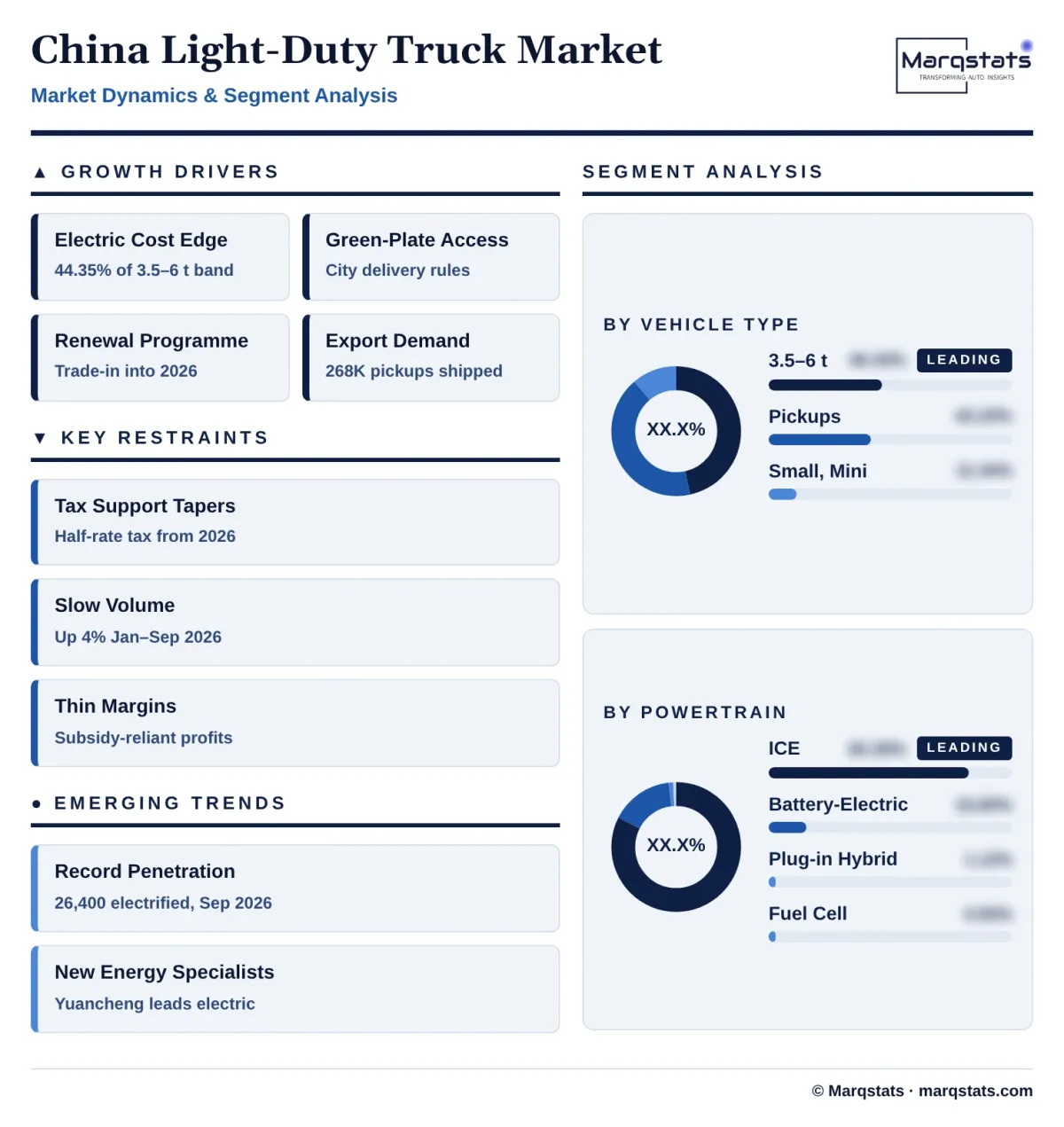
Light trucks of 3.5 to 6 tonnes account for 46.43% of 2025 value, internal combustion and other powertrains for 82.35% and East China for 31.00%. Battery-electric trucks grow fastest, at 15.30% a year, while Southwest and West China grows fastest among regions at 5.65% a year.
Key Takeaways
Market Overview & Analysis
Report Summary
Marqstats sizes the China light-duty truck market as the wholesale value of new light trucks that Chinese manufacturers sell each year, at the manufacturer price before dealer margin. It counts complete cargo trucks of 3.5 to 6 tonnes, small and mini trucks of 1.8 to 3.5 tonnes, chassis-cabs for specialised bodies and light pickups, sold at home or exported, and follows the light truck series compiled from CAAM wholesale data. Micro trucks below 1.8 tonnes, medium trucks above 6 tonnes and light passenger vans are excluded.
The category sits at the centre of Chinese freight. CAAM reported commercial vehicle sales of 4.296 million units in 2025, up 10.9%, and light trucks of 2,024,000 units, up 6.5%, make up just under half of that total. December 2025 was one of the strongest months, at about 200,000 trucks, up 13.5% on December 2024, as the equipment renewal and trade-in programme pulled forward purchases. Wholesale remained firm in 2026, with 1,541,200 trucks in January – September, up 4%, and 179,200 in September, up 11% and the fifth monthly increase in a row.
Definitions are the main source of confusion. The blue-plate rules of the Ministry of Industry and Information Technology (MIIT) and the Ministry of Public Security, set out in Joint Notice No. 3 of 2022, cap a light truck at 4.5 tonnes, while the wholesale series reaches 6 tonnes and the new energy registration series covers 3.5 to 6 tonnes only. Marqstats reconciles the three by holding the CAAM-based total as the market and treating the 3.5 to 6 tonne band as a derived share of it, about 32.50% in 2025. Diesel trucks must meet the China VI-b emission stage that took effect on 1 July 2023, which added aftertreatment cost to every combustion truck.
Electrification is the structural change. New energy commercial vehicles in China reached 954,000 units in 2025, up 65.5%, of which 871,000 were sold at home and equal to 26.9% of domestic commercial vehicle sales. In the 3.5 to 6 tonne band, registrations of electrified light trucks reached 176,985 in 2025, of which 92.04% were battery-electric, and rose to 164,000 in January – September 2026, up 35%.
Marqstats values the market at USD 29,085.82 million in 2025, equal to about CNY 208.84 billion at the 2025 average rate of CNY 7.18 per US dollar, and expects a 6.33% rise to USD 30,927.25 million in 2026 on volume of about 2,095,000 trucks, up 3.51%. Light truck wholesale in 2024 was about 1,900,000 units, so 2025 growth of 6.5% rebuilt the market after a flat year.
China Light-Duty Truck Market Size and Forecast
The China light-duty truck market grows from USD 29,085.82 million in 2025 to USD 36,036.04 million in 2030, a CAGR of 4.38%. Volume contributes 2.72% a year, from about 2,024,000 to 2,315,000 trucks, and the average value per truck rises at 1.61% a year, from about USD 14,370 to USD 15,566, because electrified trucks priced near CNY 200,000 replace combustion trucks priced below CNY 130,000.
The 2025 value is built bottom-up from vehicle types and prices. Marqstats estimates 840,000 pickups at about CNY 105,000, 526,200 small and mini trucks at CNY 45,000, 480,815 combustion trucks of 3.5 to 6 tonnes at CNY 125,000, and 176,985 electrified trucks of the same band, of which 162,897 battery-electric at CNY 200,000, 10,849 plug-in hybrid and range-extended at CNY 215,000 and 3,239 fuel-cell at CNY 600,000. The unit total of 2,024,000 is the CAAM-based wholesale figure, and the electrified count of 176,985 and the fuel-cell count of 3,239 match the Marqstats China Electric Light and Medium Truck Market page. Prices are Marqstats estimates anchored on published list prices, such as CNY 186,100 to 252,300 for the Jiangling E-Luda, from CNY 169,800 for the BYD T5EV and CNY 204,800 to 265,300 for the Farizon Xingzhi H8E, less typical dealer discounts.
The 3.5 to 6 tonne band is the pivot of the forecast. Marqstats derives its 2025 size at 657,800 trucks, 32.56% of wholesale in the 2026 data, by dividing reported electrified registrations of 164,000 by the 32.68% penetration reported for January – September 2026 and comparing the result with wholesale of 1,541,200 trucks. The band is expected to rise to 833,400 trucks, 36.00% of wholesale, as operators replace small trucks with heavier, purpose-built vans, and electrified trucks grow from 26.91% to 47.40% of the band.
Electrified units are aligned with the live Marqstats China Electric Light and Medium Truck Market page, which projects 423,000 electrified trucks of 3.5 to 12 tonnes in 2030 including 28,000 medium trucks. Removing the medium trucks leaves 395,000 light trucks, which is the 395,000 used here, so unit counts agree between the two studies. Values differ by design: Marqstats values the same electrified light trucks at wholesale prices of about CNY 200,000, whereas the live page values its 3.5 to 12 tonne set at its own price basis, so the two value series should not be added. The pace of electrified growth slows from 6.63% in 2026, when January – September registrations already reached 164,000, to 10.11% a year over 2026 – 2030, as the half-rate purchase tax and the end of the vehicle and vessel tax exemption in 2027 raise the cost of switching.
Marqstats tracks four indicators to monitor the forecast: monthly CAAM light truck wholesale and the electrified penetration rate of the 3.5 to 6 tonne band, the purchase tax and vehicle and vessel tax treatment of electric commercial vehicles after 2026, pickup and light truck export volumes recorded by the CPCA and customs, and the retail price gap between electric and diesel trucks of 4.5 tonnes.
Market Dynamics
Key Drivers
Five forces are lifting demand for light trucks in China even as overall volume growth slows to a few percent.
- Electric trucks now compete on cost in city delivery. The registered electrified share of the 3.5 to 6 tonne band reached 32.68% in January – September 2026 and 44.35% in September, and models such as the Jiangling E-Luda at CNY 186,100 to 252,300, the BYD T5EV from CNY 169,800 and the Farizon Xingzhi H8E at CNY 204,800 to 265,300 give fleets a choice of battery sizes from 77 to 100 kWh.
- Green-plate access gives electric trucks a legal advantage. City rules that reserve inner-city delivery hours and loading zones for new energy plates make electrified trucks the default for parcel, retail and postal fleets, which is why Yuancheng New Energy Commercial Vehicle reached 5,102 registrations in September 2026 alone.
- Public renewal programmes keep fleets turning over. The State Council equipment renewal and consumer goods trade-in programme launched in March 2024 continued into 2026, and the half-rate purchase tax on new energy vehicles that began in January 2026 still leaves electric trucks with a tax edge over diesel, which supported December 2025 wholesale of about 200,000 trucks.
- Exports absorb surplus capacity. China exported 268,000 pickups in January – November 2025, up 22%, and Dongfeng Motor Co., Ltd. reported light truck exports of about 13,000 units in the first half of 2026, up 81.4%, so Chinese makers can place volume abroad when domestic demand is flat.
- Electrified and pickup niches open new demand. Plug-in pickups are growing from a small base, with BYD selling 38,266 pickups in January – November 2025, up 351.9%, and Foton launched its Qimingxing pure-electric light truck platform on 21 October 2025 to widen its range beyond diesel.
Key Restraints
Four constraints hold back volume and squeeze maker margins as support for electric trucks tapers.
- Tax support for electric trucks is tapering. New energy vehicles pay a half-rate purchase tax from January 2026, and from 1 January 2027 battery-electric and fuel-cell commercial vehicles lose the vehicle and vessel tax exemption, so the cost advantage that supported the 2025 and 2026 surge narrows during the forecast.
- Volume growth is slow against a high base. Light truck wholesale rose 1.3% in the first half of 2026 and 4% in January – September, compared with 6.5% in 2025, and the record December 2025 of about 200,000 trucks sets a demanding comparison for the final quarter of 2026.
- Maker margins are thin and depend on subsidies. Dongfeng Motor Co., Ltd. reported first-half 2026 net profit of RMB 124 million but a loss of RMB 22.73 million excluding non-recurring items, with about RMB 100 million of government subsidies, which shows how little price room the leaders have to fund electric platforms.
- The upfront price gap persists. Electrified trucks in the 3.5 to 6 tonne band list at CNY 169,800 to 265,300, against a Marqstats estimate of about CNY 125,000 for a combustion truck of the same band, so buyers outside green-plate cities and without trade-in eligibility keep buying diesel.
Key Trends
Four shifts are changing which light trucks are built, sold and exported.
- Electrified penetration sets monthly records. Penetration of the 3.5 to 6 tonne band rose from 37.84% in August 2026 to 44.35% in September, with 26,400 registrations, up 59%, and the five largest makers account for most of the growth.
- New energy specialists overtake legacy leaders in the electric segment. Yuancheng held 16.2% of January – September 2026 electrified registrations against 14.9% for Foton, and Chery Commercial Vehicle, Weichai New Energy Commercial Vehicle and BYD each held about 5%.
- Pickups turn into a global product. China sold 519,000 pickups at home and exported 268,000 in January – November 2025, and Great Wall Motor, JAC, SAIC Maxus, Changan and JMC compete for overseas dealers.
- Truck makers add plug-in and fuel-cell options only at the edges. Plug-in hybrid and range-extended trucks were 6.13% of electrified registrations in 2025 and 4.02% in January – July 2026, and fuel-cell registrations fell from 3,239 to 142 over the same comparison, so battery-electric platforms take the investment.
Strategic Implications
- For truck makers, the practical lesson is to plan on the 3.5 to 6 tonne band, not on the whole light truck count. Electrified penetration of 44.35% applies to about one third of volume, so product plans that assume half of all light trucks go electric by 2027 would build battery capacity ahead of demand, while platforms for pickups and small trucks stay combustion-led through 2030.
- For battery, motor and thermal suppliers, volume comes from a narrow band. Marqstats estimates 395,000 electrified light trucks in 2030, and each carries a 77 to 100 kWh pack, so suppliers who win the top five makers in this band capture most of the demand, while the 1.8 to 3.5 tonne segment needs low-cost packs at a very different price.
- For fleet buyers and lessors, the tax calendar sets the best timing. Buying before the end of the vehicle and vessel tax exemption on 1 January 2027 locks in lower running costs, and the price gap to diesel makes lease or battery-as-a-service structures the lever that moves buyers outside green-plate cities.
- For exporters, pickups and small trucks are the volume play. Pickup exports of 268,000 in eleven months of 2025 show that overseas dealers already stock Chinese light trucks, and makers such as Dongfeng, whose export volume rose 81.4% in the first half of 2026, can use export demand to balance the domestic cycle.
- For investors and lenders, the leader is not the profit pool. Foton holds about 22.0% of wholesale, but Dongfeng Motor Co., Ltd. needed government subsidies to show a first-half 2026 profit, so credit decisions should look at electric mix, export share and subsidy dependence, not at unit rank.
Market Segmentation
Pickups account for 42.23% of 2025 value, USD 12,284.12 million, and grow at 4.52% a year to USD 15,320.33 million. Marqstats estimates 840,000 units in 2025 and 1,000,000 by 2030, built on CPCA data of 519,000 domestic sales and 268,000 exports in January – November 2025, with Great Wall Motor at 166,322 units, JAC at 53,842, SAIC Maxus at 53,093, Changan at 50,603 and JMC at 46,342.
Small and mini trucks of 1.8 to 3.5 tonnes account for 11.34% of 2025 value, USD 3,297.91 million, and are the only type that shrinks, at -1.11% a year, to USD 3,119.00 million. Marqstats estimates 526,200 units in 2025 falling to 481,600, as city delivery and rural buyers move up to heavier electric and diesel trucks. The type includes Changan Kaicheng, Chery Commercial Vehicle and Shineray models, and also includes small electric trucks that sit outside the 3.5 to 6 tonne electrified series.
Light trucks of 3.5 to 6 tonnes account for 46.43% of 2025 value, USD 13,503.79 million, and grow fastest among types, at 5.44% a year, to USD 17,596.71 million and 48.83% of the market. Marqstats estimates 657,800 units in 2025 and 833,400 in 2030, including 176,985 electrified trucks in 2025 and 395,000 in 2030. Foton Aumark and Ollin, JAC Shuailing, Dongfeng Duolika, Yuancheng Xingzhi and Sinotruk Howo light models compete in this band.
Internal combustion trucks and the other powertrains outside the 3.5 to 6 tonne electrified series account for 82.35% of 2025 value, USD 23,952.76 million, and grow at 1.85% a year to USD 26,254.81 million, while their share falls to 72.86%. The line holds 1,847,015 units in 2025 and covers diesel, gasoline and gas trucks and pickups. Electric and plug-in trucks below 3.5 tonnes, which the registration series does not count, sit in this line and are not separated.
Battery-electric trucks account for 15.60% of 2025 value, USD 4,537.52 million, and grow at 15.30% a year to USD 9,246.13 million and 25.66% of the market. Units rise from 162,897 to 377,200, with battery packs of 77 to 100 kWh in the Jiangling E-Luda, BYD T5EV and Farizon Xingzhi H8E, and 92.04% of electrified registrations in 2025 were battery-electric, rising to 95.86% in January – July 2026.
Plug-in hybrid and range-extended trucks account for 1.12% of 2025 value, USD 324.87 million, and grow at 5.18% a year to USD 418.11 million. Units rise from 10,849 to 15,800, a niche for refrigerated and long-route work where compressors and range limits favour a range extender, and the share of electrified registrations fell from 6.13% in 2025 to 4.02% in January – July 2026.
Fuel-cell trucks account for 0.93% of 2025 value, USD 270.67 million, and fall at 15.44% a year to USD 116.99 million. Registrations were 3,239 in 2025 and only 142 in January – July 2026, and Marqstats expects 2,000 units in 2030, as demonstration programmes in a few provinces give way to battery-electric trucks.
By Geography
East China
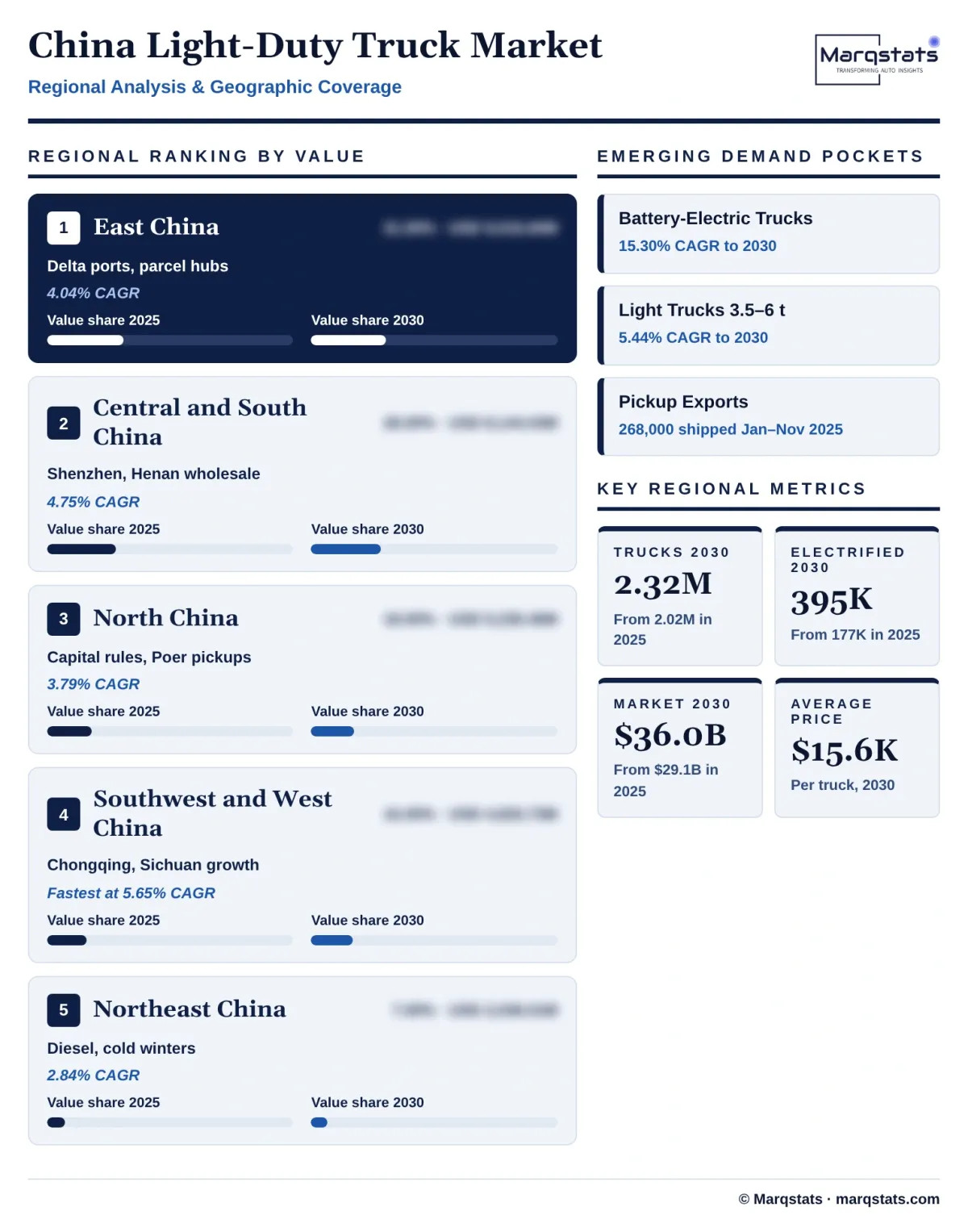
East China accounts for 31.00% of 2025 value, USD 9,016.60 million, and grows at 4.04% a year to USD 10,990.99 million and 30.50% by 2030. Shandong, Jiangsu, Zhejiang, Anhui and Shanghai combine dense manufacturing, ports and parcel hubs, and are home to JAC in Hefei, Yuejin in Nanjing, Sinotruk in Jinan and the BYD commercial vehicle plant at Huai'an. Marqstats allocates value by registration and delivery region, as buyers and lenders do, so lessors that register trucks at head offices can raise the share of coastal cities.
Central and South China
Central and South China account for 28.00% of 2025 value, USD 8,144.03 million, and grow at 4.75% a year to USD 10,270.27 million and 28.50% by 2030. Guangdong, Henan, Hubei, Hunan and Guangxi combine green-plate delivery rules in Shenzhen and Guangzhou with the large agricultural wholesale routes of Henan and Hubei, and Dongfeng light vehicles are built in Hubei, so electric and diesel trucks both sell in volume.
North China
North China accounts for 18.00% of 2025 value, USD 5,235.45 million, and grows at 3.79% a year to USD 6,306.31 million, falling to 17.50% by 2030. Beijing, Tianjin, Hebei, Shanxi and Inner Mongolia combine air-quality rules around the capital with cold winters that keep diesel in rural work, and Great Wall Motor builds its Poer pickups in Baoding and Foton builds in Beijing.
Southwest and West China
Southwest and West China account for 16.00% of 2025 value, USD 4,653.73 million, and grow fastest among regions, at 5.65% a year, to USD 6,126.13 million and 17.00% by 2030. Sichuan, Chongqing, Shaanxi, Guizhou and Yunnan add logistics capacity along the western land-sea corridor, and Changan Kaicheng and Shineray, both based in Chongqing, anchor local supply of small and electric trucks.
Northeast China
Northeast China accounts for 7.00% of 2025 value, USD 2,036.01 million, and grows at 2.84% a year to USD 2,342.34 million, the slowest region, with 6.50% by 2030. Liaoning, Jilin and Heilongjiang have harsh winters that keep diesel dominant, and FAW Jiefang in Changchun supplies the region with light trucks, so electrified adoption trails the national rate.
How Competition Is Evolving
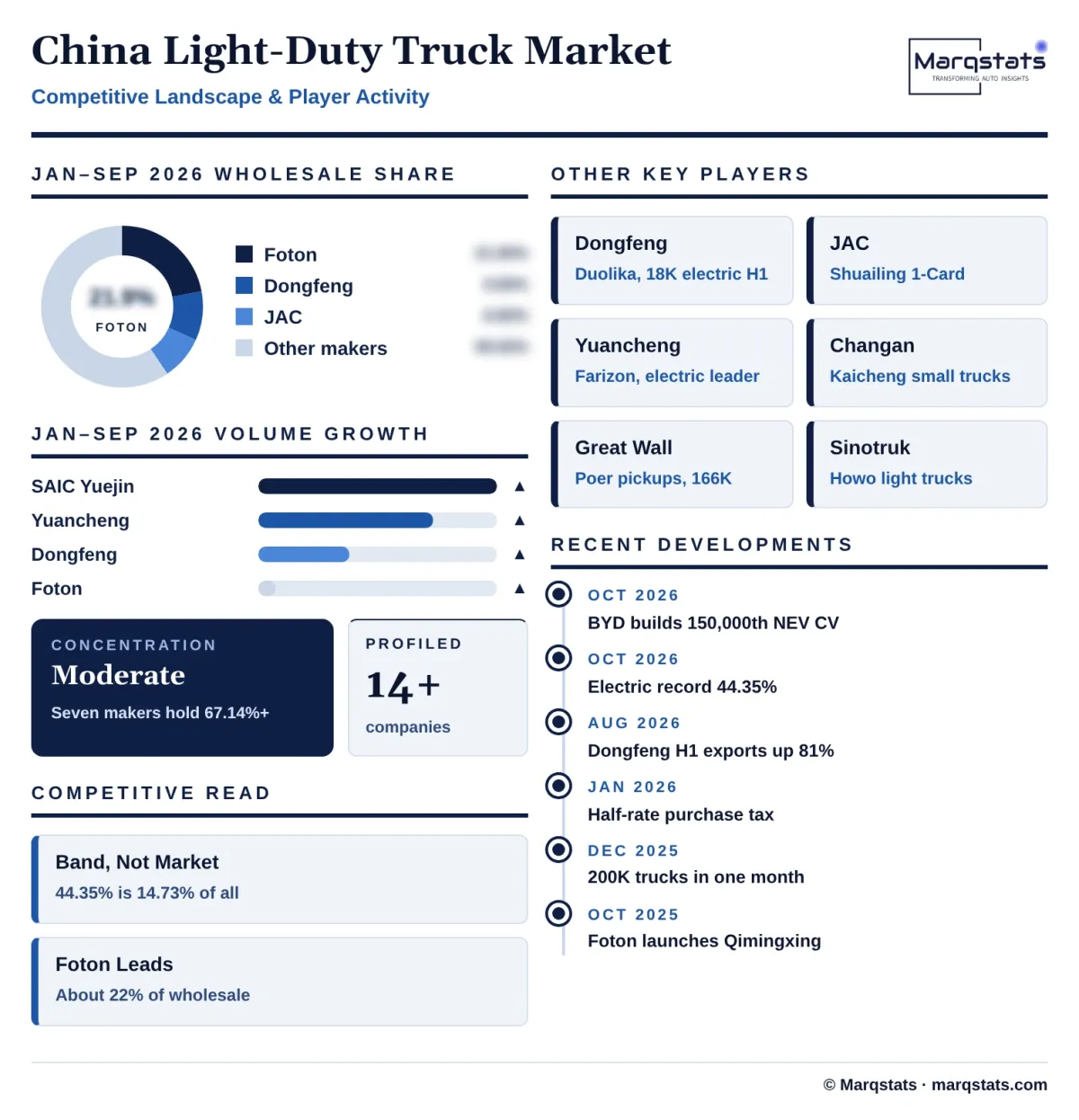
The market is moderately concentrated and led by Beiqi Foton Motor Co., Ltd. Foton delivered about 445,000 light trucks in 2025, roughly 22.0% of wholesale, and held 22.33% in the first half of 2026 with 234,415 trucks and 21.9% in January – September with 337,700. Seven makers named in the monthly CAAM-based rankings, Foton, Dongfeng, JAC, Yuancheng, Changan, SAIC Maxus Yuejin and Sinotruk, delivered at least 67.14% of January – September 2026 wholesale, which leaves a long tail of makers behind them.
The second tier is a group of makers that each hold 5% to 10% of wholesale. In January – September 2026, Dongfeng delivered about 151,400 trucks (9.8%, up 17%), JAC about 135,200 (8.8%, up 1%), Yuancheng New Energy Commercial Vehicle about 117,400 (7.6%, up 33%), Changan about 115,100 (7.5%), SAIC Maxus Yuejin about 101,500 (6.6%, up 45%) and Sinotruk about 76,400 (5.0%). In December 2025, Foton delivered 42,077 trucks, down 20.08%, while JAC delivered 17,648, up 49.51%, and Changan 17,377, up 97%.
Competition in the electrified band follows a different order. Yuancheng led with 16.2% of January – September 2026 registrations, Foton followed with 14.9%, JAC held 8.8%, Yuejin 8.4%, Sinotruk 7.8%, Dongfeng 5.5%, Weichai New Energy Commercial Vehicle 4.9%, Chery Commercial Vehicle 4.9%, BYD 4.8% and FAW Jiefang 4.4%, so the top ten held 80.6%. In January – September 2025, Yuancheng also led with 24,933 registrations ahead of Foton with 21,153, which shows a stable duopoly with a fast-growing tail.
Pickups run on their own ranking. Great Wall Motor Company Limited led with 166,322 pickups in January – November 2025, up 3.4%, ahead of JAC, SAIC Maxus, Changan and JMC, while BYD's 38,266 pickups, up 351.9%, put it seventh. Competition is moving from price to platform, and Foton's Qimingxing launch, BYD's 150,000th new energy commercial vehicle on 9 October 2026 and Dongfeng's subsidy-supported profit show that scale in electric trucks, not volume in diesel, will decide the order by 2030.
Companies Covered
Companies covered in the report include:
Recent Market Activity
Table of Contents
Coverage & Segmentation
The analysis covers the China light-duty truck market, with 2025 as the base year and 2026 – 2030 as the forecast period. It covers new light trucks of 1.8 to 6 tonnes gross vehicle weight sold by Chinese manufacturers for domestic delivery and export, including complete cargo trucks, chassis-cabs, small and mini trucks and pickups, segmented by vehicle type, powertrain and region. Values are manufacturer wholesale values in US dollars at CNY 7.18 per dollar, the 2025 average rate, before dealer margin.
Micro trucks below 1.8 tonnes, medium trucks above 6 tonnes, light passenger vans, buses, used trucks, trailers and separately sold bodies are excluded. The live Marqstats China Electric Light and Medium Truck Market page is a narrower study of electrified trucks of 3.5 to 12 tonnes, and the electrified light trucks counted here, 176,985 in 2025, are the same vehicles, so the two studies should not be added. Live pages on China electric heavy-duty and vocational trucks cover other weight classes and are disjoint from this market. Segment and regional splits are Marqstats estimates built on CAAM and CPCA data, registration series, maker disclosures and price benchmarks.