Market Snapshot
Middle bar: base-year value × (1 + CAGR), rounded to two decimals. This is a calculated illustration, not a separately researched annual estimate.
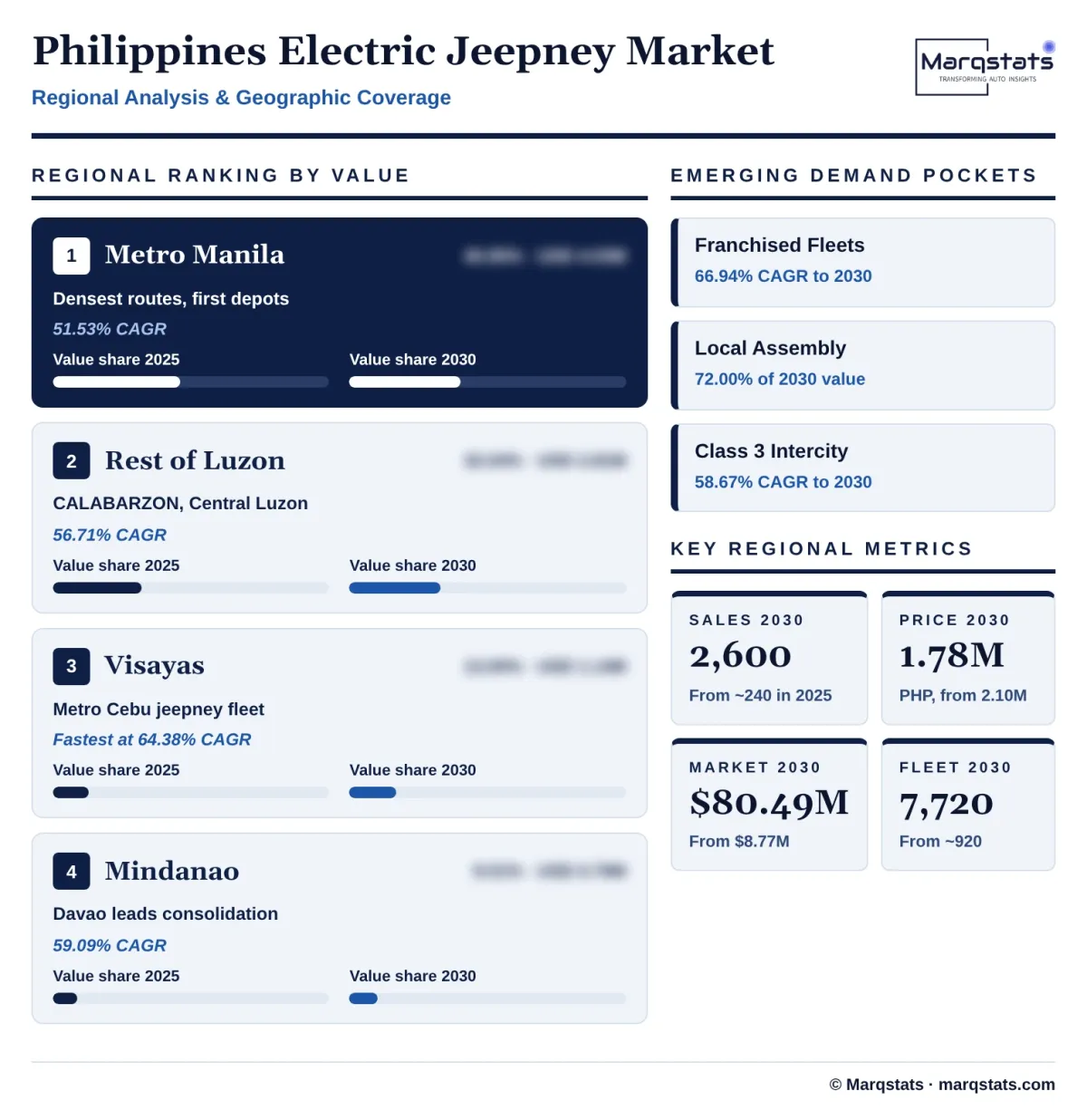
The Philippines electric jeepney market size is estimated at USD 8.77 million in 2025 and is projected to reach USD 80.49 million by 2030, growing at a CAGR of 55.79% over 2026 – 2030. Annual sales of new electric jeepneys and electric public utility vehicles (e-PUVs) rise from about 240 units to 2,600, a 61.04% annual rate, while the average selling price eases from about PHP 2.10 million to PHP 1.78 million per vehicle as local assembly grows.
Marqstats defines the market as the value of new battery electric jeepneys and modern e-PUVs built to Philippine National Standards (PNS) Class 1 to Class 4 and sold for fare-paying passenger service. It covers vehicles bought by transport cooperatives and corporations on LTFRB-franchised routes and vehicles bought for non-franchised public services such as local government circulators, economic zone shuttles, campus loops and island tourism routes. Diesel modern PUVs, electric tricycles, electric buses longer than about 9 metres, private electric cars and vans, charging equipment and battery leasing fees are excluded. Values are in US dollars at PHP 57.50 per USD, the Marqstats 2025 average rate, held constant across the forecast.
Class 2 e-PUVs, the direct replacement for the traditional jeepney, account for an estimated 70.01% of 2025 value, and vehicles assembled in the Philippines account for 54.96%. Metro Manila accounts for 45.95% of 2025 value. The study segments the market by vehicle class, build origin, buyer type and region.
Key Takeaways
Market Overview & Analysis
Report Summary
Marqstats sizes the Philippines electric jeepney market as the value of new electric jeepneys and modern e-PUVs sold for passenger service. About 240 vehicles were sold in 2025, worth an estimated PHP 504.0 million, or USD 8.77 million, at an average price of about PHP 2.10 million.
The traditional jeepney is built on reconditioned diesel truck chassis, with side-facing bench seats, an open rear entrance and no air conditioning. The Public Transport Modernization Program, formerly the Public Utility Vehicle Modernization Program, replaces these vehicles with modern PUVs that meet Philippine National Standards for size, seating, doors, emergency exits, GPS tracking, CCTV and automated fare collection. Operators can choose Euro 4 diesel or electric modern PUVs, and most early buyers chose diesel because it costs less and needs no charging depot.
The program also changed who owns the vehicles. Individual owner-drivers must join transport cooperatives or corporations, which hold the franchise and buy vehicles in fleets. More than 86% of public utility vehicles had applied for consolidation by March 2025, and the DOTr set the end of 2026 as the deadline for local government route plans, called Local Public Transport Route Plans (LPTRPs), which tell banks which routes and how many vehicles each cooperative will operate.
Electric vehicles get extra support. EVIDA, Republic Act No. 11697, lapsed into law in April 2022 and requires at least 5% of public transport, government and corporate fleets to be electric. Electric vehicles are exempt from Metro Manila number coding, get priority registration and green plates, and pay no excise tax as battery electric vehicles. The DOTr raised the PTMP equity subsidy from PHP 260,000 to PHP 400,000 per vehicle for 2026, and the DTI launched a PHP 2 billion E-Transport Loan Program in April 2026.
Few electric jeepneys are in service. The LTFRB said in June 2026 that fewer than 1,000 modernized electric jeepneys were on the road, and it aims for about 6,000 jeepneys, 5% of the national fleet of about 120,000, to move to electric by the end of 2026. Marqstats estimates the active fleet at about 920 vehicles at the end of 2025, including franchised e-PUVs, local government circulators and shuttles, after retirement of some early-generation electric jeepneys.
Electric vehicles are spreading quickly across the wider Philippine market. EV registrations reached 60,906 in 2025, more than double 2024, and EVs made up 24.68% of vehicle sales by mid-September 2026, according to the DOE. The DOE counted 1,876 charging points in September 2026, including 878 AC chargers, 470 DC chargers and 528 battery swapping stations, most of them used by private cars and two-wheelers. Electric jeepneys remain a small part of this total, but they matter most for policy because about 120,000 jeepneys still carry a large share of daily commuters.
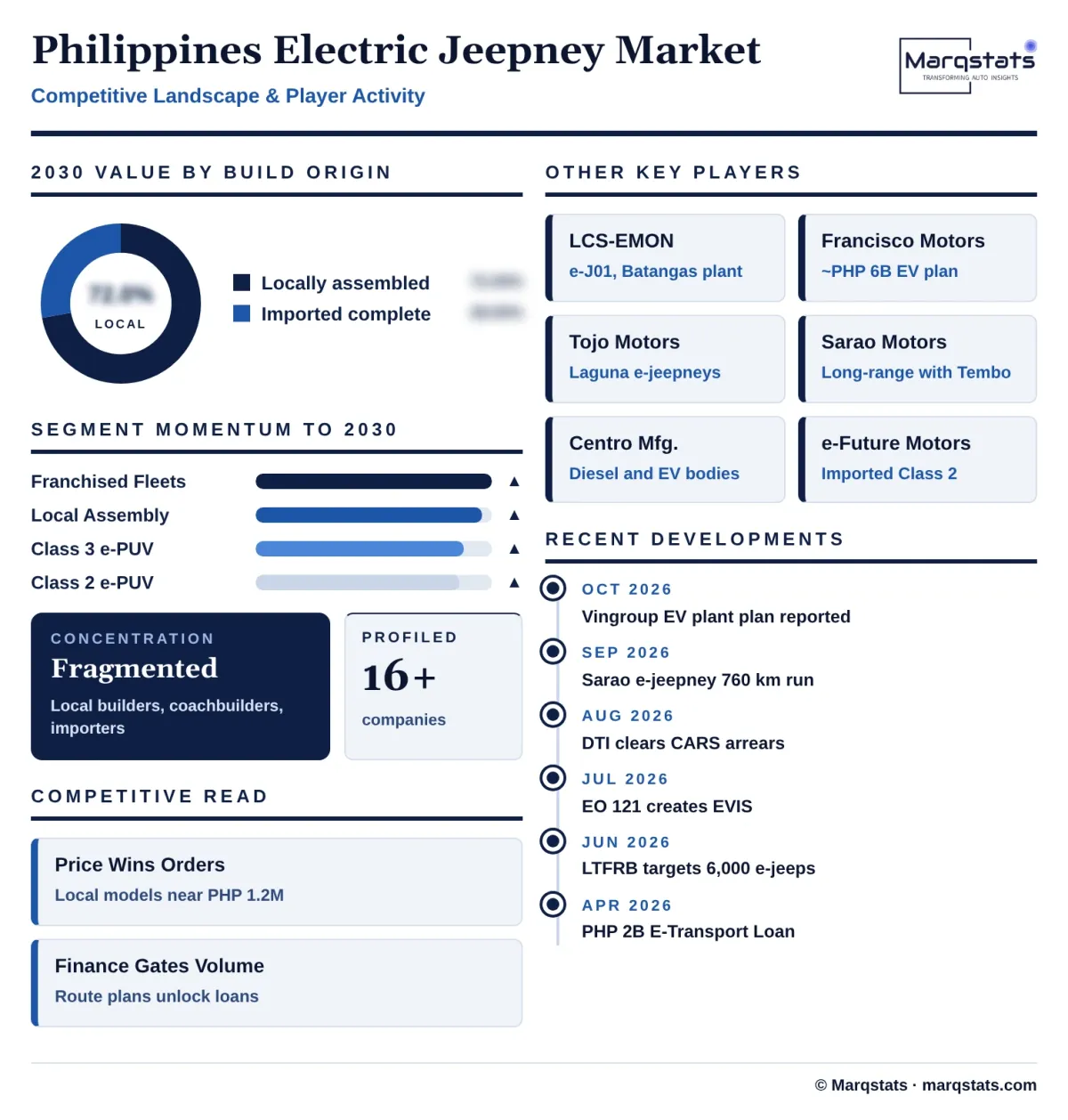
Three types of builder supply the market. Local builders such as LCS-EMON, Francisco Motors and Tojo Motors assemble electric jeepneys from imported chassis and parts. Established coachbuilders such as Centro Manufacturing, Del Monte Motor Works and Almazora Motors fit bodies to diesel and electric chassis. Importers bring in complete Class 2 e-PUVs, mostly from China. Prices range from about PHP 1.2 million for the most basic locally built models to PHP 3.0 million or more for long-range and air-conditioned vehicles.
Philippines Electric Jeepney Market Size and Forecast
The Philippines electric jeepney market grows from USD 8.77 million in 2025 to USD 80.49 million in 2030, a CAGR of 55.79%. Marqstats expects sales of about 450 vehicles worth USD 16.04 million in 2026, 800 worth USD 27.55 million in 2027, 1,300 worth USD 42.96 million in 2028 and 1,900 worth USD 60.80 million in 2029, before reaching 2,600 vehicles in 2030.
Sales have grown steadily from a small base. About 90 vehicles were sold in 2021, worth USD 3.60 million, rising to 120 in 2022, 150 in 2023 and 170 in 2024, worth USD 6.50 million, mostly through pilot routes, local government fleets and the first cooperative orders.
Prices fall as local assembly grows. The average selling price falls from about PHP 2.30 million in 2021 to PHP 2.10 million in 2025 and PHP 1.78 million in 2030. Imported Class 2 e-PUVs list at around PHP 2.4 million to PHP 3.0 million, while locally assembled models such as the LCS-EMON e-J01 sell for about PHP 1.2 million. Sales volume therefore grows at 61.04% a year while value grows at 55.79%.
The fleet grows from about 920 vehicles at the end of 2025 to 1,320 in 2026, 2,070 in 2027, 3,320 in 2028, 5,170 in 2029 and 7,720 in 2030, allowing for retirement of about 50 older vehicles a year. That puts the electric share of the jeepney fleet at about 6% to 7% by 2030 if the total fleet stays near 120,000.
Marqstats tracks four indicators to monitor the forecast: the share of approved route plans, subsidy and loan releases per quarter, the number of depot charging connections approved by distribution utilities, and the average price of locally assembled Class 2 e-PUVs.
The mix changes over the forecast. Locally assembled vehicles rise from 54.96% to 72.00% of value, franchised cooperatives and corporations from 58.04% to 82.00%, and Class 2 vehicles from 70.01% to 74.00%. Metro Manila remains the largest region but its share falls from 45.95% to 40.00% as the Visayas, led by Metro Cebu, rise from 13.00% to 17.00%.
Running costs explain why operators switch once they can finance the vehicle. Marqstats models an urban route of 120 km a day over 312 days a year. A traditional diesel jeepney uses about 0.28 litres per km and costs about PHP 2,700 a day for fuel and maintenance. A Euro 4 diesel modern PUV uses less fuel but carries loan payments, bringing its daily cost to about PHP 3,460. A Class 2 e-PUV costing PHP 2.8 million, less the PHP 400,000 subsidy and financed at 6% over seven years, costs about PHP 35,000 a month in loan payments, PHP 620 a day for depot electricity at about PHP 11.50 per kWh, PHP 140 for maintenance and PHP 320 for a battery reserve, about PHP 2,430 a day in total. Charging at public fast chargers at two to three times depot rates removes most of the saving.
Market Dynamics
Key Drivers
Five forces are moving Philippine jeepney operators from diesel to electric vehicles.
- Fleet age rules and franchise consolidation. The PTMP requires operators to join cooperatives or corporations and replace old jeepneys with modern PNS-compliant vehicles, creating a replacement market of about 120,000 jeepneys over the coming decade.
- EVIDA fleet quota and incentives. EVIDA requires 5% of public transport fleets to be electric and gives electric vehicles number-coding exemption, priority registration and excise tax exemption, making electric the preferred choice where operators can finance it.
- Larger subsidies and new loans. The PTMP equity subsidy rose to PHP 400,000 per vehicle for 2026, and the DTI's PHP 2 billion E-Transport Loan Program through the Small Business Corporation lends up to PHP 1.5 million per vehicle and PHP 3 million per borrower over five years, with up to one year of grace.
- Lower running costs. Electricity at depot rates costs about a quarter of diesel per kilometre, and electric jeepneys need no oil changes, filters or injector work. The DTI says the shift can cut fuel costs by up to 80%.
- Local manufacturing incentives. Executive Order No. 121 created the Electric Vehicle Incentive Strategy (EVIS) in July 2026 with up to PHP 60 billion of tax payment certificates, capped at PHP 15 billion per model, for locally built hybrid and battery electric passenger and commercial vehicles.
- Public pressure on fuel costs. Higher pump prices make drivers and operators more willing to switch, and transport groups that opposed the program have welcomed loans for electric vehicles, as Pasang Masda did when the LTFRB presented its plan in June 2026.
Key Restraints
Four constraints limit how fast transport cooperatives can buy electric jeepneys.
- High upfront cost. A new e-PUV costs PHP 1.2 million to PHP 3.0 million, against a few hundred thousand pesos for a used traditional jeepney, and most cooperatives have little credit history or collateral.
- Slow route plans. Banks need approved route plans before lending against fare revenue, and only about 12% of local government route plans had been approved when the DOTr set its end-2026 deadline.
- Charging and grid limits. A depot charging 15 to 30 vehicles needs several hundred kVA of transformer capacity, and urban land for depots is expensive. Outside Metro Manila, many electric cooperatives cannot supply large new connections quickly.
- Driver and operator resistance. Transport groups have staged strikes and filed court petitions against the modernization program, and some operators prefer cheaper Euro 4 diesel modern PUVs to meet deadlines.
- Policy uncertainty. Changing deadlines for consolidation, franchises and route plans make cooperatives and lenders cautious about committing to vehicles that cost several million pesos.
Key Trends
Four shifts are changing how electric jeepneys are built, financed and charged.
- Low-cost local models. Locally assembled e-jeepneys such as the LCS-EMON e-J01 at about PHP 1.2 million cost less than half the price of many imported e-PUVs.
- Long-range jeepneys for provincial routes. Sarao Motors and Tembo completed a 760 km round trip from Las Piñas to Albay with an electric jeepney in 2026, aiming at longer intercity routes.
- Battery and chassis leasing. Builders and financiers are separating battery ownership from the vehicle so cooperatives pay a monthly or per-kilometre fee instead of buying the battery.
- Depot-first charging. Cooperatives that charge overnight at their own depots get the lowest electricity cost, while public fast chargers are used as a top-up on long routes.
- Exports from the Philippines. Builders such as LCS-EMON, with an initial order of 60 units for Paraguay, and Francisco Motors, targeting African markets, are exploring exports to add volume to local plants.
Strategic Implications
- For vehicle builders, price is the key to volume. Local assembly that brings Class 2 e-PUVs closer to PHP 1.5 million, combined with a dealer and service network outside Metro Manila, will capture most cooperative orders.
- For transport cooperatives, depot charging is essential. Securing a depot lease and a utility connection before buying vehicles protects the running cost advantage that repays the loan.
- For banks and lenders, route plan approval reduces risk. Lending linked to approved routes, fare collection data and vehicle telematics can expand credit while keeping defaults low.
- For utilities, depot connections are a growth opportunity. Fast approval of transformers and time-of-use tariffs for transport depots will decide where e-PUVs are deployed outside Metro Manila.
- For policymakers, finance matters more than mandates. Faster route plan approvals and predictable subsidy releases will do more to reach the 5% EVIDA target than new deadlines.
- For investors, the replacement pipeline is large but slow. About 120,000 jeepneys must eventually be replaced, so builders and lenders that can wait for route plans and subsidy releases face a long period of steady growth rather than a sudden surge.
Market Segmentation
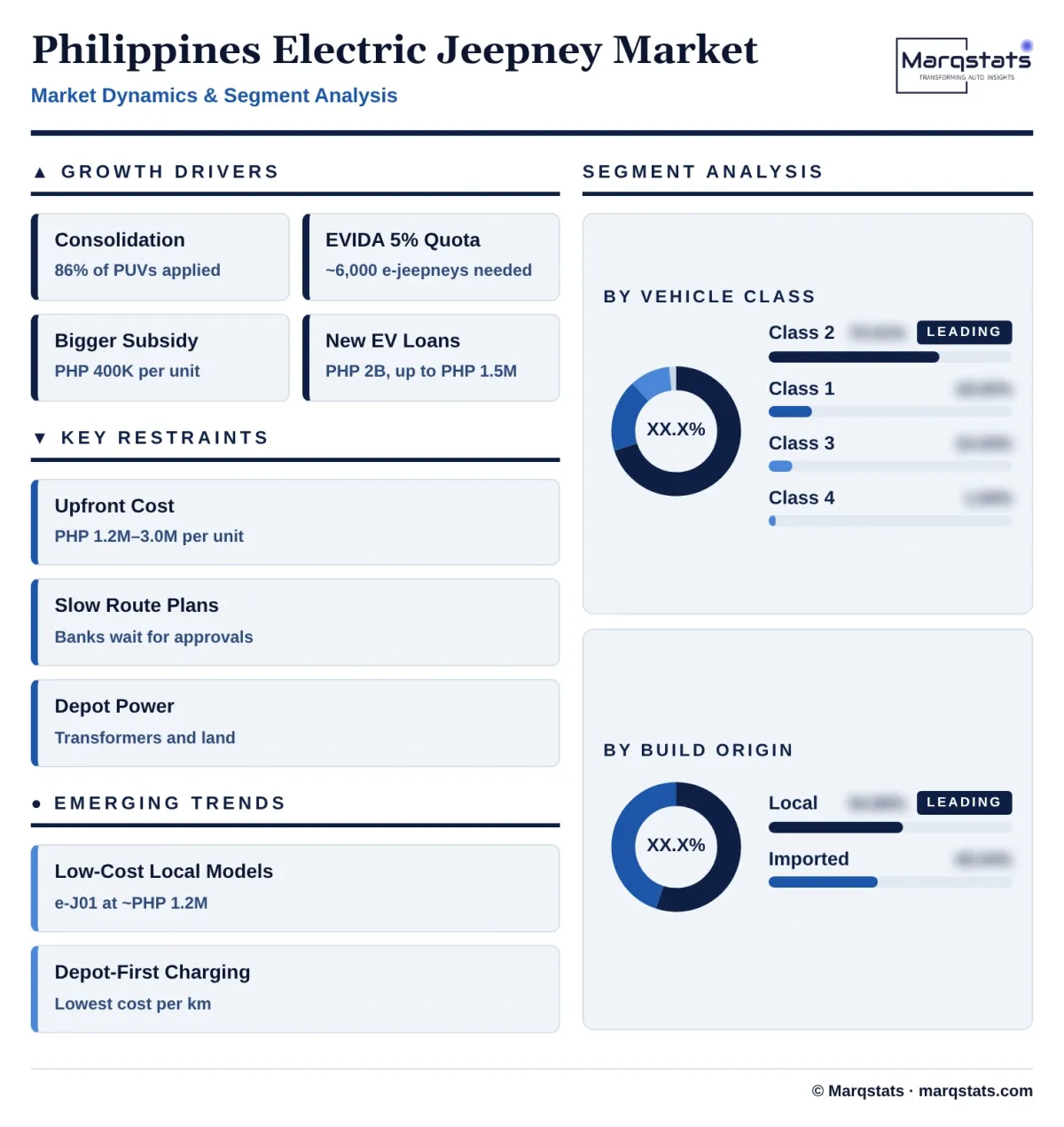
Class 2 vehicles with up to 22 seats and standing room account for 70.01% of 2025 value, USD 6.14 million, and grow at 57.53% a year to USD 59.56 million and 74.00% of the market by 2030. They replace traditional jeepneys one for one on urban trunk routes and are the focus of PTMP route plans.
Smaller all-seated Class 1 vehicles account for 18.02% of 2025 value, USD 1.58 million, and grow at 45.94% a year to USD 10.46 million. They serve narrow feeder roads, barangay links and local government circulators.
Class 3 vehicles with front-facing seats for intercity express routes account for 10.03% of 2025 value, USD 0.88 million, and grow at 58.67% a year to USD 8.85 million as long-range models reach provincial corridors.
Class 4 vehicles with cargo space for rural routes account for 1.94% of 2025 value, USD 0.17 million, rising to USD 1.62 million by 2030, a 56.97% CAGR.
Vehicles assembled in the Philippines from imported chassis and kits with local bodies account for 54.96% of 2025 value, USD 4.82 million, and grow at 64.44% a year to USD 57.95 million and 72.00% of the market by 2030. LCS-EMON in Batangas, Francisco Motors and local coachbuilders lead, and EVIS rewards local production.
Fully built imported e-PUVs, mainly from China, account for 45.04% of 2025 value, USD 3.95 million, and grow at 41.67% a year to USD 22.54 million, as their share falls to 28.00%.
Vehicles bought by LTFRB-franchised transport service entities account for 58.04% of 2025 value, USD 5.09 million, and grow fastest, at 66.94% a year, to USD 66.00 million and 82.00% of the market by 2030, as route plans are approved and subsidies and loans reach operators.
Local government circulators, economic zone and industrial park shuttles, campus loops and resort fleets account for 41.96% of 2025 value, USD 3.68 million, and grow at 31.54% a year to USD 14.49 million.
By Geography
Metro Manila
Metro Manila is the largest region, with 45.95% of 2025 value, USD 4.03 million, rising to USD 32.20 million by 2030, a 51.53% CAGR, while its share falls to 40.00%. Dense routes, the most advanced cooperatives and Meralco's grid make it the first market for e-PUVs, but depot land is scarce and expensive.
Rest of Luzon
The rest of Luzon, led by CALABARZON and Central Luzon, accounts for 32.04% of 2025 value, USD 2.81 million, and grows at 56.71% a year to USD 26.56 million. Industrial parks, the LCS-EMON plant in Batangas and routes linked to Clark support demand.
Visayas
The Visayas account for 13.00% of 2025 value, USD 1.14 million, and grow fastest, at 64.38% a year, to USD 13.68 million by 2030. Metro Cebu has a large jeepney fleet, and the LTFRB presented its electric jeepney transition plan to operators there in June 2026.
Mindanao
Mindanao accounts for 9.01% of 2025 value, USD 0.79 million, and grows at 59.09% a year to USD 8.05 million. Davao has high consolidation rates, but grid capacity and financing limit early adoption.
How Competition Is Evolving
The Philippines electric jeepney market is fragmented. Local builders, coachbuilders that are adding electric models to their diesel lines and importers of Chinese e-PUVs compete for cooperative orders, and no single supplier holds a dominant share.
Local builders compete on price. LCS-EMON e-Jeepney Manufacturing Corp. opened its plant in the LIMA Industrial Estate at the Lipa City and Malvar border in Batangas in May 2024 with a target of 500 vehicles a month, and sells the e-J01 for about PHP 1.2 million. Francisco Motors Corporation offers electric jeepneys and plans an initial investment of about PHP 6 billion, or USD 100 million, in EV production under EVIS.
Coachbuilders and importers compete on capacity and range. Centro Manufacturing, Del Monte Motor Works and Almazora Motors build bodies for diesel and electric chassis, Sarao Motors is developing a long-range electric jeepney with Tembo, and importers such as e-Future Motors sell Class 2 e-PUVs at around PHP 2.4 million.
Competition will be decided by price, financing and service. Builders that offer locally assembled vehicles with financing packages, battery warranties and service outside Metro Manila will capture the largest share of cooperative orders.
New investment is coming. The DTI reported in October 2026 that Vingroup plans an EV plant of about USD 500 million with initial capacity of 200,000 vehicles a year, with construction targeted from the first quarter of 2027, and Mitsubishi Motors Philippines and Francisco Motors have signalled interest in EVIS.
Charging partners matter. ACMobility and Meralco are building charging networks and depot connections, and cooperatives often choose builders that can bundle charging hardware, installation and utility applications with the vehicles. The DOE's charging network reached 1,876 points in September 2026, but depot chargers inside cooperative yards remain the main charging route for e-PUVs.
Companies Covered
Companies covered in the report include:
Recent Market Activity
Table of Contents
Coverage & Segmentation
The study covers the Philippines electric jeepney market, with 2025 as the base year, 2021 – 2025 as the historical period and 2026 – 2030 as the forecast period. Values are in US dollars at PHP 57.50 per USD, held constant, and volumes are annual sales of new vehicles. The market is segmented by vehicle class, build origin, buyer type and region.
Diesel modern PUVs, electric tricycles, electric buses longer than about 9 metres, private electric cars and vans, charging equipment, battery leasing fees and fare revenue are excluded. Electric jeepneys and e-PUVs are a small part of the vehicles covered in the Marqstats Philippines Electric Vehicle Market report, and the two values should not be added. Segment and regional splits are Marqstats estimates built on LTFRB, DOTr, DTI and DOE statements, builder disclosures and price benchmarks.