Market Snapshot
Middle bar: base-year value × (1 + CAGR), rounded to two decimals. This is a calculated illustration, not a separately researched annual estimate.
The global electric microvan market size is estimated at USD 2,523.15 million in 2025 and is projected to reach USD 5,531.10 million by 2030, growing at a CAGR of 17.00% over 2026 – 2030. Annual sales of battery-electric microvans rise from about 201,500 units to 471,000, an 18.51% annual rate, while the average ex-factory price eases from about USD 12,520 to USD 11,740 as lithium iron phosphate (LFP) packs get cheaper and shared platforms spread.
Microvans are the smallest purpose-built commercial vans: Chinese pure-electric micro-vans (纯电动微面) up to 4.5 metres long, Japanese kei commercial vans limited to 3.4 metres and 350 kg of payload, European L6e and L7e cargo quadricycles and micro N1 vans under 4.2 metres, Indian electric small commercial vehicles of up to 1 tonne payload, and street-legal low-speed utility vehicles in North America. China sold about 140,000 of the 201,500 units in 2025, 69.48% of the total.
China is the largest region, with 61.03% of 2025 value, followed by Japan at 11.45%, Europe at 9.90%, North America at 7.41%, the Rest of World at 5.71% and India at 4.49%. The study segments the market by vehicle class, application and battery chemistry, and by region. Values are in US dollars at constant 2025 average exchange rates and cover new vehicles at ex-factory prices excluding taxes and purchase subsidies.
Key Takeaways
Market Overview & Analysis
Report Summary
Marqstats sizes the global electric microvan market as the ex-factory value of new battery-electric microvans sold worldwide, excluding taxes and purchase subsidies. Microvans are purpose-built small commercial vans for urban goods and service work: Chinese pure-electric micro-vans up to 4.5 metres long, Japanese kei commercial vans, European L6e-BU and L7e-CU cargo quadricycles and micro N1 vans under 4.2 metres, Indian electric small commercial vehicles of up to about 1 tonne payload and North American street-legal low-speed utility vehicles. Compact vans such as the Renault Kangoo E-Tech and Ford E-Transit Courier, larger panel vans, electric three-wheelers, hybrids and conversions of existing vehicles are excluded.
The market grew from an estimated USD 817.40 million in 2021 to USD 2,523.15 million in 2025, as unit sales rose from about 61,000 to 201,500. Growth came first from Chinese urban logistics, where pure-electric micro-vans from SAIC-GM-Wuling, Geely Farizon and others replaced petrol models, and then from Japan, where Mitsubishi relaunched the Minicab EV in December 2023 and Honda launched the N-VAN e: in October 2024. Marqstats estimates sales of about 240,000 units in 2026, worth about USD 2,952.00 million.
China dominates volume. SAIC-GM-Wuling sold 148,166 new-energy commercial vehicles in 2025, the most of any Chinese maker, and China's new-energy logistics van segment sold about 241,600 units in the first nine months of 2025. Marqstats estimates that pure-electric micro-vans accounted for about 140,000 of China's 2025 new-energy van sales, at an average ex-factory price of about USD 11,000.
Microvans compete on running cost and access, not purchase price. An electric microvan costs more to buy than a petrol model of the same size, but energy and maintenance costs are much lower on short, stop-start urban routes, and electric vans can enter city zones that restrict combustion vehicles. In Japan, electric kei vans list at about JPY 2.43 million to JPY 3.47 million against roughly JPY 1.2 million to JPY 1.8 million for petrol equivalents, a gap that national CEV subsidies of up to about JPY 574,000 per vehicle only partly close.
The forecast rests on three conditions. Chinese prices keep falling as LFP pack costs decline, Japan keeps CEV subsidies and tax relief for electric kei vehicles while delivery firms face driver shortages, and European cities keep widening low- and zero-emission zones. Under these conditions, sales reach about 471,000 units in 2030 and market value reaches USD 5,531.10 million.
Global Electric Microvan Market Size and Forecast
The global electric microvan market grows from USD 2,523.15 million in 2025 to USD 5,531.10 million in 2030, a CAGR of 17.00%. The market reaches an estimated USD 2,952.00 million in 2026, passes USD 4,000 million in 2028 and reaches USD 4,716.30 million in 2029. Growth in value slows from about 19.5% in 2025 to about 17.3% in 2030 as volumes rise and prices fall.
Unit sales grow faster than value. Annual sales rise from about 201,500 units in 2025 to 471,000 in 2030, an 18.51% annual rate, while the average ex-factory price falls from about USD 12,520 to USD 11,740. Chinese micro-vans fall from about USD 11,000 to USD 9,800, Japanese kei vans from about USD 17,000 to USD 16,000 and European micro N1 vans from about USD 26,500 to USD 21,500, as LFP packs get cheaper and shared platforms spread.
The regional mix shifts away from China. China's share of value falls from 61.03% in 2025 to 45.18% in 2030, as its value grows at 10.17% a year, while Japan rises from 11.45% to 17.36%, Europe from 9.90% to 13.42% and India from 4.49% to 9.21%. China remains the largest region, with about 255,000 units in 2030.
Growth was fastest in the early years. The market grew at about 32.5% a year from 2021 to 2025 from a small base, as Chinese logistics fleets electrified and Japanese makers returned to electric kei vans. Marqstats expects growth of about 17% a year from 2026, with Japan, India and Europe each growing at more than twice the rate of China.
Market Dynamics
Key Drivers
Five forces are moving urban delivery fleets toward electric microvans.
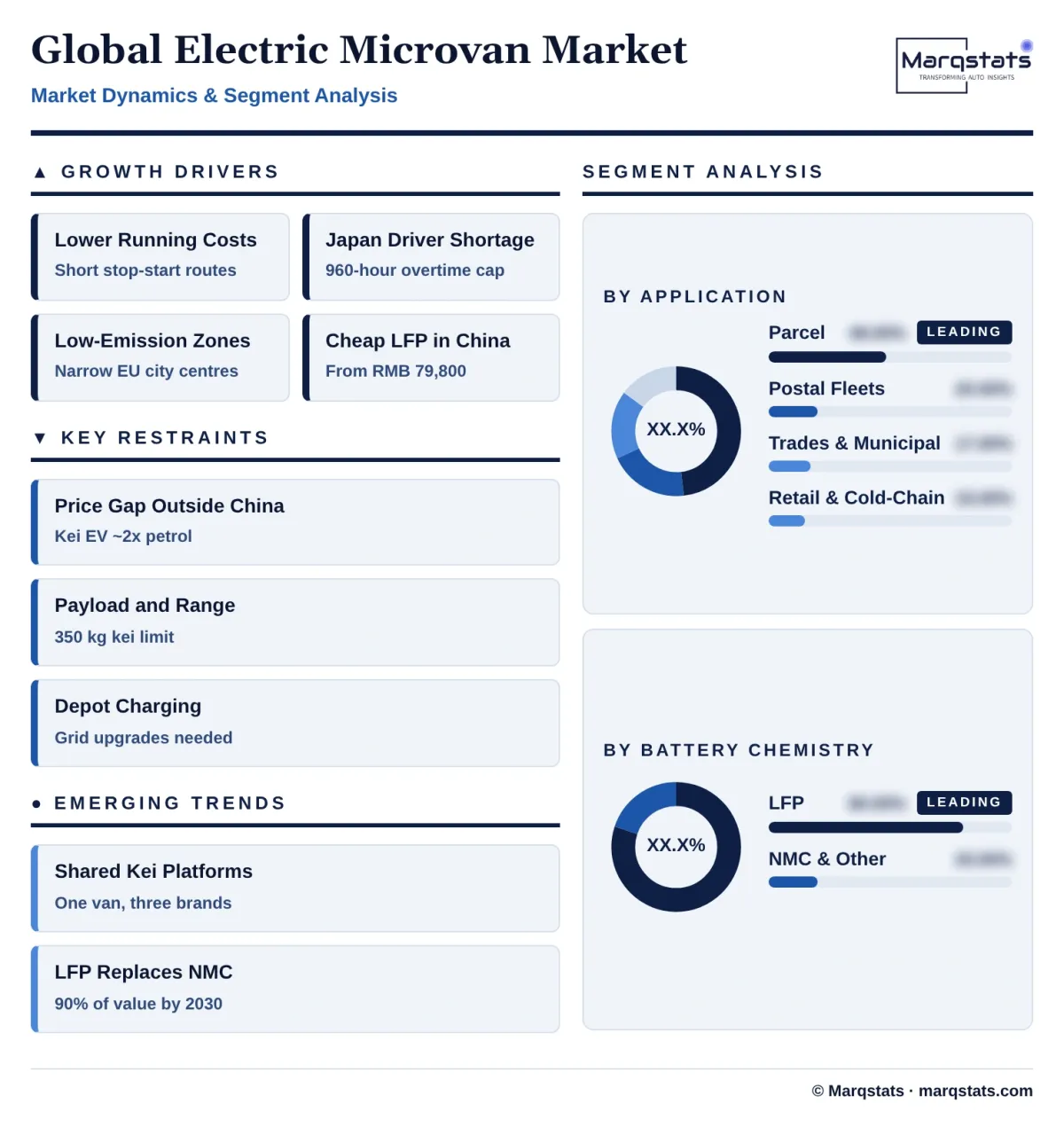
- Lower running costs on urban routes. Microvans in parcel and service work cover short, stop-start routes, often under 150 km a day, where electric drivetrains use much less energy than petrol engines and need less maintenance. Depot charging overnight at commercial tariffs keeps energy costs per kilometre well below petrol, which pays back the higher purchase price over a few years of fleet use.
- Driver shortages in Japanese logistics. Japan capped annual overtime for truck drivers at 960 hours from April 2024, which reduced delivery capacity. Delivery firms are moving more parcels into kei vans that couriers can drive on a standard licence and park on narrow streets, and the electric models qualify for national CEV subsidies of up to about JPY 574,000 per vehicle.
- Low-emission zones and access rules in Europe. Cities in France, Italy, Spain and the Netherlands are tightening low-emission zones and moving toward zero-emission zones for urban freight, and historic centres restrict vehicle width and length. Electrically chargeable vans reached 11.2% of EU van registrations in 2025 and 13.2% in the first half of 2026, and microvans and cargo quadricycles are the only option for the narrowest streets.
- Cheap LFP batteries in China. Chinese makers supply micro-vans with LFP packs of about 30 kWh to 56 kWh at prices that put pure-electric models close to petrol micro-vans. The 2025 Wuling Yangguang family starts at RMB 79,800 and offers up to 400 km of range from a 56.2 kWh pack, with 30% to 80% charging in about 20 minutes.
- E-commerce growth in India and Southeast Asia. Parcel and grocery delivery volumes in India and Southeast Asia keep rising, and four-wheel electric goods vehicles carry more and handle highways better than electric three-wheelers. India's electric goods carrier registrations grew by about 78% in 2025, with Maharashtra the leading state.
Key Restraints
Four constraints slow the switch from petrol micro-vans and kei vans.
- Higher purchase prices outside China. Electric kei vans in Japan cost about JPY 2.43 million to JPY 3.47 million against roughly JPY 1.2 million to JPY 1.8 million for petrol models, and the Toyota and Daihatsu LFP vans carry a premium of about EUR 6,000 over their petrol versions. Small fleets and owner-drivers struggle to finance the difference even with subsidies.
- Payload and range limits. Kei vans are limited to 350 kg of payload, and battery weight reduces the payload of small N1 vans and quadricycles. Cold weather and air conditioning cut usable range, so operators running longer suburban routes keep petrol vans for those shifts.
- Charging at depots and homes. Many owner-drivers in Japan and India park on streets or in shared yards without chargers, and fleet depots need grid upgrades to charge dozens of vans at once. Where charging is uncertain, operators delay switching.
- Weak demand for quadricycles. L6e and L7e cargo quadricycles are cheaper to approve than N1 vans, but they have lower crash standards, small payloads and limited heating and cooling, and some fleets avoid them for multi-shift work. Their share of value stays near an eighth of the market.
Key Trends
Four shifts are changing how electric microvans are built, priced and charged.
- Shared platforms in Japan. Suzuki, Daihatsu and Toyota now sell one Daihatsu-built electric kei van under three names, the Suzuki e Every, Daihatsu e-Hijet Cargo and Toyota Pixis Van BEV, while Mitsubishi supplies the Minicab EV to Nissan as the Clipper EV. Sharing one platform spreads battery and tooling costs across several brands.
- LFP replaces NMC. The new Japanese kei vans use a 36.6 kWh LFP pack instead of the 20 kWh NMC packs of earlier models, and Chinese micro-vans already run almost entirely on LFP. LFP accounts for an estimated 90.00% of market value by 2030.
- Longer range and faster charging in China. Chinese micro-vans now offer 300 km to 400 km of range and 2C fast charging, and CATL supplies customised packs such as the 310 km Yangguang version, which charges from 30% to 80% in about 15 minutes. Longer range lets one van cover two shifts.
- Chinese makers export microvans. Wuling, Geely Farizon and Cenntro sell microvans in Southeast Asia, Latin America, Europe and Japan, where Cenntro took an order for 500 Metro MR vans in January 2025. Exports make the Rest of World one of the faster-growing regions, at 25.03% a year.
Strategic Implications
- For vehicle makers, platform sharing is the way to cut cost. The Suzuki, Daihatsu and Toyota kei van shows how one battery, eAxle and body can serve several brands. Makers without an electric van under about 4.2 metres risk losing urban delivery customers in Japan and Europe to shared platforms and Chinese imports.
- For fleet operators, route choice decides the payback. Microvans pay back fastest on fixed, short urban routes with overnight depot charging. Operators should match battery size to route length rather than buy the largest pack, and keep petrol vans for long suburban routes until charging is in place.
- For battery and component suppliers, small LFP packs are the main opportunity. Thin, floor-mounted LFP packs of about 20 kWh to 56 kWh and compact three-in-one eAxles are standard across the segment. Suppliers that can deliver these at low cost to several makers win volume.
- For charging providers, depots come first. Microvans spend nights at depots, so managed AC charging with load control is cheaper than public fast charging. Providers that bundle chargers, grid connection and energy management for fleets of 20 to 200 vans will find steady demand.
- For policymakers, access rules work as well as subsidies. Low- and zero-emission zones, parking and loading privileges and licence rules have a large effect on which vans fleets buy. Clear timelines for urban freight rules give operators the confidence to replace petrol vans.
Market Segmentation
Fully homologated microvans, Chinese micro-vans, Japanese kei vans, European micro N1 vans and Indian small commercial vehicles, account for USD 2,232.15 million in 2025, 88.47% of value. They grow at 16.73% a year to USD 4,838.60 million by 2030 and 87.48% of value. Chinese models such as the Wuling Yangguang and Geely Farizon Xingxiang V dominate unit volume, while Japanese kei vans and European N1 vans such as the Piaggio Porter NPE carry higher prices.
European L6e and L7e cargo quadricycles and North American street-legal low-speed utility vehicles account for USD 291.00 million in 2025, 11.53% of value, rising to USD 692.50 million by 2030, an 18.93% CAGR and 12.52% of value. These vehicles cost less to approve and suit pedestrian zones, campuses and resorts, but small payloads and lower crash standards limit their use in multi-shift delivery.
Parcel, express and e-commerce delivery accounts for USD 1,211.11 million in 2025, 48.00% of value, rising to USD 2,765.55 million by 2030, a 17.96% CAGR and 50.00% of value. Couriers in China, Japan and Europe run fixed multi-drop routes with overnight depot charging, which suits small LFP packs.
National postal operators and institutional fleets account for USD 504.63 million in 2025, 20.00% of value, rising to USD 1,050.91 million by 2030, a 15.80% CAGR. Postal operators buy in large tenders with zero-emission targets, which gives makers predictable volume but strong price pressure.
Municipal maintenance, facility management and trade fleets account for USD 428.94 million in 2025, 17.00% of value, rising to USD 940.29 million by 2030, a 17.00% CAGR. Vehicle-to-load outlets let technicians run tools from the traction battery without a portable generator.
Retail, quick-commerce grocery and temperature-controlled deliveries account for USD 378.47 million in 2025, 15.00% of value, rising to USD 774.35 million by 2030, a 15.39% CAGR. Refrigeration units draw on the traction battery, so these vans need larger packs or shorter routes.
LFP microvans account for USD 2,018.52 million in 2025, 80.00% of value, rising to USD 4,977.99 million by 2030, a 19.79% CAGR and 90.00% of value. LFP is cheaper, tolerates daily full charges and fast charging, and uses no nickel or cobalt, which suits fleet duty.
Microvans with NMC and other chemistries account for USD 504.63 million in 2025, 20.00% of value, mostly first-generation Japanese kei vans and some European models. Value grows only slowly, at 1.85% a year to USD 553.11 million by 2030, and the share falls to 10.00% as new platforms switch to LFP.
By Geography
China
China is the largest region, with an estimated USD 1,540.00 million in 2025, 61.03% of value, from about 140,000 pure-electric micro-vans at an average ex-factory price of about USD 11,000. It grows at 10.17% a year to USD 2,499.00 million by 2030, when its share falls to 45.18%. SAIC-GM-Wuling leads with the Yangguang family, which starts at RMB 79,800, and sold 148,166 new-energy commercial vehicles in 2025. Geely Farizon, Ruichi and others compete for city delivery fleets, and urban green freight rules that give electric vans wider access drive replacement of petrol micro-vans. Prices keep falling, so value grows more slowly than units.
Japan
Japan accounts for an estimated USD 289.00 million in 2025, 11.45% of value, from about 17,000 electric kei commercial vans, and grows at 27.14% a year to USD 960.00 million by 2030 and 17.36% of value. The Honda N-VAN e:, on sale since October 2024 at JPY 2.44 million to JPY 2.92 million, and the Mitsubishi Minicab EV and Nissan Clipper EV were joined in March 2026 by the Suzuki e Every, Daihatsu e-Hijet Cargo and Toyota Pixis Van BEV, with 36.6 kWh LFP packs, 257 km of WLTC range and prices from JPY 3.146 million. Driver shortages and CEV subsidies of up to about JPY 574,000 drive demand from parcel and postal fleets.
Europe
Europe accounts for an estimated USD 249.75 million in 2025, 9.90% of value, from about 8,000 cargo quadricycles and 5,500 micro N1 vans, and grows at 24.35% a year to USD 742.50 million by 2030. Micro N1 vans such as the Piaggio Porter NPE and Cenntro Logistar grow faster than quadricycles such as the Citroën My Ami Cargo as fleets want higher payloads and crash standards. France, Italy and Spain lead because narrow historic centres and low-emission zones restrict larger vans. Electrically chargeable vans reached 13.2% of EU van registrations in the first half of 2026.
North America
North America accounts for an estimated USD 187.00 million in 2025, 7.41% of value, from about 8,500 street-legal low-speed utility vehicles and small electric cargo vans used on campuses, resorts, ports and in city services. It grows at 15.24% a year to USD 380.00 million by 2030. Federal rules limit low-speed vehicles to 25 mph and to roads with limits of up to 35 mph in most states, which keeps them in closed and low-speed areas.
Rest of World
The Rest of World, led by Southeast Asia and Latin America, accounts for an estimated USD 144.00 million in 2025, 5.71% of value, and grows at 25.03% a year to USD 440.00 million by 2030. Chinese exports from Wuling, Geely Farizon and Cenntro supply most units, often assembled locally, for parcel and grocery delivery in Indonesia, Thailand, the Philippines and Mexico.
India
India accounts for an estimated USD 113.40 million in 2025, 4.49% of value, from about 10,500 electric small commercial vehicles at about USD 10,800 each, and grows fastest, at 35.06% a year, to USD 509.60 million by 2030 and 9.21% of value. Tata Motors leads with the Ace EV, joined by Euler Motors and Switch Mobility, and Maharashtra leads state registrations. Values are converted at INR 87.00 per US dollar.

How Competition Is Evolving
The global electric microvan market is moderately concentrated by region. SAIC-GM-Wuling is the largest maker by volume, and in Japan a handful of companies, Honda, Mitsubishi and the Suzuki, Daihatsu and Toyota group, supply almost every electric kei van. Marqstats estimates that the top five makers hold more than half of global value, but each competes mainly in its home market.
Chinese makers compete on price and range. Wuling, Geely Farizon, Ruichi and other Chinese makers sell micro-vans with LFP packs, 300 km to 400 km of range and fast charging at prices close to petrol models. Their scale and battery supply from CATL, Gotion and others give them the lowest costs, and they are now exporting to Southeast Asia, Latin America and Europe.
Japanese makers compete through shared platforms. Daihatsu builds the electric kei van sold by Suzuki, Daihatsu and Toyota, and Mitsubishi builds the Minicab EV and the Nissan Clipper EV. Honda sells the N-VAN e: on its own platform. The Daihatsu and Toyota versions launched with sales targets of 300 and 50 units a month, small against the 12,000 to 15,000 petrol kei vans Daihatsu sells each month, which shows how early the transition still is.
European makers compete in small niches. Piaggio, Goupil, Alke and Cenntro supply micro N1 vans, while Citroën, Renault's Mobilize brand and Aixam supply cargo quadricycles. Volumes are small and fragmented, and fleets choose between cheaper quadricycles and better-equipped N1 vans.
Indian makers compete on cost per trip. Tata Motors leads electric small commercial vehicles with the Ace EV, and Euler Motors and Switch Mobility offer higher payloads and longer range. These makers sell to e-commerce and fleet operators on total cost of ownership and support sales with financing partners.
Competition is moving to total cost per day. Fleet buyers compare purchase price, energy, maintenance and downtime, and makers increasingly bundle charging, telematics and service contracts. Makers that combine low-cost LFP vehicles with financing and depot charging win fleet tenders.

Companies Covered
Companies covered in the report include:
Recent Market Activity
Table of Contents
Coverage & Segmentation
The study covers the global electric microvan market across China, Japan, Europe, India, North America and the Rest of World, with 2025 as the base year, 2021 – 2025 as the historical period and 2026 – 2030 as the forecast period. Values are in US dollars at constant 2025 average exchange rates of CNY 7.18, JPY 149.6, EUR 0.885 (USD 1.13 per euro) and INR 87.00 per US dollar. The market is defined as the ex-factory value of new battery-electric microvans excluding taxes and subsidies, and is segmented by vehicle class, application and battery chemistry.
Compact vans of more than 4.2 metres outside China, such as the Renault Kangoo E-Tech and Ford E-Transit Courier, medium and large vans, electric three-wheelers, kei trucks, plug-in hybrids, conversions and used vehicles are excluded. The market is a subset of the Marqstats Global Electric Light Commercial Vehicle study, and its Japan segment is a subset of the Marqstats Japan Electric Kei Commercial Vehicle study, which also covers kei trucks and is valued at USD 312.45 million in 2025; the figures should not be added together. Unit sales, prices and segment and regional splits are Marqstats estimates built on manufacturer disclosures, registration data and price lists.