Market Snapshot
Middle bar: base-year value × (1 + CAGR), rounded to two decimals. This is a calculated illustration, not a separately researched annual estimate.
The Egypt electric microbus market size is estimated at USD 1.67 million in 2025 and is projected to reach USD 73.91 million by 2030, growing at a CAGR of 113.40% over 2026 – 2030. Annual deliveries rise from about 28 vehicles to 1,446, a 120.09% annual rate, as El-Nasr Automotive starts series production of its electric minibus in Helwan and fleet operators add electric shuttles and feeder vans.
Marqstats defines the market as the delivered value of new battery-electric passenger microbuses and minibuses with 9 to 30 seats, UNECE Categories M2 and light M3 up to about 8 metres, together with certified electric repowers of existing passenger microbuses, entering service in Egypt. Cargo vans converted for logistics fleets, full-size city and intercity buses, tuk-tuks, passenger cars and charging hardware sold separately are excluded. Values are in US dollars converted at EGP 49.25 per USD, the 2025 annual average.
Institutional and fleet shuttles account for an estimated 54.49% of 2025 value and new factory-built vehicles for 89.82%. Greater Cairo and the New Administrative Capital account for 56.89% of 2025 value. The study segments the market by application, production route, seating capacity and region.
Key Takeaways
Market Overview & Analysis
Report Summary
Marqstats sizes the Egypt electric microbus market as the delivered value of new battery-electric passenger microbuses and minibuses with 9 to 30 seats, plus certified electric repowers of existing passenger microbuses. In 2025 about 28 vehicles entered service, 20 new and 8 repowered, worth an estimated USD 1.67 million. New vehicles averaged about USD 75,000 and repowers about USD 21,000.
The microbus is the backbone of Egyptian public transport. Privately owned 14-seat diesel and petrol microbuses run fixed routes between neighbourhoods, metro stations and regional towns, and governorates set their fares after every fuel price review. Marqstats estimates Egypt sells about 11,000 new microbuses a year; in July 2026 alone the Automotive Marketing Information Council recorded about 1,300 transport microbuses, up 58.2% year on year, out of about 1,800 buses of all types.
Fuel price reform has changed the running-cost picture. The Fuel Automatic Pricing Committee raised diesel to EGP 17.50 per litre in October 2025, said prices would then be held for at least a year, and raised diesel again to EGP 20.50 in March 2026 after global oil prices rose. At its October 2026 review the committee left prices unchanged. Each increase has been followed by higher microbus fares set by governorates, which passes some of the cost to commuters.
Electrification is led by the state manufacturer. El-Nasr Automotive Manufacturing Company restarted production in Helwan in November 2024 after a 15-year pause, and at the same time formed a joint stock company with Tron Technology and Your Transit to build a 24-passenger electric minibus for urban and tourism services, with an initial target of 300 vehicles and a battery line for 600 packs. In November 2025 El-Nasr presented its first electric minibus, an 8-metre vehicle with about 250 km of range, and announced capacity of 500 to 600 units a year from the first quarter of 2026.
Fleet operators provide the first commercial demand. Go Bus, Egypt's first privately owned intercity coach company, signed a EUR 10.6 million loan with the European Bank for Reconstruction and Development in September 2025 to buy up to 30 intercity buses, six electric microbuses for shorter routes and three other electric vehicles. Corporate staff transport, university campuses, the New Administrative Capital and Red Sea resorts add shuttle demand where one owner controls depots and routes.
The market grew from about 3 vehicles in 2021, worth USD 0.24 million, to 7 in 2022, 11 in 2023 and 17 in 2024, worth USD 1.08 million, through pilots, campus and resort shuttles and the first certified repowers. Marqstats expects about 104 deliveries worth USD 6.57 million in 2026 as El-Nasr's first production batches reach government and fleet customers.
Egypt's policy framework supports local production rather than imports. Law No. 162 of 2022 created the Supreme Council for the Automotive Industry and an eco-friendly automotive financing fund, and the 2024/2025 state budget allocated EGP 1.5 billion to the national automotive localisation strategy, whose updated version took effect in July 2025. In June 2026 El-Nasr signed an agreement with China's FAW Group to build a range of vehicles under the Nasr brand alongside its Nasr Star minibus and electric minibus.
Daily operations suit electric drivetrains on some routes but not all. A Cairo microbus typically runs two shifts and 200 km or more a day in stop-and-go traffic, with long waits at terminals, which allows midday top-up charging where a charger is available. Regional routes between governorates are longer and less predictable, so early electric deployment is concentrated on short urban feeder routes and closed shuttle networks.
The market is easy to overstate. Several electric van projects in Egypt convert cargo vans for retail and courier fleets, and these are often counted with passenger microbuses. Marqstats excludes them because they carry goods, are licensed differently and do not replace passenger microbuses; only certified conversions of passenger microbuses are counted as repowers.
Egypt Electric Microbus Market Size and Forecast
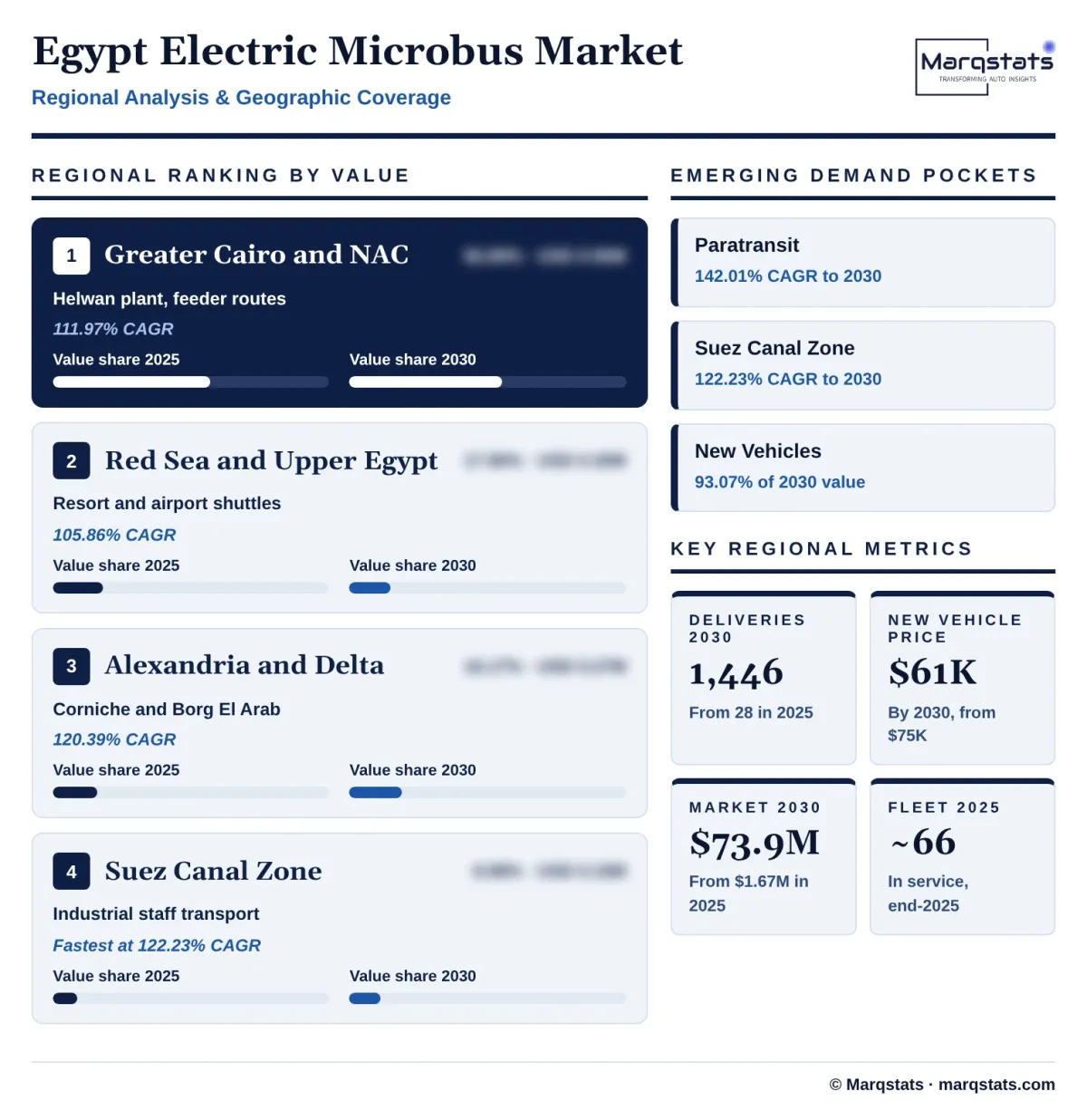
The Egypt electric microbus market grows from USD 1.67 million in 2025 to USD 73.91 million in 2030, a CAGR of 113.40%. Marqstats expects deliveries of about 276 vehicles worth USD 16.68 million in 2027, 580 worth USD 33.18 million in 2028 and 980 worth USD 53.01 million in 2029, before 1,446 vehicles in 2030, of which 1,126 are new and 320 repowered.
Prices fall as assembly moves to Helwan and other local plants. The average new vehicle price falls from about USD 80,000 in 2021 to USD 75,000 in 2025, USD 68,000 in 2027 and about USD 61,000 in 2030, as locally assembled bodies, local seating and glass and lower LFP battery prices replace fully built imports. The average repower price falls from about USD 21,000 to USD 16,000 over the same period.
The installed fleet stays small against the diesel base. Marqstats estimates about 66 electric microbuses were in service at the end of 2025, rising to about 170 in 2026 and 3,450 by 2030. Even at that level, electric vehicles would be about 13% of annual microbus deliveries in 2030 and a small share of the national microbus fleet.
Operating economics are improving but not yet decisive. Marqstats estimates a diesel microbus using 13 litres per 100 km spends about EGP 2.67 per km on fuel at EGP 20.50 per litre, while an electric microbus using 0.40 kWh per km at about EGP 2.10 per kWh spends about EGP 0.84 per km. With about EGP 0.50 per km lower maintenance, the saving is about EGP 2.33 per km, or EGP 163,000 a year at 70,000 km.
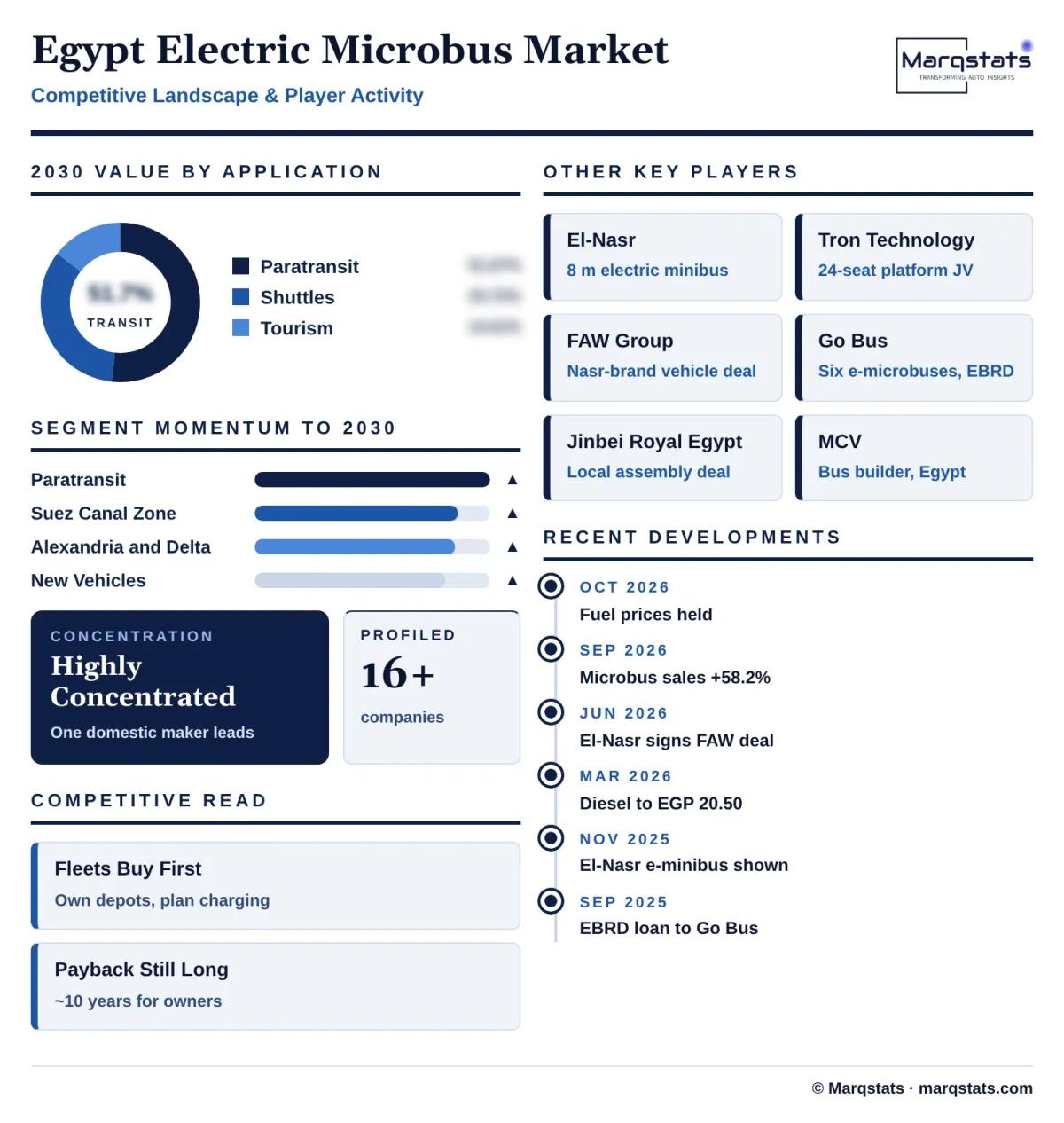
The mix changes over the forecast. Paratransit rises from 27.54% to 51.67% of value as El-Nasr minibuses reach licensed route operators, while institutional and fleet shuttles fall from 54.49% to 33.72% and tourism and intercity feeders from 17.97% to 14.61%. New factory-built vehicles rise from 89.82% to 93.07% of value as repowers grow more slowly.
This report is wider than the Egypt part of the Marqstats Africa Electric Minibus Taxi report, which counts only new 14- to 25-seat minibuses in fare-paying paratransit. The paratransit segment here, USD 0.46 million in 2025 and USD 38.19 million in 2030, matches that report's North Africa figures; institutional shuttles, tourism and intercity feeders and certified repowers are added on top. The two reports should not be added together.
Marqstats tracks four indicators to monitor the forecast: monthly output at El-Nasr's Helwan plant and other assemblers, quarterly decisions of the Fuel Automatic Pricing Committee, fleet finance from banks and development lenders, and route licensing and fare rules set by governorates for electric microbuses.
El-Nasr anchors near-term volume. Its joint venture targeted 300 electric minibuses by 2026 and its Helwan line is planned at 500 to 600 a year, but Marqstats assumes a slower ramp, with about 84 new vehicles across all suppliers in 2026, because first batches go to government and fleet buyers and supply chains for imported batteries and power electronics take time to scale.
Market Dynamics
Key Drivers
Five forces are pushing Egyptian fleet buyers from diesel microbuses towards electric models.
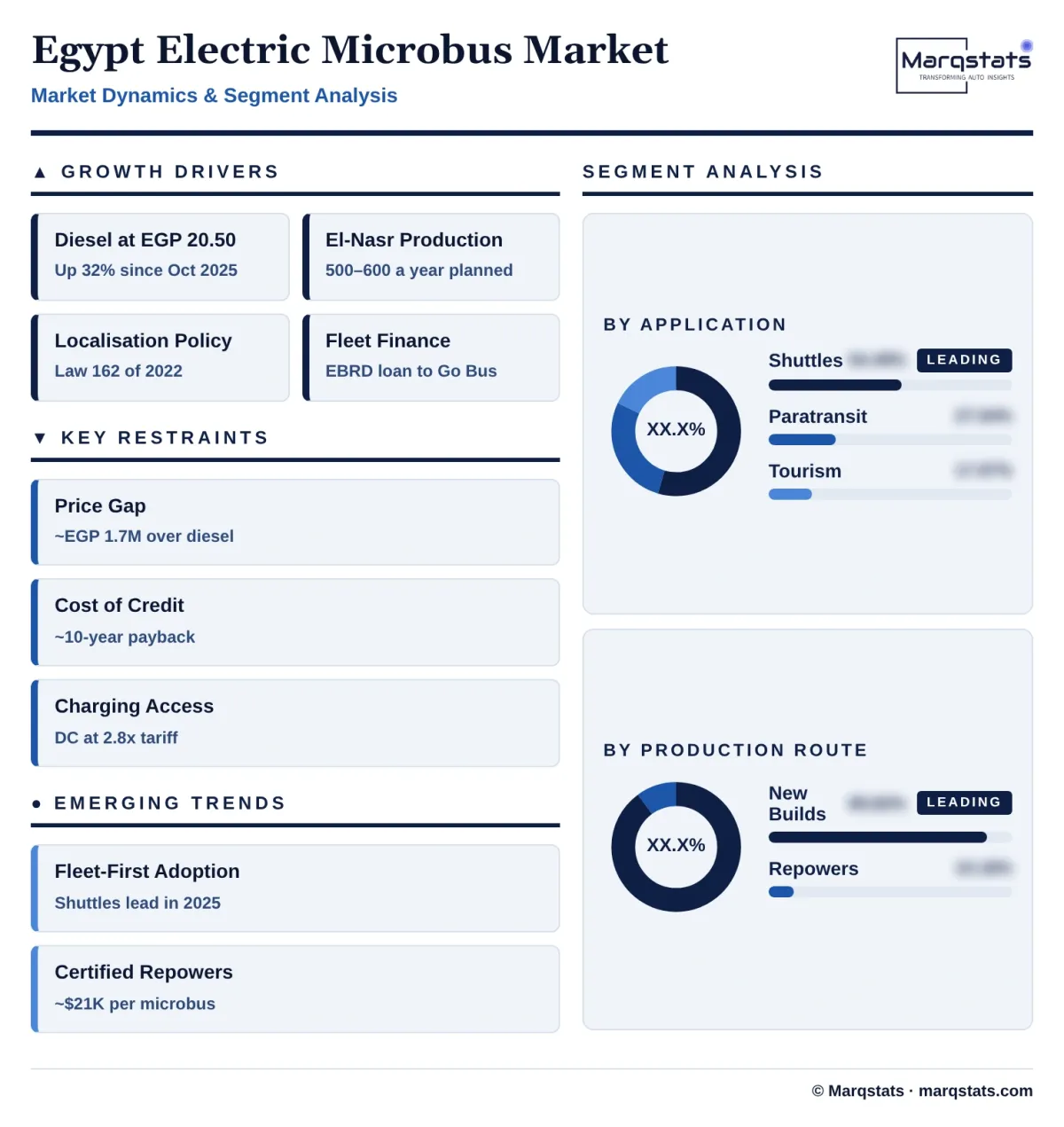
- Rising diesel prices. Diesel rose from EGP 15.50 to EGP 20.50 per litre between October 2025 and March 2026, lifting fuel cost to about EGP 2.67 per km for a typical diesel microbus.
- Local electric minibus production. El-Nasr Automotive's electric minibus, presented in November 2025 with 500 to 600 units a year of planned capacity, gives fleet and government buyers a locally built vehicle with domestic after-sales support.
- Localisation policy. Law No. 162 of 2022, the national automotive localisation strategy and the EGP 1.5 billion budget allocation favour vehicles assembled in Egypt with rising local content.
- Development finance for fleets. EBRD lending to Go Bus, with EU first-loss cover, shows how lenders can finance electric microbuses for operators with formal balance sheets.
- Clean-air and new-city planning. The New Administrative Capital, Red Sea resorts and industrial zones prefer zero-emission shuttles for staff, residents and tourists, creating demand from single owners with their own depots.
Key Restraints
Four constraints slow how fast electric microbuses can replace diesel vans on Egyptian roads.
- Purchase price gap. A new electric microbus costs about EGP 3.6 million against about EGP 1.9 million for a new diesel microbus, and most microbus owners are individuals without access to long-term finance.
- Cost of credit. Double-digit commercial lending rates make a 10-year payback unattractive for owner-drivers who finance vehicles over three to five years.
- Import dependence. Battery cells, motors and power electronics are imported and paid for in foreign currency, so the pound's movements change vehicle prices even for locally assembled models.
- Charging access. Public DC charging is priced at 2.8 times the distribution supply tariff and there are few depots at microbus terminals, while many owners park on the street overnight.
Key Trends
Four shifts are changing how electric microbuses are built, financed and charged in Egypt.
- Fleet-first adoption. Corporate staff transport, campuses, resorts and intercity operators buy electric microbuses before individual route owners, because they control depots and can plan charging.
- Certified repowers. Workshops that replace the diesel engine of an existing passenger microbus with an electric drivetrain offer a lower entry price, roughly a quarter of a new electric vehicle.
- Chinese platform partnerships. El-Nasr's agreements with Tron Technology and FAW Group follow a wider pattern of Chinese manufacturers assembling vehicles in Egypt with local partners.
- Regulated charging tariffs. Ministerial Decision No. 101 of 2025 links EV charging prices to distribution tariffs, encouraging operators to charge overnight on AC at their own depots.
Strategic Implications
- For vehicle makers, local assembly is the price of entry. Partnerships with El-Nasr, the Arab Organization for Industrialization or private assemblers give access to government buyers and lower duty exposure than fully built imports.
- For fleet operators, depot charging decides savings. Overnight AC charging at owned depots keeps energy close to the distribution tariff, while relying on public DC charging at 2.8 times that tariff removes much of the saving.
- For banks and development lenders, cash-flow lending opens the paratransit market. Loans repaid from daily fares, backed by vehicle tracking and partial guarantees, can reach route owners who cannot finance a EGP 3.6 million vehicle.
- For governorates and transport authorities, route concessions are the lever. Reserving new feeder routes to metro, monorail and bus rapid transit stations for electric microbuses would give operators the volume certainty needed for finance.
- For electricity distributors, microbus depots are new loads. Time-of-use tariffs and depot connections near terminals can turn charging into off-peak sales.
- For investors, utilisation is the key assumption. An electric microbus only approaches payback above about 70,000 km a year on depot charging, so route density and depot access matter as much as purchase price.
- For component suppliers, battery assembly is the next step. The joint venture's battery line for 600 packs a year and growing bus assembly create demand for locally assembled LFP packs, wiring harnesses and seating.
Market Segmentation
Staff, school, campus and government shuttles, including certified repowers, account for 54.49% of 2025 value, USD 0.91 million, rising to USD 24.92 million by 2030, a 93.87% CAGR, while their share falls to 33.72%. Buyers run fixed daily routes from their own depots, so they can charge overnight and plan battery use, and corporate fleets are the main customers for repowered microbuses.
Fare-paying microbus routes and feeder services to metro, monorail and bus rapid transit stations account for 27.54% of 2025 value, USD 0.46 million, and grow fastest, at 142.01% a year, to USD 38.19 million and 51.67% of 2030 value. Growth depends on El-Nasr minibuses reaching licensed route operators through fleet finance and on governorates licensing electric vehicles on new feeder routes.
Resort, airport and intercity terminal shuttles account for 17.97% of 2025 value, USD 0.30 million, rising to USD 10.80 million by 2030, a 104.77% CAGR, and 14.61% of the market. Red Sea and South Sinai resorts and intercity operators such as Go Bus use electric microbuses on short, predictable routes between terminals, hotels and airports.
New electric microbuses and minibuses, fully built or assembled locally, account for 89.82% of 2025 value, USD 1.50 million, rising to USD 68.79 million by 2030, a 114.92% CAGR, and 93.07% of the market. Local production at El-Nasr's Helwan plant and other assemblers lowers the average new vehicle price from about USD 75,000 to USD 61,000.
Certified conversions of existing passenger microbuses to battery-electric drive account for 10.18% of 2025 value, USD 0.17 million, rising to USD 5.12 million by 2030, a 97.59% CAGR, and 6.93% of the market. A repower costs about USD 21,000 in 2025, roughly a quarter of a new electric microbus, but volume is limited by homologation of each conversion and by the age and condition of donor vehicles.
Microbuses with 9 to 15 seats, the size of the Toyota HiAce and Chinese vans used on most routes, account for 41.92% of 2025 value, USD 0.70 million, rising to USD 31.04 million by 2030, a 113.48% CAGR, and 42.00% of the market. Almost all repowers fall in this class.
Minibuses and midibuses with 16 to 30 seats, up to about 8 metres long, account for 58.08% of 2025 value, USD 0.97 million, rising to USD 42.87 million by 2030, a 113.34% CAGR, and 58.00% of the market. El-Nasr's 24-passenger and 8-metre electric minibuses fall in this class, and more seats earn more fare revenue per km on busy feeder routes.
By Geography
Greater Cairo and the New Administrative Capital
Greater Cairo and the New Administrative Capital are the largest market, with 56.89% of 2025 value, USD 0.95 million, rising to USD 40.65 million by 2030, a 111.97% CAGR, while the share falls to 55.00%. Cairo, Giza and Qalyubia hold most microbus routes, El-Nasr's Helwan plant, government buyers and the feeder routes around metro, monorail and ring road bus rapid transit stations, while the New Administrative Capital plans zero-emission shuttles in its government district.
Alexandria and the Delta
Alexandria and the Delta account for 16.17% of 2025 value, USD 0.27 million, rising to USD 14.04 million by 2030, a 120.39% CAGR, and 19.00% of the market. Linear routes along Alexandria's Corniche and between Delta towns suit fixed-range electric microbuses, and the Borg El Arab industrial zone adds staff transport demand.
Red Sea, South Sinai and Upper Egypt
The Red Sea coast, South Sinai and Upper Egypt account for 17.96% of 2025 value, USD 0.30 million, rising to USD 11.09 million by 2030, a 105.86% CAGR, and 15.00% of the market. Hurghada, Sharm El-Sheikh, Luxor and Aswan use electric microbuses mainly for resort, airport and tourist transfers rather than open public routes.
Suez Canal Zone
The Suez Canal Zone accounts for 8.98% of 2025 value, USD 0.15 million, and grows fastest, at 122.23% a year, to USD 8.13 million and 11.00% of 2030 value. Industrial parks in the Suez Canal Economic Zone, Ismailia, Port Said and 10th of Ramadan run large staff transport fleets, and factories with their own power connections can install depot charging quickly.
How Competition Is Evolving
The Egypt electric microbus market is highly concentrated. El-Nasr Automotive, with its Tron Technology and Your Transit joint venture and its FAW Group agreement, is the only domestic manufacturer with a dedicated electric minibus programme, and a handful of importers of Chinese electric vans and repower workshops supply the rest.
Two business models compete. Manufacturers such as El-Nasr sell new vehicles to government entities, fleet operators and route owners, often with state-linked buyers as anchor customers. Repower providers and integrators convert existing microbuses and offer service, battery and charging packages to corporate fleets that want to avoid a full vehicle purchase.
Platform and component partners matter. Tron Technology supplies platform engineering and battery management for El-Nasr's 24-passenger minibus, Chinese manufacturers such as FAW, Higer, King Long, Yutong and Joylong supply chassis and full vehicles, and CATL and other LFP cell makers supply batteries, so local players compete mostly on assembly cost, homologation, finance and after-sales service.
Large Egyptian assemblers are preparing for electric vehicles. Manufacturing Commercial Vehicles builds city and intercity buses in Egypt, including electric bodies for export, Jinbei Royal Egypt signed in October 2025 to assemble light vehicles at Ezz Elsewedy's 6th of October plant starting with diesel and moving to electric, and the Arab Organization for Industrialization assembles buses for public transport programmes.
Competition will be decided by price, finance and charging. Suppliers that combine local assembly, fleet finance and depot charging at microbus terminals will take most of the volume as paratransit becomes the largest application after 2028.
Local content is rising. El-Nasr's joint venture planned 50% local components at launch, rising to 60% to 70%, and its Nasr Star minibus already uses more than 70% local components, which lowers exposure to imported parts and qualifies vehicles for localisation incentives.
Companies Covered
Companies covered in the report include:
Recent Market Activity
Table of Contents
Coverage & Segmentation
The study covers the Egypt electric microbus market, with 2025 as the base year, 2021 – 2025 as the historical period and 2026 – 2030 as the forecast period. Values are in US dollars at delivered vehicle prices excluding VAT, converted at EGP 49.25 per USD, the 2025 annual average, and volumes are annual deliveries of new battery-electric passenger microbuses and minibuses with 9 to 30 seats and certified electric repowers of existing passenger microbuses.
Electric conversions of cargo vans for logistics and retail delivery fleets, full-size city and intercity electric buses above about 8 metres, tuk-tuks and other three-wheelers, passenger cars, golf carts and low-speed resort vehicles, charging hardware sold separately and fare revenue are excluded. The paratransit segment matches the North Africa figures in the Marqstats Africa Electric Minibus Taxi report, which counts only new 14- to 25-seat minibuses in fare-paying service; shuttles, tourism feeders and repowers are added here, and the two reports should not be added together. Segment and regional splits are Marqstats estimates built on manufacturer and operator announcements, sales data, fuel and tariff decisions and price benchmarks.