Market Snapshot
Middle bar: base-year value × (1 + CAGR), rounded to two decimals. This is a calculated illustration, not a separately researched annual estimate.
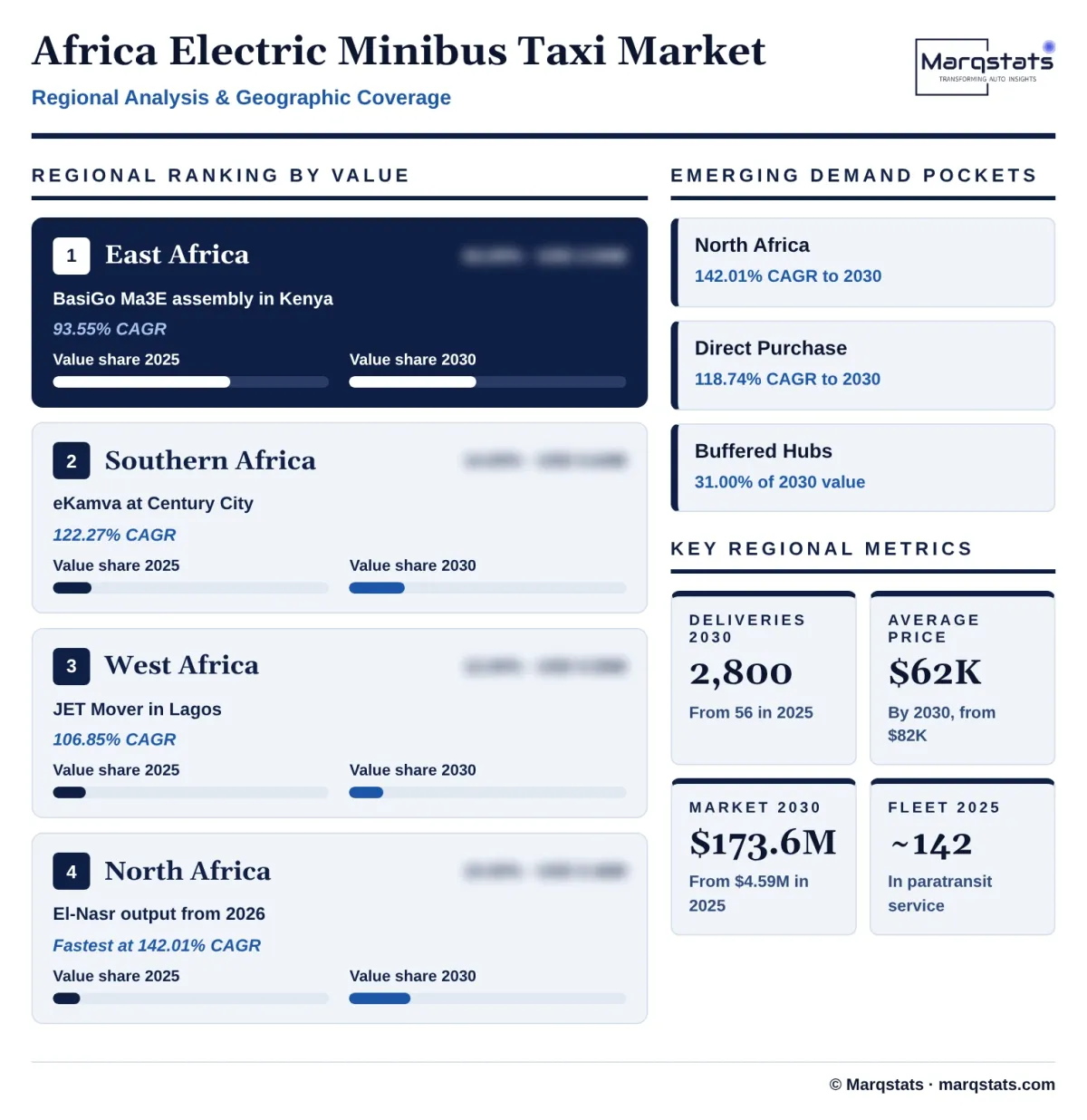
The Africa electric minibus taxi market size is estimated at USD 4.59 million in 2025 and is projected to reach USD 173.60 million by 2030, growing at a CAGR of 106.80% over 2026 – 2030. Annual deliveries rise from about 56 electric minibuses to 2,800, a 118.67% annual rate, while the average cleared price falls from about USD 82,000 to USD 62,000 per vehicle. Measured from the first year of volume assembly, value grows at 76.37% a year between 2026 and 2030.
Marqstats defines the market as the cleared value of new battery-electric minibuses with 14 to 25 passenger seats, UNECE Category M2, delivered into fare-paying paratransit service in Africa: matatus in Kenya, minibus taxis in South Africa, danfos in Nigeria and microbuses in Egypt. Full-size electric buses and coaches, corporate and campus shuttles, hotel vans, electric two- and three-wheelers, charging hardware sold separately and fare revenue are excluded.
Vehicles with 14 to 16 seats account for an estimated 56.00% of 2025 value and Pay-As-You-Drive leasing for 66.00%. East Africa accounts for 64.00% of 2025 value. The study segments the market by seating configuration, financing model, charging architecture and region.
Key Takeaways
Market Overview & Analysis
Report Summary
Marqstats sizes the Africa electric minibus taxi market as the cleared value of new battery-electric minibuses with 14 to 25 seats delivered into fare-paying paratransit service. In 2025 about 56 vehicles were delivered across Kenya, Rwanda, South Africa, Nigeria and Egypt, worth an estimated USD 4.59 million at an average cleared price of about USD 82,000.
Paratransit minibuses carry most urban public transport trips in Sub-Saharan Africa. Kenya has more than 100,000 matatus, South Africa about 250,000 registered minibus taxis carrying more than 15 million commuters a day, and Lagos tens of thousands of danfos, almost all running on second-hand diesel or petrol vans bought by individual owners and operated through route associations or savings and credit cooperatives.
Electrification started with buses rather than minibuses. BasiGo raised USD 42 million in October 2024, including USD 24 million of Series A equity and USD 17.5 million of debt from DFC and BII, to scale electric buses in Kenya and Rwanda on a Pay-As-You-Drive model. Electric minibuses followed once suppliers could put a 75 to 90 kWh lithium iron phosphate battery into a 15- to 19-seat van body that meets local body-building standards such as Kenya's KS 372 and South Africa's NRCS requirements.
The first commercial vans are now in service. BasiGo ran two intercity electric matatus for 4NTE SACCO and Manchester Travellers Coach SACCO on Nyahururu–Nyeri–Nakuru and Thika–Nairobi routes from 2025 and began local assembly in April 2026. In South Africa, GoMetro's flx EV consortium developed the 15-seat eKamva and planned first routes for about 15 taxi associations at the Century City interchange in Cape Town from October 2026. In Egypt, El-Nasr Automotive announced its first electric minibus in November 2025 with production planned from the first quarter of 2026.
The market grew from about 8 electric minibuses in 2021, worth USD 0.68 million, to 14 in 2022, 26 in 2023 and 38 in 2024, worth USD 3.15 million, as pilots in Nairobi, Kigali, Lagos and Cape Town added vehicles. Marqstats expects about 230 deliveries worth USD 17.94 million in 2026, led by BasiGo's locally assembled vans in Kenya.
Regulation shapes vehicle design in each market. Kenya requires public service vehicles to meet the KS 372 body construction standard and to operate through licensed SACCOs or companies, so imported vans must be adapted locally before the National Transport and Safety Authority will license them. South Africa requires manufacturer, importer and builder accreditation from the National Regulator for Compulsory Specifications, and Rwanda allocates routes through concessions to licensed transport companies. Egypt's 2020 automotive localisation law favours locally assembled vehicles over fully built imports.
Daily operations suit electric vehicles. Fleet tracking at Cape Town's Century City interchange shows a typical minibus taxi covering about 120 km in the morning peak and about 120 km in the evening peak, with a three- to four-hour midday rest at the rank. That rest allows a 60 kW DC charger to top up the battery in about an hour, while overnight AC charging fills it fully, so vehicles with 180 to 300 km of range can complete a full working day.
Africa Electric Minibus Taxi Market Size and Forecast
The Africa electric minibus taxi market grows from USD 4.59 million in 2025 to USD 173.60 million in 2030, a CAGR of 106.80%. Marqstats expects deliveries of about 520 vehicles worth USD 38.48 million in 2027, 1,000 worth USD 70.00 million in 2028 and 1,750 worth USD 115.50 million in 2029, before reaching 2,800 vehicles in 2030.
Prices fall as assembly moves to Africa. The average cleared price falls from about USD 85,000 in 2021 to USD 82,000 in 2025, USD 74,000 in 2027 and USD 62,000 in 2030, as completely knocked-down kits assembled in Mombasa, Cape Town and Helwan replace fully built imports and LFP battery prices fall. Deliveries therefore grow at 118.67% a year while value grows at 106.80%.
The installed fleet stays small against the diesel base. Marqstats estimates about 142 electric minibuses were in paratransit service at the end of 2025, rising to about 372 in 2026 and 6,440 by 2030. Even at that level, electric vehicles would be well under 1% of Africa's estimated 1.35 million paratransit minibuses, so the forecast measures the start of the transition, not its completion.
Operating economics decide adoption. Marqstats estimates a diesel minibus running 240 km a day at 13.5 litres per 100 km and USD 1.45 per litre spends about USD 47 a day on fuel, while an electric minibus using 42 kWh per 100 km on Kenya's KES 8 per kWh off-peak rate spends about USD 6.25. Maintenance falls from about USD 0.038 to USD 0.018 per km. The saving of more than USD 14,000 a year pays back the price premium within three to four years at high utilisation.
Marqstats tracks four indicators to monitor the forecast: monthly van output at local assemblers, financing approvals under Pay-As-You-Drive and bank asset-finance lines, e-mobility electricity tariffs and grid connection times at ranks, and changes to VAT, import duty and ad valorem rules in Kenya, South Africa, Nigeria and Egypt.
The mix changes over the forecast. Larger 17- to 25-seat minibuses rise from 44.00% to 48.00% of value, direct purchase from 34.00% to 45.00% and battery-buffered and solar hubs from 25.00% to 31.00%. East Africa remains the largest region but its share falls from 64.00% to 46.00% as Egypt's local production and South Africa's minibus taxi projects scale up; North Africa rises to 22.00% of value and Southern Africa to 20.00%.
Kenya anchors near-term volume. BasiGo's first locally assembled batch of 22 Ma3E vans, a reservation pipeline above 500 and its plan to deploy more than 1,000 electric vans across Kenya give the clearest line of sight on deliveries, and Marqstats expects Kenya to account for most of the roughly 230 vehicles delivered in 2026.
Market Dynamics
Key Drivers
Five forces are moving African minibus taxi operators from diesel vans to electric minibuses.
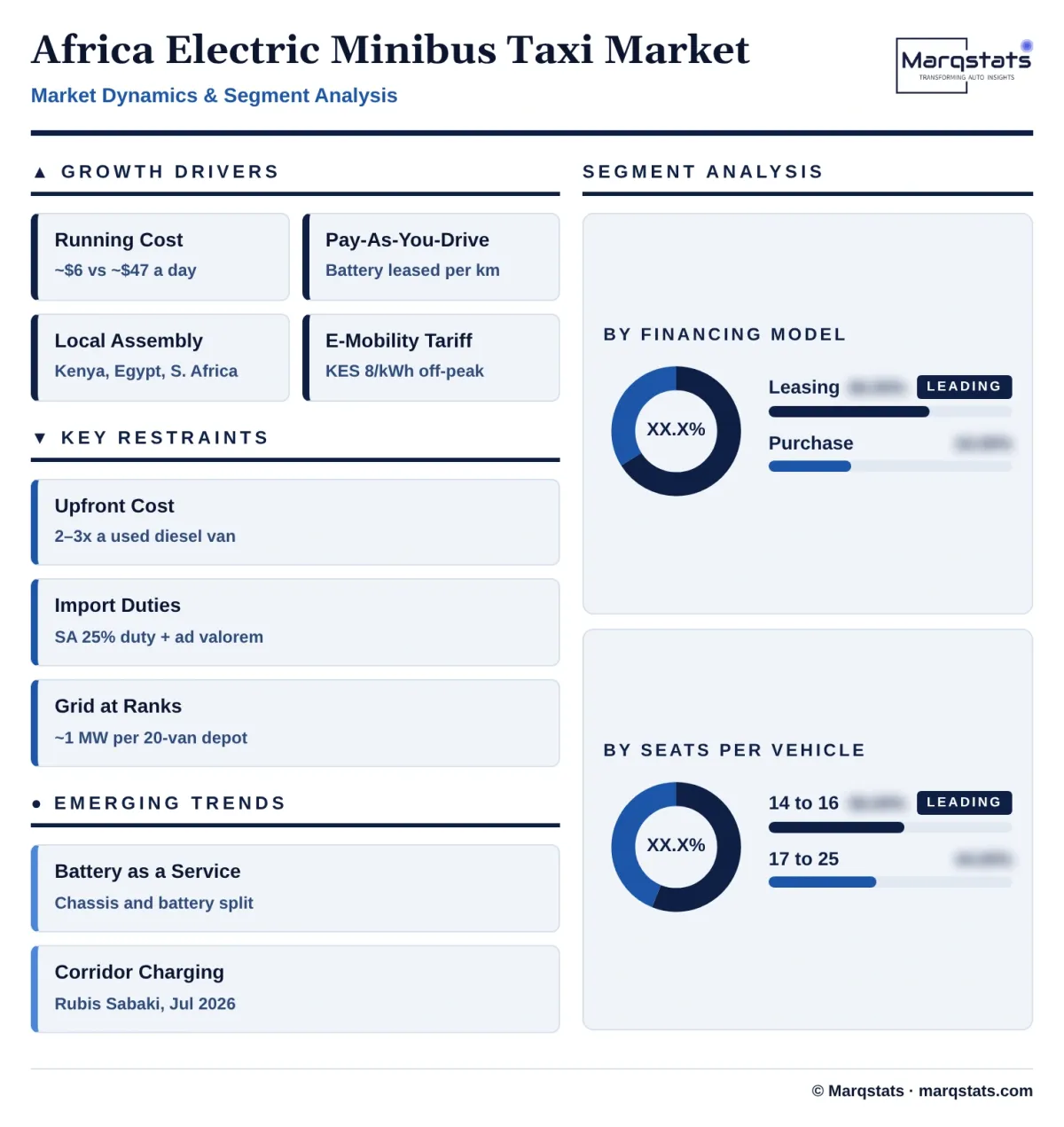
- Lower daily operating cost. Electric minibuses cut energy cost per km by about 85% against diesel on off-peak tariffs, raising daily operating margins for owners who pay their drivers from fare revenue.
- Pay-As-You-Drive leasing. BasiGo and flx EV separate the battery from the vehicle and charge a daily or per-km fee covering battery, charging and maintenance, so operators pay for electric vans from fare income rather than savings.
- Local assembly. BasiGo's CKD assembly with Associated Vehicle Assemblers in Mombasa, El-Nasr's electric minibus line in Helwan and GoMetro's eKamva programme in Cape Town cut import costs and lead times.
- Supportive tariffs and tax. Kenya's e-mobility electricity tariff of KES 16 per kWh standard and KES 8 per kWh off-peak, with the 15,000 kWh monthly cap removed in September 2026, and zero-rated VAT on electric buses and batteries lower operating and purchase costs.
- Renewable-heavy grids. Kenya and Rwanda generate most of their electricity from geothermal and hydro power, so electric minibuses cut both fuel imports and emissions, and off-peak night charging uses spare capacity.
Key Restraints
Four constraints limit how fast electric minibuses can replace diesel paratransit fleets.
- Upfront cost. A new electric minibus costs two to three times a used diesel Hiace, and individual owners rarely have the credit history or collateral that banks require.
- Import duties. South Africa charges 25% customs duty on imported battery-electric vehicles, against 18% for EU-sourced combustion vehicles, plus ad valorem tax and 15% VAT, while Nigeria's currency depreciation raises the cost of imported kits.
- Grid capacity at ranks. A depot charging 20 minibuses at 60 kW needs a grid connection of about 1 MW, and upgrading transformers at informal ranks takes time, while load-shedding in South Africa interrupts charging.
- Fiscal pressure. Treasuries losing fuel tax revenue may tax electric vehicles; Kenya's Finance Bill 2026 proposed making electric buses and batteries VAT-exempt instead of zero-rated, which assemblers said would add 10% to 14% to prices, before MPs rejected the change in June 2026.
Key Trends
Four shifts are changing how electric minibus taxis are built, financed and charged.
- Battery as a service. Operators buy or lease the van body and chassis, while the battery is leased under an energy contract, lowering the purchase price to near diesel levels.
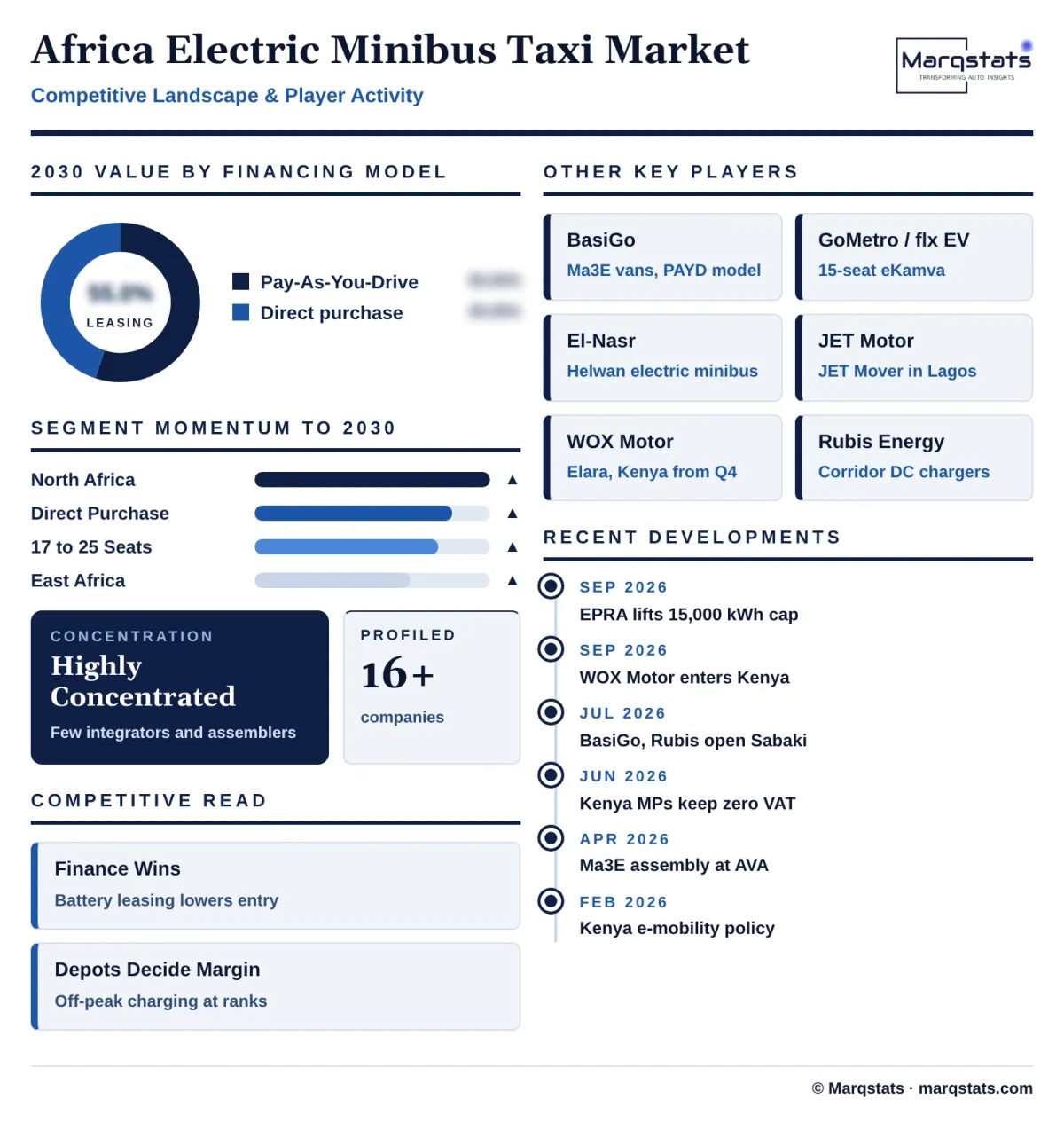
- Corridor charging at fuel stations. BasiGo and Rubis Energy Kenya opened 100 kW DC chargers at Rubis Sabaki in Athi River in July 2026, with Meru, Nanyuki and Nyeri next, allowing intercity matatu routes.
- Battery-buffered and solar hubs. Charging units with stationary batteries draw low power from the grid or solar arrays and discharge quickly into vehicles, avoiding substation upgrades and load-shedding.
- New Chinese suppliers. WOX Motor announced Kenya entry in September 2026 with the 10- to 17-seat Elara electric minibus on an 86.55 kWh CATL LFP battery, adding competition to BasiGo's Golden Dragon-based Ma3E and Joylong vans.
Strategic Implications
- For vehicle suppliers, local homologation is the entry ticket. Vans adapted to KS 372 in Kenya and NRCS rules in South Africa, assembled from CKD kits with local partners, avoid duty penalties and regulatory delays.
- For operators and SACCOs, depot charging decides profitability. Off-peak charging at owned or leased depots keeps energy cost near USD 0.06 per kWh, while relying on public chargers at KES 48 per kWh would remove much of the saving.
- For lenders and development finance institutions, cash-flow underwriting opens the market. Loans repaid from daily fares through mobile money, backed by telematics and first-loss guarantees, can replace collateral that individual owners do not have.
- For utilities, minibus depots are large new loads. Time-of-use tariffs and battery-buffered charging can turn depot demand into off-peak sales without overloading local networks.
- For governments, tax stability matters more than new subsidies. Keeping zero-rated VAT and lower duty on CKD kits gives assemblers the price predictability they need to commit capacity.
- For investors, vehicle utilisation is the key assumption. Electric minibuses only pay back when they run 200 km or more a day on off-peak electricity, so route density, depot access and driver scheduling decide returns as much as purchase price does.
Market Segmentation
Vans with 14 to 16 seats account for 56.00% of 2025 value, USD 2.57 million, rising to USD 90.27 million by 2030, a 103.76% CAGR, while their share falls to 52.00%. They match the dimensions and routes of the Toyota Hiace matatus and minibus taxis they replace, and include the BasiGo Ma3E, the flx EV eKamva and the JET Mover in Nigeria.
Higher-capacity minibuses with 17 to 25 seats account for 44.00% of 2025 value, USD 2.02 million, and grow faster, at 110.42% a year, to USD 83.33 million and 48.00% of 2030 value. More seats earn more fare revenue per km, which helps cover battery cost on busy urban corridors and intercity routes; El-Nasr's electric minibus, Joylong vans and the larger WOX Elara configurations serve this segment.
Leasing models in which the provider owns the battery and charges per km or per day account for 66.00% of 2025 value, USD 3.03 million, rising to USD 95.48 million by 2030, a 99.39% CAGR, and 55.00% of the market. BasiGo and flx EV use this model to shift battery and residual value risk away from owners.
Outright purchase financed by SACCO, bank or asset-finance loans accounts for 34.00% of 2025 value, USD 1.56 million, and grows faster, at 118.74% a year, to USD 78.12 million and 45.00% of 2030 value as lenders gain experience with electric vehicle residual values.
Vehicles charged on grid-connected 60 kW to 120 kW DC chargers at depots, ranks and fuel stations account for 75.00% of 2025 value, USD 3.44 million, rising to USD 119.78 million by 2030, a 103.41% CAGR.
Vehicles charged from battery-buffered, mobile or solar-supported hubs account for 25.00% of 2025 value, USD 1.15 million, and grow at 115.80% a year to USD 53.82 million and 31.00% of 2030 value, led by South Africa where load-shedding and slow grid connections favour buffered charging.
By Geography
East Africa
East Africa is the largest market, with 64.00% of 2025 value, USD 2.94 million, rising to USD 79.86 million by 2030, a 93.55% CAGR, while its share falls to 46.00%. Kenya leads through BasiGo's locally assembled Ma3E vans, the National Electric Mobility Policy launched in February 2026, zero-rated VAT on electric buses and batteries, and the KES 8 per kWh off-peak e-mobility tariff. Rwanda supports electric public transport through duty exemptions and route concessions in Kigali, where BasiGo's bus fleet reached 52 vehicles in July 2026.
North Africa
North Africa accounts for 10.00% of 2025 value, USD 0.46 million, and grows fastest, at 142.01% a year, to USD 38.19 million and 22.00% of the market by 2030. Egypt's El-Nasr Automotive, restarted under the state's localisation programme, announced its first electric minibus in November 2025 with Chinese partners and production planned from early 2026, alongside an earlier plan with Tron Technology for electric minibuses and a local battery line. State-directed microbus renewal in Greater Cairo provides the demand base.
Southern Africa
Southern Africa accounts for 14.00% of 2025 value, USD 0.64 million, and grows at 122.27% a year to USD 34.72 million and 20.00% of 2030 value. South Africa has about 250,000 minibus taxis, the largest addressable fleet on the continent, but 25% customs duty on imported battery-electric vehicles, ad valorem tax and load-shedding slow adoption. GoMetro's flx EV eKamva programme at Century City, working with about 15 taxi associations and the national taxi council on financing, is the leading project.
West Africa
West Africa accounts for 12.00% of 2025 value, USD 0.55 million, rising to USD 20.83 million by 2030, a 106.85% CAGR, while its share stays at 12.00%. JET Motor Company assembles the 14-seat JET Mover electric van in Lagos, and fuel subsidy removal in Nigeria has widened the operating cost gap with diesel, but grid reliability, currency depreciation and limited vehicle finance keep most deployments in logistics and pilot fleets.
How Competition Is Evolving
The Africa electric minibus taxi market is highly concentrated. A small number of integrators deliver almost all vehicles: BasiGo in Kenya with Golden Dragon-based vans assembled by Associated Vehicle Assemblers, GoMetro and the flx EV consortium in South Africa with Higer-based vans, El-Nasr Automotive in Egypt, JET Motor Company in Nigeria and importers of Joylong vans.
Two business models compete. Integrated providers such as BasiGo and flx EV sell or lease the vehicle, keep the battery, run charging and collect a per-km fee, competing on financing and uptime. Vehicle suppliers such as El-Nasr, JET Motor and WOX Motor sell vehicles through distributors and leave financing and charging to operators and banks.
Battery and chassis suppliers matter. CATL supplies LFP cells for several platforms, while Chinese chassis makers including Golden Dragon, Higer and Joylong supply the rolling base, so integrators compete mostly on local body adaptation, homologation, financing and service.
Competition will be decided by financing, local assembly and charging access. Providers that combine low-cost CKD assembly, Pay-As-You-Drive financing and depot or corridor charging along busy routes will capture the largest share of deliveries.
Local assembly capacity is being built. BasiGo assembles Ma3E vans from CKD kits with Associated Vehicle Assemblers in Mombasa and buses with Kenya Vehicle Manufacturers in Thika, El-Nasr Automotive targets 500 to 600 electric minibuses a year from Helwan, GoMetro develops the eKamva with an international chassis partner and a global battery maker, and WOX Motor plans Nairobi sales, service and training through its distributor WOX Kenya.
Companies Covered
Companies covered in the report include:
Recent Market Activity
Table of Contents
Coverage & Segmentation
The study covers the Africa electric minibus taxi market, with 2025 as the base year, 2021 – 2025 as the historical period and 2026 – 2030 as the forecast period. Values are in US dollars at cleared vehicle prices, and volumes are annual deliveries of new battery-electric minibuses with 14 to 25 seats into fare-paying paratransit service. The market is segmented by seating configuration, financing model, charging architecture and region.
Full-size electric buses and coaches, corporate, campus, school and hotel shuttles, electric two- and three-wheelers, charging hardware sold separately, battery lease fees after delivery and fare revenue are excluded. This market overlaps with the van segment of the Marqstats Kenya Electric Bus and Africa Electric Commercial Vehicle reports, which include shuttles, and the figures should not be added together. Segment and regional splits are Marqstats estimates built on operator and assembler disclosures, financing announcements, policy documents and vehicle price benchmarks.