Statistics & Highlights

Market Snapshot

Market size in USD Billion
$3.30B
2025
Base year
$3.47B
2026
Estimated
  
$4.23B
2030
Forecast
Largest market
United States
Fastest growing
Southern & Sun Belt Markets
Dominant segment
Tunnel / Conveyor Systems
Concentration
Moderately Concentrated
CAGR
5.10%
2026 – 2030
GROWTH
+$0.93B
Absolute
STUDY PARAMETERS
Base year2025
Historical period2021 – 2025
Forecast period2026 – 2030
Units consideredValue (USD BN)
REPORT COVERAGE
Segments covered4 segments
Regions covered5 regions
Companies profiled18++
Report pages250+
DeliverablesPDF, Excel, PPT
Executive Summary

Key Takeaways

North America car wash equipment market valued at USD 3.30 billion in 2025, projected to reach USD 4.23 billion by 2030 at a 5.10% CAGR.
The United States installed base spans roughly 17,500 conveyor, 29,000 in-bay automatic, and 16,250 self-service sites, with about 500 new stores built annually.
Tunnel/conveyor systems form the largest equipment category, the mirror of gantry-led Europe, driven by express-exterior and unlimited-membership models.
Sonny's is the largest conveyorized OEM; OPW Vehicle Wash Solutions, National Carwash Solutions, Washworld, and Tommy anchor the supplier tier.
DRB, a Vontier company, leads car wash software and point-of-sale, deploying its Patheon platform across major operators including Super Star's 118 sites.
Private-equity consolidation — Whistle Express, Mister Car Wash, and KKR-backed Quick Quack — concentrates high-value equipment and software orders.
Market Insights

Market Overview & Analysis

Report Summary

The North America car wash equipment market comprises the manufacture and sale of vehicle-wash hardware and systems across three core wash formats — tunnel/conveyor, automatic in-bay (rollover), and self-service — together with attached subsystems and the point-of-sale, membership, and site-management software that defines the North American model. The 2025 market of USD 3.30 billion sits against a United States installed base of roughly 17,500 conveyor, 29,000 in-bay, and 16,250 self-service sites, with Canada and Mexico adding smaller volumes. The market is defined by equipment and system revenue, distinct from the wash-service revenue earned by operators.

North America's defining feature is its tunnel orientation and software depth. The United States operates about 17,500 conveyor sites against Europe's roughly 8,000, a structure built on express-exterior tunnels, unlimited-wash memberships, and attached retail automation such as free-vacuum arrays. This makes tunnel/conveyor systems the largest equipment category by value and gives North America the deepest subsystem attachment of any market, spanning high-capacity dryers, large vacuum arrays, water reclamation, and a membership-and-payment software layer with no equivalent in other regions.

The equipment supply base is concentrated even as the operator market fragments. Sonny's Enterprises describes itself as the world's largest manufacturer of conveyorized car wash equipment, and OPW Vehicle Wash Solutions combines Belanger, PDQ, and ICS to make more wash types than any other manufacturer, spanning tunnels, touchless and soft-touch automatics, and fleet washes. National Carwash Solutions operates North America's largest service network with more than 600 direct technicians, while Washworld and Tommy Car Wash Systems supply in-bay and tunnel platforms respectively.

Software and payment define the region's competitive frontier. DRB, a Vontier company, is the clearest software and point-of-sale leader, serving the majority of the top-20 North American car wash platforms and deploying its Patheon management platform across major operators, including a 2026 rollout across Super Star Car Wash's 118 locations. Innovative Control Systems, Sonny's CarWash Controls, and membership-CRM providers complete a software stack that links point-of-sale, license-plate recognition, loyalty, and churn reduction to unlimited-membership revenue.

Regulation and consolidation shape equipment specifications and order flow. EPA WaterSense guidance identifies water reclamation as the largest water-saving lever for vehicle washing, and the 2023 Department of Energy motor-efficiency final rule tightens standards for the pumps, blowers, and dryers embedded in wash systems. Private-equity-backed roll-ups concentrate demand: Whistle Express, backed by Oaktree, acquired the former Take 5 Car Wash portfolio to exceed 530 sites, Mister Car Wash surpassed USD 1 billion in 2025 revenue across roughly 525 locations, and KKR took a stake in Quick Quack, standardizing equipment and software across expanding networks.

Market Dynamics

Key Drivers

  • Express-tunnel new-build development, at roughly 500 new United States stores annually, drives the highest-value equipment orders in the market.
  • Membership-management and point-of-sale software expands as operators monetize unlimited-wash subscriptions and reduce churn.
  • Replacement of an ageing installed base across 62,000-plus United States sites sustains steady equipment demand.
  • Water-reclamation retrofits advance under EPA WaterSense guidance identifying reclamation as the largest water-saving lever.
  • License-plate recognition and unattended payment systems spread as operators pursue frictionless membership access and throughput.
  • Private-equity-backed consolidation concentrates high-value equipment and software orders across expanding chains.

Key Restraints

  • Equipment unit sales softened in 2025 against the tunnel-build peak of prior years, as noted by suppliers reporting lower North American volumes.
  • Rising construction, land, and equipment costs extend project payback and slow greenfield tunnel development in saturated metros.
  • Site saturation in mature markets shifts demand from new builds toward replacement, refit, and software.
  • Operator financial stress, including Chapter 11 filings among over-leveraged chains, disrupts equipment order pipelines.

Key Trends

  • Enterprise membership platforms such as DRB's Patheon convert point-of-sale systems into revenue, churn, and data infrastructure for multi-site operators.
  • Free-vacuum arrays and attached retail automation expand as express operators compete on amenities beyond the wash itself.
  • Water reclamation, oil-water separation, and closed-loop controls standardize on new tunnel builds under environmental guidance.
  • Higher-efficiency motors and variable-speed drives advance under Department of Energy standards across pumps, blowers, and dryers.
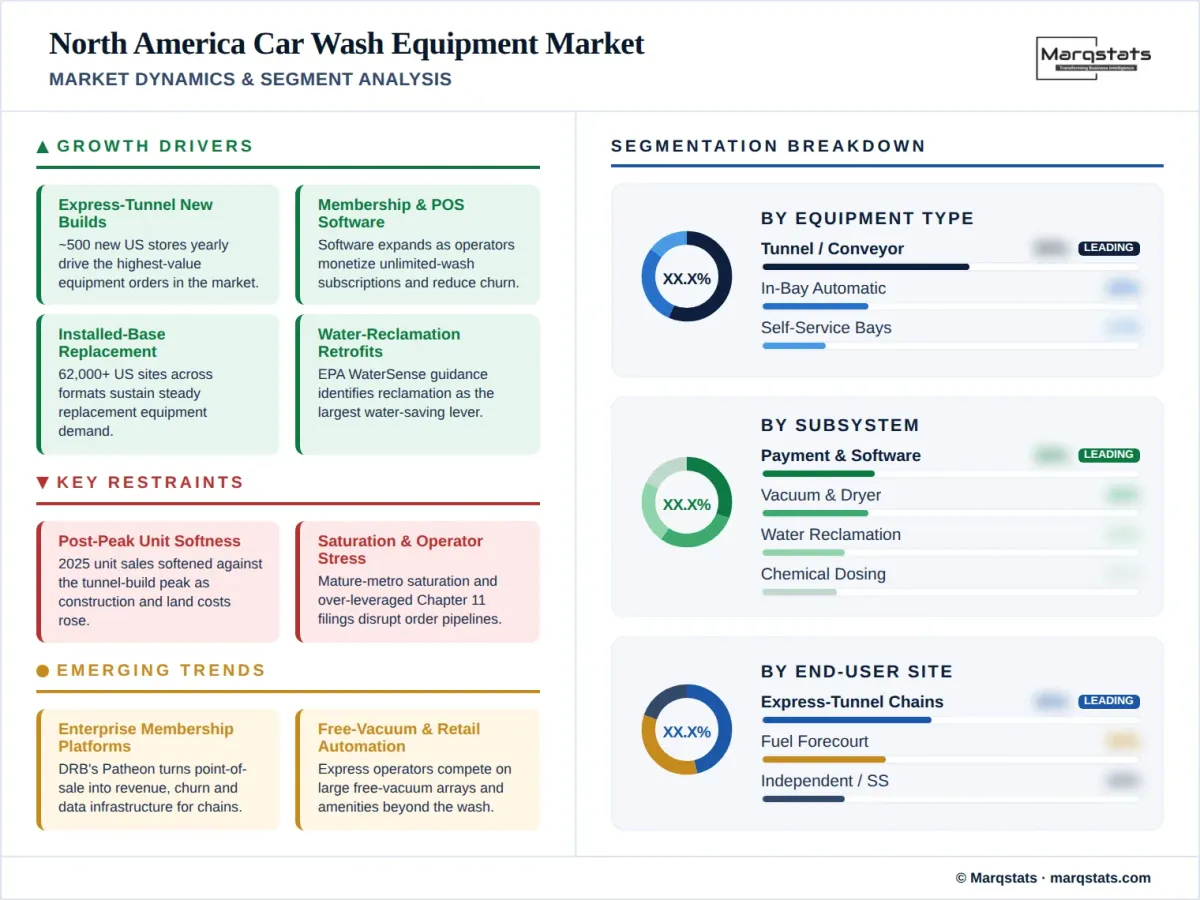
North America Car Wash Equipment Market Market Dynamics Segment Analysis Infographic
Segment Analysis

Market Segmentation

Tunnel / Conveyor Systems
Leading

Tunnel/conveyor systems form the largest and highest-value equipment category in the North America car wash equipment market, built on a United States base of roughly 17,500 conveyor sites against Europe's 8,000. Systems span conveyors, wash arches, high-capacity dryers, and integrated membership software, and a single express-tunnel installation can carry equipment value several times that of an in-bay machine. Sonny's, OPW, National Carwash Solutions, and Tommy lead tunnel supply, and the category captures the largest share of new-build spend and the deepest subsystem and software attachment throughout the forecast period.

Automatic In-Bay (Rollover)

Automatic in-bay rollover systems represent the largest United States installed base at roughly 29,000 units, concentrated at fuel-station forecourts, convenience stores, and lower-volume sites. Higher in count yet lower in per-site value than tunnels, in-bay machines anchor replacement demand and touchless and soft-touch offerings from Washworld and OPW. The category grows steadily on retrofit and forecourt upgrade rather than express-tunnel new-build economics.

Self-Service / High-Pressure Bays

Self-service high-pressure bays represent about 16,250 United States sites and a durable equipment category, spanning high-pressure pumps, chemical arches, coin and cashless payment, and vacuum modules. Often unmanned and co-located with forecourts and retail, the format adds contactless and app-based payment and remains resilient in markets where attended washing is less economic.

Payment, Membership & Site Software
Leading

Payment, membership, and site-management software is the region's defining subsystem, with no equivalent scale in other markets. DRB, a Vontier company, leads by serving the majority of the top-20 North American platforms and deploying its Patheon system across major operators. Innovative Control Systems, Sonny's CarWash Controls, and membership-CRM and churn-reduction providers complete a stack linking point-of-sale, license-plate recognition, loyalty, and unlimited-membership billing, converting standalone sites into connected, data-driven networks.

Vacuum & Dryer Systems

Vacuum and dryer systems are far larger in North America than elsewhere, driven by the free-vacuum express model where large vacuum arrays are a core competitive amenity. High-capacity dryers integrate into tunnel and gantry packages, and both categories advance under Department of Energy motor-efficiency standards through higher-efficiency blowers and drives. The subsystem ties to substantial recurring parts and service revenue across the installed base.

Water Reclamation & Filtration

Water reclamation and filtration is a fast-growing subsystem, identified by EPA WaterSense guidance as the largest water-saving lever for vehicle washing. Commercial facilities increasingly recycle or treat wash water before sanitary discharge, and reclamation, oil-water separation, and closed-loop controls standardize on new tunnel builds, with retrofit demand compounding across the installed base.

Chemical Dosing Systems

Chemical dosing systems integrate with branded chemistry programs bundled by equipment and service majors such as National Carwash Solutions. Precise dosing, pretreatment, and controlled discharge tie recurring consumables revenue to installed equipment, and environmental guidance on wash-water discharge raises the value of accurate, documented dosing across the region.

Express-Tunnel Operator Chains
Leading

Express-tunnel operator chains are the largest and fastest-growing equipment end-user, investing in high-value tunnels, membership software, and free-vacuum arrays. Private-equity-backed roll-ups including Whistle Express, Mister Car Wash, Tommy's Express, and Quick Quack drive standardized multi-site orders, and their unlimited-membership economics support the deepest software and subsystem attachment in the market.

Fuel-Station Forecourt & Convenience

Fuel-station forecourts and convenience stores are a major end-user, hosting in-bay rollover and self-service equipment, often unmanned and classified under fuel-retail sites. Estate upgrades and touchless retrofits drive replacement demand, and convenience operators increasingly add loyalty and payment integration to forecourt wash systems.

Independent & Self-Service Operators

Independent and self-service operators form a large, fragmented end-user base purchasing in-bay, self-service, and entry-tunnel equipment through distributors and OEM direct channels. This channel sustains steady mid-value demand and is a primary adopter of cashless payment and compact reclamation, though it faces consolidation pressure from expanding express chains.

Passenger-Car Systems
Leading

Passenger-car wash systems account for the large majority of North American equipment revenue, dominated by express-exterior tunnels and rollover machines. Rising sensor- and camera-equipped vehicle ownership shifts a portion of demand toward gentler touch-free and soft-touch processes, while high-frequency membership washing sustains tunnel utilization.

Commercial-Vehicle & Fleet Systems

Commercial-vehicle and fleet wash systems are a growing application, driven by logistics, delivery, and ride-hailing fleets and by mobility-as-a-service operators. Dedicated fleet-wash and drive-through truck systems, supplied by OPW and specialist manufacturers, meet presentation and throughput standards as last-mile delivery expands across the region.

Regional Analysis

By Geography

United States

The United States dominates the North America car wash equipment market, holding the vast majority of regional revenue and the world's deepest conveyor/tunnel base at roughly 17,500 sites. The express-exterior model, unlimited-wash memberships, and private-equity-backed consolidation define the global reference model, and the country hosts the foremost equipment OEMs — Sonny's, OPW, National Carwash Solutions, Washworld, and Tommy — alongside software leader DRB. About 500 new stores are built annually, and roll-ups by Whistle Express, Mister Car Wash, and Quick Quack concentrate high-value equipment and software orders.

Southern & Sun Belt Markets

Southern and Sun Belt states, including Texas, Florida, Arizona, and the Carolinas, are the country's fastest-growing equipment markets, where year-round washing weather and rapid population growth drive dense express-tunnel development. Consolidation is most active here, exemplified by Mister Car Wash's Texas expansion and Whistle Express's Carolinas footprint, and the region leads new-build tunnel and membership-software installation.

Midwest & Northeast Markets

The Midwest and Northeast combine established operator networks with seasonal winter demand that sustains washing to remove road salt. Regional roll-ups such as Club Car Wash and Express Wash Concepts expand tunnel capacity, and the mature base drives substantial replacement, refit, and reclamation-retrofit demand alongside new development in growth corridors.

Canada

Canada is a mature, benchmarked equipment market where the Canadian Carwash Association's Wash Volume Report has tracked site-level trends for more than 15 years across nearly 1,000 sites. Cold-climate washing, road-salt removal, and forecourt integration sustain in-bay and tunnel equipment demand, and Canadian operators adopt United States express-tunnel and membership models, though at smaller national scale.

Mexico

Mexico is the region's emerging equipment market, formalizing from an informal manual-wash base toward organized in-bay and entry-tunnel systems. Rising vehicle ownership, urbanization, and fuel-retailer forecourt investment drive equipment adoption from a low base, and United States and European OEMs extend distribution into the market as organized capacity expands.
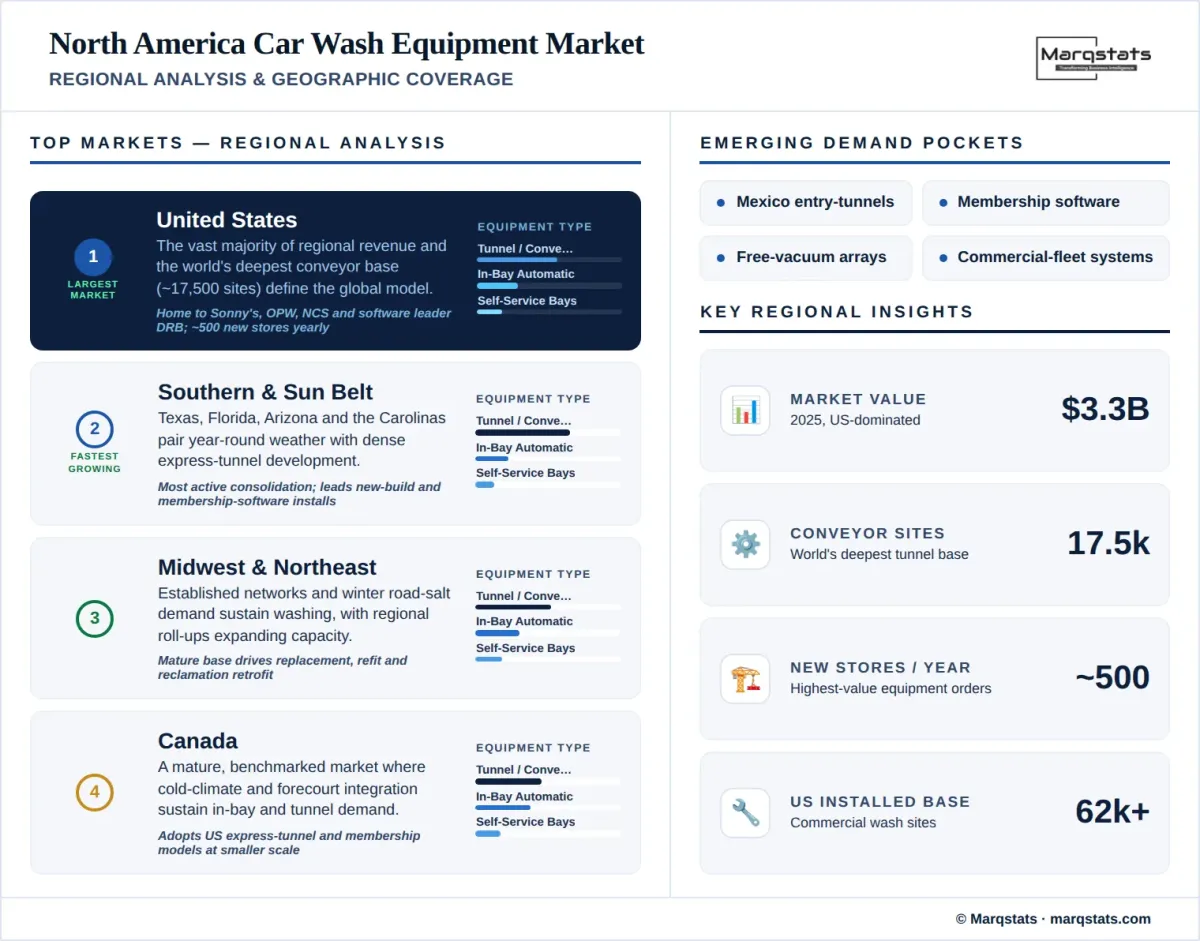
North America Car Wash Equipment Market Regional Analysis Geographic Coverage Infographic
Competitive Landscape

How Competition Is Evolving

The North America car wash equipment market is concentrated at the supplier tier atop a consolidating operator base. Sonny's Enterprises describes itself as the world's largest manufacturer of conveyorized car wash equipment and supplies parts, service, and chemistry alongside tunnels. OPW Vehicle Wash Solutions combines Belanger, PDQ, and ICS to make more wash types than any other manufacturer, spanning conveyor tunnels, touchless and soft-touch automatics, and fleet washes. National Carwash Solutions operates the region's largest service network with more than 600 direct technicians, positioning service depth as a competitive moat.

Washworld, Tommy Car Wash Systems, Ryko, and specialist builders complete the equipment tier, while software and payment form a distinct competitive layer. DRB, a Vontier company, is the clearest software leader, serving the majority of the top-20 North American platforms and expanding its Patheon management platform, including a 2026 deployment across Super Star Car Wash's 118 locations covering more than 550,000 members. Innovative Control Systems and Sonny's CarWash Controls compete in point-of-sale, alongside membership-CRM and churn-reduction providers that layer onto operator software stacks.

Operator consolidation reshapes equipment demand even as the service market fragments. Whistle Express, backed by Oaktree, acquired the former Take 5 Car Wash portfolio to become the largest United States express operator with more than 530 sites, Mister Car Wash surpassed USD 1 billion in 2025 revenue across roughly 525 locations with North America's largest subscription program, and KKR took a stake in Quick Quack. This private-equity-driven roll-up concentrates high-value tunnel, subsystem, and software orders among scaled operators, while equipment supply itself remains a comparatively short list of OEM and software groups.
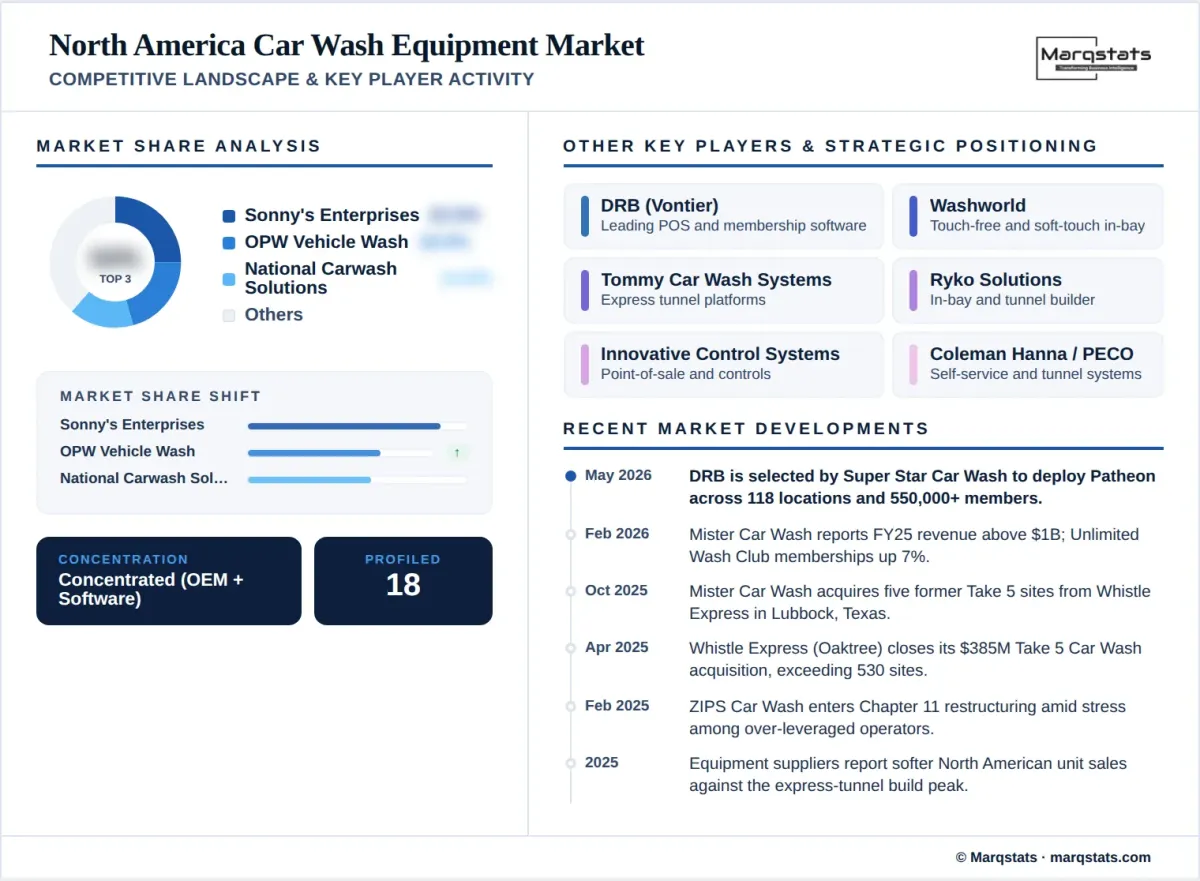
North America Car Wash Equipment Market Competitive Landscape Key Player Activity Infographic
Major Players

Companies Covered

The report profiles 18++ companies with full strategy and financials analysis, including:

Sonny's Enterprises LLC
OPW Vehicle Wash Solutions (Dover Corporation)
Belanger (OPW)
PDQ Manufacturing (OPW)
Innovative Control Systems (OPW)
National Carwash Solutions (NCS / MacNeil)
DRB Systems (Vontier Corporation)
Washworld, Inc.
Tommy Car Wash Systems
Ryko Solutions
Coleman Hanna Carwash Systems
PECO Car Wash Systems
JE Adams Industries (Vacuum Systems)
Hamilton Manufacturing (Payment)
Washify Services LLC
Everwash
AVW Equipment Company
MacNeil Wash Systems
Note: Full company profiles include revenue analysis, product portfolio, SWOT, and recent strategic developments.
Latest Developments

Recent Market Activity

May 2026
DRB, a Vontier company, was selected by Super Star Car Wash to deploy its Patheon management platform across 118 locations and 550,000-plus members.
Feb 2026
Mister Car Wash reported full-year 2025 revenue above USD 1 billion, up 4% in the fourth quarter, with Unlimited Wash Club memberships up 7%.
Oct 2025
Mister Car Wash acquired five former Take 5 sites from Whistle Express in Lubbock, Texas, expanding its Sun Belt footprint.
Apr 2025
Whistle Express, backed by Oaktree, closed its USD 385 million acquisition of Driven Brands' Take 5 Car Wash portfolio, exceeding 530 sites.
Feb 2025
ZIPS Car Wash entered Chapter 11 restructuring, reflecting financial stress among over-leveraged express operators.
2025
Equipment suppliers reported softer North American unit sales against the express-tunnel build peak of prior years, even as operator networks expanded.
Report Structure

Table of Contents

1. Introduction
1.1 Study Assumptions & Market Definition
1.1.1 Scope — Car Wash Equipment & Systems (Hardware + Software)
1.1.2 Formats Covered — Tunnel/Conveyor, In-Bay, Self-Service
1.1.3 Subsystems — Reclamation, Vacuum, Dryer, Dosing, Payment/Software
1.1.4 Inclusions — New Installs, Replacement, Retrofit, Software, Aftermarket
1.1.5 Exclusions — Wash-Service Revenue (Covered Separately)
1.2 Scope of the Study
1.3 Currency & Base Year (2025)
1.4 Key Definitions & Equipment Terminology
1.4.1 Tunnel/Conveyor (Express-Exterior) vs. In-Bay Rollover
1.4.2 Self-Service / High-Pressure Systems
1.4.3 Membership, POS & Site-Management Software
1.4.4 Touchless vs. Friction Wash Technology
2. Research Methodology
2.1 Analysis Framework & Triangulation
2.2 Bottom-Up Installed-Base Model (US Core)
2.2.1 17,500 Conveyor / 29,000 In-Bay / 16,250 Self-Service
2.2.2 New-Install Rate (~500 Stores/Yr) & Replacement Cycles
2.2.3 Subsystem, Software & Aftermarket Attachment
2.2.4 Canada & Mexico Gross-Up
2.3 Top-Down Supplier & Software Reconciliation
2.3.1 Sonny's, OPW, NCS & DRB Anchors
2.4 Installed-Base Ratios & Format-Split Cross-Check
2.5 Primary Research — 40+ Interviews
2.6 Assumptions, Estimate Flags & Limitations
3. Executive Summary
3.1 Market Size & Forecast Snapshot 2021–2030
3.2 Tunnel-Led Structure vs. Gantry-Led Europe
3.3 Installed Base — 17,500 Tunnel / 29,000 In-Bay / 16,250 Self-Service
3.4 Software, Membership & Free-Vacuum Depth
3.5 Private-Equity Consolidation & Order Concentration
4. Market Overview & Definitions
4.1 Industry Structure & Installed Base
4.1.1 US Format Census & ~500 New Stores/Yr
4.1.2 Tunnel Orientation & Express-Exterior Model
4.1.3 Concentrated Suppliers, Consolidating Operators
4.2 Value Chain & Ecosystem
4.2.1 OEMs, Distributors & Chemistry
4.2.2 Software, POS & Membership Platforms
4.2.3 Service Networks & Aftermarket Parts
4.3 Equipment Cycle Economics & Recurring Revenue
4.4 North America vs. Europe Format Structure
5. Market Dynamics
5.1 Key Drivers
5.1.1 Express-Tunnel New-Build Development
5.1.2 Membership & POS Software Expansion
5.1.3 Installed-Base Replacement Demand
5.1.4 Water-Reclamation Retrofit (EPA WaterSense)
5.1.5 License-Plate Recognition & Unattended Payment
5.1.6 Private-Equity Consolidation & Standardization
5.2 Key Restraints
5.2.1 2025 Equipment Unit-Sales Softening
5.2.2 Rising Construction, Land & Equipment Costs
5.2.3 Site Saturation in Mature Metros
5.2.4 Operator Financial Stress & Chapter 11 Disruption
5.3 Key Trends
5.3.1 Enterprise Membership Platforms (DRB Patheon)
5.3.2 Free-Vacuum Arrays & Attached Retail Automation
5.3.3 Water Reclamation & Closed-Loop Controls
5.3.4 Motor-Efficiency & Variable-Speed Drives (DOE)
5.4 Porter's Five Forces Analysis
5.5 Equipment Value Chain Analysis
6. Regulatory & Standards Framework
6.1 EPA WaterSense & Vehicle-Wash Water Guidance
6.2 Wastewater Discharge & Oil-Water Separation
6.3 US DOE Electric-Motor Efficiency Rule (2023)
6.4 State & Municipal Water-Use Rules
6.5 Canadian Standards & CCA Benchmarking
7. Technology & Equipment Innovation
7.1 Tunnel/Conveyor & High-Throughput Systems
7.2 In-Bay Touchless vs. Friction Systems
7.3 Membership, POS & Site-Management Software (Patheon, Auryon)
7.4 Free-Vacuum Arrays & High-Capacity Dryers
7.5 Water Reclamation, Filtration & Chemical Dosing
7.6 License-Plate Recognition, Loyalty & Data
8. Software, Membership & Recurring Revenue Analysis
8.1 POS & Site-Management Platforms
8.2 Unlimited-Membership Billing & Churn Reduction
8.3 Service Networks & Direct Technician Coverage
8.4 Spare Parts, Chemistry & Consumables
9. North America Car Wash Equipment Market Sizing & Forecast
9.1 Total Market Size & Forecast 2021–2030
9.1.1 Historical Revenue 2021–2025
9.1.2 Forecast Revenue 2026–2030
9.1.3 CAGR & Absolute Growth
9.2 Bottom-Up vs. Top-Down Reconciliation
9.2.1 Installed-Base Model Output
9.2.2 Supplier & Software Anchor Output
10. Market Segmentation — By Equipment Type
10.1 Tunnel / Conveyor Systems
10.1.1 Revenue & Share 2021–2030 (Largest & Highest-Value)
10.1.2 ~17,500-Site Base & Express-Build Economics
10.2 Automatic In-Bay (Rollover)
10.2.1 Revenue & Share 2021–2030 (~29,000 Sites)
10.2.2 Forecourt & Touchless Retrofit Demand
10.3 Self-Service / High-Pressure Bays
10.3.1 Revenue & Share 2021–2030 (~16,250 Sites)
11. Market Segmentation — By Subsystem
11.1 Payment, Membership & Site Software
11.1.1 Revenue & Share 2021–2030 (Region-Defining Subsystem)
11.2 Vacuum & Dryer Systems
11.2.1 Revenue & Share 2021–2030 (Free-Vacuum Model)
11.3 Water Reclamation & Filtration
11.3.1 Revenue & Share 2021–2030
11.4 Chemical Dosing Systems
11.4.1 Revenue & Share 2021–2030
12. Market Segmentation — By End-User / Site
12.1 Express-Tunnel Operator Chains
12.1.1 Revenue & Share 2021–2030 (Largest & Fastest)
12.2 Fuel-Station Forecourt & Convenience
12.2.1 Revenue & Share 2021–2030
12.3 Independent & Self-Service Operators
12.3.1 Revenue & Share 2021–2030
13. Market Segmentation — By Vehicle Application
13.1 Passenger-Car Systems
13.1.1 Revenue & Share 2021–2030
13.2 Commercial-Vehicle & Fleet Systems
13.2.1 Revenue & Share 2021–2030 (Growing Application)
14. Regional Analysis
14.1 United States — Largest — World's Deepest Tunnel Base
14.1.1 Market Size & Forecast 2021–2030
14.1.2 ~17,500 Conveyor Sites & ~500 New Stores/Yr
14.1.3 OEM & Software Leadership (Sonny's, OPW, NCS, DRB)
14.2 Southern & Sun Belt — Fastest — Year-Round Express Builds
14.2.1 Market Size & Forecast 2021–2030
14.2.2 Texas, Florida, Arizona, Carolinas Density
14.2.3 Consolidation Hotbed (Mister, Whistle Express)
14.3 Midwest & Northeast — Established Networks & Winter Demand
14.3.1 Market Size & Forecast 2021–2030
14.3.2 Road-Salt Removal & Seasonal Washing
14.3.3 Club Car Wash / Express Wash Concepts Expansion
14.4 Canada — Mature, Benchmarked Market
14.4.1 Market Size & Forecast 2021–2030
14.4.2 CCA Wash Volume Report (15+ Years, ~1,000 Sites)
14.4.3 Cold-Climate In-Bay & Tunnel Demand
14.5 Mexico — Emerging — Formalizing Base
14.5.1 Market Size & Forecast 2021–2030
14.5.2 Informal-to-Organized In-Bay & Entry-Tunnel Shift
14.5.3 Forecourt Investment & OEM Distribution Entry
15. Competitive Landscape
15.1 Market Structure & Supplier Concentration
15.2 Equipment Leadership (Sonny's, OPW, NCS, Washworld, Tommy)
15.3 Software & POS Leadership (DRB/Vontier, ICS, Sonny's Controls)
15.4 Service-Network & Aftermarket Competition
15.5 Operator Consolidation & Order Concentration
15.6 Chemistry Integration & Recurring Revenue Strategy
16. Company Profiles
16.1 Sonny's Enterprises LLC
16.1.1 Company Overview
16.1.2 Equipment / Software Portfolio
16.1.3 Installed Base & Geographic Presence
16.1.4 Service, Chemistry & Digital Approach
16.1.5 Recent Strategic Developments
16.2 OPW Vehicle Wash Solutions (Dover Corporation)
16.2.1 Company Overview
16.2.2 Equipment / Software Portfolio
16.2.3 Installed Base & Geographic Presence
16.2.4 Service, Chemistry & Digital Approach
16.2.5 Recent Strategic Developments
16.3 Belanger (OPW)
16.3.1 Company Overview
16.3.2 Equipment / Software Portfolio
16.3.3 Installed Base & Geographic Presence
16.3.4 Service, Chemistry & Digital Approach
16.3.5 Recent Strategic Developments
16.4 PDQ Manufacturing (OPW)
16.4.1 Company Overview
16.4.2 Equipment / Software Portfolio
16.4.3 Installed Base & Geographic Presence
16.4.4 Service, Chemistry & Digital Approach
16.4.5 Recent Strategic Developments
16.5 Innovative Control Systems (OPW)
16.5.1 Company Overview
16.5.2 Equipment / Software Portfolio
16.5.3 Installed Base & Geographic Presence
16.5.4 Service, Chemistry & Digital Approach
16.5.5 Recent Strategic Developments
16.6 National Carwash Solutions (NCS / MacNeil)
16.6.1 Company Overview
16.6.2 Equipment / Software Portfolio
16.6.3 Installed Base & Geographic Presence
16.6.4 Service, Chemistry & Digital Approach
16.6.5 Recent Strategic Developments
16.7 DRB Systems (Vontier Corporation)
16.7.1 Company Overview
16.7.2 Equipment / Software Portfolio
16.7.3 Installed Base & Geographic Presence
16.7.4 Service, Chemistry & Digital Approach
16.7.5 Recent Strategic Developments
16.8 Washworld, Inc.
16.8.1 Company Overview
16.8.2 Equipment / Software Portfolio
16.8.3 Installed Base & Geographic Presence
16.8.4 Service, Chemistry & Digital Approach
16.8.5 Recent Strategic Developments
16.9 Tommy Car Wash Systems
16.9.1 Company Overview
16.9.2 Equipment / Software Portfolio
16.9.3 Installed Base & Geographic Presence
16.9.4 Service, Chemistry & Digital Approach
16.9.5 Recent Strategic Developments
16.10 Ryko Solutions
16.10.1 Company Overview
16.10.2 Equipment / Software Portfolio
16.10.3 Installed Base & Geographic Presence
16.10.4 Service, Chemistry & Digital Approach
16.10.5 Recent Strategic Developments
16.11 Coleman Hanna Carwash Systems
16.11.1 Company Overview
16.11.2 Equipment / Software Portfolio
16.11.3 Installed Base & Geographic Presence
16.11.4 Service, Chemistry & Digital Approach
16.11.5 Recent Strategic Developments
16.12 PECO Car Wash Systems
16.12.1 Company Overview
16.12.2 Equipment / Software Portfolio
16.12.3 Installed Base & Geographic Presence
16.12.4 Service, Chemistry & Digital Approach
16.12.5 Recent Strategic Developments
16.13 JE Adams Industries (Vacuum Systems)
16.13.1 Company Overview
16.13.2 Equipment / Software Portfolio
16.13.3 Installed Base & Geographic Presence
16.13.4 Service, Chemistry & Digital Approach
16.13.5 Recent Strategic Developments
16.14 Hamilton Manufacturing (Payment)
16.14.1 Company Overview
16.14.2 Equipment / Software Portfolio
16.14.3 Installed Base & Geographic Presence
16.14.4 Service, Chemistry & Digital Approach
16.14.5 Recent Strategic Developments
16.15 Washify Services LLC
16.15.1 Company Overview
16.15.2 Equipment / Software Portfolio
16.15.3 Installed Base & Geographic Presence
16.15.4 Service, Chemistry & Digital Approach
16.15.5 Recent Strategic Developments
16.16 Everwash
16.16.1 Company Overview
16.16.2 Equipment / Software Portfolio
16.16.3 Installed Base & Geographic Presence
16.16.4 Service, Chemistry & Digital Approach
16.16.5 Recent Strategic Developments
16.17 AVW Equipment Company
16.17.1 Company Overview
16.17.2 Equipment / Software Portfolio
16.17.3 Installed Base & Geographic Presence
16.17.4 Service, Chemistry & Digital Approach
16.17.5 Recent Strategic Developments
16.18 MacNeil Wash Systems
16.18.1 Company Overview
16.18.2 Equipment / Software Portfolio
16.18.3 Installed Base & Geographic Presence
16.18.4 Service, Chemistry & Digital Approach
16.18.5 Recent Strategic Developments
17. Investment, Consolidation & Software Analysis
17.1 Private-Equity Roll-Ups & Order Concentration
17.2 Express-Tunnel New-Build Capex
17.3 Membership & POS Software Investment
17.4 Water-Reclamation & Motor-Efficiency Retrofit
18. Opportunities, Risks & Strategic Recommendations
18.1 Growth Opportunities by Equipment Type & Region
18.2 Cost, Saturation & Operator-Stress Risk Assessment
18.3 Software, Retrofit & Recurring-Revenue Strategy
18.4 Strategic Recommendations for Suppliers & Investors
19. Appendix
19.1 Research Methodology Detail
19.2 Triangulation & Estimate Confidence Flags
19.3 Abbreviations & Glossary
19.4 List of Tables
19.5 List of Figures
19.6 Disclaimer & Legal Notice
Study Scope & Focus

Coverage & Segmentation

This report provides a comprehensive analysis of the North America car wash equipment market covering the historical period 2021 to 2025 and the forecast period 2026 to 2030, with 2025 as the base year. The study defines the market as annual revenue from the manufacture and sale of vehicle-wash equipment and systems — tunnel/conveyor, automatic in-bay, and self-service formats — together with attached subsystems (water reclamation, vacuums, dryers, chemical dosing) and the point-of-sale, membership, and site-management software that defines the North American model; wash-service revenue earned by operators is excluded and covered in a separate study. Market size is presented in value terms (USD), with 2025 as the base year and forecasts assuming constant conditions.

The study segments the market by equipment type, subsystem, end-user/site, and vehicle application, and examines country and sub-regional demand across the United States, Sun Belt, Midwest and Northeast, Canada, and Mexico, alongside supplier concentration, software leadership, consolidation, and regulation. Market sizing triangulates a bottom-up installed-base model — roughly 17,500 conveyor, 29,000 in-bay, and 16,250 self-service United States sites, with replacement cycles, new installs, subsystem attachment, software, and aftermarket parts — against a top-down reconciliation of supplier and software revenues, and cross-checks against public installed-base counts. The competitive section profiles 18 equipment suppliers and software providers.

Frequently Asked Questions

FAQs About the North America Car Wash Equipment Market

The North America car wash equipment market is valued at approximately USD 3.30 billion in 2025 and is projected to reach USD 4.23 billion by 2030, expanding at a 5.10% CAGR over the forecast period.
The market is expected to grow at a 5.10% CAGR between 2025 and 2030, driven by express-tunnel new-build development, membership and point-of-sale software, water-reclamation retrofits, and replacement of an ageing installed base.
Tunnel/conveyor systems form the largest and highest-value category, the mirror of gantry-led Europe, built on a US base of roughly 17,500 conveyor sites against Europe's 8,000. The US installed base also includes about 29,000 in-bay and 16,250 self-service sites.
Sonny's Enterprises is the world's largest conveyorized OEM. OPW Vehicle Wash Solutions (Belanger, PDQ, ICS), National Carwash Solutions, Washworld, and Tommy anchor the equipment tier, while DRB, a Vontier company, leads car wash software and point-of-sale.
Membership and point-of-sale software is a region-defining subsystem with no equivalent scale elsewhere. DRB, a Vontier company, serves the majority of the top-20 platforms and deployed its Patheon system across Super Star Car Wash's 118 locations in 2026.
Marqstats triangulates a bottom-up installed-base model (roughly 17,500 conveyor, 29,000 in-bay, and 16,250 self-service US sites, with replacement, new-install, subsystem, software, and aftermarket revenue) against a top-down reconciliation of supplier and software revenues.
The report is delivered as a PDF report (250+ pages), Excel data tables with market sizing across 2021–2030 by equipment type, subsystem, end-user, and region, and a PowerPoint summary deck, with analyst email support included in every licence tier.