Market Snapshot
Key Takeaways
Market Overview & Analysis
Report Summary
The Mexico car wash services market comprises professional and informal operators that clean passenger and light commercial vehicles across four service formats — manual or mobile hand wash (autolavados), in-bay automatic (roll-over), tunnel/conveyor, and self-service — monetized almost entirely through pay-per-wash tickets. The 2025 market of USD 1.02 billion sits against a vehicle parc of roughly 47 million and a paid-wash penetration near 50% when informal washing is included. Wash frequency is high, at about 12 washes per vehicle each year, reflecting a warm, dusty climate and low prices.
The market is defined by informality. Manual autolavados, street washers, and mobile operators account for roughly 75% of revenue in 2025, most operating as micro-enterprises with minimal capital. Organized formats — express tunnels, roll-over bays, and fuel-station forecourt washes — remain a small share, and no dominant national express-tunnel chain of the United States type has emerged. Wash intensity per vehicle is near USD 19, only about 29% of the United States level, underscoring both the low ticket and the large informal base.
Formalization is the central growth driver. Organized franchises such as Autowash Mexico, eco and waterless operators such as My Wash Mexico and Rapid Wash Mexico, and fuel retailers expanding forecourt washes are converting a slice of informal demand into organized capacity. Tunnel/conveyor share rises from about 9% in 2025 toward 12% by 2030, and fuel-station forecourt from about 14% toward 16%, while the autolavado share eases from 75% to 69%. Real pricing gains and continued vehicle-parc growth support the headline 5.60% CAGR.
Water scarcity shapes the market more than in any other North American geography. CONAGUA data show drought across a large share of national territory, and Nuevo Leon's Monterrey metropolitan area has faced acute shortages that prompted restrictions on non-essential water use. The 2025 reforms to the National Water Law and the General Law on Circular Economy push operators toward water reclamation and waterless methods. Only about 1% of Mexican wastewater is recycled, so reclamation-equipped organized sites and low-water eco models hold a structural advantage as regulation tightens.
Operating economics differ sharply from mature markets. Informal autolavados run on low fixed costs, family labour, and cash tickets, which supports resilience yet caps investment in automation, reclamation, and membership systems. Organized operators carry higher capital and compliance costs, however they command MXN 150 to 600 tickets in metros such as Mexico City, alongside better throughput and water efficiency. This gap between a large low-price informal base and a small higher-value organized layer defines the market's structure and its formalization runway through 2030.
Market Dynamics
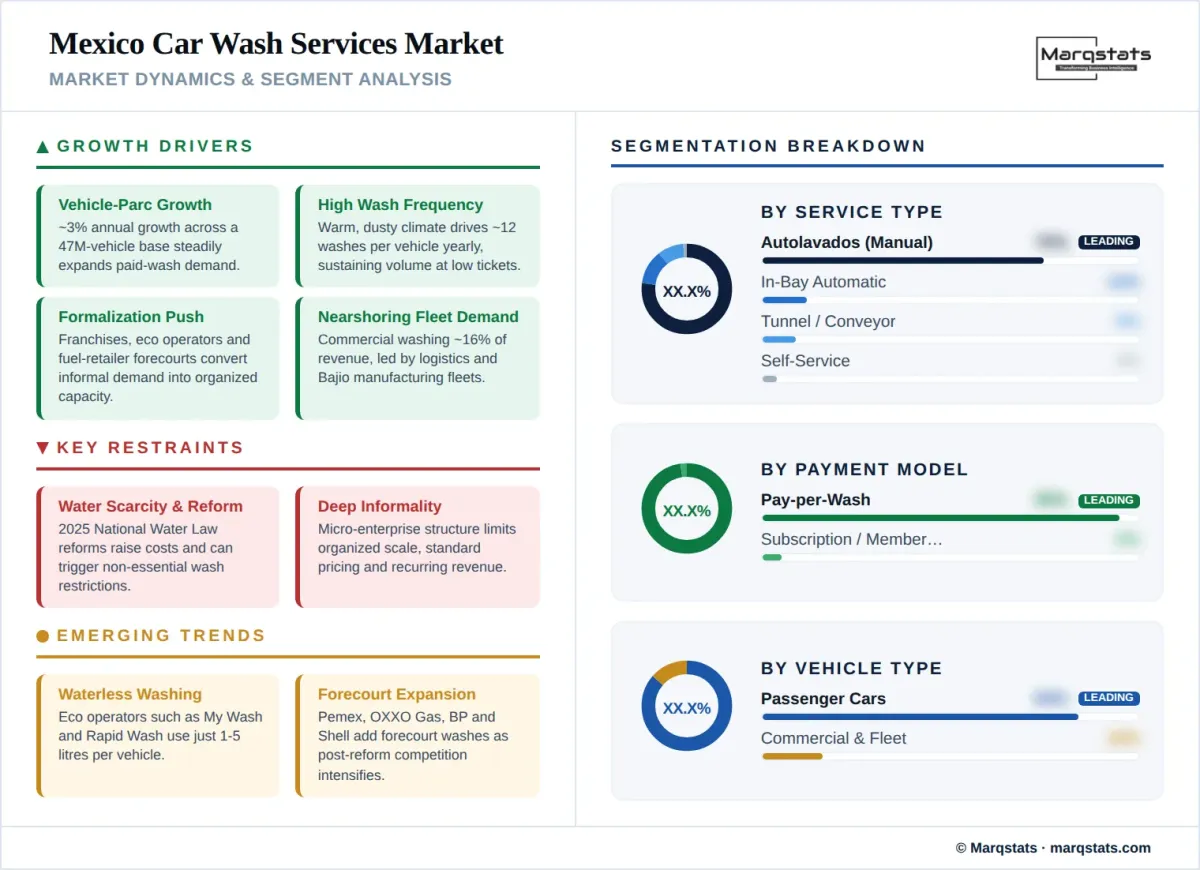
Key Drivers
- Vehicle-parc growth of roughly 3% per year across a 47-million-vehicle base steadily expands the addressable market for paid washing.
- A warm, dusty climate sustains high wash frequency of about 12 washes per vehicle each year, supporting volume even at low tickets.
- Formalization converts informal demand into organized capacity, led by autolavado franchises, eco operators, and fuel-retailer forecourt washes.
- Real pricing gains, as organized formats charge MXN 150 to 600 in metros such as Mexico City, lift average revenue per wash.
- Commercial and fleet demand, higher than in the United States at roughly 16% of revenue, grows with logistics, ride-hailing, and nearshoring investment.
- Water regulation and drought convert into demand for waterless and reclamation-equipped washing, favoring organized eco operators over informal street washers.
Key Restraints
- Severe regional water scarcity and 2025 National Water Law reforms raise water and compliance costs and can trigger restrictions on non-essential washing.
- Deep informality and micro-enterprise structure limit organized-operator scale, standardized pricing, and recurring-revenue models.
- Low blended tickets near USD 3 constrain per-site profitability and slow investment in reclamation and automation.
- Limited wastewater recycling, at about 1% nationally, and weak enforcement complicate compliant water discharge for new sites.
Key Trends
- Waterless and low-water washing spreads rapidly, with operators such as My Wash Mexico and Rapid Wash Mexico using one to five litres per vehicle.
- Autolavado franchising and organized express formats expand from a low base, professionalizing a historically informal market.
- Fuel retailers, including Pemex-branded stations, OXXO Gas, BP, and Shell, add forecourt washes as post-reform retail competition intensifies.
- On-demand mobile and app-based eco washing grows in Mexico City, Monterrey, and Guadalajara, serving fleets and time-constrained urban drivers.
- Nearshoring and auto-manufacturing investment in the Bajio and northern corridors expand industrial and fleet washing demand at organized sites.
Market Segmentation
Manual autolavados and mobile hand-wash services hold the dominant revenue share at roughly 75% in 2025, equal to USD 766.62 million, and remain the core of the Mexican market. The segment spans fixed neighbourhood autolavados, street washers, and a fast-growing waterless mobile channel led by operators such as My Wash Mexico, Rapid Wash Mexico, and CarWashDomicilios. Its share eases toward 69% by 2030 as organized formats formalize a portion of demand, yet it stays the largest segment throughout the forecast period. Low tickets, family labour, and cash payment sustain the segment's scale, while water scarcity gradually shifts a portion of manual demand toward low-water eco methods.
In-bay automatic washes hold about 12% share in 2025 at USD 120.21 million, the largest organized format. Many sit on fuel-station forecourts and in urban service centres, and the segment grows steadily toward 14% by 2030 as fuel retailers and franchises install roll-over equipment with water reclamation to meet tightening rules. Roll-over systems suit mid-density urban sites where land costs and throughput do not justify a full express tunnel.
Tunnel/conveyor washes hold about 9% share in 2025 at USD 88.46 million, a small yet fast-growing format that rises toward 12% by 2030. Express-tunnel development concentrates in wealthier northern and Bajio metros, where organized franchises and higher tickets support the capital cost of high-throughput sites with reclamation systems.
Self-service bays account for roughly 4% of 2025 revenue, USD 45.36 million, a smaller base than in the United States or Canada. The format grows slowly toward 5% by 2030, serving price-sensitive users and smaller cities where automated tunnel density is low. Adoption is constrained by water-use scrutiny and the ready availability of low-cost manual washing across most urban areas.
Single-visit tickets account for about 95% of 2025 revenue, USD 973.01 million, reflecting the informal, cash-based structure of the market. The share eases toward 92% by 2030 as organized operators introduce prepaid and membership options. Blended tickets are low nationally, though organized metro sites charge substantially more than street washers.
Unlimited and prepaid memberships are nascent at roughly 5% of 2025 revenue, USD 47.63 million, yet grow near 18% annually to about 8% of revenue by 2030, worth USD 107.22 million. Membership is the fastest-expanding revenue stream, introduced by organized franchises and eco operators in Mexico City, Monterrey, and Guadalajara, though it starts from a very small base.
Standalone sites, including fixed autolavados and informal lots, hold about 68% of 2025 revenue, USD 696.30 million, and remain the backbone of the market. The format spans micro-enterprise autolavados and a growing number of organized express and eco sites, and its share eases gradually toward 66% by 2030 as forecourt washing expands.
Forecourt washes attached to fuel stations hold about 14% of 2025 revenue, USD 140.62 million, and gain share toward 16% by 2030, the fastest-growing format by site type. Post-reform competition among Pemex-branded stations, OXXO Gas, BP, Shell, Mobil, and Chevron drives forecourt wash investment, particularly in northern and central metros. Bundling washes with fuel and convenience purchases, together with points and loyalty programs, helps retailers differentiate stations in an increasingly contested post-liberalization market.
Mobile and street formats account for about 18% of 2025 revenue, USD 183.72 million, a larger share than in the United States or Canada. App-based eco and waterless providers add organized capacity within this channel, particularly in Mexico City and Monterrey, where water scarcity favours low-water home-service models. This channel is the primary entry point through which technology-enabled operators formalize informal street-washing demand.
Passenger vehicles generate about 84% of 2025 revenue, USD 852.80 million, reflecting broad household demand for frequent, low-cost washing. The share eases slightly across the forecast period as commercial washing grows faster.
Commercial and fleet washing holds roughly 16% share in 2025, USD 167.84 million, higher than in the United States or Canada, and rises toward 17% by 2030. Growth is driven by logistics, delivery, and ride-hailing fleets — including mobility-as-a-service operators — and by nearshoring-linked industrial fleets across the Bajio and northern manufacturing corridors.
By Geography
Valle de México (Mexico City Metropolitan Area)
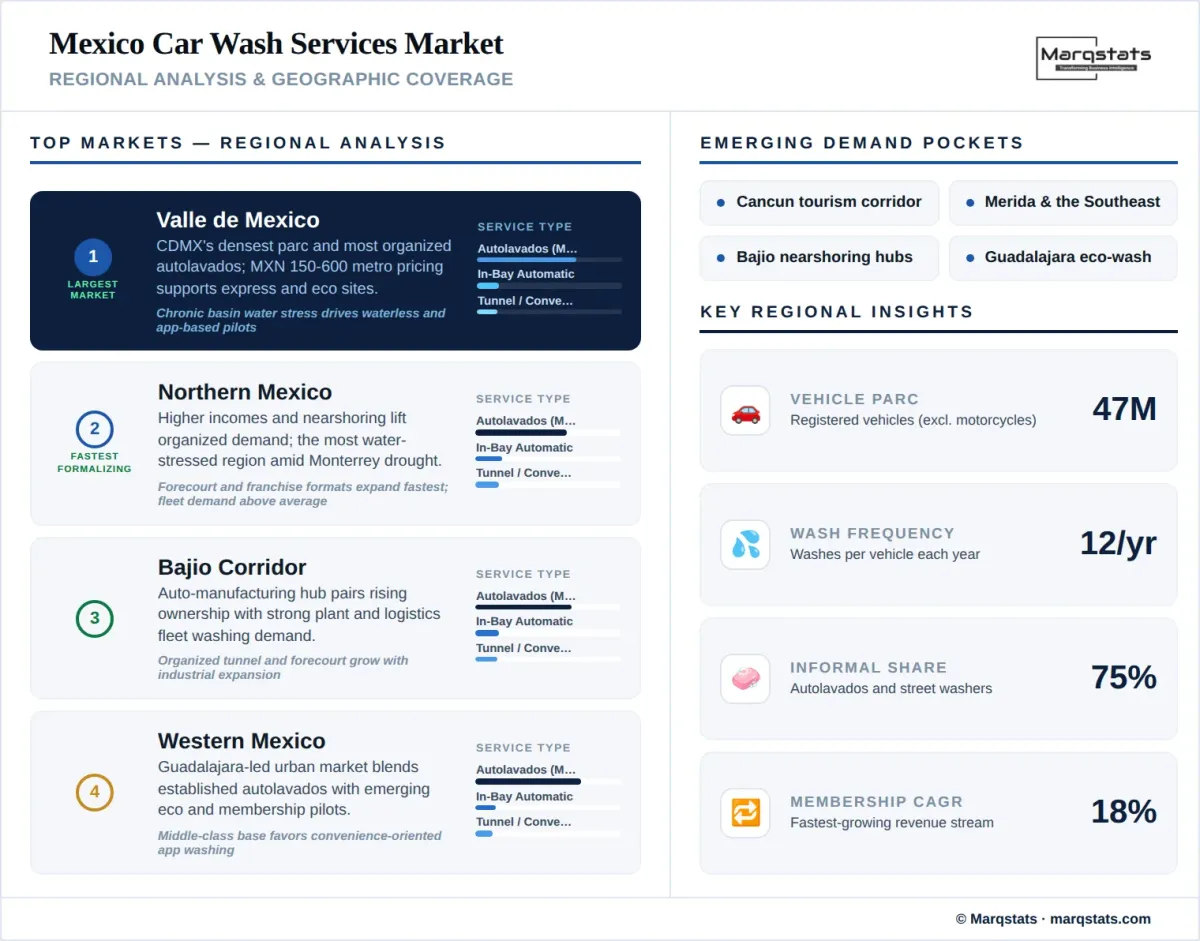
The Valle de Mexico, centred on Mexico City and the surrounding Estado de Mexico, is the largest regional market, anchored by the country's densest vehicle parc and highest concentration of organized autolavados. Formal metro pricing of MXN 150 to 600 supports organized express and eco sites, while chronic water stress across the basin drives adoption of waterless and low-water models. The region hosts most early membership and app-based booking pilots, and its dense traffic and long commutes sustain frequent washing despite periodic water restrictions.
Northern Mexico (Nuevo León, Chihuahua, Baja California)
Northern Mexico is the fastest-formalizing region, propelled by higher incomes, industrial and nearshoring investment, and organized retail. It is also the most water-stressed: Monterrey's acute drought and Nuevo Leon's water-security measures accelerate reclamation and waterless washing. Fuel-retailer forecourt washes and organized franchises expand fastest here, and manufacturing and logistics fleets in Nuevo Leon, Coahuila, and Baja California lift commercial washing above the national average, reinforcing the region's shift toward organized, water-efficient formats.
Bajío (Guanajuato, Querétaro, Aguascalientes)
The Bajio auto-manufacturing corridor combines rising vehicle ownership with strong commercial and fleet demand from automotive plants and logistics operators. Organized tunnel and forecourt formats grow with the region's industrial expansion, and fleet washing forms a larger revenue share than the national average.
Western Mexico (Jalisco / Guadalajara)
Western Mexico, led by Guadalajara in Jalisco, is a large urban market with a mix of established autolavados and emerging organized and eco operators. App-based mobile washing and membership pilots concentrate in the Guadalajara metropolitan area, supported by a sizeable middle-class consumer base and a growing technology and services economy that favours convenience-oriented washing.
Southeast & Yucatán Peninsula
The Southeast and Yucatan Peninsula, including Merida and the Cancun tourism corridor, form a smaller, humid-climate market where manual autolavados dominate. Tourism and rental-fleet demand support washing in Quintana Roo, while organized penetration remains lower than in central and northern Mexico. Higher rainfall reduces winter-style salt exposure, so demand is driven more by dust, coastal salt air, and tourism-fleet turnover than by seasonal road treatment.
How Competition Is Evolving
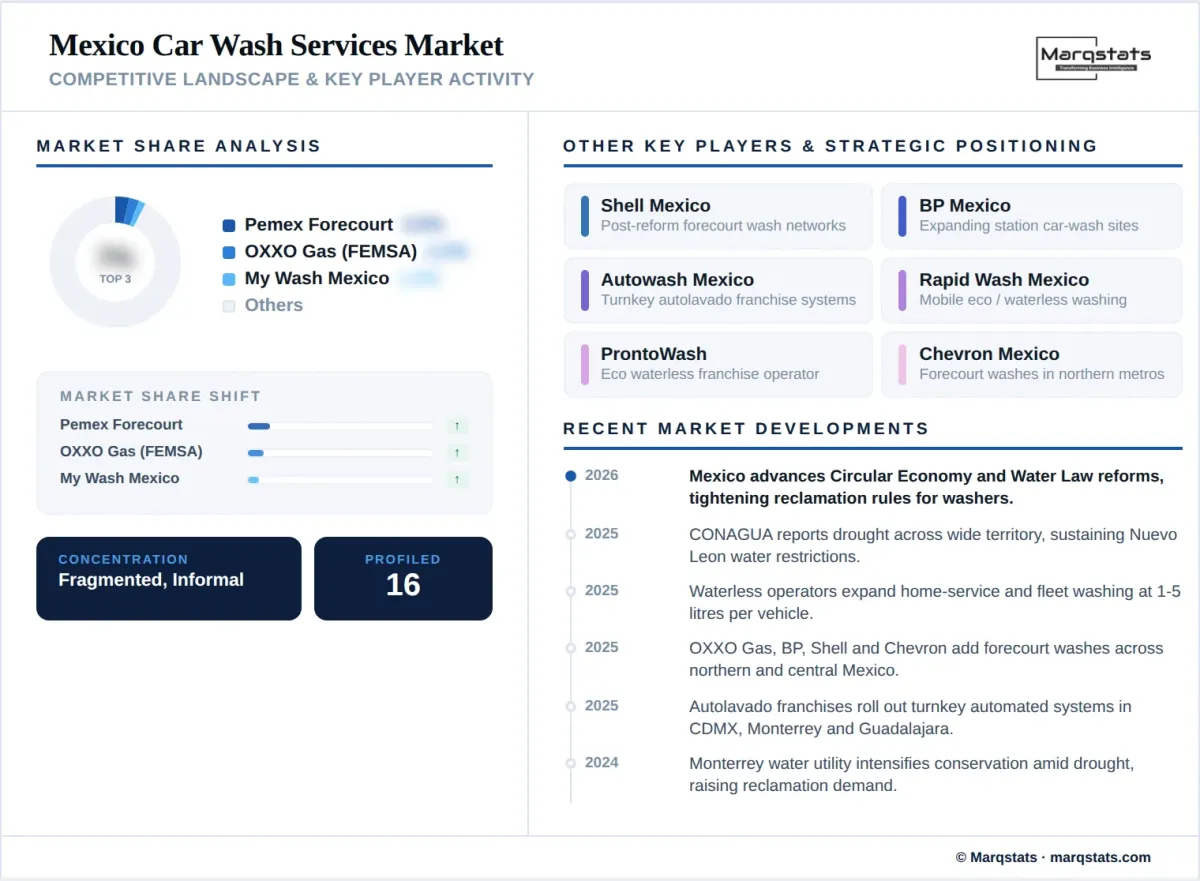
The Mexico car wash services market is highly fragmented and largely informal, with manual autolavados, street washers, and micro-enterprises accounting for roughly 75% of revenue. No dominant national express-tunnel chain of the United States type has emerged, and large United States operators have not entered at scale. Competition among organized players centres on formalization, water efficiency, and metro-level service quality rather than national scale.
Organized competition spans three groups. Autolavado franchises such as Autowash Mexico provide turnkey automated wash systems to independent operators. Eco and waterless operators — My Wash Mexico, Rapid Wash Mexico, ProntoWash, and CarWashDomicilios — compete on low water use of one to five litres per vehicle, home service, and fleet contracts, a positioning strengthened by water scarcity. Fuel retailers — Pemex-branded stations, OXXO Gas, BP, Shell, Mobil, Chevron, and TotalEnergies — expand forecourt washes as post-reform retail competition intensifies.
Water scarcity is the decisive competitive variable. Operators equipped with reclamation systems or waterless technology hold an advantage as CONAGUA rules tighten and drought recurs, particularly in Nuevo Leon and the Valle de Mexico. Formalization is expected to continue gradually, with organized express, forecourt, and eco formats capturing share from informal washers, though the micro-enterprise base ensures the market stays fragmented across the forecast period.
The competitive base tiers into three groups. Fuel retailers hold the widest organized footprints through forecourt washes, supported by post-reform retail competition and national station networks. Autolavado franchises and organized express operators drive standalone formalization, concentrated in wealthier northern, central, and Bajio metros. Eco and waterless operators form a fast-growing niche positioned directly against water scarcity, serving households and corporate fleets through home service and app-based booking. Below these sit tens of thousands of informal autolavados and street washers that sustain the market's fragmentation and low average ticket.
Companies Covered
The report profiles 16++ companies with full strategy and financials analysis, including:
Recent Market Activity
Table of Contents
Coverage & Segmentation
This report provides a comprehensive analysis of the Mexico car wash services market covering the historical period 2021 to 2025 and the forecast period 2026 to 2030, with 2025 as the base year. The study defines the market as annual revenue earned by professional and informal operators cleaning passenger and light commercial vehicles through manual (autolavado), in-bay automatic, tunnel/conveyor, and self-service formats, inclusive of basic interior cleaning; full detailing and equipment or chemical sales are excluded. Market size is presented in value terms (USD billion).
The study segments the market by service type, payment model, site format, and vehicle type, and examines regional demand across the Valle de Mexico, Northern Mexico, the Bajio, Western Mexico, and the Southeast and Yucatan Peninsula, alongside competitive concentration, formalization, and water regulation. Market sizing uses a bottom-up model anchored to INEGI vehicle registrations and Censos Economicos data for SCIAN 811192 (lavado y lustrado de autos), cross-checked against wash intensity per vehicle. The competitive section profiles 16 operators spanning autolavado franchises, eco and waterless operators, and fuel-retailer forecourt networks.