Market Snapshot
Key Takeaways
Market Overview & Analysis
Report Summary
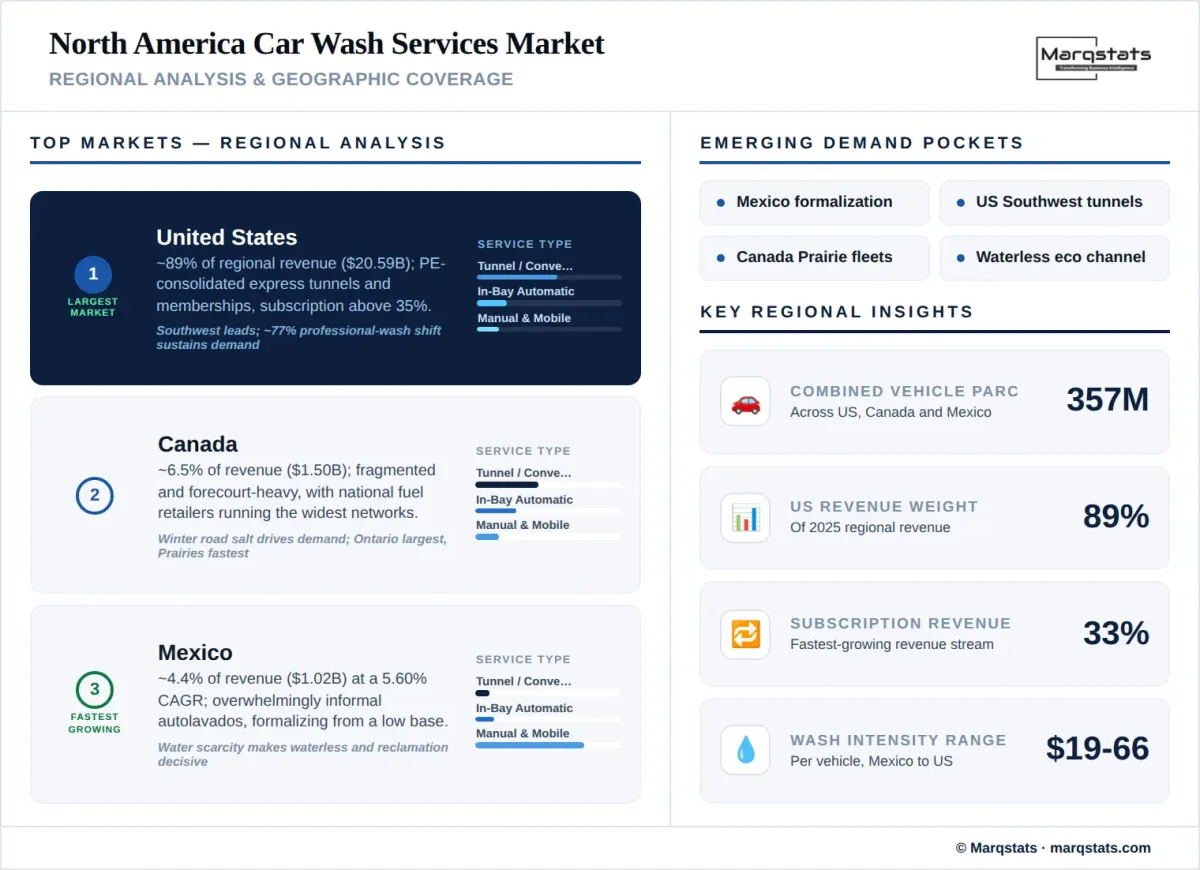
The North America car wash services market comprises the professional and informal cleaning of passenger and light commercial vehicles across the United States, Canada, and Mexico, delivered through tunnel/conveyor, in-bay automatic, self-service, and manual formats and monetized through single-visit tickets and unlimited memberships. The 2025 market of USD 23.11 billion is heavily weighted to the United States, which contributes about USD 20.59 billion, followed by Canada at USD 1.50 billion and Mexico at USD 1.02 billion. The combined vehicle parc of roughly 357 million underpins steady regional demand.
The three national markets differ structurally. The United States is the largest and most consolidated, with express-exterior tunnels and unlimited memberships driving growth and private-equity roll-up reshaping ownership. Canada is more fragmented and forecourt-heavy, with national fuel retailers operating the widest wash networks and winter road salt driving demand. Mexico is overwhelmingly informal, with manual autolavados accounting for the majority of revenue and formalization only beginning, constrained by severe water scarcity. These differences make North America a single geography with three distinct competitive and regulatory environments.
Format and payment mix reflect the United States weighting. Tunnel/conveyor washes hold about 52% of regional revenue in 2025 and rise toward 59% by 2030, while subscription memberships reach roughly 33% of revenue and grow near 11.5% annually. Both figures are pulled upward by the United States, where tunnel share exceeds 55% and subscription penetration exceeds 35%. In Canada, forecourt and in-bay formats hold larger shares, and in Mexico manual autolavados dominate, so the regional averages mask wide national variation.
Water and regulation vary sharply across the region. United States operators face tightening storm-water and reclamation rules in drought-prone states; Canadian operators manage municipal wastewater bylaws and cold-climate reclamation; and Mexican operators contend with acute water scarcity, CONAGUA drought declarations, and 2025 National Water Law and circular-economy reforms. Across all three, water reclamation and low-water technologies are becoming competitive differentiators, most urgently in Mexico and the United States Southwest.
Wash intensity per vehicle captures the divergence between the three markets. The United States generates roughly USD 66 per vehicle in annual wash spending, Canada about USD 51, and Mexico near USD 19, reflecting differences in ticket price, format mix, and formalization. Canada sits near 78% and Mexico near 29% of United States intensity, so as organized capacity, subscription penetration, and pricing rise in Canada and Mexico, both markets carry structural headroom to converge toward United States levels over the long term.
Market Dynamics
Key Drivers
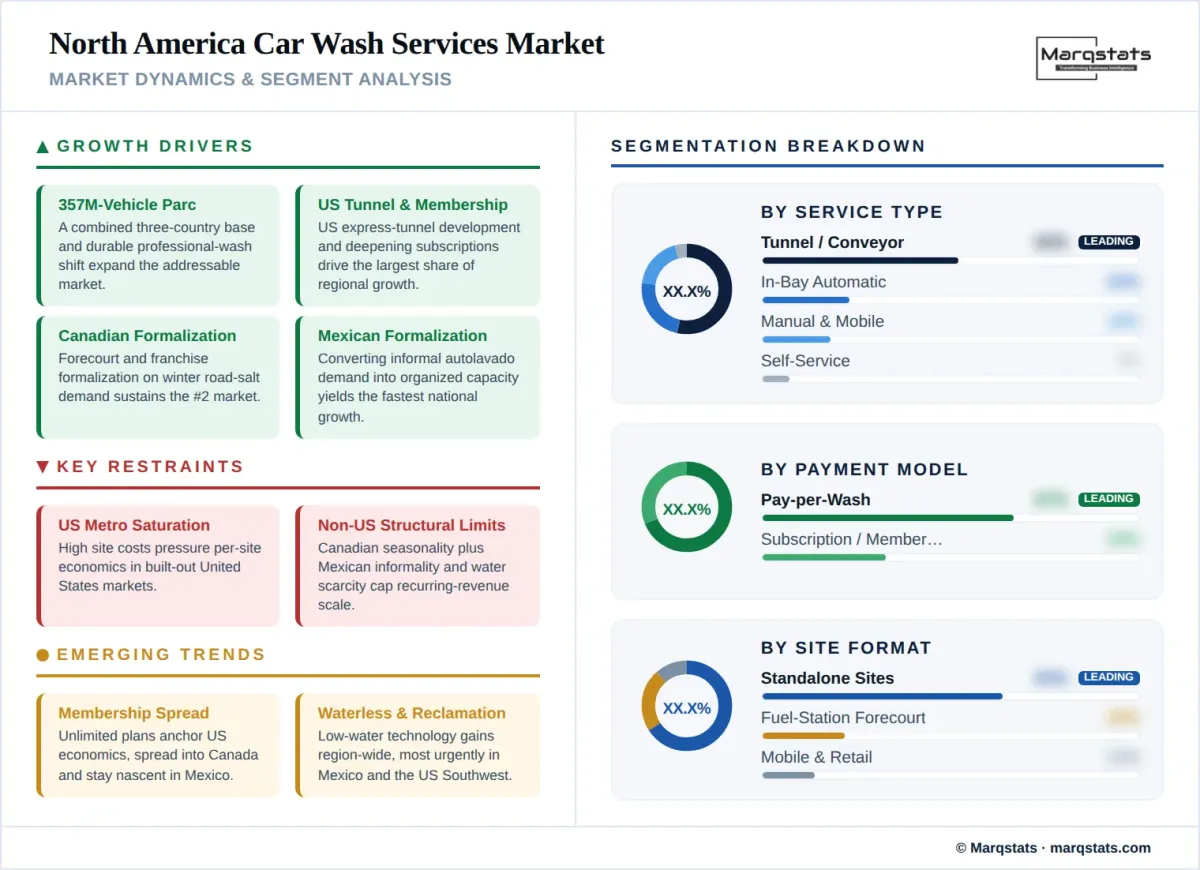
- A combined 357-million-vehicle parc and a durable shift toward professional washing expand the addressable market across all three countries.
- United States express-tunnel development and deepening subscription penetration drive the largest share of regional revenue growth.
- Canadian forecourt and franchise formalization, supported by winter road-salt demand, sustains steady growth in the second-largest market.
- Mexican formalization converts informal autolavado demand into organized capacity, producing the region's fastest national growth.
- Commercial and fleet demand rises across the region with logistics, ride-hailing, and nearshoring-linked industrial fleets.
- Cross-border operating know-how, equipment supply, and franchise models transfer between the three markets, supporting formalization in Canada and Mexico.
Key Restraints
- Market saturation and high site costs pressure per-site economics in built-out United States metros.
- Cold-climate seasonality concentrates Canadian demand in winter and shoulder months, limiting year-round utilization.
- Severe water scarcity and 2025 water-law reforms in Mexico raise costs and can trigger restrictions on non-essential washing.
- Deep informality and low tickets in Mexico, and fragmentation in Canada, limit recurring-revenue scale outside the United States.
Key Trends
- Unlimited memberships anchor operator economics in the United States and spread into Canada, while remaining nascent in Mexico.
- Private-equity roll-up continues to consolidate the United States, with lighter consolidation in Canada and minimal activity in Mexico.
- Water reclamation and waterless technologies gain adoption region-wide, most urgently in Mexico and the drought-prone United States Southwest.
- License-plate recognition, app-based payment, and loyalty integration standardize across organized operators in all three markets.
- Rising electric-vehicle ownership across the region raises demand for sensor-safe, touch-free washing and closer ties with mobility platforms.
Market Segmentation
Tunnel/conveyor washes hold the largest revenue share at about 52% in 2025, equal to USD 12.13 billion, and rise toward 59% by 2030. The format is driven by United States express-tunnel development, where it exceeds 55% of national revenue, and is growing from lower bases in Canada and Mexico as organized capacity expands. High throughput, free vacuums, and membership integration make it the focus of new-site development across the region.
In-bay automatic washes hold about 23% share in 2025 at USD 5.23 billion. The format carries a higher weighting in Canada and Mexico, where forecourt roll-overs at fuel-station networks are common, than in the United States, where express tunnels have displaced much roll-over capacity. It grows in absolute terms while ceding revenue share to tunnels through 2030, and operators upgrade aging units with reclamation and soft-cloth systems to defend forecourt volumes.
Manual and mobile hand-wash services hold about 18% share in 2025 at USD 4.14 billion, weighted heavily by Mexico, where informal autolavados dominate at roughly 75% of national revenue. The segment loses regional share to automated formats yet remains large owing to Mexican informality and a durable premium hand-wash and detailing base in the United States and Canada. A fast-growing waterless mobile channel, concentrated in Mexican and United States metros, adds organized capacity within this segment.
Self-service bays account for about 7% of 2025 revenue, USD 1.60 billion, and decline gradually toward 5% by 2030. The format is in structural decline across the region as express tunnels capture convenience-oriented customers, retaining relevance for oversized vehicles, price-sensitive users, and smaller communities in all three countries, with a comparatively larger base in Canada and Mexico.
Single-visit tickets account for about 67% of 2025 revenue, USD 15.45 billion, and remain the entry channel that operators convert into memberships. The share declines toward 55% by 2030 as United States and Canadian subscription adoption deepens, while Mexico stays predominantly pay-per-wash.
Unlimited-membership plans reach about 33% of 2025 revenue, USD 7.66 billion, and grow near 11.5% annually to roughly 45% of revenue by 2030. Recurring membership is the fastest-expanding revenue stream, concentrated in the United States, where it exceeds 35% of national revenue, with rising adoption in Canada and an early base in Mexico.
Standalone sites hold about 64% of 2025 revenue, USD 14.77 billion, and gain share toward 67% by 2030 as United States and Canadian express-tunnel development continues. The format includes purpose-built express tunnels in the United States and Canada, which carry the highest throughput and strongest membership economics, and fixed autolavados in Mexico, which anchor the informal base. Rising site-development and water-reclamation costs favor better-capitalized operators across the region.
Forecourt washes attached to fuel and convenience retail hold about 22% of 2025 revenue, USD 5.17 billion, with a larger weighting in Canada and Mexico than in the United States. These sites increasingly integrate retail energy services, including EV charging deployments across North American retail networks that reshape site economics for fuel-retailer operators.
Mobile and retail-parking formats account for about 14% of 2025 revenue, USD 3.18 billion, with a larger share in Mexico, where street and waterless mobile washing is common. App-based eco and on-demand providers add organized capacity across major metros in all three countries, and waterless models lower the water and permitting burden for operators without fixed sites, a growing advantage as water regulation tightens across the region.
Passenger vehicles generate about 90% of 2025 revenue, USD 20.83 billion, reflecting the consumer orientation of tunnel, membership, and autolavado models. The share eases slightly across the forecast period as commercial washing grows faster.
Commercial and fleet washing holds about 10% share in 2025, USD 2.28 billion, and rises toward 10.5% by 2030. Growth is driven by last-mile delivery, logistics, ride-hailing, and nearshoring-linked industrial fleets — including mobility-as-a-service operators — with the highest commercial weighting in Mexico.
By Geography
United States
The United States is the largest and most consolidated market, contributing about USD 20.59 billion, or 89% of 2025 regional revenue, and growing at a 4.70% CAGR to USD 25.91 billion by 2030. Express-exterior tunnels with free vacuums and unlimited memberships dominate, and private-equity roll-up has consolidated the top tier around operators such as Mister Car Wash, Whistle Express, Quick Quack, and Tidal Wave Auto Spa. Subscription penetration exceeds 35% of national revenue, the highest in the region, and new-site development runs at 600 to 700 tunnels per year.
The United States market entered a discipline-focused phase after a 2025 correction, marked by more selective construction and the Zips Car Wash Chapter 11 filing. Water regulation tightens in drought-prone states, and consolidation continues among well-capitalized platforms, though lenders have grown cautious on highly leveraged transactions. The Southwest holds the largest regional share within the country, supported by warm, dry weather and year-round operations, while the professional-wash shift, at roughly 77% of drivers, sustains demand nationwide.
Canada
Canada contributes about USD 1.50 billion, or 6.5% of 2025 regional revenue, and grows at a 4.40% CAGR to USD 1.86 billion by 2030. The market is more fragmented and forecourt-heavy than the United States, with national fuel retailers — Suncor's Petro-Canada, Imperial Oil's Esso, Shell Canada, and Couche-Tard's Circle K — operating the widest wash networks. Winter road salt drives exterior-wash frequency across Ontario, Quebec, and the Prairies, while milder coastal British Columbia carries steadier year-round demand.
Subscription penetration is lower than in the United States at about 24% of national revenue, and private-equity roll-up is limited. Regional express chains such as Bubbles Car Wash & Detail Centres and Express Auto Wash, alongside franchise operator Tommy's Express, drive standalone formalization and membership adoption. Ontario is the largest provincial market, while Alberta and the Prairies form the fastest-growing region on harsh winters and resource-sector fleet demand.
Mexico
Mexico contributes about USD 1.02 billion, or 4.4% of 2025 regional revenue, and is the fastest-growing country at a 5.60% CAGR, reaching USD 1.34 billion by 2030. The market is overwhelmingly informal, with manual autolavados and street washers accounting for about 75% of national revenue at low blended tickets. Formalization is the growth story, led by autolavado franchises such as Autowash Mexico, waterless operators such as My Wash Mexico, and fuel-retailer forecourt washes at Pemex-branded stations and OXXO Gas.
Water scarcity shapes the Mexican market more than any other in the region. CONAGUA drought data, the Monterrey water crisis, and 2025 National Water Law and circular-economy reforms accelerate waterless and reclamation-equipped washing. Only about 1% of Mexican wastewater is recycled, giving reclamation-equipped and low-water operators a structural advantage as regulation tightens, with the Valle de Mexico and northern industrial metros at the forefront of organized formalization.
How Competition Is Evolving
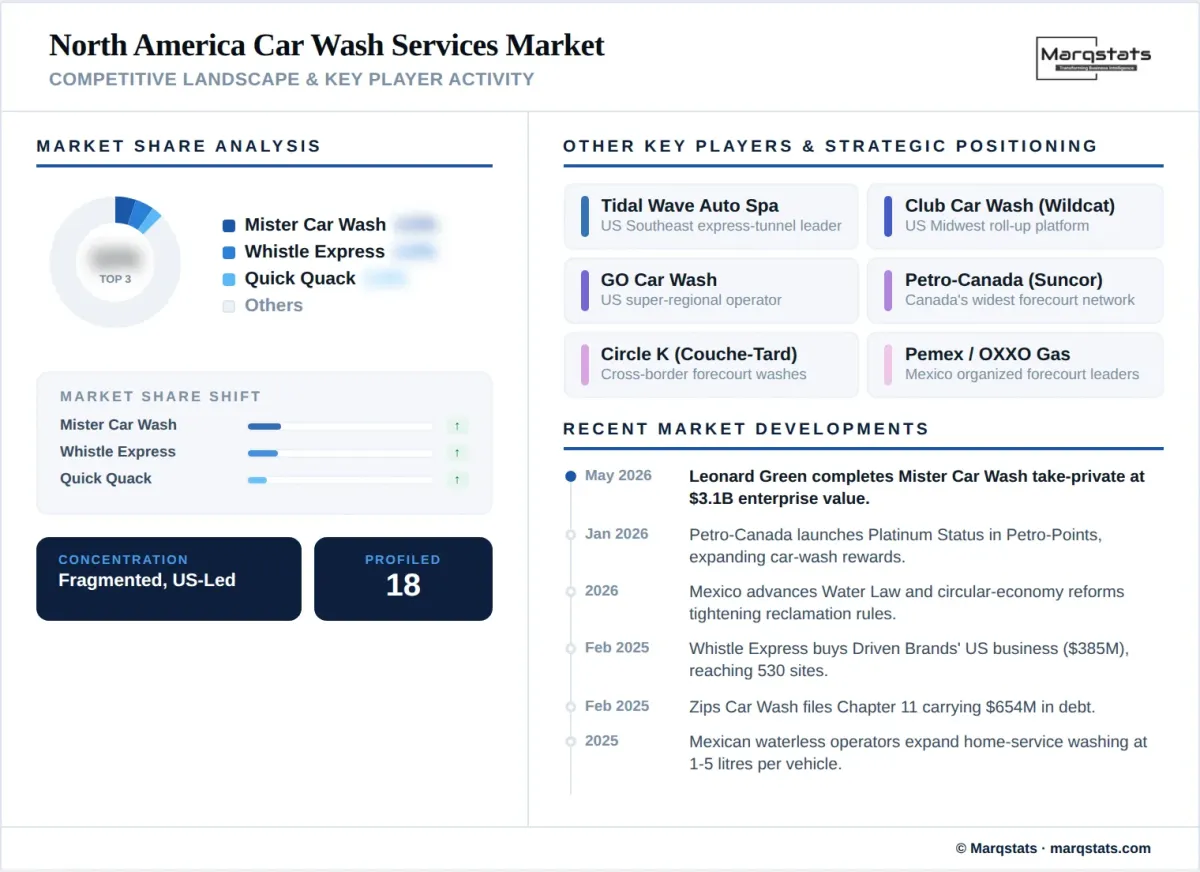
The North America car wash services market is fragmented overall, with sharply different competitive structures across its three countries. The United States is consolidating fastest, where private equity controls nearly every national express-tunnel platform and the largest operators — Mister Car Wash, Whistle Express, Quick Quack, Club Car Wash, and Tidal Wave Auto Spa — compete on membership penetration and site throughput. Canada is more fragmented and led by national fuel retailers, while Mexico is overwhelmingly informal with no dominant national chain.
Competitive strategy differs by market. In the United States, operators compete on unlimited memberships, license-plate recognition, and location quality, with roll-up acquisitions driving scale. In Canada, fuel retailers leverage forecourt networks and loyalty programs such as Petro-Points, while regional express chains build membership bases. In Mexico, organized players compete on formalization and water efficiency against a vast informal base, with waterless and reclamation technology a growing differentiator.
Consolidation is expected to continue unevenly. United States roll-up persists among well-capitalized platforms despite more cautious lending; Canadian consolidation advances slowly through franchise and fuel-retailer expansion; and Mexican formalization proceeds gradually as organized express, forecourt, and eco formats capture share from informal washers. Across the region, water reclamation and low-water technology are becoming decisive competitive variables, most urgently in Mexico and the drought-prone United States Southwest.
Companies Covered
The report profiles 18++ companies with full strategy and financials analysis, including:
Recent Market Activity
Table of Contents
Coverage & Segmentation
This report provides a comprehensive analysis of the North America car wash services market covering the historical period 2021 to 2025 and the forecast period 2026 to 2030, with 2025 as the base year. The study aggregates the United States, Canada, and Mexico, defining the market as annual revenue earned by professional and informal operators cleaning passenger and light commercial vehicles through tunnel/conveyor, in-bay automatic, self-service, and manual formats, inclusive of basic interior cleaning; full detailing and equipment or chemical sales are excluded. Market size is presented in value terms (USD billion).
The study segments the market by service type, payment model, site format, and vehicle type, and examines demand and competition across the three countries, including United States consolidation, Canadian forecourt structure, and Mexican informality and water regulation. Market sizing aggregates bottom-up country models anchored to US Census Bureau, Federal Highway Administration, Statistics Canada, and INEGI data, cross-checked against wash intensity per vehicle. The competitive section profiles 18 operators spanning United States national platforms, Canadian fuel retailers and express chains, and Mexican franchises and eco operators.