Market Snapshot
Key Takeaways
Market Overview & Analysis
Report Summary
The Europe car wash services market comprises professional and informal operators cleaning passenger and light commercial vehicles across four service formats — in-bay automatic (roll-over), tunnel/conveyor, self-service, and manual or mobile hand wash — monetized through pay-per-wash tickets and wash subscriptions. The 2025 market of USD 9.43 billion aggregates Germany (USD 2.25 billion), the United Kingdom (USD 1.62 billion), France (USD 1.46 billion), Italy (USD 1.23 billion), Spain (USD 0.82 billion), and the Rest of Europe (USD 2.05 billion), against a combined parc of roughly 294 million vehicles.
Europe's defining feature is national divergence within a single region. Germany pairs strict home-washing restrictions with roughly 78% professional-wash penetration and a Portalanlage-dominated format mix. The United Kingdom is dominated by low-cost hand car washes at about 68% of national revenue, with labour-standards enforcement reshaping the sector. France runs Europe's deepest high-pressure self-service culture, anchored by the Elephant Bleu network, at about 37% of national revenue. Italy blends roll-overs with a large manual autolavaggi base, and Spain's self-service boxes hold about 32% of national revenue, supported by home-market equipment maker Istobal.
Aggregated across the five major markets, in-bay automatic roll-overs hold the largest share at about 32% of 2025 revenue (USD 2.37 billion), followed by manual and hand-wash formats at 26% (USD 1.90 billion), tunnels at 22% (USD 1.66 billion), and self-service at 20% (USD 1.45 billion). Tunnels gain share toward 25% by 2030 as premium Waschstrassen and express formats expand, while fuel-station forecourts and standalone sites split site-format revenue almost evenly at about 43% and 44% respectively.
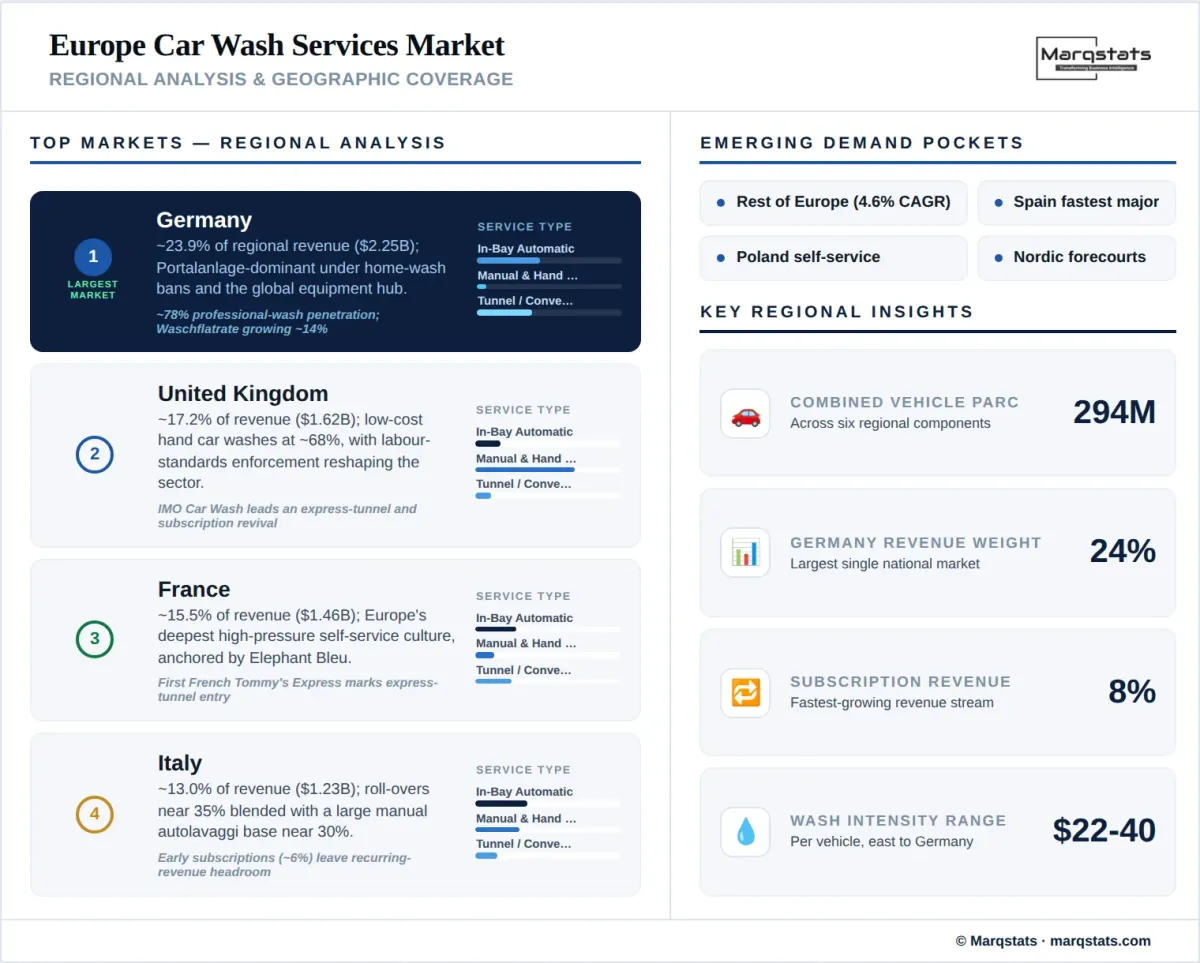
Wash intensity per vehicle falls along a clear gradient — about USD 40 in Germany, USD 38 in the United Kingdom, USD 31 in France, USD 26 in Italy and Spain, and USD 22 across the Rest of Europe — versus roughly USD 66 in the United States. This gap frames Europe's structural headroom: as subscriptions, premium tunnel formats, and organized capacity expand, southern and eastern markets converge gradually toward northern intensity levels. Wash subscriptions already reach about 8% of major-market revenue and grow near 13% annually, led by German Waschflatrate programs and UK automated operators.
Regulation shapes the region as much as consumer preference. Northern Europe channels demand into professional washing through water-protection rules — German home-wash bans and Nordic driveway-wash restrictions — while the United Kingdom applies labour-standards enforcement to its hand-car-wash sector and Southern Europe manages seasonal water stress. Wastewater-discharge and reclamation requirements apply across the region, favouring reclamation-equipped organized sites. This regulatory mosaic, combined with Europe's position as the global centre of wash-equipment manufacturing, gives the region a technology-led, quality-oriented character distinct from the convenience-led North American model.
Market Dynamics
Key Drivers
- Services pricing gains, tracking elevated European inflation, add roughly 2 percentage points of annual revenue growth across the format mix.
- Water-protection rules, including German home-wash bans and Nordic driveway-wash restrictions, channel demand into professional washing.
- Premiumization toward textile tunnels and express formats lifts average tickets in Germany, France, and the United Kingdom.
- Wash-subscription adoption converts episodic demand into recurring revenue, growing near 13% annually across the major markets.
- Europe's domestic equipment ecosystem — WashTec, Otto Christ, Karcher, Istobal, and BKF — accelerates technology and efficiency upgrades.
- Central and Eastern European growth, led by Poland's self-service sector, expands organized capacity from a lower base.
Key Restraints
- Mature vehicle parcs and high existing penetration across Western Europe leave limited volume headroom.
- High energy, water, and labour costs pressure operator margins, particularly in Germany and the Nordics.
- Informality in the UK hand-car-wash and Southern European manual segments constrains pricing power and standards.
- Wastewater-discharge and reclamation requirements raise construction and compliance costs for new sites across the region.
Key Trends
- Wash subscriptions spread from German Waschflatrate and UK automated operators to French, Spanish, and Nordic networks, including fuel-retailer plans.
- Express-tunnel franchise entry advances, marked by the first French Tommy's Express site opening at Allonne in 2025.
- Consolidation continues among pan-European automated operators, exemplified by the IMO Car Wash ownership change completed in early 2026.
- Digital and IoT site management, led by WashTec's SmartCare Connect, standardizes chemical dosing, pricing, and uptime across networks.
- Water reclamation and touch-free systems gain adoption as EV ownership rises and water rules tighten across the region.
Market Segmentation
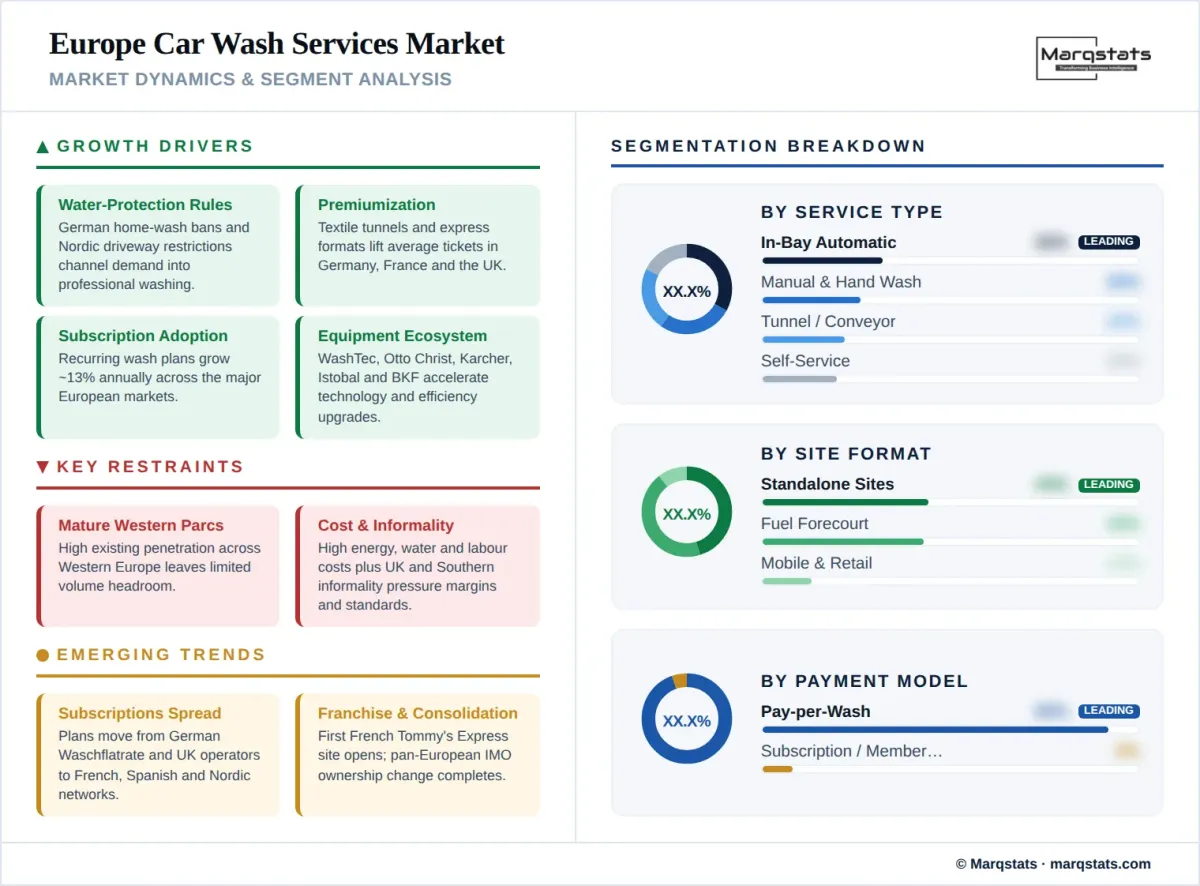
In-bay automatic roll-overs hold the largest share at about 32% of 2025 major-market revenue, USD 2.37 billion, anchored by Germany's roughly 14,000 Portalanlagen and dense forecourt networks in Italy, Spain, and France. The format is prized for cleaning and drying performance and suits Europe's many mid-density forecourt sites. Its share eases toward 31% by 2030 as tunnels gain ground, yet it remains the region's structural backbone throughout the forecast period.
Manual and hand-wash formats hold about 26% of 2025 major-market revenue, USD 1.90 billion, concentrated in the United Kingdom, where hand car washes account for roughly 68% of national revenue, and in Italy's autolavaggi segment at about 30%. Labour-standards enforcement and accreditation, led by the UK's Responsible Car Wash Scheme, gradually formalize the segment, whose regional share stays near 26% through 2030.
Tunnel/conveyor washes hold about 22% of 2025 major-market revenue, USD 1.66 billion, and rise toward 25% by 2030, the fastest-growing service format. German Waschstrassen lead the segment, including flagship sites processing more than 500,000 cars per year, while franchise express entrants expand in France and the United Kingdom. Tunnels integrate most readily with subscriptions and premium programs, capturing the bulk of new organized investment.
Self-service bays hold about 20% of 2025 major-market revenue, USD 1.45 billion, a far larger share than in North America. France's haute-pression culture, anchored by Elephant Bleu, and Spain's self-service boxes account for the largest national weightings, while Poland's dense self-service sector, built by domestic equipment makers led by BKF, drives Rest-of-Europe volumes. The format eases gradually toward 19% by 2030 as automated formats expand.
Standalone sites hold about 44% of 2025 major-market revenue, USD 3.24 billion, spanning German full-service centres, UK hand-car-wash lots, French Elephant Bleu centres, and Southern European autolavaggi. The share edges higher through 2030 as express-tunnel and premium standalone development advances across the major markets.
Forecourt washes hold about 43% of 2025 major-market revenue, USD 3.16 billion, far above North American levels. Aral, Shell, Esso, TotalEnergies, Eni, Repsol, and Circle K operate extensive roll-over networks bundled with fuel and convenience retail, with forecourt weightings highest in Germany at about 56% and France at about 44%. The share eases modestly as standalone tunnels expand.
Mobile and retail-parking formats hold about 13% of 2025 major-market revenue, USD 0.98 billion, spanning supermarket car-park washes, mobile valeting, and app-based eco providers across major metros. The channel gains share gradually as convenience-oriented and fleet washing expands.
Single-visit tickets account for about 92% of 2025 major-market revenue, USD 6.77 billion, reflecting the walk-up nature of forecourt, self-service, and hand-wash formats. The share declines toward 87% by 2030 as subscriptions expand, though pay-per-wash remains dominant across Southern and Eastern Europe.
Wash subscriptions reach about 8% of 2025 major-market revenue, USD 0.60 billion, and grow near 13% annually to about 13% of revenue by 2030, worth USD 1.13 billion. Germany's Waschflatrate programs and UK automated operators lead adoption, with fuel-retailer subscription plans such as Repsol's Spanish monthly offer extending the model across Southern Europe.
Passenger vehicles generate about 90% of 2025 major-market revenue, USD 6.62 billion, reflecting the consumer orientation of forecourt, self-service, and hand-wash formats across the region. The share eases slightly across the forecast period as commercial washing grows faster.
Commercial and fleet washing holds about 10% of 2025 major-market revenue, USD 0.76 billion, rising through 2030. Growth is driven by logistics, delivery, and mobility fleets — including mobility-as-a-service operators — and by dedicated bus and truck wash systems supplied by European equipment makers.
By Geography
Germany
Germany is Europe's largest market, contributing USD 2.25 billion, or 23.9% of 2025 regional revenue, and growing at a 3.30% CAGR to USD 2.65 billion by 2030. Strict water-protection rules restrict home washing, lifting professional-wash penetration to roughly 78% across a 52-million-vehicle parc. In-bay Portalanlagen dominate at about 43% of national revenue, fuel-station Tankstellen hold about 56% of site revenue, and Waschflatrate subscriptions grow near 14% annually. Germany also anchors the global equipment industry through WashTec, Otto Christ, and Karcher.
United Kingdom
The United Kingdom contributes USD 1.62 billion, or 17.2% of 2025 regional revenue, growing at a 3.56% CAGR to USD 1.93 billion by 2030. Low-cost hand car washes dominate at about 68% of national revenue and roughly 80% of volume, with an estimated 10,000 to 20,000 sites. Labour-standards enforcement through the Gangmasters and Labour Abuse Authority and Responsible Car Wash Scheme accreditation reshape the sector, while automated operator IMO Car Wash, with 280-plus sites, leads an express-tunnel and subscription revival.
France
France contributes USD 1.46 billion, or 15.5% of 2025 regional revenue, growing at a 3.40% CAGR to USD 1.72 billion by 2030. France runs Europe's deepest high-pressure self-service culture at about 37% of national revenue, anchored by the Elephant Bleu network, Europe's largest self-service brand, alongside TotalEnergies Wash forecourt sites and hypermarket washes. Tunnel share rises from about 24% toward 26% by 2030 as express formats expand, marked by the first French Tommy's Express site at Allonne.
Italy
Italy contributes USD 1.23 billion, or 13.0% of 2025 regional revenue, growing at a 3.10% CAGR to USD 1.43 billion by 2030. The market blends in-bay roll-overs at about 35% of national revenue with a large manual autolavaggi base near 30%, served heavily through Eni and other fuel-retailer forecourts at about 39% of site revenue. Subscription adoption is early at about 6% of national revenue, leaving substantial recurring-revenue headroom.
Spain
Spain contributes USD 0.82 billion, or 8.7% of 2025 regional revenue, and is the fastest-growing major market at a 3.78% CAGR, reaching USD 0.99 billion by 2030. Self-service boxes hold about 32% of national revenue, supported by home-market equipment maker Istobal and networks such as Elefante Azul, while Repsol's monthly wash subscription extends recurring plans across its forecourt estate. Tunnel share rises from a low base as cashless, app-based formats spread.
Rest of Europe
The Rest of Europe contributes USD 2.05 billion, or 21.8% of 2025 regional revenue, and is the fastest-growing component at a 4.60% CAGR, reaching USD 2.57 billion by 2030. The Nordics and Benelux combine high wash intensity with driveway-wash restrictions and strong forecourt chains such as Circle K and Wash World, while Poland hosts one of Europe's densest self-service sectors, built by roughly 40 domestic equipment producers led by BKF. Central and Eastern Europe adds organized capacity from a lower base, narrowing the intensity gap with Western Europe.
How Competition Is Evolving
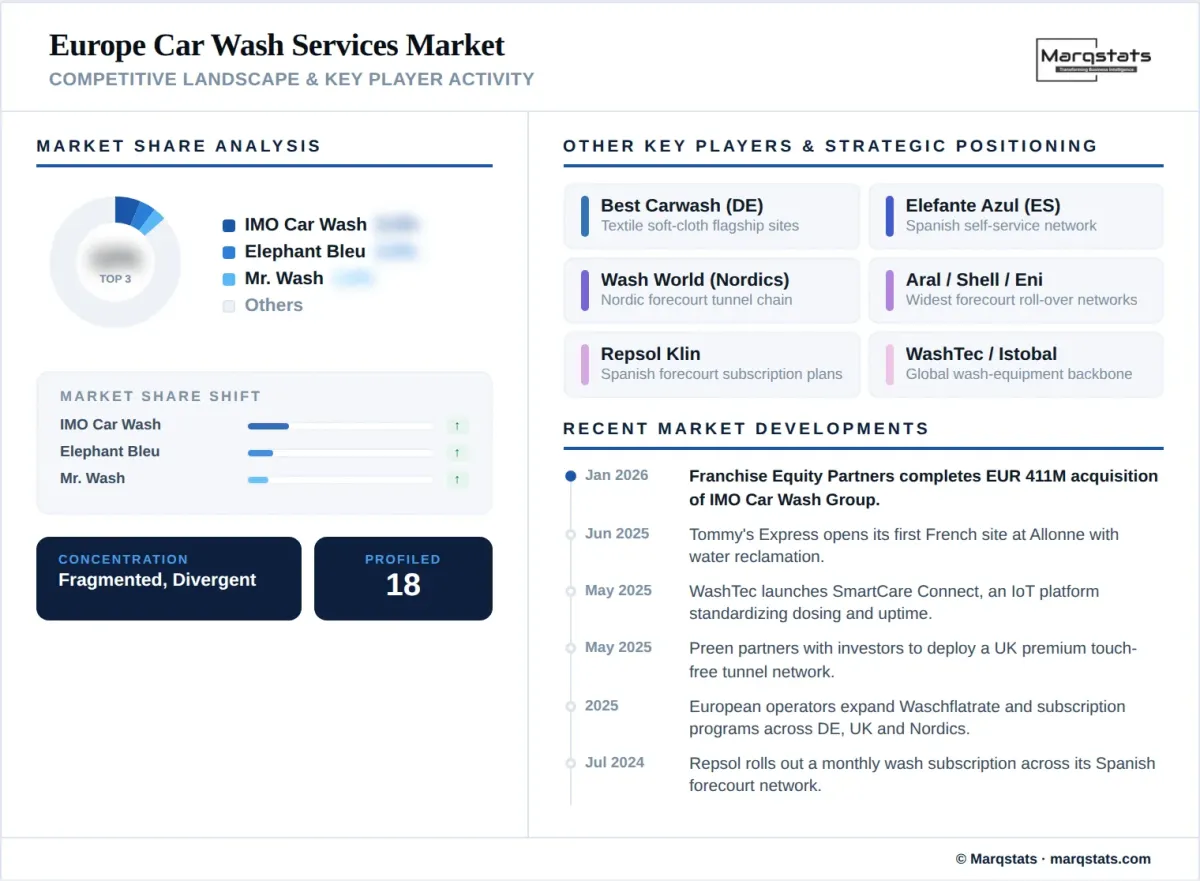
The Europe car wash services market is fragmented, with no operator holding a dominant regional share and competitive structures differing by country. IMO Car Wash Group is the widest automated network, operating more than 700 sites across Europe following its ownership change completed in early 2026. National champions anchor their home markets: Mr. Wash and Best Carwash in Germany, Elephant Bleu across France and neighbouring markets, Elefante Azul in Spain, and Wash World in the Nordics, alongside thousands of independents and hand car washes.
Fuel retailers form the second competitive tier. Aral, Shell, Esso, TotalEnergies, Eni, Repsol, and Circle K operate extensive forecourt roll-over networks bundled with fuel, convenience retail, and loyalty programs, holding the largest aggregate site share in Germany, France, Italy, and Spain. Their scale makes forecourt washing the backbone of Southern and Central European supply, while subscription plans such as Repsol's Spanish monthly offer extend recurring revenue into the forecourt channel.
Equipment makers form Europe's third and globally distinctive tier. WashTec of Augsburg, the world's largest wash-equipment manufacturer, together with Otto Christ, Karcher, Istobal of Spain, and Poland's BKF, supplies the technology backbone for operators worldwide and accelerates IoT, water-reclamation, and eco-chemistry adoption at home. Competition across all tiers increasingly turns on subscription penetration, water efficiency, digital site management, and compliance, with consolidation advancing gradually through chain expansion and franchise entry.
Companies Covered
The report profiles 18++ companies with full strategy and financials analysis, including:
Recent Market Activity
Table of Contents
Coverage & Segmentation
This report provides a comprehensive analysis of the Europe car wash services market covering the historical period 2021 to 2025 and the forecast period 2026 to 2030, with 2025 as the base year. The study aggregates Germany, the United Kingdom, France, Italy, and Spain together with the Rest of Europe, defining the market as annual revenue earned by professional and informal operators cleaning passenger and light commercial vehicles through in-bay automatic, tunnel/conveyor, self-service, and manual formats, inclusive of basic interior cleaning; full detailing and equipment or chemical sales are excluded. Market size is presented in value terms (USD billion), with historical figures reflecting euro and sterling exchange effects and forecasts assuming constant exchange rates.
The study segments the market by service type, payment model, site format, and vehicle type, with segment aggregates computed across the five modeled major markets, and examines country demand, format divergence, regulation, and competition across all six components. Market sizing aggregates bottom-up country models anchored to Destatis, the Kraftfahrt-Bundesamt, the UK Department for Transport, SDES, ACI, and DGT vehicle and turnover data, cross-checked against wash intensity per vehicle. The competitive section profiles 18 operators, fuel retailers, and equipment makers spanning the region.