Statistics & Highlights

Market Snapshot

Market size in USD Billion
$1.46B
2025
Base year
$1.52B
2026
Estimated
  
$1.81B
2030
Forecast
Largest market
Brazil
Fastest growing
Brazil
Dominant segment
Manual / Lava-Rapido & Hand Wash
Concentration
Fragmented
CAGR
4.42%
2026 – 2030
GROWTH
+$0.35B
Absolute
STUDY PARAMETERS
Base year2025
Historical period2021 – 2025
Forecast period2026 – 2030
Units consideredValue (USD BN)
REPORT COVERAGE
Segments covered4 segments
Regions covered3 regions
Companies profiled18++
Report pages280+
DeliverablesPDF, Excel, PPT
Executive Summary

Key Takeaways

South America car wash services market valued at USD 1.46 billion in 2025, projected to reach USD 1.81 billion by 2030 at a 4.42% CAGR.
Brazil dominates at 71.4% of 2025 revenue, ahead of the Rest of South America at 15.9% and Argentina at 12.7%.
Manual and hand-wash formats form the largest service type at about 68% of modeled-market revenue, with in-bay automatic second at about 18%.
Brazil grows fastest at a 4.60% CAGR, closely followed by the Rest of South America at 4.48%; Argentina lags at 3.30%.
Ecological, waterless franchise models, led from Brazil, are the region's principal formalization channel.
Wash intensity per vehicle spans USD 11.7 to USD 21 across the region, roughly 18% to 32% of the United States level.
Market Insights

Market Overview & Analysis

Report Summary

The South America car wash services market comprises professional and informal operators cleaning four-wheel vehicles across four service formats — manual lava-rapido and hand wash, in-bay automatic (roll-over), tunnel/conveyor, and self-service — monetized through pay-per-wash and subscription plans. The 2025 market of USD 1.46 billion aggregates Brazil (USD 1.04 billion), the Rest of South America (USD 0.23 billion), and Argentina (USD 0.19 billion).

South America's defining feature is Brazilian dominance over a shared manual-washing structure. Brazil, at nearly three-quarters of regional revenue, anchors the market with the largest parc, the deepest organized layer, and the region's ecological franchise template led by Acquazero and DryWash. Argentina and the Rest of South America follow the same lava-rapido-led pattern at smaller scale, with Argentina distinguished by heavy reliance on YPF fuel-station forecourts and the Rest of South America by ultra-low tickets across Chile, Colombia, Peru, and neighbouring markets.

Aggregated across the two modeled major markets, manual and hand wash holds the largest share at about 68% of 2025 revenue (USD 0.83 billion), reflecting Brazil's lava-rapido base and Argentina's hand-wash sector, followed by in-bay automatic at about 18% (USD 0.22 billion), tunnels at about 8% (USD 0.09 billion), and self-service at about 7% (USD 0.08 billion). This manual-led structure resembles emerging Asia-Pacific more than the automated markets of North America and Europe, and reflects abundant low-cost labour and strong hand-wash cultural preference across the region.

Formalization runs through franchising and fuel-retail forecourts rather than automation. At tickets ranging from about USD 2.6 in the Rest of South America to USD 3.5 in Brazil, manual washing remains cheaper to deliver than automated washing wherever labour is abundant, so organized growth comes from branded franchise networks, ecological differentiation, subscription clubs, and forecourt machine installation. Wash intensity per vehicle spans an emerging-market range — about USD 21 in Brazil, USD 15 in Argentina, and USD 11.7 across the Rest of South America — versus roughly USD 66 in the United States, framing a long formalization and premiumization runway.

Water conservation and macroeconomic volatility shape the region's evolution. Periodic drought and rising water costs in major cities make waterless and low-water franchise methods a competitive advantage, exported most prominently from Brazil, while currency depreciation and inflation — most acute in Argentina — weigh on dollar-denominated market value and investment. These forces make the region's growth path steadier in Brazil and the Andean markets than in Argentina, where macroeconomic conditions add volatility to underlying demand.

South America's position within the global market is distinctive. At USD 1.46 billion, it is smaller than every other major region yet grows at a healthy 4.42%, faster than mature North America and Europe though slower than emerging Asia-Pacific. Its manual-led, franchise-formalizing structure most closely resembles India and the Rest of Asia-Pacific, and its growth path depends on how quickly Brazil's ecological franchise template spreads to Argentina and the Andean markets, how far forecourt washing extends organized supply, and whether macroeconomic stabilization allows Argentine and regional tickets to rise in real terms through 2030.

Market Dynamics

Key Drivers

  • Vehicle-parc expansion across Brazil and the Rest of South America steadily enlarges the addressable washing base.
  • Formalization through franchising converts informal manual demand into organized, standardized capacity.
  • Ecological and waterless franchise models, led from Brazil, differentiate organized operators amid water scarcity.
  • Subscription and membership-club plans convert episodic demand into recurring revenue across organized chains.
  • Fuel-retailer forecourt washing, anchored by YPF in Argentina and major Brazilian networks, adds organized capacity.
  • High wash frequency and strong hand-wash preference sustain large underlying volumes across the region.

Key Restraints

  • Very low tickets across all three markets cap revenue per wash and stretch automated-equipment payback.
  • Currency depreciation and inflation, most acute in Argentina, weigh on dollar-denominated value and investment.
  • Large informal bases with limited regulation constrain standards, water use, and pricing power.
  • Abundant low-cost labour keeps manual washing economically dominant, slowing automation.

Key Trends

  • Ecological, waterless franchise expansion spreads from Brazil across the region.
  • Subscription clubs formalize recurring washing, bundling cleaning with detailing services.
  • Fuel retailers add forecourt washing as non-fuel revenue across YPF, Copec, Terpel, and Brazilian networks.
  • Instant-payment rails, led by Brazil's Pix, lower friction for small operators and subscription billing.
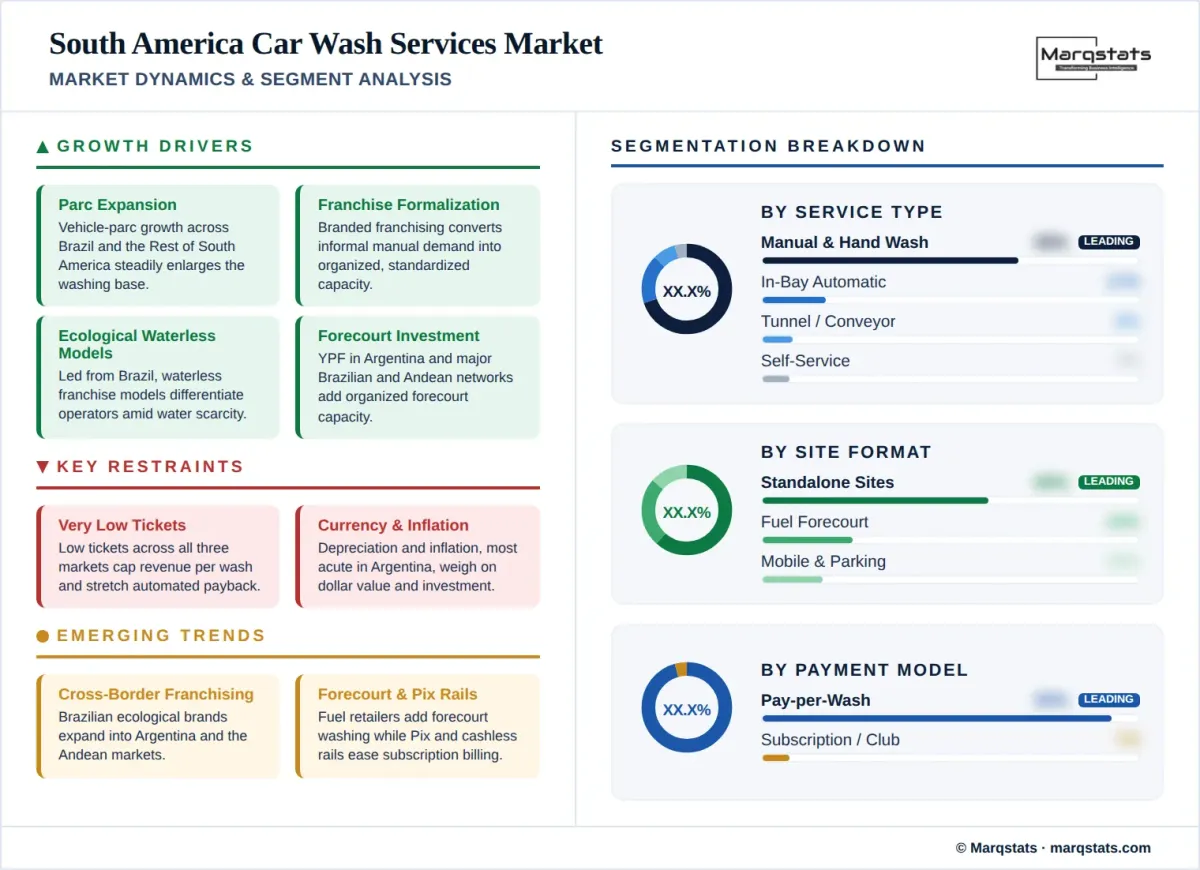
South America Car Wash Services Market Market Dynamics Segment Analysis Infographic
Segment Analysis

Market Segmentation

Manual / Lava-Rapido & Hand Wash
Leading

Manual and hand-wash formats hold the largest share at about 68% of 2025 modeled-market revenue, USD 0.83 billion, spanning Brazil's lava-rapido operations at about 69% of national revenue and Argentina's hand-wash sector at about 60%. The Rest of South America is similarly manual-dominated. The regional share eases gradually as franchising and automation advance, yet manual washing remains the region's structural core, sustained by low labour costs and strong hand-wash preference. Franchise networks formalize the upper tier of the segment with ecological washing, standardized service, and subscription-based offers.

In-Bay Automatic (Roll-over)

In-bay automatic roll-overs hold about 18% of 2025 modeled-market revenue, USD 0.22 billion, the largest automated format. Machines concentrate at fuel-station forecourts and organized outlets across Brazil and Argentina, where YPF and major Brazilian fuel networks anchor adoption. The format gains share region-wide as emerging markets automate from a manual base at higher-traffic sites, and falling equipment costs gradually improve payback where wash volumes are highest.

Tunnel / Conveyor

Tunnel/conveyor washes hold about 8% of 2025 modeled-market revenue, USD 0.09 billion, and are among the fastest-growing formats. Express tunnels concentrate in Sao Paulo, Buenos Aires, and other large metros, where throughput and membership economics justify land and capital costs, and integrate most readily with subscription plans. The format captures the bulk of new automated investment as organized operators seek throughput that manual washing cannot match at scale.

Self-Service

Self-service bays hold about 7% of 2025 modeled-market revenue, USD 0.08 billion, growing steadily from a small base at fuel stations and standalone sites. The format serves cost-conscious users and enthusiasts, and faces strong competition from cheap full-service manual washing across the region's low-wage markets. Cashless and app-based payment increasingly support the format at newer sites.

Standalone Sites (incl. Informal Lots)
Leading

Standalone sites, including informal lots, organized outlets, and franchise stores, hold about 60% of 2025 modeled-market revenue, USD 0.74 billion. The channel includes the bulk of manual lava-rapido and hand washing alongside franchise and detailing outlets, and consolidates gradually around branded, standardized formats across Brazil and Argentina. Shopping-centre franchise units, a format pioneered in Brazil, extend organized washing into high-traffic retail locations across the region's largest cities.

Fuel-Station Forecourt

Forecourt washes hold about 24% of 2025 modeled-market revenue, USD 0.29 billion, the fastest-growing site format. YPF anchors Argentine forecourt washing at about 30% of national revenue, while Petrobras-branded stations, Ipiranga, Shell, and Vibra networks add capacity in Brazil, and Copec, Terpel, and Primax expand forecourt washing across the Rest of South America. Fuel retailers treat washing as a growing non-fuel revenue line, bundling it with convenience retail and loyalty programs across the region's dense service-station networks.

Others (Mobile, Parking)

Mobile and parking-lot formats hold about 16% of 2025 modeled-market revenue, USD 0.20 billion. Mobile ecological washing, shopping-centre franchise kiosks, and app-booked doorstep services serve convenience-oriented demand across major cities, with Brazil's mobile ecological model the region's most developed. The low-water, no-fixed-site model has become a low-cost entry route for franchise operators in dense, water-conscious metros.

Pay-per-Wash
Leading

Single-visit payment accounts for about 93% of 2025 modeled-market revenue, USD 1.14 billion, reflecting walk-up demand across informal, forecourt, and organized formats. The share declines as subscriptions expand, supported by instant-payment rails led by Brazil's Pix and cashless payment across Argentine and Andean markets. Digital payment has been a quiet enabler of formalization, letting small operators accept cashless payment and improving revenue tracking across a historically cash-based sector.

Subscription / Membership

Subscription and membership plans reach about 7% of 2025 modeled-market revenue, USD 0.08 billion, and are the fastest-growing revenue stream. Franchise membership clubs led from Brazil, together with organized-chain plans, formalize recurring washing relationships. Recurring revenue is the primary lever operators use to stabilize demand, especially valuable where mobility-as-a-service fleets and ride-hailing drivers require regular, predictable washing.

Passenger Cars
Leading

Passenger vehicles generate about 85% of 2025 modeled-market revenue, USD 1.05 billion, reflecting household demand for frequent, low-cost cleaning across the region. The share eases slightly as commercial washing grows faster, though private-vehicle washing remains the market's core, sustained by strong car culture and limited home-washing in dense urban housing across Brazilian and Argentine cities.

Commercial Vehicles (incl. Fleet)

Commercial washing holds about 15% of 2025 modeled-market revenue, USD 0.19 billion, among the highest commercial shares of any region. Ride-hailing, delivery, and logistics fleets sustain high-frequency washing across Brazil's and Argentina's dense metros and transport corridors, with app-based ride-hailing a growing source of demand. Fleet-leasing and rental operators add contracted washing volumes, and platform presentation standards keep driver washing frequent.

Regional Analysis

By Geography

Brazil

Brazil is the region's dominant market, contributing USD 1.04 billion, or 71.4% of 2025 regional revenue, and growing fastest at a 4.60% CAGR to USD 1.30 billion by 2030. Manual lava-rapido washing holds about 69% of national revenue, and the organized layer is led by ecological franchise networks Acquazero and DryWash, which export waterless models internationally. Fuel retailers Petrobras, Ipiranga, Shell, and Vibra add forecourt washing, subscription clubs drive the fastest-growing revenue stream, and Pix instant payment accelerates formalization across the sector. Brazil's scale and franchise maturity make it the template the rest of the region follows.

Argentina

Argentina contributes USD 0.19 billion, or 12.7% of 2025 regional revenue, growing at a 3.30% CAGR to USD 0.22 billion by 2030 — the slowest of the three components under currency and inflation pressure. Manual and hand-wash formats hold about 60% of national revenue, while YPF, the dominant national fuel retailer, channels about 30% of washing through its forecourts, the highest fuel-station share in the region. Macroeconomic volatility weighs on dollar-denominated value, though underlying wash demand across a parc of roughly 11.5 million vehicles remains resilient. Buenos Aires anchors organized demand, and a gradual stabilization of the economy would support real ticket growth and franchise entry.

Rest of South America

The Rest of South America contributes USD 0.23 billion, or 15.9% of 2025 regional revenue, growing at a 4.48% CAGR to USD 0.29 billion by 2030 — closely tracking Brazil as the region's second-fastest component. Spanning Chile, Colombia, Peru, Ecuador, Uruguay, Venezuela, Bolivia, and Paraguay, the market is manual-dominated at ultra-low tickets near USD 2.6 across an aggregate four-wheel parc of roughly 18 million. Fuel retailers Copec, Terpel, and Primax anchor forecourt washing, and organized franchise entry advances from Brazil and Chile as motorization and incomes rise. Chile and Colombia lead organized penetration within the group, while Andean and smaller markets remain almost entirely informal.
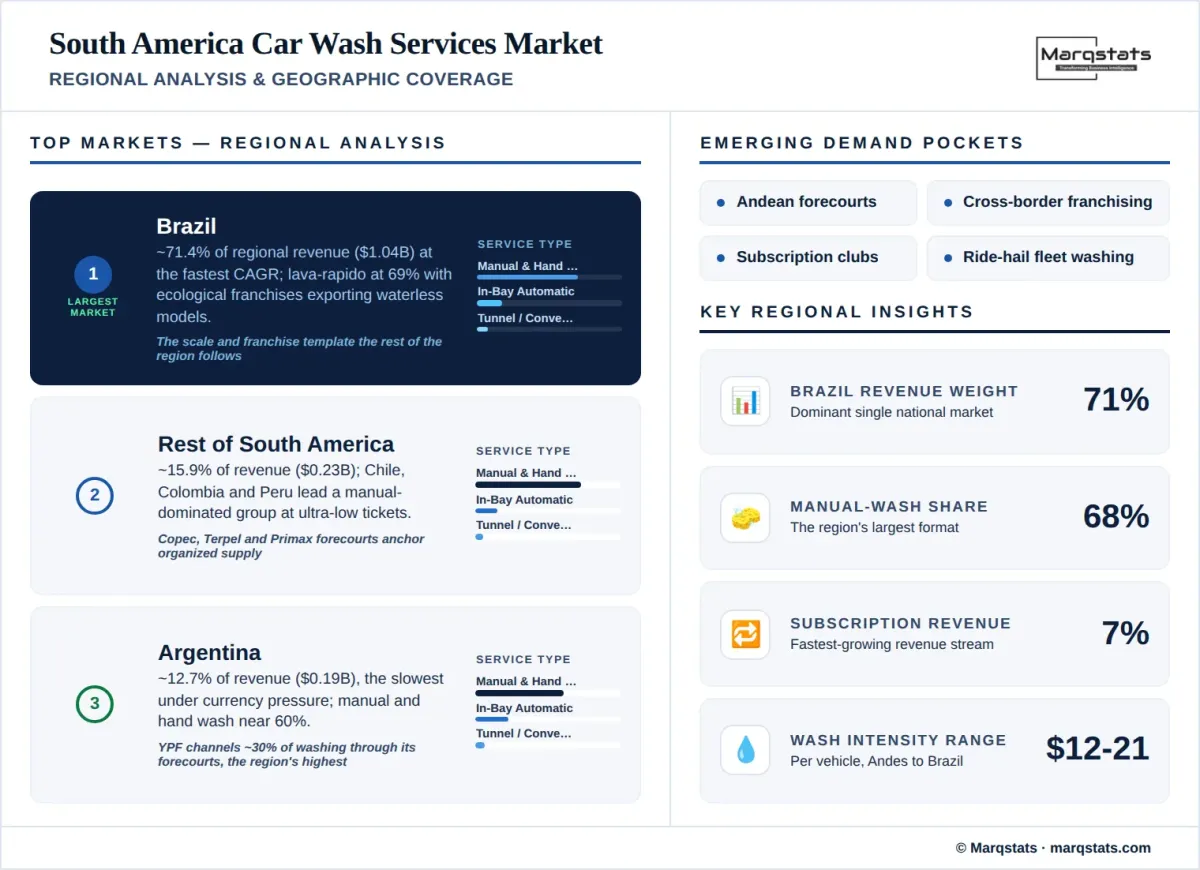
South America Car Wash Services Market Regional Analysis Geographic Coverage Infographic
Competitive Landscape

How Competition Is Evolving

The South America car wash services market is intensely fragmented, with informal manual operators delivering the majority of washes and no operator holding a material regional share. The organized layer is led from Brazil by ecological franchise networks: Acquazero, the largest automotive-cleaning franchise with hundreds of units, and DryWash, a waterless pioneer of over 30 years, anchor the segment and export their models across the region and abroad, alongside Freewet and independent detailing studios.

Fuel retailers form the region's most consistent organized channel. YPF dominates Argentine forecourt washing, Petrobras-branded stations, Ipiranga, Shell through Raizen, and Vibra operate extensive Brazilian networks, and Copec, Terpel, Primax, and Enex expand forecourt washing across Chile, Colombia, and Peru. These networks bundle washing with fuel and convenience retail, making forecourts the backbone of organized supply outside Brazil's franchise sector. Their national reach gives them a distribution advantage that independent operators and franchises cannot easily match outside the major metros.

Competition turns on franchise economics, water efficiency, and forecourt convenience. Waterless and low-water methods differentiate franchise brands amid drought and rising water costs, subscription clubs build recurring revenue, and fuel retailers compete on location and fuel-linked loyalty. Equipment suppliers WashTec, Karcher, and Istobal support the automated tiers, and detailing-chemical brands add to the premium end. Formalization is expected to advance steadily through franchising and forecourt investment, while the vast informal base keeps the market fragmented and Brazil-anchored through 2030. Cross-border franchise expansion, particularly from Brazilian ecological brands into Argentina and the Andean markets, is the most likely path to regional consolidation.
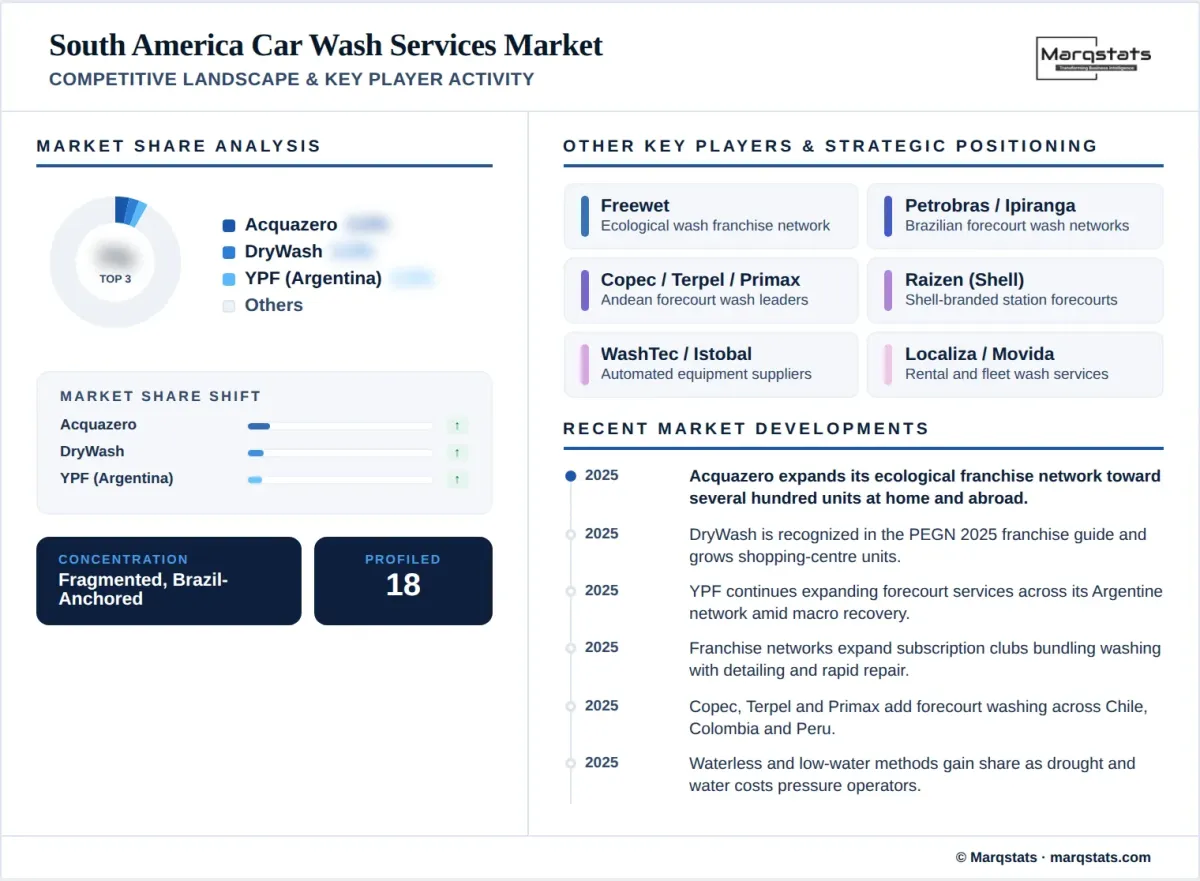
South America Car Wash Services Market Competitive Landscape Key Player Activity Infographic
Major Players

Companies Covered

The report profiles 18++ companies with full strategy and financials analysis, including:

Acquazero Car Wash
DryWash
Freewet
Petrobras (Petrobras Distribuidora / forecourt washes)
Vibra Energia S.A.
Ipiranga (Ultrapar Participacoes S.A.)
Raizen S.A. (Shell-branded stations)
YPF S.A.
Axion Energy Argentina
Organizacion Terpel S.A.
Empresas Copec S.A.
Primax (Peru & Ecuador)
Enex S.A. (Chile)
WashTec AG
Alfred Karcher (South America)
Istobal (South America operations)
Turtle Wax (Latin America)
Localiza & Movida (Fleet Wash Services)
Note: Full company profiles include revenue analysis, product portfolio, SWOT, and recent strategic developments.
Latest Developments

Recent Market Activity

2025
Acquazero expanded its ecological franchise network toward several hundred units across Brazil and international markets.
2025
DryWash was recognized in the Pequenas Empresas & Grandes Negocios 2025 franchise guide and expanded shopping-centre units.
2025
YPF continued to expand forecourt services across its Argentine service-station network amid macroeconomic recovery efforts.
2025
Franchise networks expanded subscription clubs bundling washing with detailing and rapid-repair services.
2025
Fuel retailers Copec, Terpel, and Primax added forecourt washing across Chile, Colombia, and Peru.
2025
Waterless and low-water methods gained share as drought and rising water costs pressured traditional operators.
Report Structure

Table of Contents

1. Introduction
1.1 Study Assumptions & Market Definition
1.1.1 Scope — Professional & Informal Car Wash Services (Brazil, Argentina, Rest of SA)
1.1.2 Formats Covered — Manual Lava-Rapido, In-Bay Automatic, Tunnel, Self-Service
1.1.3 Inclusions — Four-Wheel Cleaning, Interior, Tickets, Subscriptions
1.1.4 Exclusions — Full Detailing, Vitrification & Equipment Sales
1.1.5 Market Metric — Annual Service Revenue (USD)
1.2 Scope of the Study
1.3 Currency, FX Treatment & Base Year (2025)
1.4 Key Definitions & Regional Terminology
1.4.1 Lava-Rapido & Hand Wash
1.4.2 Ecological / Waterless Washing
1.4.3 Franchise Networks & Subscription Clubs
1.4.4 Fuel-Station Forecourt Washing
2. Research Methodology
2.1 Analysis Framework & Regional Aggregation
2.2 Brazil Model — SENATRAN Fleet & IBGE Services Survey
2.3 Argentina Model — DNRPA Registration
2.4 Rest of South America — Aggregate Parc (~18M, Chile, Colombia, Peru & Others)
2.5 Country-to-Region Summation & Cross-Checks
2.5.1 Wash-Intensity Gradient (USD 11.7–21 per Vehicle vs. US ~66)
2.6 FX Treatment — USD Terms, Argentine Depreciation, Constant-FX Forecast
2.7 Informality Note — Large Unregistered Base Across the Region
2.8 Primary Research — 40+ Interviews Across the Region
2.9 Assumptions & Limitations
3. Executive Summary
3.1 South America Market Size & Forecast Snapshot 2021–2030
3.2 Country Shares — Brazil 71.4%, Rest of SA 15.9%, Argentina 12.7%
3.3 Brazil-Anchored, Manual-Led Regional Structure
3.4 Franchise-Led Formalization & Ecological Positioning
3.5 Key Findings & Analyst Takeaways
4. Market Overview & Definitions
4.1 Regional Structure & Country Contributions
4.1.1 Brazil — Lava-Rapido Base & Ecological Franchise Template
4.1.2 Argentina — YPF Forecourt-Led, Macro-Constrained
4.1.3 Rest of South America — Manual, Ultra-Low-Ticket
4.2 Value Chain & Ecosystem
4.2.1 Ecological Franchise Networks & Detailing Studios
4.2.2 Fuel Retailers & Forecourt Washing
4.2.3 Equipment Suppliers & Instant-Payment Rails
4.3 Combined Vehicle Parc & Wash Behavior
4.4 Wash-Intensity Gradient & Formalization Headroom
5. Market Dynamics
5.1 Key Drivers
5.1.1 Vehicle-Parc Expansion (Brazil & Rest of SA)
5.1.2 Formalization Through Franchising
5.1.3 Ecological / Waterless Differentiation
5.1.4 Subscription & Membership-Club Adoption
5.1.5 Fuel-Retailer Forecourt Washing (YPF, Copec, Terpel)
5.1.6 High Wash Frequency & Hand-Wash Preference
5.2 Key Restraints
5.2.1 Very Low Tickets Across All Three Markets
5.2.2 Currency Depreciation & Inflation (Argentina)
5.2.3 Large Informal Base & Limited Regulation
5.2.4 Abundant Low-Cost Labour Slowing Automation
5.3 Key Trends
5.3.1 Ecological / Waterless Franchise Expansion from Brazil
5.3.2 Subscription-Club Formalization
5.3.3 Fuel-Retailer Forecourt Washing Growth
5.3.4 Instant-Payment Enablement (Pix & Regional Rails)
5.4 Porter's Five Forces Analysis
5.5 Regional Value Chain Analysis
6. Regulatory & Environmental Framework
6.1 Water Restrictions & Drought Management (Brazil, Chile)
6.2 Wastewater & Effluent-Discharge Rules
6.3 Waterless / Ecological Washing Standards
6.4 Franchising & Establishment Regulation
6.5 Labour & Informal-Sector Compliance
7. Technology & Format Innovation
7.1 Waterless & Low-Water Washing Systems
7.2 Roll-Over & Semi-Automatic Machines
7.3 Express Tunnel & Conveyor Systems
7.4 Subscription & Instant-Payment Platforms
7.5 Detailing, Vitrification & PPF Technologies
8. Franchising & Subscription Economics
8.1 Franchise Model & Unit Economics
8.2 Subscription-Club Model & Recurring Revenue
8.3 Ecological Positioning & Premiumization
8.4 Cross-Border Franchise Expansion from Brazil
9. South America Car Wash Services Market Sizing & Forecast
9.1 Regional Market Size & Forecast 2021–2030
9.1.1 Historical Revenue 2021–2025 (incl. FX Effect)
9.1.2 Forecast Revenue 2026–2030 (Constant FX)
9.1.3 CAGR & Absolute Growth
9.2 Country-Level Sizing & Share Trend
9.2.1 Brazil 2021–2030
9.2.2 Argentina 2021–2030
9.2.3 Rest of South America 2021–2030
10. Market Segmentation — By Service Type
10.1 Manual / Lava-Rapido & Hand Wash
10.1.1 Revenue & Share 2021–2030 (~68% of Modeled Revenue)
10.1.2 Brazilian Lava-Rapido & Argentine Hand-Wash Base
10.2 In-Bay Automatic (Roll-over)
10.2.1 Revenue & Share 2021–2030 (~18%)
10.2.2 Forecourt & Organized-Outlet Machines
10.3 Tunnel / Conveyor
10.3.1 Revenue & Share 2021–2030 (~8%)
10.3.2 Express Tunnels in Sao Paulo & Buenos Aires
10.4 Self-Service
10.4.1 Revenue & Share 2021–2030 (~7%)
11. Market Segmentation — By Site Format
11.1 Standalone Sites (incl. Informal Lots)
11.1.1 Revenue & Share 2021–2030 (~60%)
11.2 Fuel-Station Forecourt
11.2.1 Revenue & Share 2021–2030 (~24%)
11.2.2 YPF, Petrobras, Ipiranga, Copec & Terpel Networks
11.3 Others (Mobile, Parking)
11.3.1 Revenue & Share 2021–2030 (~16%)
12. Market Segmentation — By Payment Model
12.1 Pay-per-Wash
12.1.1 Revenue & Share 2021–2030 (~93%)
12.1.2 Pix & Regional Instant-Payment Rails
12.2 Subscription / Membership
12.2.1 Revenue & Share 2021–2030 (~7%, Fastest-Growing)
12.2.2 Franchise Membership-Club Growth
13. Market Segmentation — By Vehicle Type
13.1 Passenger Cars
13.1.1 Revenue & Share 2021–2030 (~85%)
13.2 Commercial Vehicles (incl. Fleet)
13.2.1 Revenue & Share 2021–2030 (~15%)
13.2.2 Ride-Hailing, Delivery & Logistics Demand
14. Regional Analysis — By Country
14.1 Brazil — Largest & Fastest — 71.4%, 4.60% CAGR
14.1.1 Market Size & Forecast 2021–2030
14.1.2 Lava-Rapido Base & Ecological Franchises (Acquazero, DryWash)
14.1.3 Fuel Forecourts, Subscription Clubs & Pix
14.2 Argentina — YPF Forecourt-Led — 12.7%, 3.30% CAGR
14.2.1 Market Size & Forecast 2021–2030
14.2.2 Hand-Wash Base & YPF Forecourt Dominance
14.2.3 Macroeconomic Volatility & Resilient Demand
14.3 Rest of South America — Second-Fastest — 15.9%, 4.48% CAGR
14.3.1 Market Size & Forecast 2021–2030
14.3.2 Chile, Colombia, Peru, Ecuador, Uruguay, Venezuela, Bolivia, Paraguay
14.3.3 Ultra-Low-Ticket Manual Base & Forecourt Entry
15. Competitive Landscape
15.1 Regional Structure & Fragmentation
15.2 Brazilian Ecological Franchise Networks (Acquazero, DryWash, Freewet)
15.3 Fuel-Retailer Networks (YPF, Petrobras, Copec, Terpel, Primax)
15.4 Equipment Suppliers & Detailing Brands
15.5 Competitive Variables — Franchise Economics, Water Efficiency, Forecourt Convenience
16. Company Profiles
16.1 Acquazero Car Wash
16.1.1 Company Overview
16.1.2 Format & Service / Franchise Portfolio
16.1.3 Network Footprint & Country Presence
16.1.4 Subscription / Water-Efficiency / Technology Approach
16.1.5 Recent Strategic Developments
16.2 DryWash
16.2.1 Company Overview
16.2.2 Format & Service / Franchise Portfolio
16.2.3 Network Footprint & Country Presence
16.2.4 Subscription / Water-Efficiency / Technology Approach
16.2.5 Recent Strategic Developments
16.3 Freewet
16.3.1 Company Overview
16.3.2 Format & Service / Franchise Portfolio
16.3.3 Network Footprint & Country Presence
16.3.4 Subscription / Water-Efficiency / Technology Approach
16.3.5 Recent Strategic Developments
16.4 Petrobras (Petrobras Distribuidora / forecourt washes)
16.4.1 Company Overview
16.4.2 Format & Service / Franchise Portfolio
16.4.3 Network Footprint & Country Presence
16.4.4 Subscription / Water-Efficiency / Technology Approach
16.4.5 Recent Strategic Developments
16.5 Vibra Energia S.A.
16.5.1 Company Overview
16.5.2 Format & Service / Franchise Portfolio
16.5.3 Network Footprint & Country Presence
16.5.4 Subscription / Water-Efficiency / Technology Approach
16.5.5 Recent Strategic Developments
16.6 Ipiranga (Ultrapar Participacoes S.A.)
16.6.1 Company Overview
16.6.2 Format & Service / Franchise Portfolio
16.6.3 Network Footprint & Country Presence
16.6.4 Subscription / Water-Efficiency / Technology Approach
16.6.5 Recent Strategic Developments
16.7 Raizen S.A. (Shell-branded stations)
16.7.1 Company Overview
16.7.2 Format & Service / Franchise Portfolio
16.7.3 Network Footprint & Country Presence
16.7.4 Subscription / Water-Efficiency / Technology Approach
16.7.5 Recent Strategic Developments
16.8 YPF S.A.
16.8.1 Company Overview
16.8.2 Format & Service / Franchise Portfolio
16.8.3 Network Footprint & Country Presence
16.8.4 Subscription / Water-Efficiency / Technology Approach
16.8.5 Recent Strategic Developments
16.9 Axion Energy Argentina
16.9.1 Company Overview
16.9.2 Format & Service / Franchise Portfolio
16.9.3 Network Footprint & Country Presence
16.9.4 Subscription / Water-Efficiency / Technology Approach
16.9.5 Recent Strategic Developments
16.10 Organizacion Terpel S.A.
16.10.1 Company Overview
16.10.2 Format & Service / Franchise Portfolio
16.10.3 Network Footprint & Country Presence
16.10.4 Subscription / Water-Efficiency / Technology Approach
16.10.5 Recent Strategic Developments
16.11 Empresas Copec S.A.
16.11.1 Company Overview
16.11.2 Format & Service / Franchise Portfolio
16.11.3 Network Footprint & Country Presence
16.11.4 Subscription / Water-Efficiency / Technology Approach
16.11.5 Recent Strategic Developments
16.12 Primax (Peru & Ecuador)
16.12.1 Company Overview
16.12.2 Format & Service / Franchise Portfolio
16.12.3 Network Footprint & Country Presence
16.12.4 Subscription / Water-Efficiency / Technology Approach
16.12.5 Recent Strategic Developments
16.13 Enex S.A. (Chile)
16.13.1 Company Overview
16.13.2 Format & Service / Franchise Portfolio
16.13.3 Network Footprint & Country Presence
16.13.4 Subscription / Water-Efficiency / Technology Approach
16.13.5 Recent Strategic Developments
16.14 WashTec AG
16.14.1 Company Overview
16.14.2 Format & Service / Franchise Portfolio
16.14.3 Network Footprint & Country Presence
16.14.4 Subscription / Water-Efficiency / Technology Approach
16.14.5 Recent Strategic Developments
16.15 Alfred Kärcher (South America)
16.15.1 Company Overview
16.15.2 Format & Service / Franchise Portfolio
16.15.3 Network Footprint & Country Presence
16.15.4 Subscription / Water-Efficiency / Technology Approach
16.15.5 Recent Strategic Developments
16.16 Istobal (South America operations)
16.16.1 Company Overview
16.16.2 Format & Service / Franchise Portfolio
16.16.3 Network Footprint & Country Presence
16.16.4 Subscription / Water-Efficiency / Technology Approach
16.16.5 Recent Strategic Developments
16.17 Turtle Wax (Latin America)
16.17.1 Company Overview
16.17.2 Format & Service / Franchise Portfolio
16.17.3 Network Footprint & Country Presence
16.17.4 Subscription / Water-Efficiency / Technology Approach
16.17.5 Recent Strategic Developments
16.18 Localiza & Movida (Fleet Wash Services)
16.18.1 Company Overview
16.18.2 Format & Service / Franchise Portfolio
16.18.3 Network Footprint & Country Presence
16.18.4 Subscription / Water-Efficiency / Technology Approach
16.18.5 Recent Strategic Developments
17. Investment, Formalization & Franchise Analysis
17.1 Franchise Network Expansion & Unit Economics
17.2 Subscription-Club & Recurring-Revenue Investment
17.3 Fuel-Retailer Non-Fuel Wash Investment
17.4 Water-Efficiency & Equipment Capex
18. Opportunities, Risks & Strategic Recommendations
18.1 Growth Opportunities by Country & Format
18.2 Ticket, Currency, Water & Informality Risk Assessment
18.3 Franchising, Subscription & Cross-Border Strategy
18.4 Strategic Recommendations for Operators & Investors
19. Appendix
19.1 Research Methodology Detail
19.2 Country Model Aggregation & Confidence Flags
19.3 Abbreviations & Glossary
19.4 List of Tables
19.5 List of Figures
19.6 Disclaimer & Legal Notice
Study Scope & Focus

Coverage & Segmentation

This report provides a comprehensive analysis of the South America car wash services market covering the historical period 2021 to 2025 and the forecast period 2026 to 2030, with 2025 as the base year. The study aggregates Brazil, Argentina, and the Rest of South America, defining the market as annual revenue earned by professional and informal operators cleaning four-wheel vehicles through manual lava-rapido and hand wash, in-bay automatic, tunnel/conveyor, and self-service formats, inclusive of basic interior cleaning; full detailing and equipment or chemical sales are excluded. Market size is presented in value terms (USD), with historical figures reflecting real exchange effects and forecasts assuming constant exchange rates.

The study segments the market by service type, site format, payment model, and vehicle type, with segment aggregates computed across the two modeled major markets, and examines country demand, formalization, water conservation, and macroeconomic conditions across all three components. Market sizing aggregates bottom-up country models anchored to SENATRAN and DNRPA vehicle-registration data, cross-checked against wash intensity per vehicle. The competitive section profiles 18 franchise networks, fuel retailers, and equipment suppliers spanning the region.

Frequently Asked Questions

FAQs About the South America Car Wash Services Market

The South America car wash services market is valued at approximately USD 1.46 billion in 2025 and is projected to reach USD 1.81 billion by 2030, expanding at a 4.42% CAGR. It aggregates Brazil, Argentina, and the Rest of South America.
The market is expected to grow at a 4.42% CAGR between 2025 and 2030, driven by vehicle-parc expansion, formalization through franchising, and real pricing gains, led by Brazil and the Andean markets.
Brazil dominates at about 71.4% of 2025 revenue (USD 1.04 billion), followed by the Rest of South America at 15.9% and Argentina at 12.7%. Brazil also grows fastest at a 4.60% CAGR, closely followed by the Rest of South America at 4.48%.
Manual and hand-wash formats form the largest service type at about 68% of modeled-market revenue — driven by Brazil's lava-rapido base and Argentina's hand-wash sector — with in-bay automatic second at about 18%. The structure resembles emerging Asia-Pacific more than automated North America or Europe.
Brazil leads with a fast-expanding ecological franchise sector and Pix-enabled subscriptions, Argentina channels about 30% of washing through YPF fuel-station forecourts amid macroeconomic volatility, and the Rest of South America is manual-dominated at ultra-low tickets across Chile, Colombia, Peru, and neighbouring markets.
Major players include Brazil's ecological franchises Acquazero and DryWash; fuel retailers Petrobras, Ipiranga, Vibra, and Raizen in Brazil, YPF and Axion in Argentina, and Copec, Terpel, and Primax across the Andean markets; and equipment suppliers WashTec, Karcher, and Istobal.
The report is delivered as a PDF report (280+ pages), Excel data tables with market sizing across 2021–2030 by country, segment, and format, and a PowerPoint summary deck, with analyst email support included in every licence tier.