Statistics & Highlights

Market Snapshot

Market size in USD Billion
$0.70B
2025
Base year
$0.74B
2026
Estimated
  
$0.92B
2030
Forecast
Largest market
Riyadh Region (Central)
Fastest growing
Riyadh Region (Central)
Dominant segment
Manual / Hand Wash & Mobile
Concentration
Fragmented
CAGR
5.48%
2026 – 2030
GROWTH
+$0.22B
Absolute
STUDY PARAMETERS
Base year2025
Historical period2021 – 2025
Forecast period2026 – 2030
Units consideredValue (USD BN)
REPORT COVERAGE
Segments covered4 segments
Regions covered5 regions
Companies profiled16++
Report pages250+
DeliverablesPDF, Excel, PPT
Executive Summary

Key Takeaways

Saudi Arabia car wash services market valued at USD 702 million in 2025, projected to reach USD 917 million by 2030 at a 5.48% CAGR.
An active parc of roughly 12 million (GASTAT) is washed about 20 times per vehicle each year, the highest frequency of any emerging market, driven by desert dust.
Wash intensity of roughly USD 52 per vehicle reaches about 79% of the United States level, the highest of any emerging market.
Manual station washes dominate with about 64% of 2025 revenue, declining under automation mandates as roll-over and tunnel formats gain share.
Subscription plans reach about 10% of revenue and grow near 14% annually, the fastest stream, led by fuel-retailer and app-based memberships.
Water scarcity, a majority water-recycling mandate, and municipal automation rules drive steam, waterless, and recycled-water methods.
Market Insights

Market Overview & Analysis

Report Summary

The Saudi Arabia car wash services market comprises professional operators cleaning four-wheel vehicles across four service formats — manual and mobile hand wash, in-bay automatic (roll-over), tunnel/conveyor, and self-service — monetized through pay-per-wash and subscription plans. The 2025 market of USD 702 million sits against an active parc of roughly 12 million, with paid-wash penetration near 65% and the highest wash frequency of any emerging market at about 20 washes per vehicle annually, driven by pervasive desert dust and sand.

The market's defining characteristic is high demand intensity meeting rapid formalization. At about USD 52 per vehicle, wash intensity approaches developed-market levels despite low tickets, because dust and sand force frequent cleaning across the Kingdom. Manual station washes — attended hand washing at dedicated sites and fuel forecourts — still hold about 64% of revenue, yet the organized layer is expanding quickly through steam and automated operators such as Petromin Express, fuel-retailer networks including SASCO and Aldrees, automated specialists, and app-based on-demand services.

Vision 2030 reshapes the market structure. The Kingdom's economic-diversification program drives organized retail buildout, technology adoption, and subscription models, while water policy transforms operating methods. Municipalities have begun licensing and enforcing a transition from manual to automatic car washing at fuel stations and service centres, allowing existing manual operations only until current licences expire. This regulatory shift, unique among manual-dominated markets, accelerates automation and gives compliant, water-efficient operators a structural advantage.

Water scarcity is both constraint and catalyst. Saudi Arabia faces a water deficit of about 3.5 billion cubic metres annually, and a traditional wash consumes upward of 100 litres, so operators must recycle a majority of wash water under national water strategy. Steam systems, such as Petromin's eco-steam wash, use only a few litres per vehicle, and waterless and recycled-water methods spread rapidly. This positions the Kingdom as the Gulf's proving ground for water-efficient washing, alongside its neighbours pursuing similar sustainability targets.

Saudi Arabia's structure is distinct from every other manual-dominated market in this series. Where India, Brazil, and much of Asia-Pacific let manual washing persist on wage economics, the Kingdom is actively legislating it out at fuel stations while pairing high demand intensity with the capital to automate quickly. This makes Saudi Arabia a rare case where regulation, not just economics, drives the shift from manual to automated washing, compressing a formalization path that takes decades elsewhere into a policy-driven transition through 2030. The combination of near-developed-market intensity, low tickets, and rapid regulatory change gives the market an unusually clear automation runway.

Market Dynamics

Key Drivers

  • Desert dust and sand drive the highest wash frequency of any emerging market at about 20 washes per vehicle each year.
  • Vehicle-parc growth of about 3% annually, on rising ownership across a young population, expands the addressable base.
  • Vision 2030 formalization drives organized retail buildout, technology adoption, and subscription models.
  • Municipal automation mandates replace manual fuel-station washing with automatic systems, accelerating organized capacity.
  • Water-efficiency requirements favour steam, waterless, and recycled-water operators over traditional water-intensive washing.
  • Subscription and membership plans, led by fuel retailers and app platforms, convert high-frequency demand into recurring revenue.

Key Restraints

  • Low tickets near SAR 15 cap revenue per wash despite very high frequency.
  • A large informal and manual base faces disruption as automation mandates take effect.
  • High summer temperatures and water costs raise the operating burden for water-intensive formats.
  • Capital costs of automated and water-recycling systems slow conversion among smaller operators.

Key Trends

  • Steam and eco-steam washing spread rapidly, using a few litres per vehicle versus over 100 for traditional washing.
  • Automated roll-over and tunnel systems replace manual washing at fuel-station forecourts under municipal rules.
  • App-based on-demand and mobile washing scales, including Careem's acquisition of on-demand operator Ezhalha.
  • Water-recycling systems reclaiming a majority of wash water become standard for organized operators.
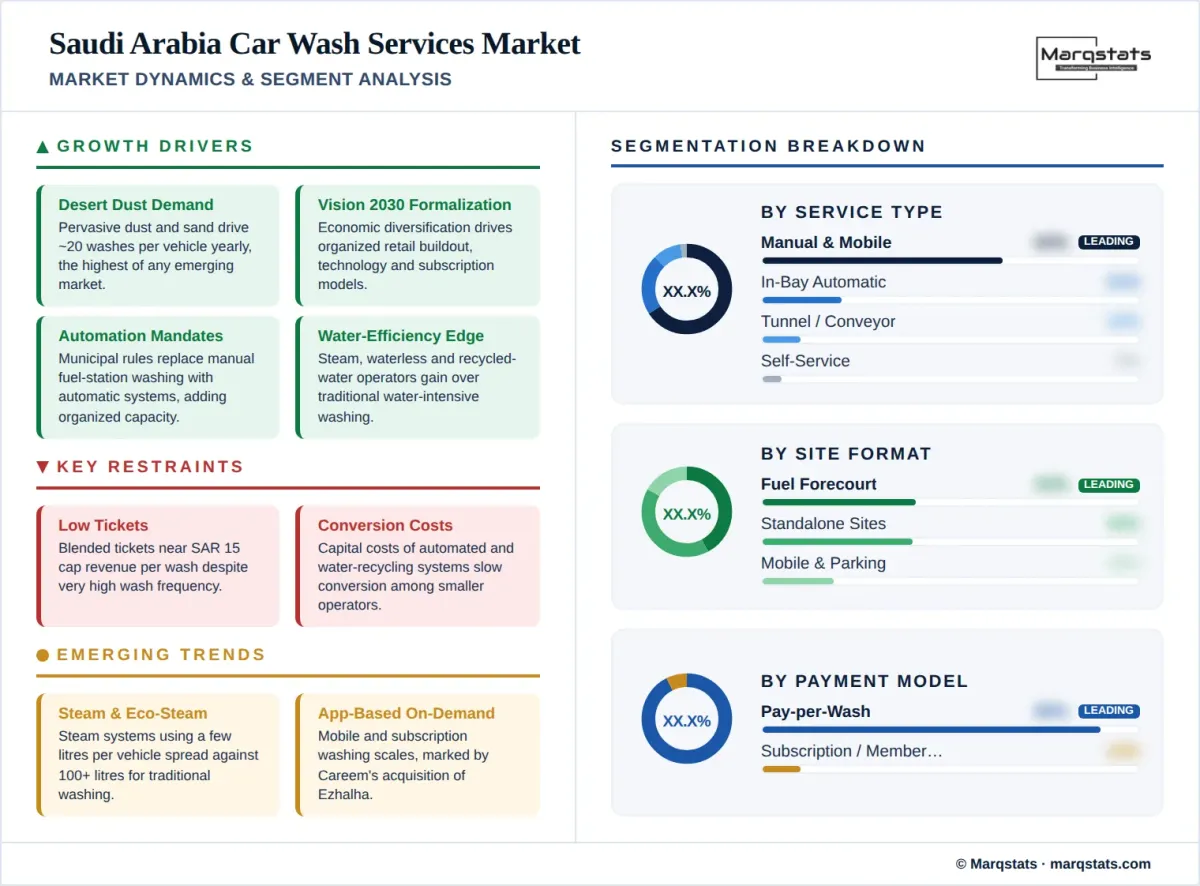
Saudi Arabia Car Wash Services Market Market Dynamics Segment Analysis Infographic
Segment Analysis

Market Segmentation

Manual / Hand Wash & Mobile
Leading

Manual and mobile hand-wash formats hold the dominant revenue share at about 64% in 2025, equal to USD 449.57 million, spanning attended washing at dedicated sites, fuel forecourts, and mobile providers. The share declines toward 59% by 2030 — the fastest decline of any market — as municipal automation mandates and water rules push operators toward automated and steam systems. The segment remains large in absolute terms, and its upper tier formalizes through steam washing and app-based mobile services. Low-cost expatriate labour long sustained the model, and the shift away from it marks a genuine structural break driven by policy rather than economics.

In-Bay Automatic (Roll-over)

In-bay automatic roll-overs hold about 21% of 2025 revenue, USD 149.86 million, and rise toward 23% by 2030, the largest automated format. Machines concentrate at fuel-station forecourts and organized outlets, and gain share fastest as municipal rules mandate automatic systems at fuel stations. Fuel retailers and automated specialists anchor adoption, with water-recycling integration increasingly standard. The format captures much of the demand displaced from manual washing at forecourts, making it the primary beneficiary of the regulatory transition.

Tunnel / Conveyor

Tunnel/conveyor washes hold about 10% of 2025 revenue, USD 71.81 million, and rise toward 13% by 2030, the fastest-growing service format. Express and touchless tunnels concentrate in Riyadh, Jeddah, and the Eastern Province, where throughput, membership economics, and premium touchless positioning justify land and capital costs, and integrate water-recycling to meet policy requirements. Premium touchless tunnels appeal to owners seeking scratch-free washing for higher-value vehicles, a growing segment in the affluent metros.

Self-Service

Self-service bays hold about 4% of 2025 revenue, USD 31.22 million, rising toward 5% by 2030. The format grows from a small base at fuel stations and standalone sites, serving cost-conscious users and enthusiasts, and increasingly adds cashless and app-based payment across the Kingdom. It remains a minor format, constrained by the availability of affordable attended washing and the summer heat that discourages self-service in open bays.

Fuel-Station Forecourt
Leading

Forecourt washes hold about 41% of 2025 revenue, USD 288.78 million, the largest site format, where fuel retailers including SASCO, Aldrees, and Saudi TotalEnergies operate wash bays. The share eases toward 40% by 2030 as the format converts from manual to automatic under municipal rules, making forecourts the epicentre of the market's automation transition. Fuel retailers treat washing as a core non-fuel revenue line and are investing in automated and water-recycling systems to comply with licensing requirements while retaining forecourt footfall.

Standalone Dedicated Sites

Standalone dedicated sites hold about 40% of 2025 revenue, USD 284.10 million, and gain share toward 41% by 2030. Dedicated wash centres, steam-wash outlets, and automated specialists such as Petromin Express anchor the channel, which consolidates around branded, water-efficient formats as organized capacity expands. Purpose-built automated and steam centres increasingly capture demand from converting fuel-forecourt operations, strengthening the standalone channel's share.

Others (Mobile, Parking)

Mobile and parking-lot formats hold about 18% of 2025 revenue, USD 129.56 million, and gain share toward 19% by 2030 — among the highest mobile shares of any market. App-based on-demand washing, including Careem-owned Ezhalha and other platforms, mobile steam vans, and mall parking services define this fast-growing, technology-driven channel. The convenience of doorstep washing suits the Kingdom's car-centric, mall-oriented lifestyle, and waterless and steam methods make mobile operation practical without fixed water infrastructure.

Pay-per-Wash
Leading

Single-visit payment accounts for about 90% of 2025 revenue, USD 635.33 million, reflecting walk-up demand at stations, forecourts, and mobile services. The share declines toward 86% by 2030 as subscriptions expand, with cashless and app-based payment near universal across organized formats.

Subscription / Membership

Subscription and membership plans reach about 10% of 2025 revenue, USD 67.12 million, and grow near 14% annually to about 14% of revenue by 2030, worth USD 128.41 million — the fastest-growing revenue stream. Fuel-retailer plans, app-based unlimited-wash memberships, and organized-chain subscriptions convert the Kingdom's very high wash frequency into recurring revenue, and are the primary lever operators use to build loyalty. High frequency makes unlimited-wash economics especially attractive to consumers, accelerating subscription uptake faster than in lower-frequency markets.

Passenger Cars
Leading

Passenger vehicles generate about 85% of 2025 revenue, USD 593.96 million, reflecting household demand for frequent cleaning in a dusty climate. The share eases slightly across the forecast period as commercial washing grows faster, though private-vehicle washing remains the market's core, sustained by high car ownership and the constant dust that keeps cleaning frequent.

Commercial Vehicles (incl. Fleet)

Commercial washing holds about 15% of 2025 revenue, USD 108.49 million, rising toward 16% by 2030. Logistics, delivery, and ride-hailing fleets — including mobility-as-a-service operators — sustain high-frequency washing across Riyadh, Jeddah, and the Eastern Province, with fleet contracts a growing organized revenue source.

Regional Analysis

By Geography

Riyadh Region (Central)

The Riyadh Region is the largest regional market, anchored by the capital and its rapidly growing vehicle parc and organized retail base. Dust and sand from the surrounding desert drive intense wash frequency, automated and steam operators concentrate in the city, and Vision 2030 development sustains premium and subscription demand. The region leads the Kingdom's shift to automated and water-efficient washing, and major mixed-use and residential development expands the addressable base each year.

Makkah Province (Jeddah & Makkah)

Makkah Province, anchored by Jeddah and Makkah, is a major market combining a large coastal-city parc with pilgrimage-related vehicle and fleet activity. Humidity and coastal conditions sustain frequent washing, organized chains and fuel-forecourt washing are extensive, and mobile and app-based services scale in Jeddah's dense urban areas. Year-round pilgrimage traffic adds a substantial base of visiting-vehicle and transport-fleet washing that is largely unique to the province.

Eastern Province (Dammam, Dhahran & Al Khobar)

The Eastern Province, spanning Dammam, Dhahran, and Al Khobar, is a high-income market anchored by the energy sector. Corporate and industrial fleets add commercial washing demand, high car ownership supports premium and automated formats, and the region's affluence drives strong subscription and touchless-wash adoption. Proximity to the energy industry and a large expatriate professional population sustain frequent, quality-oriented washing across the metropolitan area.

Madinah & Northern Regions

Madinah and the northern regions form a substantial market where pilgrimage traffic in Madinah and dispersed populations across the north sustain steady washing demand. Fuel-forecourt and standalone washing dominate, and organized operators expand into the largest cities as vehicle ownership rises. Northern border and logistics corridors add commercial-fleet washing along major highway routes.

Asir & Southern Regions

Asir and the southern regions, including Abha and Najran, form a smaller, dispersed market with cooler highland conditions in parts. Manual and fuel-forecourt washing dominate, and organized chains and automated systems are entering the largest cities as incomes and vehicle ownership grow from a lower base. Tourism development in the highlands under Vision 2030 is expected to lift both vehicle activity and organized washing demand over the forecast period.
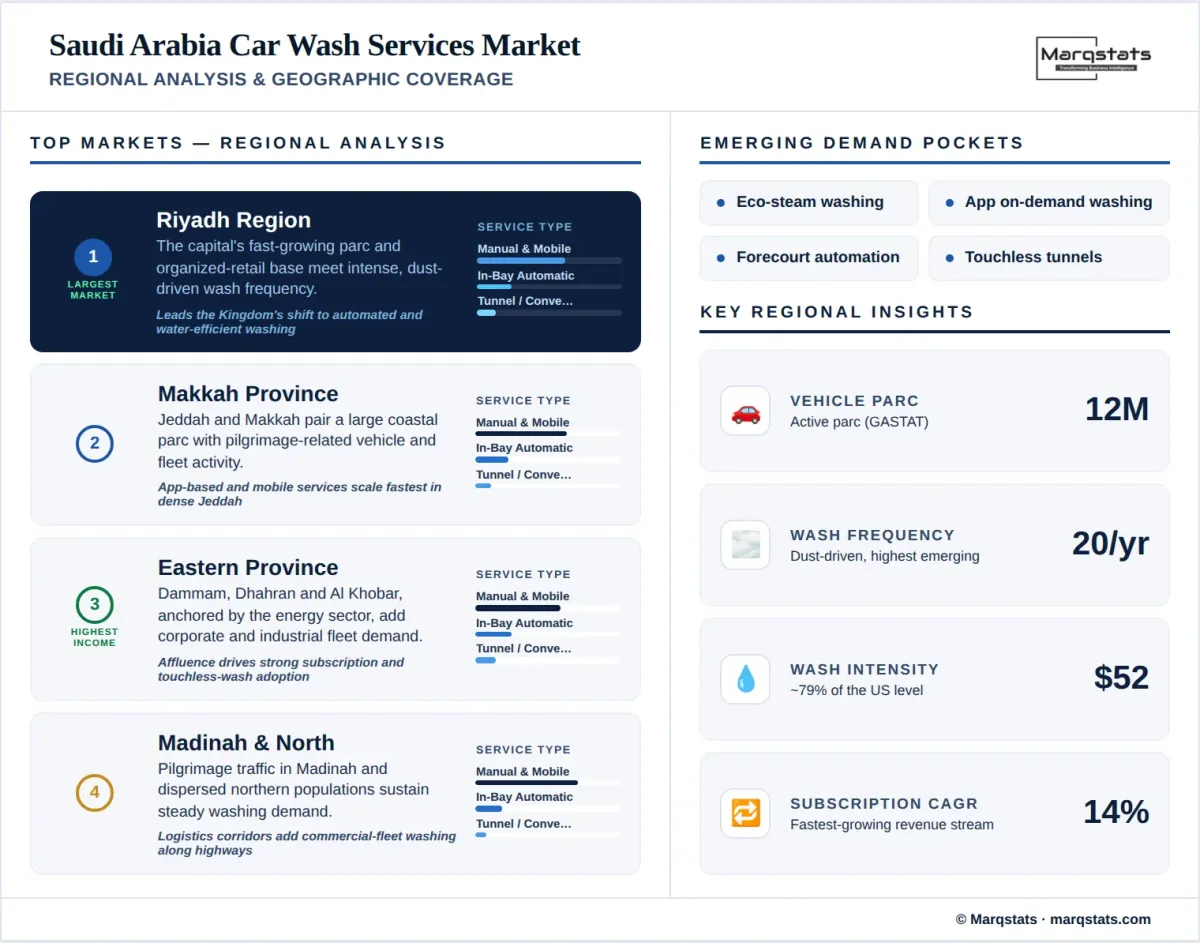
Saudi Arabia Car Wash Services Market Regional Analysis Geographic Coverage Infographic
Competitive Landscape

How Competition Is Evolving

The Saudi Arabia car wash services market is fragmented yet formalizing rapidly, with manual operators still delivering the majority of washes and a fast-growing organized layer led by steam, automated, and app-based specialists. Petromin, through Petromin Express and its eco-steam system, is a prominent organized anchor, while fuel retailers SASCO, Aldrees Petroleum, and Saudi TotalEnergies operate extensive forecourt wash networks that are converting to automated systems under municipal rules.

App-based and on-demand operators form a distinct competitive tier. Ezhalha, acquired by ride-hailing platform Careem, together with CAFU, Washy, and other on-demand services, brings mobile and subscription washing to customers' locations, while automated specialists such as CarWishha and waterless and steam brands including Clean Cloud and Chem-Dry compete on water efficiency and premium touchless service. Equipment suppliers WashTec and Karcher, together with water-recycling system providers, underpin the automated tiers. The entry of ride-hailing and delivery platforms into on-demand washing signals the sector's convergence with the Kingdom's broader mobility and services digitization.

Competition turns on water efficiency, automation, and subscription reach. Municipal automation mandates and the majority water-recycling requirement separate compliant, water-efficient operators from traditional manual rivals, subscription plans build recurring revenue from very high wash frequency, and app platforms compete on convenience. Formalization is expected to advance rapidly through Vision 2030 investment, fuel-retailer conversion, and regulatory enforcement, consolidating the market around organized, water-efficient operators through 2030. Well-capitalized fuel retailers and Vision 2030-backed operators are strongly positioned to fund the automated and water-recycling systems that regulation now requires, likely accelerating consolidation at the expense of small manual operators.
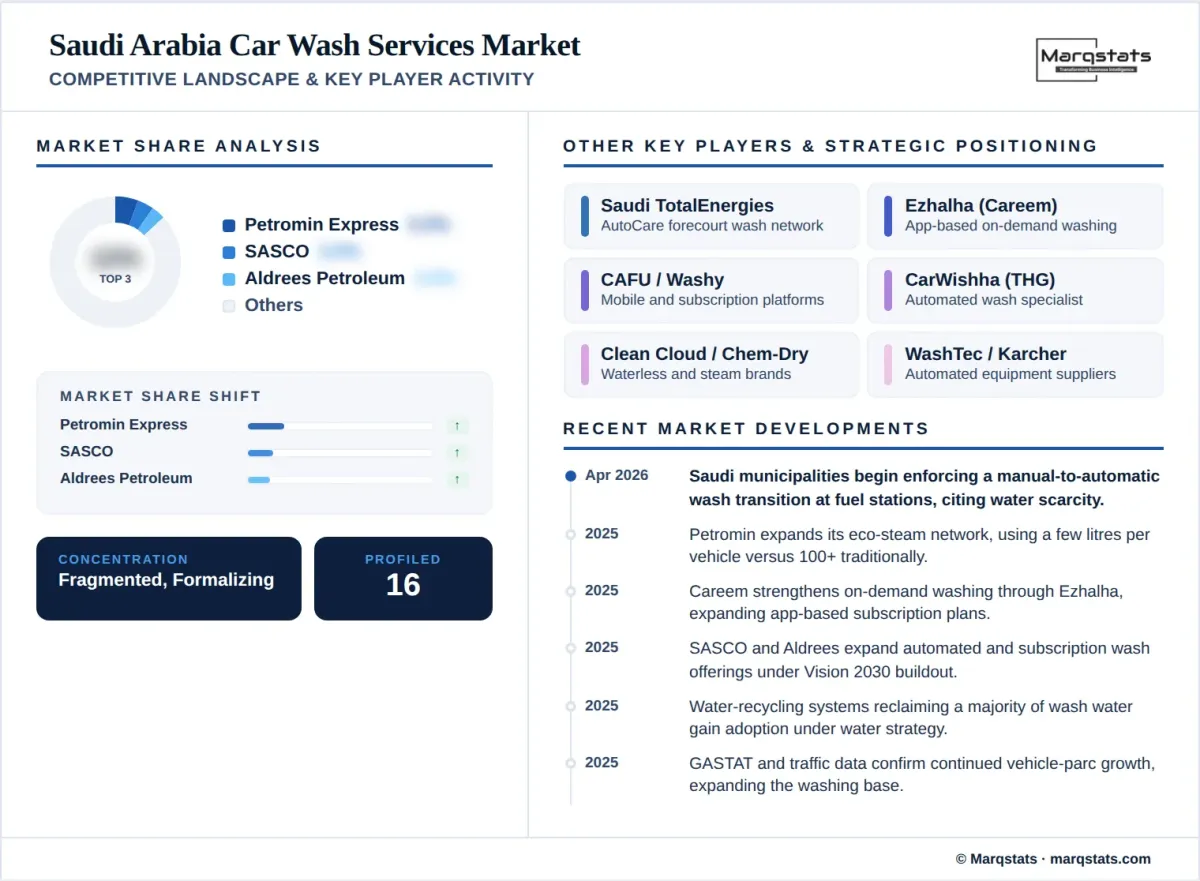
Saudi Arabia Car Wash Services Market Competitive Landscape Key Player Activity Infographic
Major Players

Companies Covered

The report profiles 16++ companies with full strategy and financials analysis, including:

Petromin Corporation (Petromin Express Car Wash)
Saudi Automotive Services Company (SASCO)
Aldrees Petroleum & Transport Services Co.
Saudi TotalEnergies (AutoCare Car Wash)
Bright Car Wash
Ezhalha (Careem)
CAFU
Wecarry Technologies
Wasel Car Wash
Al-Futtaim Express Auto Wash (KSA)
CarWishha (THG)
Clean Cloud (Waterless)
Chem-Dry (Steam)
Washy
Alfred Karcher (Saudi Arabia)
WashTec AG
Note: Full company profiles include revenue analysis, product portfolio, SWOT, and recent strategic developments.
Latest Developments

Recent Market Activity

Apr 2026
Saudi municipalities began licensing and enforcing a transition from manual to automatic car washing at fuel stations and service centres, citing water scarcity.
2025
Petromin expanded its eco-steam car wash network, using a few litres per vehicle versus over 100 for traditional washing.
2025
Careem strengthened its on-demand car wash presence through the Ezhalha platform, expanding app-based subscription washing.
2025
Fuel retailers, including SASCO and Aldrees, expanded automated and subscription wash offerings under Vision 2030 retail buildout.
2025
Water-recycling systems reclaiming a majority of wash water gained adoption as operators met national water-strategy requirements.
2025
GASTAT and traffic data confirmed continued vehicle-parc growth, expanding the addressable washing base.
Report Structure

Table of Contents

1. Introduction
1.1 Study Assumptions & Market Definition
1.1.1 Scope — Professional Car Wash Services (Four-Wheel)
1.1.2 Formats Covered — Manual, In-Bay Automatic, Tunnel, Self-Service
1.1.3 Inclusions — Basic Interior Cleaning, Tickets, Subscriptions
1.1.4 Exclusions — Full Detailing & Equipment/Chemical Sales
1.1.5 Market Metric — Annual Service Revenue (USD)
1.2 Scope of the Study
1.3 Currency, FX Treatment & Base Year (2025)
1.4 Key Definitions & Industry Terminology
1.4.1 Manual Station Wash & Mobile
1.4.2 Steam & Eco-Steam Washing
1.4.3 Waterless & Water-Recycling Systems
1.4.4 App-Based On-Demand & Subscription Models
2. Research Methodology
2.1 Analysis Framework
2.2 Bottom-Up Base — Parc × Penetration × Frequency × Ticket
2.2.1 GASTAT & Traffic-Authority Parc (~12M)
2.2.2 Paid-Wash Penetration (~65%)
2.2.3 Dust-Driven Wash Frequency (~20/Vehicle/Yr) & Ticket (~SAR 15)
2.3 Vision 2030 Formalization & Municipal-Regulation Reference
2.4 FX Treatment — SAR Pegged to USD, Constant-FX Forecast
2.5 Wash-Intensity Cross-Check vs. United States (~79%)
2.6 Primary Research — 40+ Interviews
2.7 Assumptions & Limitations
3. Executive Summary
3.1 Market Size & Forecast Snapshot 2021–2030
3.2 Key Findings & Analyst Takeaways
3.3 Highest Wash Frequency & Intensity of Any Emerging Market
3.4 Vision 2030 Formalization & Automation Mandate
3.5 Water Scarcity, Steam & Water-Recycling
4. Market Overview & Definitions
4.1 Industry Structure & Universe of Operators
4.1.1 Manual Station & Mobile Operators
4.1.2 Organized Steam, Automated & App-Based Operators
4.1.3 Fragmentation & Rapid Formalization
4.2 Value Chain & Ecosystem
4.2.1 Fuel Retailers & Forecourt Washing
4.2.2 App-Based On-Demand Platforms
4.2.3 Equipment & Water-Recycling System Providers
4.3 Consumer Behavior & Dust-Driven High Frequency (~20/Yr)
4.4 Unit Economics & the Regulation-Driven Automation Path
5. Market Dynamics
5.1 Key Drivers
5.1.1 Desert Dust & Highest-of-Emerging-Markets Frequency
5.1.2 Vehicle-Parc Growth (~3%/Yr)
5.1.3 Vision 2030 Formalization
5.1.4 Municipal Automation Mandates at Fuel Stations
5.1.5 Water-Efficiency Requirements Favouring Steam & Recycling
5.1.6 Subscription & App-Based Membership Adoption
5.2 Key Restraints
5.2.1 Low Tickets (~SAR 15) & Equipment Payback
5.2.2 Manual-Base Disruption Under Automation Rules
5.2.3 High Temperatures & Water Costs
5.2.4 Capital Costs of Automation & Water-Recycling
5.3 Key Trends
5.3.1 Steam & Eco-Steam Washing Expansion (Petromin)
5.3.2 Fuel-Forecourt Manual-to-Automatic Conversion
5.3.3 App-Based On-Demand Scaling (Careem / Ezhalha)
5.3.4 Majority Water-Recycling as Standard
5.4 Porter's Five Forces Analysis
5.5 Industry Value Chain Analysis
6. Regulatory & Environmental Framework
6.1 Municipal Fuel-Station Manual-to-Automatic Wash Mandate
6.2 National Water Strategy & Majority Water-Recycling Requirement
6.3 Water Deficit (~3.5 Billion Cubic Metres) & Conservation
6.4 Vision 2030 Retail & Licensing Framework
6.5 Wastewater, Effluent & Chemical Compliance
7. Technology & Format Innovation
7.1 Steam & Eco-Steam Washing Systems
7.2 Water-Recycling & Reclamation Technology
7.3 Automated Roll-Over & Touchless Tunnel Systems
7.4 App-Based On-Demand & Subscription Platforms
7.5 Waterless Washing Technology
8. Vision 2030, Formalization & Subscription Economics
8.1 Vision 2030 Retail Buildout & Organized Expansion
8.2 Subscription & Membership Model (High-Frequency Economics)
8.3 Subscription Penetration Trend 2021–2030 (6% → 14%)
8.4 Fuel-Retailer Conversion & Investment
9. Saudi Arabia Car Wash Services Market Sizing & Forecast
9.1 Total Market Size & Forecast 2021–2030
9.1.1 Historical Revenue 2021–2025
9.1.2 Forecast Revenue 2026–2030
9.1.3 CAGR & Absolute Growth
9.2 Growth Driver Decomposition
9.2.1 Parc-Growth Contribution
9.2.2 Formalization Contribution
9.2.3 Real-Pricing Contribution
9.2.4 Subscription-Adoption Contribution
10. Market Segmentation — By Service Type
10.1 Manual / Hand Wash & Mobile
10.1.1 Revenue & Share 2021–2030 (68% → 59%)
10.1.2 Station, Forecourt & Mobile Washing
10.2 In-Bay Automatic (Roll-over)
10.2.1 Revenue & Share 2021–2030 (20% → 23%)
10.2.2 Fuel-Forecourt & Organized-Outlet Machines
10.3 Tunnel / Conveyor
10.3.1 Revenue & Share 2021–2030 (8% → 13%)
10.3.2 Express & Touchless Tunnels in Major Metros
10.4 Self-Service
10.4.1 Revenue & Share 2021–2030 (4% → 5%)
11. Market Segmentation — By Site Format
11.1 Fuel-Station Forecourt
11.1.1 Revenue & Share 2021–2030 (42% → 40%)
11.1.2 SASCO, Aldrees & Saudi TotalEnergies Networks
11.2 Standalone Dedicated Sites
11.2.1 Revenue & Share 2021–2030 (40% → 41%)
11.2.2 Petromin Express & Steam-Wash Centres
11.3 Others (Mobile, Parking)
11.3.1 Revenue & Share 2021–2030 (18% → 19%)
11.3.2 Careem / Ezhalha & On-Demand Platforms
12. Market Segmentation — By Payment Model
12.1 Pay-per-Wash
12.1.1 Revenue & Share 2021–2030 (94% → 86%)
12.2 Subscription / Membership
12.2.1 Revenue & Share 2021–2030 (6% → 14%)
12.2.2 Recurring-Revenue Growth (~14% CAGR)
13. Market Segmentation — By Vehicle Type
13.1 Passenger Cars
13.1.1 Revenue & Share 2021–2030 (85% → 84%)
13.2 Commercial Vehicles (incl. Fleet)
13.2.1 Revenue & Share 2021–2030 (15% → 16%)
13.2.2 Logistics, Delivery & Ride-Hailing Demand
14. Regional Analysis
14.1 Riyadh Region (Central) — Largest Market — Capital, Dust & Automation Lead
14.1.1 Market Size & Forecast 2021–2030
14.1.2 Demand Drivers & Key Operators
14.2 Makkah Province (Jeddah & Makkah) — Coastal Parc & Pilgrimage Fleet Demand
14.2.1 Market Size & Forecast 2021–2030
14.2.2 Demand Drivers & Key Operators
14.3 Eastern Province (Dammam, Dhahran & Al Khobar) — High-Income — Energy Sector & Fleets
14.3.1 Market Size & Forecast 2021–2030
14.3.2 Demand Drivers & Key Operators
14.4 Madinah & Northern Regions — Pilgrimage & Dispersed Demand
14.4.1 Market Size & Forecast 2021–2030
14.4.2 Demand Drivers & Key Operators
14.5 Asir & Southern Regions — Dispersed, Emerging Organized Entry
14.5.1 Market Size & Forecast 2021–2030
14.5.2 Demand Drivers & Key Operators
15. Competitive Landscape
15.1 Market Structure & Rapid Formalization
15.2 Steam & Automated Specialists (Petromin Express, CarWishha)
15.3 Fuel-Retailer Forecourt Networks (SASCO, Aldrees, TotalEnergies)
15.4 App-Based On-Demand Platforms (Careem / Ezhalha, CAFU)
15.5 Competitive Variables — Water Efficiency, Automation, Subscription
16. Company Profiles
16.1 Petromin Corporation (Petromin Express Car Wash)
16.1.1 Company Overview
16.1.2 Format & Service / Technology Portfolio
16.1.3 Network Footprint & Regional Presence
16.1.4 Water-Efficiency / Subscription / Automation Approach
16.1.5 Recent Strategic Developments
16.2 Saudi Automotive Services Company (SASCO)
16.2.1 Company Overview
16.2.2 Format & Service / Technology Portfolio
16.2.3 Network Footprint & Regional Presence
16.2.4 Water-Efficiency / Subscription / Automation Approach
16.2.5 Recent Strategic Developments
16.3 Aldrees Petroleum & Transport Services Co.
16.3.1 Company Overview
16.3.2 Format & Service / Technology Portfolio
16.3.3 Network Footprint & Regional Presence
16.3.4 Water-Efficiency / Subscription / Automation Approach
16.3.5 Recent Strategic Developments
16.4 Saudi TotalEnergies (AutoCare Car Wash)
16.4.1 Company Overview
16.4.2 Format & Service / Technology Portfolio
16.4.3 Network Footprint & Regional Presence
16.4.4 Water-Efficiency / Subscription / Automation Approach
16.4.5 Recent Strategic Developments
16.5 Bright Car Wash
16.5.1 Company Overview
16.5.2 Format & Service / Technology Portfolio
16.5.3 Network Footprint & Regional Presence
16.5.4 Water-Efficiency / Subscription / Automation Approach
16.5.5 Recent Strategic Developments
16.6 Ezhalha (Careem)
16.6.1 Company Overview
16.6.2 Format & Service / Technology Portfolio
16.6.3 Network Footprint & Regional Presence
16.6.4 Water-Efficiency / Subscription / Automation Approach
16.6.5 Recent Strategic Developments
16.7 CAFU
16.7.1 Company Overview
16.7.2 Format & Service / Technology Portfolio
16.7.3 Network Footprint & Regional Presence
16.7.4 Water-Efficiency / Subscription / Automation Approach
16.7.5 Recent Strategic Developments
16.8 Wecarry Technologies
16.8.1 Company Overview
16.8.2 Format & Service / Technology Portfolio
16.8.3 Network Footprint & Regional Presence
16.8.4 Water-Efficiency / Subscription / Automation Approach
16.8.5 Recent Strategic Developments
16.9 Wasel Car Wash
16.9.1 Company Overview
16.9.2 Format & Service / Technology Portfolio
16.9.3 Network Footprint & Regional Presence
16.9.4 Water-Efficiency / Subscription / Automation Approach
16.9.5 Recent Strategic Developments
16.10 Al-Futtaim Express Auto Wash (KSA)
16.10.1 Company Overview
16.10.2 Format & Service / Technology Portfolio
16.10.3 Network Footprint & Regional Presence
16.10.4 Water-Efficiency / Subscription / Automation Approach
16.10.5 Recent Strategic Developments
16.11 CarWishha (THG)
16.11.1 Company Overview
16.11.2 Format & Service / Technology Portfolio
16.11.3 Network Footprint & Regional Presence
16.11.4 Water-Efficiency / Subscription / Automation Approach
16.11.5 Recent Strategic Developments
16.12 Clean Cloud (Waterless)
16.12.1 Company Overview
16.12.2 Format & Service / Technology Portfolio
16.12.3 Network Footprint & Regional Presence
16.12.4 Water-Efficiency / Subscription / Automation Approach
16.12.5 Recent Strategic Developments
16.13 Chem-Dry (Steam)
16.13.1 Company Overview
16.13.2 Format & Service / Technology Portfolio
16.13.3 Network Footprint & Regional Presence
16.13.4 Water-Efficiency / Subscription / Automation Approach
16.13.5 Recent Strategic Developments
16.14 Washy
16.14.1 Company Overview
16.14.2 Format & Service / Technology Portfolio
16.14.3 Network Footprint & Regional Presence
16.14.4 Water-Efficiency / Subscription / Automation Approach
16.14.5 Recent Strategic Developments
16.15 Alfred Kärcher (Saudi Arabia)
16.15.1 Company Overview
16.15.2 Format & Service / Technology Portfolio
16.15.3 Network Footprint & Regional Presence
16.15.4 Water-Efficiency / Subscription / Automation Approach
16.15.5 Recent Strategic Developments
16.16 WashTec AG
16.16.1 Company Overview
16.16.2 Format & Service / Technology Portfolio
16.16.3 Network Footprint & Regional Presence
16.16.4 Water-Efficiency / Subscription / Automation Approach
16.16.5 Recent Strategic Developments
17. Investment, Formalization & Automation Analysis
17.1 Fuel-Forecourt Automation Conversion Investment
17.2 Steam, Waterless & Water-Recycling Capex
17.3 App-Based Platform & Subscription Investment
17.4 Vision 2030 Retail & Consolidation Analysis
18. Opportunities, Risks & Strategic Recommendations
18.1 Growth Opportunities by Region & Format
18.2 Ticket, Water, Regulation & Conversion Risk Assessment
18.3 Automation, Water-Efficiency & Subscription Strategy
18.4 Strategic Recommendations for Operators & Investors
19. Appendix
19.1 Research Methodology Detail
19.2 Data Triangulation & Confidence Flags
19.3 Abbreviations & Glossary
19.4 List of Tables
19.5 List of Figures
19.6 Disclaimer & Legal Notice
Study Scope & Focus

Coverage & Segmentation

This report provides a comprehensive analysis of the Saudi Arabia car wash services market covering the historical period 2021 to 2025 and the forecast period 2026 to 2030, with 2025 as the base year. The study defines the market as annual revenue earned by professional operators cleaning four-wheel vehicles through manual, in-bay automatic, tunnel/conveyor, and self-service formats, inclusive of basic interior cleaning; full detailing and equipment or chemical sales are excluded. Market size is presented in value terms (USD), with the Saudi riyal pegged to the United States dollar; forecasts assume constant exchange rates.

The study segments the market by service type, site format, payment model, and vehicle type, and examines regional demand across the Riyadh Region, Makkah Province, the Eastern Province, Madinah and the northern regions, and Asir and the southern regions, alongside Vision 2030 formalization, water policy, automation mandates, and subscription adoption. Market sizing uses a bottom-up model anchored to GASTAT and traffic-authority parc data, cross-checked against a wash intensity of roughly USD 52 per vehicle. The competitive section profiles 16 organized operators, fuel retailers, and equipment suppliers.

Frequently Asked Questions

FAQs About the Saudi Arabia Car Wash Services Market

The Saudi Arabia car wash services market is valued at approximately USD 702 million in 2025 and is projected to reach USD 917 million by 2030, expanding at a 5.48% CAGR over the forecast period.
The market is expected to grow at a 5.48% CAGR between 2025 and 2030, driven by vehicle-parc expansion, Vision 2030 formalization, and real pricing gains, with dust-driven wash frequency the highest of any emerging market.
Manual station washes dominate with about 64% of 2025 revenue, but the share is declining fastest of any market as municipal rules mandate automatic systems at fuel stations and roll-over and tunnel formats gain share.
Saudi Arabia faces a water deficit of about 3.5 billion cubic metres annually, and operators must recycle a majority of wash water. Steam systems use only a few litres per vehicle versus over 100 for traditional washing, and waterless and recycled-water methods are spreading rapidly.
Saudi municipalities have begun licensing and enforcing a transition from manual to automatic car washing at fuel stations and service centres, citing water scarcity. Existing manual operations may continue only until their current licences expire, after which automated systems are required.
Major players include steam and automated specialists Petromin Express and CarWishha; fuel retailers SASCO, Aldrees, and Saudi TotalEnergies; app-based on-demand operators Ezhalha (Careem) and CAFU; and waterless and steam brands Clean Cloud and Chem-Dry.
The report is delivered as a PDF report (250+ pages), Excel data tables with market sizing across 2021–2030 by segment and region, and a PowerPoint summary deck, with analyst email support included in every licence tier.