Market Snapshot
The Kenya truck market size is estimated at USD 376.27 million in 2025 and is projected to reach USD 658.42 million by 2030, growing at a CAGR of 11.84% over 2026 – 2030. Annual sales rise from 6,459 to 9,900 new trucks, a 8.92% annual rate, while the average value per truck climbs from about USD 58,255 to USD 66,507 as heavier trucks and tractor heads take a larger share of the mix.
Marqstats defines the market as the value of new goods trucks above 3.5 tonnes gross vehicle weight sold in Kenya each year, counted as the chassis-cab transaction value before value added tax, whether the truck is assembled locally from kits or imported fully built. It covers light, medium and heavy rigid trucks and tractor heads, such as the Isuzu NMR, NPR, FRR and FVZ, Mitsubishi Fuso Canter and Fighter, Hino 300 and 500, Tata Ultra, Sinotruk HOWO and Scania ranges. Pickups, buses, vans, used trucks, trailers and fitted bodies are excluded.
Medium trucks account for 34.03% of 2025 value, locally assembled trucks for 64.92% and general freight and distribution for 38.99%. The Nairobi Metropolitan Area accounts for 49.00% of value, while tractor heads and heavy-duty trucks grow fastest of all classes, at 15.51% a year, as Mombasa transit cargo to Uganda, Rwanda and the Democratic Republic of the Congo expands.
Key Takeaways
Market Overview & Analysis
Report Summary
Marqstats sizes the Kenya truck market as the value of new goods trucks above 3.5 tonnes gross vehicle weight that enter the national fleet each year. It counts light cab-over trucks of 3.5 to 7.5 tonnes, medium trucks of 7.5 to 16 tonnes, heavy rigid trucks above 16 tonnes and tractor heads, whether the truck is assembled from completely knocked-down kits or imported complete. Pickups, buses, vans and used vehicles are excluded, so the market is a clean measure of freight capacity added to the Kenyan road fleet.
The market sits inside a formal new-vehicle market of 13,583 vehicles in 2025, up 19.65% from 11,352 in 2024, as recorded by the Kenya Motor Industry Association. That total splits into 5,496 trucks, 963 heavy-duty trucks, 3,242 pickups, 2,675 buses, 963 station wagons, 31 saloons and about 213 vans and unallocated units. Trucks and heavy-duty trucks together give the 6,459 units sized here, 47.55% of the total, and Isuzu East Africa alone sold 6,494 vehicles of all types, 47.8% of the market.
The demand base is regional freight. The Port of Mombasa handled 45.45 million tonnes in 2025, up 10.9% from 40.99 million, and 2.11 million twenty-foot containers, while transit cargo to landlocked neighbours rose 19.5% to 15.88 million tonnes, with Uganda up 25.2%, Rwanda up 22.8% and the Democratic Republic of the Congo up 16.5%. The Standard Gauge Railway earned KES 21.4 billion in 2025, up 18.6% from KES 18.1 billion, so rail is growing too, but every container railed to Nairobi or Naivasha still needs a truck for the last leg.
Policy keeps buyers in the new-truck market. The Kenya Bureau of Standards enforces standard KS 1515, which bars used rigid trucks of 3.5 to 30 tonnes, closed imports of used tractor heads and prime movers after 30 June 2023, and caps the age of other used vehicles at eight years. Transporters protested that the rule would lift the price of a truck from about USD 60,000 to more than USD 160,000, but it has been enforced since January 2023 and pushes demand towards Isuzu East Africa, Simba Corporation and other assemblers.
Marqstats estimates the market at 6,459 trucks and USD 376.27 million in 2025, about KES 48.66 billion at the 2025 average rate of KES 129.31 per US dollar, after a 31.82% rebound from about 4,900 trucks in 2024. The Kenya Motor Industry Association reported 12,606 new vehicles of all types in January to September 2026, up 27.03% from 9,924, so 2026 is running well above 2025.
Kenya Truck Market Size and Forecast
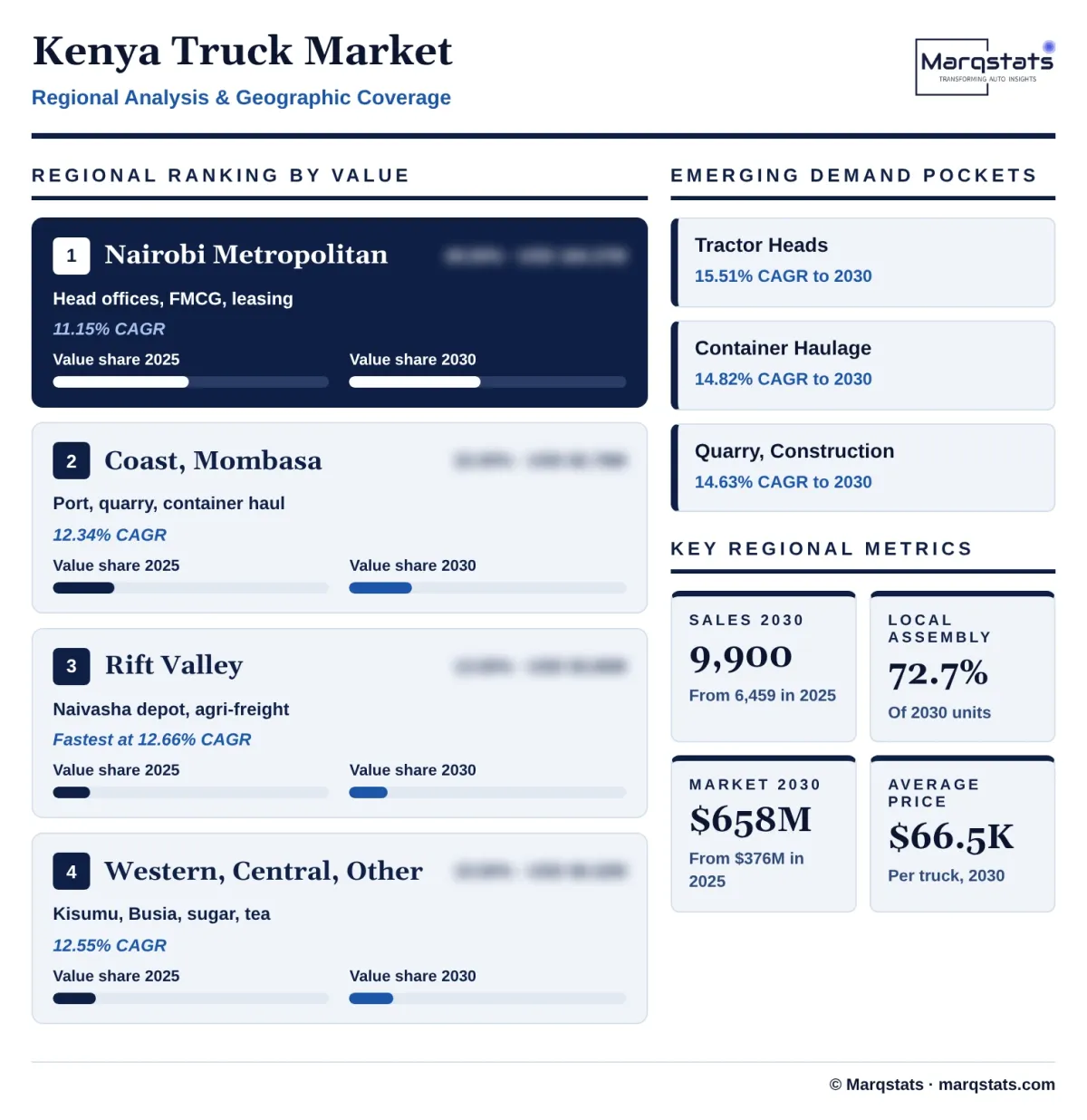
The Kenya truck market grows from USD 376.27 million in 2025 to USD 658.42 million in 2030, a CAGR of 11.84%. In shilling terms the market rises from about KES 48.66 billion to KES 85.14 billion at a constant rate of KES 129.31 to the US dollar. Volume contributes 8.92% a year, from 6,459 to 9,900 trucks, and the average value per truck adds 2.68% a year, from about USD 58,255 to USD 66,507, as tractor heads and heavy rigid trucks take more of the mix. Marqstats estimates 2026 at 8,100 trucks and USD 487.24 million.
The 2025 value is built bottom-up from classes and prices. Marqstats estimates 2,250 light trucks at about KES 4.50 million each, 2,300 medium trucks at KES 7.20 million, 946 heavy rigid trucks at KES 10.50 million and 963 tractor heads and heavy-duty trucks at KES 12.50 million, before value added tax and before bodies and trailers. At KES 129.31 these are about USD 34,800, USD 55,700, USD 81,200 and USD 96,700. The tractor head average sits close to the heavy rigid average because Sinotruk HOWO units, priced well below European tractors, make up a large share of heavy sales.
The unit base comes from the Kenya Motor Industry Association. Its 2025 categories give 5,496 trucks and 963 heavy-duty trucks, and Marqstats splits the 5,496 into light, medium and heavy rigid trucks using Isuzu East Africa and Mitsubishi Fuso model mix and the 963 as tractor heads and heavy-duty units. The result is cross-checked against Isuzu East Africa: its 6,494 vehicles of all types in 2025 equal about 3,360 trucks at Marqstats's estimated 52% share of truck units, leaving about 3,130 for D-Max pickups and bus chassis, which fits 3,242 pickups and 2,675 buses in the market.
The first half of 2026 supports the near-term path. The association recorded 7,819 vehicles in January to June, up 23% from 6,360, with trucks at 3,521 and prime movers at 547, and January to September reached 12,606, up 27.03%. Marqstats expects 8,100 trucks in 2026, up 4.63%, then growth of 5% to 6% a year as the post-credit-cut rebound fades and diesel at KES 227.76 a litre weighs on operators.
Marqstats tracks four indicators to monitor the forecast: monthly Kenya Motor Industry Association sales of trucks and prime movers, the Central Bank Rate and bank asset-finance terms, Energy and Petroleum Regulatory Authority pump prices and the fuel value added tax rate, and the timing of the kit lines that Sinotruk, Tata Motors and Simba Corporation have announced.
Market Dynamics
Key Drivers
Five forces are lifting demand for new trucks in Kenya even as fuel costs rise.
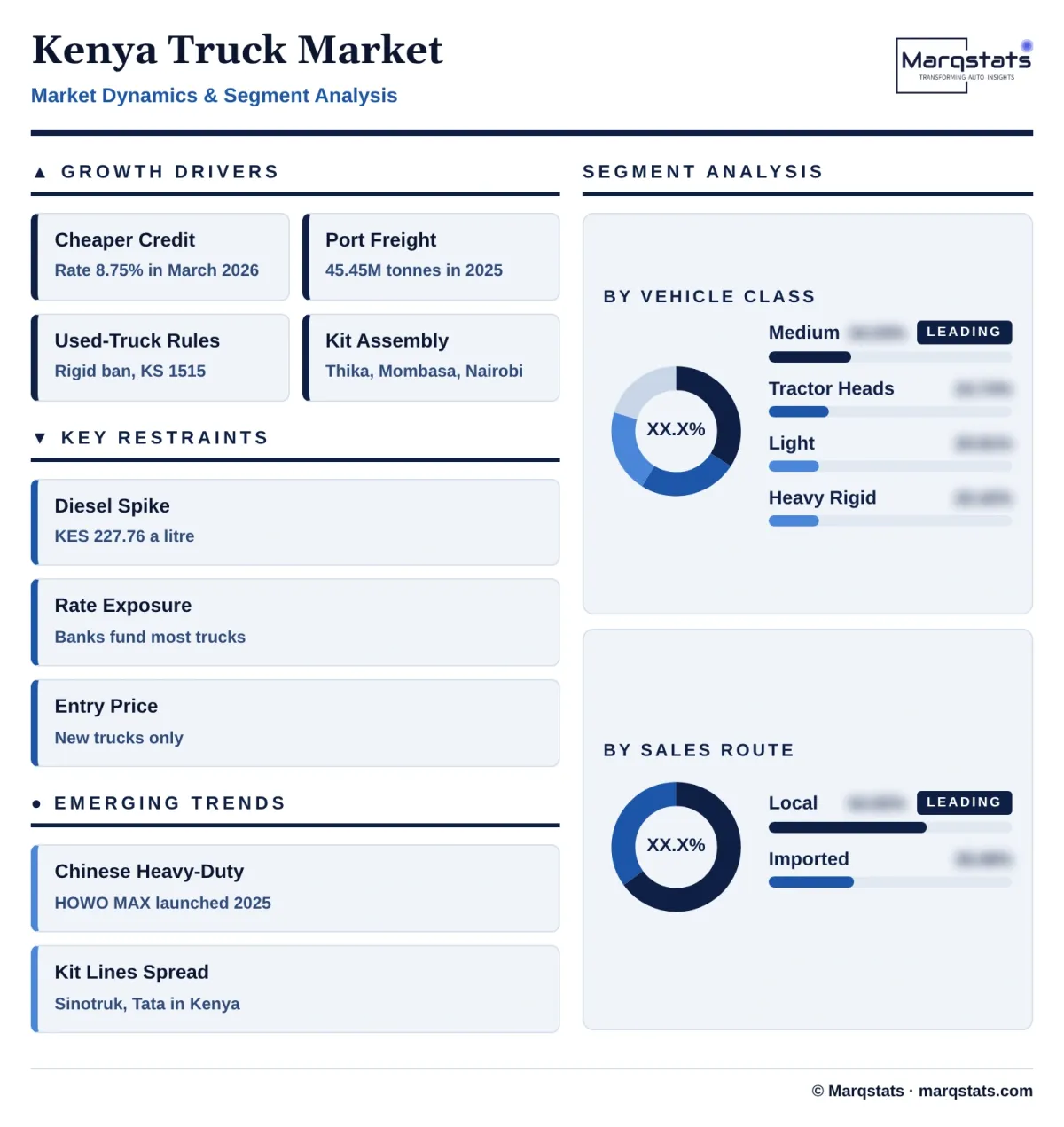
- Cheaper credit lets operators renew fleets. The Central Bank Rate was 8.75% in March 2026 against 11.25% in January 2025, and banks now finance trucks aggressively: Sinotruk and CFAO Mobility Kenya launched the HOWO H2 and H3 in July 2025 with Equity Bank offering up to 90% finance over 60 months and a 60-day moratorium. Lower instalments directly widen the pool of owner-operators who can buy a new truck.
- Regional freight keeps growing. The Port of Mombasa handled 45.45 million tonnes in 2025, up 10.9%, and transit cargo rose 19.5% to 15.88 million tonnes, with Uganda up 25.2%, Rwanda up 22.8% and the Democratic Republic of the Congo up 16.5%. Every extra tonne that leaves the port by road needs tractor heads, trailers and rigid trucks, and the 2.11 million twenty-foot equivalent units handled in 2025 set the pace for tractor demand.
- Used-truck rules push demand to new vehicles. The Kenya Bureau of Standards bars imports of used rigid trucks of 3.5 to 30 tonnes under standard KS 1515, closed used tractor-head imports after 30 June 2023 and caps other used vehicles at eight years, with Euro IV required for new imports. Operators who once bought second-hand trucks in Japan or Europe now compare new Isuzu, Fuso, Tata and Sinotruk models.
- Local kit assembly lowers delivery times and tax cost. Isuzu East Africa, Associated Vehicle Assemblers in Mombasa and Kenya Vehicle Manufacturers in Thika assemble trucks from kits under the National Automotive Policy, and CFAO Kenya announced a KES 1 billion investment to modernise the Thika plant after Sinotruk signed a memorandum with the plant on 22 September 2025. Preferential tax treatment of kits keeps assembled trucks cheaper than imported complete units.
- Construction and state payments release spending. Business Daily reported in October 2026 that state payments helped lift new vehicle sales 27.03% in January to September 2026 to 12,606 vehicles, and in July 2026 it reported that businesses were investing in trucks, pickups and other commercial vehicles amid a construction boom. Tippers, mixers and tractor heads are the first purchases when contractors are paid.
Key Restraints
Four constraints keep truck buyers cautious and slow fleet renewal in the weaker segments.
- Diesel costs have jumped. The Energy and Petroleum Regulatory Authority raised the maximum Nairobi diesel price by KES 9.90 to KES 227.76 a litre from 15 October 2026, after the average landed cost of diesel rose 11.32%, and the pump price includes a temporary 8% value added tax on fuel that replaced 16%. Fuel is the largest running cost of a long-haul truck, so each increase erodes the operator margin that funds new purchases.
- Credit-driven demand is exposed to rate and currency swings. Banks finance most truck purchases, so a reversal of the Central Bank Rate cuts that took the rate from 11.25% to 8.75% would hit orders quickly, and the shilling, which traded between KES 129.72 and KES 129.91 per dollar in October 2026, anchors the dollar cost of imported kits and complete trucks.
- The used-truck rules raise the entry price. Transporters on the Northern Corridor told The EastAfrican in January 2023 that the rules would lift the cost of a truck from about USD 60,000 to more than USD 160,000, and argued that the rule conflicts with East African Community transport protocols. Small owners who cannot finance a new truck delay replacement or stay with older vehicles.
- Rail and axle-load rules cap truck intensity. The Standard Gauge Railway lifted revenue 18.6% to KES 21.4 billion in 2025 and moves containers to inland depots at Nairobi and Naivasha, while the East African Community Vehicle Load Control Act of 2016 is enforced at weighbridges, so overloaded trucks cannot make up for thin margins by carrying more.
Key Trends
Four shifts are changing who builds, finances and buys trucks in Kenya.
- Chinese brands move into heavy-duty. Printan Limited launched the Sinotruk HOWO MAX tractor in Nairobi on 6 May 2025 and cited a 55% share of the heavy-duty segment for HOWO, and CFAO Mobility Kenya launched the HOWO H2 and H3 light and medium trucks on 24 July 2025, taking Sinotruk into segments that Japanese brands have led for decades.
- Assemblers extend kit lines. Sinotruk and Kenya Vehicle Manufacturers signed a memorandum on 22 September 2025 to assemble Sinotruk vehicles in Thika, and Tata Motors unveiled four battery-electric tippers, pickups and mini-trucks on 25 May 2026 with plans to assemble them in Kenya, so local content rises across brands.
- Electric assembly begins, starting with cars. Simba Corporation committed KES 1 billion in June 2026 to a dedicated electric vehicle line at Associated Vehicle Assemblers in Mombasa, which starts with passenger cars and is meant to extend to trucks and buses, so electric trucks stay a small part of the market to 2030.
- Transit freight shifts towards new corridors. Lamu port handled 799,161 tonnes in 2025 against 74,380 in 2024 and Kisumu 496,516 tonnes against 295,516, which shows cargo spreading beyond the Mombasa to Nairobi axis and creating demand for trucks in the north and west.
Strategic Implications
- For truck makers, the practical route into Kenya is kit assembly at an established plant. Fully built trucks carry the full import tax stack, while kits assembled at Kenya Vehicle Manufacturers or Associated Vehicle Assemblers qualify for preferential treatment, so a brand that signs an assembly and distribution partner and a bank finance programme can compete with Isuzu East Africa on delivered price.
- For incumbent assemblers, the defence of the medium-truck core is service and trade-in value, not price. Isuzu East Africa held 51% of all new vehicle sales in the first half of 2026, and Sinotruk now sells light and medium models with 90% finance, so incumbents need guaranteed resale values, parts availability and fleet maintenance contracts along the Mombasa to Malaba corridor.
- For fleet operators, utilisation matters more than purchase price. With diesel at KES 227.76 a litre and fleet additions outgrowing cargo growth, the operators that win are those with contracted backhaul, telematics and finance that matches contract length, rather than those that add trucks on spot rates.
- For lenders, new-truck finance is concentrated in a handful of brands and borrowers. Banks that price risk by brand, contract and fuel exposure can serve owner-operators that large lenders decline, and manufacturer-backed programmes such as the 90% finance that Equity Bank attached to the Sinotruk HOWO H2 and H3 launch show how an assembler and a bank can share that risk.
- For parts, body and service providers, the used-truck rules mean a younger fleet but one dominated by a few platforms, so stocking Isuzu, Fuso, Hino and Sinotruk wear parts, and building bodies and tippers to East African Community axle limits, gives predictable demand.
Market Segmentation
Light trucks of 3.5 to 7.5 tonnes account for 20.81% of 2025 value, USD 78.30 million, and grow at 8.67% a year to USD 118.67 million. Marqstats estimates 2,250 units in 2025, led by the Isuzu NMR and NPR, Mitsubishi Fuso Canter and Tata models sold to distributors, beverage and food firms and county services in Nairobi and Mombasa.
Medium trucks of 7.5 to 16 tonnes are the largest class, with 34.03% of 2025 value, USD 128.06 million, growing at 10.85% a year to USD 214.37 million. About 2,300 units were sold in 2025, mainly Isuzu FRR and FSR, Hino 500, Fuso Fighter and Tata Ultra trucks that carry produce, consumer goods and bagged commodities between regional towns.
Heavy rigid trucks above 16 tonnes account for 20.42% of 2025 value, USD 76.82 million, and grow at 11.77% a year to USD 133.98 million. About 946 units were sold in 2025, mostly six-wheel and eight-wheel tippers and cargo trucks such as the Isuzu FVZ, Sinotruk HOWO and Tata Prima, bought by contractors, quarry owners and cement and sugar haulers.
Tractor heads and heavy-duty trucks match the 963 heavy-duty trucks recorded by the Kenya Motor Industry Association and account for 24.74% of 2025 value, USD 93.09 million. They grow fastest, at 15.51% a year, to USD 191.40 million and 29.07% of the market, as Sinotruk HOWO MAX, Scania, Mercedes-Benz and Isuzu tractors serve container and bulk haulage to Uganda, Rwanda and the Democratic Republic of the Congo.
Trucks assembled in Kenya from kits account for 64.92% of 2025 value, USD 244.28 million, and grow at 12.13% a year to USD 432.93 million. Marqstats estimates 4,650 units, built at Isuzu East Africa in Nairobi, Associated Vehicle Assemblers in Mombasa and Kenya Vehicle Manufacturers in Thika, and expects the route to keep about 72.73% of 2030 units.
Fully built trucks account for 35.08% of 2025 value, USD 131.99 million, and grow at 11.31% a year to USD 225.49 million. They concentrate in premium tractors, specialist heavy trucks and low-volume brands such as Scania, Mercedes-Benz, Volvo and MAN, where volumes do not justify a kit line, and carry a higher average price than assembled trucks.
General freight and distribution account for 38.99% of 2025 value, USD 146.67 million, and grow at 9.86% a year to USD 234.69 million and 35.65% of the market. Retail, wholesale, consumer goods and third-party logistics fleets buy light and medium trucks for urban and inter-county delivery.
Agriculture and food account for 20.20% of 2025 value, USD 76.02 million, and grow at 9.84% a year to USD 121.54 million. Tea, horticulture, dairy, sugar and grain movements use medium rigid trucks with insulated or ventilated bodies, bought by cooperatives, exporters and processors in the Rift Valley and Western Kenya.
Construction, quarrying and mining account for 17.80% of 2025 value, USD 66.99 million, and grow at 14.63% a year to USD 132.57 million. Tippers, concrete mixers and water bowsers are bought by road and housing contractors and quarry operators, and these buyers move fastest when state payments are released.
Containers and long-haul logistics account for 15.13% of 2025 value, USD 56.94 million, and grow at 14.82% a year to USD 113.63 million. Tractor heads that pull skeletal and flatbed trailers between Mombasa, Nairobi, Naivasha and the Malaba and Busia border posts drive this use, and it is the segment most exposed to transit cargo growth.
Fuel, water and municipal bodies account for 7.88% of 2025 value, USD 29.65 million, and grow at 13.56% a year to USD 55.99 million. Petroleum distributors, county water and waste departments and specialist body builders buy chassis for tankers, refuse compactors and vacuum units.
By Geography
Nairobi Metropolitan Area
The Nairobi Metropolitan Area accounts for 49.00% of 2025 value, USD 184.37 million, and grows at 11.15% a year to USD 312.75 million and 47.50% by 2030. Registration data overstate the capital because banks, leasing firms and corporate fleets register trucks at head offices, so Marqstats allocates value to the area where the truck is deployed and puts Nairobi at roughly half the market, not the larger registered share.
Coast and Mombasa Corridor
The Coast and Mombasa corridor accounts for 22.00% of 2025 value, USD 82.78 million, and grows at 12.34% a year to USD 148.14 million. Container haulage from the Port of Mombasa, which handled 2.11 million containers in 2025, quarry and cement freight and Lamu port traffic keep heavy tractors and tippers in demand.
Rift Valley
The Rift Valley accounts for 13.50% of 2025 value, USD 50.80 million, and grows fastest, at 12.66% a year, to USD 92.18 million and 14.00% by 2030. The Naivasha inland container depot, Nakuru and Eldoret agri-freight, geothermal construction and the trucking route to Malaba draw fleet investment inland.
Western, Central and Other Counties
Western, Central and other counties, including Kisumu, Busia, Nyeri, Meru and the northern counties, account for 15.50% of 2025 value, USD 58.32 million, and grow at 12.55% a year to USD 105.35 million. Kisumu port handled 496,516 tonnes in 2025 against 295,516 a year earlier, and sugar, tea, livestock and cross-border trade create steady demand for medium rigid trucks.
How Competition Is Evolving
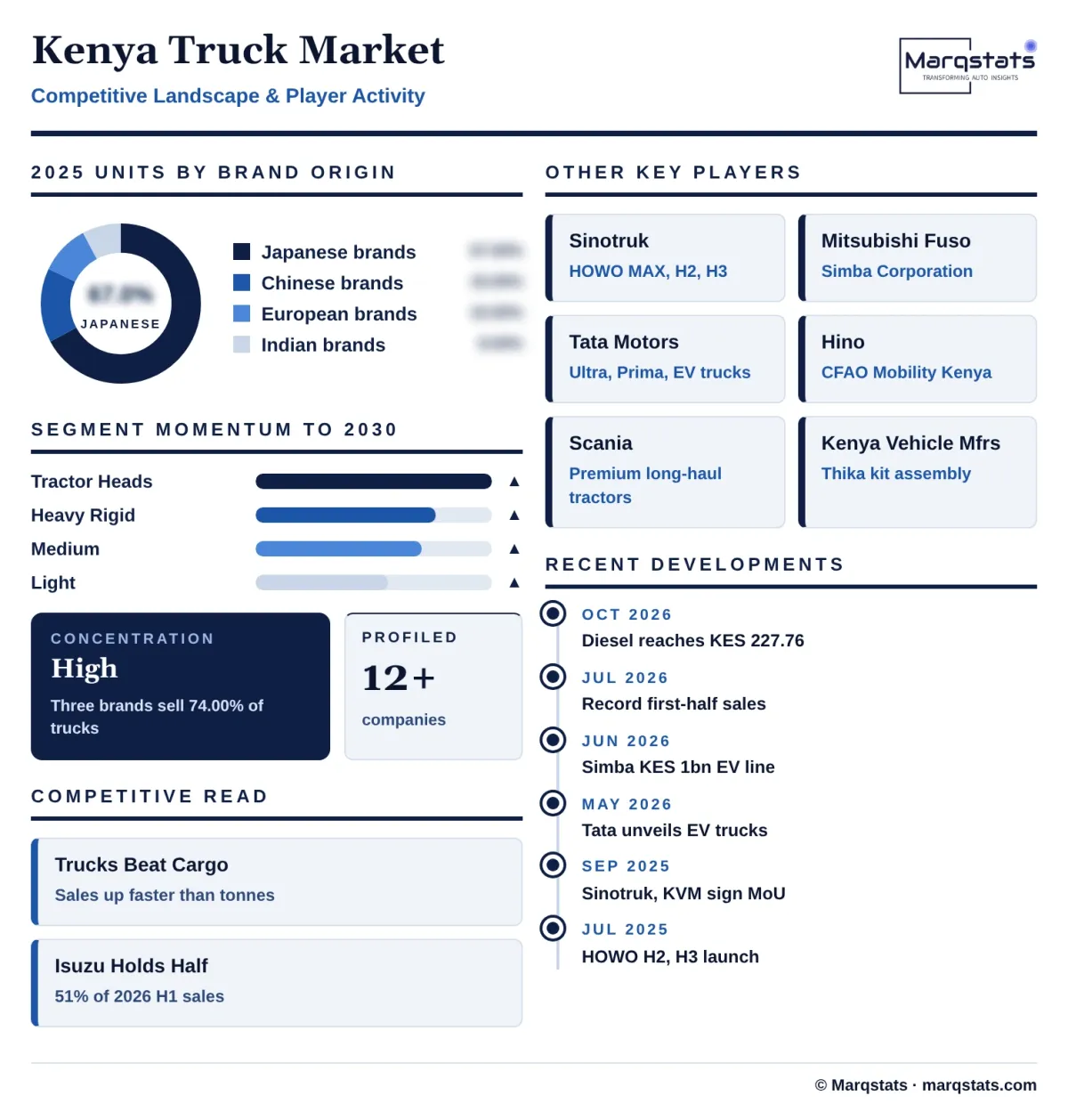
The market is concentrated in a few Japanese platforms and challenged by Chinese entrants. Marqstats estimates that Isuzu East Africa sold about 52.00% of 2025 truck units, Sinotruk dealers about 12.00%, Mitsubishi Fuso 10.00%, Tata Motors 7.00%, Hino 5.00% and Scania 4.00%, with the remaining 10.00% spread over Mercedes-Benz, MAN, Ashok Leyland, FAW, SHACMAN and other brands. By origin, Japanese brands hold about 67.00%, Chinese 15.00%, European 10.00% and Indian 8.00%.
Isuzu East Africa leads on service reach and resale value. It sold 6,494 vehicles of all types in 2025, 47.8% of the formal market, 2,036 in the first quarter of 2026, up 23.54% from 1,648, and 51% of all vehicles in the first half of 2026, while CFAO Mobility held 30.5% and Simba Corporation 7.9%. CFAO Mobility Kenya sells Hino and Sinotruk and majority-owns Kenya Vehicle Manufacturers, and Simba Corporation owns Associated Vehicle Assemblers.
Sinotruk is the fastest-moving challenger. Printan Limited reported a 55% share of the heavy-duty segment for HOWO in May 2025, CFAO Mobility Kenya added the H2 and H3 trucks in July 2025 with Equity Bank finance, and the memorandum with Kenya Vehicle Manufacturers of 22 September 2025 gives Sinotruk a local kit route, which Marqstats expects to lift Chinese brands from about 15.00% of units towards 20.00% by 2030.
Competition is shifting from list price to total cost of ownership. Assemblers and distributors now compete on finance terms of up to 90% over 60 months, free service packages for the first 200 HOWO H2 and H3 buyers, parts depth in Nairobi and Mombasa, and electric options, as shown by Tata Motors's May 2026 electric truck launch and Simba Corporation's June 2026 investment in an electric assembly line.
Companies Covered
Companies covered in the report include:
Recent Market Activity
Table of Contents
Coverage & Segmentation
The study covers the Kenya truck market, with 2025 as the base year, 2021 – 2025 as the historical period and 2026 – 2030 as the forecast period. It covers new goods trucks above 3.5 tonnes gross vehicle weight, assembled locally from kits or imported complete, segmented by vehicle class, sales route, end use and region. Values are chassis-cab transaction values in US dollars, before value added tax, bodies and trailers, and shilling figures use the 2025 average of KES 129.31 per US dollar.
Pickups, buses and matatus, vans, used trucks, trailers, fitted bodies, agricultural tractors and off-road machines are excluded. Segment and regional splits are Marqstats estimates built on Kenya Motor Industry Association categories, assembler and distributor disclosures and price benchmarks. The live Marqstats reports on Africa Chinese commercial vehicles, Africa electric commercial vehicles and Africa commercial vehicle aftermarket are broader regional parents, and the Marqstats Kenya electric bus analysis covers buses only, so none of their figures should be added to this market.
