Market Snapshot
Middle bar: base-year value × (1 + CAGR), rounded to two decimals. This is a calculated illustration, not a separately researched annual estimate.
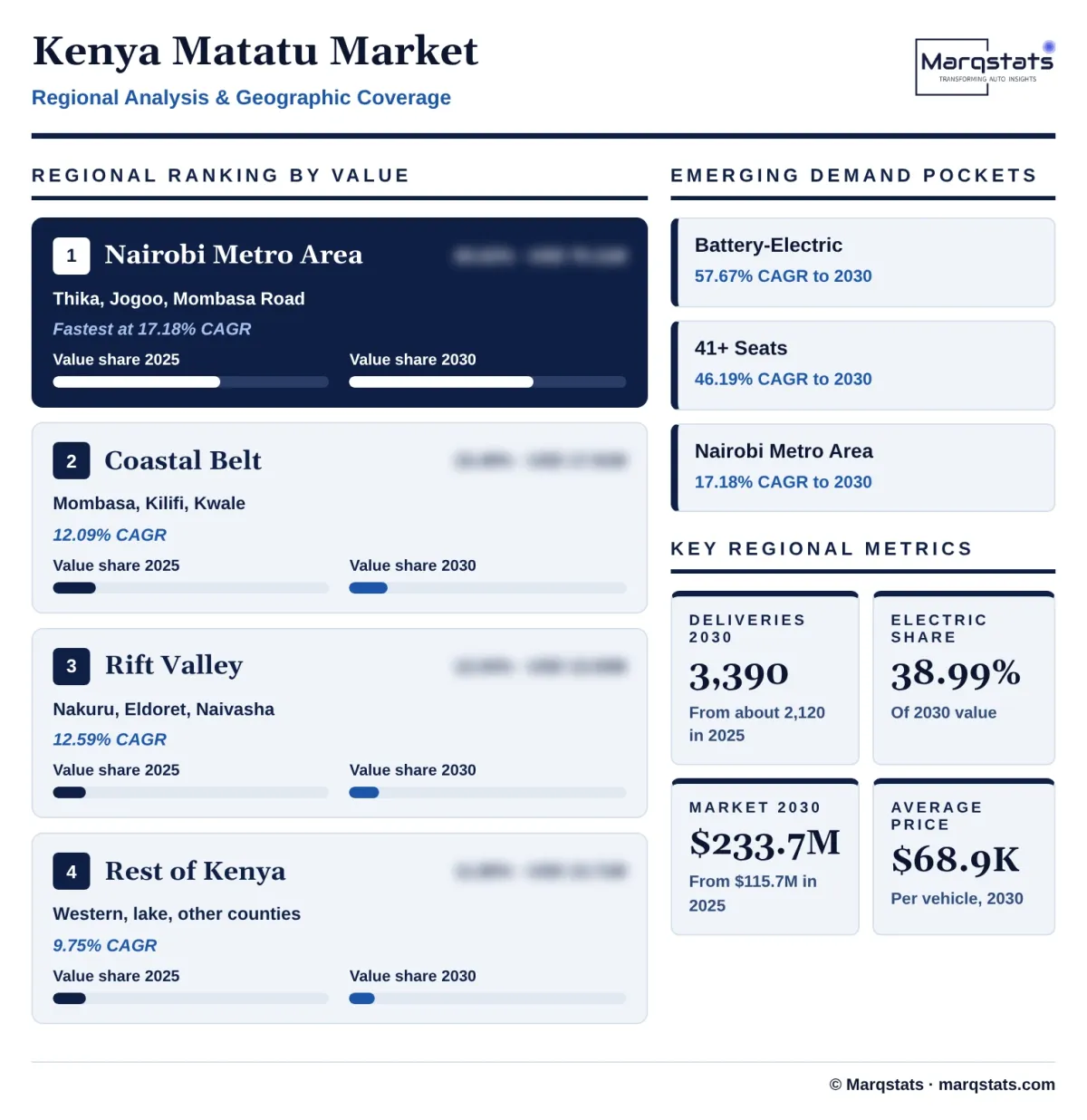
The Kenya matatu market size is estimated at USD 115.66 million in 2025 and is projected to reach USD 233.65 million by 2030, growing at a CAGR of 15.10% over 2026 – 2030. Annual deliveries rise from about 2,120 to 3,390 vehicles, a 9.84% annual rate, while the average value per vehicle climbs from about USD 54,560 to USD 68,920 as battery-electric buses take a larger share of the mix.
Marqstats defines the market as the value of new minibuses, midi-buses and larger buses of 14 or more seats that enter Kenyan matatu, shuttle and commercial passenger service each year, counted as the complete road-ready vehicle: chassis plus locally fabricated body for assembled units, and landed cost for imported complete vehicles. Examples include the Toyota HiAce high-roof, Isuzu NPR and NQR midi-buses, Mitsubishi Fuso and Hino midi-buses, and the BasiGo electric buses built on BYD and King Long platforms. School and institutional buses, freight vehicles, vans under 14 seats, three-wheelers, motorcycles and used vehicles are excluded.
Midi-buses of 21 to 40 seats account for 65.54% of 2025 value, diesel vehicles for 91.92% and the Nairobi Metropolitan Area for 60.62%. Battery-electric buses are the fastest-growing segment, at 57.67% a year, as pay-as-you-drive leasing, bank asset finance and new fast chargers make them practical for Nairobi operators.
Key Takeaways
Market Overview & Analysis
Report Summary
Marqstats sizes the Kenya matatu market as the value of new passenger vehicles of 14 or more seats entering matatu, shuttle and commercial passenger service. The matatu is Kenya's privately owned public service vehicle, and the market covers the vans, midi-buses and larger buses that operators buy to replace older vehicles or add capacity on licensed routes.
The market sits inside a larger formal vehicle market. The Kenya Motor Industry Association recorded 13,583 new vehicles sold in 2025, up 19.65% from 11,352 in 2024, of which 2,675 were buses, 5,496 trucks and 3,242 pickups. Isuzu East Africa alone sold 6,494 vehicles, up 20.48%. Marqstats estimates that about 2,120 vehicles entered matatu and commercial passenger service in 2025, which equals 79.25% of the buses recorded by KMIA after adding converted high-roof vans sold outside that bus category and removing buses delivered to schools and institutions.
Public service vehicles are regulated as cooperatives, not as individual owners. NTSA rules require a PSV SACCO or company to operate at least 30 serviceable vehicles, so an owner of one matatu joins a SACCO that holds the route licence and answers to NTSA for the conduct of all its members. Vehicle bodies must follow the KS 372 standard for bus body construction, built by body builders assessed by accredited bodies, and vehicles carry speed limiters set to 80 kilometres an hour.
The market recovered strongly after the 2022 to 2024 slowdown. Marqstats estimates about 1,420 matatu-class vehicles in 2021 and 2,120 in 2025, a 10.54% annual rate. KMIA sales in the first half of 2026 reached a record 7,819 vehicles, up 23% from 6,360, with 985 buses, mainly for the matatu industry and corporate transport, as the Central Bank Rate fell to 8.75% from 10.75% a year earlier.
Electrification gives the market a new product and a new financing model. BasiGo, founded in Nairobi in 2021, leases electric buses under pay-as-you-drive terms, assembles King Long buses with Kenya Vehicle Manufacturers in Thika and has more than 100 buses on the road. The Marqstats Kenya Electric Bus Market report sizes the same electric buses on a stand-alone basis, and the two figures overlap and must not be added.
Kenya Matatu Market Size and Forecast
The Kenya matatu market grows from USD 115.66 million in 2025 to USD 233.65 million in 2030, a CAGR of 15.10%. In shilling terms the market rises from about KES 14.96 billion to KES 30.21 billion at a constant exchange rate of KES 129.31 to the US dollar. Volume contributes 9.84% a year, from 2,120 to 3,390 vehicles, and the average value per vehicle adds 4.78% a year, from about USD 54,560 to USD 68,920, as electric buses carry more of the mix. Marqstats estimates 2026 at about 2,340 vehicles and USD 137.7 million.
The 2025 value is built bottom-up from seat bands, powertrains and regions. Marqstats estimates 700 vehicles of 14 to 20 seats at about KES 5.6 million each, 1,285 diesel midi-buses of 21 to 40 seats at about KES 7.1 million, 80 diesel buses of 41 or more seats at about KES 8.8 million, and 55 electric buses at an average of about USD 170,000. Diesel prices combine a forward-control chassis such as the Isuzu NQR with a locally fabricated body, and are held at constant 2025 shilling levels through 2030.
The electric segment follows the stand-alone Kenya Electric Bus report. That report counts 55 electric buses in 2025 at about USD 170,000 each, about 145 in 2026 and about 580 in 2030 on its growth path. Marqstats uses the same bus path here, 55 buses in 2025 and about 580 in 2030, and adds a small number of electric high-roof matatus of 14 to 20 seats, from none in 2025 to about 100 in 2030, as Rideence begins local assembly of Joylong vehicles at Associated Vehicle Assemblers in Mombasa. Total electric deliveries therefore rise from 55 to about 680 vehicles.
Diesel vehicles still deliver most volume, but not most growth. Diesel deliveries rise from 2,065 to 2,710 vehicles, a 5.59% annual rate, and diesel value from USD 106.31 million to USD 142.55 million, a 6.04% rate. Electric value rises from USD 9.35 million to USD 91.10 million, and about 1.00 percentage point of 2030 units moving from diesel to electric, about 34 vehicles, adds about USD 2.76 million of value.
Marqstats tracks four indicators to monitor the forecast: KMIA monthly bus sales and the Central Bank Rate, the number of electric buses delivered by BasiGo and other assemblers, bank lending to PSV SACCOs through facilities such as NCBA's KES 2 billion e-mobility line, and the pace of fast-charger openings along Mombasa Road and the upcountry corridors.
Market Dynamics
Key Drivers
Five forces are lifting the number and the value of new matatu-class buses that Kenyan operators buy each year.
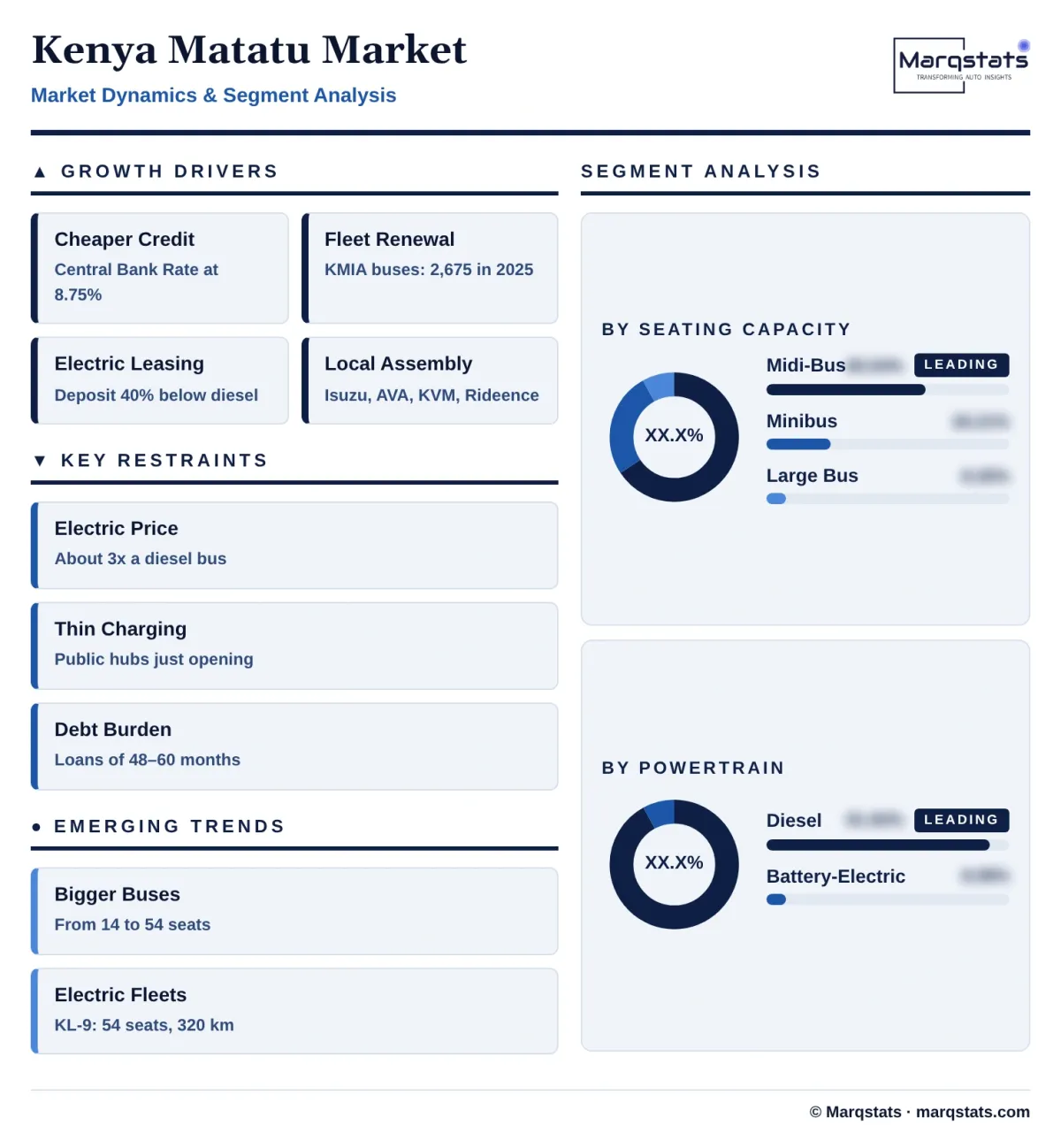
- Cheaper credit supports fleet renewal. The Central Bank Rate fell to 8.75% by March 2026 from 11.25% in January 2025, after eight consecutive cuts. Most matatus are bought on bank loans, so lower interest rates cut monthly instalments directly and helped lift KMIA bus sales to 985 vehicles in the first half of 2026.
- Used-vehicle limits push buyers to new assembled vehicles. From 1 January 2026 only vehicles first registered on or after 1 January 2019 may be imported for use in Kenya, an eight-year limit that KEBS enforces against KS 1515. Kenya imported 72,482 used vehicles in 2024, and operators that once bought older vans abroad now compare locally assembled buses more closely.
- Local assembly lowers the cost of new buses. Isuzu East Africa, Associated Vehicle Assemblers in Mombasa and Kenya Vehicle Manufacturers in Thika assemble chassis from kits, and local body builders fabricate bus bodies to KS 372. This keeps a large share of vehicle value in Kenya and gives operators short delivery times.
- Electric leasing removes the largest barrier to electric buses. BasiGo keeps ownership of the traction battery and charges operators a pay-as-you-drive fee, so the operator pays a deposit about 40% lower than for a diesel bus and does not carry battery replacement risk. The company has a reservation list of 1,200 customers.
- Policy favours electric buses. The National Electric Mobility Policy launched on 3 February 2026 zero-rates value-added tax on electric buses and lithium-ion batteries, and the Energy and Petroleum Regulatory Authority has set an e-mobility tariff with an off-peak rate of KES 8 a kilowatt-hour against KES 16 at peak.
Key Restraints
Four constraints keep the market tied to credit conditions, price and charging access.
- Electric buses cost about three times as much as diesel. An electric bus averages about USD 170,000 in 2025, against about USD 51,480 for a diesel matatu, and only lessors, banks and larger SACCOs can fund that gap. Individual owners in small SACCOs mostly keep buying diesel.
- Charging infrastructure is still thin. BasiGo and Rubis Energy Kenya opened the first public 100-kilowatt fast charger at Sabaki in July 2026 and plan three more at Meru, Nanyuki and Nyeri, with public charging expected to cost about KES 48 a kilowatt-hour. Operators outside Nairobi still depend on depot charging or have no electric option.
- Operators carry heavy debt. NCBA offers PSV SACCOs up to 90% of asset value over 60 months and individual members up to 80% over 48 months, so a new bus commits an owner to years of daily instalments on top of fuel, parking fees and insurance. Higher rates or weaker fares quickly delay replacement.
- Compliance raises the cost of small operators. A SACCO must run at least 30 serviceable vehicles, and every vehicle needs a KS 372 body, speed limiter and tracking. NTSA can suspend a whole SACCO after a serious breach, which makes owners cautious about joining weaker operators.
Key Trends
Four shifts are changing what a new matatu is, who builds it and how it is paid for.
- Bigger buses replace vans on busy routes. Operators on Nairobi corridors are moving from 14-seat vans to 25-seat and 54-seat buses to carry more passengers per trip, which lifts the share of vehicles above 20 seats and the average price per vehicle.
- Electric buses move from pilots to fleets. BasiGo reports more than 100 electric buses and says it targets 1,000 by 2027, while the King Long KL-9, unveiled on 11 September 2025, offers 54 passenger places and a range of up to 320 kilometres with a CATL battery that recharges in about two hours.
- Assemblers add electric lines. Rideence committed KES 320 million in February 2026 to assemble Joylong electric high-roof matatus at Associated Vehicle Assemblers, and AVA's owner Simba Corporation committed KES 1 billion in June 2026 to a dedicated electric vehicle assembly line that starts with cars and is meant to extend to trucks and buses.
- Banks build products for transport cooperatives. NCBA's KES 2 billion e-mobility facility, with a 1.5% processing fee and terms of up to 60 months for PSV SACCOs, shows lenders treating electric matatus as a distinct asset class with telematics-backed risk control.
Strategic Implications
- For vehicle makers, the 21-to-40-seat midi-bus is the volume product and the electric 54-seat bus is the value product. Makers should keep a competitive diesel midi-bus while building electric variants with lessors, because operators and banks decide on instalments, not list prices.
- For SACCOs and owners, buying new at replacement is increasingly the practical route as the eight-year limit narrows used imports. Owners should compare total instalments, battery risk and charging access, and use SACCO-level negotiation to secure bank terms.
- For banks and lessors, electric buses on pay-as-you-drive terms are an expanding asset class. Lenders such as NCBA can reduce credit risk by tying repayments to route revenue and telematics, and by financing only vehicles that meet KS 372 and NTSA rules.
- For body builders, the KS 372 standard and the growth of electric chassis mean a move from manual fabrication to jig-built, tested bodies. Builders that can fit bodies to electric chassis and meet accredited assessment will win larger fleet orders.
- For energy and charging companies, depot and corridor charging along Mombasa Road and the upcountry routes is the enabling investment. Off-peak electricity at KES 8 a kilowatt-hour makes overnight depot charging far cheaper than public charging at about KES 48.
Market Segmentation
Minibuses and high-roof vans of 14 to 20 seats account for USD 30.31 million in 2025, 26.21% of value and 33.02% of units, and grow at 4.06% a year to USD 36.98 million, while their value share falls to 15.83% by 2030. The Toyota HiAce is the best-known model. These vehicles serve feeder routes, rural centres and secondary towns where roads are narrow or unpaved, and electric high-roof vans such as the Joylong begin to appear from 2026.
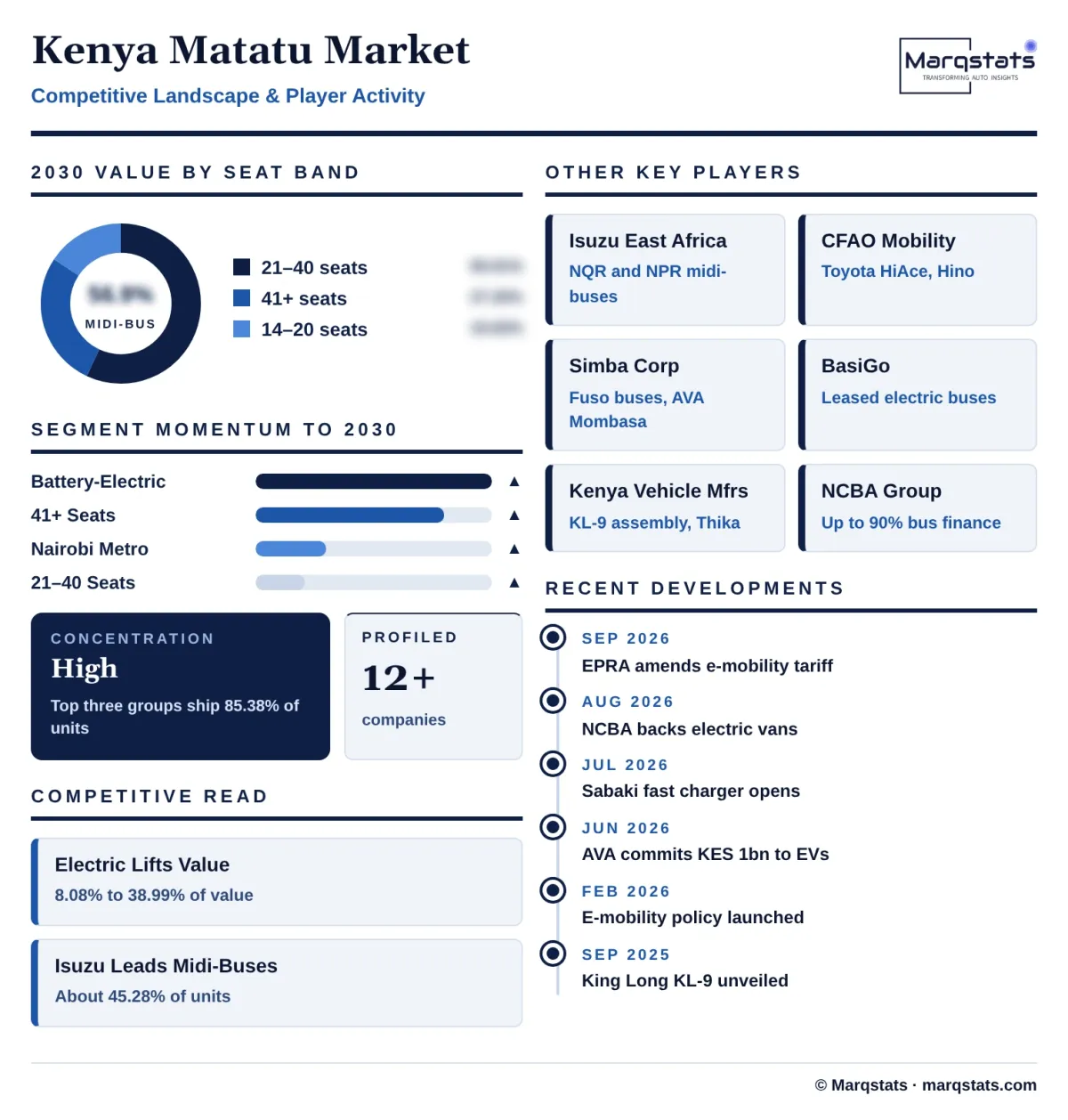
Midi-buses of 21 to 40 seats account for USD 75.81 million in 2025, 65.54% of value and 62.26% of units, and grow at 11.90% a year to USD 132.98 million and 56.91% by 2030. The Isuzu NQR 33-seater, the Isuzu NPR 29-seater and similar Mitsubishi Fuso and Hino buses dominate, and large SACCOs on Thika Road, Jogoo Road and Ngong Road buy them in batches. A fully trimmed 33-seater costs about KES 7.1 million.
Buses of 41 or more seats account for USD 9.54 million in 2025, 8.25% of value and 4.72% of units, and grow at 46.19% a year to USD 63.69 million and 27.26% by 2030. The segment is small today but is where the 54-passenger KL-9 electric city bus sits, with diesel buses on Isuzu forward-control chassis serving inter-urban routes.
Diesel vehicles account for USD 106.31 million in 2025, 91.92% of value and 97.41% of units, and grow at 6.04% a year to USD 142.55 million, while their share falls to 61.01% of value and 79.94% of units by 2030. Isuzu 4HL1 and similar turbo-diesel engines remain the working standard because fuel is available everywhere and mechanics know the engines.
Battery-electric vehicles account for USD 9.35 million in 2025, 8.08% of value and 2.59% of units, and grow at 57.67% a year to USD 91.10 million and 38.99% of value by 2030, when they reach about 680 vehicles. They are led by BasiGo buses built on BYD and King Long platforms, followed by Roam shuttles and electric high-roof matatus assembled in Mombasa, and most charge overnight at depots.
By Geography
Nairobi Metropolitan Area
The Nairobi Metropolitan Area, which includes Nairobi County and the commuter suburbs of Kiambu, Machakos and Kajiado, is the largest market with USD 70.11 million, 60.62% of 2025 value and 56.60% of units, and it grows fastest, at 17.18% a year, to USD 154.93 million and 66.31% by 2030. Radial routes along Thika Road, Jogoo Road and Mombasa Road support midi-buses and electric buses, and all of the 55 electric buses in the 2025 base operate in the area. Marqstats allocates vehicles by route licensing area, not by the registry where a leasing company or SACCO registers them.
Coastal Belt
The Coastal Belt, centred on Mombasa and the routes to Kilifi, Kwale and Malindi, accounts for USD 17.91 million, 15.49% of 2025 value, and grows at 12.09% a year to USD 31.69 million and 13.56% by 2030. Mombasa is the base for Associated Vehicle Assemblers and for Rideence's local electric van assembly, so electric high-roof matatus enter the market there first outside Nairobi.
Rift Valley
The Rift Valley, anchored by Nakuru, Eldoret and Naivasha, accounts for USD 13.93 million, 12.04% of 2025 value, and grows at 12.59% a year to USD 25.20 million and 10.79% by 2030. Inter-town routes on the Nairobi to Nakuru and Eldoret highways use midi-buses and small buses, and agricultural and industrial growth supports steady replacement demand.
Western and Lake Basin
The Western and Lake Basin, led by Kisumu, Kakamega and Bungoma, accounts for USD 8.72 million, 7.54% of 2025 value, and grows at 9.99% a year to USD 14.04 million and 6.01% by 2030. Small and medium vehicles dominate, and diesel remains the only practical powertrain over the forecast period.
Other Corridors
Other corridors, including northern, north-eastern and smaller central counties, account for USD 4.99 million, 4.31% of 2025 value, and grow at 9.32% a year to USD 7.79 million and 3.33% by 2030. Rugged roads and long distances favour 14-to-16-seat vans and strong leaf-spring suspension, and bank finance is harder to obtain. The central corridor through Nanyuki, Nyeri and Meru is the first upcountry area to get public fast chargers, planned by BasiGo and Rubis Energy Kenya.
How Competition Is Evolving
The market is highly concentrated. Marqstats estimates that Isuzu East Africa, CFAO Mobility Kenya and Simba Corporation supplied vehicles representing about 85.38% of 2025 deliveries, with BasiGo's electric buses and other brands sharing the rest. Isuzu sold 6,494 vehicles in Kenya in 2025, about 47.8% of the 13,583 sold, and held 51% of the formal market in the first half of 2026, against 30.5% for CFAO Mobility and 7.9% for Simba.
Marqstats estimates 2025 matatu-class deliveries by chassis group at about 960 for Isuzu, 45.28%, led by the NQR and NPR; about 560 for CFAO Mobility's Toyota HiAce and Hino buses, 26.42%; about 290 for Simba Corporation's Mitsubishi Fuso buses, 13.68%; 55 for BasiGo's electric buses, 2.59%; and about 255 for other brands, 12.03%. These are Marqstats estimates built from brand sales and PSV registrations, not reported shares.
Isuzu East Africa, the former General Motors East Africa, is the clear leader in midi-buses and has a full medium-duty order book. CFAO Mobility is strongest in the 14-seat segment with the Toyota HiAce, and Simba Corporation sells Mitsubishi Fuso buses assembled at its Mombasa subsidiary.
BasiGo is the leader in electric buses and a financing company as much as a vehicle maker. It leases buses, owns batteries, builds chargers with Rubis Energy Kenya and has partners in banking, with NCBA, and in assembly, with King Long and Kenya Vehicle Manufacturers. Roam and Rideence add electric shuttles and high-roof vans, while body builders such as Banbros and Labh Singh Harnam Singh fabricate bodies on diesel chassis.
Companies Covered
Companies covered in the report include:
Recent Market Activity
Table of Contents
Coverage & Segmentation
The study covers the Kenya matatu market, with 2025 as the base year, 2021 – 2025 as the historical period and 2026 – 2030 as the forecast period. It covers new minibuses, midi-buses and larger buses of 14 or more seats entering matatu, shuttle and commercial passenger service, both diesel and battery-electric, segmented by seating capacity, powertrain and region across the Nairobi Metropolitan Area, the Coastal Belt, the Rift Valley, the Western and Lake Basin and other corridors. Values are the complete road-ready vehicle value in US dollars, and shilling figures are converted at KES 129.31 to the US dollar, the 2025 average.
The battery-electric buses counted here are the same vehicles sized in the Marqstats Kenya Electric Bus Market report, plus a small number of electric high-roof matatus. The two reports overlap and their values must not be added. Electric vans used for freight or private service, school and institutional buses, freight vehicles, vans under 14 seats, three-wheelers, motorcycles, used vehicles and aftermarket parts are excluded.