Market Snapshot
Middle bar: base-year value × (1 + CAGR), rounded to two decimals. This is a calculated illustration, not a separately researched annual estimate.
School buses are the single most credible near-term vehicle-to-grid (V2G) opportunity in the United States because their duty cycle is uniquely grid-friendly: typically parked for up to 18 hours per day during the school year and nearly three months over summer, with average weekday trip distances of only about 25 miles, and more than 90% of the national fleet electrifiable with currently available vehicle ranges. As of mid-2025, 26 utilities in 19 states had active electric school bus V2G programmes. The committed fleet includes 13,931 electric school buses across 1,542 school districts in 49 states, Washington DC, and four US territories, with California leading at 3,382 committed buses. EPA’s Clean School Bus Program has awarded nearly USD 3 billion, funding roughly 8,500 clean buses—95% of which are electric. The United States electric school bus V2G market size was valued at approximately USD 78.42 million in 2025 and is projected to reach USD 412.56 million by 2030, expanding at a CAGR of 39.38% during the forecast period (2026–2030).
The economics are already generating real compensation. In Beverly, Massachusetts, participation in National Grid’s Connected Solutions programme produced compensation of approximately USD 200 per kW delivered during summer peak events, translating to roughly USD 6,000 per vehicle per year. In South Burlington, Vermont, Green Mountain Power’s flexible-load-management structure has generated around USD 9,000 per vehicle per year. In California, Emergency Load Reduction Program (ELRP) dispatches have paid USD 2 per kWh during event periods. Oakland Unified became the first major US district with a fully electrified school-bus system (74 buses, Zum, August 2024), with bidirectional chargers and an AI-enabled virtual power plant (VPP) setup expected to return approximately 2.1 GWh annually to the grid. Electric school buses with 155–180 kWh battery packs and highly predictable schedules are ideal V2G assets because they combine large stored energy with reliable plug-in behaviour during peak grid periods.
However, V2G is not yet a fully standardised business. Battery warranty and degradation concerns remain top obstacles: although the White Plains/Con Edison three-year pilot found battery degradation similar to normal driving-only use (with approximately 85% of stored power returned to the grid), many fleet operators still need more confidence before committing to bidirectional dispatch. The market is also constrained by higher V2G infrastructure costs, uncertain or immature compensation mechanisms in many utility territories, and interoperability issues across buses, chargers, software, and utilities. Hubject, Heliox, Cummins, and Blue Bird achieved the first commercial deployment of an interoperable V2G charging solution under ISO 15118-20 (June 2025)—a milestone that directly addresses the interoperability barrier. The Marqstats India electric bus battery pack market report provides complementary coverage of the battery-pack architecture used in electric bus V2G systems.
Key Takeaways
Market Overview & Analysis
Report Summary
The United States electric school bus V2G market covers all revenue and value streams generated by electric school buses providing bidirectional energy services: utility demand response and peak-event dispatch, virtual power plant (VPP) aggregation and grid services, vehicle-to-building (V2B) backup and resilience, managed charging and load management, and the enabling infrastructure layer including bidirectional EVSE, V2G software/aggregation platforms, and utility programme design. The scope covers fleet-as-a-service operators (Zum, Highland Electric Fleets, First Student), V2G software and aggregation providers (Nuvve, The Mobility House, ChargeScape), utilities with active ESB V2G programmes (PG&E, Green Mountain Power, National Grid, Con Edison, ComEd, Dominion Energy, Portland General Electric, SDG&E, Potomac Edison), and bus OEMs with V2G-capable vehicles (Blue Bird, Thomas Built Buses, IC Bus, Lion Electric). The national school-bus fleet comprises approximately 500,000 buses, of which approximately 95% still run on diesel—defining an enormous conversion opportunity.
V2G works best when a vehicle has predictable downtime, modest daily mileage, and reliable plug-in behaviour. Electric school buses meet all three conditions. Managed charging alone can reduce peak depot charging loads by up to 77%. Once bidirectional discharge is added, fleets can earn revenue from demand response, capacity, peak shaving, and resilience services. The DOE Vehicle-Grid Integration (VGI) 10-Year Roadmap (2025) positions school buses as a priority application for vehicle-grid integration because of their grid-friendly duty cycle, concentrated depot charging, and fleet-manager decision-making (versus fragmented consumer decisions). The standards stack—ISO 15118 (communication/interoperability), SAE J3072 (utility interconnection for onboard inverters), UL 1741 (inverter equipment), UL 9741 (bidirectional EVSE), IEEE 1547 (distributed energy resource interconnection), and now SAE J3400 (NACS with V2G requirements)—is improving but not yet fully harmonised across all OEMs and utilities.
Market Dynamics
Key Drivers
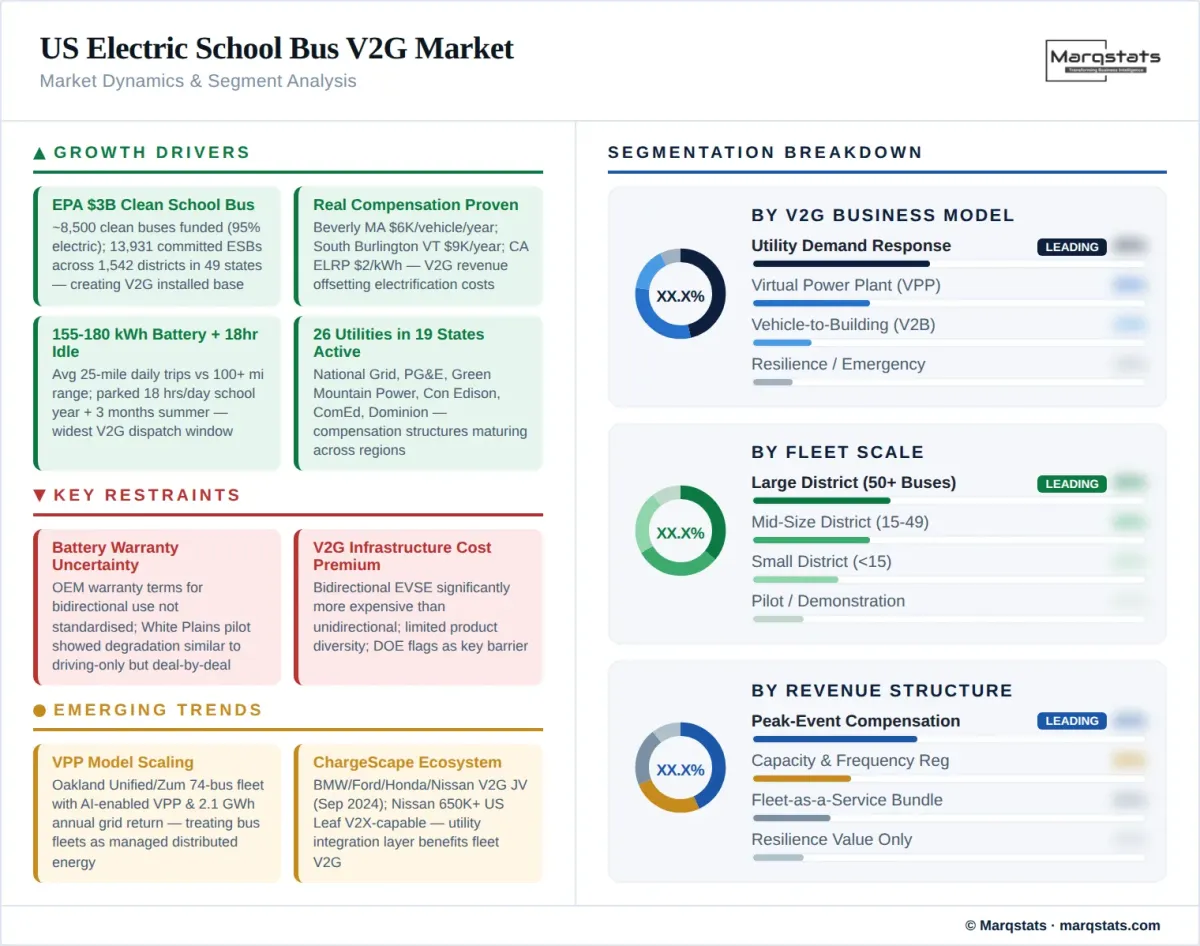
- EPA Clean School Bus Program supporting the fleet pipeline: The Infrastructure Investment and Jobs Act directed EPA to provide USD 5 billion from FY2022–FY2026 for cleaner school buses. Nearly USD 3 billion has been awarded, funding roughly 8,500 clean buses (95% electric). By 2025, 13,931 committed electric school buses were spread across 1,542 districts in 49 states, DC, and 4 US territories. California leads with 3,382 committed buses, followed by New York (1,100+), Maryland, Illinois, and Massachusetts. These commitments form a pipeline for future electric school bus and V2G deployment.
- Real-world compensation proving V2G economics in leading utility territories: Beverly, Massachusetts / National Grid: approximately USD 200/kW during summer peaks, translating to ~USD 6,000 per vehicle per year. South Burlington, Vermont / Green Mountain Power: ~USD 9,000 per vehicle per year through flexible load management. California ELRP: USD 2/kWh during event periods. These compensation levels make V2G a legitimate revenue source that can offset incremental electrification costs, though they are not yet available in all utility territories.
- ESB battery capacity (155–180 kWh) and predictable schedules creating ideal V2G assets: Electric school buses carry large battery packs relative to daily energy needs (average 25-mile weekday trips versus 100+ mile range), are reliably plugged in mid-day and overnight, and are parked for extended periods during summer. This creates the widest V2G dispatch windows of any vehicle class. NREL found that more than 90% of the US school bus fleet could be electrified with current ranges.
- DOE VGI 10-Year Roadmap (2025) prioritising school buses for vehicle-grid integration: The DOE’s vehicle-grid integration assessment identifies school buses as a priority V2G application because of concentrated depot charging, fleet-manager decision-making, and grid-friendly duty cycles. This policy signal helps utilities justify V2G programme design for school bus fleets and helps districts access federal and state funding for bidirectional infrastructure.
- Utility-backed cost-sharing models strengthening commercial viability: Potomac Edison’s approved Maryland pilot covers up to 100% of the incremental vehicle cost difference plus up to 100% of EVSE, V2G platform, and maintenance costs for a 28-bus pilot over five years, with V2G-dispatched buses providing distribution-system load relief. Dominion Energy’s Virginia Electric School Bus Infrastructure programme facilitates utility coordination, network upgrades, and charger installation for V2G-capable buses. Lion Electric’s buses are eligible for Dominion’s programme. These utility-backed models point to what the stronger commercial structure looks like.
Key Restraints
- V2G battery warranty and degradation concerns: Battery life and warranty treatment remains the top fleet-operator concern. OEM warranty terms for bidirectional use are not yet standardised. However, the White Plains/Con Edison three-year pilot found degradation similar to normal driving-only use, and approximately 85% of stored power was returned to the grid. As real-world data accumulates across more programmes, warranty confidence should improve—but for now, this is still a deal-by-deal negotiation issue.
- Higher V2G infrastructure cost versus unidirectional charging: V2G requires safety-certified bidirectional EVSE, which costs significantly more than unidirectional DC fast chargers. DOE notes that the higher cost and limited product diversity of bidirectional charging equipment remain important barriers. ChargePoint and Eaton’s Express Grid V2X architecture (August 2025, up to 600 kW) and Heliox’s V2G-capable DC fast chargers under ISO 15118-20 represent the leading edge of product availability, but the market needs more options and lower price points.
- Compensation mechanism immaturity in many utility territories: While 26 utilities in 19 states have V2G programmes, compensation structures vary enormously. Some territories lack the tariff design or demand-response mechanisms needed to value bus-to-grid dispatch. Without clear, bankable compensation, fleet operators cannot justify the incremental V2G investment. The market expands fastest in utility territories that create explicit compensation pathways.
- Interoperability across buses, chargers, software, and utilities: Interoperability remains a recurring practical barrier. Different bus OEMs, charger manufacturers, and V2G software platforms do not always communicate seamlessly. The Hubject/Heliox/Cummins/Blue Bird ISO 15118-20 deployment (June 2025) is the first commercial interoperable V2G solution under the international standard—a milestone, but one that highlights how recently standardised interoperability became commercially available.
Key Trends
- Electric school bus virtual power plant (VPP) model scaling from Oakland: Oakland Unified / Zum’s 74-bus fleet with AI-enabled VPP and expected 2.1 GWh annual grid return is the most cited flagship. Branford, Connecticut / Zum announced the largest fully electric V2G district in the Northeast (February 2026). The VPP model treats school bus fleets as managed distributed energy resources, not just vehicles—creating a transportation-plus-grid asset story.
- ChargeScape V2G software platform uniting BMW, Ford, Honda, and Nissan: ChargeScape (operational September 2024) connects utilities, automakers, and EV drivers for smart charging (V1G) and vehicle-to-grid (V2G). Nissan joined as 25% investor (October 2024), bringing 650,000+ US Leaf sales with V2X capability. While ChargeScape focuses on passenger EVs, its utility integration layer creates ecosystem infrastructure that benefits fleet V2G programmes including school buses.
- Nuvve expanding V2G platform beyond school buses to BESS and grid services: Nuvve’s GIVe platform now manages 150+ MW of combined battery and V2G capacity across the US and Europe, including the first public V2G-capable school bus deployment in New Mexico (late 2024). Nuvve won a Sourcewell cooperative-purchasing contract (October 2025) giving 75,000+ public agencies streamlined access to V2G chargers and FLEETBOX energy management software. Nuvve’s New Mexico state contract estimates approximately USD 400 million total addressable market for fleet electrification and V2G infrastructure.
- Massachusetts launching one of the largest state-led V2X programmes: Resource Innovations and The Mobility House were selected to deploy 100 bidirectional chargers to residential, school bus, municipal, and commercial fleet participants in Massachusetts (February 2025)—totalling approximately 1.5 MW of new storage capacity. This represents one of the largest state-led V2X initiatives in the US and creates a scalable blueprint for V2X programmes nationwide.
Market Segmentation
The most common current V2G structure. Buses are dispatched during limited peak grid events in exchange for utility payments. Beverly/National Grid (USD 200/kW, ~USD 6,000/vehicle/year), South Burlington/Green Mountain Power (~USD 9,000/vehicle/year), and California ELRP (USD 2/kWh) represent this model. Revenue is event-based and seasonal, typically concentrated in summer peak periods and winter demand events.
The highest-value model where bus fleets behave as managed grid assets. Oakland Unified / Zum (74 buses, 2.1 GWh annual return), Branford Connecticut / Zum (largest Northeast V2G fleet), and Nuvve’s GIVe platform (150+ MW managed capacity) represent this tier. VPP aggregation enables continuous dispatch optimisation rather than event-only participation, and can stack multiple value streams (demand response, capacity, frequency regulation, peak shaving).
School buses providing backup power to school buildings, emergency shelters, and community facilities. Hood River County, Oregon pilots demonstrated school-building resilience applications. This model matters commercially where grid-market revenues are modest but resilience has high institutional value—particularly for districts in wildfire, hurricane, or extreme-weather zones. Eaton’s V2H/V2G architecture (CES 2025) demonstrates bidirectional infrastructure that supports building-backup applications.
Not technically V2G discharge, but the foundational revenue layer. NREL found managed charging alone reduces peak depot charging loads by up to 77%. Managed charging creates grid value before bidirectional capability is even installed, making it the lowest-barrier entry point for fleet-grid integration. Most V2G programmes include managed charging as the baseline service tier.
Zum (Oakland 74-bus VPP, Branford CT V2G), Highland Electric Fleets, and First Student (450 ESBs deployed, 2,022 EVs awarded, V2X-ready charging platform) manage the full electrification stack: bus procurement, charger deployment, utility coordination, and V2G programme participation. Districts increasingly prefer turnkey fleet-as-a-service models over self-managed electrification.
Nuvve (GIVe platform, 150+ MW managed, Sourcewell contract, New Mexico state contract) and The Mobility House (Fremont USD V2G fleet, Massachusetts V2X programme) sit at the orchestration layer. ChargeScape (BMW/Ford/Honda/Nissan JV) provides utility-OEM integration. This layer is critical because V2G value depends on dispatch optimisation, settlement, and charger-bus-grid coordination.
Blue Bird says V2G is a standard feature on its electric buses and achieved the first ISO 15118-20 interoperable V2G deployment with Hubject/Heliox/Cummins. Thomas Built Buses promotes V2G revenue potential. IC Bus markets V2G on its electric CE Series. Lion Electric’s V2G-capable buses are eligible for Dominion Energy’s Virginia programme. By 2025, 26 ESB models from 23 OEMs were available in the market overall.
By Geography
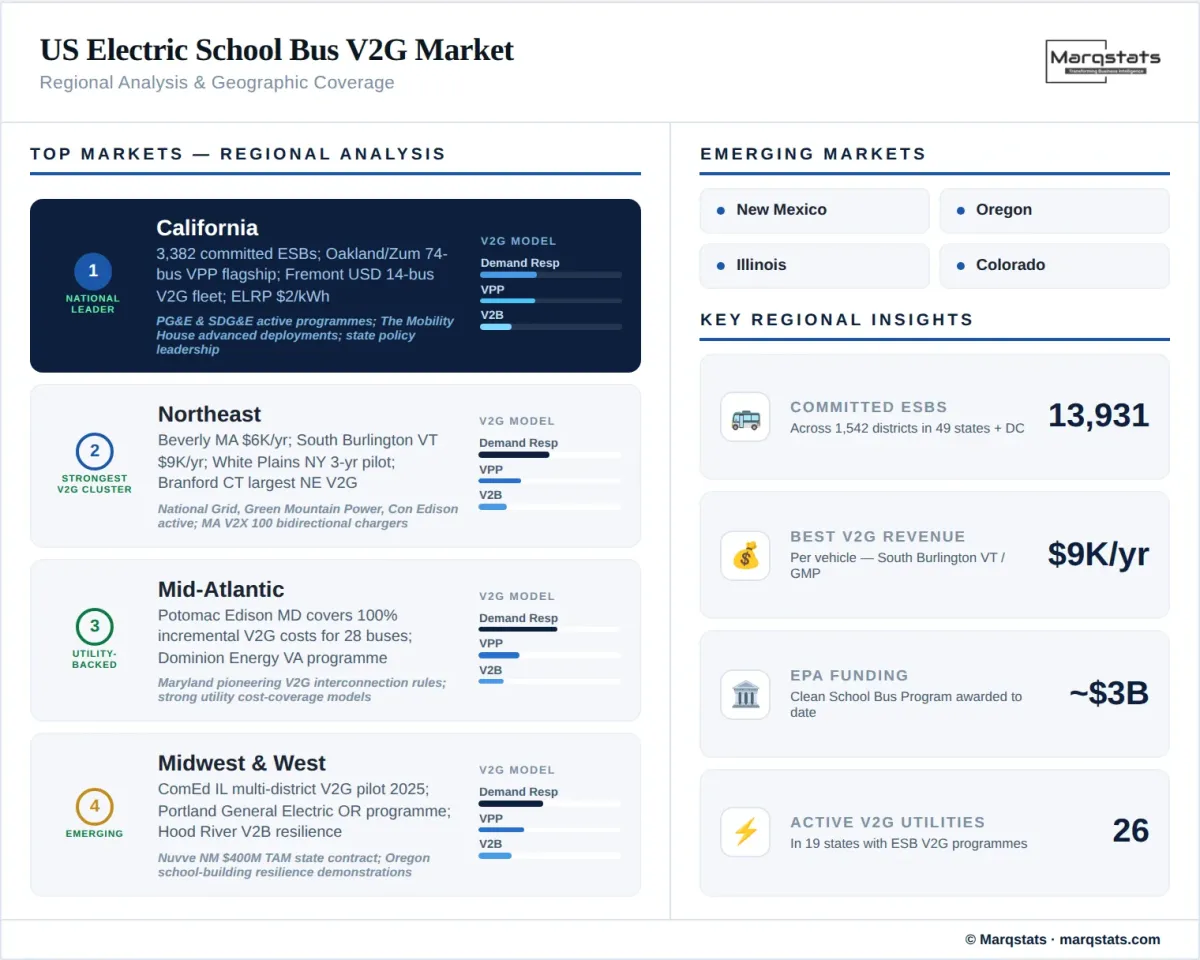
California
The national leader by committed ESB count (3,382 buses) and V2G deployment maturity. Oakland Unified / Zum is the most cited V2G flagship nationally. Fremont USD / PG&E / The Mobility House operates one of California’s most advanced V2G school-bus fleets (14 buses, 22 chargers including 6 bidirectional DC). SDG&E and PG&E both have active ESB V2G programmes. California’s ELRP pays USD 2/kWh during dispatch events.
Northeast (Massachusetts, Vermont, Connecticut, New York)
The second-strongest V2G cluster. Beverly, Massachusetts / National Grid: USD 200/kW, ~USD 6,000/vehicle/year. South Burlington, Vermont / Green Mountain Power: ~USD 9,000/vehicle/year. White Plains, New York / Con Edison: three-year pilot proving 85% energy return and minimal battery degradation. Branford, Connecticut / Zum: largest fully electric V2G district in the Northeast (February 2026). Massachusetts V2X programme: 100 bidirectional chargers including school bus participants, ~1.5 MW total.
Mid-Atlantic (Maryland, Virginia, Washington DC)
Strong utility-backed models. Potomac Edison’s Maryland pilot covers up to 100% of incremental vehicle and EVSE/V2G costs for 28 buses over five years. Dominion Energy’s Virginia programme facilitates utility coordination, network upgrades, and charger installation for V2G-capable buses. Lion Electric’s buses are eligible for the Virginia programme. Maryland represents one of the first comprehensive V2G interconnection rule frameworks in the US.
Midwest (Illinois, Ohio)
ComEd’s northern Illinois utility pilot (launched 2025) assesses grid and societal impacts across several districts. Illinois is one of the top five states by committed ESB count. Ohio and Michigan represent emerging V2G territories with growing ESB deployment funded through the Clean School Bus Program.
West and Southwest (Oregon, New Mexico, Texas)
Hood River County, Oregon used buses for school resilience and V2B applications. Portland General Electric has an active ESB V2G programme. Nuvve launched New Mexico LLC and won a state contract estimating ~USD 400 million TAM for fleet electrification and V2G infrastructure; Las Cruces became the first public V2G-capable school bus deployment in New Mexico (late 2024). Texas hosts growing ESB deployment with supportive grid economics for demand-response services.
How Competition Is Evolving
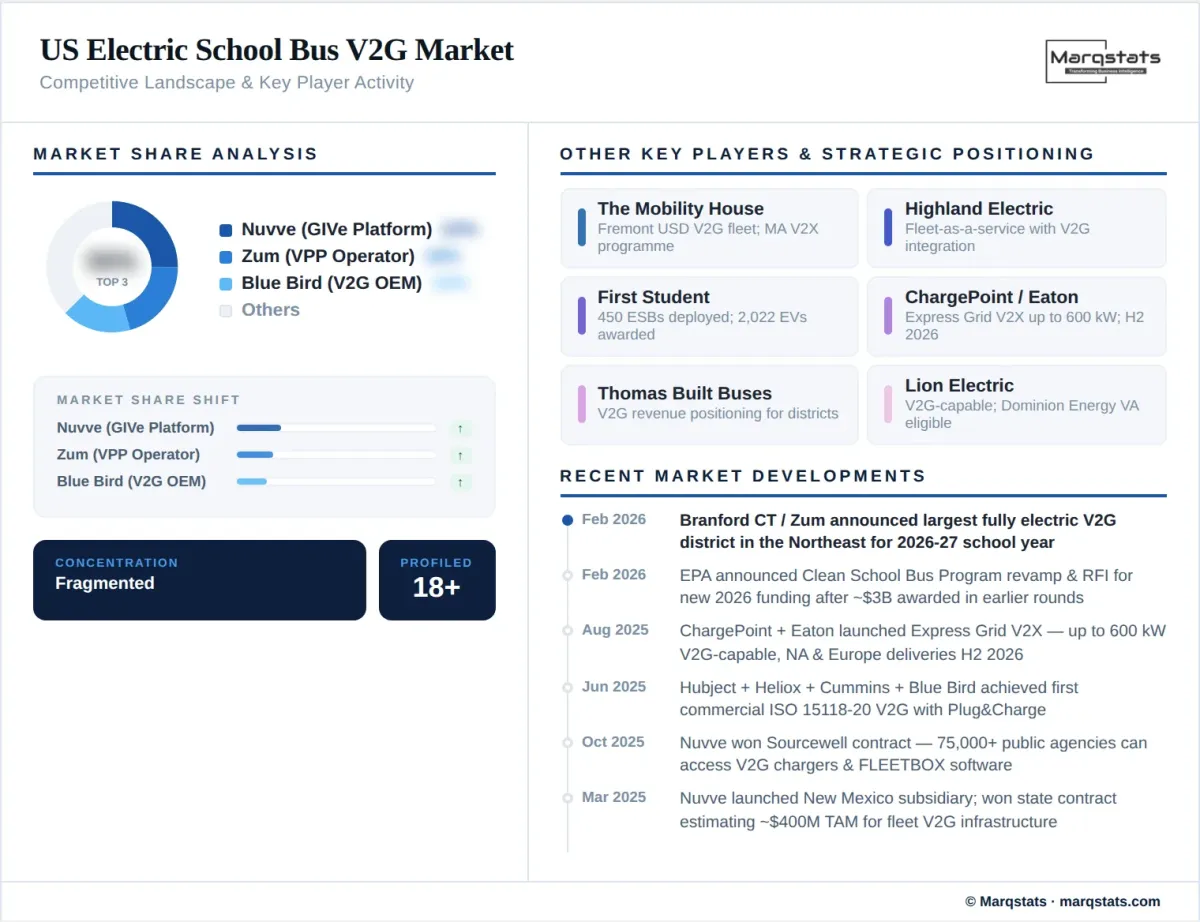
The market has four competitive layers. Fleet operators and deployment companies manage the full electrification-to-V2G stack: Zum leads with Oakland’s 74-bus VPP (first major 100% electrified district, 2.1 GWh expected annual return) and Branford, Connecticut (largest Northeast V2G fleet, February 2026). Highland Electric Fleets is a leading fleet-as-a-service provider for school bus electrification with V2G integration. First Student has deployed 450 electric school buses and been awarded 2,022 EVs, with a V2X-ready charging platform. These operators’ value is managing buses, chargers, utility coordination, and financing as a turnkey service.
V2G software and aggregation providers form the orchestration layer. Nuvve’s GIVe platform manages 150+ MW of combined capacity, won the Sourcewell cooperative-purchasing contract (October 2025) for 75,000+ agencies, and secured the New Mexico state contract (~USD 400M TAM). The Mobility House operates Fremont USD’s advanced V2G fleet and was selected for Massachusetts’ V2X programme. ChargeScape (BMW/Ford/Honda/Nissan JV, operational September 2024) provides utility-OEM V2G integration software.
Bus OEMs provide V2G-capable hardware: Blue Bird offers V2G as a standard feature and achieved the first ISO 15118-20 interoperable V2G deployment (June 2025, with Hubject/Heliox/Cummins). Thomas Built Buses promotes V2G revenue potential. IC Bus markets V2G on its electric CE Series. Lion Electric’s buses are eligible for Dominion Energy’s Virginia programme. Utilities are effectively co-creators of the market: PG&E, Green Mountain Power, National Grid, Con Edison, ComEd, Dominion Energy, Portland General Electric, SDG&E, and Potomac Edison all have active ESB V2G programmes.
Companies Covered
Companies covered in the report include:
Recent Market Activity
Table of Contents
Coverage & Segmentation
This report provides a comprehensive analysis of the United States electric school bus V2G market covering the historical period (2021–2025) and forecast period (2026–2030), with 2025 as the base year. The study examines market size in USD across V2G business model (utility demand response, VPP aggregation, V2B/resilience, managed charging), value chain position (fleet operators, V2G software/aggregation, bus OEMs, utilities, infrastructure), and geography covering 14 states and key utility territories. Company profiling covers 20+ players across fleet operators, V2G platforms, bus OEMs, charging infrastructure, and utilities. Standards analysis covers ISO 15118, SAE J3072, SAE J3400, UL 1741, UL 9741, and IEEE 1547. Policy analysis covers EPA Clean School Bus Program, DOE VGI 10-Year Roadmap, state utility commission decisions, and utility tariff/compensation design.
Research methodology combines bottom-up modelling from committed ESB counts (13,931 across 1,542 districts), utility V2G programme inventory (26 utilities in 19 states), compensation data (USD/kW, USD/kWh, USD/vehicle/year), and bidirectional charger deployment tracking. Primary research encompasses 40+ interactions with school district transportation directors, fleet-as-a-service operators, V2G software providers, utility programme managers, bus OEM electrification teams, and bidirectional charging infrastructure suppliers across California, Northeast, Mid-Atlantic, Midwest, and Southwest regions.