Market Snapshot
The Middle East and Africa passenger car market size is estimated at USD 89,157.85 million in 2025 and is projected to reach USD 111,687.57 million by 2030, growing at a CAGR of 4.61% over 2026 – 2030. Sales rise from about 2,705,028 to 3,247,600 cars after a Gulf-led dip in 2026.
Marqstats defines the market as the retail value of new M1 passenger cars, meaning sedans, hatchbacks, SUVs, crossovers and people carriers with up to nine seats, sold to buyers in the six Gulf Cooperation Council states, Israel, Iraq and the Levant, and every African country. Value is the price the buyer pays, including value added tax, customs duty and purchase taxes. Pickups, vans, trucks, buses, used cars, imported used cars and vehicles built for export are excluded, and Türkiye and Iran sit outside the region.
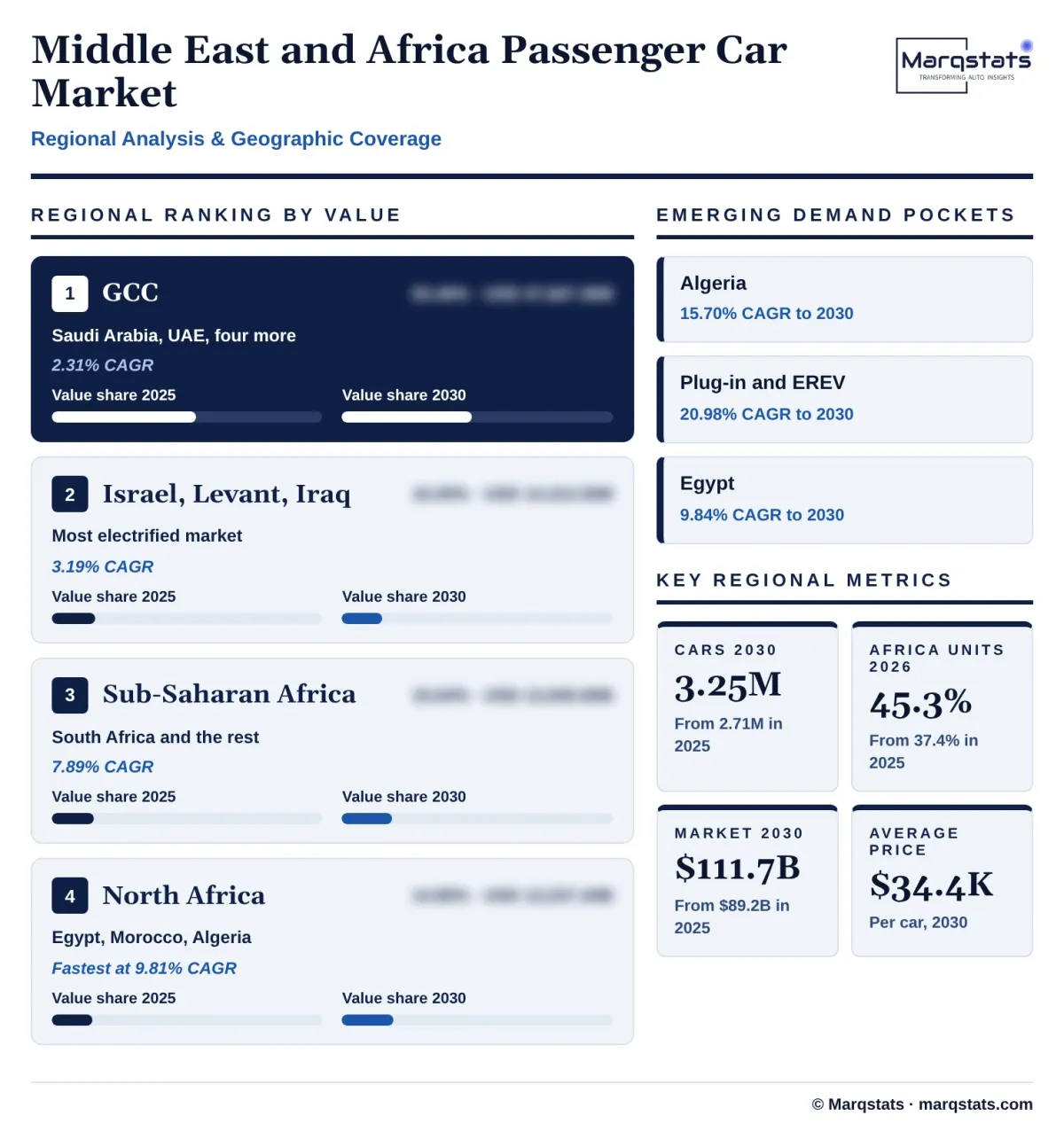
SUVs and crossovers account for 58.00% of 2025 value, petrol and diesel cars for 86.00% and private buyers for 70.00%. Saudi Arabia is the largest country at 23.39% of value, and Algeria grows fastest at 15.70% a year, while North Africa as a group grows at 9.81% a year against 2.31% in the Gulf.
Key Takeaways
Market Overview & Analysis
Report Summary
Marqstats sizes the Middle East and Africa passenger car market as the retail value of new M1 passenger cars delivered to buyers in the region each year. The region covers Saudi Arabia, the UAE, Kuwait, Qatar, Oman and Bahrain, Israel, Iraq, Jordan, Lebanon and the other Levant and Arabian Peninsula states, and all 54 African countries. Türkiye is excluded because Marqstats sizes it as a European market in its own Turkey passenger car study, and Iran is excluded because its sanctions-bound domestic market prices cars at several official and open-market exchange rates that cannot be put on one dollar basis.
The market is built from ten country groups. Six of them, Saudi Arabia, the UAE, Egypt, Morocco, Algeria and South Africa, are anchored on published national series and on Marqstats country builds, and they hold 1,907,028 cars, or 70.50% of 2025 units. Four groups are Marqstats constructions: the other four GCC states, Israel, Iraq and the Levant, and the rest of Africa, each built from importer and association totals and a price estimate.
The International Organization of Motor Vehicle Manufacturers (OICA) reported 1,285,408 new vehicles of all types sold in Africa in 2025, against 1,053,734 in 2024, with South Africa at 597,338, Morocco at 235,372 and Egypt at 163,757. In the Middle East it reported 827,544 vehicles for Saudi Arabia, 308,495 for the UAE, 306,724 for Israel and 145,471 for Kuwait. These are all-vehicle totals, so Marqstats removes pickups, vans, trucks and buses country by country before valuing passenger cars.
The region is a set of very different car markets under one label. In the Gulf, buyers pay among the lowest fuel prices in the world and choose large SUVs such as the Toyota Land Cruiser and Nissan Patrol, so the average car sells for about USD 51,305 in the UAE including tax. In North Africa, foreign exchange controls, import quotas and assembly rules shape supply, and Dacia, Renault, Hyundai, Chery and MG compete on price. In South Africa a large local industry exports most of what it builds while buyers increasingly choose imported Chinese and Indian cars.
The base year 2025 was strong almost everywhere. Saudi Arabia tracked 857,247 new light vehicles, its highest total since 2015, Morocco registered a record 208,848 passenger cars, up 32.91%, Egypt recovered with 133,973 cars reported by the Automotive Marketing Information Council (AMIC), up 64.4%, and South Africa sold its most passenger cars in more than a decade. The 2026 reversal in the Gulf therefore starts from a high base.
Middle East and Africa Passenger Car Market Size and Forecast
The Middle East and Africa passenger car market grows from USD 89,157.85 million in 2025 to USD 111,687.57 million in 2030, a CAGR of 4.61%. Unit sales grow at 3.72% a year, from about 2,705,028 to 3,247,600 cars, and the average value per car grows at 0.85% a year, from about USD 32,960 to USD 34,391, so volume contributes most of the growth and the move to electrified and premium cars adds the rest.
The path is not smooth. Marqstats estimates that the market falls 9.20% to USD 80,951.62 million in 2026, with units down 7.91% to about 2,491,000 cars, because Saudi sales drop from 732,515 to about 522,000 cars and UAE sales from 288,800 to about 234,000. The market regains its 2025 value in 2027, at USD 89,445.65 million, and then grows at 7.68% a year to 2030 as Gulf supply chains normalise and African demand keeps rising.
The value basis is the price paid by the buyer. Saudi Arabia is counted including its 15% value added tax (VAT), Egypt including customs duty, schedule tax and 14% VAT, Morocco including 20% VAT and import duties, and Algeria and South Africa including all taxes. Marqstats sizes the UAE before its 5% VAT in its UAE study, so the UAE enters this market at that value plus 5%: USD 14,816.94 million in 2025 against USD 14,111.37 million in the country study.
The six anchored countries carry their country build figures without change. Saudi Arabia is USD 20,850.42 million, Egypt USD 5,577.93 million, Morocco USD 5,541.62 million and Algeria USD 2,117.79 million in 2025. South Africa is built from naamsa unit sales of 422,292 at a Marqstats average retail price of about ZAR 450,000, or USD 25,168 at the 2025 average of ZAR 17.88 per US dollar.
Marqstats tracks four indicators to monitor the forecast: monthly Saudi and UAE light-vehicle sales after the Hormuz disruption, naamsa passenger car sales and the South African prime lending rate, AMIC and AIVAM monthly registrations in Egypt and Morocco, and Algerian import quotas and the output of the Fiat plant at Tafraoui, which together explain most of the gap between a good and a bad year.
Market Dynamics
Key Drivers
Five forces keep the regional market growing through a Gulf downturn that dominates the 2026 numbers.
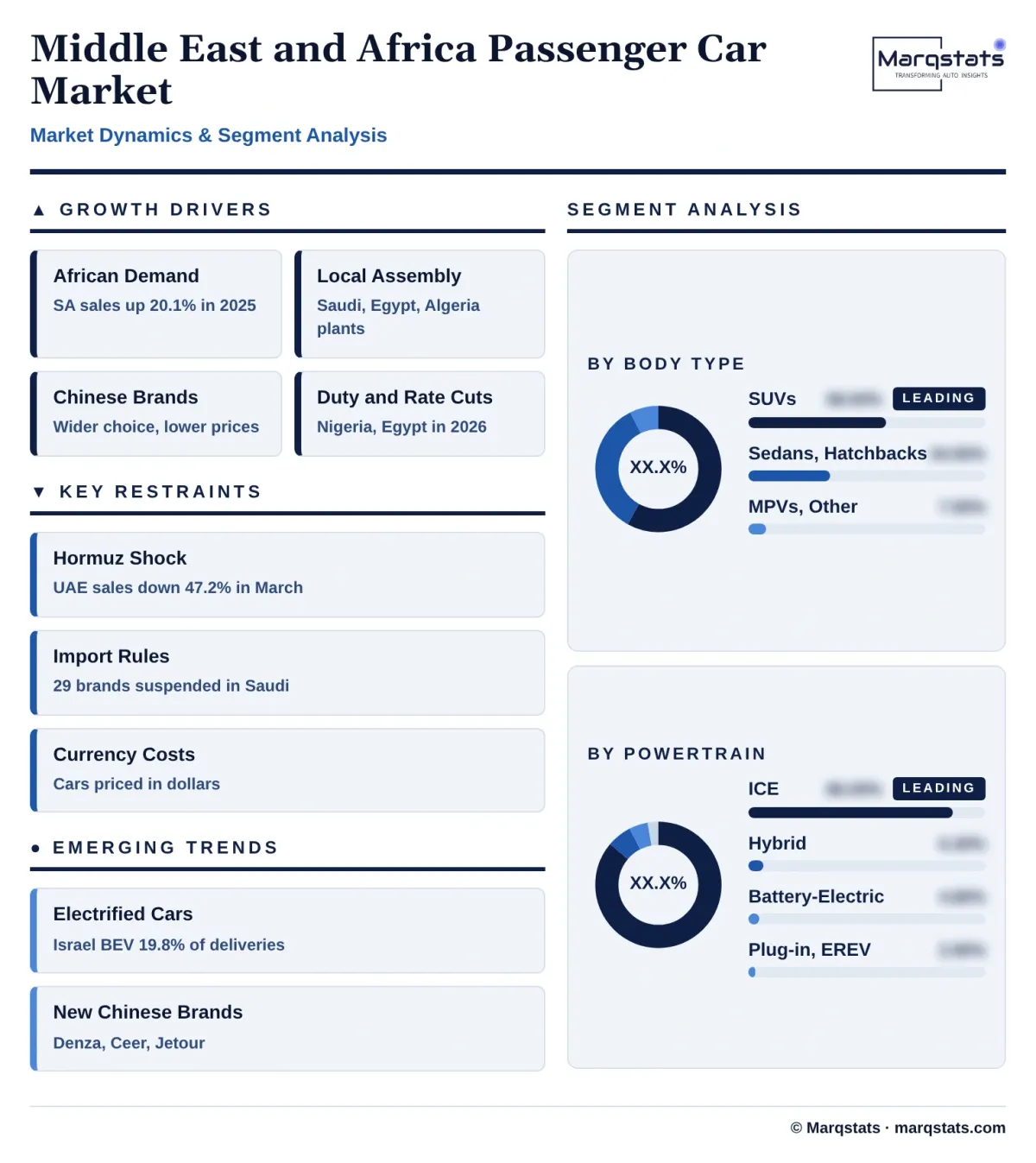
- African demand is rising from a low base of car ownership. Egypt, Morocco, Algeria and South Africa together add about 109,287 cars in 2026 on Marqstats estimates, and naamsa reported South African passenger car sales up 14.7% in September 2026 after a 20.1% rise in 2025. Lower interest rates, cheaper imported models and pent-up replacement demand all point the same way.
- Local assembly lowers prices and secures supply. Hyundai Motor Manufacturing Middle East, a joint venture of the Public Investment Fund (PIF) with 70% and Hyundai Motor Company with 30%, broke ground on 14 May 2025 on a 50,000-car plant in the King Salman Automotive Cluster, Al-Mansour Automotive broke ground on 4 November 2025 on a USD 150 million MG plant in 6th of October City, and Stellantis builds Fiat cars at Tafraoui in Algeria.
- Chinese brands widen choice at lower prices. Chinese brands held 7.7% of Moroccan passenger car registrations in 2025 and 11.8% by September 2026, Jetour rose to 14% of Qatari sales in 2025, and Haval and Jetour gained share in Saudi Arabia in 2026 even as the market fell.
- Tax and duty cuts reduce the price of a new car. Nigeria cut the duty on fully built passenger cars from 70% to 40% and the new-vehicle levy from 20% to 10% in July 2026, and the Central Bank of Egypt cut its lending rate by 100 basis points to 20% on 12 February 2026, lowering the cost of car loans in two of the most price-sensitive markets.
- Gulf incomes and SUV demand keep prices high. Toyota held 28.6% of Saudi light-vehicle sales and 28.3% of Qatari sales in 2025, led by the Land Cruiser, and large SUVs carry high average prices that keep the GCC at more than half of regional value even in a weak year.
Key Restraints
Four constraints hold the market below its potential and make the forecast lumpier than its compound rate suggests.
- The Gulf is exposed to shipping shocks. In March 2026 Maersk and Hapag-Lloyd suspended transits through the Strait of Hormuz and CMA CGM imposed an emergency surcharge of up to USD 4,000 per container bound for the UAE, and UAE sales fell 47.2% in March and 23.2% over January to August 2026, while Saudi sales fell 26.9% over the same eight months.
- Import rules can close supply at short notice. The Saudi Ministry of Commerce and the Saudi Standards, Metrology and Quality Organization (SASO) suspended light-vehicle imports from 29 manufacturers that missed the 2026 supply-plan filing in June 2026, Algeria controls new-car imports through licences and quotas, and Kenya allows only used cars first registered in 2019 or later from 1 January 2026.
- Currencies and credit keep cars expensive in Africa. The Egyptian pound averaged EGP 49.25 per US dollar in 2025, the naira NGN 1,520 and the rand ZAR 17.88, and most cars or their kits are bought in dollars or euros, so price rises follow every devaluation and buyers in Nigeria, Kenya and Ghana turn to imported used cars instead.
- Data outside the large markets is thin. Most Sub-Saharan countries other than South Africa issue no regular new passenger car series, and Gulf distributors report only to private trackers, so the rest of Africa and the smaller Gulf and Levant markets are Marqstats estimates rather than counts.
Key Trends
Four shifts are changing which cars are sold, where they come from and how they are powered.
- Electrified cars move from niche to mainstream. Israel reported 91,877 battery-electric and plug-in hybrid cars in 2025, with pure electric cars at 19.8% of deliveries, South African new energy vehicle sales of 18,945 in the first eight months of 2026 already exceeded the 16,703 sold in all of 2025, and Moroccan electrified cars reached 17.8% of registrations by September 2026.
- Chinese premium and electric brands arrive. Auto Nejma launched Denza in Morocco on 14 July 2026 with prices from MAD 629,900, and Ceer Motors, the Saudi electric car brand, unveiled its first model, the Exobot, on 22 September 2026, with production planned from January 2027.
- Range-extended cars open a new segment. The live Marqstats Middle East and Africa range-extended electric vehicle study puts the segment at 1,950 cars and USD 109.20 million in 2025, rising to 49,000 cars by 2030, with the UAE and Egypt as the first markets.
- Markets formalise. Egypt adds about 50,000 cars a year sold by importers that do not report to AMIC, Nigeria introduced a pre-shipment certification rule for imported vehicles in April 2026, and Ghana tightened its used-vehicle regime from October 2026, all of which push buyers toward new and documented cars over time.
Strategic Implications
- For carmakers, the region needs two plans, not one. A Gulf plan built around SUVs, hybrids and dealer stock that can absorb a shipping shock, and an African plan built around assembly partners, price points below USD 25,000 and finance, because the two halves move in opposite directions in 2026.
- For Chinese entrants, North Africa and South Africa are the growth markets and the Gulf is the profit market. Algeria, Egypt and Morocco add more cars between 2025 and 2030 than the UAE, while a Gulf SUV earns about twice the revenue of a North African car.
- For distributors such as Abdul Latif Jameel Motors, Al-Futtaim Motors, GB Corp and Auto Nejma, inventory and supply-chain resilience matter more than brand count in the Gulf after March 2026, while in Africa finance partnerships decide volume.
- For suppliers and investors, the electrified share rising from 14.00% to 27.50% of value means demand for chargers, battery service and hybrid parts concentrates first in Israel, the UAE, Morocco and South Africa, not evenly across the region.
- For policymakers, duty and quota decisions are the strongest lever on sales: Nigeria's July 2026 cuts, Egypt's rate cuts and Algeria's import licences each move national demand by more than any model launch.
Market Segmentation
SUVs and crossovers account for 58.00% of 2025 value, USD 51,711.55 million, and grow at 6.01% a year to USD 69,246.29 million and 62.00% of the market by 2030. Large SUVs such as the Toyota Land Cruiser, Nissan Patrol and Jetour T2 lead in the Gulf, while compact crossovers such as the Hyundai Tucson, Chery Tiggo and Dacia Duster take share in North and South Africa.
Sedans and hatchbacks account for 34.50% of 2025 value, USD 30,759.46 million, and grow at 2.06% a year to USD 34,064.71 million. They remain the volume choice in Egypt, Morocco and Algeria, where the Dacia Logan and Sandero, Hyundai Accent, Toyota Corolla and Fiat models sell to first-time buyers and rental fleets, but they lose share as crossovers become affordable.
MPVs, people carriers and other body types account for 7.50% of 2025 value, USD 6,686.84 million, and grow at 4.61% a year to USD 8,376.57 million. Seven-seat models such as the Fiat Doblo Panorama in Algeria and the Toyota Avanza and Suzuki Ertiga serve large families and ride-hailing drivers.
Petrol and diesel cars account for 86.00% of 2025 value, USD 76,675.75 million, and grow slowly, at 1.10% a year, to USD 80,973.49 million while their share falls to 72.50%. Cheap fuel keeps them dominant in the Gulf, and diesel still made up 63.5% of Moroccan registrations to September 2026.
Full and mild hybrids account for 6.30% of 2025 value, USD 5,616.94 million, and grow at 19.00% a year to USD 13,402.51 million and 12.00% of the market. Toyota and Hyundai hybrids suit hot climates and long distances, and hybrids made up most of South African new energy vehicle sales in 2025.
Plug-in hybrids and range-extended cars account for 2.90% of 2025 value, USD 2,585.58 million, and grow fastest among powertrains, at 20.98% a year, to USD 6,701.25 million. Chinese brands such as BYD, Denza, Jetour and Geely lead, and the segment includes the range-extended cars sized in the live Marqstats regional study, which should not be added to this market.
Battery-electric cars account for 4.80% of 2025 value, USD 4,279.58 million, and grow at 19.91% a year to USD 10,610.32 million and 9.50% of the market. Israel, where pure electric cars were 19.8% of 2025 deliveries, and the UAE hold most of the segment, with Tesla, BYD and Geely-group brands leading.
Private households account for 70.00% of 2025 value, USD 62,410.50 million, and grow at 4.31% a year to USD 77,064.42 million. Loan rates decide demand in South Africa, Egypt and Morocco, while cash and Islamic finance purchases dominate in the Gulf.
Corporate, leasing and government fleets account for 19.00% of 2025 value, USD 16,939.99 million, and grow at 5.15% a year to USD 21,779.08 million. Company-car schemes in Israel, leasing in Saudi Arabia and the UAE and government purchases in Algeria and Nigeria make this the steadiest channel.
Rental, tourism and ride-hailing fleets account for 11.00% of 2025 value, USD 9,807.36 million, and grow fastest among buyer types, at 5.54% a year, to USD 12,844.07 million. Rental and tourism fleets took 34% of Moroccan registrations in 2025, and South African rental companies buy heavily before each holiday season.
By Geography
Saudi Arabia
Saudi Arabia is the largest market, with USD 20,850.42 million, or 23.39% of 2025 value, on about 732,515 cars, and grows at 1.74% a year to USD 22,723.97 million. It also takes the deepest 2026 fall, to about 522,000 cars, because Toyota and Hyundai supplies were cut after March and 29 brands lost import approval in June. The Hyundai plant at King Abdullah Economic City and Ceer Motors are the first steps toward local supply.
United Arab Emirates
The UAE accounts for USD 14,816.94 million, or 16.62% of 2025 value including 5% VAT, on about 288,800 cars, and grows at 2.14% a year to USD 16,468.35 million. It has the highest average price in the region, about USD 51,305 per car, and the most electrified sales in the Gulf, but its re-export trade and port dependence made it the first market hit in 2026.
Other GCC (Kuwait, Qatar, Oman, Bahrain)
Kuwait, Qatar, Oman and Bahrain account for USD 12,000.00 million, or 13.46% of 2025 value, on about 300,000 cars, and grow at 3.48% a year. Kuwait sold 152,879 new vehicles in 2025, up 15%, Qatar 88,065, up 21.9%, and Bahrain 37,713, up 8.8%, with Toyota leading each market and Jetour second in Qatar and Bahrain. Marqstats removes pickups and vans and adds an estimate for Oman.
Israel
Israel accounts for USD 11,610.00 million, or 13.02% of 2025 value, on about 258,000 cars, and grows at 2.16% a year. The Israel Vehicle Importers Association reported 293,591 new vehicles up to 3.5 tonnes in 2025, up 8%, of which Marqstats treats about 258,000 as passenger cars. Israel is the most electrified market in the region, with 91,877 battery-electric and plug-in hybrid registrations in 2025.
Iraq, Jordan, Lebanon and Other Middle East
Iraq, Jordan, Lebanon and the other Middle East markets account for USD 2,702.50 million, or 3.03% of 2025 value, on about 115,000 cars, and grow at 7.19% a year, the fastest in the Middle East. Iraq is the largest of these markets and buys mostly Korean, Japanese and Chinese cars through Gulf ports, while Jordan has moved quickly toward electric cars.
Egypt
Egypt accounts for USD 5,577.93 million, or 6.26% of 2025 value, on 183,973 cars, and grows at 9.84% a year to USD 8,919.62 million. The total adds the 133,973 cars reported by AMIC to about 50,000 cars sold by importers outside AMIC, and AMIC passenger car sales rose 22% over January to August 2026 as foreign exchange became easier to obtain.
Morocco
Morocco accounts for USD 5,541.62 million, or 6.22% of 2025 value, on 208,848 cars registered with the Association des Importateurs de Véhicules au Maroc (AIVAM), and grows at 7.14% a year to USD 7,822.69 million. Dacia and Renault lead, Chinese brands reached 11.8% of registrations by September 2026, and rental and tourism fleets buy about a third of cars.
Algeria
Algeria accounts for USD 2,117.79 million, or 2.38% of 2025 value, on about 70,600 new cars, and grows fastest in the region, at 15.70% a year, to USD 4,390.04 million. The Fiat plant at Tafraoui produced about 53,000 vehicles in 2025, and Chinese shipments to Algeria rose 235.5% in the first half of 2026 as import licences were issued.
South Africa
South Africa accounts for USD 10,628.15 million, or 11.92% of 2025 value, on 422,292 cars, and grows at 7.69% a year to USD 15,392.90 million. It is the largest African market by units, sales rose 20.1% in 2025 and 14.7% in September 2026, and Toyota, Suzuki, Volkswagen and Chinese brands such as Chery, Haval and Omoda lead a market where imported models gain share.
Rest of Africa
The rest of Africa accounts for USD 3,312.50 million, or 3.72% of 2025 value, on about 125,000 new cars, and grows at 8.53% a year. It covers new cars only: the 13,000 imported new cars and 14,000 locally assembled cars Marqstats estimates for Nigeria, about 11,500 new cars in Ghana and 994 new passenger cars reported in Kenya, plus Tunisia, Libya, Côte d'Ivoire, Angola, Tanzania and other markets. Imported used cars belong to the live Marqstats used car studies.
How Competition Is Evolving
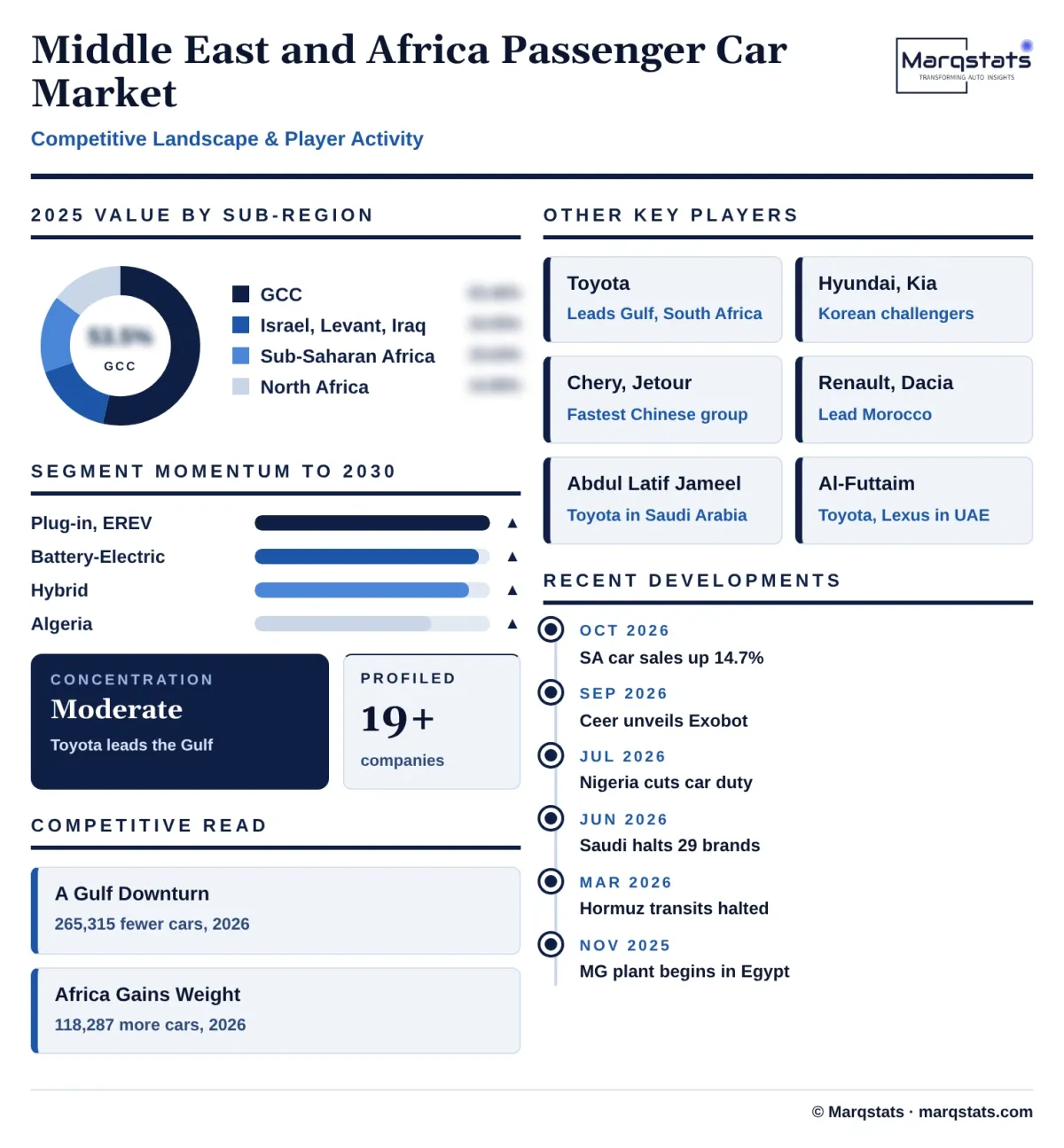
The market is moderately concentrated, with Toyota the clear leader. Toyota held 28.6% of Saudi light-vehicle sales and 24.4% of UAE sales in 2025, 28.3% in Qatar and 32.1% in Bahrain, and leads South Africa, while Dacia and Renault lead Morocco and Chinese and Korean brands lead Egypt. No single brand leads every sub-region, which is why Marqstats describes competition by brand origin and by distributor rather than with one regional share table.
Japanese and Korean brands hold the Gulf. Toyota and Lexus are sold through Abdul Latif Jameel Motors in Saudi Arabia and Al-Futtaim Motors in the UAE, Nissan through Arabian Automobiles and Al Masaood, and Hyundai and Kia ranked second and third in Saudi Arabia with 15.9% and 7.8% of 2025 sales. The first signs of change came in 2026, when Hyundai briefly overtook Toyota in Saudi Arabia in July and Haval and Jetour gained share in a falling market.
Chinese brands are the challengers everywhere. Chery, with its Jetour and Omoda and Jaecoo brands, Great Wall Motor with Haval and Tank, Geely, SAIC with MG, Changan and BYD grew fastest across the region in 2025 and 2026. Jetour rose to second place in Qatar and Bahrain, Chinese brands reached 11.8% of Moroccan registrations by September 2026, and Chinese brands led Israeli electric car sales over January to October 2025.
European groups compete through local plants. Renault Group builds Dacia and Renault cars at Tangier and Casablanca, Stellantis builds Fiat cars at Tafraoui and Peugeot and Citroën models at Kénitra, and Volkswagen, BMW, Mercedes-Benz, Toyota and Ford build cars in South Africa, mostly for export. Their regional advantage is cost and duty-free access, not volume in the Gulf.
Companies Covered
Companies covered in the report include:
Recent Market Activity
Table of Contents
Coverage & Segmentation
The study covers the Middle East and Africa passenger car market, with 2025 as the base year, 2021 – 2025 as the historical period and 2026 – 2030 as the forecast period. It covers new M1 passenger cars, segmented by body type, powertrain, buyer type and ten country groups in four sub-regions: the GCC, Israel with Iraq and the Levant, North Africa, and South Africa with the rest of Sub-Saharan Africa. Values are retail prices paid by the buyer in US dollars, including VAT, duties and purchase taxes, converted at single 2025 average rates: SAR 3.75, AED 3.6725, EGP 49.25, MAD 9.34, DZD 131.67, ZAR 17.88, NGN 1,520, KES 129.31 and GHS 12.654 per US dollar.
Pickups, vans, light and heavy trucks, buses, used cars, imported used cars, cars built for export and aftermarket parts are excluded, as are Türkiye and Iran. The Marqstats country studies for Saudi Arabia, the UAE, Egypt, Morocco and Algeria are the anchors for those countries; the UAE study is before 5% VAT and enters here with VAT added. The Kenya, Ghana and Nigeria passenger car studies count imported used cars and only their new-car channels enter here. Live Marqstats studies on the Middle East and Africa used car market, range-extended electric vehicles, the UAE electric vehicle market, GCC Chinese new energy vehicles and the South African and Egyptian Chinese brand and hybrid markets overlap or sit beside this market and should not be added to it.