Market Snapshot
Middle bar: base-year value × (1 + CAGR), rounded to two decimals. This is a calculated illustration, not a separately researched annual estimate.
Market Size (2025, Base Year): USD 1,845.50 Million
Estimated Value (2026): USD 2,248.80 Million
Forecast Value (2030): USD 4,635.80 Million
CAGR: 20.23% | Forecast Period: 2026 – 2030
Growth — Absolute: USD 2790.30 Million
SDV-Equipped Assembly Volume: 1,522,095 Units (2025) to 3,024,000 Units (2030)
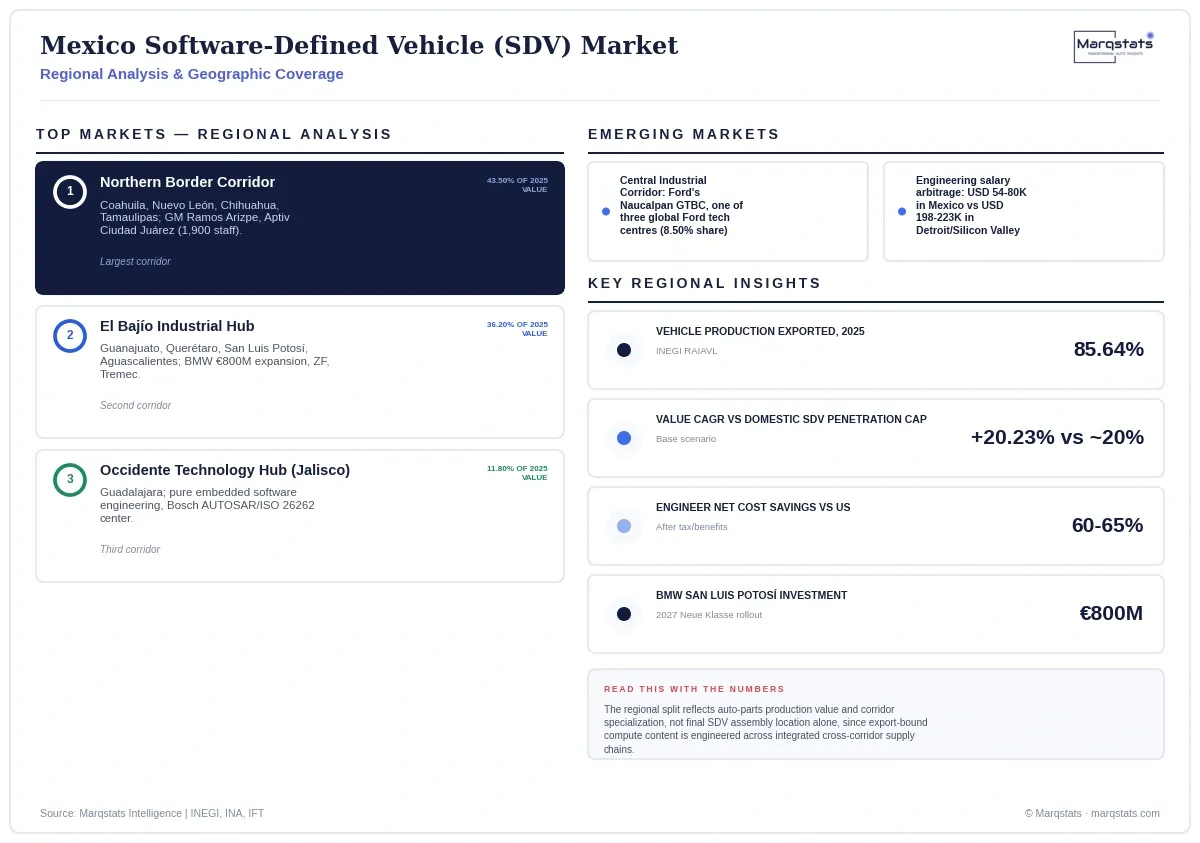
Largest Market: Northern Border Corridor (43.50% of 2025 value)
Fastest Growing Segment: Battery Electric Vehicles (28.00% to 46.00% share, 2025-2030)
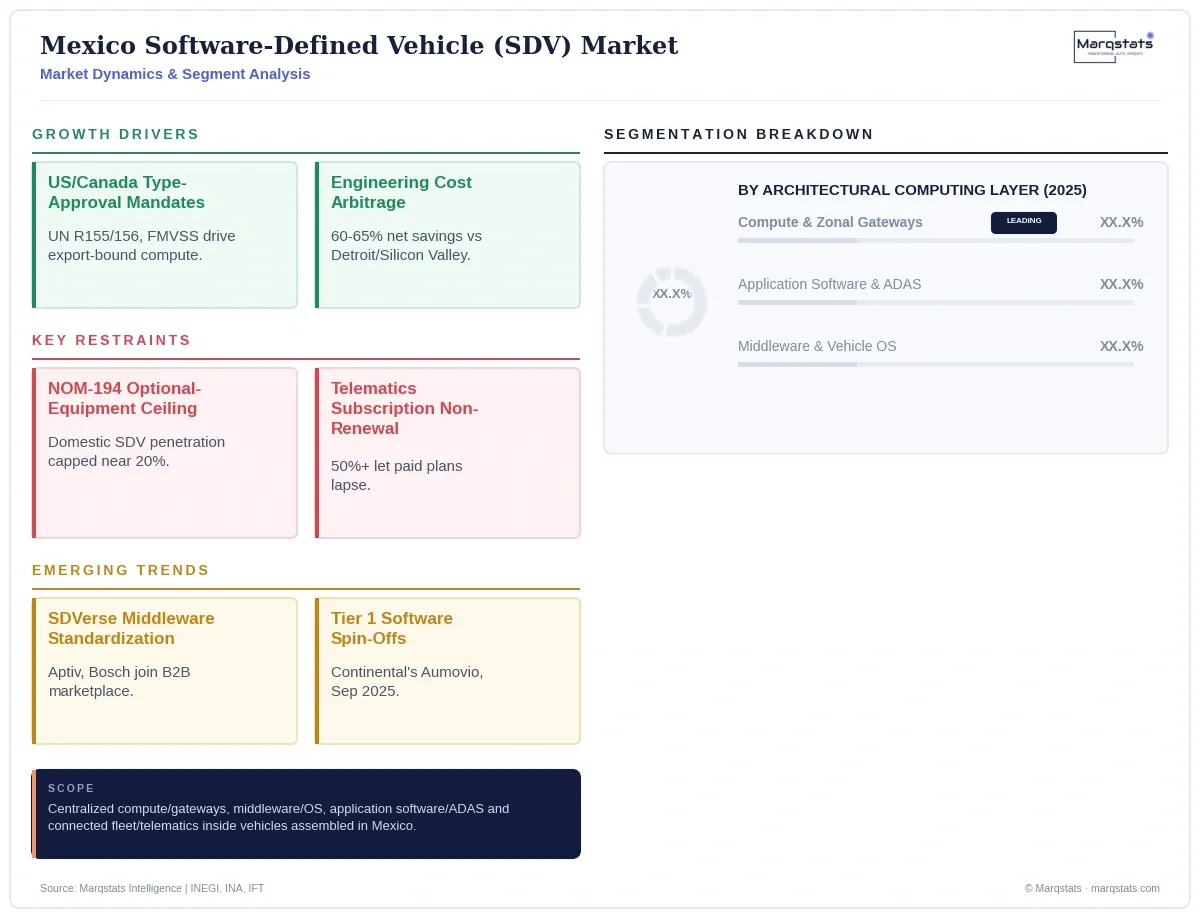
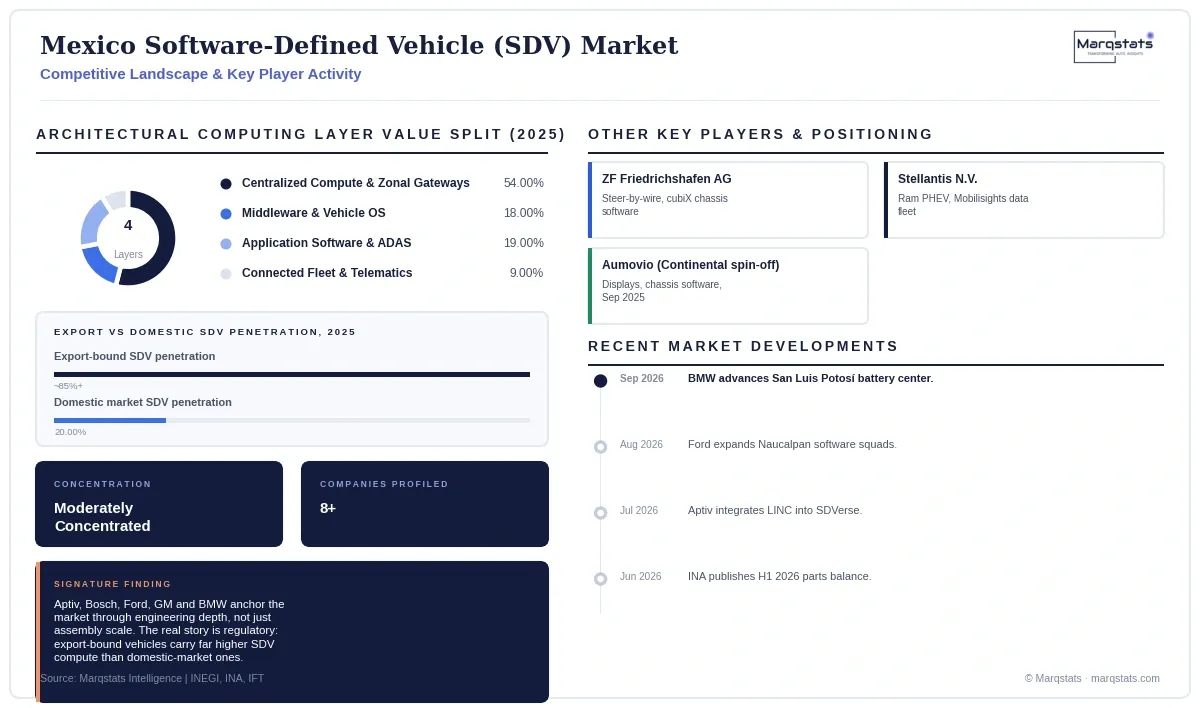
Dominant Layer: Centralized Compute & Zonal Gateways (54.00% of 2025 value)
Market Concentration: Moderately Concentrated (Aptiv, Bosch, Ford, GM, BMW Lead)
Base Year: 2025 | Historical Period: 2021 – 2025 | Forecast Period: 2026 – 2030
Units Considered: Value (USD Million)
Segments Covered: 3 | Regions Covered: 4 | Companies Profiled: 8
Report Pages: 165 | Deliverables: PDF, Excel, PPT
Key Takeaways
Market Overview & Analysis
Report Summary
Mexico's software-defined vehicle market is best understood as a regulatory pass-through operation: the country manufactures compute-intensive vehicles primarily because its customers in Washington and Ottawa require it, not because Mexican law does, a distinction that shapes nearly every strategic decision in this market.
The analysis measures the value of centralized compute and zonal gateways, middleware and vehicle operating systems, application software and ADAS stacks, and connected fleet/telematics platforms inside vehicles assembled in Mexico: USD 1,845.50 million in 2025, growing to USD 4,635.80 million by 2030, a period spanning the critical 2026 USMCA Joint Review.
The headline sizing chain is a transparent, stated construction from INA and INEGI data; one specific segment figure traces to a source Marqstats could not independently verify, disclosed narrowly in the evidence section rather than affecting the report's broader figures, which purchasers can weigh accordingly.
The analysis is written for four readers: an OEM deciding how much export-market regulatory compliance to engineer into Mexican-assembled platforms, a Tier 1 supplier evaluating the Mexico-versus-Detroit engineering cost calculation, an investor tracking the 2026 USMCA Joint Review, and a policymaker assessing the domestic-market SDV adoption gap relative to export-market requirements.
Mexico's position as North America's dominant vehicle-export assembly base, combined with a domestic regulatory regime that leaves SDV-enabling safety technology optional, makes it a structurally distinct market from every domestic-demand-led SDV market in this vertical, one where export-market regulation matters more than domestic policy.
An Industry Built for Customers Who Don't Live in Mexico
The single fact that explains more about Mexico's SDV market than any other: most of what gets built here is never meant to be sold here.
85.64% of Mexican-assembled light vehicles were exported in 2025, with the United States receiving 79.0% of shipments and Canada a further 11.1%. Both destinations enforce UNECE UN R155/R156 cybersecurity and software-update type approvals, or the equivalent US FMVSS standards, as a hard condition of market entry, which means export-bound vehicles are built with high-performance domain compute, redundant Ethernet backbones and Level 2+ perception suites regardless of what Mexican law itself requires. Domestically, where NOM-194-SE-2021 leaves autonomous braking, blind-spot monitoring and connected telematics as optional equipment, SDV architecture penetration drops to roughly 20.00% of the retail market. Mexico's SDV manufacturing base exists at the scale it does because Washington and Ottawa require it, and the 2026 USMCA Joint Review, not any pending Mexican regulation, is the single event most likely to reshape this market's trajectory.
A Report That Argues Against Its Own Headline Number Being Bigger
Most market-sizing exercises have an incentive to find the largest defensible number. This one explicitly argues for a smaller one.
INA's published data shows Mexico's total auto-parts electrical component production reached USD 22,968 million in 2025. Treating that entire figure as advanced digital vehicle technology would be a mistake: roughly 65% of it is manual wiring harnesses, conventional starter motors, alternators, lead-acid batteries and basic lighting circuits, produced by labor-intensive facilities across the northern border states, none of it software-defined in any meaningful sense. After deducting that mechanical component, the addressable electronics core narrows to roughly USD 2,300 million, within which centralized domain controllers, zonal processors and integrated vehicle software represent the 8.04% genuinely software-defined slice. The pack's own analysis states plainly that treating the full electrical-parts total as SDV technology would overstate the market by more than twelvefold, a level of self-imposed discipline worth noting, since most aggregator-style market sizing runs in the opposite direction.
Why an Engineer in Guadalajara Costs a Third of One in Detroit, and Not Just on Salary
The headline salary gap between Mexican and US automotive software engineers understates the real economics, because salary is only part of what a manufacturer actually pays.
Senior automotive embedded software engineers in Guadalajara, Querétaro and Monterrey earn USD 54,000 to USD 80,000 annually, against USD 198,000 to USD 223,000 in Detroit or Silicon Valley. But once taxes, mandatory benefits and administrative overhead are factored in on both sides, North American manufacturers realize net operational savings of 60% to 65% per engineer, a wider gap than the raw salary comparison alone suggests. Combined with Central and Eastern time zone overlap that supports real-time collaboration with US engineering teams, this is why Ford's Naucalpan campus is positioned as one of only three primary Ford technology centres worldwide, and why Bosch, Aptiv and Continental's Aumovio spin-off have all built genuine embedded-software engineering capability in Mexico rather than simple assembly-line presence.
A Connected Fleet That's Bigger on Paper Than in Practice
Counting factory-installed hardware and counting actual active usage produces two very different pictures of how connected Mexico's vehicle fleet really is.
More than 65% of new premium and mid-tier vehicles sold in Mexico since 2022 ship with factory-fitted telematics control units and embedded eSIMs. But survey data shows over 50% of Mexican vehicle owners decline to renew paid OEM telematics plans once complimentary trial periods, typically 12 to 36 months, expire, falling back on smartphone projection systems like Apple CarPlay and Android Auto running on personal cellular data instead. The result: cumulative factory hardware fitment figures meaningfully exceed the roughly 1.41 million actively subscribed connected vehicles in 2025. For OEMs and telematics providers, hardware fitment counts and active recurring revenue are simply not the same number in Mexico, and treating them interchangeably would overstate the addressable subscription market substantially.
Four Corridors, Four Genuinely Different Jobs in the Same Supply Chain
Mexico's automotive software footprint isn't evenly distributed because it isn't doing the same work everywhere. Each industrial corridor specializes in a distinct stage of the SDV supply chain, not just a share of assembly volume.
The Northern Border Corridor, Coahuila, Nuevo León, Chihuahua and Tamaulipas, handles high-volume EV production, wire harness integration and hardware domain compute assembly, the physically intensive end of the stack. El Bajío, spanning Guanajuato, Querétaro, San Luis Potosí and Aguascalientes, specializes in high-voltage battery systems and embedded chassis controls, the electromechanical-to-software bridge. Jalisco's Occidente hub does almost none of the physical assembly work; it exists specifically for embedded software coding, AUTOSAR configuration and real-time operating systems, pure engineering output with no factory floor attached. The Central Corridor around Estado de México and Puebla runs enterprise cloud platforms and diagnostic modernization, the customer-facing software layer. A single national SDV strategy would miss all four of these distinctions; understanding where a specific capability actually lives in Mexico requires treating each corridor as its own specialization, not a smaller copy of the others.
Why Telematics Hardware Counts Overstate the Real Connected Fleet
A factory-installed modem and an active paying subscriber are two different things, and Mexico's own data shows exactly how far apart those two numbers actually sit.
Machine-to-machine and IoT cellular connections in Mexico approached 15 million lines by 2024-2025 according to IFT data, with the OECD separately recording 4.1 million dedicated industrial M2M lines in 2024. Neither of those aggregate telecom figures maps cleanly onto the passenger-vehicle SDV market specifically, where active connected telematics subscriptions totaled only around 1.41 million units in 2025. The gap exists because more than 65% of new premium and mid-tier vehicles sold since 2022 ship with factory-fitted TCUs and eSIMs, but over half of owners let paid OEM telematics plans lapse once complimentary trial periods end, falling back on smartphone-based CarPlay or Android Auto instead. Any analysis treating Mexico's broader M2M/IoT connection counts as a proxy for active vehicle telematics demand would be measuring the wrong number entirely.
Market Dynamics
Key Drivers
- US and Canadian type-approval mandates (UN R155/R156, FMVSS) directly require high-performance domain compute on export-bound vehicles, regardless of Mexican domestic regulation, since over 90% of shipments go to those two destinations alone.
- Rising battery-electric vehicle production is lowering integration friction for full SDV control, since centralized high-voltage battery management already shares computing topology with SDV architecture, unlike distributed legacy ICE platforms.
- Substantial engineering cost savings (60-65% net operational savings per engineer) versus Detroit and Silicon Valley are sustaining continued embedded-software investment in Guadalajara, Querétaro and Monterrey, reinforced by compatible working-hour overlap.
- Foreign direct investment in Mexican auto parts, particularly electromobility-specific capital, is accelerating sharply, up 31.3% YoY in H1 2026 to a multi-year high, a signal worth watching ahead of the 2026 USMCA review.
- Major OEM capacity expansions, including BMW's €800 million San Luis Potosí battery facility and Ford's growing Naucalpan software campus, are structurally deepening Mexico's SDV engineering base well beyond simple assembly-line presence.
Key Restraints
- Domestic SDV penetration remains structurally capped around 20% because NOM-194-SE-2021 leaves core SDV-enabling safety technology as optional equipment rather than mandatory, unlike the export markets Mexican assembly lines primarily serve.
- Consumer non-renewal of paid OEM telematics subscriptions after complimentary trial periods expire limits recurring connected-services revenue relative to factory hardware fitment counts, a gap most sizing exercises overlook.
- A contentious 2026 USMCA Joint Review outcome, with tariff disputes or regulatory uncertainty, would directly delay OEM capital allocation for next-generation electronic architectures, the Downside scenario's central trigger, with effects rippling across the entire supplier base.
- Elevated federal spectrum fees continue to limit commercial 5G coverage outside major metropolitan areas, constraining connected telematics adoption in secondary and rural markets specifically.
Key Trends
- Software standardization consortia participation is expanding, with Aptiv and Bosch both joining SDVerse to license standardized, containerized middleware components across customer platforms, reducing fragmentation across the supplier ecosystem.
- Tier 1 suppliers are formally separating software operations into independent legal entities, following Continental's September 2025 Aumovio spin-off into a dedicated Mexican corporate structure.
- Engineering center investment is shifting from pure cost-arbitrage staffing toward genuine R&D ownership, exemplified by Querétaro's 350-plus Tier-1/Tier-2 supplier cluster developing steer-by-wire and automated transmission control software, not merely testing code written elsewhere.
- Cloud-native diagnostic and enterprise software development is consolidating at dedicated campuses like Ford's GTBC, positioning Mexican facilities as global technology centres rather than regional support functions serving only the domestic market.
Strategic Implications
- OEMs should engineer Mexican assembly lines to the stricter of US/Canadian and Mexican regulatory requirements by default, since export-bound compute and cybersecurity specifications already exceed domestic NOM-194 mandates, and retrofitting a lower-spec domestic line for export compliance later is costlier than building to the higher standard from the outset, particularly given how concentrated exports are toward those two destinations.
- Tier 1 suppliers and technology investors should treat Mexican engineering centres as genuine R&D assets rather than low-cost staffing pools, given the demonstrated capability at facilities like Aptiv's Ciudad Juárez centre and Bosch's Guadalajara AUTOSAR/ISO 26262 operation, and should budget for the full 60-65% net cost advantage rather than raw salary comparisons alone, which understate the true savings.
- Telematics and connected-services providers should design monetization models around actual subscription renewal behaviour, not factory hardware fitment counts, given the substantial gap between eSIM-equipped vehicles and actively paying subscribers, since over half of owners let paid plans lapse after complimentary trials end.
- Investors should track the 2026 USMCA Joint Review outcome and any NOM-194-SE-2021 amendment aligning domestic Mexican safety standards with UNECE WP.29, the two named triggers separating the Baseline, Accelerated and Trade Friction scenarios, and should note that one segment figure here traces to a source Marqstats could not independently verify, disclosed narrowly in the evidence section rather than affecting the report's broader figures.
Outlook
Three scenarios are tested, each anchored to a distinct, named trigger tied to the 2026 USMCA Joint Review rather than differing growth-rate assumptions applied to the same story.
Under Scenario A (Regional Integration Baseline), the July 2026 USMCA Joint Review concludes with an orderly treaty extension preserving the 75.00% Regional Value Content requirement, and production programs at GM Ramos Arizpe and BMW San Luis Potosí proceed on schedule. Value reaches USD 4,635.80 million, a 20.23% CAGR, with SDV architecture penetration reaching 72.00%.
Under Scenario B (Accelerated Nearshoring & Mandates), the USMCA review establishes stricter origin-tracing rules for automotive semiconductor firmware, accelerating software integration transfer to Querétaro, Jalisco and Nuevo León, while NOM-194 is updated to align with UNECE WP.29 by 2028. Penetration reaches 82.00% (3,444,000 units), and value reaches USD 5,680.00 million, a 25.21% CAGR.
Under Scenario C (Trade Friction & Stagnation), the 2026 review becomes contentious, triggering tariff disputes and regulatory uncertainty that delay OEM capital allocation for next-generation architectures. Penetration reaches only 52.00% (2,184,000 units), and value reaches USD 3,520.00 million, a 13.79% CAGR.
Market Segmentation
USD 996.57 million (54.00% share) in 2025, moving to USD 2132.47 million (46.00% share) by 2030.
USD 332.19 million (18.00% share) in 2025, moving to USD 973.52 million (21.00% share) by 2030.
USD 350.65 million (19.00% share) in 2025, moving to USD 1066.23 million (23.00% share) by 2030.
USD 166.09 million (9.00% share) in 2025, moving to USD 463.58 million (10.00% share) by 2030.
USD 1144.21 million (62.00% share) in 2025, moving to USD 1761.60 million (38.00% share) by 2030.
USD 516.74 million (28.00% share) in 2025, moving to USD 2132.47 million (46.00% share) by 2030.
USD 184.55 million (10.00% share) in 2025, moving to USD 741.73 million (16.00% share) by 2030.
USD 1577.90 million (85.50% share) in 2025, moving to USD 3847.71 million (83.00% share) by 2030.
USD 267.60 million (14.50% share) in 2025, moving to USD 788.09 million (17.00% share) by 2030.
By Geography
Northern Border Corridor
USD 54.45 billion in 2025 auto-parts value (43.50% of national SDV value).
El Bajío Industrial Hub
USD 48.20 billion in 2025 auto-parts value (36.20% of national SDV value).
Occidente Technology Hub (Jalisco)
USD 4.20 billion in 2025 auto-parts value (11.80% of national SDV value).
Central Industrial Corridor
USD 12.15 billion in 2025 auto-parts value (8.50% of national SDV value).
Engineering Cost Arbitrage
Senior automotive embedded software engineers in Guadalajara, Querétaro and Monterrey earn USD 54,000 to USD 80,000 annually, against USD 198,000 to USD 223,000 in Detroit or Silicon Valley; after taxes, mandatory benefits and administrative costs, North American manufacturers realize 60% to 65% net operational savings per engineer while working within compatible Central and Eastern time zones.
How Competition Is Evolving
Mexico's SDV competitive landscape spans multinational OEMs, specialized Tier 1 systems integrators, and automotive software developers, all independently and specifically sourced to company disclosures and named facility data.
Aptiv PLC operates its Mexico Technical Center in Ciudad Juárez with roughly 1,900 staff, including over 800 engineers working on vehicle network packaging, active safety systems and electrical load architectures, alongside a Monterrey engineering centre supporting high-speed data connectivity projects. Robert Bosch operates a dedicated Bosch Global Software Technologies centre in Guadalajara focused on AUTOSAR Adaptive middleware, ISO 26262 functional safety engineering, and edge AI algorithms.
Aumovio, spun off from Continental AG in September 2025 as an independent Mexican legal entity, operates across Silao, Guadalajara, Querétaro and Cuautitlán, developing displays, automated braking and chassis software. Ford Motor Company's Global Technology and Business Center in Naucalpan de Juárez, designed for up to 9,000 employees and currently housing over 4,000 specialists, is one of three primary Ford technology centres worldwide, developing cloud-native diagnostics on Google Cloud Platform and Ford Pro commercial connectivity software.
General Motors leads EV volume assembly at its Ramos Arizpe and Silao complexes, producing the Chevrolet Equinox EV and Blazer EV on its Ultium compute platform alongside OnStar connected services. BMW Group is investing €800 million to expand its San Luis Potosí complex by 110,000 square metres, including an 80,000 square-metre battery facility for sixth-generation e-drive packs, ahead of 2027 Neue Klasse production.
ZF Friedrichshafen maintains active engineering operations across El Marqués, El Salto and Monterrey developing steer-by-wire controls and cubiX chassis dynamics software. Stellantis operates major light-truck assembly hubs in Toluca and Saltillo, integrating Ram PHEV platforms with its Mobilisights data-fleet unit. Aptiv and Bosch have both joined SDVerse, an automotive B2B software marketplace for standardized, containerized middleware licensing.
Companies Covered
Companies covered in the report include:
Recent Market Activity
Table of Contents
Coverage & Segmentation
The analysis measures centralized compute and zonal gateways, middleware and vehicle operating systems, application software and ADAS stacks, and connected fleet/telematics platforms inside vehicles assembled in Mexico, for a 2025 base year and a 2026 to 2030 forecast, in United States dollars.
The analysis covers three segmentation dimensions, architectural computing layer, vehicle propulsion type and commercial destination, a four-corridor regional split, and eight profiled entities. One specific segment figure carries a narrow sourcing flag; every other figure is independently and specifically sourced. See the verification log for full disclosure.