Market Snapshot
Middle bar: base-year value × (1 + CAGR), rounded to two decimals. This is a calculated illustration, not a separately researched annual estimate.
Market Size (2025, Base Year): USD 4.47 Billion (JPY 679.00 Billion)
Estimated Value (2026): USD 4.84 Billion
Forecast Value (2030): USD 6.66 Billion
CAGR: 8.30% | Forecast Period: 2026 – 2030
Growth — Absolute: USD 2.189 Billion
SDV Solutions Share of Total Software: 19.70% (2025) to 56.30% (2030)
Largest Market: Chubu, Aichi/Shizuoka/Mie (48.50% of 2025 value)
Fastest Growing Segment: Vehicle OS & Middleware / SDV Solutions (33.61% CAGR, 2025-2030)
Dominant Layer: Embedded Firmware & Low-Level Control (63.40% of 2025 value, contracting)
Market Concentration: Moderately Concentrated (Toyota, Honda-Nissan-Mitsubishi, Denso Lead)
Base Year: 2025 | Historical Period: 2021 – 2025 | Forecast Period: 2026 – 2030
Units Considered: Value (USD Billion)
Segments Covered: 3 | Regions Covered: 4 | Companies Profiled: 8
Report Pages: 165 | Deliverables: PDF, Excel, PPT
Key Takeaways
Market Overview & Analysis
Report Summary
Japan's software-defined vehicle market is currently running two live experiments in how to build vehicle software at scale, one collaborative and thriving, one isolated and just cancelled, inside the same twelve-month window, a genuinely rare natural comparison.
The analysis measures the value of vehicle OS/middleware (SDV Solutions), application software (cockpit/HMI/IT), and embedded firmware/low-level control inside vehicles sold in Japan: USD 4.47 billion (JPY 679.00 billion) in 2025, growing to USD 6.66 billion by 2030, spanning both proprietary in-house platforms and newly collaborative cross-brand alliances.
The headline sizing chain traces to Yano Research Institute's own automotive software study; several blocklisted sources appear elsewhere in the pack but support only narrow, non-numeric details, fully disclosed in the verification log.
The analysis is written for four readers: an OEM deciding between proprietary and collaborative platform strategy, a semiconductor or Tier 1 supplier evaluating ASRA consortium participation, a regulator tracking UN R155/R156 and Mobility DX Strategy enforcement, and an investor tracking three scenarios anchored to corporate and regulatory triggers, each with a distinct, dated milestone worth monitoring closely.
Japan's combination of a legacy keiretsu supply structure under genuine strain, a newly collaborative OEM alliance model, and a semiconductor consortium racing toward chiplet standardization makes it structurally distinct from single-OEM or open-source-consortium SDV markets elsewhere in this vertical, one where a major joint venture's public failure and a rival alliance's formal agreement landed within the same year.
Two Corporate Strategies, One Brutal Natural Experiment
Japan's SDV market delivered a genuinely rare thing in 2026: a controlled comparison between two opposite corporate strategies, playing out in full public view, within months of each other.
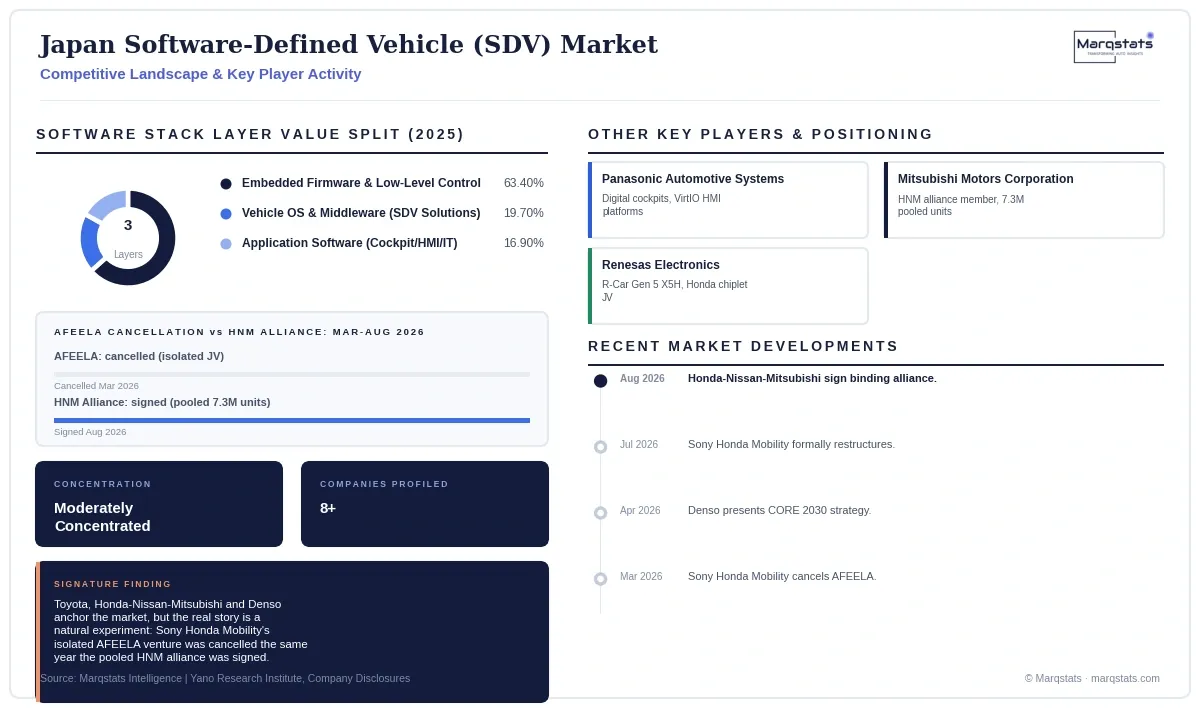
On 31 August 2026, Honda, Nissan and Mitsubishi signed a binding joint development agreement establishing common specifications for next-generation ECUs, vehicle operating systems and middleware, aggregating 7.3 million combined annual production units specifically to lower unit development costs, targeting deployment in fiscal 2029. Months earlier, on 25 March 2026, Sony Honda Mobility, a joint venture founded in 2022 to build the AFEELA brand of software-defined vehicles entirely in-house, cancelled its production programmes outright, refunding customer deposits and reassigning roughly 400 personnel back to its parent companies. One approach pooled volume across three competitors to spread development cost. The other tried to build a full vertical stack alone, at a scale too small to absorb the capital intensity. The market did not need five years to settle which structural bet was sounder; it settled within the same reporting period.
A Semiconductor Consortium Betting on Modularity Instead of Monoliths
Japan's chip strategy for SDVs is not trying to build one bigger single processor. It is trying to build several smaller processors that snap together cleanly.
The Advanced SoC Research for Automotive consortium, established 1 December 2023 in Nagoya, unites 14 automotive OEMs, Tier 1 suppliers and semiconductor firms around chiplet architectures, separate silicon dies combined on an interposer, rather than monolithic system-on-chip designs. The logic is straightforward: chiplets let a consortium member swap in an improved compute die or a cheaper memory die without redesigning an entire SoC from scratch, reducing fabrication cost and easing the modularity problem that has made in-house full-stack silicon so capital-intensive for any single automaker. Targeting proof-of-concept validation by 2028 and commercial deployment from 2030, backed by an international partnership with Belgium's imec formalized in December 2025, ASRA is effectively betting that standardized modularity beats proprietary integration at the silicon layer just as clearly as the Honda-Nissan-Mitsubishi alliance is betting it beats proprietary integration at the software layer.
Why a Chip Vendor Is Now Also an OEM's Silicon Design Partner
Renesas isn't just selling Honda a processor anymore. It is co-designing one specifically with Honda, a materially different kind of relationship than an ordinary standard supplier contract.
Renesas sampled its R-Car Gen 5 X5H system-on-chip in 10 December 2025, manufactured on TSMC's 3-nanometre process and delivering 400 TOPS of AI compute at a 35% power reduction versus 5nm alternatives. Separately, and more unusually, Renesas is partnering directly with Honda to develop custom chiplet-based AI accelerators delivering up to 2,000 TOPS specifically for Honda's future production models, a bespoke silicon-design partnership rather than an off-the-shelf component sale. That distinction matters: it signals Renesas is willing to commit design engineering resources to a single customer's specific roadmap, a level of customization that only makes commercial sense once a supplier is confident enough in an OEM's production volume and platform longevity to justify the dedicated engineering investment, a bar Renesas evidently judged Honda's roadmap had cleared.
A Contraction That Is Actually the Point
One line in this market's own segmentation table looks like bad news at first glance. It is actually the clearest evidence the transition is working exactly as intended.
Embedded firmware and low-level control software, the traditional dominant category, contracts from JPY 430.49 billion in 2025 to JPY 303.54 billion by 2030, a -6.73% annual decline. That is not a market shrinking; it is the specific, predictable consequence of dozens of low-level microcontrollers, each running dedicated static firmware for a single sensor or actuator, being consolidated into multi-core domain and zonal processors running standardized operating systems. The functions those microcontrollers performed do not disappear; they migrate into the SDV Solutions segment, which is exactly why that segment grows at a 33.61% CAGR while embedded firmware shrinks. Reading the contraction in isolation would suggest decline. Reading it alongside SDV Solutions' growth shows a single value pool migrating from one architectural layer to another, not a market losing ground.
A Registration Map That Hides Where Cars Actually Drive
Japan's automotive software geography carries the same distortion seen in other advanced markets: where a company's headquarters sits on a tax registry is not where its vehicles actually operate.
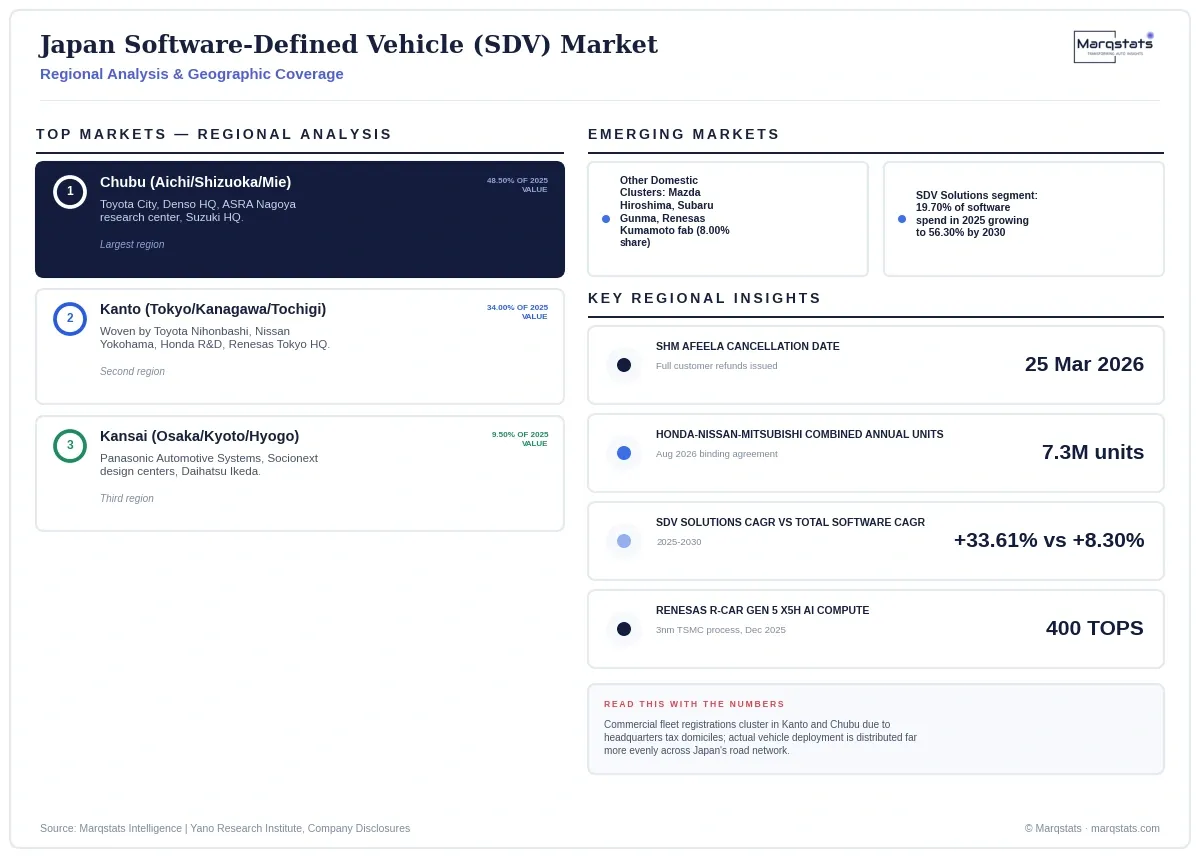
Commercial fleet and corporate vehicle registrations show elevated concentrations in Kanto and Chubu prefectures specifically because of headquarters tax domiciles, not because vehicles registered there disproportionately stay there. Toyota City, Denso's Kariya engineering centres, and ASRA's Nagoya research hub anchor Chubu's 48.50% share of national software value; Woven by Toyota's Nihonbashi facilities, Nissan's Yokohama operations, and Renesas's Tokyo headquarters anchor Kanto's 34.00% share. Actual physical vehicle deployment, by contrast, is distributed far more evenly across the country's road network. A telematics or connected-services provider planning coverage strictly by registration share would systematically overweight the two headquarters-dense regions and underweight everywhere else vehicles genuinely operate day to day.
A Personnel Number That Tells You What 'Restructuring' Actually Meant
Corporate language around joint-venture failures tends to stay vague about what actually happens to the people involved. This one didn't.
When Sony Honda Mobility restructured in July 2026 following the AFEELA cancellation, the company disclosed a specific figure: roughly 400 personnel were reassigned back to parent companies Sony and Honda, rather than laid off outright. That single number tells a more precise story than the word 'restructuring' alone would: the venture's failure was concentrated specifically in capital-intensive vehicle assembly and hardware manufacturing ambitions, not in the underlying engineering talent, which both parent companies judged worth retaining and redeploying rather than discarding. It is a genuinely useful signal for reading how seriously Sony and Honda still take the underlying software and sensing technology even after abandoning the vehicle-production ambition that originally justified assembling that talent in one place.
A Volume Number That Explains Why Three Rivals Signed the Same Contract
The Honda-Nissan-Mitsubishi alliance makes little sense read company by company. It makes complete sense read as a single number.
Individually, none of Honda, Nissan or Mitsubishi commands the kind of production scale that makes full in-house SDV platform development straightforwardly affordable. Combined, the three brands aggregate 7.3 million annual production units under the August 2026 joint development agreement, a volume base large enough to spread the fixed engineering cost of common ECU, operating system and middleware specifications across far more vehicles than any one of the three could justify alone. This is the same logic ASRA applies at the silicon layer and the same logic Sony Honda Mobility's cancellation demonstrates in reverse: development cost for a modern vehicle software stack is largely fixed regardless of how many units it eventually ships across, which means the number of competitors willing to share that fixed cost matters at least as much as any single competitor's individual engineering talent, if not more.
Market Dynamics
Key Drivers
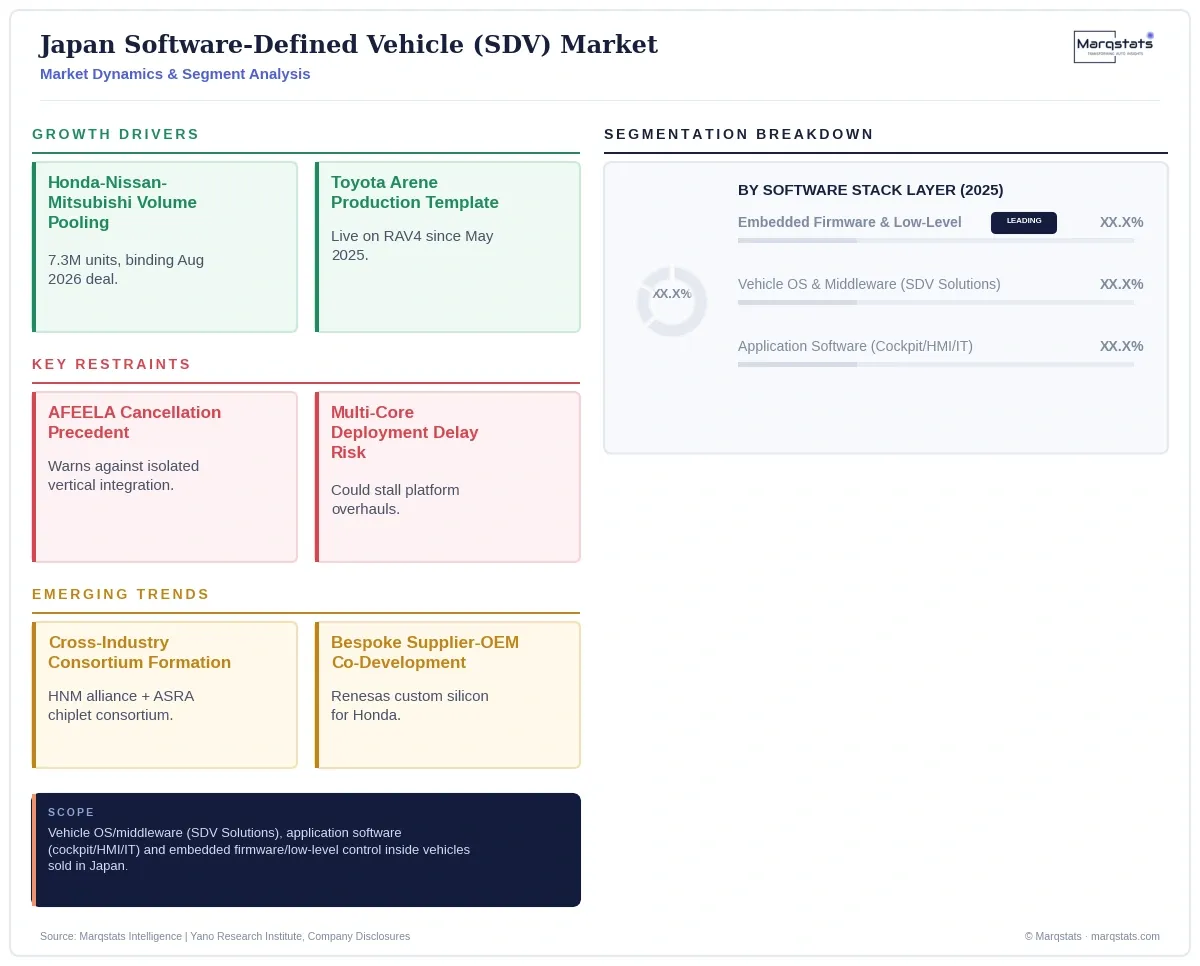
- The Honda-Nissan-Mitsubishi joint development alliance is pooling 7.3 million combined annual production units to lower unit software and ECU development costs across three competing brands, a structural response to the very same capital intensity that sank AFEELA.
- Toyota's Arene platform, already in production on the RAV4, is providing a proven internal-development template other domestic OEMs can benchmark against, ahead of rivals still in development or prototyping stages.
- The ASRA semiconductor consortium's chiplet standardization strategy is reducing fabrication costs and compute modularity constraints across 14 member organizations, from Toyota and Honda through Denso and Renesas Electronics.
- UN R155/R156 cybersecurity and software-update-management compliance mandates are sustaining continuous software verification expenditure across all registered models, not just newly type-approved ones.
- Renesas's bespoke chiplet co-development partnership with Honda demonstrates growing supplier confidence in dedicating design engineering resources to single-OEM roadmaps directly.
Key Restraints
- Sony Honda Mobility's AFEELA cancellation demonstrates the structural risk of pursuing isolated, proprietary vehicle software development without verified production volume scale, a cautionary precedent the pack itself names explicitly.
- Delayed multi-core deployment and recurring OS development setbacks, similar to past cancellations, could constrain domestic software expenditure well below baseline projections, keeping legacy microcontrollers dominant for longer.
- Legacy keiretsu supply-chain structures remain under genuine strain as full-stack software development requires capital commitments beyond what traditional vertically integrated networks were originally built to absorb.
- Administrative registration clustering in Kanto and Chubu prefectures, driven by headquarters tax domiciles, complicates accurate territory-level demand planning relative to where vehicles actually operate day to day.
Key Trends
- Cross-industry consortium formation, exemplified by both the Honda-Nissan-Mitsubishi software alliance and the ASRA chiplet consortium, is displacing isolated proprietary development as the dominant industry strategy across both software and silicon layers.
- Chiplet-based modular silicon architecture is emerging as Japan's preferred alternative to monolithic system-on-chip design, reducing fabrication cost and easing multi-vendor integration across the ASRA member base.
- Bespoke supplier-OEM silicon co-development partnerships, exemplified by Renesas and Honda, are deepening beyond standard component supply relationships into dedicated design engineering commitments.
- B2B software monetization, including commercial telematics and predictive maintenance via the Ouranos Ecosystem, is emerging as an alternative revenue path to lagging consumer subscription adoption industry-wide, especially among fleet operators.
Strategic Implications
- OEMs still pursuing isolated, fully proprietary vehicle software stacks should treat Sony Honda Mobility's AFEELA cancellation as a direct cautionary precedent and reassess honestly whether their own production volume genuinely justifies the capital intensity involved.
- Semiconductor and Tier 1 suppliers should evaluate ASRA consortium participation as a genuine strategic option for reducing chiplet fabrication costs, rather than pursuing monolithic SoC development independently and absorbing the full cost alone.
- Suppliers with genuine design engineering depth should pursue bespoke co-development partnerships with individual OEMs, following Renesas's Honda relationship, once production volume and platform longevity genuinely justify the dedicated investment required.
- Investors should track the Honda-Nissan-Mitsubishi alliance's fiscal 2029 deployment milestone and ASRA's 2028 proof-of-concept target, the two named triggers separating the Baseline, Accelerated and Downside scenarios, and should treat the SDV Solutions segment's rapid growth as the clearest single indicator of how quickly this transition is actually progressing, well ahead of the more moderate blended total figure.
Outlook
Three scenarios are tested, each anchored to a distinct, named corporate or regulatory trigger tied to alliance execution and ASRA silicon delivery rather than differing growth-rate assumptions applied to the same story.
Under the Baseline Platform Consolidation scenario, the Honda-Nissan-Mitsubishi alliance meets its fiscal 2029 deployment milestone, Toyota scales Arene beyond the RAV4 across TNGA refreshes by 2028, and zonal compute architecture captures 40% of domestic production by 2030. Value reaches USD 6.66 billion (JPY 1,011.80 billion), a 8.30% CAGR, with SDV Solutions capturing 56.30% of total software expenditure.
Under the Accelerated Silicon and Autonomous Scale-Out scenario, ASRA delivers functional chiplet platforms a year ahead of schedule by 2027, MLIT's Level 4 framework expands autonomous logistics across over 150 routes by 2028, and B2B software monetization via the Ouranos Ecosystem accelerates. Value reaches USD 8.19 billion (JPY 1,245.00 billion), a 12.89% CAGR, with SDV Solutions capturing 62.65% of total spend.
Under a downside stagnation scenario, delayed multi-core deployments and recurring OS development setbacks, similar to past cancellations, limit domestic software expenditure to USD 5.39 billion (JPY 820.00 billion), with low-level microcontrollers retaining over 45% market share as manufacturers delay major platform overhauls.
Market Segmentation
JPY 133.76 billion (19.70% share) in 2025, moving to JPY 569.64 billion (56.30% share) by 2030.
JPY 114.75 billion (16.90% share) in 2025, moving to JPY 138.62 billion (13.70% share) by 2030.
JPY 430.49 billion (63.40% share) in 2025, moving to JPY 303.54 billion (30.00% share) by 2030.
72.50% of 2025 production share (6,097,418 units), moving to 22.00% share (1,936,000 units) by 2030.
23.00% of 2025 production share (1,934,353 units), moving to 38.00% share (3,344,000 units) by 2030.
4.50% of 2025 production share (378,461 units), moving to 40.00% share (3,520,000 units) by 2030.
JPY 58.85 billion (44.00% share) in 2025, moving to JPY 273.43 billion (48.00% share) by 2030.
JPY 38.79 billion (29.00% share) in 2025, moving to JPY 148.11 billion (26.00% share) by 2030.
JPY 36.12 billion (27.00% share) in 2025, moving to JPY 148.10 billion (26.00% share) by 2030.
By Geography
Chubu (Aichi/Shizuoka/Mie)
JPY 329.32 billion (48.50% share) of national software market value in 2025.
Kanto (Tokyo/Kanagawa/Tochigi)
JPY 230.86 billion (34.00% share) of national software market value in 2025.
Kansai (Osaka/Kyoto/Hyogo)
JPY 64.51 billion (9.50% share) of national software market value in 2025.
Other Domestic Clusters
JPY 54.32 billion (8.00% share) of national software market value in 2025.
Registration Clustering Note
Commercial fleet and corporate vehicle registrations show elevated concentrations in Kanto and Chubu prefectures due to headquarters tax domiciles, whereas actual physical vehicle deployments are distributed more evenly across the nation's road network.
How Competition Is Evolving
Japan's SDV ecosystem spans OEMs pursuing divergent corporate strategies (proprietary platform development, cross-brand collaborative alliances, and capital-intensive joint ventures), a 14-member semiconductor standardization consortium, and Tier 1 suppliers deepening bespoke co-development relationships with individual automakers.
Toyota Motor Corporation pursues an internal platform strategy through Woven by Toyota, developer of the Arene automotive operating system, which achieved production debut on the RAV4 on 21 May 2025. Honda Motor and Nissan Motor, following the termination of merger discussions in February 2025, shifted to project-based cooperation; on 31 August 2026, Honda, Nissan and Mitsubishi signed a binding joint development agreement for common ECU, OS and middleware specifications, aggregating 7.3 million combined annual production units, targeting fiscal 2029 deployment.
Sony Honda Mobility, founded 2022 as an equal joint venture to develop the AFEELA brand, presented a production-ready AFEELA 1 sedan at CES 2025 and an SUV prototype at CES 2026 before cancelling both programmes on 25 March 2026, issuing full customer deposit refunds; the venture restructured in July 2026, reassigning roughly 400 personnel and pivoting to software IP licensing and in-cabin sensing.
The Advanced SoC Research for Automotive (ASRA) consortium, established 1 December 2023 in Nagoya, unites 14 OEMs, Tier 1 suppliers and semiconductor firms around chiplet architecture standardization, targeting proof-of-concept silicon by 2028 and commercial deployment from 2030, backed by a December 2025 partnership with Belgium's imec.
Renesas Electronics sampled its R-Car Gen 5 X5H SoC (400 TOPS, TSMC 3nm process) on 10 December 2025 and separately co-develops chiplet-based AI accelerators delivering up to 2,000 TOPS with Honda. Denso Corporation presented its 'CORE 2030' strategy on 1 April 2026, committing JPY 3.7 trillion in R&D and expanding its software engineering workforce from 12,000 to 18,000 by 2030.
Companies Covered
Companies covered in the report include:
Recent Market Activity
Table of Contents
Coverage & Segmentation
The analysis measures vehicle OS/middleware (SDV Solutions), application software (cockpit/HMI/IT), and embedded firmware/low-level control inside vehicles sold in Japan, for a 2025 base year and a 2026 to 2030 forecast, in United States dollars and Japanese yen at a benchmark rate of JPY 152.00 per USD.
The analysis covers three segmentation dimensions, software stack layer, E/E architecture topology and application domain, a four-region industrial/software cluster split, and eight profiled entities. No blocklisted publisher drives any headline figure; see the verification log for full sourcing detail.