Market Snapshot
Middle bar: base-year value × (1 + CAGR), rounded to two decimals. This is a calculated illustration, not a separately researched annual estimate.
Market Size (2025, Base Year): USD 1.28 Billion (EUR 1.18 Billion)
Estimated Value (2026): USD 1.64 Billion
Forecast Value (2030): USD 3.75 Billion
CAGR: 24.00% | Forecast Period: 2026 – 2030
Growth — Absolute: USD 2.47 Billion
SDV-Ready New Vehicle Penetration: 32.02% (2025) to 68.5% (2030)
Largest Market: Piedmont, Turin Urban Cluster (38.00% of 2025 value)
Fastest Growing Segment: Cloud Services & Data Platforms (29.85% CAGR, 2025-2030)
Dominant Layer: HPC Compute & Zonal Hardware (34.50% of 2025 value)
Market Concentration: Moderately Concentrated (Stellantis, Ferrari, Brembo Lead)
Base Year: 2025 | Historical Period: 2021 – 2025 | Forecast Period: 2026 – 2030
Units Considered: Value (USD Billion)
Segments Covered: 2 | Regions Covered: 4 | Companies Profiled: 8
Report Pages: 165 | Deliverables: PDF, Excel, PPT
Key Takeaways
Market Overview & Analysis
Report Summary
Italy's software-defined vehicle market is shaped as much by a provincial tax code as it is by any semiconductor roadmap: a small Alpine region captures a wildly disproportionate share of national registration statistics for reasons that have nothing to do with vehicle demand, and everything to do with where a tax form gets filed.
The analysis measures the value of HPC compute and zonal hardware, vehicle OS and middleware, differentiated application software, and cloud services/data platforms inside new vehicles sold in Italy: USD 1.28 billion (EUR 1.18 billion) in 2025, growing to USD 3.75 billion by 2030, spanning the full range from mass-market Fiat platforms to Ferrari's ultra-luxury architecture.
The headline sizing chain traces substantially to a secondary source relaying Politecnico di Milano's Osservatorio data; this is disclosed prominently below and in the accompanying verification log, not omitted, so purchasers can weigh it accordingly.
The analysis is written for four readers: an OEM executing a centralized-architecture roadmap under EU regulatory pressure, a Tier 1 supplier evaluating brake-by-wire or zonal-hardware investment, a telematics or fleet-services provider planning regional coverage, and an investor tracking three regulation-anchored forward scenarios, each with a distinct, named trigger condition.
Italy's combination of Stellantis's centralized architecture ambitions, a globally significant automotive semiconductor and mechatronics supply base in Lombardy, and a luxury-segment innovation engine in Emilia-Romagna's Motor Valley makes it structurally distinct from volume-only or consortium-led SDV markets elsewhere in this vertical, one spanning mass-market Fiat platforms and ultra-luxury Ferrari architecture at once, a genuinely unusual combination of scale and specialization within a single national market.
A Tax Code That Rewrote Italy's Vehicle Registration Map
The single statistic that most distorts any naive reading of Italian vehicle demand data has nothing to do with vehicles at all. It comes down to a provincial tax rate.
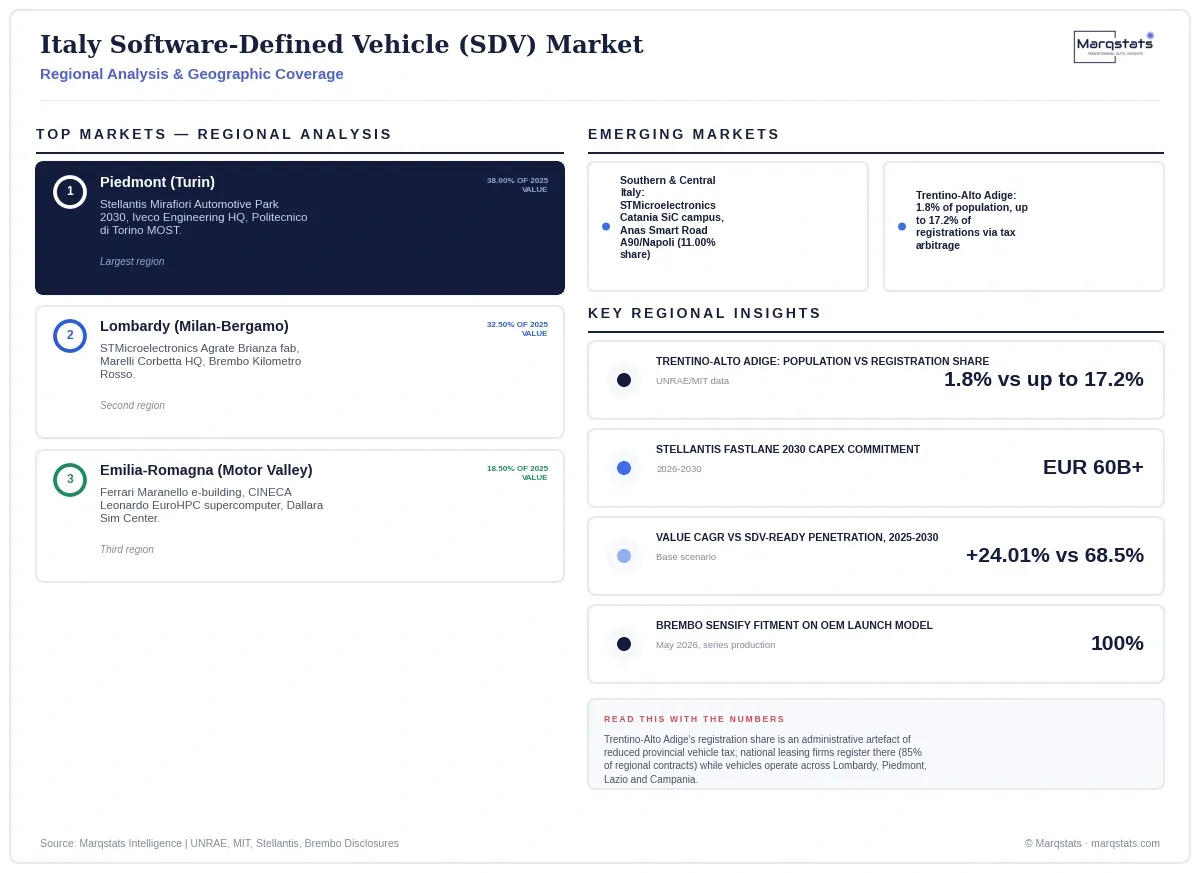
Trentino-Alto Adige, an autonomous Alpine province cluster representing just 1.8% of Italy's population, captures between 12.1% and 17.2% of national new car registrations, and up to 11.5% of all national long-term leasing contracts. This is not a hidden pocket of automotive enthusiasm in the Dolomites. Trento and Bolzano maintain statutory authority to set vehicle registration tax rates substantially below other Italian provinces, and national fleet leasing and rental companies, accounting for 85.0% of the region's registration contracts, respond precisely as the tax incentive predicts: they register centrally in Trentino-Alto Adige, then deploy the vehicles immediately across corporate networks in Lombardy, Piedmont, Lazio and Campania. Anyone reading Italian regional SDV demand purely through registration statistics would badly overstate Alpine adoption and understate exactly where these vehicles actually operate.
A Braking System That Stopped Being Just Mechanical
Brembo makes brakes. What it announced in May 2026 is not really a brake anymore, at least not in the way that word has meant anything for well over a century.
The Sensify platform replaces traditional hydraulic brake circuits with smart wheel actuators governed by independent braking algorithms, an electromechanical, software-defined system rather than a purely mechanical one. When it entered large-scale series production in May 2026, it achieved 100% standard fitment on a global OEM's launch model, with supply agreements scaling to hundreds of thousands of units per year. For a company whose core product has been a physical friction component since its founding, that is a genuine business-model shift: Brembo is now selling software-governed deceleration as a system, not just calipers and rotors as parts. It is one of the clearest examples anywhere in this vertical of a legacy mechanical Tier 1 supplier successfully repositioning around software rather than being disrupted by a company that started there.
Why a Supercomputer Ended Up in Ferrari's Supply Chain
Ferrari's newest software architecture didn't just come out of Maranello. Part of it came out of a national supercomputing facility in Bologna that most people would never associate with automotive engineering.
The 'Ferrari Luce' electric vehicle, unveiled in February 2026, integrates Qualcomm Snapdragon Digital Chassis compute nodes with custom vehicle dynamics software fabricated in Maranello's dedicated e-building. That software validation relies directly on CINECA's Leonardo EuroHPC supercomputer in Bologna, performing high-fidelity aerodynamic and edge-compute machine-learning simulations that would be impractical to run on in-house automotive engineering hardware alone. This is a genuinely distinctive pattern within Italy's SDV ecosystem: national scientific computing infrastructure, originally built for academic and research purposes, directly supporting commercial ultra-luxury vehicle software development. Few other SDV markets in this vertical show a comparable direct line between public supercomputing infrastructure and a specific production vehicle's software validation pipeline, a genuinely uncommon arrangement between a national research facility and a single ultra-premium automaker's own engineering roadmap.
A Development Cycle Cut Nearly in Half, on a Fixed Deadline
Stellantis didn't just promise faster software development. It attached a specific, falsifiable number to the promise, and a specific mechanism for hitting it.
Under FaSTLAne 2030, Stellantis committed to compressing vehicle engineering development cycles from up to 44 months down to 24 months, nearly halving the timeline, through cloud-based Software-in-the-Loop simulation formalized in an agreement with dSPACE. That is a genuinely aggressive target, and the Downside scenario covered here names exactly what happens if it slips: an 18-month deployment delay if SIL validation proves more complex than anticipated, pushing OEMs to rely on stop-gap domain controllers rather than retiring legacy distributed ECUs on schedule. The gap between the 24-month target and the Downside scenario's 18-month slip risk is a genuinely useful number for anyone trying to judge how much execution risk is actually baked into Stellantis's public roadmap.
A Sizing Model That Names What Fraction of Itself Is Audited
This market's own methodology states plainly how much of its 2025 baseline comes from verified corporate and statutory data versus how much is calibrated assumption, a level of transparency worth taking at face value.
42.15% of the total headline SDV market is derived directly from verified corporate reporting of automotive silicon shipments, published telematics market indices, and statutory vehicle registration censuses. The remaining 57.85% is constructed via calibration coefficients rooted in Tier 1 engineering supply schedules and architectural bill-of-materials analysis, specifically an assumed average embedded software and zonal compute content of EUR 2,114.70 per SDV-ready registered vehicle in 2025. For anyone treating this market's headline figure as a single precise number, that split is a useful reminder that a majority of the total still rests on a well-reasoned engineering estimate rather than an audited statutory statement.
Two Italian Icons, Two Genuinely Different Software Bets
Stellantis and Ferrari are both Italian automotive icons pursuing centralized compute architecture. They are betting on almost opposite validation strategies to actually get there.
Stellantis is scaling software development for mass and premium volume production, which is precisely why it needed to compress development cycles from 44 to 24 months through cloud-based Software-in-the-Loop simulation with dSPACE, a tooling investment built for speed and repeatability across many vehicle lines. Ferrari, by contrast, is validating a single, ultra-low-volume flagship architecture for the Ferrari Luce using CINECA's Leonardo EuroHPC supercomputer, a tooling investment built for depth and fidelity on one platform rather than throughput across many. Both companies concluded that in-house engineering capacity alone could not deliver the simulation workload their software roadmaps required, but they reached for completely different kinds of external compute to solve two structurally different problems: Stellantis needed velocity, Ferrari needed precision.
A Fleet Renewal Rate Threshold That Decides More Than It Sounds Like It Should
A single vehicle-sales number, easy to miss inside a much larger analysis, turns out to be the specific line separating a genuinely healthy scenario from a stalled one.
This market's own Downside scenario names a concrete threshold: if an extended European macroeconomic downturn compresses Italian new passenger vehicle registrations below 1.40 million units annually, the fleet-renewal rate needed to introduce SDV architecture into the circulating parc slows enough to constrain the entire market to a 15.73% CAGR rather than the Base Case's 24.00%. Italy's 2025 registration total, 1,525,722 units, already sits only modestly above that threshold, which means this is not a distant, unlikely trigger condition; it is a level Italian registrations have already approached in recent history. For anyone modelling this market's downside risk, that single registration-volume threshold is worth tracking as closely as any regulatory milestone, since it is arguably the more proximate risk of the two.
Market Dynamics
Key Drivers
- Stellantis's EUR 60 billion FaSTLAne 2030 capital commitment is directly funding centralized STLA Brain/SmartCockpit/AutoDrive architecture deployment across its global delivery volume, on a five-year timeline management has stated publicly.
- Brembo's Sensify brake-by-wire platform is demonstrating that legacy mechanical Tier 1 suppliers can successfully reposition around software-governed systems rather than being displaced entirely by new, software-native entrants.
- EU General Safety Regulation II active-safety mandates are accelerating centralized domain compute adoption across mainstream passenger vehicle segments, not just premium nameplates.
- CINECA's Leonardo EuroHPC supercomputer is enabling high-fidelity simulation capacity that individual automotive engineering teams could not economically replicate in-house, at a scale few dedicated engineering campuses could match.
- Italy's Smart Road regulatory framework, exemplified by the Tangenziale di Napoli certification, is establishing dedicated infrastructure for continuous Level 3 autonomous vehicle testing.
Key Restraints
- Software-in-the-Loop validation delays in complex centralized compute architectures could force an 18-month deployment slip, pushing OEMs toward stop-gap domain controllers rather than full architecture retirement on the original schedule.
- An extended European macroeconomic downturn compressing Italian new vehicle registrations below 1.40 million units annually would slow the fleet-renewal rate needed to introduce SDV architecture into the circulating parc, a threshold registrations already sit close to.
- Registration-tax-driven distortion in Trentino-Alto Adige complicates accurate territory-level demand planning for software and telematics vendors relying on statutory registration data without correcting for the provincial tax effect.
- Hardware compute commoditization, while beneficial for overall cost structure, compresses margins for Tier 1 suppliers still primarily reliant on physical silicon and zonal hardware revenue rather than software licensing.
Key Trends
- Legacy mechanical Tier 1 suppliers are successfully repositioning around software-governed systems, following Brembo's Sensify brake-by-wire platform into series production at scale.
- National scientific supercomputing infrastructure is directly supporting commercial vehicle software validation, exemplified by CINECA's role in Ferrari's Luce development pipeline.
- Cloud-based Software-in-the-Loop simulation is compressing OEM development cycles industry-wide, following Stellantis's dSPACE-formalized agreement targeting a 44-to-24-month reduction, a compression other automakers are likely to study closely.
- Dedicated Smart Road infrastructure certification is expanding from restricted motorway trials toward urban and commercial freight corridors under Italy's regulatory framework, starting with the Tangenziale di Napoli certification in June 2026.
Strategic Implications
- OEMs and Tier 1 suppliers should treat legacy mechanical component businesses as genuine software-repositioning candidates rather than assuming disruption must come from new entrants, following Brembo's Sensify precedent all the way into full series production.
- Telematics and connected-services providers should weight regional investment by industrial execution data, not registration statistics, given Trentino-Alto Adige's extreme tax-driven registration distortion relative to its genuine operational footprint and true population share.
- Technology and simulation infrastructure providers should explore partnerships with national supercomputing facilities for automotive validation workloads, following CINECA's direct role in Ferrari's software development pipeline as a working template.
- Investors should track Stellantis's Software-in-the-Loop validation milestones and the EU Data Act's API interoperability enforcement timeline, the two named triggers separating the Downside, Base and Upside scenarios, and should note that the headline sizing chain here traces to a source Marqstats could not independently verify, disclosed in the evidence section rather than presented as an audited figure.
Outlook
Three scenarios are tested, each anchored to a distinct, named trigger tied to Stellantis execution and EU Data Act enforcement rather than differing growth-rate assumptions applied to the same story.
Under the Base Case (Planned Zonal Migration), Stellantis's FaSTLAne 2030 roadmap executes on schedule, reaching 35% global volume on STLA Brain by 2030, alongside expanding Sensify brake-by-wire production and steady UN R155/R156-compliant registration growth. Value reaches USD 3.75 billion (EUR 3.46 billion), a 24.00% CAGR, with 1,420,000 SDV units annually (68.5% penetration).
Under the Upside Case (Open Cloud & Accelerated Fleet), aggressive EU Data Act enforcement breaks down proprietary software barriers, Italian corporate fleet tax reform expands zero-emission SDV deductibility, and Stellantis accelerates STLA Brain deployment to 50% coverage by 2030. Value reaches USD 4.58 billion (EUR 4.22 billion), a 29.03% CAGR, with 1,750,000 units (82.1% penetration).
Under the Downside Case (Hardware Fragmentation & Stalls), Software-in-the-Loop validation failures cause an 18-month deployment slip and European passenger car sales contract below 1.40 million units. Value reaches only USD 2.66 billion (EUR 2.45 billion), a 15.73% CAGR, with 980,000 units (51.2% penetration).
Market Segmentation
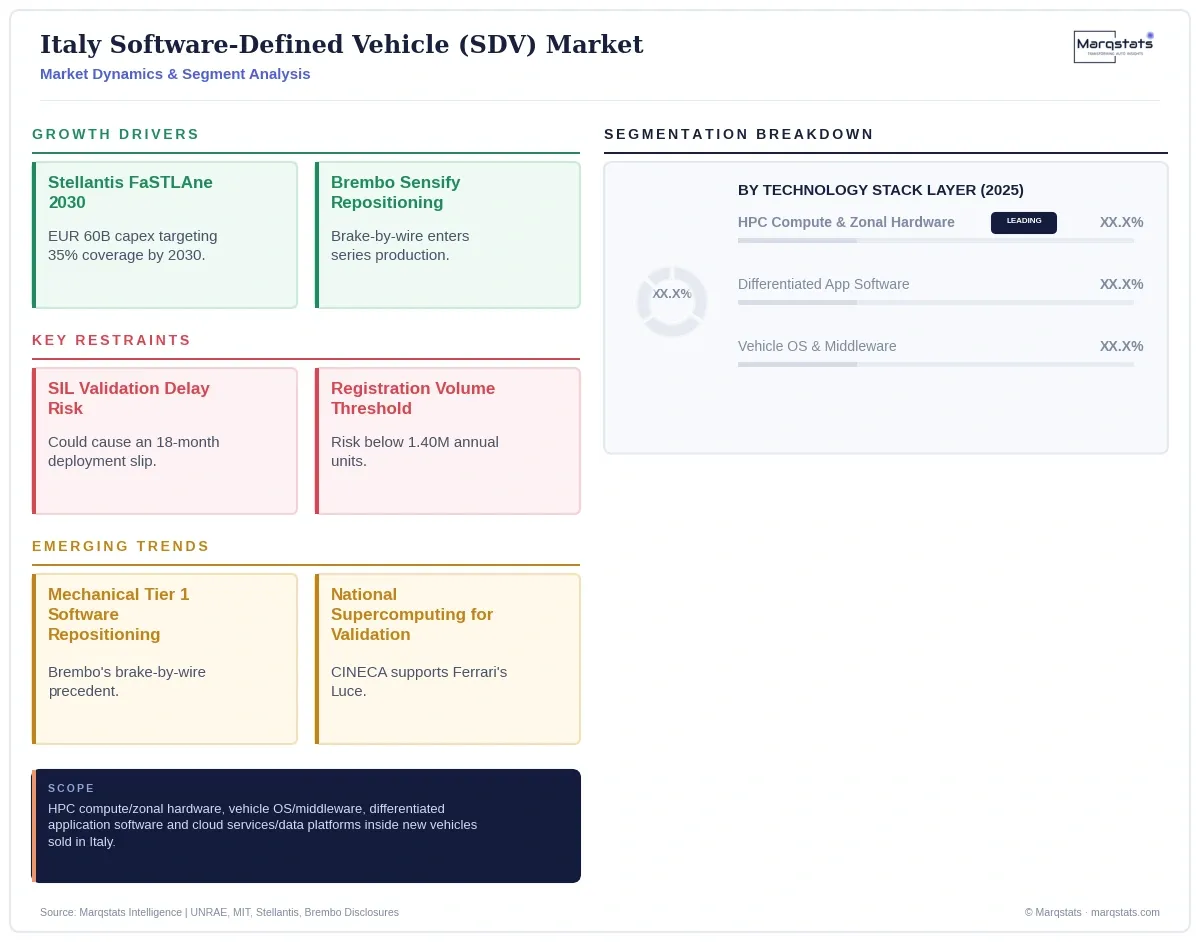
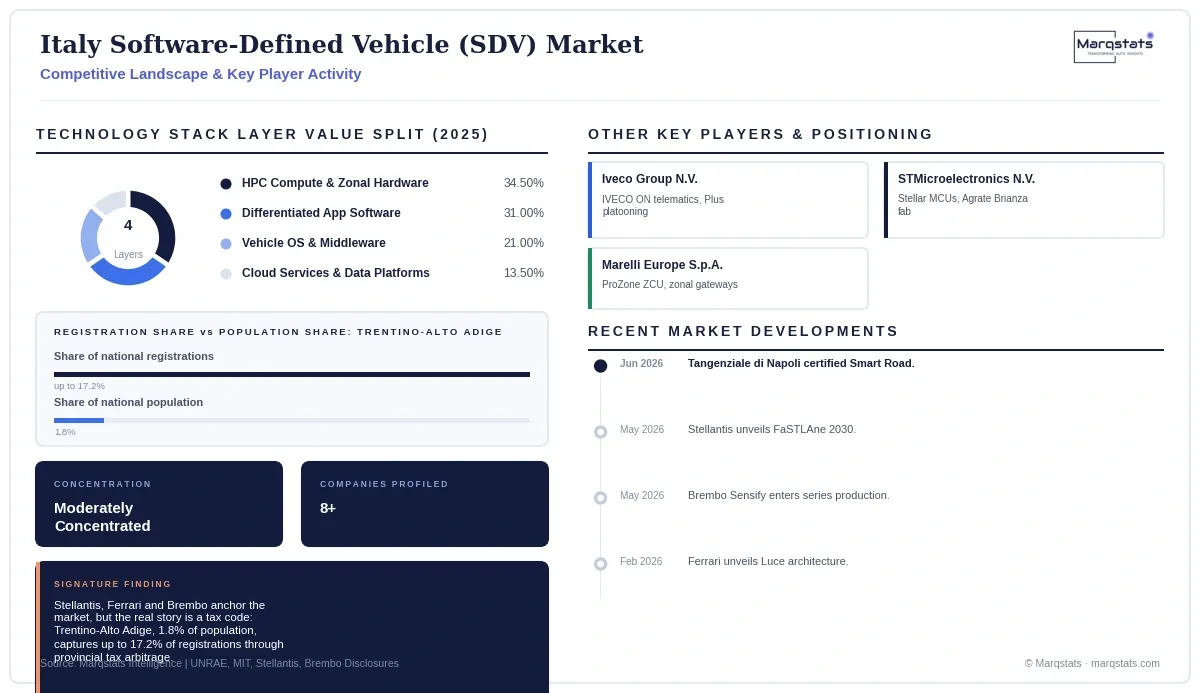
USD 0.442 billion (34.50% share) in 2025, moving to USD 1.069 billion (28.50% share) by 2030, a 19.35% CAGR. Segment and regional values are reported in USD, using the USD headline value for each year and the stated market shares. Amounts are rounded to three decimal places; their sum can differ from the headline by USD 0.001 billion due to rounding.
USD 0.269 billion (21.00% share) in 2025, moving to USD 0.675 billion (18.00% share) by 2030, a 20.24% CAGR.
USD 0.397 billion (31.00% share) in 2025, moving to USD 1.369 billion (36.50% share) by 2030, a 28.12% CAGR.
USD 0.173 billion (13.50% share) in 2025, moving to USD 0.638 billion (17.00% share) by 2030, a 29.85% CAGR.
USD 0.960 billion (75.00% share) in 2025, moving to USD 2.681 billion (71.50% share) by 2030, a 22.82% CAGR.
USD 0.218 billion (17.00% share) in 2025, moving to USD 0.731 billion (19.50% share) by 2030, a 27.46% CAGR.
USD 0.102 billion (8.00% share) in 2025, moving to USD 0.338 billion (9.00% share) by 2030, a 26.97% CAGR.
By Geography
Piedmont (Turin)
USD 0.486 billion (38.00% share) of national industrial SDV value in 2025.
Lombardy (Milan-Bergamo)
USD 0.416 billion (32.50% share) of national industrial SDV value in 2025.
Emilia-Romagna (Motor Valley)
USD 0.237 billion (18.50% share) of national industrial SDV value in 2025.
Southern & Central Italy
USD 0.141 billion (11.00% share) of national industrial SDV value in 2025.
Trentino-Alto Adige Registration Distortion
The autonomous province cluster of Trentino-Alto Adige, representing only 1.8% of Italy's population, captures between 12.1% and 17.2% of national new car registrations and up to 11.5% of long-term leasing contracts, an administrative artefact of the region's reduced provincial vehicle registration tax (Imposta Provinciale di Trascrizione); national leasing and rental companies account for 85.0% of the region's registration contracts, with vehicles immediately deployed across corporate networks in Lombardy, Piedmont, Lazio and Campania.
How Competition Is Evolving
Italy's SDV ecosystem spans a diversified OEM base (mass-market, ultra-luxury, and heavy commercial), a globally significant semiconductor and mechatronics Tier 1 supply chain, and dedicated cloud/data-platform subsidiaries, concentrated within Northern and Central Italian industrial corridors.
Stellantis N.V. is the primary domestic OEM across mass and premium segments, building its STLA Brain (central compute), STLA SmartCockpit and STLA AutoDrive architecture alongside its Mobilisights Connect data-as-a-service platform. Under its May 2026 FaSTLAne 2030 plan, Stellantis committed over EUR 60 billion in capex and R&D through 2030, targeting 35% of global delivery volume on centralized architecture by 2030 (rising to 70% by 2035), and compressing development cycles from 44 to 24 months via dSPACE-based Software-in-the-Loop simulation.
Ferrari N.V. builds proprietary integrated dynamic vehicle control software on Qualcomm's Snapdragon Digital Chassis, validated using CINECA's Leonardo EuroHPC supercomputer in Bologna; its all-electric 'Ferrari Luce' architecture was unveiled in February 2026. Iveco Group operates IVECO ON cloud telematics and a Plus autonomous heavy-truck platooning stack across its Turin, Brescia and Suzzara facilities.
Brembo S.p.A., a global Tier 1 braking and chassis-software manufacturer (EUR 3.7 billion 2025 revenue), brought its Sensify intelligent fluid-free electromechanical brake-by-wire platform into large-scale series production in May 2026, achieving 100% standard fitment on a global OEM's launch model. STMicroelectronics operates 300mm wafer fabrication in Agrate Brianza and a silicon-carbide campus in Catania, supplying its Stellar 32-bit automotive microcontroller families with embedded Phase Change Memory for zero-downtime dual-bank OTA updates.
Marelli Europe S.p.A., headquartered in Corbetta (Milan), supplies its ProZone Zone Control Unit consolidating up to 15 distributed body, chassis and lighting ECUs into a single zonal gateway, alongside Lean Cockpit and ASA Motion Link display systems. Mobilisights Connect, Stellantis's wholly-owned data subsidiary rebranded in March 2026, integrates with over 40 European telematics partners as a Data-as-a-Service and Software-as-a-Service platform.
Companies Covered
Companies covered in the report include:
Recent Market Activity
Table of Contents
Coverage & Segmentation
The analysis measures HPC compute and zonal hardware, vehicle OS and middleware, differentiated application software, and cloud services/data platforms inside new vehicles sold in Italy, for a 2025 base year and a 2026 to 2030 forecast, in United States dollars and euros at the official 2025 ECB average exchange rate.
The analysis covers two segmentation dimensions, technology stack layer and vehicle category, a four-region industrial corridor split, and eight profiled entities. The headline sizing chain traces to a secondary source; company-level facts and the regional tax-distortion finding do not. See the verification log for full disclosure.