Market Snapshot
Middle bar: base-year value × (1 + CAGR), rounded to two decimals. This is a calculated illustration, not a separately researched annual estimate.
Market Size (2025, Base Year): USD 722.94 Million (EUR 669.39 Million)
Estimated Value (2026): USD 1,018.46 Million
Forecast Value (2030): USD 3,296.31 Million
CAGR: 35.45% | Forecast Period: 2026 – 2030
Growth — Absolute: USD 2573.37 Million
SDV-Architected Vehicle Volume: 567,279 Units (2025) to 1,664,200 Units (2030), Volume CAGR 24.02%
Largest Region: Île-de-France (42.00% of 2025 value)
Fastest Growing Domain: ADAS & Automated Driving (31.00% to 35.00% share, 2025-2030)
Dominant Domain: Digital Cockpit & In-Cabin UX (33.50% of 2025 value)
Market Concentration: Moderately Concentrated (Renault, Stellantis, Valeo Lead)
Base Year: 2025 | Historical Period: 2021 – 2025 | Forecast Period: 2026 – 2030
Units Considered: Value (USD Million)
Segments Covered: 2 | Regions Covered: 5 | Companies Profiled: 8
Report Pages: 165 | Deliverables: PDF, Excel, PPT
Key Takeaways
Market Overview & Analysis
Report Summary
France's software-defined vehicle market is the clearest evidence yet that vehicle computing value has decoupled from vehicle sales volume: registrations fell, production for export rose, and the embedded software layer inside each new vehicle grew regardless of which direction the headline sales number moved.
The analysis measures the embedded software, compute silicon and connectivity layer inside new vehicles, isolated from the physical glider and electromechanical assemblies: USD 722.94 million (EUR 669.39 million) in 2025, growing to USD 3,296.31 million by 2030.
The monetary sizing is a stated construction built from Valeo's published Brain Division disclosures and OEM R&D capex splits, since no source publishes a standalone SDV software and compute figure for France; this is disclosed prominently below and in the accompanying verification log, not presented as an independently published statistic, so purchasers can weigh it accordingly against the vehicle-volume anchor, which is independently published.
The analysis is written for four readers: an OEM deciding how fast to consolidate legacy distributed electronics into zonal architecture, a Tier 1 supplier deciding whether to decouple software from hardware, a technology entrant evaluating co-development access, and an investor tracking three regulation-anchored forward scenarios, each with its own named, dated trigger condition.
France's position as home to both of Stellantis's and Renault's core engineering centres, a major European semiconductor fabrication cluster in Grenoble, and the origin of the cross-industry Software République consortium makes this market a useful bellwether for how European SDV regulation and industrial policy interact, with implications reaching well beyond the French market alone, into how the rest of the EU auto sector responds.
A Market Growing Faster Than the Vehicles That Carry It
The single most important fact about France's SDV market is not its growth rate. It is the direction that growth rate points relative to the underlying vehicle market it sits inside.
French light vehicle registrations fell 4.8% in 2025 to 1,990,453 units, sitting 26.3% below the pre-crisis 2019 benchmark of 2,214,279 units, a decline that has removed roughly 580,000 annual passenger car deliveries from domestic channels. Over the same year, Valeo's Brain Division, the supplier's centralized-electronics and ADAS unit, recorded EUR 5.0 billion in sales and captured 37% of a EUR 24.6 billion order-intake pool that grew 38% year-on-year. Two numbers moving in opposite directions inside the same national market, in the same year, is the clearest possible evidence that vehicle computing value has genuinely decoupled from vehicle sales volume: content-per-vehicle gains are outpacing the market-wide volume pressure that would otherwise be expected to drag every supplier's revenue down with it.
A Regulation Written for Safety That Rewrote the Bill of Materials
EU GSR II was not written as an industrial policy instrument. Its cost structure is functioning as one anyway.
Analysis prepared for the PFA found that GSR II and CAFE compliance added EUR 3,058 in indirect cost per vehicle sold in France by 2025, split between EUR 2,708 in powertrain electrification adjustments and EUR 350 in mandatory sensor fitment for driver-distraction cameras and autonomous emergency braking hardware. That cost structure fell hardest on the cheapest cars: A-segment registrations collapsed 79.0% between 2019 and 2025, from a 9.0% market share to just 3.0%. A regulation designed purely to make every vehicle safer has, as a direct side effect, priced an entire vehicle segment out of the French retail market and accelerated the computing consolidation that survives it, since the multi-camera, multi-sensor processing GSR II requires simply cannot run on the isolated microcontrollers the A-segment was built around.
Two French Champions, Two Genuinely Different Bets on Who Builds What
Renault and Stellantis are both consolidating distributed electronics into centralized compute. They are making almost opposite choices about who supplies the pieces.
Renault's Ampere unit pursues a horizontal partnership model, integrating third-party technology rather than building every layer internally: Qualcomm's Snapdragon Digital Chassis for central compute, Google's Android Automotive OS and Google Cloud for the infotainment and digital-twin stack, and a dedicated co-development partnership with Valeo for the physical zonal electrical architecture. Stellantis, by contrast, is building a vertically orchestrated internal stack, STLA Brain, STLA SmartCockpit and STLA AutoDrive, engineered to replace legacy controllers directly, and brought external partners like Applied Intuition and Amazon in to accelerate specific toolchains rather than to own core architecture layers. Both companies are converging on the same destination, a consolidated zonal architecture, from opposite directions: Renault buying integration speed through partnership, Stellantis buying platform control through internal ownership. Which approach proves cheaper to scale across STLA One's targeted 70% component reuse versus Ampere's targeted partnership breadth is one of the more consequential open questions in the European SDV transition.
A Van Platform That Got Expensive Enough to Bring In-House
Flexis was built to prove that a joint venture could industrialize a software-defined commercial platform faster than any single OEM could alone. Eighteen months later, Renault decided it could do it faster alone.
Flexis launched in 2024 as a three-way joint venture between Renault Group, Volvo Group and CMA CGM, built around a native 800-volt electric skateboard chassis and a centralized SDV backbone developed by Ampere. But commercial-vehicle electrification lagged behind passenger cars throughout 2025, BEVs reached 20.0% of passenger registrations but only 9.4% of light commercial registrations, straining the economics of a platform built specifically for electric vans. In June 2026, Renault bought out Volvo Group's 45% stake and CMA CGM's 10% stake, absorbing EUR 350 million in pre-production investment onto its own balance sheet to secure the Sandouville production ramp. A joint venture built to spread SDV development risk across three partners ended up being absorbed by the one partner with the clearest industrial reason to see it through, a pattern worth watching wherever else multi-party SDV platform ventures get announced across Europe.
The Regulation That Made an Entire Vehicle Class Uneconomical
Most regulatory analyses in this space focus on what compliance costs add to a vehicle. France's own registration data shows what those costs subtract from the market instead.
The mechanism is straightforward once isolated: GSR II's per-vehicle compliance cost, EUR 3,058 by 2025, does not scale down proportionally for a cheaper car. A EUR 15,000 A-segment hatchback absorbs the same mandatory sensor and powertrain-adjustment cost as a EUR 40,000 D-segment saloon, which means the compliance burden consumes a far larger share of the cheaper car's total cost structure. That asymmetry is precisely why A-segment registrations collapsed nearly four-fifths between 2019 and 2025 while the broader market contracted by roughly a quarter: the regulation is genuinely neutral on paper, but its economic effect falls unevenly by price tier, and the cheapest tier absorbed most of the damage.
Why Content-Per-Vehicle Is the Metric That Actually Matters Here
A market sizing built purely on unit volume would have badly mispredicted how this industry actually performed in 2025.
SDV-architected vehicle volume grew from 469,728 units in 2024 to 567,279 in 2025, a healthy expansion on its own. But the average SDV content per vehicle grew alongside it, from EUR 1,060 to EUR 1,180, so the market's monetary growth outpaced its unit growth by a meaningful margin. That gap, value growth running ahead of volume growth, is projected to persist and widen through 2030 as content per vehicle climbs toward EUR 1,834. For a supplier or investor, tracking unit adoption alone would have understated this market's actual trajectory in every year of the historical series; content-per-vehicle is doing more of the work than penetration rate.
Market Dynamics
Key Drivers
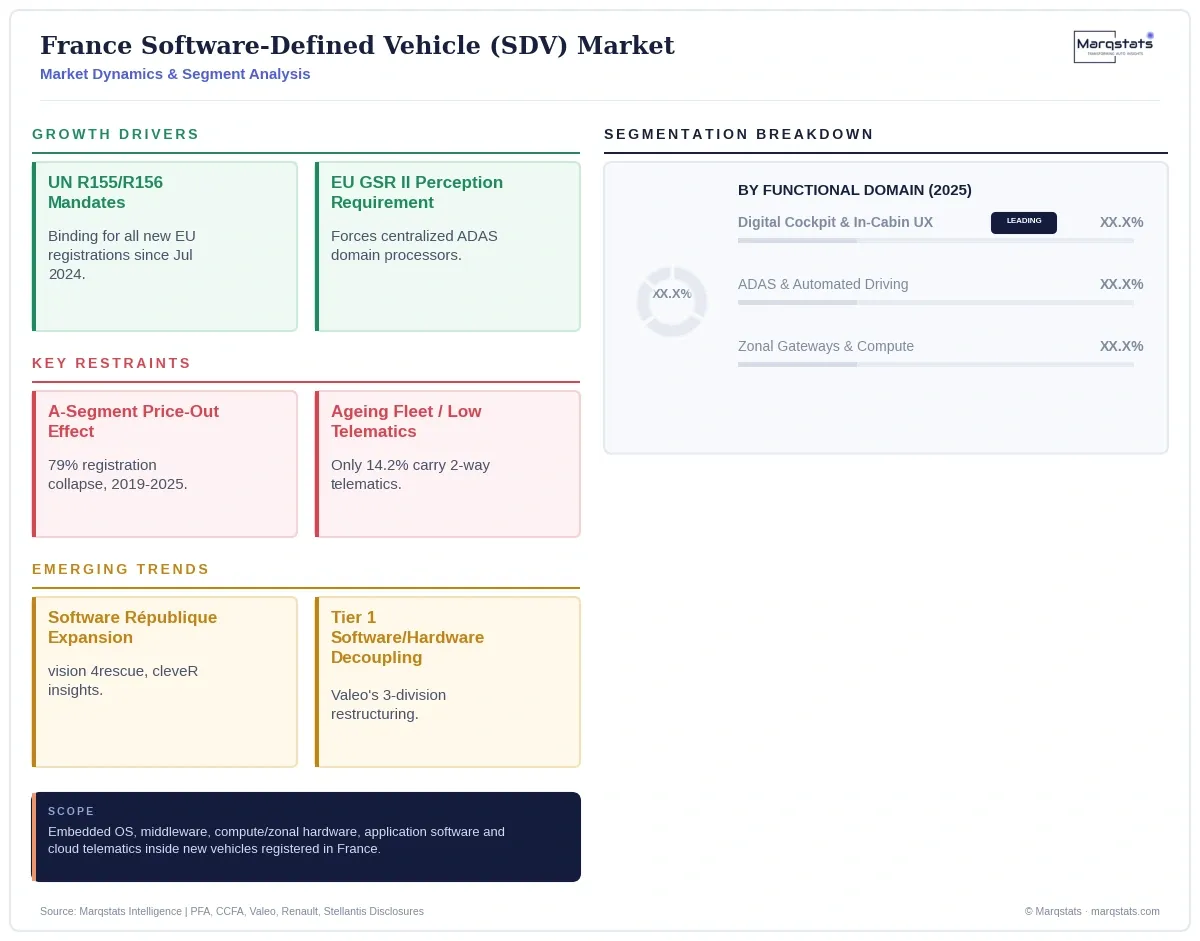
- UN R155/R156 cybersecurity and software-update mandates, binding for all new EU registrations since July 2024, make unprotected distributed CAN architectures legally obsolete.
- EU GSR II's multi-camera, multi-sensor perception requirements cannot run on legacy isolated microcontrollers, directly forcing centralized ADAS domain-processor adoption.
- Valeo's Brain Division growth, expanding faster than the vehicle market is contracting, demonstrates that content-per-vehicle economics are strong enough to outrun volume pressure on their own.
- Stellantis's STLA One and Renault's Ampere/Flexis platforms both target major component and engineering reuse, structurally lowering the marginal cost of extending SDV architecture to lower-volume segments.
- The EU Data Act grants independent software vendors and hyperscalers direct legal access to vehicle telemetry, opening high-margin downstream services beyond proprietary OEM data ecosystems.
Key Restraints
- GSR II and CAFE compliance costs have already priced the A-segment out of much of the French market, shrinking the volume base onto which future SDV content can be layered at the entry-level price point.
- An ageing fleet, now averaging 12.3 years, and low two-way telematics penetration (14.2%) mean the addressable base for OTA lifecycle monetization stays a small slice of the total operating parc for years yet.
- Slower commercial-vehicle electrification than passenger cars strained Flexis's original joint-venture economics badly enough that Renault had to absorb the platform onto its own balance sheet.
- A late-2026 European Commission review of CAFE emissions regulation could postpone penalties or dilute zero-emission mandates, directly triggering the Downside scenario's slower architecture bifurcation path.
Key Trends
- The Software République consortium is expanding from pure R&D collaboration into deployed public-service applications, from vision 4rescue's emergency-response platform to cleveR insights' municipal environmental sensing.
- Tier 1 suppliers are restructuring around decoupled software licensing rather than bundled black-box ECUs, following Valeo's three-division (Power, Light, Brain) reorganization.
- Fleet telematics and predictive maintenance are emerging as the commercial-vehicle SDV value driver, ahead of consumer-facing subscription services that dominate passenger-car narratives elsewhere in Europe.
- Regional engineering specialization is hardening: Grenoble for silicon, Sophia-Antipolis for middleware and V2X, Sandouville for 800V skateboard integration, each cluster increasingly difficult for a new entrant to replicate from scratch.
Strategic Implications
- Automotive manufacturers should eliminate dual E/E architecture maintenance, running legacy point-to-point wiring for ICE models alongside centralized zonal compute for EVs creates engineering overhead that STLA One's single-platform consolidation and 70% component reuse target are specifically designed to eliminate.
- Tier 1 suppliers should decouple application software from physical compute hardware licensing now, before OEMs bypass slower-moving suppliers entirely by partnering directly with semiconductor vendors and specialized software providers, as Renault has already done with Qualcomm and Google.
- Technology entrants and hyperscalers should budget for genuine joint engineering co-location with OEM technical centres rather than off-the-shelf consumer software deployment, functional safety certification under ISO 26262 and UN R155/R156 cannot be retrofitted onto a stack built for a different regulatory environment.
- Investors should track the European Commission's late-2026 review of Regulation (EU) 2019/631 and the mid-2027 Euro 7 digital-compliance mandate, the two named regulatory triggers separating the Downside, Base and Upside scenarios, and should weigh the monetary sizing here as a stated construction rather than an independently published market statistic, per the disclosure in the evidence section.
Outlook
Three scenarios are tested, each anchored to a distinct, named, dated regulatory trigger rather than differing growth-rate assumptions applied to the same story.
Under the Base Path (Industrial Execution), Renault's Flexis platform enters series production at Sandouville in late 2026 and Stellantis begins rolling out STLA One in 2027, under continued EU GSR II enforcement and preserved France 2030 industrial funding. Volume reaches 1,664,200 units, a 24.02% CAGR, and value reaches USD 3,296.31 million (EUR 3,052.14 million), a 35.45% CAGR, with content per vehicle rising from EUR 1180 to EUR 1834.
Under the Downside Path (Architecture Bifurcation), triggered by a late-2026 European Commission review of Regulation (EU) 2019/631 that postpones CAFE penalties or dilutes zero-emission mandates, manufacturers extend legacy distributed platforms rather than transitioning them. Volume reaches only 1,250,000 units, a 17.12% CAGR, and value reaches USD 2,322.00 million (EUR 2,150.00 million), a 26.29% CAGR, with SDV computing confined mainly to premium electric vehicles.
Under the Upside Path (Sovereign Acceleration), triggered by ratification of Euro 7 standards mandating software-defined on-board emissions monitoring by mid-2027 alongside European sovereign cloud-telemetry mandates, legacy CAN networks retire faster and high-performance compute spreads into compact vehicles. Volume reaches 1,920,000 units, a 27.61% CAGR, and value reaches USD 4,233.60 million (EUR 3,920.00 million), a 42.40% CAGR.
Market Segmentation
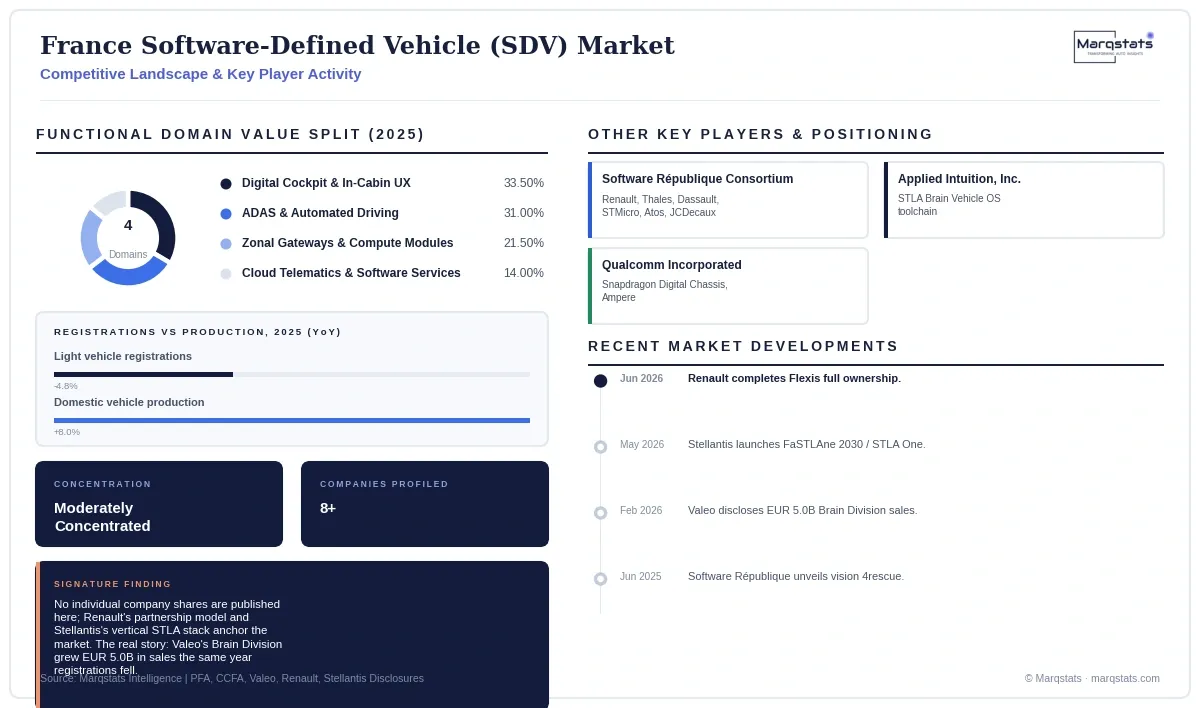
EUR 224.25 million (33.50% share) in 2025, moving to EUR 763.04 million (25.00% share) by 2030.
EUR 207.51 million (31.00% share) in 2025, moving to EUR 1068.25 million (35.00% share) by 2030.
EUR 143.92 million (21.50% share) in 2025, moving to EUR 671.47 million (22.00% share) by 2030.
EUR 93.71 million (14.00% share) in 2025, moving to EUR 549.39 million (18.00% share) by 2030.
EUR 565.63 million (84.50% share) in 2025, moving to EUR 2441.71 million (80.00% share) by 2030.
EUR 103.76 million (15.50% share) in 2025, moving to EUR 610.43 million (20.00% share) by 2030.
By Geography
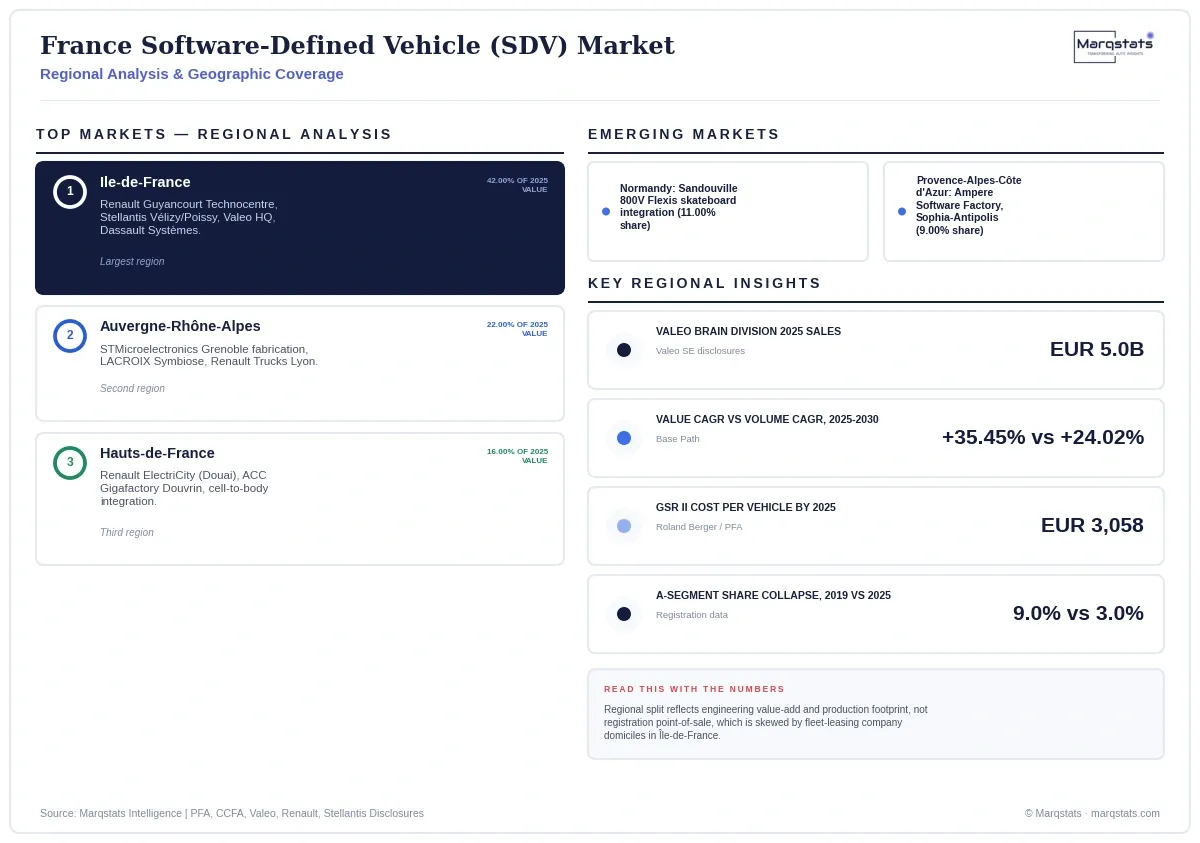
Île-de-France
EUR 281.14 million (42.00% share) of national SDV engineering value in 2025.
Auvergne-Rhône-Alpes
EUR 147.27 million (22.00% share) of national SDV engineering value in 2025.
Hauts-de-France
EUR 107.10 million (16.00% share) of national SDV engineering value in 2025.
Normandy
EUR 73.63 million (11.00% share) of national SDV engineering value in 2025.
Provence-Alpes-Côte d'Azur
EUR 60.25 million (9.00% share) of national SDV engineering value in 2025.
Registration-vs-Engineering Distinction
Statutory registration datasets compiled by the Ministry of Ecological Transition (SDES) show corporate fleet-leasing registrations concentrated in Île-de-France and Auvergne-Rhône-Alpes due to the legal domiciles of major fleet leasing providers like Arval and Ayvens; the regional distribution used here instead evaluates engineering value-add, software patent filings, and direct factory production footprints, to reflect underlying industrial capability rather than sales point-of-sale bias.
How Competition Is Evolving
The French SDV market is anchored by two domestic OEM champions pursuing structurally different architecture strategies, supported by a restructured Tier 1 supplier base and a cross-industry collaborative consortium. No aggregate market-share percentages are published for individual companies in the source; positioning below rests on named operational, financial and strategic facts.
Renault Group consolidates its electric powertrain and embedded software development within its Ampere subsidiary, operating software engineering facilities across Sophia-Antipolis, Toulouse and Guyancourt. Ampere pursues a horizontal partnership model: Qualcomm's Snapdragon Digital Chassis for central compute, Google's Android Automotive OS and Google Cloud for infotainment and digital-twin simulation, and a dedicated co-development partnership with Valeo for zonal electrical architecture, cutting wire-harness weight by an estimated 15 to 20 kilograms per vehicle. Renault's primary SDV deployment vehicle is Flexis SAS, now a wholly owned subsidiary following its June 2026 full-ownership acquisition, industrializing an 800-volt electric skateboard platform at the Sandouville complex in Normandy.
Stellantis N.V. pursues a vertically orchestrated internal technology strategy formalized in its May 2026 'FaSTLAne 2030' plan. Its foundational digital backbone, STLA Brain, reduces total ECU count by approximately 50%, increases central compute performance six-fold, and expands in-vehicle data bandwidth 1,000-fold using multi-gigabit Ethernet. The cabin layer, STLA SmartCockpit, is co-developed with Amazon and Foxconn Mobile Drive; automated mobility is governed by STLA AutoDrive, developed with Valeo and BMW. Stellantis expanded its partnership with Applied Intuition in May 2026 to integrate Vehicle OS and automated release pipelines into STLA Brain, compressing software development cycles from 44 to 24 months, and introduced the STLA One modular architecture the same month, consolidating five legacy platforms into one across the B, C and D segments.
Valeo SE, France's leading Tier 1 supplier, reorganized around three divisions, Power, Light and Brain, with the Brain Division integrating ADAS sensing, interior monitoring, body electronics, domain compute and zonal control. Its full-year 2025 disclosures reported EUR 5.0 billion in Brain Division sales, contributing to a 38% increase in group order intake to EUR 24.6 billion, while the company simultaneously cut gross R&D 7.3% to EUR 193 million and capex 30% to EUR 348 million, generating EUR 756 million in free cash flow before exceptional restructuring costs.
The Software République consortium, established in April 2021 by Renault Group, Dassault Systèmes, STMicroelectronics, Thales and Atos (later joined by JCDecaux), operates an open-innovation ecosystem spanning cybersecurity, digital-twin simulation, embedded edge silicon and urban infrastructure. It unveiled the 'vision 4rescue' emergency-response platform in June 2025 and the 'cleveR insights' municipal data-sensing platform in June 2026, both mounted on production Renault E-Tech Electric models.
Companies Covered
Companies covered in the report include:
Recent Market Activity
Table of Contents
Coverage & Segmentation
The analysis measures embedded operating systems, standardized middleware, central high-performance compute and zonal gateway hardware, application software (digital cockpit, ADAS Levels 2-3, connected chassis) and vehicle-to-cloud telematics/OTA orchestration software inside new vehicles registered in France, for a 2025 base year and a 2026 to 2030 forecast, in United States dollars and euros at a baseline ECB average rate of EUR 1.00 = USD 1.08. It excludes physical vehicle assembly, battery cells, legacy distributed microcontrollers, physical repair labour and aftermarket accessories.
The analysis covers two segmentation dimensions, functional domain and UNECE vehicle class, a five-region industrial-cluster split, and eight profiled entities. The monetary sizing is a stated construction (see Methodology); the underlying vehicle-volume anchor is independently published. See the verification log for full disclosure.