Market Snapshot
Middle bar: base-year value × (1 + CAGR), rounded to two decimals. This is a calculated illustration, not a separately researched annual estimate.
Market Size (2025, Base Year): USD 948.25 Million (BRL 5,112.96 Million)
Estimated Value (2026): USD 1,215.60 Million
Forecast Value (2030): USD 2,755.80 Million
CAGR: 23.78% | Forecast Period: 2026 – 2030
Growth — Absolute: USD 1807.55 Million
Active Connected Vehicle Parc: 3,650,000 Units (2025) to 10,410,000 Units (2030)
Largest Market: São Paulo (42.00% of 2025 value)
Fastest Growing Segment: Bio-Hybrid & Flex Hybrids (39.79% CAGR, 2025-2030)
Dominant Stack Layer: Hardware & Centralized Compute (54.20% of 2025 value)
Market Concentration: Moderately Concentrated (Stellantis, GM, VW Lead)
Base Year: 2025 | Historical Period: 2021 – 2025 | Forecast Period: 2026 – 2030
Units Considered: Value (USD Million)
Segments Covered: 3 | Regions Covered: 5 | Companies Profiled: 8
Report Pages: 165 | Deliverables: PDF, Excel, PPT
Key Takeaways
Market Overview & Analysis
Report Summary
Brazil's software-defined vehicle market is unlike any other in this vertical: its fastest-growing segment exists because of a fuel, not a powertrain category, and that single fact shapes almost every strategic decision an automaker makes here, from R&D allocation to regulatory strategy.
The analysis measures the value of hardware and centralized compute, middleware and embedded operating systems, and cloud platforms and connectivity services inside new vehicles sold in Brazil: USD 948.25 million (BRL 5,112.96 million) in 2025, growing to USD 2,755.80 million (BRL 14,859.27 million) by 2030.
The core sizing and segmentation chain traces to a source Marqstats could not independently verify; this is disclosed prominently below and in the accompanying verification log, not omitted, so purchasers can weigh it accordingly.
The analysis is written for four readers: an OEM deciding how much to invest in Brazil-specific ethanol powertrain software, a Tier 1 supplier evaluating the Ford Bahia engineering-export model, a fleet telematics provider designing for national roaming, and an investor tracking three Programa Mover-anchored forward scenarios, each with a named, verifiable trigger condition.
Brazil's position as the world's largest flex-fuel vehicle market, combined with a tax system that actively distorts where fleets register versus where they operate, makes it a structurally distinct SDV market that cannot be modelled as a smaller version of any market in North America, Europe or Asia, a distinction worth keeping in mind for anyone applying a global SDV playbook here unmodified.
A Software Category That Exists Because of a Fuel Pump, Not a Global Powertrain Trend
Every other market in this vertical frames its fastest-growing SDV segment around electrification. Brazil's fastest-growing segment exists because of what comes out of the fuel pump.
Bio-Hybrid and Flex-Fuel Hybrid powertrain software is projected to expand from USD 232.32 million in 2025 to USD 1240.11 million by 2030, a 39.79% CAGR that outpaces even battery-electric software growth. This isn't a compliance checkbox: reconciling high-voltage battery discharge with the combustion characteristics of ethanol-gasoline blends ranging from E27 to pure E100 hydrated ethanol requires powertrain domain controllers that dynamically adjust fuel injection timing, ignition curves and cold-start heating strategies in real time, software with no direct equivalent in a market running on a single, standardized fuel specification. Stellantis has committed BRL 30 billion through 2030 specifically to this Bio-Hybrid lineup, anchored at a dedicated R&D centre in Betim, Minas Gerais, treating ethanol-hybrid software engineering as a genuine competitive battleground rather than a footnote to the global EV transition.
A Tax Rate Difference That Rewrote Brazil's Vehicle Registration Map, and Not by Accident
A 3-percentage-point difference in a state vehicle tax has done more to distort Brazil's SDV regional data than any single industrial policy.
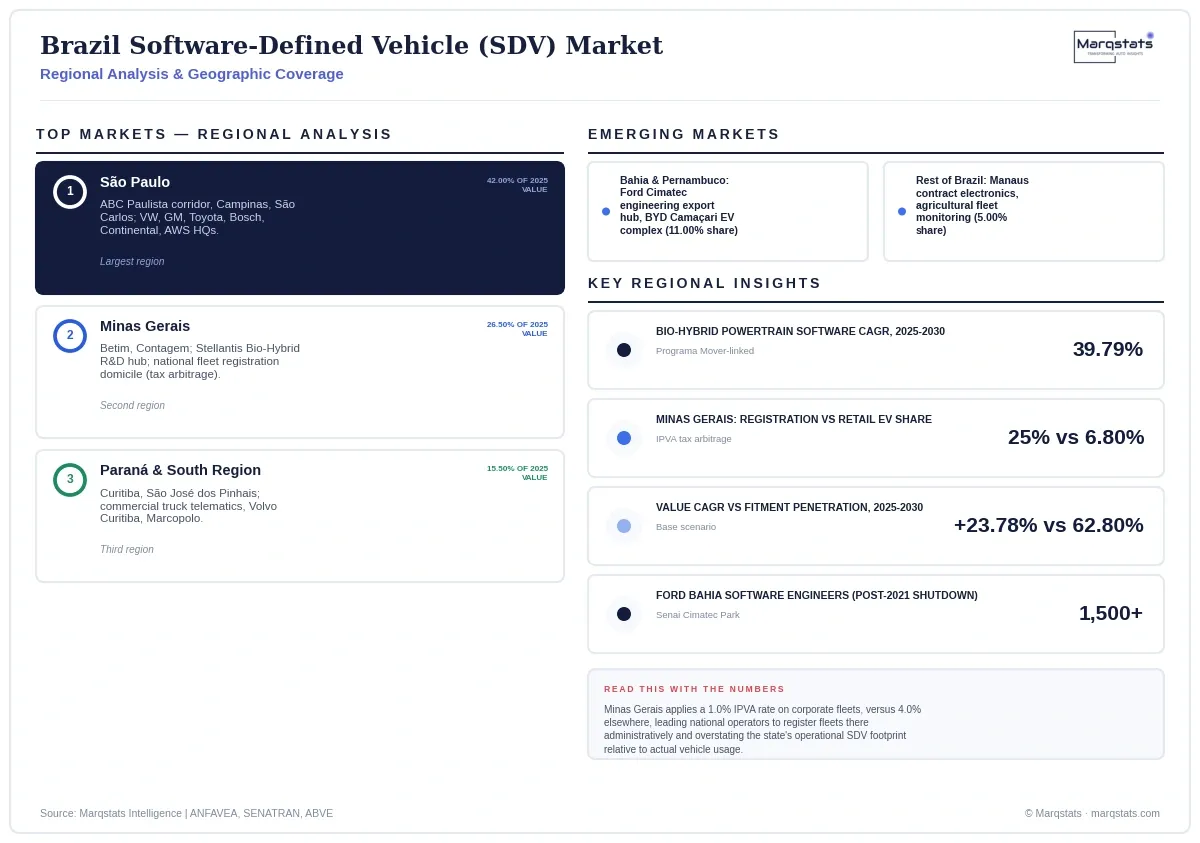
Minas Gerais levies a 1.0% IPVA rate on corporate rental and leasing fleet vehicles, against a standard 4.0% rate in São Paulo and Rio de Janeiro. National fleet operators Localiza Rent a Car and Movida Locação de Veículos respond to that gap exactly as the incentive predicts: they register their nationally-operating fleets through Minas Gerais subsidiaries, which is why the state captures roughly 25% of all national vehicle registrations despite representing only 6.80% of end-user retail electrified deliveries. The practical consequence reaches well beyond tax administration: because these vehicles physically operate across the entire country while being administratively domiciled in one state, telematics providers cannot design connectivity around localized regional networks. They have to build for multi-operator national cellular roaming from day one, a structural requirement this tax quirk created almost by accident.
An Engineering Export Business That Doesn't Need a Single Local Factory
Ford's Brazilian operation proves something that would have sounded implausible a decade ago: a company can grow its automotive software workforce in a country after it stops building cars there.
Ford ended domestic vehicle manufacturing in Brazil in 2021. Rather than closing its Brazilian operations entirely, it expanded its Bahia Technology and Development Center at Senai Cimatec Park to more than 1,500 software and systems engineers, who develop foundational algorithms for digital cockpits, off-board cloud connectivity and active driver-assistance systems, including Ford's BlueCruise ADAS platform, that ship in vehicles built in North America, Europe and Asia. This is a genuine engineering-export model: the facility's output has nothing to do with what gets assembled on Brazilian soil. For any OEM or Tier 1 supplier evaluating Brazil purely as a manufacturing or sales market, Ford's Bahia operation is a live demonstration that the country's software engineering talent pool can be a standalone asset, decoupled entirely from local vehicle production decisions.
A Sizing Model That Names Its Own Blind Spot
This market's headline number rests on an input Brazilian institutions don't publish directly, and the underlying research is explicit about exactly which one.
While the physical vehicle registration baseline carries a fully published verification level through ANFAVEA and SENATRAN datasets, no Brazilian registry publishes a unified, single-line figure for the embedded software and compute stack itself. Sensitivity testing shows how much that gap matters: a 1.00 percentage-point shift in the projected 2025 fitment-penetration rate alone moves the base-year market value by USD 29.77 million, and a USD 50.00 change in average software content per fitted vehicle shifts it by USD 42.09 million. Anyone using this market's headline figure for investment or planning purposes should treat it as a well-reasoned construction built from real Tier 1 BOM contracts and carrier filings, not a number any single Brazilian institution has directly published and certified.
Three Automakers, Three Genuinely Different Bets on Where Software Comes From
Stellantis, General Motors and Volkswagen are all racing toward centralized compute in Brazil, but each is sourcing the software layer from a structurally different place.
Stellantis is building proprietary architecture internally, STLA Brain and STLA SmartCockpit, engineered specifically to coordinate ethanol combustion dynamics with dual-motor hybrid systems, a genuinely Brazil-specific engineering problem no global platform solves off the shelf. General Motors leans on its existing Global B Vehicle Intelligence Platform architecture while layering in Google Built-in software for infotainment, blending an internal electronic backbone with an external application layer. Volkswagen do Brasil takes the most externally dependent path of the three, building its VW Play infotainment system jointly with Visteon while gradually importing CARIAD software assets to adapt its global MQB-A0 and MEB architectures for local use. Three different sourcing strategies, all converging on the same centralized-compute destination, is a useful signal that no single template for 'how to build SDV software in Brazil' has actually won yet.
Why a Market-Wide Methodology Change Made the Data Suddenly Cleaner
A single accounting decision by an industry association can matter more to market clarity than a year of actual sales growth.
Beginning in January 2025, ABVE updated its electrification methodology to exclude 12-volt and 48-volt micro-hybrids from official statistics, because these systems cannot move a vehicle on electric power alone and therefore don't represent genuine software-defined electric powertrains requiring battery management systems, high-voltage isolation software, or dedicated inverter controls. That exclusion means Brazil's 2025 electrification figures, 223,912 light electrified vehicles across PHEVs, BEVs, full flex-fuel hybrids and conventional hybrids, represent a cleaner, more analytically useful baseline than prior years' data, which mixed in vehicles with no real SDV powertrain software requirement at all. Anyone comparing Brazil's electrification trajectory year over year should treat the pre- and post-2025 series as measuring genuinely different things.
Market Dynamics
Key Drivers
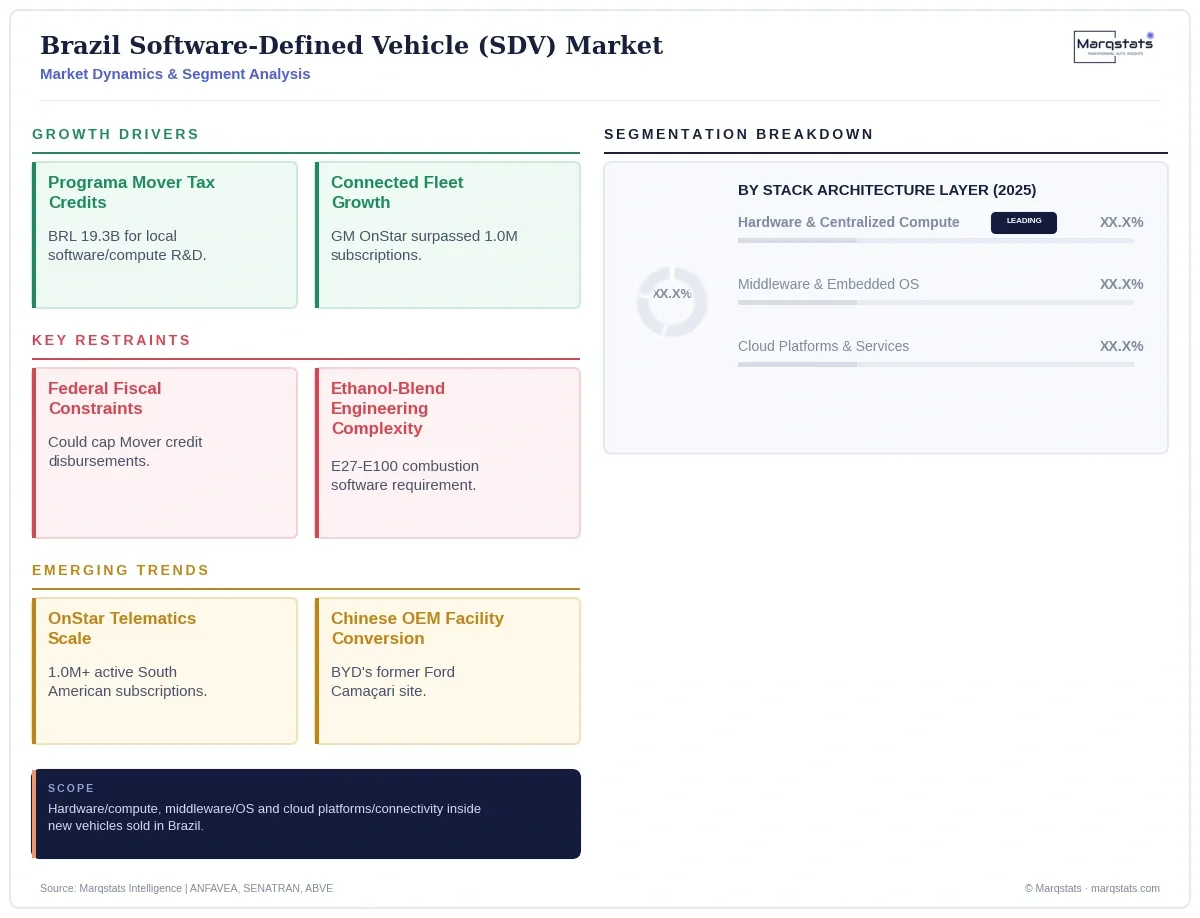
- Programa Mover's carbon-intensity tax credits are directly incentivizing OEMs to develop specialized Bio-Hybrid ethanol powertrain software, a requirement unique to the Brazilian market and one no global platform can meet off the shelf.
- Rising connected-vehicle fleet penetration is creating an installed base large enough to sustain recurring OTA feature activation and telematics subscription revenue, as GM's OnStar milestone already demonstrates at scale.
- CONTRAN's phased mandate for AEBS and ESC systems (Resolução nº 1006/2023) is forcing the consolidation of distributed ECUs into centralized domain controllers capable of supporting active safety processing, on a timeline the Accelerated scenario assumes speeds up further.
- Ford's Bahia software-engineering-export model demonstrates that Brazil's talent pool can sustain SDV value creation independent of domestic vehicle manufacturing volume, a template other OEMs may find worth studying.
- Chinese OEM expansion, with BYD's Camaçari facility and GWM's Iracemápolis operations, is normalizing centralized compute and OTA-capable architecture at competitive price points, pressuring legacy manufacturers to accelerate their own transitions.
Key Restraints
- Federal fiscal constraints capping Mover tax-credit disbursements would directly slow corporate investment in localized software development, the Constrained Macro scenario's central trigger, with knock-on effects across the whole supplier ecosystem.
- Elevated domestic Selic interest rates curb retail automotive financing, indirectly constraining the new-vehicle base onto which SDV content is fitted, a macro headwind no individual OEM can offset alone.
- The requirement to engineer bespoke ethanol-blend powertrain software adds genuine engineering complexity and cost that markets running on standardized fuel specifications do not face, raising the bar for any new entrant's local R&D commitment.
- ANATEL's prohibition on permanent international eSIM roaming requires new entrants to establish local mobile network operator agreements before launch, a structural barrier to fast market entry that generic global platforms cannot simply route around.
Key Trends
- Recurring telematics subscription revenue is scaling past luxury-segment pilots, with GM's OnStar platform surpassing 1.0 million active South American subscriptions, a scale few other emerging-market telematics programmes have reached.
- Chinese OEMs are converting former legacy-manufacturer facilities, including BYD's use of Ford's former Camaçari site, into centralized-compute EV production hubs, turning idle industrial capacity into a competitive asset.
- LGPD and ANPD data-protection compliance is becoming a standard design requirement for cloud telematics backends handling vehicular telemetry, biometrics and geolocation, mirroring the compliance burden already familiar from GDPR-anchored markets.
- Software engineering talent is increasingly decoupled from vehicle assembly decisions, with dedicated development centres exporting algorithms to global vehicle lines regardless of local production status, a model Ford's Bahia centre exemplifies directly.
Strategic Implications
- New entrants should establish local mobile network operator agreements and eUICC profile-switching systems before launch, since importing vehicles on permanent international roaming violates ANATEL directives, and should build engineering capacity for Bio-Hybrid ethanol powertrain software to access Programa Mover's R$19.3 billion in tax credits, rather than treating that credit pool as a secondary consideration.
- Established manufacturers should accelerate the shift from legacy distributed ECUs toward centralized domain controllers, since Chinese entrants are already normalizing that architecture at competitive price points, and should treat localized Bio-Hybrid software development as a genuine R&D priority rather than a market-specific afterthought, given how directly it ties to Programa Mover eligibility.
- Tier 1 suppliers and technology investors should prioritise modular middleware and open API compatibility with localized flex-fuel engine management, since vendors offering pre-validated compatibility with Brazil's ethanol-blend requirements will capture higher content value per vehicle than generic global platforms unable to make the same claim.
- Investors should track Programa Mover's disbursement timetable and CONTRAN/SENATRAN's UNECE WP.29 enforcement schedule, the two named regulatory triggers separating the Accelerated, Base and Constrained scenarios, and should treat the headline sizing and segmentation figures here with the caution disclosed in the evidence section, since no Brazilian institution directly publishes a unified SDV software and compute figure at this time.
Outlook
Three scenarios are tested, each anchored to a distinct, named trigger tied to Programa Mover disbursement and CONTRAN/SENATRAN enforcement timing rather than differing growth-rate assumptions applied to the same story.
Under the Base Trajectory scenario, Mover R&D tax incentives disburse steadily through 2028, UNECE WP.29 cybersecurity principles adopt in phases by 2028, and connected Bio-Hybrid passenger vehicle uptake remains stable. Volume reaches 10,410,000 active connected units, and value reaches USD 2,755.80 million (BRL 14,859.27 million), a 23.78% CAGR, with fitment penetration reaching 62.80%.
Under the Accelerated Technology scenario, MDIC fully allocates available Mover credit reservations, ANATEL establishes a subsidized spectrum framework for V2X testing corridors, CONTRAN accelerates mandatory AEBS/lane-keeping milestones, and Chinese OEMs expand assembly in Bahia and São Paulo. Fitment penetration reaches 75.00% (2,268,750 units), and value reaches USD 3,315.40 million (BRL 17,876.64 million), a 28.45% CAGR.
Under the Constrained Macro scenario, federal budget pressure caps annual Mover tax deductions, elevated Selic interest rates curb retail automotive financing, and CONTRAN postpones active-safety type-approval requirements. Fitment penetration reaches only 48.00% (1,452,000 units), and value reaches USD 1,988.20 million (BRL 10,720.37 million), a 15.96% CAGR.
Market Segmentation
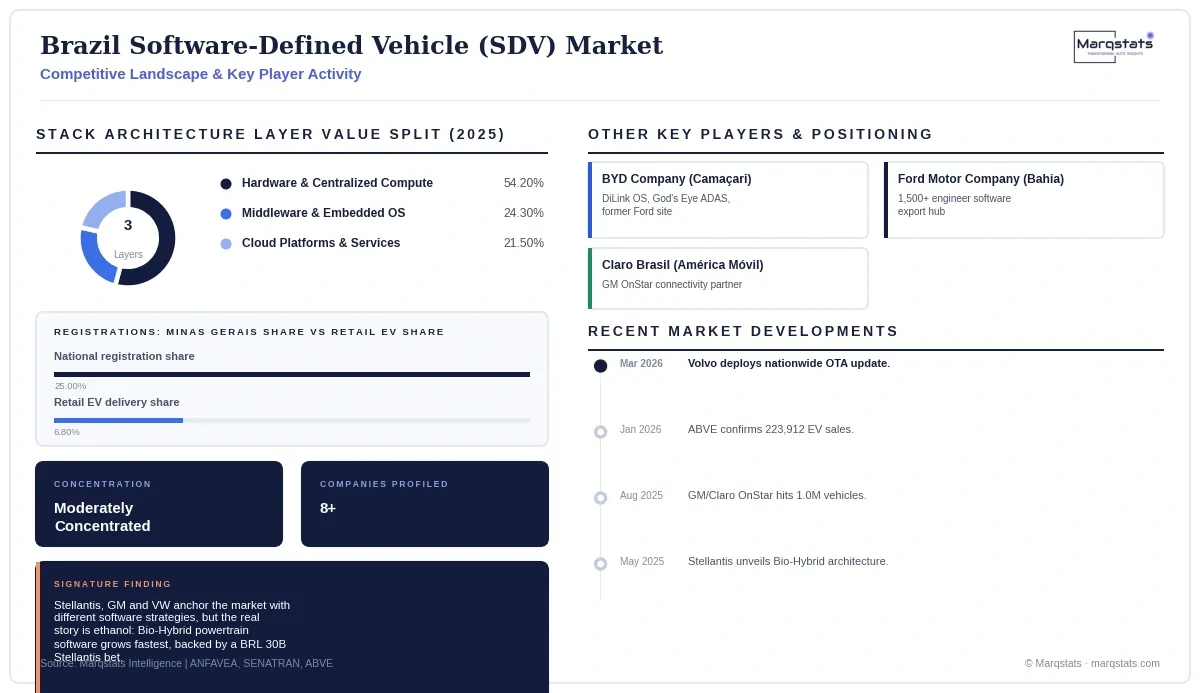
USD 513.95 million (54.20% share) in 2025, moving to USD 1281.45 million (46.50% share) by 2030, a 20.04% CAGR.
USD 230.42 million (24.30% share) in 2025, moving to USD 749.58 million (27.20% share) by 2030, a 26.61% CAGR.
USD 203.88 million (21.50% share) in 2025, moving to USD 724.77 million (26.30% share) by 2030, a 28.87% CAGR.
USD 635.33 million (67.00% share) in 2025, moving to USD 1846.39 million (67.00% share) by 2030, a 23.78% CAGR.
USD 189.65 million (20.00% share) in 2025, moving to USD 523.60 million (19.00% share) by 2030, a 22.52% CAGR.
USD 123.27 million (13.00% share) in 2025, moving to USD 385.81 million (14.00% share) by 2030, a 25.64% CAGR.
USD 550.00 million (58.00% share) in 2025, moving to USD 854.30 million (31.00% share) by 2030, a 9.21% CAGR.
USD 232.32 million (24.50% share) in 2025, moving to USD 1240.11 million (45.00% share) by 2030, a 39.79% CAGR.
USD 165.93 million (17.50% share) in 2025, moving to USD 661.39 million (24.00% share) by 2030, a 31.86% CAGR.
By Geography
São Paulo
USD 398.27 million (42.00% share) of national SDV value in 2025.
Minas Gerais
USD 251.29 million (26.50% share) of national SDV value in 2025.
Paraná & South Region
USD 146.98 million (15.50% share) of national SDV value in 2025.
Bahia & Pernambuco
USD 104.31 million (11.00% share) of national SDV value in 2025.
Rest of Brazil
USD 47.40 million (5.00% share) of national SDV value in 2025.
Minas Gerais Registration Distortion
A 1.0% IPVA rate on corporate rental/leasing fleet vehicles, against a standard 4.0% rate in São Paulo and Rio de Janeiro, leads national fleet operators Localiza Rent a Car and Movida Locação de Veículos to register their nationally-operating fleets through Minas Gerais subsidiaries, so the state captures roughly 25% of national vehicle registrations despite representing only 6.80% of end-user retail electrified deliveries.
How Competition Is Evolving
Brazil's SDV ecosystem spans established multinational OEMs, Chinese electric-vehicle entrants, global Tier 1 suppliers, semiconductor vendors and domestic telecommunications operators. Company facts below are independently and specifically sourced to OEM disclosures, trade press and government filings.
Stellantis leads domestic production volume across its plants in Betim, Goiana and Porto Real, and has committed BRL 30 billion between 2025 and 2030 to introduce its Bio-Hybrid powertrain lineup alongside its STLA Brain compute architecture and STLA SmartCockpit platform, developing proprietary software to coordinate ethanol combustion dynamics with dual-motor electric hybrid systems in support of Programa Mover compliance.
General Motors operates from São Caetano do Sul and São José dos Campos on its Global B Vehicle Intelligence Platform architecture; in August 2025, GM and Claro Brasil confirmed its OnStar platform surpassed 1.0 million active connected vehicles across South America, with newer architectures featuring native Google Built-in software.
Volkswagen do Brasil, headquartered at its Anchieta facility in São Bernardo do Campo, bases its digital strategy on the VW Play infotainment system developed jointly with Visteon, gradually adopting CARIAD software assets to adapt its MQB-A0 and MEB architectures for remote recalibration and active safety. BYD Company operates from the former Ford site in Camaçari, Bahia, producing the Dolphin, Dolphin Mini and Song Plus PHEV with its DiLink software stack and God's Eye driving-assistance system; GWM's Iracemápolis facility deploys its Coffee Intelligence software suite across the Haval H6 and Ora 03 lines.
Ford Motor Company, despite ending domestic vehicle manufacturing in Brazil in 2021, expanded its Bahia Technology and Development Center at Senai Cimatec Park to more than 1,500 software and systems engineers, developing global ADAS software including its BlueCruise platform. Toyota do Brasil leads flex-fuel hybrid manufacturing at Sorocaba and Indaiatuba, producing the Corolla and Corolla Cross HEV Flex lines under its Toyota Safety Sense package.
Companies Covered
Companies covered in the report include:
Recent Market Activity
Table of Contents
Coverage & Segmentation
The analysis measures hardware and centralized compute, middleware and embedded operating systems, and cloud platforms/connectivity services inside new vehicles sold in Brazil, for a 2025 base year and a 2026 to 2030 forecast, in United States dollars and Brazilian reais at a benchmark 2025 PTAX rate of R$5.3920 per USD. It excludes the physical vehicle glider and electromechanical assemblies.
The analysis covers three segmentation dimensions, stack architecture layer, vehicle application and powertrain integration, a five-region state/industrial split, and eight profiled entities. The headline sizing and segmentation totals carry a sourcing flag; company-level facts and the Minas Gerais tax-distortion finding do not. See the verification log for full disclosure.