Market Snapshot
The Mexico heavy truck market size is estimated at USD 3,303.24 million in 2025 and is projected to reach USD 4,405.65 million by 2030, growing at a CAGR of 5.93% over 2026 – 2030. New truck and tractor sales rise from about 34,121 to 41,800 units a year, and tractor heads make up 66.93% of 2025 value.
Marqstats defines the market as the retail value, before value-added tax, of new goods trucks and tractor units above 3,857 kilograms gross vehicle weight sold to end users in Mexico, whether built in Mexico or imported. It follows the cargo classes of the Asociación Mexicana de Distribuidores de Automotores (AMDA) and the Instituto Nacional de Estadística y Geografía (INEGI): rigid cargo trucks of Classes 4 to 8 and tractocamiones. Buses, coaches, pickups, vans, used trucks, exports and separately sold trailers and bodies are excluded.
Tractor heads lead, diesel trucks hold 98.16% of 2025 value and long-haul and cross-border freight accounts for 46.46%. Central and Bajío is the largest region at 38.00% of value, while the Northern Border and Northeast grows fastest at 6.56% a year as nearshoring plants and border logistics hubs fill with trucks.
Key Takeaways
Market Overview & Analysis
Report Summary
Marqstats sizes the Mexico heavy truck market as the retail value of new goods trucks and tractor units above 3,857 kilograms gross vehicle weight sold to Mexican end users each year. It follows the cargo classes in which AMDA reports heavy-vehicle retail sales from INEGI data: resto carga, which covers rigid trucks of Classes 4 to 8, and tractocamiones. Values are in US dollars at the 2025 average rate of MXN 19.20 per US dollar and exclude the 16% value-added tax.
The boundary is set to keep the Marqstats Mexico series additive. AMDA reported 39,833 heavy vehicles at retail in 2025, which includes 6,712 buses and coaches (5,230 urban and suburban buses and 1,482 long-distance coaches). Removing them leaves 33,121 cargo vehicles, made up of 17,097 tractor heads and 16,024 rigid trucks. Marqstats adds an estimated 1,000 trucks from brands that do not report to INEGI, which gives 34,121 units. Buses sit in the Mexico Bus and Coach Market and pickups in the Mexico Pickup Truck Market, so none of those vehicles is counted here.
Mexico is a manufacturing base first and a truck market second. INEGI recorded production of 117,121 heavy vehicles in January to September 2026, of which 98,394, or 84.01%, were exported, while domestic retail sales of all heavy vehicles were 25,289. In the first half of 2026 the United States took 53,797 of 58,260 exports, 92.34%. Domestic demand follows Mexican freight, fleet age and credit, and it moved separately from export output in both 2025 and 2026.
The domestic series has been volatile. AMDA retail sales of cargo vehicles grew from about 27,029 in 2021 to 34,856 in 2022, about 44,300 in 2023 and 48,989 in 2024, a record led by 27,091 tractor heads, then fell 32.39% to 33,121 in 2025. Marqstats attributes the fall to a pull-forward of purchases before the 1 January 2025 change in emission certification under NOM-044-SEMARNAT-2017, to dealer stock built in 2024, and, late in the year, to trade uncertainty after the United States imposed a 25% tariff on imported medium and heavy trucks from 1 November 2025.
Marqstats values the 2025 market at USD 3,303.24 million, equal to about MXN 63.42 billion at MXN 19.20 per US dollar. The estimate multiplies unit sales by class prices anchored on published price lists, and it is not a customs or factory value. Retail price is used because fleets buy at the dealer, and the value therefore includes dealer margin but excludes tax, bodies, trailers and financing.
Mexico Heavy Truck Market Size and Forecast
The Mexico heavy truck market grows from USD 3,303.24 million in 2025 to USD 4,405.65 million in 2030, a CAGR of 5.93%. Volume contributes most of the growth: sales rise at 4.14% a year, from about 34,121 to 41,800 trucks, and the average price per truck rises at 1.71% a year, from about USD 96,810 to USD 105,398. The path is not smooth, because 2026 is expected to fall to 29,600 units and USD 2,883.57 million before recovery starts in 2027.
The 2025 value is built bottom-up from classes and prices. Marqstats estimates 17,547 tractor heads at about USD 126,000 each, 8,682 heavy rigid trucks at USD 84,000 and 7,892 light and medium rigid trucks at USD 46,000, all at retail before value-added tax. The prices sit inside the published range for Foton, whose catalogue lists the EST-A X13 tractor at MXN 2,622,000 including tax, or USD 117,726 before tax, and the Galaxy tractor at MXN 2,999,000, or USD 134,653. The Aumark S12 rigid truck is MXN 1,599,000, or USD 71,794, the S38 is MXN 1,975,000, or USD 88,676, and the Miler entry truck is MXN 655,000, or USD 29,409.
The unit base is AMDA data with one Marqstats layer. AMDA recorded 17,097 tractor heads and 16,024 rigid cargo trucks at retail in 2025, and Marqstats allocates the rigid trucks to heavy and light and medium classes using brand mix, because Isuzu, Hino, Foton and Mercedes-Benz sell the lighter models and Kenworth, Freightliner, International and Mack sell the vocational trucks. The added 1,000 trucks from non-reporting brands are split 450 tractors, 350 heavy rigid and 200 light and medium rigid trucks.
The forecast assumes a gradual recovery. Sales fall 13.25% in 2026, using January to September 2026 AMDA cargo sales of 21,352 units, 15.8% below the prior year, and a fourth quarter about 10% below 2025. They then rise 11.49% in 2027, 11.52% in 2028, 7.61% in 2029 and 5.56% in 2030, which leaves 2030 sales at 41,800 units, still about 15% below the 48,989 cargo vehicles of 2024. Tractor heads rise at 5.19% a year in units, heavy rigid trucks at 3.88% and light and medium rigid trucks at 1.97%.
Marqstats tracks five indicators to monitor the forecast: monthly AMDA retail and INEGI wholesale sales, which show whether destocking has ended; the Section 232 tariff and the annual review of the United States, Mexico and Canada Agreement (T-MEC) that follows the 1 July 2026 joint review; Mexican tariffs on heavy trucks from countries without a trade agreement, now 5% to 20%; used heavy-vehicle imports from the United States, which ANPACT counts at 55.3 for every 100 new trucks in January to May 2026; and diesel and interest rate levels for fleet credit.
Market Dynamics
Key Drivers
Five forces are lifting demand for new trucks in Mexico as dealer stock clears and fleets renew.
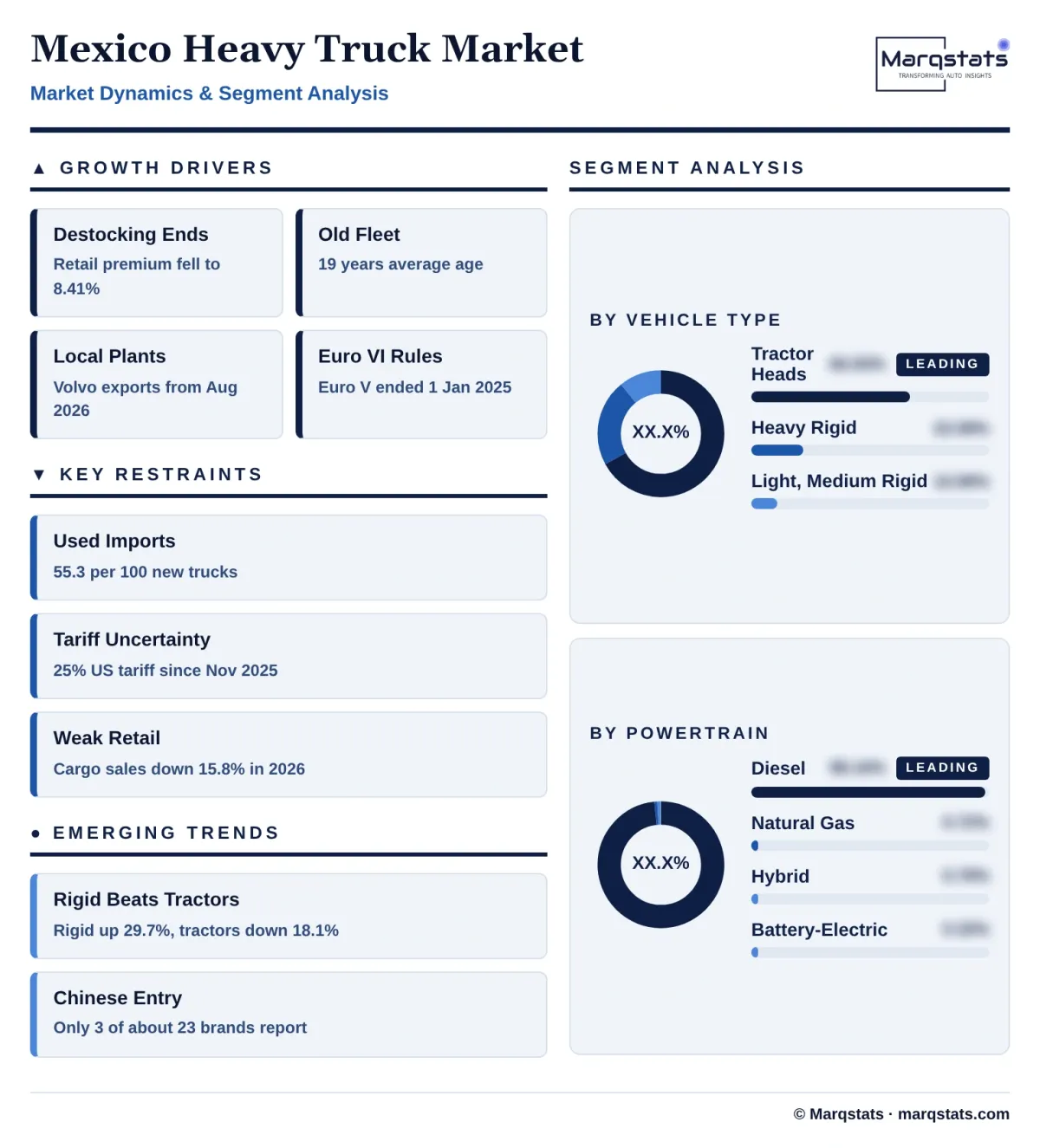
- Destocking is ending, so factory shipments are closing on retail. Cargo wholesale rose 8.1% to 19,696 units in January to September 2026 while cargo retail fell 15.8% to 21,352, and the retail premium over wholesale narrowed to 8.41% from 39.17% a year earlier. The gap also includes trucks that importers sold outside the factory series, so Marqstats treats it as an indicator and not an exact stock count. Once dealers hold lean stock, every fleet order passes through to the factory.
- An old fleet needs replacement. ANPACT put the average age of the heavy-vehicle fleet at 19 years in February 2026, and a fleet of that age was built to far looser emission and safety standards than the Euro VI engines now certified under NOM-044-SEMARNAT-2017. Tractor heads carry the most deferred renewal, because the 17,097 sold in 2025 compare with 27,091 in 2024.
- Local production widens choice. Volvo Group México began exporting trucks from Ciénega de Flores on 19 August 2026 on a USD 1,000 million investment, and Volvo Trucks retail sales rose from 17 to 155 units and Mack Trucks from 216 to 284 between January to September 2025 and 2026. A domestic plant also shortens delivery time for Mexican buyers.
- Emission rules favour newer trucks. From 1 January 2025, heavy diesel vehicles above 3,857 kilograms can no longer be certified to Euro V or EPA 2007, and Hino launched its Serie 500 2027 range in July 2026 with a Euro VI engine using selective catalytic reduction and a particulate filter. Operators that run to ultra-low-sulfur diesel corridors gain fuel and maintenance savings.
- Chinese brands widen the price ladder. Foton retail sales doubled from 591 to 1,273 units in 2025 (AMDA, all types), SHACMAN sold 499, and Foton's tractors list at MXN 2,622,000 to MXN 2,999,000 including tax, so entry-level fleets can buy a new Euro VI tractor instead of a used import.
Key Restraints
Four constraints hold the market below its 2024 peak and slow the move to cleaner trucks.
- Used imports undercut new trucks. ANPACT reported that 7,123 used heavy vehicles from the United States entered Mexico in January to May 2026, 55.3 for every 100 new vehicles sold, and in August 2026 said some enter at customs values below market prices. A used tractor competes directly with a new one for small carriers.
- Trade uncertainty delays orders. The United States has charged 25% on imported medium and heavy trucks and key parts since 1 November 2025, vehicles that meet T-MEC origin rules pay only on non-US content, and the 1 July 2026 joint review ended without a renewal, which starts annual reviews. Production fell 13.0% to 70,876 units in the first half of 2026 and some ANPACT members cut about 20% of staff.
- Retail demand is still falling. AMDA retail sales of all heavy vehicles were 25,289 units in January to September 2026, down 17.5%, and 2,980 in September, down 11.3%. Monthly cargo retail averaged about 2,372 units against 2,817 a year earlier, so fleets remain slow to commit capital.
- Fuel and charging networks are thin. ANPACT still asks for nationwide supply of ultra-low-sulfur diesel, natural gas truck sales fell from 126 to 9 units between January to September 2025 and 2026, and battery-electric trucks numbered only 59 in 2025. Alternative-fuel trucks cannot yet replace long-haul diesel tractors.
Key Trends
Four shifts are changing which trucks Mexican fleets buy and who reports the sales.
- Rigid trucks outperform tractors at the factory gate. ANPACT reported that first-half 2026 wholesale of rigid cargo trucks rose 29.7% to 6,673 units while tractocamiones fell 18.1% to 5,920, a split Marqstats links to regional distribution and construction orders while long-haul tractor buyers wait.
- Hybrid trucks begin to scale. Hybrid cargo vehicles rose from 129 to 240 units and battery-electric from 37 to 44 between January to September 2025 and 2026, and Marqstats expects hybrid sales of 1,200 units and battery-electric sales of 650 by 2030.
- Chinese entry outruns official reporting. ANPACT counts about 23 brands in Mexico and says only three report to INEGI, and asked on 10 July 2026 for a 50% tariff on heavy trucks from countries without a trade agreement, against 5% to 20% now.
- Mexican plants serve North America first. Exports of 98,394 heavy vehicles in January to September 2026 equal 4.61 times cargo retail sales, so new capacity such as Volvo Group México in Nuevo León adds supply for export and only a small amount for Mexican buyers.
Strategic Implications
- For truck makers, the recovery starts with tractors and with lean dealer stock. Wholesale already runs close to retail, so brands that hold inventory below 2024 levels and offer financing for Euro VI tractors capture the 2027 rebound before competitors restock.
- For Chinese and new entrants, the entry price is attractive but the tariff risk is real. ANPACT is lobbying for a 50% tariff, so entrants should assemble or finish trucks locally, register with INEGI to build credibility and price against used US imports, not against Kenworth, Freightliner or International.
- For fleet operators, the 19-year average fleet age and the cost of used imports with customs undervaluation favour contracts that fix a total cost per kilometre. Buying a new Euro VI tractor before the T-MEC annual review resolves locks in supply at current prices.
- For lenders and lessors, credit lines for 2027 should follow tractor orders and not total heavy-vehicle sales, because tractors carry the larger swing in both directions.
- For suppliers of aftertreatment, telematics and parts, the NOM-044 transition and the growth of hybrid and electric trucks create demand for service networks along the Northern Border and the Bajío, where Marqstats expects the largest regional unit gains.
Market Segmentation
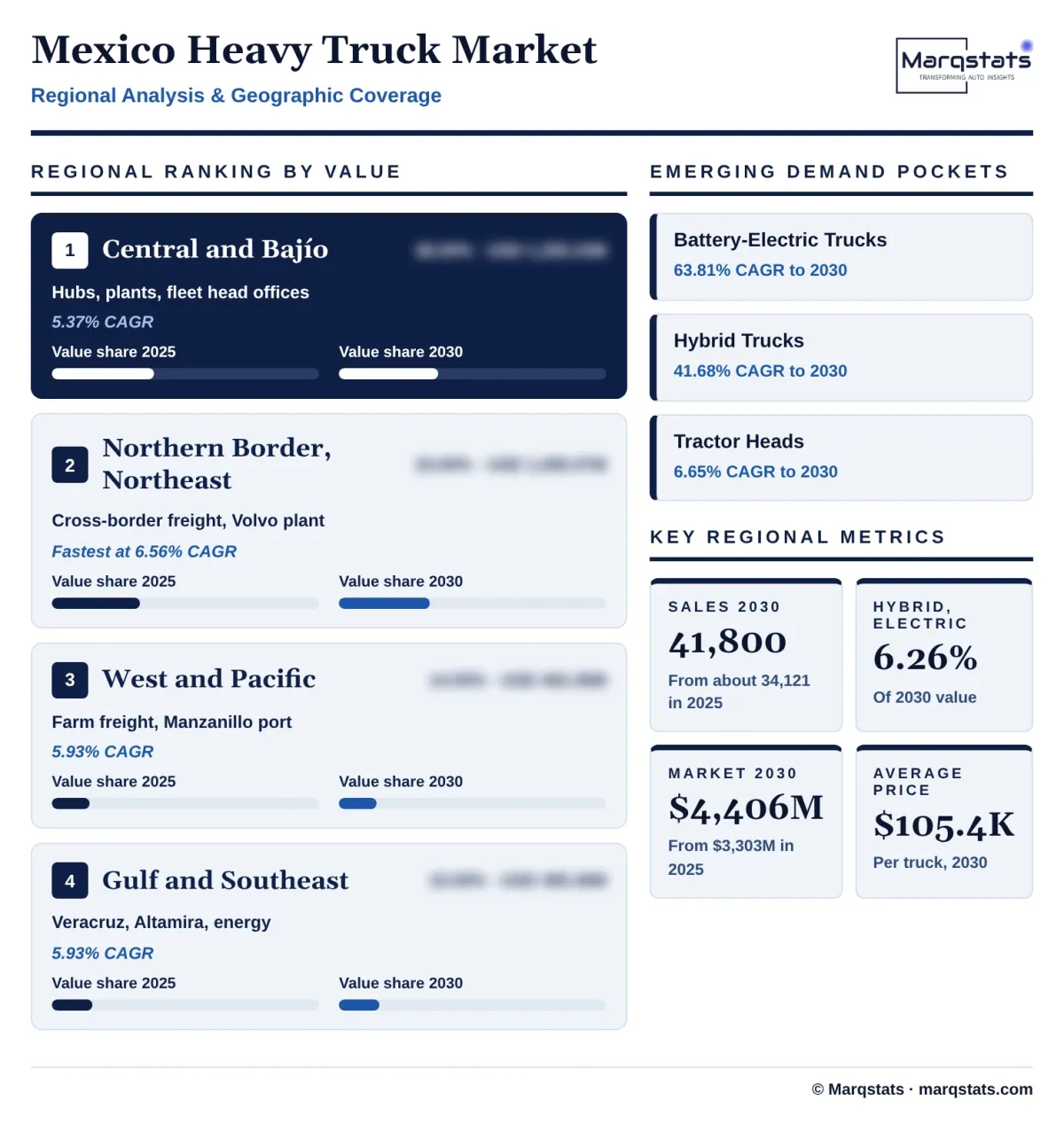
Tractor heads for semi-trailers and double combinations account for 66.93% of 2025 value, USD 2,210.92 million, and grow at 6.65% a year to USD 3,051.00 million. AMDA recorded 17,097 tractocamiones in 2025, down 36.89% from 27,091, and Marqstats adds 450 from non-reporting brands for 17,547 units, rising to 22,600 by 2030. Kenworth, Freightliner, International and Volvo Trucks lead, and Foton and SHACMAN models compete on price.
Heavy rigid trucks, from about 15 tonnes gross weight up, account for 22.08% of 2025 value, USD 729.29 million, and grow at 4.85% a year to USD 924.00 million. Marqstats estimates 8,682 units in 2025 from the AMDA rigid cargo total of 16,024, mostly tippers, mixers, dump trucks and tankers built on Kenworth, Freightliner, International, Mack and Foton chassis for construction, aggregates and bulk liquids.
Light and medium rigid trucks, from 3,857 kilograms to about 15 tonnes, account for 10.99% of 2025 value, USD 363.03 million, and grow at 3.48% a year to USD 430.65 million. About 7,892 units were sold in 2025, led by Isuzu, Hino, Mercedes-Benz and Foton for urban distribution, and Isuzu and Hino retail sales both rose between January to September 2025 and 2026 while the market fell.
Diesel trucks account for 98.16% of 2025 value, USD 3,242.58 million, and grow at 4.78% a year to USD 4,095.40 million, while their share slips to 92.96%. AMDA listed 39,113 diesel heavy vehicles of all types in 2025, and the Euro VI and EPA 2010 engines required since 1 January 2025 raise price but not volume.
Natural gas trucks account for 0.72% of 2025 value, USD 23.84 million, and grow at 7.55% a year to USD 34.30 million. Marqstats estimates 186 units in 2025 from the AMDA total of 334 gas vehicles, then only 15 in 2026 after cargo sales fell from 126 to 9 in nine months, with recovery to 250 units by 2030 from Kenworth T680 and Foton gas tractors.
Hybrid trucks account for 0.79% of 2025 value, USD 26.02 million, and grow at 41.68% a year to USD 148.55 million and 3.37% of the market. AMDA lists 321 hybrid heavy vehicles in 2025 and cargo hybrids rose from 129 to 240 in January to September 2026, so Marqstats expects 1,200 units by 2030.
Battery-electric trucks account for 0.33% of 2025 value, USD 10.80 million, and grow at 63.81% a year to USD 127.40 million and 2.89% of the market. AMDA lists 65 electric heavy vehicles in 2025, of which Marqstats allocates 59 to trucks, and the live Marqstats Mexico Electric Truck Market covers the same vehicles on the heavy-vehicle register, so the two should not be added.
Long-haul and cross-border freight accounts for 46.46% of 2025 value, USD 1,534.29 million, and grows at 6.10% a year to USD 2,063.27 million. It buys most tractor heads for Monterrey, Laredo, Querétaro and Mexico City lanes and carries the highest price per unit.
Urban and regional distribution accounts for 22.91% of 2025 value, USD 756.90 million, and grows at 5.60% a year to USD 993.93 million. Food, beverage, retail and parcel fleets buy light and medium rigid trucks, which held up better than tractors in 2026.
Construction, mining and materials account for 21.18% of 2025 value, USD 699.74 million, and grow at 6.38% a year to USD 953.23 million, the fastest end use. Tippers, mixers and aggregate tractors serve road, rail, energy and industrial park projects.
Agriculture, energy and other uses account for 9.45% of 2025 value, USD 312.31 million, and grow at 4.82% a year to USD 395.22 million. Grain, produce, fuel and special-purpose fleets in Sinaloa, Sonora, Veracruz and Tabasco make up this group.
By Geography
Central and Bajío
Central and Bajío account for 38.00% of 2025 value, USD 1,255.23 million, about 12,966 trucks, and grow at 5.37% a year to USD 1,630.09 million and 37.00% by 2030. Mexico City, the State of Mexico, Puebla, Querétaro, Guanajuato and San Luis Potosí hold the distribution hubs, vehicle plants and fleet head offices. Marqstats allocates by fleet home base, which can place trucks at the head office instead of the operating lane.
Northern Border and Northeast
The Northern Border and Northeast account for 33.00% of 2025 value, USD 1,090.07 million, about 11,260 trucks, and grow fastest, at 6.56% a year, to USD 1,497.92 million and 34.00% by 2030. Nuevo León, Coahuila, Tamaulipas, Chihuahua, Sonora and Baja California handle the cross-border freight on which tractor demand depends, and the Volvo Group plant at Ciénega de Flores adds a local source of trucks.
West and Pacific
West and Pacific account for 14.00% of 2025 value, USD 462.45 million, about 4,777 trucks, and grow at 5.93% a year to USD 616.79 million. Jalisco, Michoacán, Colima, Sinaloa and Nayarit buy trucks for farm freight, the ports of Manzanillo and Lázaro Cárdenas and the Guadalajara industrial belt.
Gulf and Southeast
Gulf and Southeast account for 15.00% of 2025 value, USD 495.49 million, about 5,118 trucks, and grow at 5.93% a year to USD 660.85 million. Veracruz, Tabasco, Yucatán, Chiapas and Oaxaca use trucks for port freight at Veracruz and Altamira, energy projects and regional distribution.
How Competition Is Evolving
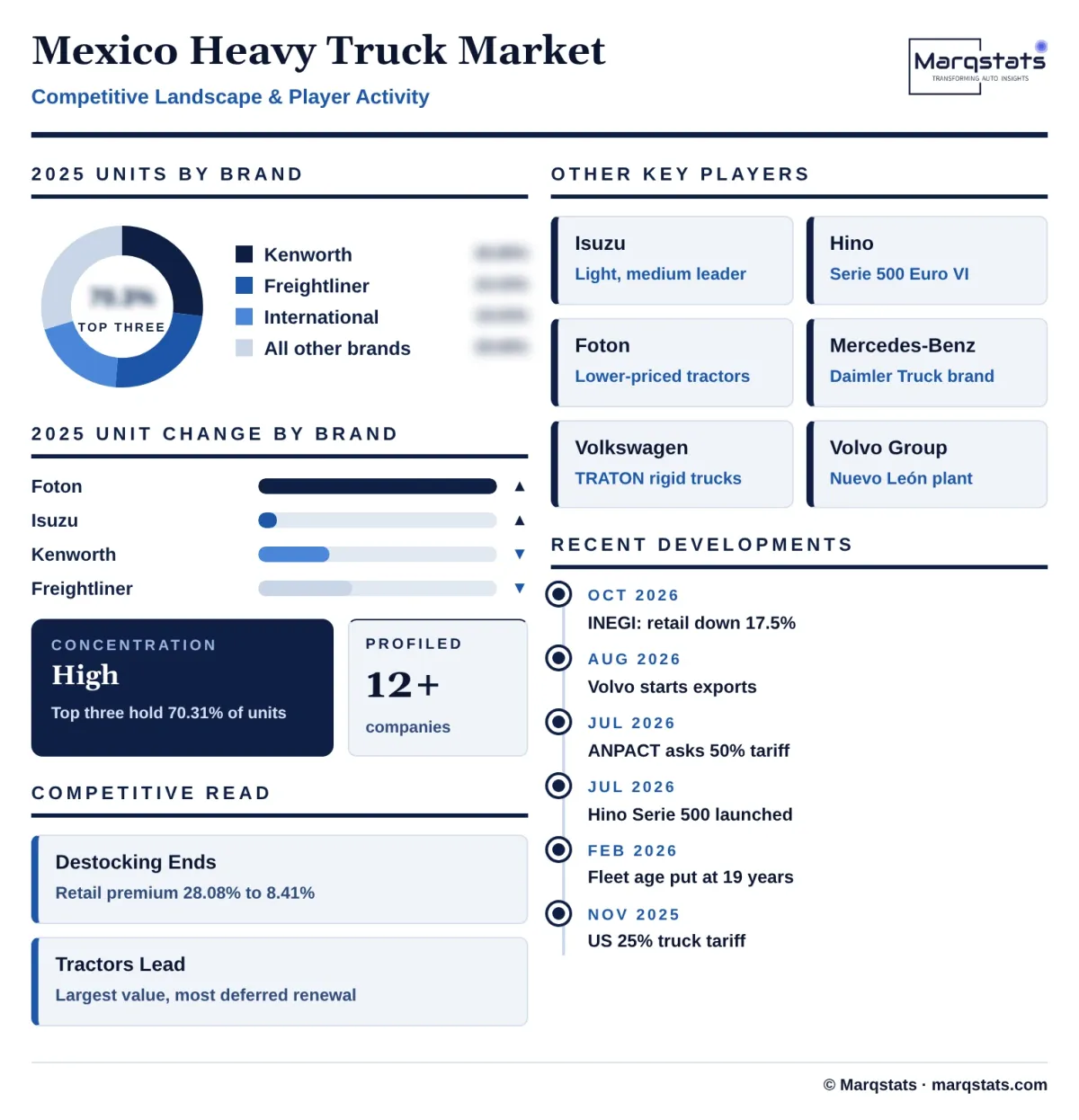
The market is highly concentrated at the top. Kenworth, Freightliner and International sold 9,160, 8,337 and about 6,493 cargo vehicles in 2025, together 23,990 of the 33,121 AMDA cargo units, which is 70.31% of the Marqstats market of 34,121 units. Kenworth, the PACCAR México brand, leads with 26.85%, followed by Freightliner at 24.43% and International at 19.03%. All other brands hold 29.69%.
The tail is moving faster than the leaders. Between 2024 and 2025 Kenworth sales fell 34.8%, Freightliner 44.6% and International 25.1%, while Isuzu rose 9.3% to 3,323 units and Foton more than doubled, up 115.4% to 1,273. Hino fell 37.3% to 1,288, Volkswagen 33.1% to 1,904 and Scania 39.1% to 1,644, though those totals include buses.
Premium brands compete on uptime and financing, and Chinese brands on price. Kenworth builds tractors in Mexicali, where PACCAR México produced its 400,000th unit, a Kenworth T680 with a natural gas engine, in June 2025. Volvo Group México began exports from Nuevo León in August 2026. In January to September 2026, Volvo Trucks sales rose to 155 units, Mack to 284 and Isuzu to 2,140 in cargo.
Competition is shifting from product to policy. ANPACT members report a regional value content of 64% against a 70% requirement for heavy trucks from 2027, and ask for a 50% tariff on trucks from non-treaty countries. ANPACT says heavy trucks from countries without a trade agreement pay 5% to 20% duty today, so a rise would lift the price of fully imported Chinese trucks more than that of North American assemblers.
Companies Covered
Companies covered in the report include:
Recent Market Activity
Table of Contents
Coverage & Segmentation
The study covers the Mexico heavy truck market, with 2025 as the base year, 2021 – 2025 as the historical period and 2026 – 2030 as the forecast period. It covers new goods trucks and tractor units above 3,857 kilograms gross vehicle weight sold at retail to end users in Mexico, segmented by vehicle type, powertrain, end use and region. Values are retail prices in US dollars before value-added tax, and peso figures use the 2025 average of MXN 19.20 per US dollar.
Buses and coaches (6,712 units in 2025, covered by the Marqstats Mexico Bus and Coach Market), pickups and vans below 3,857 kilograms (covered by the Mexico Pickup Truck Market), passenger cars, used and grey-market imports, exports, bodies and trailers sold separately, and off-road mining and construction machines are excluded. The live Marqstats Mexico Electric Truck Market covers battery-electric heavy vehicles on the same register, so its figures should not be added to this market. Splits are Marqstats estimates built on AMDA and INEGI data and published price lists.