Market Snapshot
The Colombia truck market size is estimated at USD 796.71 million in 2025 and is projected to reach USD 1,511.97 million by 2030, growing at a CAGR of 13.67% over 2026 – 2030. New registrations rise from 12,405 to 22,000 trucks, a 12.14% annual rate, while the average value per truck climbs from about USD 64,225 to USD 68,726 as tractors and cleaner powertrains take a larger share.
Marqstats defines the market as the value of new freight vehicles above 3.5 tonnes gross vehicle weight registered in Colombia: light, medium and heavy rigid trucks, dump trucks (volquetas), tractor trucks and vocational chassis such as tankers, mixers, cranes and compactors. Value is counted at the importer list price of the chassis-cab or tractor, in US dollars at COP 4,051.51 per dollar, before bodywork, financing and registration fees. Pickups, vans, buses and used vehicles are excluded.
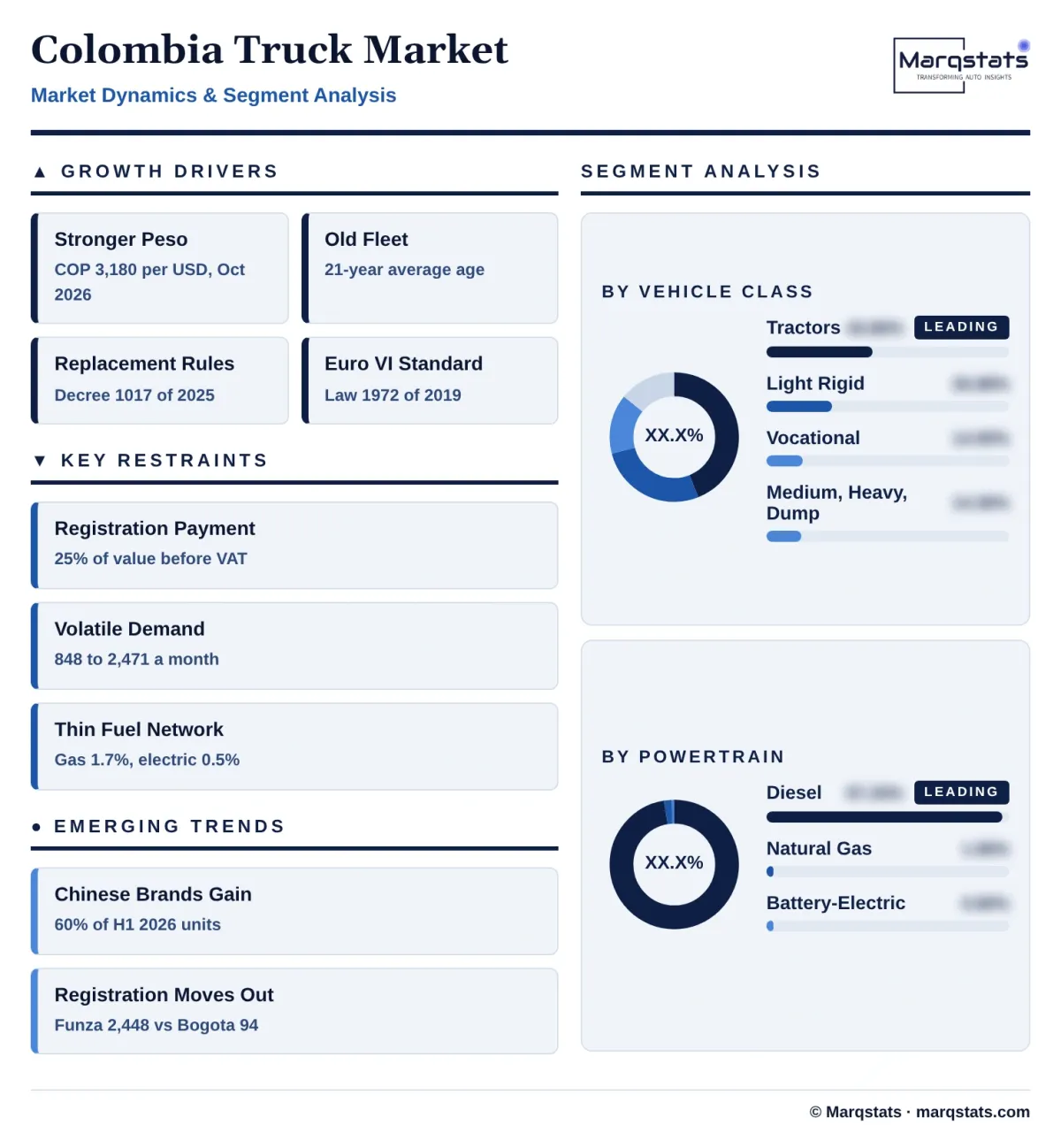
Tractor trucks account for 43.86% of 2025 value although they are only 22.37% of units, and light rigid trucks for 50.24% of units but 26.88% of value. Diesel trucks hold 97.25% of 2025 value, and Cundinamarca and Bogota hold 47.88%, a registration-domicile effect, while Antioquia grows fastest at 16.33% a year.
Key Takeaways
Market Overview & Analysis
Report Summary
Marqstats sizes the Colombia truck market as the value of new freight vehicles above 3.5 tonnes gross vehicle weight (Peso Bruto Vehicular, PBV) registered each year in the Registro Unico Nacional de Transito (RUNT). The count follows the freight series that ANDI and Fenalco publish from RUNT: rigid trucks up to 10.5 tonnes, trucks of 10.5 to 17 tonnes, trucks of 17 to 28 tonnes, dump trucks, two-axle and three-axle tractor trucks and a group of other trucks that holds cranes, tankers, mixers and platforms.
The series totals 12,405 registrations in 2025, up 34.60% from about 9,216 in 2024. That is 4.88% of the 254,205 new vehicles of every type that ANDI and Fenalco counted in 2025. The Marqstats study of the Colombia passenger car market splits the same 254,205 into 221,534 passenger cars and 32,671 other vehicles, and freight trucks are a subset of those 32,671, next to pickups (17,006), commercial passenger vehicles (2,414), vans (697) and quadricycles (151). The ANDI sector report shows the freight line at 12,403, two units below the freight series, and Marqstats uses the freight series.
The fleet is old and the buyers are small. Colfecar, the federation of freight carriers, reported in 2025 that the average age of the freight fleet is 21 years, the second oldest in Latin America. Most trucks belong to owner-operators who own one or two vehicles, so demand moves with credit, the exchange rate and the rules that govern replacement, rather than with the orders of a few large fleets.
Policy changed in September 2025. Decree 1017 of 2025, issued by the Ministerio de Transporte and in force from 22 September 2025, sets minimum payments for freight services, widens the replacement (reposicion) programme for light vehicles and dump trucks, requires every road freight operation to be reported to the national freight registry (RNDC) and allows vehicles to move from private to public service. Fedetranscarga, a carriers federation, told Valora Analitik that it also lifted the registration payment for new heavy trucks from 15% to 25% of the commercial value before VAT and applied 25% to light trucks and dump trucks that had been exempt, which pulled purchases into September 2025.
The market rebounded sharply. Registrations were 12,405 in 2025, with 1,577 in September 2025 against 625 a year earlier, 8,589 for January to September and 1,207 in December. In the first half of 2026 they reached 9,641, with 2,471 in June against 848 in June 2025. The Banco de la Republica representative rate averaged COP 4,051.51 per dollar in 2025, and the dollar opened at about COP 3,180 on 23 October 2026, which makes imported chassis cheaper in pesos.
Colombia Truck Market Size and Forecast
The Colombia truck market grows from USD 796.71 million in 2025 to USD 1,511.97 million in 2030, a CAGR of 13.67%. Volume contributes most of the growth: registrations rise at 12.14% a year, from 12,405 to 22,000 trucks, and the average value per truck rises at 1.36% a year, from about USD 64,225 to USD 68,726, as tractors and gas and electric trucks take a larger share. The 2025 value equals about COP 3.23 trillion at COP 4,051.51 per dollar.
The 2025 value is built bottom-up from classes and price lists. Marqstats applies the importer list price of the chassis-cab or tractor to each ANDI and Fenalco class: about COP 139.2 million for the 6,232 light rigid trucks, COP 222 million for the 993 medium rigid trucks, COP 400 million for the 95 heavy rigid trucks, COP 290 million for the 707 dump trucks, COP 510.2 million for the 2,775 tractor trucks and COP 300 million for the 1,603 vocational trucks. Light-truck prices come from published ranges of COP 130 million to COP 180 million for Foton Aumark, COP 120 million to COP 165 million for the Chevrolet N-Series and COP 95 million to COP 145 million for JAC, weighted by brand.
Tractor prices are built the same way. Registrations of 603 Kenworth, 398 Foton, 317 Shacman, 208 Sinotruk, 192 Freightliner and 175 Scania tractors in 2025 are weighted by price ranges of COP 600 million to COP 850 million for the Kenworth T800 and T680, COP 340 million to COP 440 million for the Foton Auman GTL, COP 280 million to COP 360 million for Shacman, COP 255 million to COP 330 million for Sinotruk and COP 680 million to COP 920 million for Scania. The remaining 882 tractors are priced at COP 420 million, which gives an average of COP 510.2 million and shows why 22.37% of units carry 43.86% of value.
Marqstats expects registrations to fall back from the 2026 surge before they resume growth. The first half of 2026 reached 9,641 trucks, and the second half of 2025 had 7,323, so a second half about 29% above that gives about 9,460 and a 2026 total of about 19,100. Marqstats then adds about 725 trucks a year to reach 22,000 in 2030, which is a 2.87% annual rate from 2026. Value reaches about USD 1,162.36 million in 2026 at constant 2025 prices and the dollar rate of COP 4,051.51.
Gas and electric trucks add value faster than volume. Marqstats expects natural gas trucks to rise from 195 units in 2025 to 1,300 in 2030 and battery-electric trucks from 50 to 800, so their combined share of units grows from 1.98% to 9.55%. Gas trucks are priced at about 1.25 times and electric trucks at about 2.00 times a diesel truck of the same class, which lifts their share of value to 13.95% in 2030. Marqstats tracks four indicators: monthly ANDI and Fenalco freight registrations, the Banco de la Republica representative rate, the pace of replacement approvals under Decree 1017 and diesel price decisions that set carrier margins.
Market Dynamics
Key Drivers
Five forces are lifting demand for new freight vehicles in Colombia, from a stronger peso to an ageing fleet.
- A stronger peso lowers the landed cost of imported chassis. The representative rate averaged COP 4,051.51 per dollar in 2025, and the dollar opened at about COP 3,180 on 23 October 2026, 21.5% fewer pesos per dollar. Nearly every truck sold in Colombia is imported fully built, so a lower rate cuts the peso price of a COP 140 million light truck or a COP 510 million tractor directly.
- The fleet is old and replacement is overdue. Colfecar reports an average freight fleet age of 21 years, and registrations of 12,405 in 2025 and 9,641 in the first half of 2026 are the first sustained recovery after a weak 2024, when only about 9,216 trucks were registered. Replacement demand explains why light trucks supplied 64.97% of the first-half 2026 increase.
- Decree 1017 of 2025 widens the replacement (reposicion) programme for light vehicles and dump trucks, which makes scrapping an old truck the cheapest way to register a new one. The decree took effect on 22 September 2025, and registrations of 1,577 in September 2025 against 625 a year earlier show how quickly owners respond to changes in the rule.
- Infrastructure and industry need trucks. Dump trucks rose to 725 registrations in the first half of 2026 (up 118.4%), and tractor trucks to 1,919 (up 46.9%), with 1,497 three-axle and 422 two-axle units, as civil works, cement and port corridors from Bogota, Medellin and Cali to Buenaventura, Cartagena and Barranquilla move more cargo.
- Euro VI diesel and gas trucks are now the standard offer. Law 1972 of 2019 requires new diesel vehicles to meet Euro VI or United States EPA 2010 limits from 2023, so every new diesel truck carries selective catalytic reduction and urea, and importers have retooled ranges around Cummins and other Euro VI engines. Gas trucks reached 165 registrations in the first half of 2026 and electric trucks 53.
Key Restraints
Four constraints keep the market volatile and cap how far registrations can climb.
- Registration payments raise the price of a new truck. Fedetranscarga told Valora Analitik that Decree 1017 of 2025 lifted the payment for new heavy trucks from 15% to 25% of the commercial value before VAT and applied 25% to light trucks and dump trucks that had been exempt. Owners who cannot scrap an old vehicle pay the difference, which is a barrier for single-truck owners.
- Demand is volatile. Registrations fell to about 9,216 in 2024, rose 34.60% in 2025 and 89.71% in the first half of 2026 against the first half of 2025, with monthly counts from 848 in June 2025 to 2,471 in June 2026. Importers who stock for the peak risk a hangover, and Marqstats assumes growth after 2026 of about 2.87% a year, not a repeat of the surge.
- Credit is tight for small owners. Owner-operators who own one or two trucks cannot easily finance a COP 140 million to COP 510 million vehicle, and carriers federations such as Fedetranscarga and the Asociacion de Camioneros de Colombia have struck over diesel prices, most recently in September 2024, which raises the risk premium lenders attach to the sector.
- Gas and electric infrastructure is thin. Natural gas trucks were 1.70% and electric trucks 0.50% of first-half 2026 registrations, because filling stations are concentrated on the Atlantic coast and the Magdalena valley and heavy electric tractors cannot yet cover long mountain routes. Marqstats therefore expects diesel to remain at 90.45% of 2030 units.
Key Trends
Four shifts are changing who sells trucks in Colombia and what they run on.
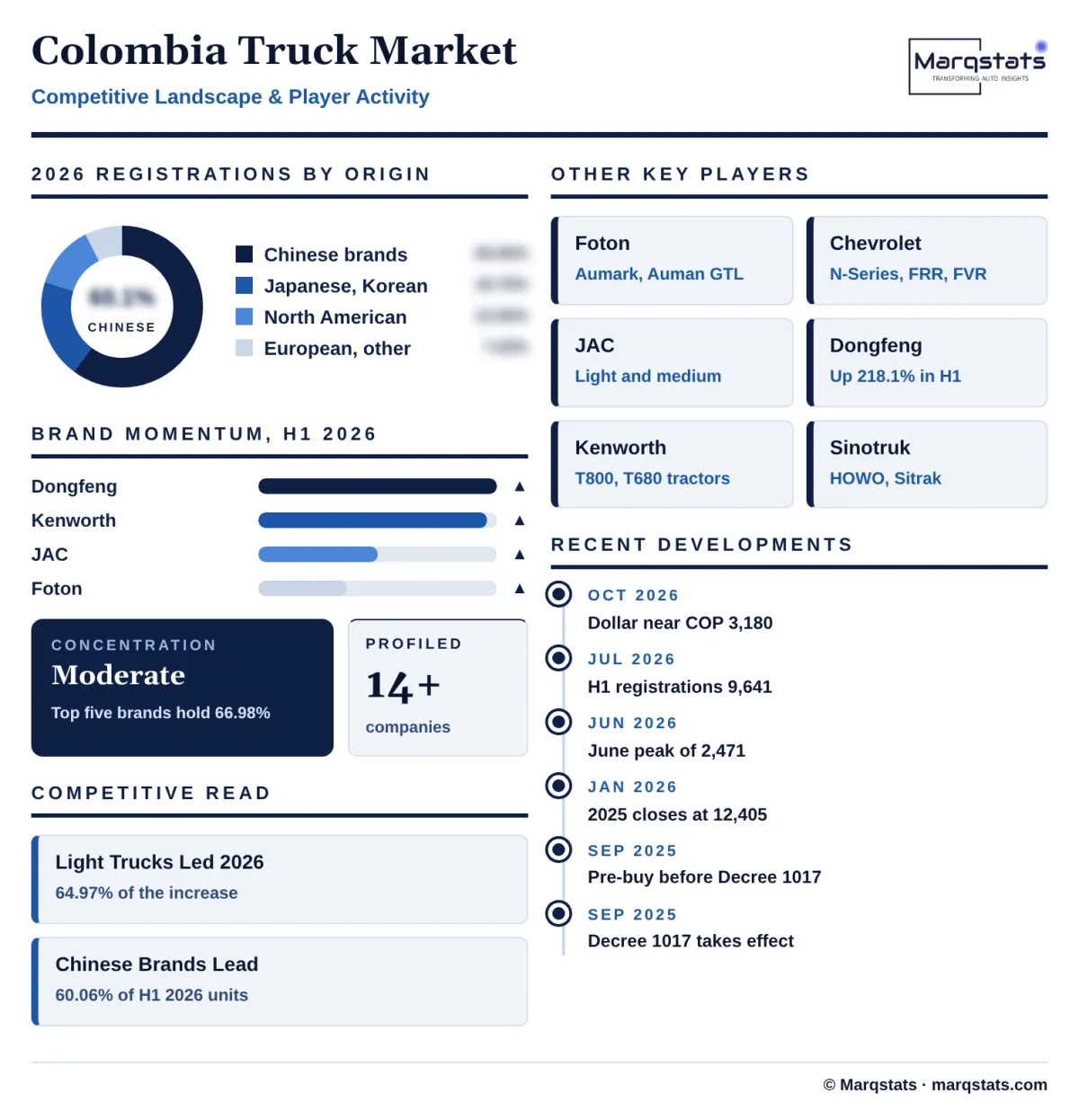
- Chinese brands keep gaining. Foton led with 23.7% of first-half 2026 registrations, Dongfeng grew 218.1% to 824 trucks and Sinotruk reached 626, so Chinese brands held 60.06% of the brand lines ANDI and Fenalco published, against Japanese and Korean brands at 19.75% and North American brands at 12.56%.
- Local assembly has ended for the largest light-truck brand. General Motors ended vehicle assembly at its Colmotores plant in Bogota in 2024, so the Chevrolet N-Series, with 2,679 registrations in 2025 and 1,655 in the first half of 2026, now arrives fully built from Japan, and the whole market is import-supplied.
- Tractor buyers split between Chinese value and Western brands. Kenworth, Foton and Sinotruk took 60% of tractor registrations in the first half of 2026, while Freightliner (192) and Scania (175) kept premium niches in 2025 at prices of COP 680 million to COP 920 million.
- Registration moves to the edge of Bogota. Funza registered 2,448 trucks, Mosquera 725 and Madrid 510 in the first half of 2026 against 94 in Bogota itself, so a fleet owner chooses the municipality that offers the lowest fees, not the place where the truck works.
Strategic Implications
- For truck makers and importers, the light-truck replacement cycle is the main near-term opportunity, and stock decisions for 2027 should assume about 19,800 registrations, not the 2026 run rate. Importers who align price lists with the stronger peso, as Foton and JAC have done below COP 180 million, will keep volume as the surge fades.
- For carriers, Decree 1017 makes scrapping an old truck the cheapest route to a new one, and the minimum-payment rules narrow the advantage of old, fully depreciated vehicles. Owners with trucks above 20 years should plan replacement before registration payments or Euro VI requirements change again.
- For lenders and lessors, the buyer is a single-truck owner whose income is tied to freight payments. Products that finance the registration payment and the scrapping gap, secured on the vehicle and the contracted freight, address the real barrier to purchase.
- For fuel and charging suppliers, gas and electric trucks reach only about 9.55% of 2030 units on Marqstats estimates, so the investable corridors are the Atlantic coast, the Magdalena valley and the urban rings of Bogota and Medellin, where daily routes are short and predictable.
- For parts and service providers, a fleet that averages 21 years and a new fleet that is Euro VI mean two different businesses: rebuilt components for old trucks and urea, filters and electronic diagnostics for the new ones, delivered through the same dealer and workshop networks.
Market Segmentation
Rigid trucks up to 10.5 tonnes account for 26.88% of 2025 value, USD 214.15 million, and 50.24% of units, with 6,232 registrations. Value grows at 14.53% a year to USD 422.02 million by 2030. The class reached 5,456 registrations in the first half of 2026, up 118.8% and about 57% of the total, led by Foton Aumark, Chevrolet N-Series and JAC models used for consolidation, farm collection and city distribution.
Rigid trucks of 10.5 to 17 tonnes account for 6.83% of 2025 value, USD 54.41 million, with 993 registrations. Value grows at 10.96% a year to USD 91.50 million. First-half 2026 registrations of 520 were up 115.8%, serving regional distribution of food, beverages and building materials with Chevrolet FRR and FVR, Hino 500 and Foton Auman trucks priced at COP 175 million to COP 290 million.
Rigid trucks of 17 to 28 tonnes account for 1.18% of 2025 value, USD 9.38 million, with only 95 registrations in 2025 and 49 in the first half of 2026. Value grows at 22.17% a year to USD 25.53 million. Colombian operators prefer tractor-trailer combinations for long haul, so this class stays small, and Marqstats prices it at COP 400 million as an estimate.
Dump trucks (volquetas) account for 6.35% of 2025 value, USD 50.61 million, with 707 registrations. Value grows at 16.36% a year to USD 107.95 million, flat in units because 2026 already reaches 1,400. First-half 2026 registrations were 725, up 118.4%, for road, quarry and cement work with Sinotruk and Foton tippers at about COP 290 million.
Tractor trucks account for 43.86% of 2025 value, USD 349.46 million, from 2,775 registrations: 2,073 three-axle and 702 two-axle. Value grows at 13.72% a year to USD 664.75 million and 43.97% of the market. First-half 2026 registrations were 1,919, up 46.9%, and Kenworth, Foton and Sinotruk took 60% of them, so the class is where price premiums are most visible.
Vocational trucks cover cranes, tankers, mixers, compactors and platforms, which ANDI and Fenalco report as other trucks. They account for 14.90% of 2025 value, USD 118.70 million, with 1,603 registrations, and grow at 11.02% a year to USD 200.22 million. First-half 2026 registrations were 972, and the chassis price of about COP 300 million excludes the body that turns it into a mixer or tanker.
Diesel trucks account for 97.25% of 2025 value, USD 774.81 million, and 98.03% of units on Marqstats estimates. They grow at 10.92% a year to USD 1,301.11 million, while their share of value falls to 86.05%. ANDI and Fenalco recorded 9,423 diesel trucks, 97.70% of first-half 2026 registrations, all to Euro VI or EPA 2010 limits under Law 1972 of 2019.
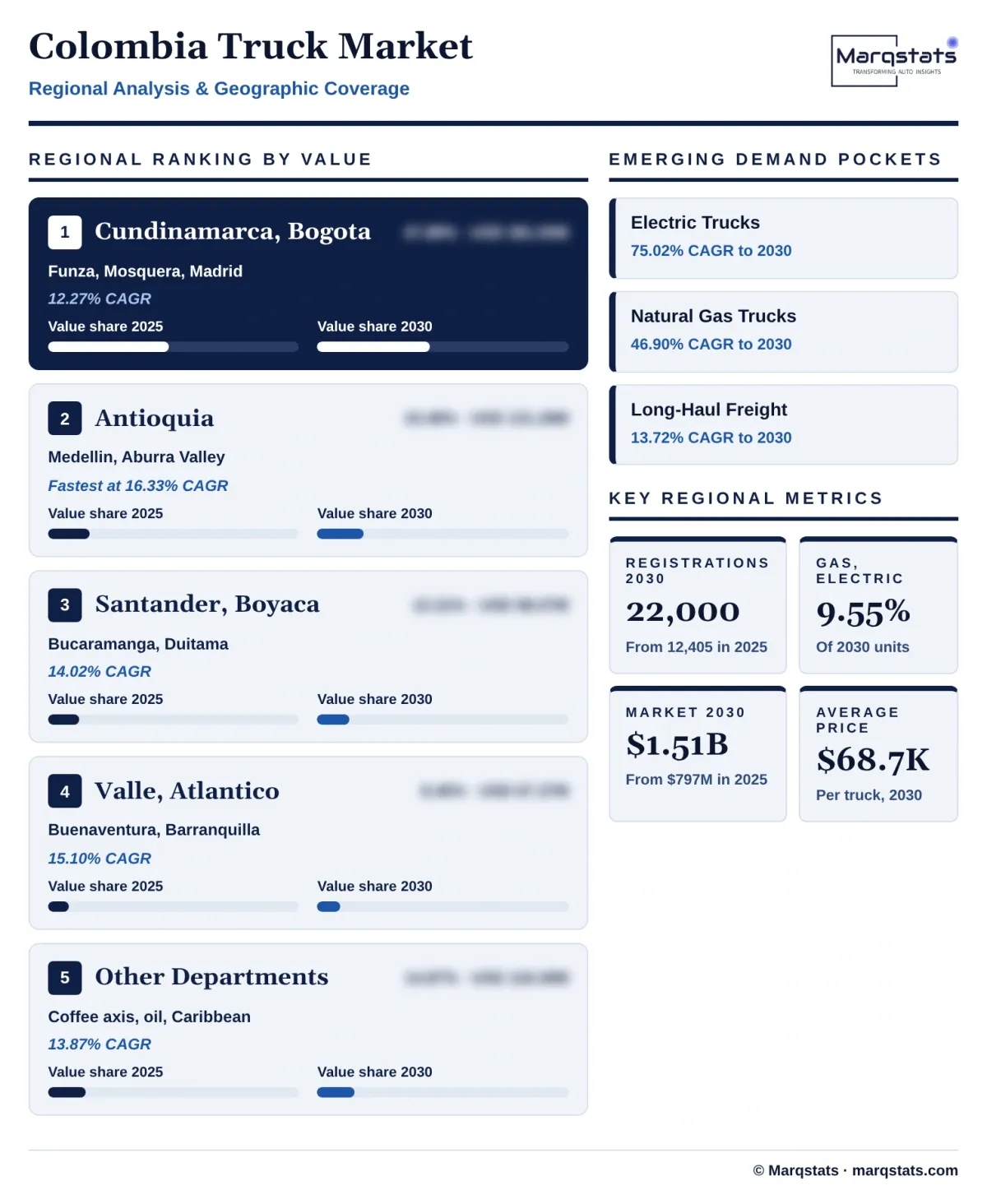
Natural gas trucks account for 1.95% of 2025 value, USD 15.53 million, and grow at 46.90% a year to USD 106.25 million and 7.03% of value. First-half 2026 registrations were 165, 1.70% of the total. Marqstats expects 1,300 gas trucks in 2030, mostly tractors and distribution trucks on the Atlantic coast and the Magdalena valley.
Battery-electric trucks account for 0.80% of 2025 value, USD 6.37 million, and grow at 75.02% a year to USD 104.61 million and 6.92% of value. First-half 2026 registrations were 53, 0.50% of the total. They are light and medium trucks for urban delivery, and Marqstats expects 800 units in 2030. The live Marqstats Colombia Electric Vehicle report counts all electric vehicles, so these trucks are part of that market and must not be added to it.
Urban and regional distribution accounts for 28.18% of 2025 value, USD 224.50 million, and grows at 13.73% a year to USD 427.12 million. It covers parcel, retail, food and beverage fleets using light and medium rigid trucks, which are the most exposed to the peso and to replacement rules.
Long-haul and container freight accounts for 37.28% of 2025 value, USD 297.04 million, and grows fastest among end uses, at 13.72% a year, to USD 565.04 million. Tractor trucks serve the corridors from Bogota, Medellin and Cali to Buenaventura, Cartagena, Barranquilla and Santa Marta.
Construction, mining and infrastructure accounts for 18.11% of 2025 value, USD 144.25 million, and grows at 14.21% a year to USD 280.37 million. Dump trucks, concrete mixers, cranes and heavy rigid trucks serve road, quarry and cement demand, and the end use depends on public works budgets.
Agriculture, fuels and industrial bulk accounts for 16.43% of 2025 value, USD 130.92 million, and grows at 12.83% a year to USD 239.44 million. It covers medium trucks for farm produce, tankers for fuel and chemicals, and bulk tractor combinations for cement and grain.
By Geography
Cundinamarca and Bogota
Cundinamarca and Bogota account for 47.88% of 2025 value, USD 381.50 million, from 5,940 registrations, and grow at 12.27% a year to USD 680.38 million. The share is a registration-domicile effect: in the first half of 2026 Funza registered 2,448 trucks, Mosquera 725 and Madrid 510, while Bogota itself registered 94. Marqstats reads this as owners choosing municipalities with lower fees and allocates value by registration, as lenders and insurers do.
Antioquia
Antioquia accounts for 16.48% of 2025 value, USD 131.28 million, from 2,044 registrations, and grows fastest, at 16.33% a year, to USD 279.71 million and 18.50% by 2030. First-half 2026 registrations of 1,881 were up 118%, and Medellin and the Aburra Valley registered 1,808 of them, so the department is a real operating market for distribution and port-bound freight.
Santander and Boyaca
Santander and Boyaca account for 12.31% of 2025 value, USD 98.07 million, from 902 and 625 registrations, and grow at 14.02% a year to USD 189.00 million. Bucaramanga registered 682 trucks in the first half of 2026, and the corridor serves oil, cement and metallurgical freight with an owner-operator base.
Valle del Cauca and Atlantico
Valle del Cauca and Atlantico account for 8.46% of 2025 value, USD 67.37 million, from 712 and 337 registrations, and grow at 15.10% a year to USD 136.08 million. Valle del Cauca registered 565 trucks in the first half of 2026 and hosts the Cali-Yumbo industrial belt and the road to Buenaventura, while Atlantico holds the Barranquilla port.
Other Departments
All other departments account for 14.87% of 2025 value, USD 118.49 million, from 1,845 registrations, and grow at 13.87% a year to USD 226.80 million. The group covers the coffee axis, Tolima, Huila, Meta and the Caribbean coast outside Atlantico, where coffee, rice, palm and oil freight create steady demand for medium trucks.
How Competition Is Evolving
The market is moderately concentrated and led by Chinese brands. The five largest brands held 64.80% of 2025 registrations (Foton 3,153, Chevrolet 2,679, JAC 950, International 638 and Kenworth 618) and 66.98% in the first half of 2026 (Foton 2,281, Chevrolet 1,655, JAC 944, Dongfeng 824 and Kenworth 754). On the brand lines ANDI and Fenalco published for the first half of 2026, Chinese brands hold 60.06%, Japanese and Korean brands 19.75%, North American brands 12.56% and European brands 6.86%.
Foton is the largest brand, with 25.42% of 2025 registrations and 23.7% in the first half of 2026. The share has slipped as Dongfeng, Kenworth and Sinotruk grew faster, yet Foton sells across light, medium and tractor classes and registered 618 trucks in June 2026. Chevrolet is second with 21.6% in 2025 and 17.2% in 2026, supplied fully built since General Motors ended assembly at Colmotores in 2024.
JAC, Dongfeng, Sinotruk and Forland sell on price. JAC registered 944 trucks in the first half of 2026 at COP 95 million to COP 145 million for light models, Dongfeng grew 218.1% to 824, Sinotruk registered 626 and Forland 400. Sinotruk HOWO and Sitrak tractors cost COP 255 million to COP 330 million against COP 600 million to COP 850 million for a Kenworth T800 or T680.
Western brands defend the premium. Kenworth grew 209% to 754 trucks in the first half of 2026, International registered 339, Mercedes-Benz 241, Freightliner 95, Scania 85, DAF 81 and Volvo 64. Competition is shifting from price to service: brands with parts stock, workshops and finance win the single-truck owner, who buys once and keeps the truck for many years.
Companies Covered
Companies covered in the report include:
Recent Market Activity
Table of Contents
Coverage & Segmentation
The study covers the Colombia truck market, with 2025 as the base year, 2024 and 2025 as the historical anchors and 2026 – 2030 as the forecast period. It covers new freight vehicles above 3.5 tonnes gross vehicle weight registered in Colombia, segmented by vehicle class, powertrain, end use and region. Values are importer list prices of the chassis-cab or tractor in US dollars at COP 4,051.51 per dollar, the 2025 average, before bodywork, financing and registration payments.
Pickups, vans, buses and minibuses, taxis, quadricycles, used trucks and trailers sold separately are excluded. The market is a subset of the 32,671 non-passenger-car registrations in the 254,205 vehicles that Marqstats uses in the Colombia passenger car study, so the two studies are disjoint. The live Marqstats Colombia Electric Vehicle report includes electric trucks and is broader, so its figures should not be added to this market. Segment and regional splits are Marqstats estimates built on ANDI and Fenalco registrations, brand price lists and unit assumptions.