Market Snapshot
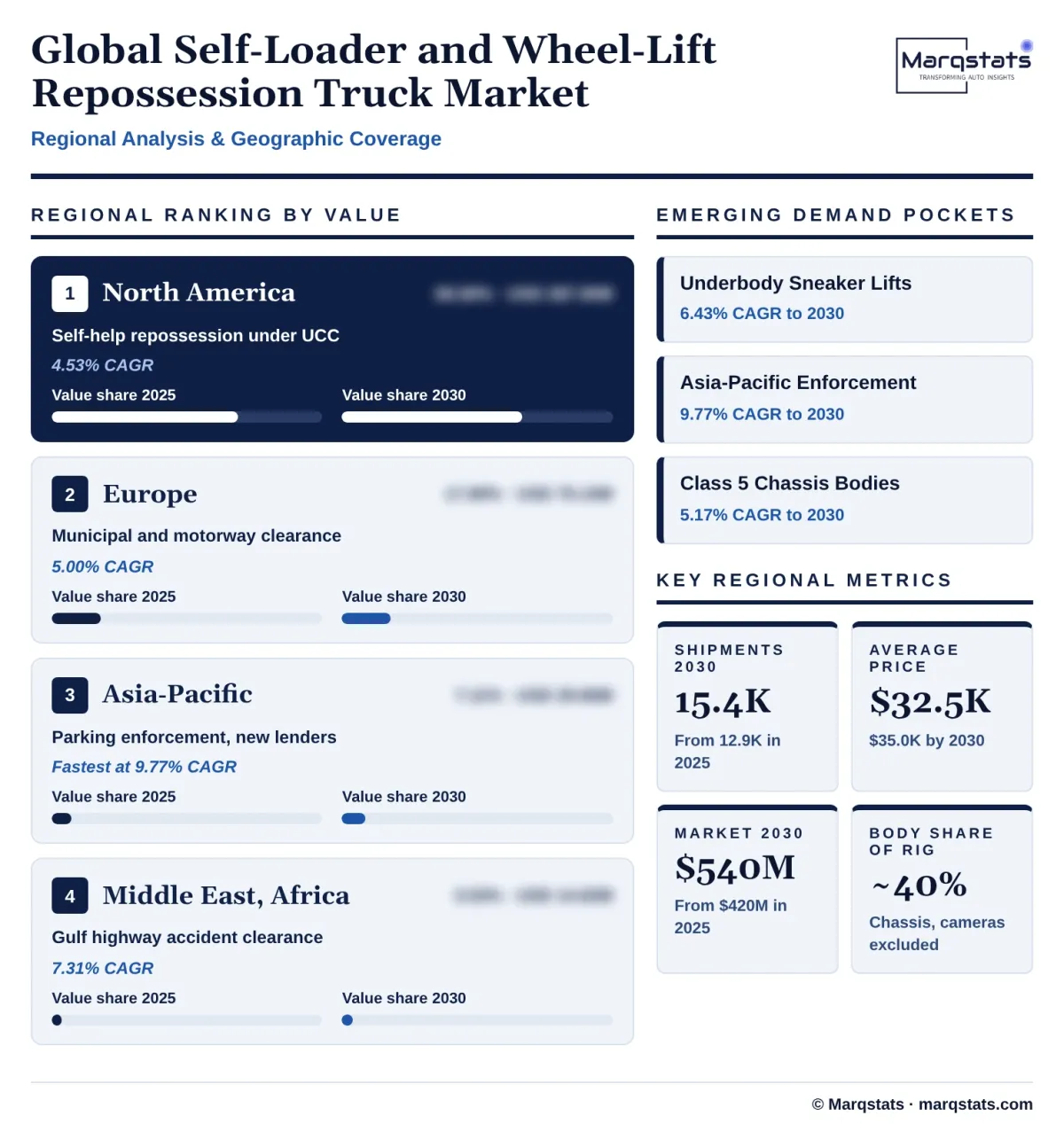
The global self-loader and wheel-lift repossession truck market size is estimated at USD 419.89 million in 2025 and is projected to reach USD 540.14 million by 2030, growing at a CAGR of 5.17% over 2026 – 2030. Shipments rise from about 12,920 to 15,415 bodies and kits a year, a 3.59% annual rate, at about USD 32,499 per unit.
Marqstats defines the market as the installed value of purpose-built self-loader and wheel-lift recovery bodies and kits sold for repossession, parking enforcement and light recovery work: integrated cab-controlled self-loaders, underbody sneaker lifts and bed slide-in wheel-lifts, including installation. The donor chassis-cab or pickup, licence-plate camera suites and telematics, heavy-duty wreckers and rotators, and flatbed rollbacks and car carriers are excluded, so the market is the body and not the truck.
Integrated self-loaders account for 73.11% of 2025 value and North America for 68.56%. Collateral repossession agencies are the largest end user at 46.49%. The study segments the market by product type, host vehicle class, end user and region, and sizes each from shipments multiplied by installed body prices.
Key Takeaways
Market Overview & Analysis
Report Summary
Marqstats sizes the global self-loader and wheel-lift repossession truck market as the installed value of recovery bodies and kits that let one operator hook and tow a vehicle from the cab, without leaving the driver exposed at the kerb. In 2025 about 12,920 units shipped worldwide, worth an estimated USD 419.89 million at an average installed price of about USD 32,499.
Three product families make up the market. Integrated cab-controlled self-loaders are wrecker bodies fitted to Class 4 and Class 5 cab-chassis such as the Ford F-450 and F-550 and the Ram 4500 and 5500; the driver reverses to the target vehicle and uses an in-cab console or remote to close the jaws on the tyres. Miller Industries lists boom ratings of up to 16,000 lb on its Century Express line, and light-duty integrated units carry wheel-lifts rated at about 4,000 lb. Underbody sneaker lifts fold under the bed and frame of a pickup and are rated at 4,000 to 5,000 lb of lift: the Detroit Wrecker Lil Hercules 2.0 carries 5,000 lb of lift and 10,000 lb of tow, the Lift and Tow Z-Series 4,000 lb and 8,000 lb, and the Dynamic Stealth 5,000 lb with 75 inches of reach. Bed slide-in wheel-lifts such as the Minute Man XD, rated at 3,500 lb of lift and 7,500 lb of tow, bolt into a pickup bed and come out again, and Minute Man prices the attachment at about USD 13,000 before the pickup.
The boundary is the body. Marqstats excludes the donor chassis-cab or pickup, licence-plate recognition cameras and fleet software, heavy-duty wreckers and rotators, flatbed rollbacks and car carriers, and used equipment. The distinction matters because a turnkey rig costs about USD 140,000 and the body about USD 55,500, so counting whole trucks would multiply the market by about 2.5.
The market moves with credit and with the vehicle cycle. Chassis shortages between 2021 and 2023 held back bodybuilders, order books built up, and 2024 deliveries were followed by a correction in 2025 as distributors worked down stock. Miller Industries, which sells towing and recovery equipment across all weight classes, reported 2025 net sales of USD 790.3 million, 37.2% below 2024, with a fourth quarter of USD 171.2 million. In 2026 net sales were USD 420.9 million for the first half, 4.3% lower than a year earlier, but the second quarter rose 12.1% to USD 240.0 million, and the company guided to USD 850 million to USD 900 million for the year. Those totals include car carriers, heavy wreckers and rotators, so they are context for the cycle and not a size for this market.
Marqstats estimates the market at USD 441.33 million in 2026, 5.11% above 2025, with about 13,380 units. The 2025 base is a trough in shipments for integrated bodies and a normal year for kits, which is why growth resumes without a stimulus.
Global Self-Loader and Wheel-Lift Repossession Truck Market Size and Forecast
The global self-loader and wheel-lift repossession truck market grows from USD 419.89 million in 2025 to USD 540.14 million in 2030, a CAGR of 5.17%. Volume contributes about two thirds of the growth: shipments rise at 3.59% a year from about 12,920 to 15,415 units, and the average installed price rises at 1.52% a year from USD 32,499 to USD 35,040. Marqstats expects USD 464.11 million in 2027, USD 487.93 million in 2028 and USD 513.20 million in 2029.
The 2025 value is built bottom-up from shipments and installed prices by region and product. In North America Marqstats estimates 3,400 integrated self-loaders at about USD 57,000, 2,300 underbody sneaker kits at about USD 22,000 and 3,000 bed slide-ins at about USD 14,500, which gives USD 287.90 million. Europe ships 2,000 units at lower specification prices, about USD 46,000 for an integrated body, or EUR 40,700 at EUR 1 = USD 1.13. Asia-Pacific, Latin America and the Middle East and Africa ship 1,240, 500 and 480 units. Integrated prices combine a body of about USD 48,000 to 52,000 with USD 6,500 to 8,500 of power take-off and controls and installation.
Prices rise more slowly than volume. Marqstats expects integrated bodies in North America to move from about USD 57,000 to USD 62,500 by 2030 as booms and underlifts are specified for heavier vehicles, sneaker kits from USD 22,000 to USD 23,800 and slide-ins from USD 14,500 to USD 15,400, so the blended price gains 1.52% a year.
The forecast follows the replacement cycle more than the credit cycle. A recovery truck works long days and is typically replaced after several years, so the 2025 shipment trough, which followed distributor destocking, implies a rebound in 2026 and 2027 even if delinquencies stay near today's levels. Marqstats expects shipments of about 13,380 in 2026 and 13,855 in 2027.
Marqstats tracks four indicators: serious delinquency flow in the Federal Reserve Bank of New York household debt report, quarterly net sales and commentary from Miller Industries and Oshkosh Corporation, chassis allocations for Class 4 and Class 5 cab-chassis from Ford, Ram and General Motors, and municipal tow-contract awards in North America and Europe.
Market Dynamics
Key Drivers
Five forces keep fleets buying self-loader and wheel-lift bodies even though the market is far smaller than the trucks they ride on.
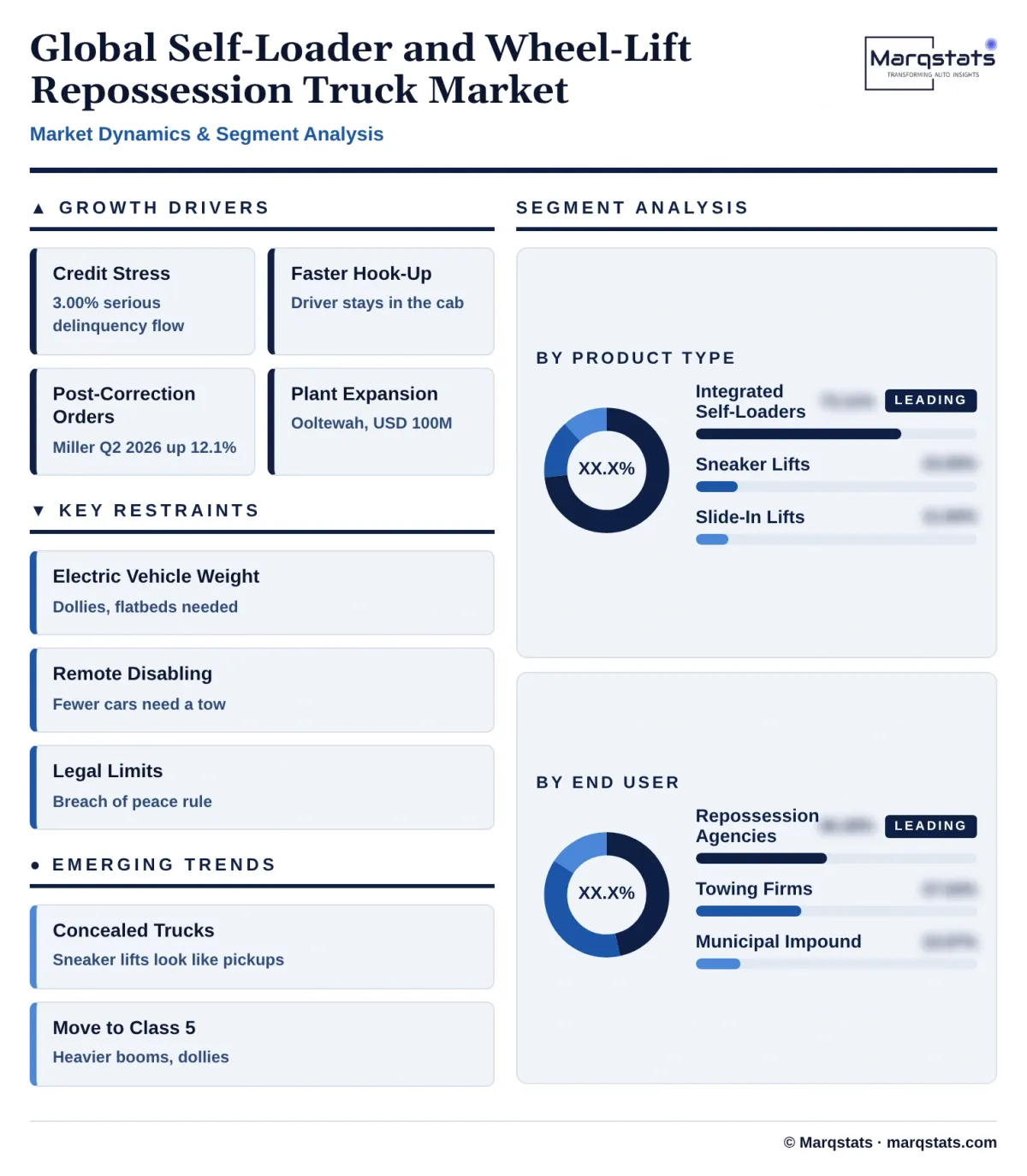
- Elevated auto credit stress keeps repossession volumes high. The Federal Reserve Bank of New York reported auto balances of USD 1.713 trillion and a serious delinquency transition rate of 3.00% in the second quarter of 2026, against 2.93% a year earlier. Every repossession assignment is a job for a self-loader or wheel-lift truck.
- Self-loaders cut the time and risk of each recovery. A cab-controlled body hooks a vehicle in under a minute and keeps the driver in the cab, against several minutes for sling and L-arm wreckers, which raises jobs per shift and lowers confrontation risk. Agencies justify the USD 50,000 body on productivity.
- Replacement follows a distributor correction. Miller Industries net sales fell 37.2% in 2025 to USD 790.3 million as distributors cut stock, then rose 12.1% in the second quarter of 2026 to USD 240.0 million, and Miller guided to USD 850 million to USD 900 million for 2026. Fleets that deferred purchases in 2025 return as inventory normalises.
- Municipal enforcement needs fast, damage-free towing. Cities that clear illegal parking, bus lanes and abandoned vehicles favour wheel-lift self-loaders that fit under low garage clearances, which supports Europe and Asia-Pacific demand where private repossession is limited.
- Manufacturers are adding capacity. Miller Industries announced a USD 100 million expansion of its Ooltewah, Tennessee plant with completion in late 2027 and bought Omars S.p.A. of Cuneo, Italy, on 2 December 2025 for about EUR 17.5 million, adding a European body maker with annual revenue of about USD 27 million for 2024.
Key Restraints
Four constraints hold back volume and push buyers toward heavier, costlier equipment.
- Electric vehicles complicate wheel-lift recovery. Battery-electric cars and pickups are heavier than petrol equivalents, and many all-wheel-drive models cannot be towed with driven wheels rolling because the motors generate current, so operators need dollies or flatbeds, which adds minutes at the kerb and shifts some spending from self-loaders to rollback carriers.
- Remote disabling reduces physical recoveries. Lenders can use starter interrupt devices and connected-car geofencing to bring borrowers back to terms or locate cars, which trims the number of cars that need a tow. Marqstats treats this as a drag on volume growth in the forecast.
- Legal limits constrain recovery methods. Under Uniform Commercial Code section 9-609 a lender may repossess without judicial process only if there is no breach of the peace, and state laws add notice and licensing rules, so a driver who meets resistance must stop. In Europe repossession generally needs a court order, which confines self-loaders to municipal and roadside work.
- Chassis cost and availability. A Class 5 cab-chassis costs about USD 62,000 to 72,000, more than the body on top, so high chassis prices and allocation limits delay the purchase of complete rigs even when body demand is firm.
Key Trends
Four shifts are changing what recovery bodies are built and who buys them.
- Concealed trucks. Sneaker lifts fold under a pickup so that the vehicle looks like a private truck, which helps in apartment complexes where marked wreckers draw attention. Detroit Wrecker, Dynamic Towing and Lift and Tow sell these units.
- Move to Class 5. Heavier electric cars and full-size SUVs lead fleets to specify Class 5 chassis with stronger booms and underlifts, and to carry dollies for all-wheel-drive electric vehicles.
- Camera upgrades. Digital Recognition Network, a Motorola Solutions company, ended support for its ReaperSD cameras on 1 August 2025 and fleets are moving to newer multi-lane cameras, which competes with bodies for the same capital though the cameras sit outside this market.
- Consolidation among recovery body makers. Miller Industries bought Omars in December 2025, and Omars contributed about USD 8.6 million of net sales in the second quarter of 2026 and USD 16.2 million in the first half, which lifted Miller's foreign sales to USD 95.7 million in the half from USD 77.4 million.
Strategic Implications
- For body makers, the profit pool is the body and its controls, about 40% of a rig. Selling a turnkey package with the chassis and cameras brings pass-through revenue but less margin, so the strongest position is a body that fits several chassis and is installed by distributors.
- For recovery agencies, the purchase choice is between a Class 5 self-loader that carries dollies and handles heavy electric vehicles and a cheaper concealed sneaker lift for urban work. A mixed fleet matched to the portfolio of vehicles recovered avoids overspending.
- For distributors, inventory discipline decides the cycle. The 2025 correction shows that building stock ahead of demand creates a trough in factory orders, so floor-plan financing and shorter ordering cycles reduce risk.
- For lenders and forwarders, equipment is a constraint on speed. Recovery capacity limits how fast assignments can be completed, and faster hook-up lowers the cost per recovery.
- For municipal buyers, tender specifications should cap tow weight and reach for the vehicles in the local fleet, since oversizing a body adds cost without adding capability.
Market Segmentation
Integrated self-loaders account for 73.11% of 2025 value, USD 306.98 million and about 6,090 units, and grow at 5.17% a year to USD 394.97 million. They are wrecker bodies with a hydraulic boom and wheel-lift mounted on a Class 4 or Class 5 chassis, made by Miller Industries under the Century and Vulcan names and by Jerr-Dan, part of Oshkosh Corporation. They serve agencies and towing firms that run long shifts and need winches for light ditch recoveries.
Underbody sneaker lifts account for 15.05% of 2025 value, USD 63.18 million and about 3,210 units, and grow fastest, at 6.43% a year, to USD 86.28 million. The lift folds flush under a pickup, rated at 4,000 to 5,000 lb of lift, with the trade-off of limited reach and no boom. Demand comes from repossession agencies working residential and apartment locations.
Bed slide-ins account for 11.84% of 2025 value, USD 49.73 million and about 3,620 units, and grow at 3.44% a year to USD 58.89 million. They are the entry route for independent operators because the attachment costs about USD 13,000 before the pickup and can be removed, but their share is held down by the 3,500 lb lift rating and by heavier vehicles.
Bodies for pickups and vans account for 26.89% of 2025 value, USD 112.91 million, and grow at 5.15% a year to USD 145.17 million. This is where sneaker lifts and slide-ins are installed on Class 2b and Class 3 trucks that need no commercial driver licence.
Class 4 bodies account for 23.39% of 2025 value, USD 98.23 million, and grow at 5.17% a year to USD 126.39 million. Marqstats attributes about 32% of integrated body value to Class 4 chassis such as the Ford F-450 and Ram 4500, which balance turning radius and structure for urban work.
Class 5 and above bodies account for 49.72% of 2025 value, USD 208.75 million, and grow at 5.17% a year to USD 268.58 million, the largest class. The Ford F-550 and Ram 5500 and cab-over medium trucks carry the heaviest booms and the dual-wheel rear axles that heavy electric vehicles require.
Repossession agencies account for 46.49% of 2025 value, USD 195.21 million, and grow at 5.31% a year to USD 252.88 million. They buy the concealed sneaker lifts and Class 5 self-loaders and are most exposed to credit delinquency and lender rules.
Municipal parking and impound authorities account for 15.97% of 2025 value, USD 67.05 million, and grow at 5.16% a year to USD 86.24 million. Cities buy compact self-loaders for bus-lane clearance and illegal parking, mostly through contractors.
Private-property and light roadside towing firms account for 37.54% of 2025 value, USD 157.63 million, and grow at 4.98% a year to USD 201.02 million. They use integrated self-loaders and slide-ins for garage work, apartment-complex enforcement and motor-club calls.
By Geography
North America
North America accounts for 68.56% of 2025 value, USD 287.90 million and about 8,700 units, and grows at 4.53% a year to USD 359.28 million and 66.52% by 2030. Self-help repossession under Uniform Commercial Code Article 9, auto balances of USD 1.713 trillion and a large pickup and SUV fleet make the United States the centre of demand, while Miller Industries and Jerr-Dan supply the integrated bodies. North American sales for Miller Industries were USD 325.2 million in the first half of 2026 against USD 362.3 million a year earlier, showing the destocking cycle that Marqstats expects to turn.
Europe
Europe accounts for 17.89% of 2025 value, USD 75.10 million and about 2,000 units, and grows at 5.00% a year to USD 95.83 million. Private repossession generally needs a court order, so demand comes from municipal enforcement, motorway breakdown and urban impound. Omars of Cuneo, owned by Miller Industries since December 2025, and other Italian and French body makers supply short-wheelbase bodies for narrow streets.
Asia-Pacific
Asia-Pacific accounts for 7.11% of 2025 value, USD 29.85 million and about 1,240 units, and grows fastest, at 9.77% a year, to USD 47.58 million. Japan, South Korea, Australia and Singapore run strict parking enforcement, and consumer auto lending in India and Southeast Asia is creating recovery networks. In many Asian markets the word self-loader refers to a flatbed carrier, which Marqstats excludes, so wheel-lift volumes are smaller than the vehicle parc suggests.
Latin America
Latin America accounts for 2.91% of 2025 value, USD 12.22 million and about 500 units, and grows at 6.01% a year to USD 16.36 million. Brazil and Mexico lead, with judicial asset recovery and metropolitan impound towing, and demand is limited by import costs and the use of flatbeds.
Middle East and Africa
The Middle East and Africa account for 3.53% of 2025 value, USD 14.82 million and about 480 units, and grow at 7.31% a year to USD 21.09 million. Gulf highway authorities use wheel-lift recovery trucks for rapid accident clearance, and South Africa has an active vehicle recovery trade.
How Competition Is Evolving
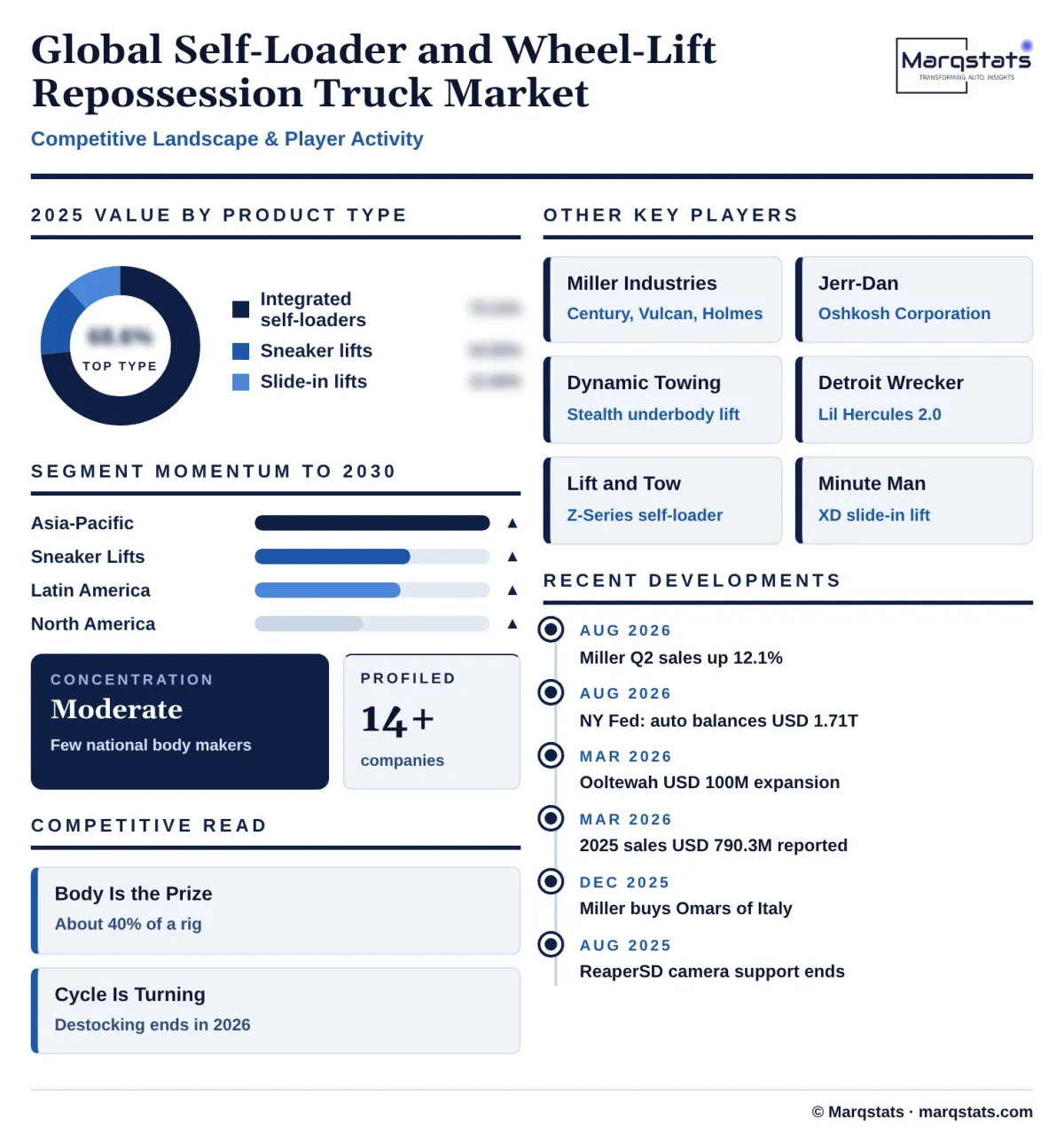
The market is concentrated at the top and fragmented below. Marqstats describes competition by layer and states no company shares, because bodybuilders report towing and recovery equipment as a single line. Miller Industries, Inc. of Ooltewah, Tennessee, is the largest maker of towing and recovery equipment and sells light-duty integrated self-loaders under the Century, Vulcan and Holmes names, with Omars and other brands in Europe. Jerr-Dan, part of Oshkosh Corporation, is the other national integrated brand.
The second layer is underbody and slide-in specialists: Dynamic Towing Equipment and Manufacturing with its Stealth lift, Detroit Wrecker Sales with the Lil Hercules 2.0, Lift and Tow with the Z-Series and Minute Man Wheel Lifts with the XD. These firms sell mostly through distributors and installers, and the installer often decides the brand.
The third layer is regional upfitters that build bodies or mount imported lifts on local chassis in Europe, Asia-Pacific and Latin America. Local content and service reach decide the sale.
Competition is moving from boom ratings to total recovery time. The body maker that offers a Class 5 self-loader with an integrated dolly system for all-wheel-drive electric vehicles, built-in camera mounting and strong distributor finance will take the replacement orders of 2026 to 2028, when Marqstats expects shipments to rise from 12,920 to 14,345 units.
Companies Covered
Companies covered in the report include:
Recent Market Activity
Table of Contents
Coverage & Segmentation
The study covers the global self-loader and wheel-lift repossession truck market, with 2025 as the base year, 2021 – 2025 as the historical period and 2026 – 2030 as the forecast period. Values are in US dollars at the installed price of the body or kit, including installation, and volumes are annual shipments. The market is segmented by product type, host vehicle class, end user and region.
The donor chassis-cab or pickup, licence-plate camera suites and telematics, heavy-duty wreckers and rotators, flatbed rollbacks and car carriers, used equipment and sales of parts are excluded. Miller Industries net sales and the Omars deal are context only. Segment and regional splits are Marqstats estimates built on shipments, installed price lists and distributor and fleet interviews.