Market Snapshot
Middle bar: base-year value × (1 + CAGR), rounded to two decimals. This is a calculated illustration, not a separately researched annual estimate.
The Indonesia electric angkot market size is estimated at USD 0.55 million in 2025 and is projected to reach USD 26.77 million by 2030, growing at a CAGR of 117.50% over 2026 – 2030. Annual deliveries of new electric angkots and feeder microbuses rise from about 25 vehicles to 1,400, a 123.69% annual rate, while the average price eases from about IDR 360 million to IDR 315 million per vehicle as local assembly and higher volumes bring costs down.
Marqstats defines the market as the value of new battery-electric angkots, Mikrotrans-type minivans and feeder microbuses with 9 to 15 passenger seats delivered into fare-paying urban paratransit and municipal feeder service in Indonesia. It covers vehicles registered as public passenger cars (Mobil Penumpang Umum) or small buses (Mobil Bus Kecil) under Government Regulation No. 55 of 2012, whether built on a factory electric van platform or fitted with a purpose-built body by a karoseri. Electric buses longer than about 6 metres, corporate, campus and resort shuttles, private electric vans, electric two- and three-wheelers, charging equipment sold separately and fare revenue are excluded. Values are in US dollars at IDR 16,475 per USD, the 2025 average rate, held constant across the forecast.
Factory electric van platforms converted for passenger service account for an estimated 72.73% of 2025 value, vehicles bought under municipal Buy-the-Service (BTS) gross-cost contracts account for 80.00%, and DKI Jakarta accounts for 60.00%. The study segments the market by vehicle build, contract model, seating capacity and region.
Key Takeaways
Market Overview & Analysis
Report Summary
Marqstats sizes the Indonesia electric angkot market as the value of new electric angkots and feeder microbuses delivered into fare-paying urban paratransit. About 25 vehicles were delivered in 2025, mostly pre-series and pilot units for Jakarta's Mikrotrans program and for city pilots in West Java, worth an estimated IDR 9.0 billion, or USD 0.55 million, at an average price of about IDR 360 million.
Angkots, short for angkutan kota, are the small vans that carry passengers on fixed urban routes across Indonesia, known as mikrolet in Jakarta, lyn in Surabaya and oplet in Pekanbaru. Most are petrol Suzuki Carry, Daihatsu Gran Max and Mitsubishi L300 vans with side benches for 8 to 12 passengers, owned by individuals who rent them to drivers for a daily deposit, the setoran. Drivers compete for passengers, wait at roadsides to fill up, and run vehicles that are often more than 15 years old. Bogor had taken action against more than 1,000 angkots at least 20 years old, nearly half its fleet, by September 2026.
Jakarta showed how to change the model. Since 2018, Transjakarta has contracted angkot owners through cooperatives such as KWK to run air-conditioned Mikrotrans minivans on JakLingko feeder routes, paying operators per vehicle-kilometre and giving passengers free or integrated fares. Drivers earn salaries rather than depending on the setoran, and the Rp 10,000 integrated fare cap covers trips of up to 180 minutes across buses, Mikrotrans and rail. This Buy-the-Service model is what makes a more expensive electric vehicle bankable, because the operator gets predictable revenue regardless of ridership.
Electrification began with trials. Transjakarta signed an agreement with DFSK distributor PT Sokonindo Automobile in September 2024 to trial three air-conditioned 11-seat electric Mikrotrans units with a 42 kWh battery and about 300 km of range. Bogor ran five electric angkots, owned by fleet provider PT Kalista Nusa Armada, on the 13 km Cidangiang–Suryakencana route from April to July 2024. In November 2025, the DKI Jakarta government announced that 100 old angkots would be replaced by Mikrotrans EVs with air conditioning, CCTV and GPS, in two tranches of 50 planned for December 2025 and February 2026, operated by KWK, Mayasari Bakti and Steady Safe.
Deployment has taken longer than announced. In June 2026, KWK said its 100 electric Mikrotrans units would enter professional trials from early 2027 with the support of the Jakarta regional parliament, and Marqstats counts the Jakarta program mainly as 2026 and 2027 deliveries. Transjakarta, which has about 500 electric buses in service, set targets in August 2026 of 50% pollution-free public transport by 2027, 100% by 2030 and 96% of existing operator contracts on electric vehicles by 2030.
Other cities are preparing. Bandung's transport agency received a prototype electric smart angkot built by coachbuilder PT Marlip Indo Mandiri in August 2025, with air conditioning, a 360-degree camera, an electric door and cashless payment. Surabaya's Wira-Wiri feeder network reached 102 vehicles on 11 routes in August 2025 and runs on gross-cost contracts that can be switched to electric vehicles at renewal. ITDP Indonesia published electrification roadmaps for feeder services in Greater Jakarta and for cities such as Surabaya and Pekanbaru in 2025, and estimates that fully electrifying public transport fleets in 11 priority cities by 2030 could cut their greenhouse gas emissions by about 25%.
Policy supports local electric vehicles. Presidential Regulation No. 55 of 2019, amended by Presidential Regulation No. 79 of 2023, sets minimum local content for four-wheeled battery electric vehicles at 40% from 2022 to 2026, 60% from 2027 to 2029 and 80% from 2030, with conversions of existing vehicles excluded. Vehicles that meet the thresholds qualify for tax incentives, and the zero luxury goods tax on battery electric vehicles lowers their price. Electric microbuses must also obtain Ministry of Transportation type approval and registration certificates (SUT and SRUT) before they can be licensed for public service, which coachbuilders must secure for each new body design.
The market is still small next to the vehicles it will replace. Jakarta alone has thousands of angkots and Mikrotrans minivans, Surabaya has more than 100 Wira-Wiri feeder vehicles plus older lyn routes, and Bogor, Bandung, Medan, Makassar and other cities each have hundreds to thousands of angkots. Marqstats expects about 3,520 electric angkots and feeder microbuses in service by 2030, still a small share of the national angkot fleet, because replacement depends on contracts being converted city by city.
Indonesia Electric Angkot Market Size and Forecast
The Indonesia electric angkot market grows from USD 0.55 million in 2025 to USD 26.77 million in 2030, a CAGR of 117.50%. Marqstats expects deliveries of about 120 vehicles worth USD 2.55 million in 2026, 320 worth USD 6.60 million in 2027, 650 worth USD 13.02 million in 2028 and 1,000 worth USD 19.54 million in 2029, before reaching 1,400 vehicles in 2030.
Deliveries were tiny before 2025. Marqstats counts about one demonstration unit in 2021, three in 2022, two in 2023 and eight in 2024, when the Jakarta and Bogor trials ran, worth between USD 0.02 million and USD 0.18 million a year. These were trial vehicles, often owned by suppliers or fleet providers rather than by route operators.
Prices fall as volumes rise. The average price falls from about IDR 400 million in 2021 to IDR 360 million in 2025 and IDR 315 million in 2030. The DFSK Gelora E B-Type launched at IDR 248 million on the road in Jakarta in November 2025, and adding passenger seats, handrails, automatic doors and air-conditioning upgrades brings a converted van to about IDR 300 million to IDR 400 million, while coachbuilt 14-seat bodies cost about IDR 360 million to IDR 400 million in small batches. Deliveries therefore grow at 123.69% a year while value grows at 117.50%.
The fleet grows from about 30 vehicles at the end of 2025 to 150 in 2026, 470 in 2027, 1,120 in 2028, 2,120 in 2029 and 3,520 in 2030, with almost no retirements because the vehicles are new. Jakarta's electrification plan for 3,782 Transjakarta buses and Mikrotrans units, which Governor Pramono Anung said in October 2026 would need about IDR 5.07 trillion of financing from Bank Jakarta and Jamkrida, is the main source of this growth.
Marqstats tracks four indicators to monitor the forecast: the number of Mikrotrans contracts converted to electric vehicles each year, new gross-cost feeder contracts signed by cities outside Jakarta, depot grid connections approved by PLN, and the local content achieved by electric van and microbus builders as the 60% threshold approaches in 2027.
The mix changes over the forecast. Coachbuilt microbuses rise from 27.27% to 41.99% of value, 12- to 15-seat vehicles from 23.64% to 37.99% and Buy-the-Service contracts from 80.00% to 85.99%. DKI Jakarta remains the largest region but its share falls from 60.00% to 52.00% as Central and East Java rise from 9.09% to 15.99% and cities outside Java from 3.64% to 10.01%.
Running costs explain why contracted operators switch. Marqstats models an angkot route of 180 km a day over 330 days a year, 59,400 km in total. A petrol angkot at about 8.5 km per litre spends about IDR 1,176 per km on Pertalite at IDR 10,000 a litre, or about IDR 69.9 million a year. An electric angkot using about 0.20 kWh per km and charged at a depot on a PLN business tariff of about IDR 1,445 per kWh spends about IDR 290 per km, or about IDR 17.2 million a year. Maintenance falls from about IDR 280 to IDR 140 per km. Total savings come to about IDR 61 million a year, so a converted van costing only IDR 20 million to IDR 70 million more than a new petrol angkot pays back within about a year, and a coachbuilt microbus costing about IDR 130 million more pays back in a little over two years.
Market Dynamics
Key Drivers
Five forces are pushing Indonesian cities to replace petrol angkots with electric microbuses.
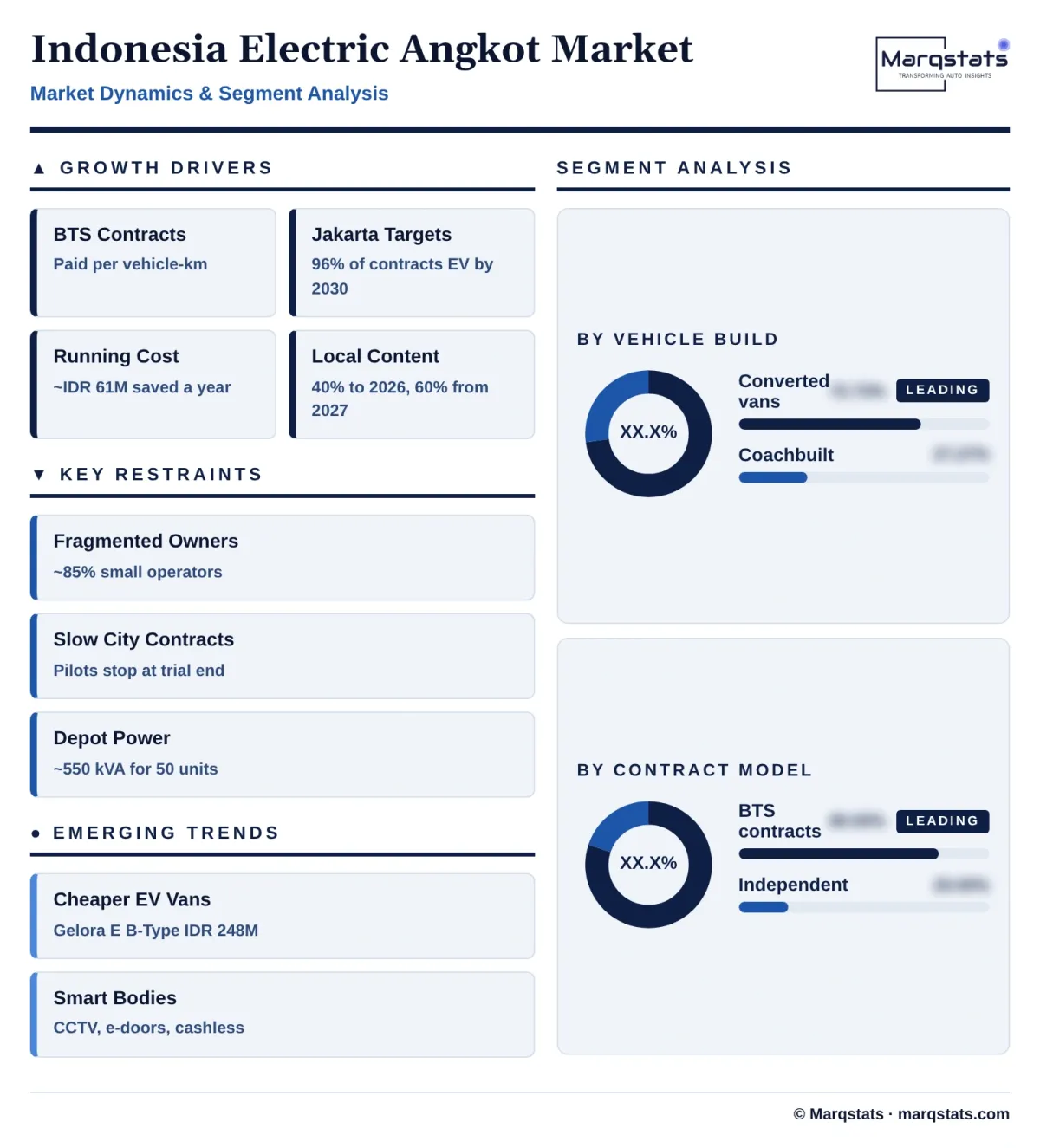
- Buy-the-Service contracts. Gross-cost contracts that pay operators per vehicle-kilometre, used by Transjakarta for Mikrotrans and by Surabaya for Wira-Wiri, give operators the steady revenue needed to finance vehicles that cost more upfront but less to run.
- Jakarta's electrification targets. Transjakarta aims for 50% pollution-free public transport by 2027 and 100% by 2030, with 96% of existing operator contracts on electric vehicles by 2030, and the governor has set a goal of 10,000 electric buses by 2029.
- Large savings on fuel and maintenance. Even against subsidised Pertalite, depot charging cuts energy cost per km by about 75%, and electric drivetrains need no oil changes, clutches or exhaust repairs.
- Fleet age and air quality. Many angkots are 15 to 20 years old, and cities such as Bogor are removing old vehicles from the road, creating a replacement wave that cities want to fill with cleaner vehicles.
- Industrial policy. Presidential Regulation No. 79 of 2023 keeps tax incentives for four-wheeled battery electric vehicles that meet local content (TKDN) thresholds of 40% through 2026, 60% from 2027 to 2029 and 80% from 2030, rewarding vans and microbuses assembled in Indonesia.
- Integrated networks. Jakarta's JakLingko system and the Rp 10,000 fare cap for trips up to 180 minutes link Mikrotrans with buses and rail, raising feeder ridership and making contracted angkots a core part of the network rather than a separate business.
Key Restraints
Five constraints limit how fast electric angkots move from pilots to fleets.
- Fragmented ownership. Nearly 85% of the public transport fleet is run by individual owners or small operators with little access to credit, and an owner-driver cannot finance a vehicle costing IDR 250 million to IDR 400 million on daily fare income alone.
- Slow city contracts. Outside Jakarta, few cities have budgets for multi-year gross-cost feeder contracts, and pilots such as Bogor's 2024 trial stopped when the trial agreement ended.
- Delays in delivery. Jakarta's 100-unit Mikrotrans EV program, first planned for December 2025 and February 2026, moved toward professional trials from early 2027, showing how procurement, certification and driver training stretch timelines.
- Depot land and grid connections. A depot charging 50 microbuses at 11 kW needs a connection of at least about 550 kVA, and dense cities have little affordable land for depots close to routes.
- Driver and owner resistance. Owners fear losing route rights and income when angkots are consolidated, and drivers must pass new training and certification before they can drive contracted vehicles.
- Low petrol prices. Subsidised Pertalite at IDR 10,000 a litre narrows the fuel saving compared with markets where drivers pay full fuel prices, and any rise in electricity tariffs would weaken the case further.
Key Trends
Five shifts are changing how electric angkots are built, contracted and charged.
- Lower-priced electric vans. The DFSK Gelora E B-Type at IDR 248 million on the road brought the base price of a locally assembled electric van close to new petrol vans, making conversions for passenger use cheaper.
- Purpose-built bodies with smart features. New microbuses such as the Marlip prototype for Bandung combine air conditioning, 360-degree cameras, electric doors and cashless payment, matching the service standards cities set in feeder contracts.
- Driver certification. Transjakarta requires Mikrotrans drivers to pass training at the Transjakarta Academy, and the program targets 1,000 new certified drivers, linking electrification to safer and more reliable service.
- Fleet-as-a-service and leasing. Providers such as PT Kalista Nusa Armada supply vehicles and chargers to cities and operators for a fee, reducing the capital that cooperatives must raise.
- Integrated fares and digital payment. JakLingko and other city systems use QRIS and tap cards, and contracted electric angkots are fitted with GPS and validators, which lets cities pay operators by verified kilometres.
- Bigger feeder vehicles. Cities planning new feeder corridors are moving from 8- to 11-seat vans toward 12- to 15-seat microbuses with standing room, which lifts the average value per vehicle in the coachbuilt segment.
Strategic Implications
- For vehicle makers, local content and price decide orders. Electric vans and microbuses that meet the 60% TKDN threshold from 2027 and stay near IDR 300 million will win most city tenders.
- For coachbuilders, feeder specifications are an opening. Karoseri that can certify passenger bodies for electric chassis, with low floors, accessible doors and fare systems, will supply the higher-value end of the market.
- For cooperatives and operators, consolidation comes first. Owner groups that form legal entities, pool routes and win gross-cost contracts can finance electric vehicles; those that stay fragmented will be left out of contracted networks.
- For cities, contract design matters more than subsidy. Multi-year gross-cost contracts with per-kilometre rates that reflect electric vehicle costs, plus depot sites, will move more vehicles than one-off vehicle grants.
- For PLN and charging providers, depots are the main load. Early planning of medium-voltage connections and off-peak tariffs for feeder depots will lower operator costs and spread demand away from peak hours.
- For lenders and investors, contracted revenue lowers risk. Financing linked to Transjakarta and city gross-cost contracts, like the IDR 5.07 trillion arranged with Bank Jakarta and Jamkrida, offers predictable repayments, while lending to unconsolidated owners remains risky.
Market Segmentation
Factory electric van platforms fitted with passenger seats, handrails, automatic doors and fare equipment account for 72.73% of 2025 value, USD 0.40 million, and grow at 107.88% a year to USD 15.53 million and 58.01% of the market by 2030. The DFSK Gelora E, assembled by PT Sokonindo Automobile in Cikande, Banten, with 44% local content, leads, and other locally assembled electric vans are expected to join as the 60% local content threshold approaches.
Electric microbuses with bodies built by Indonesian coachbuilders account for 27.27% of 2025 value, USD 0.15 million, and grow faster, at 137.10% a year, to USD 11.24 million and 41.99% of 2030 value. PT Marlip Indo Mandiri, PT Mobil Anak Bangsa Indonesia and established karoseri such as Laksana and Adiputro can build 12- to 15-seat bodies with higher local content, which suit city feeder specifications.
Vehicles bought by operators under city gross-cost contracts, such as Transjakarta Mikrotrans and Surabaya Wira-Wiri, account for 80.00% of 2025 value, USD 0.44 million, and grow at 120.66% a year to USD 23.02 million and 85.99% of the market by 2030. Per-kilometre payments let operators borrow against contract revenue and spread the higher vehicle cost over the contract term.
Vehicles bought by cooperatives and owner groups outside city contracts, including leased units, account for 20.00% of 2025 value, USD 0.11 million, and grow at 102.55% a year to USD 3.75 million. Without guaranteed revenue, these buyers rely on leasing and fleet-as-a-service offers, and their share falls to 14.01%.
Minivans with 9 to 11 seats, the size of current Mikrotrans units and most converted vans, account for 76.36% of 2025 value, USD 0.42 million, and grow at 108.63% a year to USD 16.60 million by 2030. They fit narrow residential streets and replace existing angkots one for one.
Microbuses with 12 to 15 seats account for 23.64% of 2025 value, USD 0.13 million, and grow fastest by seating, at 139.15% a year, to USD 10.17 million and 37.99% of 2030 value. Cities such as Bandung and Surabaya plan larger feeder vehicles for busier corridors, where more seats lower the cost per passenger.
By Geography
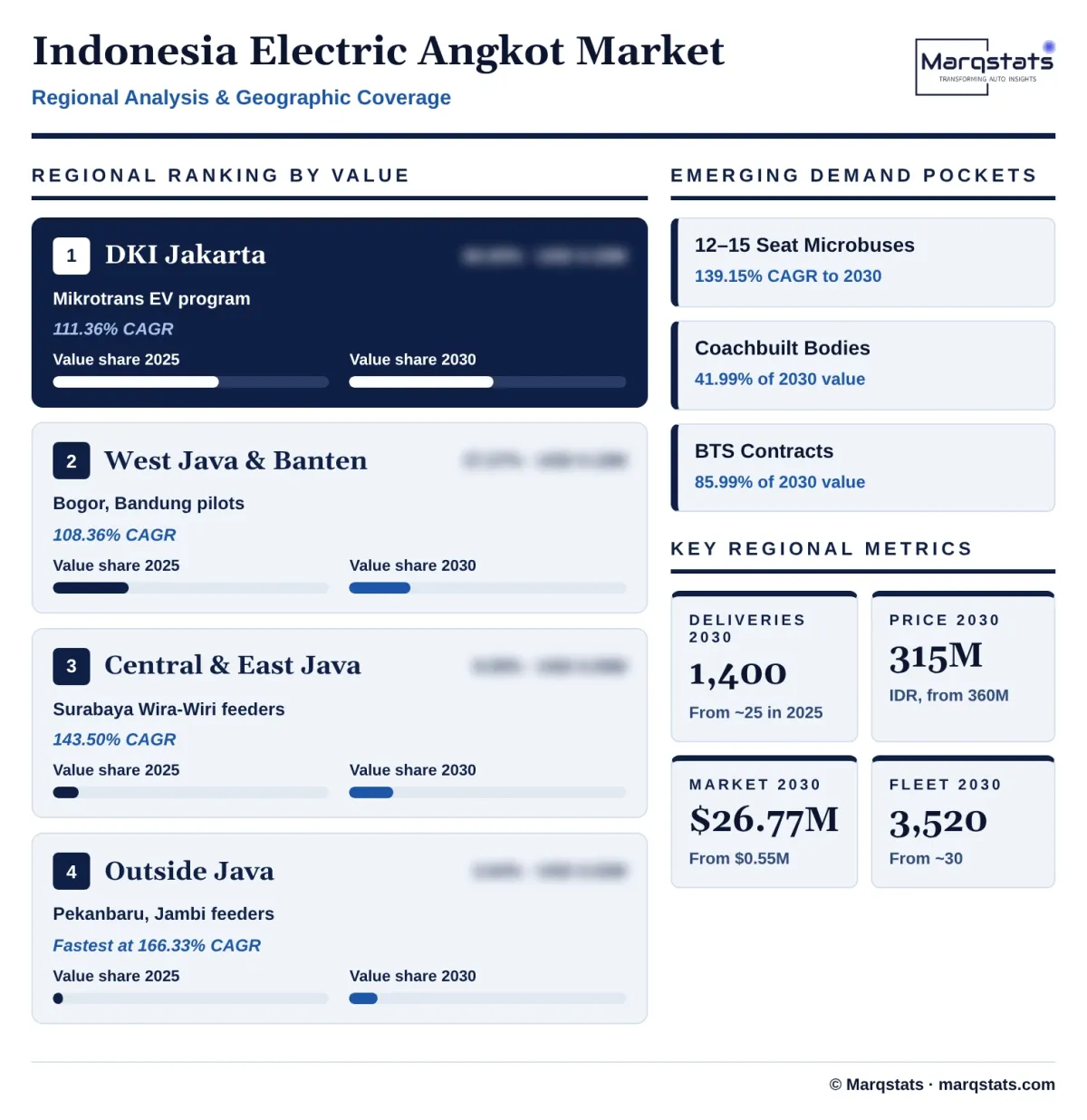
DKI Jakarta
DKI Jakarta is the largest region, with 60.00% of 2025 value, USD 0.33 million, rising to USD 13.92 million by 2030, a 111.36% CAGR, while its share falls to 52.00%. Transjakarta's Mikrotrans network, the 100-unit Mikrotrans EV program operated by KWK, Mayasari Bakti and Steady Safe, and the target of 96% of operator contracts on electric vehicles by 2030 make Jakarta the anchor market.
West Java and Banten
West Java and Banten, including Bogor, Depok, Bekasi, Tangerang and Bandung, account for 27.27% of 2025 value, USD 0.15 million, and grow at 108.36% a year to USD 5.89 million. Bogor ran the first city electric angkot pilot in 2024, Bandung is testing a locally built electric angkot, and the DFSK plant in Cikande, Banten supplies the leading converted van.
Central and East Java
Central and East Java account for 9.09% of 2025 value, USD 0.05 million, and grow at 143.50% a year to USD 4.28 million and 15.99% of 2030 value. Surabaya's Wira-Wiri feeder network, with 102 vehicles on 11 routes in August 2025 and gross-cost contracts in place, is the most likely next large buyer, and MAB is based in Kudus, Central Java.
Outside Java
Cities outside Java, such as Pekanbaru, Jambi, Medan, Makassar and Denpasar, account for 3.64% of 2025 value, USD 0.02 million, and grow fastest, at 166.33% a year, to USD 2.68 million and 10.01% of the market by 2030. Pekanbaru and Jambi already run contracted feeder or angkot services, and ITDP roadmaps are preparing more cities for electric feeders.
How Competition Is Evolving
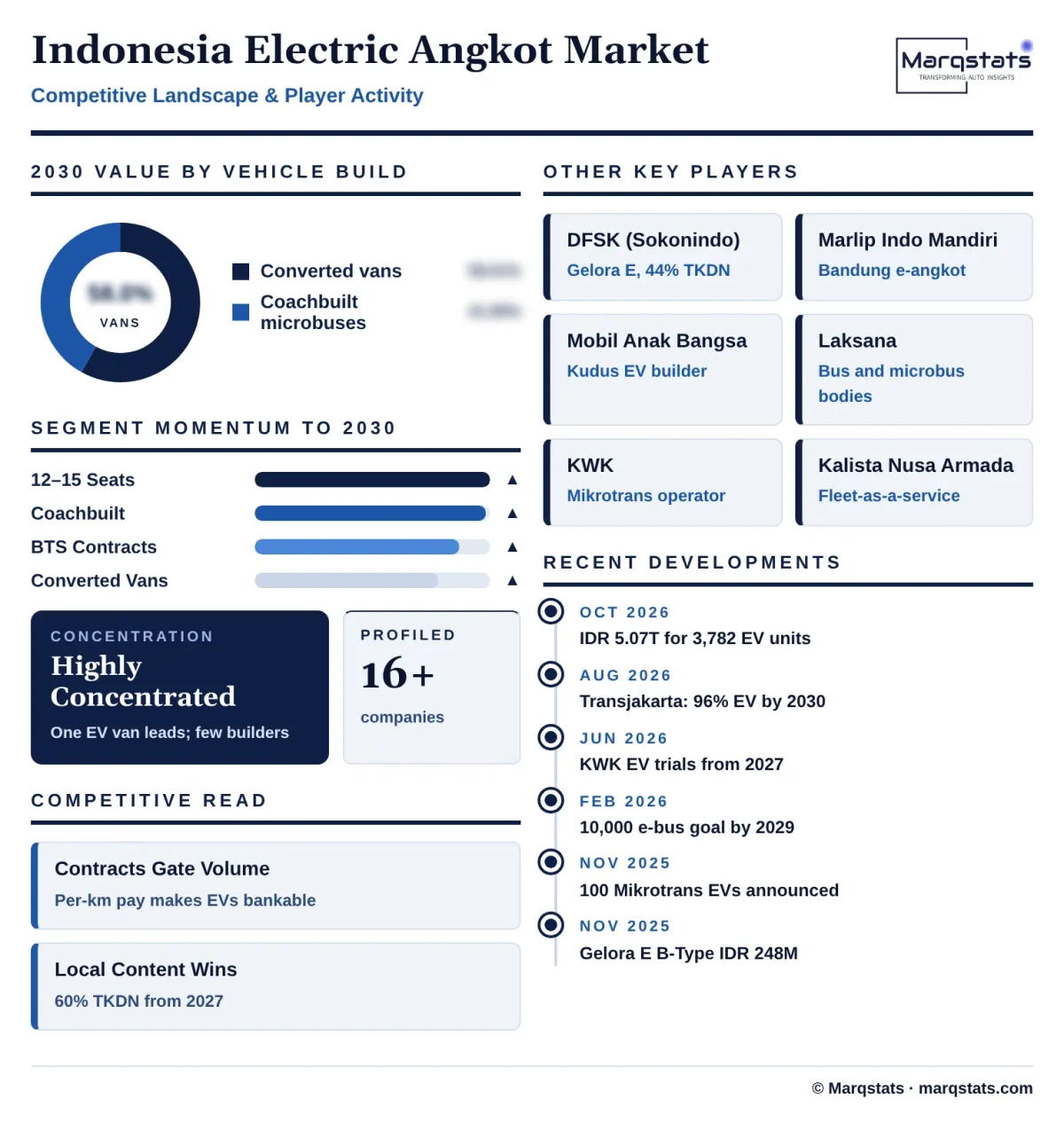
The Indonesia electric angkot market is highly concentrated. A small number of suppliers deliver almost all vehicles: PT Sokonindo Automobile with the DFSK Gelora E, coachbuilders that fit passenger bodies, and a few domestic electric vehicle makers developing purpose-built microbuses.
PT Sokonindo Automobile leads with the DFSK Gelora E, assembled in Cikande with 44% local content. The electric van was the vehicle chosen for Transjakarta's Mikrotrans electric trial in 2024, it took orders for 150 blind vans and 80 minibuses at GIIAS 2025, and the cheaper Gelora E B-Type was launched at IDR 248 million on the road in November 2025.
Domestic builders compete on local content and design. PT Marlip Indo Mandiri built Bandung's electric angkot prototype with air conditioning, a 360-degree camera and an electric door, and PT Mobil Anak Bangsa Indonesia in Kudus builds electric buses and smaller passenger vehicles. Established coachbuilders such as Laksana, Adiputro, Tentrem and New Armada fit passenger bodies on electric chassis.
Operators and fleet providers shape demand. KWK, Mayasari Bakti and Steady Safe operate Mikrotrans contracts in Jakarta, PT Kalista Nusa Armada supplied the Bogor pilot vehicles and chargers, and Transjakarta sets specifications and pays per kilometre. Suppliers that can meet Transjakarta's standards and deliver on time will set the benchmark for other cities.
Competition will be decided by local content, price and after-sales service. Suppliers that reach 60% TKDN before 2027, keep prices near IDR 300 million and offer battery warranties and depot charging packages will capture most of the contracted volume.
Charging partners matter. PLN supplies depot connections and business tariffs, and suppliers that bundle chargers, installation and grid applications with vehicles reduce the work operators must do. Bogor's pilot used a dedicated charging point for the electric angkots, and Jakarta's depots are being prepared for both electric buses and Mikrotrans units.
Companies Covered
Companies covered in the report include:
Recent Market Activity
Table of Contents
Coverage & Segmentation
The study covers the Indonesia electric angkot market, with 2025 as the base year, 2021 – 2025 as the historical period and 2026 – 2030 as the forecast period. Values are in US dollars at IDR 16,475 per USD, held constant, and volumes are annual deliveries of new vehicles into paratransit and feeder service. The market is segmented by vehicle build, contract model, seating capacity and region.
Electric buses longer than about 6 metres, corporate, campus and resort shuttles, private electric vans, electric two- and three-wheelers, charging equipment sold separately and fare revenue are excluded. Electric angkots are a part of the van segment of the Marqstats Indonesia Electric Commercial Vehicle report, which uses a different exchange rate and price basis, and the two values should not be added. Segment and regional splits are Marqstats estimates built on city, Transjakarta and ministry statements, supplier disclosures and price benchmarks.