Market Snapshot
Middle bar: base-year value × (1 + CAGR), rounded to two decimals. This is a calculated illustration, not a separately researched annual estimate.
The Latin America electric mototaxi market size is estimated at USD 21.80 million in 2025 and is projected to reach USD 86.13 million by 2030, growing at a CAGR of 31.63% over 2026 – 2030. Annual sales rise from about 7,650 to 32,500 vehicles, a 33.55% annual rate, while the average landed wholesale price eases from about USD 2,850 to USD 2,650 per vehicle.
Marqstats defines the market as the wholesale value, excluding VAT and registration fees, of new battery-electric three-wheelers sold for commercial passenger and goods transport in Latin America: Peruvian mototaxis and trimotos, Colombian motocarros, Mexican and Central American mototaxis and tuk-tuks, and electric cargo trikes used by traders, couriers and wholesale markets. It covers factory-built imports and vehicles assembled locally from kits. Petrol and LPG three-wheelers, two-wheeled electric motorcycles and motoconchos, pedal rickshaws, four-wheeled micro-cars and battery retrofit kits are excluded.
Passenger vehicles account for an estimated 65.00% of 2025 value and lithium-ion batteries for 58.00%. Peru accounts for 45.00% of 2025 value, Colombia for 25.00% and Mexico for 15.00%. The study segments the market by application, battery technology, supply route and country.
Key Takeaways
Market Overview & Analysis
Report Summary
Marqstats sizes the Latin America electric mototaxi market as the wholesale value of new battery-electric three-wheelers sold for commercial passenger and goods transport. In 2025 about 7,650 such vehicles were sold across the region, worth an estimated USD 21.80 million at an average landed wholesale price of about USD 2,850, excluding VAT and registration fees.
Three-wheelers are a large and growing part of Latin American transport. In Peru, mototaxis carry passengers on short trips in Lima's outer districts and in provincial and Amazonian towns where buses do not run, and the Asociación Automotriz del Perú (AAP) reported sales of 108,213 trimotos in 2025, up 26.6%, within record motorcycle sales of 425,884. In Colombia, motocarros are used mainly to move goods, and ANDI reported 24,370 sold in 2025, up 51.33%, with a fleet of about 150,000 vehicles supporting more than 150,000 families. Mexico, Guatemala, Honduras, Nicaragua, Ecuador and Bolivia also have large mototaxi and tuk-tuk fleets.
Electric versions are still a small share. Marqstats estimates regional three-wheeler sales of about 180,000 in 2025, of which about 4.25% were electric. Most electric mototaxis are imported from China, with motors of 1 kW to 3 kW and batteries of 48 V to 72 V, and sold through distributors and showrooms in Lima, Bogotá, Barranquilla, Mexico City and provincial cities. Indian makers Bajaj, TVS, Mahindra and Piaggio, which dominate the petrol three-wheeler market in the region through local distributors, are introducing electric versions of their platforms.
The economics favour electric vehicles for drivers who run long shifts. A petrol trimoto driven 80 to 100 km a day can spend USD 6 to USD 8 a day on fuel, while an electric vehicle charged at home or at a depot uses about 3 to 5 kWh for the same distance, costing under USD 1 at residential tariffs. Marqstats estimates a driver recovers the higher purchase price of a lithium-ion electric mototaxi in about 13 to 18 months, depending on daily distance, fuel prices and battery choice.
The market grew from about 2,100 vehicles worth USD 5.78 million in 2021 to 3,200 in 2022, 4,500 in 2023 and 5,800 in 2024, worth USD 16.36 million, a 39.36% CAGR in value over 2021 – 2025. Marqstats expects about 10,120 sales worth USD 28.54 million in 2026.
Regulation differs by country. In Peru, three-wheelers above the light personal vehicle threshold need a SUNARP title, AAP plates, compulsory accident insurance and a municipal permit to carry passengers. In Colombia, motocarros are registered in the national traffic registry, electric vehicles pay vehicle tax capped at 1% of their commercial value under Law 1964 of 2019 and are exempt from many local driving restrictions, and Decreto 0595 of June 2026 created an assembly regime for electrified vehicles. In Mexico, mototaxis are regulated by states and municipalities, and the State of Mexico is standardising the image and identification of mototaxi services.
Vehicle designs are converging. Passenger mototaxis carry two to three passengers behind the driver, increasingly in enclosed or semi-enclosed cabins, with 1.5 kW to 3 kW motors, rear differential axles and lithium iron phosphate packs of 4 kWh to 8 kWh. Cargo trikes carry 300 kg to 500 kg in open or closed boxes. Most vehicles charge from a standard socket in four to eight hours, and a few operators are testing removable batteries for drivers who cannot charge at home.
Latin America Electric Mototaxi Market Size and Forecast
The Latin America electric mototaxi market grows from USD 21.80 million in 2025 to USD 86.13 million in 2030, a CAGR of 31.63%. Marqstats expects sales of about 13,800 vehicles worth USD 38.36 million in 2027, 18,500 worth USD 50.88 million in 2028 and 24,800 worth USD 66.96 million in 2029, before reaching 32,500 vehicles in 2030.
Volume grows faster than value because prices ease. The average landed wholesale price falls from about USD 2,850 in 2025 to USD 2,650 in 2030 as lithium iron phosphate cell prices fall, local assembly spreads and competition between Chinese and Indian makers increases. The fall is partly offset by the move from lead-acid to lithium-ion packs and from open passenger trikes to enclosed cabins.
Penetration drives the forecast. Marqstats estimates regional three-wheeler sales grow at about 5.02% a year, from about 180,000 in 2025 to 230,000 in 2030, while the electric share rises from about 4.25% to 14.13%. Each percentage point of electric share in 2025 is worth about 1,800 vehicles and USD 5.13 million.
The forecast is most sensitive to price and penetration. Each USD 100 change in the average price moves the 2025 market by about USD 0.77 million. Marqstats tracks four indicators to monitor the forecast: Peruvian trimoto registrations and plate issuance, Colombian motocarro registrations by fuel type, petrol prices and subsidy changes in Peru, Colombia and Mexico, and the landed price of lithium iron phosphate battery packs.
The mix changes over the forecast. Cargo rises from 35.00% to 39.00% of value, lithium-ion from 58.00% to 85.00% and local assembly from 30.00% to 45.00%. Peru remains the largest country, but its share falls from 45.00% to 40.00% as Colombia rises to 27.00% and Mexico to 18.00%.
Marqstats has not been able to observe electric three-wheeler sales directly in most countries, because registries rarely split three-wheelers by fuel type. The 2025 base is therefore a Marqstats construction from total three-wheeler sales, distributor and import data and an assumed electric share, and the country and segment splits carry more uncertainty than the regional total.
Market Dynamics
Key Drivers
Five forces are pushing Latin American mototaxi and motocarro operators toward electric three-wheelers.
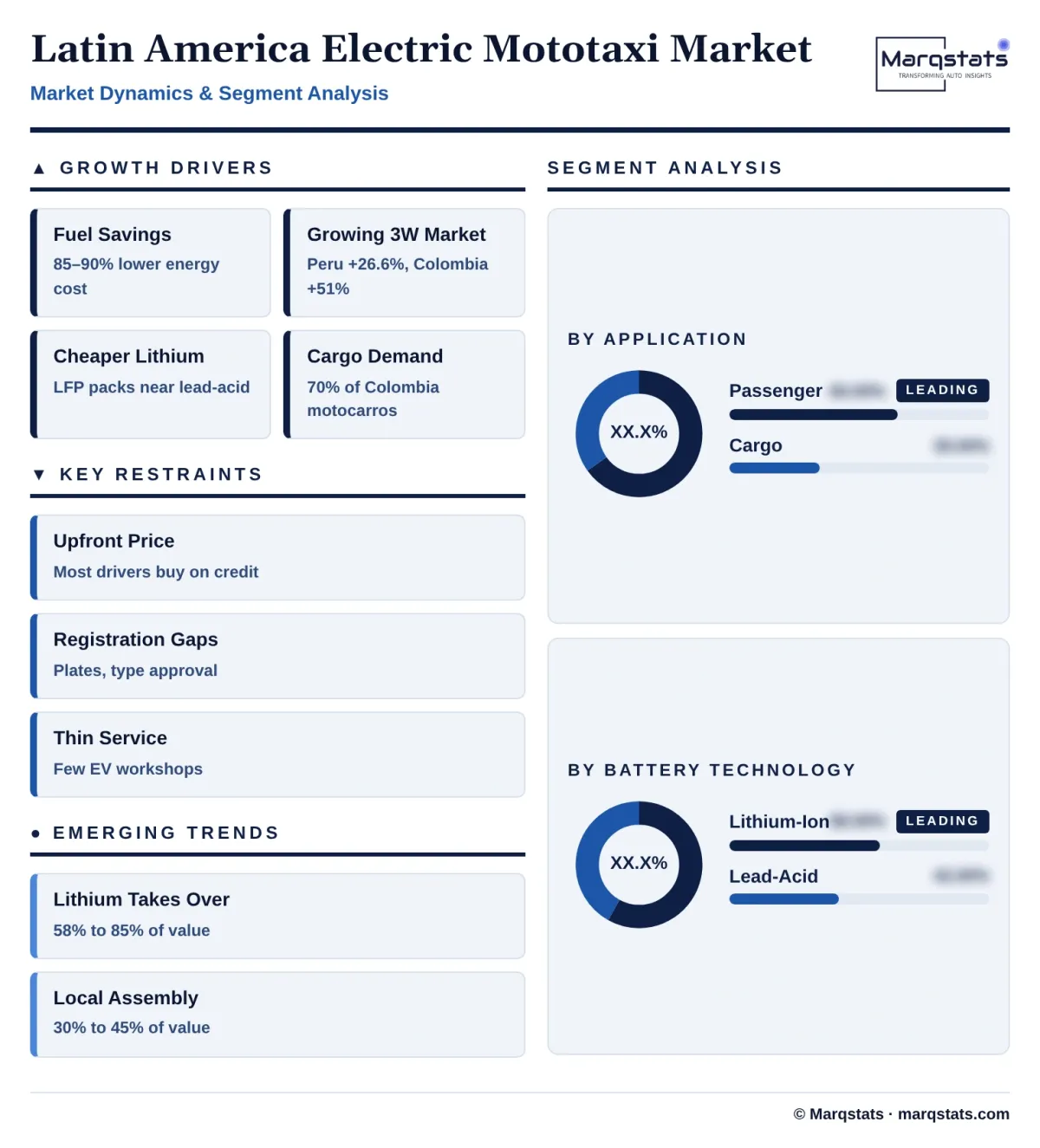
- Fuel savings for drivers. A petrol mototaxi on an 80 to 100 km daily shift spends several dollars a day on fuel; an electric vehicle charged overnight cuts energy costs by about 85% to 90%, which is decisive for drivers who earn by the trip.
- A large and growing three-wheeler market. Peru sold 108,213 trimotos in 2025, up 26.6%, and Colombia 24,370 motocarros, up 51.33%, so every year a larger pool of new buyers can choose electric.
- Cheaper lithium batteries. Falling lithium iron phosphate pack prices let distributors sell lithium-ion mototaxis with longer warranties and ranges of 80 to 120 km at prices close to those of lead-acid models.
- Cargo demand from traders and couriers. Wholesale markets, small shops, couriers and municipal services use motocarros and cargo trikes for short urban trips, where quiet operation and low running costs matter.
- Policy support for electric vehicles. Colombia applies lower vehicle taxes and exemptions from driving restrictions to electric vehicles under Law 1964 of 2019 and created an assembly regime for electrified vehicles in June 2026, while Mexico City and the State of Mexico are formalising mototaxi services.
- Rising registrations in formal markets. Peru's record trimoto sales and Colombia's motocarro growth show strong demand for formal, registered vehicles, which favours type-approved electric models sold through established distributors.
Key Restraints
Four constraints slow the switch from petrol to electric three-wheelers across the region.
- Higher upfront prices. A lithium-ion electric mototaxi typically costs more than a comparable petrol trimoto, and most drivers buy on credit or with savings, so upfront price weighs heavily on buyers with low incomes.
- Informality and registration gaps. Many mototaxis operate without full registration or municipal permits, and low-cost electric imports sold without type approval cannot be registered, keeping part of the market outside formal sales.
- Limited service networks. Outside large cities, few workshops can diagnose and repair electric motors, controllers and battery management systems, and replacement batteries can be hard to find.
- Battery life on hilly and unpaved routes. Lead-acid packs wear out within one to two years under heavy use on Andean and unpaved roads, and early bad experiences with cheap batteries make some drivers wary of electric vehicles.
Key Trends
Four shifts are changing how electric mototaxis are built, sold and financed in Latin America.
- Lead-acid to lithium-ion. Distributors are moving their ranges to lithium iron phosphate packs with longer warranties, and lithium-ion vehicles rise from 58.00% to 85.00% of market value by 2030.
- Local assembly from kits. Colombian and Peruvian assemblers combine imported chassis, motors and batteries with locally made bodies and cabins, reducing freight costs and adapting vehicles to local uses.
- Enclosed cabins and standard liveries. Municipal formalisation programmes, such as the State of Mexico rules setting a single colour scheme and identification for mototaxis from the end of 2025, push buyers toward newer, standardised vehicles.
- Financing tied to daily income. Distributors and microfinance lenders offer instalment plans with daily or weekly payments that drivers cover from fuel savings.
Strategic Implications
- For Chinese makers, distribution and after-sales service decide market share. Partnerships with established motorcycle distributors in Peru, Colombia and Mexico, spare parts stocks and battery warranties matter more than headline price.
- For Indian makers that lead the petrol three-wheeler market, electric versions of existing platforms protect their position. Bajaj, TVS, Mahindra and Piaggio can use their dealer and finance networks to sell electric models to existing customers.
- For local assemblers, kits and body building are the growth path. Colombian and Peruvian assemblers that combine imported powertrains with locally built bodies can cut costs and meet registration and municipal requirements.
- For lenders, the fuel saving is the repayment source. Loans structured around daily payments, with telematics and battery warranties as security, can expand sales to drivers who cannot pay upfront.
- For governments and cities, formalisation and electrification go together. Registration capacity, type approval and municipal permits decide how many electric vehicles enter formal service and whether drivers can access finance.
- For battery suppliers, warranty and recycling build trust. Lithium iron phosphate packs with warranties of two to three years, replacement programmes and collection of used lead-acid batteries address the main concern of drivers who have had bad experiences with cheap packs.
Market Segmentation
Electric mototaxis and tuk-tuks carrying passengers account for 65.00% of 2025 value, USD 14.17 million and about 4,970 vehicles, rising to USD 52.54 million by 2030, a 29.96% CAGR, while their share falls to 61.00%. Peru is the main market, with mototaxis serving short trips in Lima and provincial towns.
Electric cargo trikes and motocarros account for 35.00% of 2025 value, USD 7.63 million and about 2,680 vehicles, and grow faster, at 34.50% a year, to USD 33.59 million and 39.00% of the market by 2030. Colombian traders, couriers and wholesale markets are the largest buyers.
Lithium-ion vehicles account for 58.00% of 2025 value, USD 12.64 million, and grow at 42.09% a year to USD 73.21 million and 85.00% of the market by 2030 as lithium iron phosphate packs get cheaper and last longer.
Sealed lead-acid vehicles account for 42.00% of 2025 value, USD 9.16 million, and grow slowly, at 7.12% a year, to USD 12.92 million, falling to 15.00% of the market as they are confined to the cheapest models.
Vehicles imported fully built, mainly from China and India, account for 70.00% of 2025 value, USD 15.26 million, rising to USD 47.37 million by 2030, a 25.43% CAGR, while their share falls to 55.00%.
Vehicles assembled in the region from imported kits with local bodies account for 30.00% of 2025 value, USD 6.54 million, and grow at 42.75% a year to USD 38.76 million and 45.00% of the market by 2030, led by Colombia.
By Geography
Peru
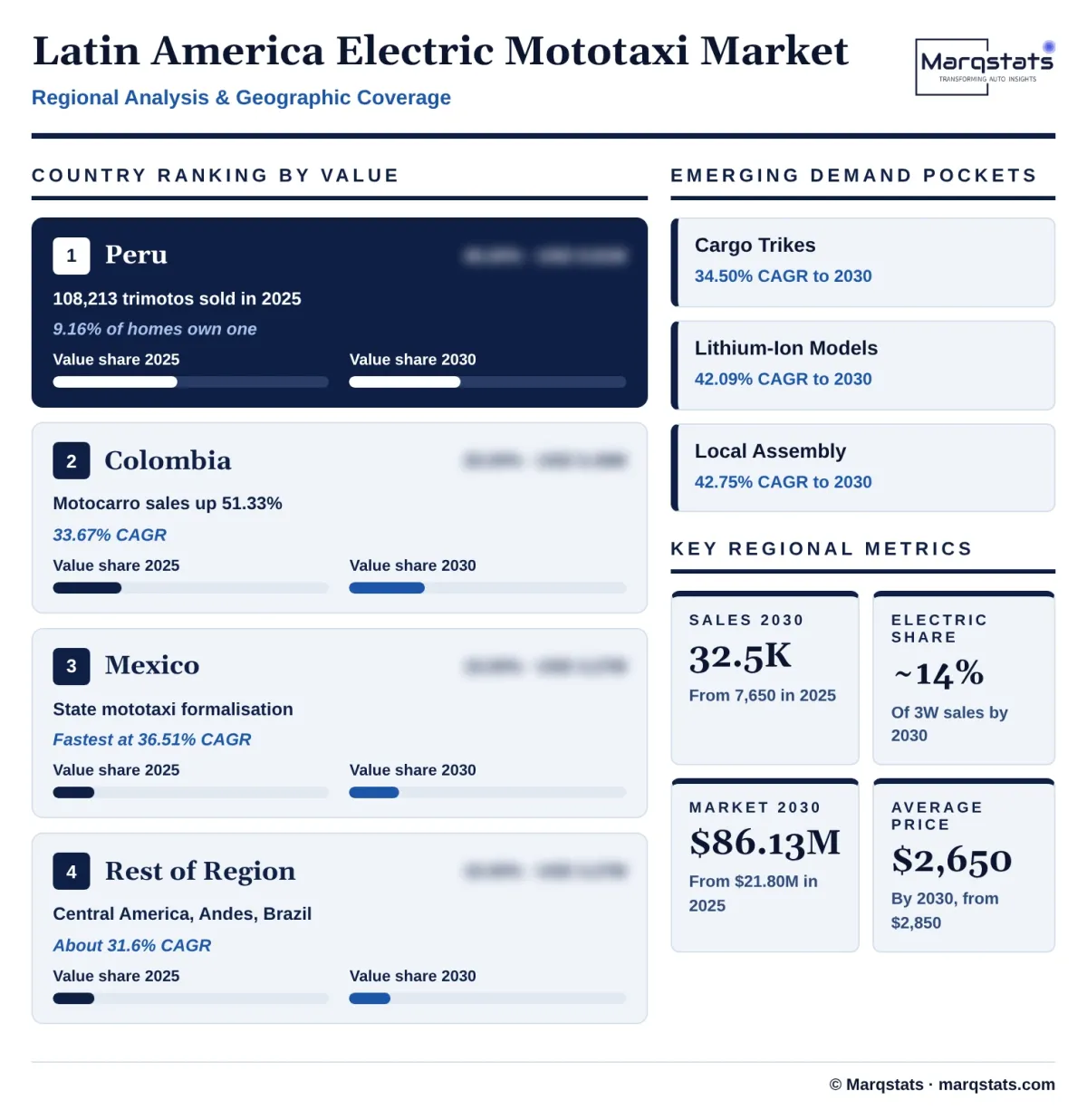
Peru is the largest market, with 45.00% of 2025 value, USD 9.81 million and about 3,440 vehicles, rising to USD 34.45 million by 2030, a 28.56% CAGR, while its share falls to 40.00%. Peru sold 108,213 trimotos in 2025, up 26.6%, and 9.16% of households own a mototaxi. Electric models are sold through showrooms in Lima and Callao and through provincial distributors. Registration requires a title with SUNARP and a plate issued through the AAP, and the plate shortage of January 2026 delayed deliveries of new vehicles. Electric mototaxis compete mainly with petrol trimotos from Bajaj, TVS and Chinese brands in the price range below USD 3,000, so financing and battery warranties are the main tools distributors use to win buyers.
Colombia
Colombia accounts for 25.00% of 2025 value, USD 5.45 million and about 1,910 vehicles, and grows at 33.67% a year to USD 23.26 million and 27.00% of the market by 2030. Motocarro sales rose 51.33% to 24,370 in 2025, 70% of them cargo vehicles, and more than 90% were assembled locally. Electric vehicles pay lower vehicle taxes under Law 1964 of 2019, and Decreto 0595 of June 2026 created an assembly regime for electrified vehicles. Cargo motocarros used in wholesale markets, building supplies and parcel delivery are the main electric opportunity, because they run fixed daily routes and return to the same yard each night for charging.
Mexico
Mexico accounts for 15.00% of 2025 value, USD 3.27 million and about 1,150 vehicles, and grows fastest, at 36.51% a year, to USD 15.50 million and 18.00% of the market by 2030. Mototaxis serve outer districts of Mexico City and towns in the State of Mexico, Yucatán, Veracruz and Oaxaca, and the State of Mexico has introduced a single colour scheme and identification rules for mototaxis to formalise the service.
Central America and Caribbean
Central America and the Caribbean account for 7.00% of 2025 value, USD 1.53 million, rising to USD 6.03 million by 2030, a 31.56% CAGR. Guatemala, Honduras and Nicaragua have large tuk-tuk and mototaxi fleets in towns and secondary cities, and electric tricycle pilots, such as the EU-funded project in San Juan Comalapa, Guatemala, have tested electric vehicles for public transport and municipal services.
Rest of South America
Ecuador, Bolivia, Brazil and other South American countries account for 8.00% of 2025 value, USD 1.74 million, rising to USD 6.89 million by 2030, a 31.68% CAGR, with demand from Amazonian towns, border cities and urban cargo services.
How Competition Is Evolving
The Latin America electric mototaxi market is fragmented. Indian makers Bajaj, TVS, Mahindra and Piaggio dominate the petrol three-wheeler market through local distributors such as Auteco in Colombia, but most electric three-wheelers sold today are imported from Chinese manufacturers including Jinpeng, Huaihai, Zongshen and Qiangsheng and sold under distributor or local brands.
Distributors and assemblers hold the customer relationship. Colombian motorcycle companies such as Auteco, AKT and Grupo UMA, Peruvian brands and showroom networks such as Mavila and SOLVARYA, and Mexican brands such as Italika and Vento control retail sales, financing partnerships and spare parts.
Competition is moving from price to total cost. Lithium-ion batteries with longer warranties, local service and spare parts, and instalment plans linked to daily income are becoming more important than the lowest purchase price.
Competition will be decided by distribution, battery quality and registration. Makers that combine type-approved vehicles that can be registered, reliable lithium-ion packs and wide service networks will gain share as more drivers switch from petrol trimotos and motocarros.
New entrants are arriving through distributors. Chinese manufacturers export complete vehicles and kits to Latin American importers, while Indian makers extend their established petrol dealer networks to electric models, so distributors with showrooms, finance partners and workshops in provincial cities are the most valuable partners for any maker.
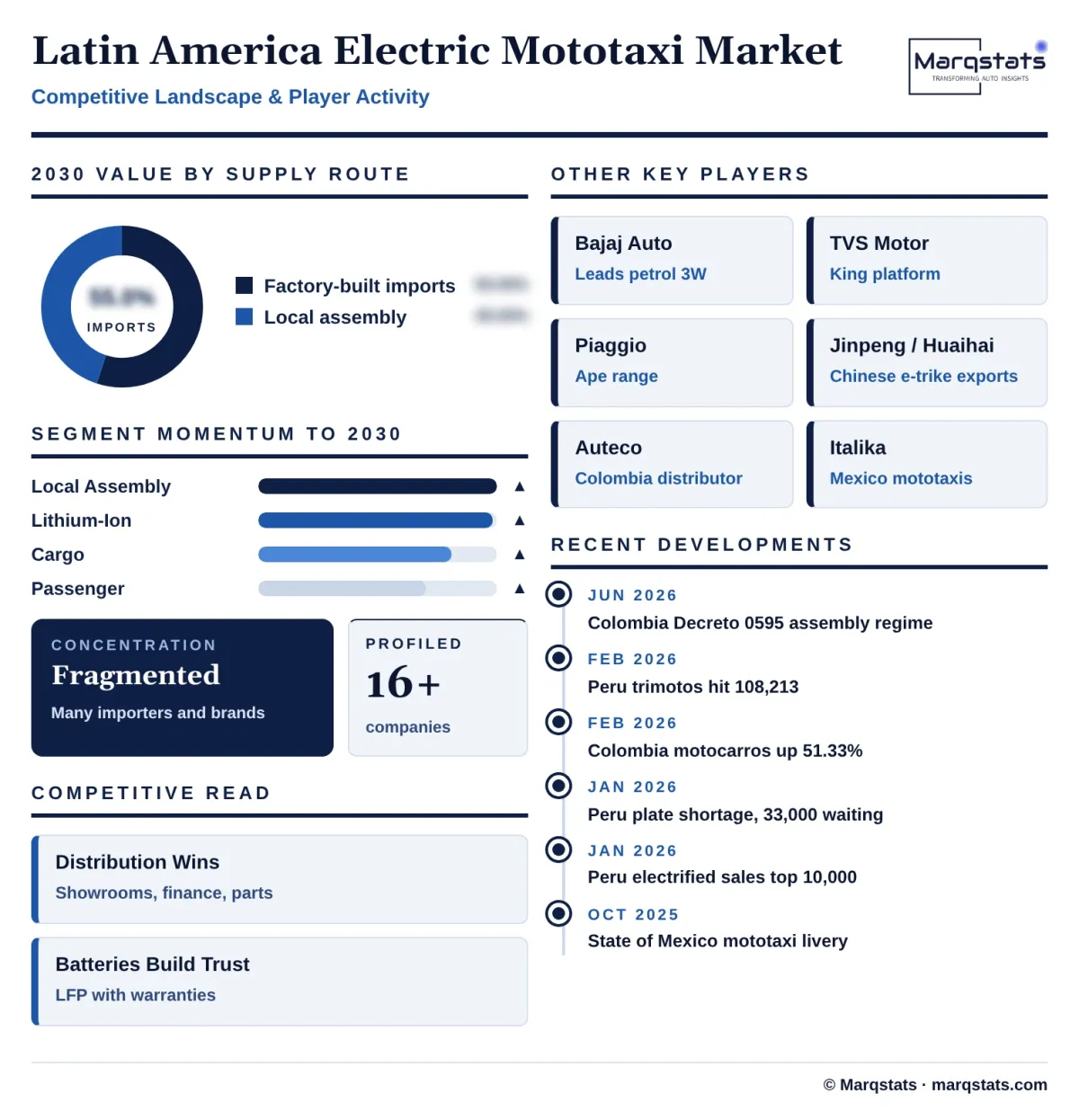
Companies Covered
Companies covered in the report include:
Recent Market Activity
Table of Contents
Coverage & Segmentation
The study covers the Latin America electric mototaxi market, with 2025 as the base year, 2021 – 2025 as the historical period and 2026 – 2030 as the forecast period. Values are in US dollars at landed wholesale prices excluding VAT and registration fees, converted at 2025 average exchange rates, and volumes are annual sales of new vehicles. The market is segmented by application, battery technology, supply route and country.
Petrol and LPG three-wheelers, two-wheeled electric motorcycles and motoconchos, pedal rickshaws, four-wheeled micro-cars and battery retrofit kits are excluded. Electric cargo motocarros and trikes sold in Latin America are also counted within the Rest of World region of the Marqstats Global Electric Cargo Tricycle Market study, so the cargo segment here overlaps with that study and the two figures should not be added. Application, battery, supply route and country splits are Marqstats estimates built on registration and sales data, distributor price lists, trade data and battery price benchmarks.