Market Snapshot
Middle bar: base-year value × (1 + CAGR), rounded to two decimals. This is a calculated illustration, not a separately researched annual estimate.
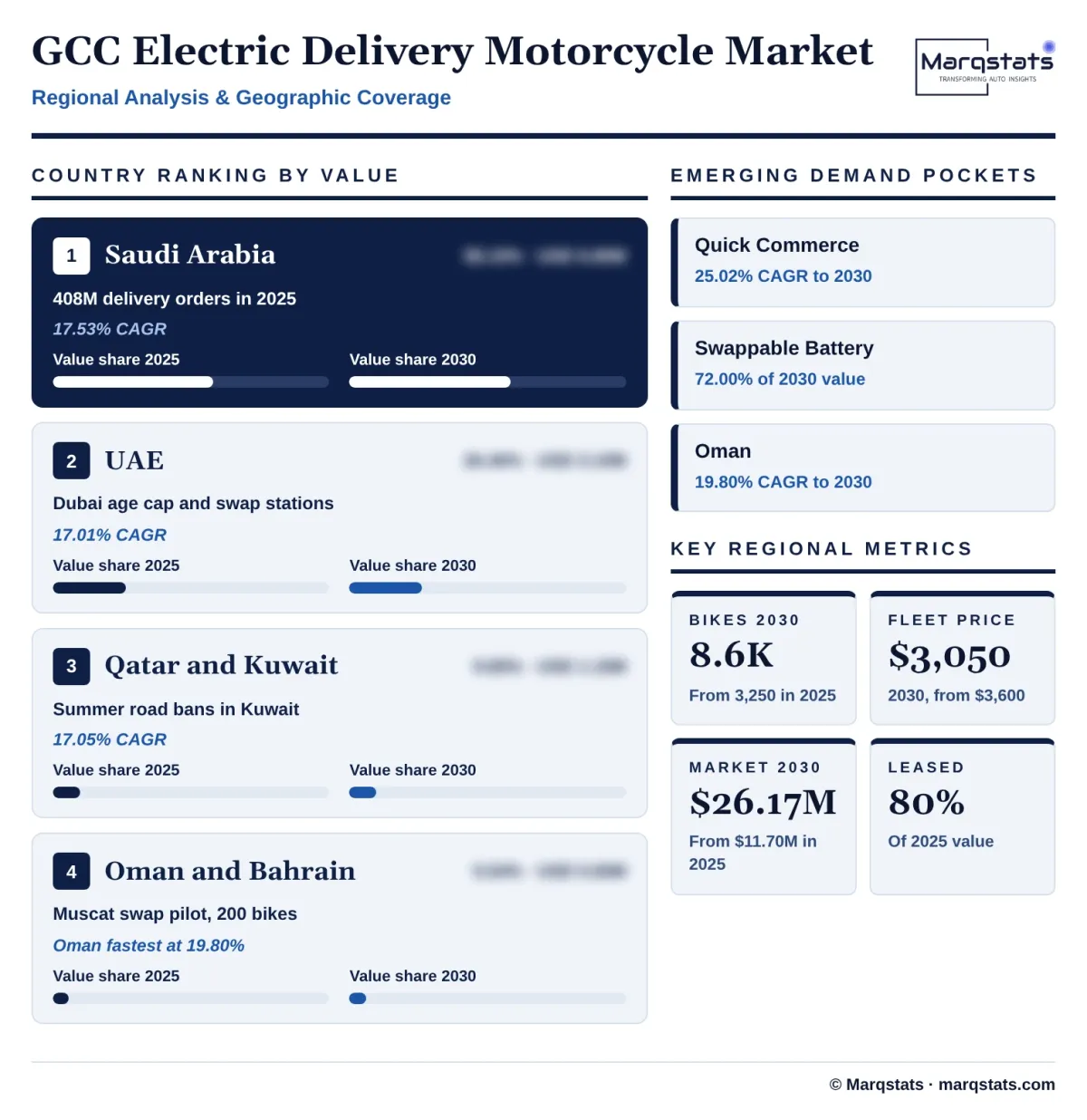
The GCC electric delivery motorcycle market size is estimated at USD 11.70 million in 2025 and is projected to reach USD 26.17 million by 2030, growing at a CAGR of 17.47% over 2026 – 2030. Annual deliveries of new electric motorcycles and mopeds into food, grocery and parcel delivery fleets rise from about 3,250 units to 8,580, a 21.43% annual rate, while the average fleet price falls from about USD 3,600 to USD 3,050.
Delivery fleets are where electric two-wheelers have taken hold in the Gulf. Marqstats estimates that about 86% of electric two-wheelers registered in Saudi Arabia and the UAE in 2025 went into commercial delivery service, and that electric bikes made up about 17% of new delivery and fleet motorcycles in those two countries, against only 3% to 4% of all two-wheeler sales. Saudi Arabia is the largest market, with 58.15% of 2025 value, followed by the UAE at 26.46%.
The study covers Saudi Arabia, the UAE, Qatar, Kuwait, Oman and Bahrain and segments the market by vehicle class, energy model, acquisition model and delivery vertical. Values are fleet purchase prices excluding VAT, in US dollars at constant 2025 exchange rates, with the dirham converted at its fixed rate of AED 3.6725 per US dollar.
Key Takeaways
Market Overview & Analysis
Report Summary
Marqstats sizes the GCC electric delivery motorcycle market as the fleet purchase value, excluding VAT, of new battery-electric motorcycles and mopeds registered for commercial delivery in the six Gulf Cooperation Council states. The vehicles are bought by delivery platforms, third-party logistics (3PL) contractors, leasing companies and corporate fleets and carry food, groceries, parcels and documents. Bikes include their first set of batteries where sold with the vehicle. Petrol motorcycles, privately owned electric commuter bikes, rental e-scooters, pedal-assisted e-bikes, battery swap subscription fees and charging hardware are excluded.
The market grew from an estimated USD 1.12 million in 2021 to USD 11.70 million in 2025, a 79.78% annual rate, as deliveries rose from about 260 trial bikes to 3,250. Early volumes came from pilots: talabat UAE trialled electric bikes with Motoboy in Dubai, Jahez said it would electrify a quarter of its Saudi delivery fleet by 2026, and Deliveroo piloted electric bikes from its dark stores in Dubai. From 2024 leasing companies began to order electric bikes in batches, and swap networks appeared at fuel stations in Abu Dhabi and Muscat.
The market sits inside the broader Gulf two-wheeler market. The live Marqstats Middle East electric scooter and motorcycle study puts 2025 electric two-wheeler volumes at about 2,190 units in Saudi Arabia and 990 in the UAE; Marqstats estimates that about 1,890 and 860 of these went into delivery fleets. The Saudi Arabia and UAE two-wheeler studies estimate that commercial and fleet buyers take about 17% of all two-wheeler units in each country, and delivery operators are the earliest electric adopters among them.
Gulf delivery runs on an asset-light model. Platforms such as talabat, Jahez, Keeta, Deliveroo, Careem and noon rarely own bikes or employ riders directly. They contract licensed 3PL companies, which sponsor rider visas, and these contractors lease bikes from specialists such as EasyLease, which manages more than 35,000 motorcycles in the UAE. Platforms set safety and sustainability targets, but leasing companies and 3PLs carry the capital cost and battery risk, so electrification moves at the speed of their financing.
The forecast rests on three conditions. Dubai's age cap and inspection rules, Saudi Arabia's new motorcycle goods transport regulations and Kuwait's and the UAE's summer work bans stay in place; LFP pack prices keep falling; and fuel retailers and platforms keep expanding swap stations in Riyadh, Jeddah, Dubai, Abu Dhabi, Doha and Muscat. Under these conditions deliveries reach 8,580 bikes in 2030 and the market reaches USD 26.17 million.
GCC Electric Delivery Motorcycle Market Size and Forecast
The GCC electric delivery motorcycle market grows from USD 11.70 million in 2025 to USD 26.17 million in 2030, a CAGR of 17.47%. The market reaches an estimated USD 14.79 million in 2026, USD 17.69 million in 2027, USD 20.70 million in 2028 and USD 23.47 million in 2029. Growth slows from about 26% in 2026 to about 11% in 2030 as the largest 3PL fleets complete their first replacement cycle.
Units grow faster than value because prices fall. Annual deliveries rise from about 3,250 bikes in 2025 to 8,580 in 2030, while the average fleet price falls from about USD 3,600, or AED 13,200, to about USD 3,050. Chinese models homologated for the Gulf sell to fleets for roughly USD 2,400 to USD 2,700, while models assembled or finished in the UAE with heat-resistant packs and cargo frames sell for USD 4,000 or more, so the mix between them moves the average as much as battery prices do.
Penetration of new delivery bikes doubles. Marqstats estimates that electric bikes take about 17% of new delivery and fleet motorcycles in Saudi Arabia and the UAE in 2025 and about a third by 2030, while electric bikes remain below 10% of total two-wheeler sales. Delivery fleets therefore account for about 86% of electric two-wheeler volume in the two largest markets in 2025, rising to about 90% by 2030.
Swap networks and leasing shape the value mix. Swappable-battery bikes rise from 58.00% of value to 72.00% and leased bikes from 80.00% to 85.00% by 2030. Bikes sold for swap networks often come with one battery or none, and the operator owns the rest, so a rising swap share lowers the average vehicle price even before battery costs fall.
Market Dynamics
Key Drivers
Five forces are pushing Gulf delivery fleets from petrol motorcycles to electric ones.
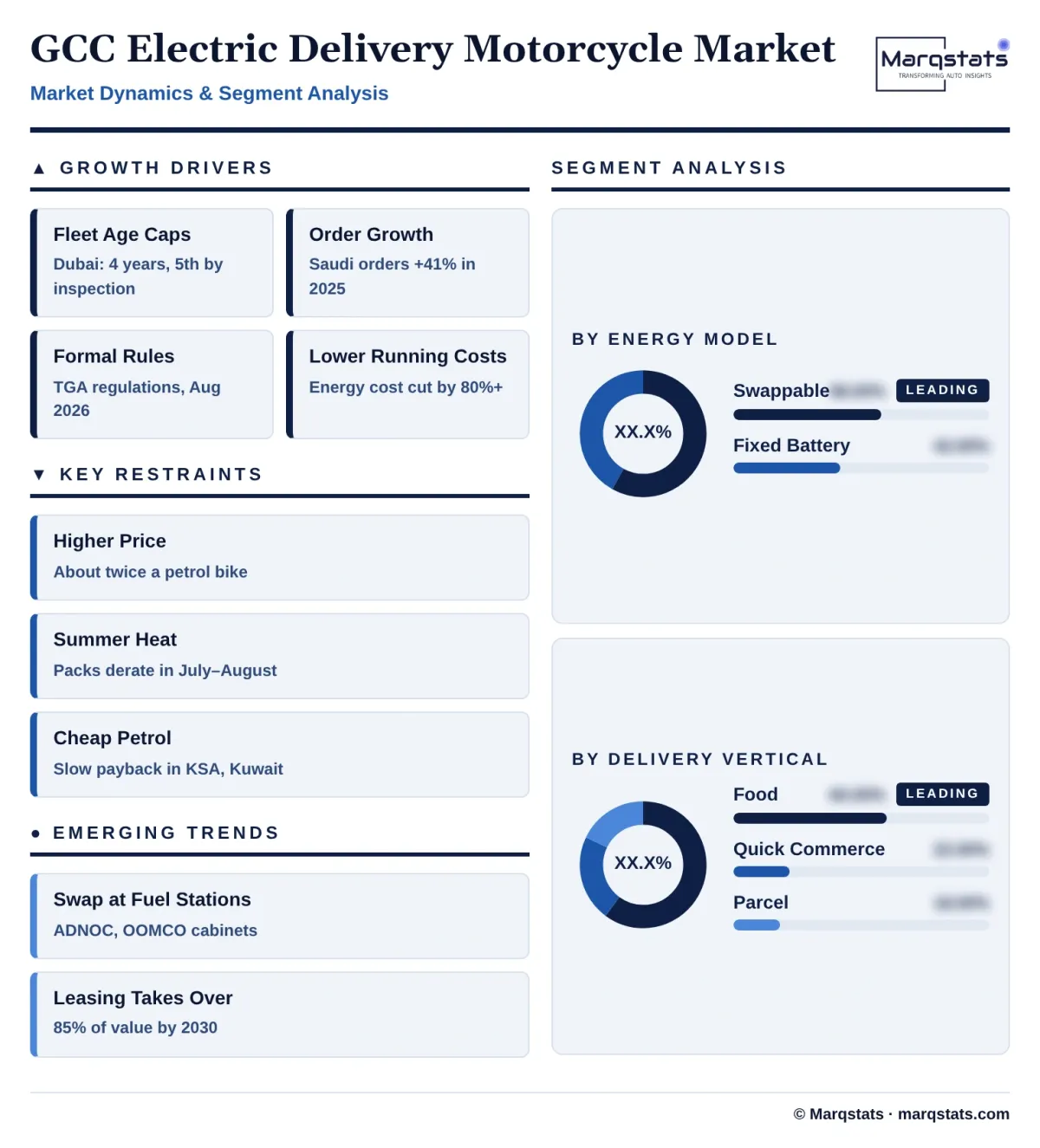
- Fleet age caps and inspection rules. Dubai limits the working life of a delivery motorcycle to four years from manufacture, so the fleet turns over every four to five years. In February 2026 the RTA introduced an optional technical inspection that lets companies extend a bike's registration for a fifth year, which helps leasing firms spread the higher price of electric bikes over 60 months.
- Growth in delivery orders. Saudi delivery apps fulfilled 408 million orders in 2025, up 41% from 290 million in 2024, and talabat reported 157,000 active riders across its eight markets in December 2025 and gross merchandise value of USD 9.4 billion for the year. More orders mean more bikes, and every new bike is a chance to switch to electric.
- Formal regulation of delivery riders. Saudi Arabia's TGA issued executive regulations for goods transport by motorcycle in August 2026, moving the activity out of a regulatory sandbox, and Dubai introduced lane bans and front plates for delivery bikes in late 2025. Regulated fleets need connected, well-maintained vehicles, and fleet operators use the transition to standardise on new electric models.
- Lower running costs. A 125 cc petrol delivery bike covering 140 to 180 km a day burns about 4 litres of fuel, while an electric bike with LFP packs uses about 7 to 9 kWh. Even with petrol at about AED 2.6 to 3.0 a litre in the UAE and SAR 2.18 a litre for 91-octane in Saudi Arabia, energy costs fall by more than 80%, and electric bikes need no oil changes, clutches or drive belts.
- Investment by leasing companies and energy retailers. Emirates Islamic provided EasyLease with an AED 200 million working-capital facility in February 2026, and EasyLease signed a memorandum with Empala in May 2026 for an electric delivery motorcycle proof of concept. ADNOC Distribution and OOMCO have put swap stations at fuel stations, which gives fleets energy access without building their own depots.
Key Restraints
Four constraints keep electric bikes a minority of new delivery motorcycles in the Gulf.
- Higher purchase price. An electric delivery bike costs about AED 13,200 on average, roughly twice the price of a basic 125 cc petrol bike. 3PL contractors work on thin margins under platform contracts, so they need leasing companies or battery subscriptions to bridge the gap.
- Heat stress on batteries. Summer air temperatures of 45 to 50 °C and road surfaces above 60 °C push battery packs beyond their best operating range, so battery management systems reduce power and real range falls in July and August. Nickel-rich chemistries age quickly in these conditions, and fleets that bought low-cost packs have faced early failures.
- Cheap petrol in Saudi Arabia and Kuwait. Fuel prices in Saudi Arabia and Kuwait are among the lowest in the world, so fuel savings alone pay back the price gap slowly. In these markets electrification depends more on platform targets, leasing terms and regulation than on fuel costs.
- Limited swap coverage outside major cities. Swap stations are concentrated in Dubai, Abu Dhabi, Riyadh and Muscat, and riders on suburban or intercity routes cannot rely on them. Fire-safety rules for charging batteries in rider accommodation and depots add to the cost of plug-in charging.
Key Trends
Four shifts are changing how electric delivery bikes are bought, powered and run in the GCC.
- Swap stations at fuel retailers and dark stores. Energy companies are adding swap cabinets at service stations, and quick-commerce platforms are putting them in dark stores so riders swap while they collect orders. Swappable-battery bikes rise from 58.00% to 72.00% of value by 2030.
- Lithium iron phosphate becomes the standard. Fleets are moving to LFP packs because they tolerate heat better and last 2,000 to 3,000 cycles under Gulf conditions, compared with far fewer for nickel-rich packs. Suppliers are adding reflective panels, ducted battery bays and temperature-based power control.
- Desert-ready models from local assemblers. UAE companies such as One Moto and Empala design or finish bikes for Gulf operating conditions, with heat-resistant packs, frames that carry standard insulated delivery boxes and brackets for Dubai's front plates. Chinese suppliers such as TYCORUN compete on price and supply swap kiosks with their bikes.
- Leasing replaces outright purchase. Leasing companies bundle the bike, registration, insurance, tracking and maintenance into one monthly fee, so small 3PLs can switch to electric without capital outlay. Leased bikes rise from 80.00% of value in 2025 to 85.00% by 2030.
Strategic Implications
- For delivery platforms, contracts drive the switch. Platforms that write electric targets into their 3PL agreements give leasing companies the volume certainty they need to borrow against electric fleets. Placing swap cabinets in dark stores and kitchens removes separate charging trips during peak hours.
- For leasing companies and 3PLs, life extension changes the maths. The RTA's fifth-year inspection lets an electric bike earn for 60 months instead of 48, which lowers the monthly capital charge by a fifth. Leasing firms should plan electric fleets around five-year terms, buy LFP packs with thermal management and contract swap access rather than own batteries where possible.
- For vehicle makers, homologation and heat resistance come first. Bikes must meet Gulf technical regulations and pass conformity checks by SASO in Saudi Arabia and the Ministry of Industry and Advanced Technology in the UAE. Models that carry standard 50 cm delivery boxes without upsetting balance, accept front plates and keep full power in summer will win fleet tenders.
- For energy retailers, delivery fleets are an anchor load. Swap stations at fuel stations earn from riders who pass several times a day. Retailers that standardise battery formats across bike brands, or partner with the largest platforms, will fill their cabinets faster.
- For regulators, consistent rules speed adoption. Dubai's inspection-based life extension, Saudi Arabia's motorcycle goods transport regulations and battery-safety standards for depots reduce uncertainty for financiers. Clear rules on battery charging in rider housing and standard battery formats would help smaller operators switch.
Market Segmentation
Electric motorcycles with 3 to 6 kW motors and top speeds of 80 to 100 km/h account for USD 8.66 million in 2025, 74.00% of value. They grow at 18.70% a year to USD 20.41 million by 2030 and 78.00% of value. They match the acceleration of 110 to 125 cc petrol bikes and can use multi-lane roads, so they suit the city-wide routes of food delivery riders in Riyadh, Jeddah and Dubai.
Lower-speed electric mopeds and scooters account for USD 3.04 million in 2025, 26.00% of value, rising to USD 5.76 million by 2030, a 13.63% CAGR, while their share falls to 22.00%. They are used for short dark-store and community routes, where Dubai allows speed-limited e-bikes on dedicated tracks, but cannot keep up with traffic on main roads.
Bikes built for battery swapping account for USD 6.79 million in 2025, 58.00% of value. They are the fastest-growing energy model, rising at 22.64% a year to USD 18.84 million by 2030 and 72.00% of value. A swap takes under a minute, against several hours for a plug-in charge, so swapping keeps bikes on the road across double shifts.
Bikes with fixed batteries charged at depots or rider accommodation account for USD 4.91 million in 2025, 42.00% of value. They grow at 8.34% a year to USD 7.33 million by 2030, and their share falls to 28.00%. They suit single-shift suburban routes, but depot charging needs electrical upgrades and fire-safety measures.
Bikes supplied to 3PLs and platforms under full-service operating leases account for USD 9.36 million in 2025, 80.00% of value. They grow at 18.90% a year to USD 22.24 million by 2030 and 85.00% of value. Leasing companies bundle the bike, registration, insurance, tracking and servicing and carry battery and residual-value risk.
Bikes bought outright by platforms, 3PLs and corporate fleets such as restaurant groups, postal operators and retailers account for USD 2.34 million in 2025, 20.00% of value. They grow at 10.93% a year to USD 3.93 million by 2030, and their share falls to 15.00% as more buyers move to leases.
Restaurant and meal delivery accounts for USD 7.02 million in 2025, 60.00% of value. It remains the largest vertical, rising to USD 13.09 million by 2030, a 13.27% CAGR, but its share falls to 50.00%. Food delivery generates most Gulf orders, and its long evening peaks favour bikes with swappable packs.
Grocery and convenience delivery from dark stores accounts for USD 2.57 million in 2025, 22.00% of value. It is the fastest-growing vertical, at 25.02% a year, reaching USD 7.85 million and 30.00% of value by 2030. Short trips of a few kilometres and swap cabinets in the dark store make it the easiest vertical to electrify.
Parcel, document and pharmacy delivery accounts for USD 2.11 million in 2025, 18.00% of value, rising to USD 5.23 million by 2030, a 19.91% CAGR and 20.00% of value. Courier companies and postal operators run planned routes from depots, which suits plug-in charging, and Saudi Arabia's National Address requirement for parcel shipments improves route efficiency.
By Geography
Saudi Arabia
Saudi Arabia is the largest market, with an estimated USD 6.80 million in 2025, 58.15% of value, rising to USD 15.25 million by 2030, a 17.53% CAGR, and 58.28% of value. Marqstats estimates about 1,890 electric delivery bikes were added in 2025, rising to about 5,000 by 2030. Delivery app orders rose 41% to 408 million in 2025, and licensed delivery motorcycles grew from about 4,765 to 19,032 during 2024 as platforms replaced cars with bikes. Jahez set a target of electrifying 25% of its delivery fleet by 2026, and the TGA issued executive regulations for goods transport by motorcycle in August 2026. Cheap petrol slows the payback, so platform targets and leasing terms do most of the work.
United Arab Emirates
The UAE accounts for an estimated USD 3.10 million in 2025, 26.46% of value, rising to USD 6.80 million by 2030, a 17.01% CAGR. Marqstats estimates about 860 electric delivery bikes were added in 2025, rising to about 2,230 by 2030. Dubai has the Gulf's most detailed rules: delivery bikes have been barred from fast lanes since 1 November 2025, company bikes need a front plate with code 9 from late December 2025, and an optional inspection has allowed a fifth working year since February 2026. ADNOC Distribution and Terra Tech opened Abu Dhabi's first motorbike swap station in October 2025, and EMX, the logistics arm of 7X, agreed in April 2026 to deploy electric bikes from Empala, a joint venture of the Ministry of Energy and Infrastructure and PACT Carbon.
Qatar
Qatar accounts for an estimated USD 0.61 million in 2025, 5.23% of value, rising to USD 1.28 million by 2030, a 15.98% CAGR. Marqstats estimates about 170 electric delivery bikes were added in 2025, rising to about 420 by 2030. talabat, Snoonu and other platforms operate dense delivery networks in Doha, and electric bikes are concentrated in quick commerce and planned courier routes. Qatar grows slowest because swap infrastructure is less developed than in the UAE or Oman.
Kuwait
Kuwait accounts for an estimated USD 0.54 million in 2025, 4.62% of value, rising to USD 1.25 million by 2030, an 18.28% CAGR. Marqstats estimates about 150 electric delivery bikes were added in 2025, rising to about 410 by 2030. Kuwait's Interior Ministry bars delivery bikes from roads between 11 am and 4 pm from June to August, which concentrates orders into morning and evening peaks. Low fuel prices weaken the energy saving, but newer fleets and platform targets support adoption.
Oman
Oman accounts for an estimated USD 0.47 million in 2025, 4.00% of value, and is the fastest-growing country, rising at 19.80% a year to USD 1.16 million by 2030 and 4.43% of value. Marqstats estimates about 130 electric delivery bikes were added in 2025, rising to about 380 by 2030. talabat and OOMCO piloted ten electric motorcycles with three swap stations in Muscat in May 2025, and TYCORUN delivered 200 swappable-battery electric motorcycles in Oman in October 2026, the country's first commercial-scale electric delivery batch.
Bahrain
Bahrain accounts for an estimated USD 0.18 million in 2025, 1.54% of value, rising to USD 0.43 million by 2030, a 19.03% CAGR and 1.62% of value. Marqstats estimates about 50 electric delivery bikes were added in 2025, rising to about 140 by 2030. Short distances across the island suit electric bikes, and talabat and Jahez operate in the country, but the small fleet means a single leasing contract can double annual volume. Country splits are Marqstats allocations based on two-wheeler registrations, platform order data and operator announcements.
How Competition Is Evolving
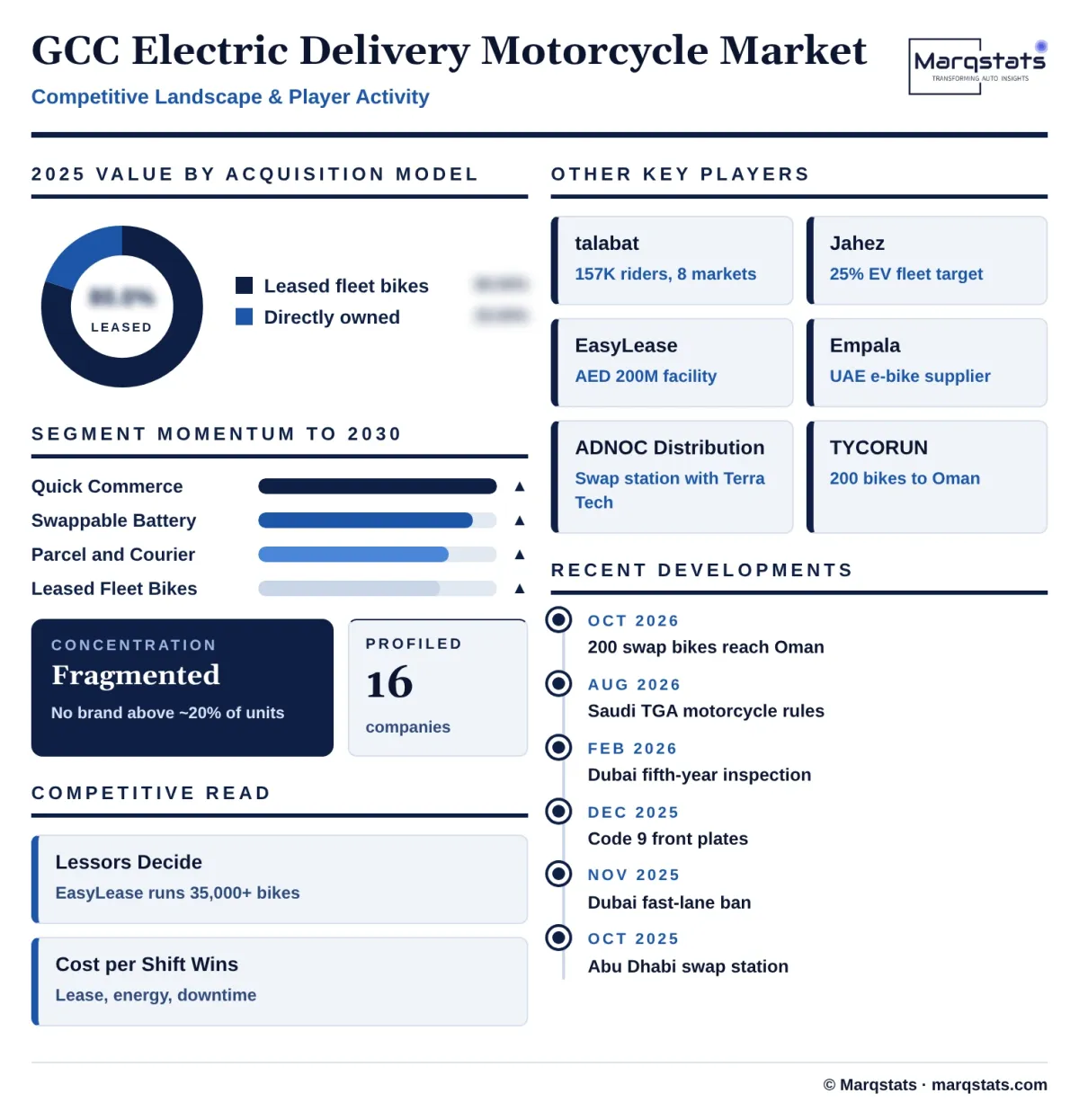
The GCC electric delivery motorcycle market is fragmented across three layers. Delivery platforms set targets and contract riders, leasing companies and 3PLs buy the bikes, and vehicle suppliers and energy companies provide bikes, batteries and swap stations. Marqstats estimates that no single vehicle brand supplies more than about 20% of 2025 deliveries.
Platforms shape demand. talabat, part of Delivery Hero, operates in all six GCC states and reported 157,000 active riders across its eight markets in December 2025. Jahez leads in Saudi Arabia alongside HungerStation and Keeta, Meituan's international brand, which is expanding in Saudi Arabia and the UAE. Deliveroo, now part of DoorDash, noon and Careem compete in the UAE. These platforms run pilots and set fleet targets but rarely own vehicles.
Leasing companies are the main buyers. EasyLease, a subsidiary of International Holding Company, manages more than 35,000 motorcycles in the UAE and received an AED 200 million working-capital facility from Emirates Islamic in February 2026. Its choice of models, battery formats and contract terms reaches hundreds of smaller 3PLs that serve the platforms.
Vehicle suppliers compete on heat resistance and price. UAE-based companies such as One Moto, Empala and Motoboy offer bikes designed or finished for Gulf conditions, while Chinese manufacturers such as TYCORUN and BENLG supply lower-priced models homologated for the Gulf, often with their own swap cabinets. Fleets increasingly specify LFP packs, standard delivery-box frames and telematics.
Energy companies are a fourth player. ADNOC Distribution with Terra Tech in Abu Dhabi and OOMCO in Muscat have put swap stations at fuel stations, giving them a new revenue stream from fleets that would otherwise build depots. Competition is moving to battery standards: whoever controls the battery format used by the largest fleets controls swap traffic.
Competition is shifting to cost per shift. Fleet buyers compare lease fee, energy cost, downtime and battery warranty per rider shift rather than the bike's price. Suppliers that bundle bikes with swap access and service networks in Riyadh, Jeddah, Dubai and Abu Dhabi win the large leasing orders, while importers selling on price alone face rising warranty claims in summer.
Companies Covered
Companies covered in the report include:
Recent Market Activity
Table of Contents
Coverage & Segmentation
The study covers the GCC electric delivery motorcycle market in Saudi Arabia, the United Arab Emirates, Qatar, Kuwait, Oman and Bahrain, with 2025 as the base year, 2021 – 2025 as the historical period and 2026 – 2030 as the forecast period. The market is defined as the fleet purchase value, excluding VAT, of new battery-electric motorcycles and mopeds registered for commercial delivery and bought by delivery platforms, 3PL contractors, leasing companies and corporate fleets, including batteries sold with the vehicle. Values are in US dollars at constant 2025 exchange rates, with the dirham at its fixed rate of AED 3.6725. The market is segmented by vehicle class, energy model, acquisition model and delivery vertical.
Petrol delivery motorcycles, privately owned electric commuter bikes, shared rental e-scooters, pedal-assisted e-bikes, cargo tricycles and vans, battery swap subscription fees, spare batteries bought by swap operators and charging equipment are excluded. The market is a subset of the GCC portion of the Marqstats Middle East electric scooter and motorcycle study and of the electric segment of the Saudi Arabia and UAE two-wheeler studies, and its figures should not be added to those reports. Unit deliveries, prices and segment and country splits are Marqstats estimates built on registration data, platform and operator disclosures, regulatory notices and vehicle price benchmarks.