Market Snapshot
Middle bar: base-year value × (1 + CAGR), rounded to two decimals. This is a calculated illustration, not a separately researched annual estimate.
The Indonesia light commercial vehicle market size is estimated at USD 1,244.10 million in 2025 and is projected to reach USD 2,029.13 million by 2030, growing at a CAGR of 10.28% over 2026 – 2030. Wholesale volume rises from 126,808 to 190,500 vehicles, 8.48% a year, and light vans grow fastest.
Marqstats defines the market as the ex-factory value of new pickups and light vans of up to 5 tonnes gross vehicle weight wholesaled by manufacturers to dealers in Indonesia. It covers small 4x2 pickups, medium 4x2 diesel pickups, 4x4 pickups and light vans, led by the Daihatsu Gran Max blind van and minibus. Value is built bottom-up as units multiplied by estimated ex-factory prices before value-added tax and dealer margin, converted at IDR 16,476.85 per US dollar, the 2025 average. Marqstats estimates the average ex-factory price at about USD 9,811, or IDR 161.7 million, per vehicle in 2025, and the forecast is most sensitive to how long free-meal and cooperative fleet buying lasts.
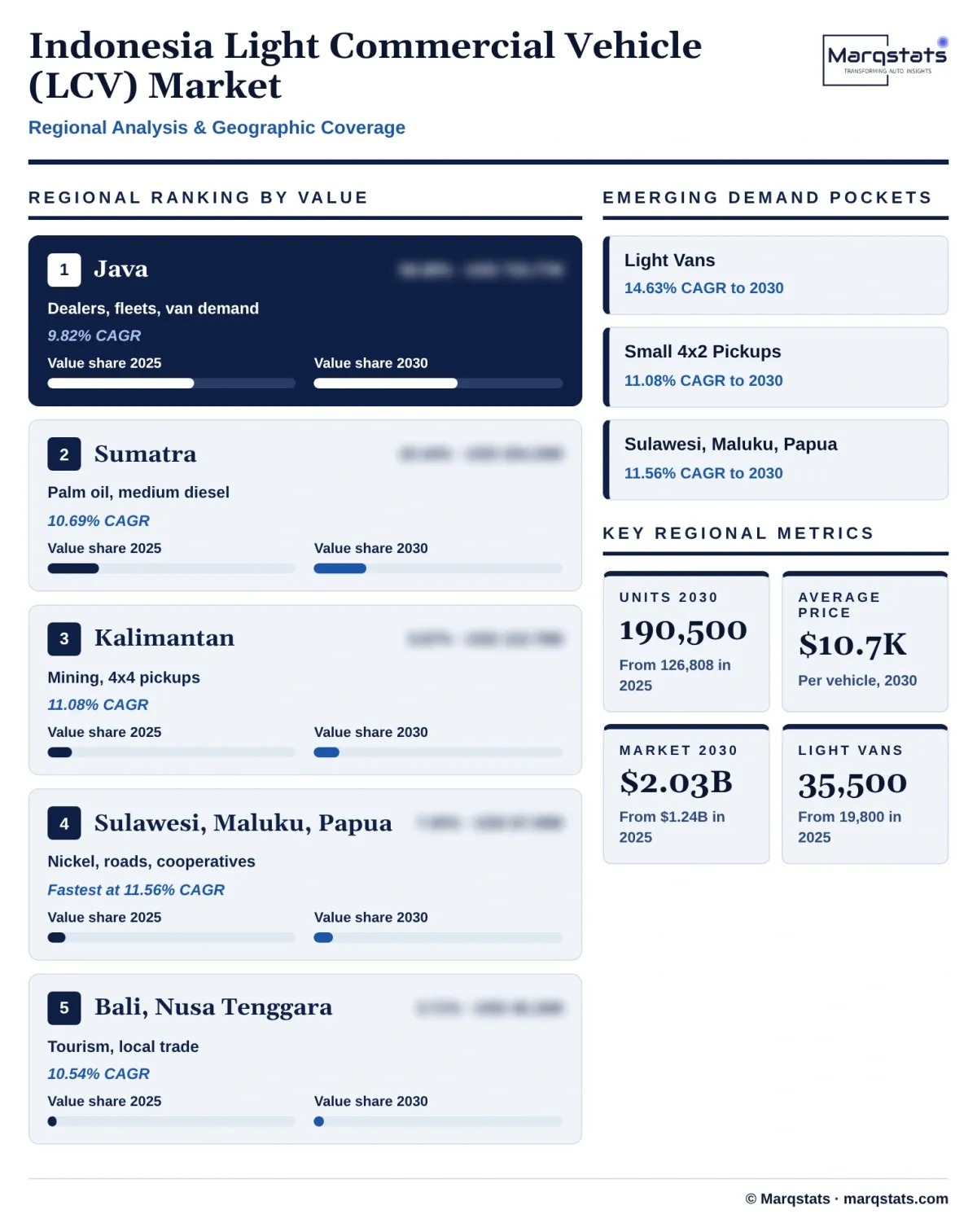
Small 4x2 pickups account for 46.09% of 2025 value, but light vans are the fastest-growing line, at 14.63% a year. Java accounts for 58.98% of value, while Sulawesi, Maluku and Papua grow fastest among regions, at 11.56% a year. Gaikindo data show Daihatsu wholesaled 14,784 Gran Max blind vans and minibuses in the first half of 2026, which annualises to 29,568, 62.35% above the 18,212 sold in 2025.
Key Takeaways
Market Overview & Analysis
Report Summary
Indonesian light commercial vehicles are being bought for new reasons. After total vehicle wholesales fell 7.2% to 803,687 units in 2025 from 865,723 in 2024, the Association of Indonesian Automotive Industries (Gaikindo) reported pickup wholesales of 107,008 units, up 5.35% from 101,572, while national wholesales for January to August 2026 reached 599,491 units, up 20.06%. Pickups rose about 44% in the same period, and the Daihatsu Gran Max blind van and minibus, a line that most pickup studies leave out, wholesaled 14,784 units in the first half of 2026.
Marqstats measures pickups and light vans of up to 5 tonnes gross vehicle weight at ex-factory value. The 2025 base is 126,808 vehicles, 15.78% of national wholesales: 107,008 pickups from the Gaikindo pickup class and 19,800 light vans, which Marqstats derives from the Gran Max blind van and minibus line of 18,212 units and a ratio that places that nameplate at 92% of the semi-commercial van segment. All dollar figures use IDR 16,476.85 per US dollar. Excluded adjacent markets are passenger cars, 608,687 units; trucks above 5 tonnes, 56,754 units; buses, 4,541 units, and microbuses, commuter vans and other commercial vehicles, 6,897 units; and electric buses, trucks and vans, USD 32.04 million.
The analysis is built for four groups. Vehicle makers and distributors can use it to set price and capacity by pickup class and for the van line that has opened since 2025. Leasing and multi-finance companies can size residual-value and credit exposure to small-business and programme fleets. Body builders and component suppliers can plan content by class. Investors and policy teams can test the effect of free-meal logistics, state procurement, biodiesel and overload rules on a market where one nameplate family carries almost half of volume.
Indonesia Light Commercial Vehicle (LCV) Market Size and Forecast
The Indonesia light commercial vehicle market grows from USD 1,244.10 million in 2025, or IDR 20.50 trillion, to USD 2,029.13 million in 2030, a CAGR of 10.28%. Volume is the primary series and price the derived one: wholesale units rise at 8.48% a year, from 126,808 to 190,500, and the average ex-factory price rises at 1.66% a year, from about USD 9,811 to USD 10,652. Pickups contribute USD 1,069.86 million in 2025 and USD 1,684.21 million in 2030, a 9.50% CAGR, and light vans USD 174.24 million and USD 344.92 million, a 14.63% CAGR.
The 2025 base is built bottom-up from Gaikindo wholesale data. The pickup line of 107,008 units is split into 70,522 small 4x2, 31,386 medium 4x2 and 5,100 4x4 pickups, anchored on model wholesales of 40,761 for the Daihatsu Gran Max Pick Up, 28,461 for the Suzuki Carry Pick Up, 12,410 for the Mitsubishi Colt L300 and 16,678 for the Toyota Hilux family. Ex-factory prices are estimated at IDR 134 million, IDR 198 million and IDR 385 million, equal to USD 8,133, USD 12,017 and USD 23,366. The van line starts from 18,212 Gran Max blind van and minibus wholesales, scaled to 19,800 vans because Daihatsu states that this nameplate holds 92% of the semi-commercial segment, and is priced at an ex-factory IDR 145 million, or USD 8,800.
The van price is derived from list prices. On the road in Jakarta Pusat, Zigwheels lists the Gran Max Pick Up from IDR 168.75 million and the blind van from IDR 169.6 million, while the Jakarta Utara list for blind van and minibus variants runs from IDR 184.4 million for the 1.3 standard to IDR 236.35 million for the 1.5 models. Marqstats weights the standard blind van and the higher minibus and automatic variants to an ex-factory price of IDR 145 million, about 8% above the IDR 134 million small pickup, which fits a vehicle with a closed body, rear doors and, in some variants, air conditioning and power steering.
The path to 2030 starts from a much higher 2026. Marqstats estimates 165,500 vehicles in 2026, 30.51% above 2025: 134,000 pickups, the January to August run rate of about 89,000 extended over the year, and 31,500 light vans, because Gran Max blind van and minibus wholesales were 14,784 in the first half and 2,726 in July and 2,316 in August. Growth after 2026 slows to 3.58% a year, to 170,500 in 2027, 176,500 in 2028, 183,200 in 2029 and 190,500 in 2030, because Marqstats treats free-meal, cooperative and rental fleet buying as a step up in the base and not a new growth rate.
The value rate exceeds the volume rate through price and the van line. Marqstats assumes ex-factory price increases of 2.00% a year for small pickups and vans, 2.20% for medium and 2.50% for 4x4 pickups, taking the 2030 ex-factory prices to about IDR 148 million for small pickups, IDR 221 million for medium pickups, IDR 436 million for 4x4 pickups and IDR 160 million for vans. Value in 2026 is USD 1,644.97 million, up 32.22%, and the average price rises 1.66% a year to 2030 even though cheaper small pickups grow faster than the medium class.
The market ladder shows where light commercial vehicles sit. National wholesales were 803,687 vehicles in 2025, of which 608,687 were passenger cars and about 195,000 were commercial vehicles. Of the commercial total, 107,008 were pickups, 56,754 trucks and 31,238 other commercial vehicles, a group that contains the light vans, buses and microbuses. Marqstats places 19,800 of the 31,238 in the van line, 63.38% of the group, and leaves 4,541 bus chassis, covered by the Indonesia Bus Market, and 6,897 microbuses, commuter vans and other vehicles outside it. Light commercial vehicles therefore total 126,808 units, 15.78% of national wholesales and 2.23 times the truck market in units.
Marqstats tracks four indicators to monitor the forecast: monthly Gaikindo wholesales for the Gran Max blind van and minibus, Gran Max Pick Up and Carry Pick Up; the number of Free Nutritious Meals kitchens in operation; deliveries of state-procured Indian pickups to village cooperatives; and the medium-pickup share of diesel pickups once B50 biodiesel is fully in use.
Market Dynamics
Key Drivers
Five forces keep light pickups and vans the default goods vehicles for Indonesian micro-businesses, meal programmes and village logistics.
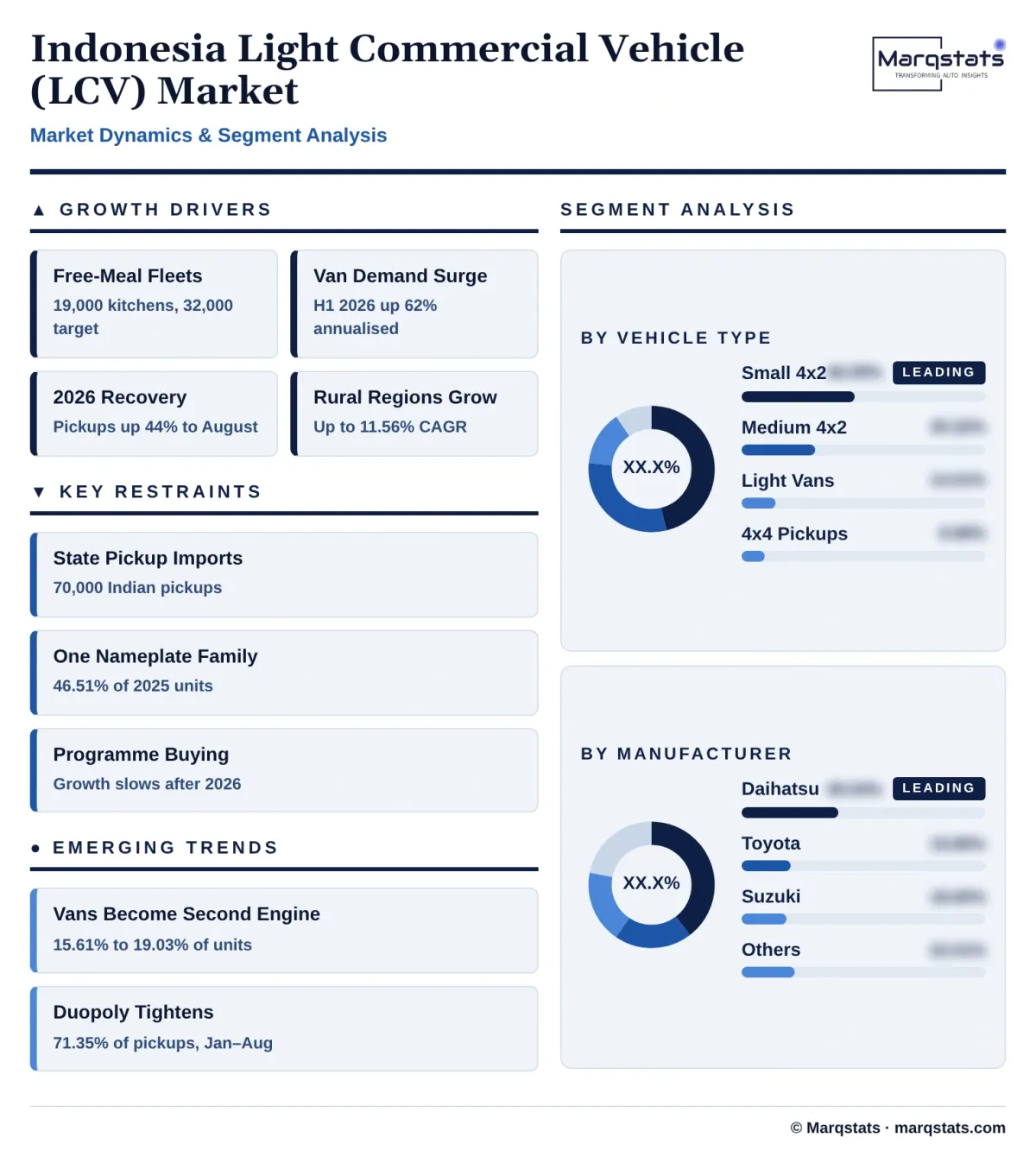
- Free-meal logistics create a new fleet buyer. Badan Gizi Nasional (BGN), the National Nutrition Agency, said in January 2026 that about 19,000 meal kitchens were operating and targeted 32,000 by the end of April 2026, and every kitchen needs delivery vehicles for schools and health posts. Daihatsu reported blind van wholesales rising from about 1,200 to about 2,300 a month, although Daihatsu did not attribute the rise to the programme.
- Micro-business logistics anchor pickup demand. The Gran Max Pick Up and Suzuki Carry Pick Up sold 69,222 units in 2025, 64.69% of pickups, and serve market traders, farmers and small distributors who need a low-cost load carrier with dense service coverage across the islands.
- The 2026 recovery lifts volume. Gaikindo data show about 89,000 pickups wholesaled in January to August 2026, up 44% year on year, and national wholesales of 599,491 units, up 20.06%, after a 2024 trough of 101,572 pickups that left many small fleets with ageing vehicles.
- Rural and resource regions are growing faster than Java. Sumatra, Kalimantan and Sulawesi, Maluku and Papua together account for 37.31% of 2025 value and grow at 10.69% to 11.56% a year as plantation, mining and village-cooperative logistics expand.
- Local assembly keeps prices stable. Daihatsu, Suzuki, Toyota, Mitsubishi and Isuzu build their pickups and vans in Indonesian plants, so a weaker rupiah, at IDR 16,476.85 per dollar in 2025, raises costs less than it would for imported models.
Key Restraints
Four constraints could slow growth or move volume out of the factory-to-dealer channel.
- State-procured imports bypass dealers. PT Agrinas Pangan Nusantara ordered 105,000 vehicles from India worth Rp 24.66 trillion, of which 35,000 are Mahindra Scorpio pickups and 35,000 Tata Yodha pickups, equal to 55.20% of 2025 light commercial wholesales. The Ministry of Cooperatives said on 30 March 2026 that imports would continue for cooperatives whose buildings were ready, and every unit delivered stays outside the factory-to-dealer series.
- One nameplate family carries the market. With 46.51% of 2025 units in the Gran Max pickup, blind van and minibus, a recall, a supply interruption or a price change moves total volume, and makers of medium and 4x4 pickups cannot offset it.
- Programme buying can reverse. Free-meal fleets and cooperative trucks are bought in waves, and Marqstats assumes growth slows to 3.58% a year after 2026 because a wave that fills an installed base does not repeat. The 2024 fall of 13.18% in pickups showed how quickly orders drop when borrowing costs rise or commodity incomes weaken.
- Biodiesel raises demands on diesel models. B50 became mandatory on 1 July 2026, and diesel medium and 4x4 pickups must run on a fuel blend with more palm oil, which raises fuel-system requirements and ownership risk for the 39.90% of value that sits in the medium and 4x4 classes.
Key Trends
Four shifts are changing who sells light commercial vehicles in Indonesia and what they are used for.
- Vans move from niche to second engine. Light vans rise from 15.61% of units in 2025 to 19.03% in 2026 and 18.64% in 2030, and the Gran Max blind van and minibus wholesaled 2,726 units in July 2026 and 2,316 in August 2026.
- The Gran Max and Carry duopoly tightens in pickups. Their share of pickup wholesales rose from 64.69% in 2025 to 71.35% in January to August 2026, and the monthly lead changes hands: the Carry sold 3,866 units against 3,565 for the Gran Max in May 2026.
- Factory-fitted bodies and comfort features spread. Isuzu showed Traga variants with factory-fitted air conditioning and custom boxes at the April 2026 commercial vehicle show, and the Toyota Hilux Rangga, launched on 15 October 2024 with up to 1.2 tonnes of payload, wholesaled 4,239 units in the first half of 2026.
- Local assembly becomes a political issue. Parliament and the Chamber of Commerce and Industry (Kadin) challenged the Indian import plan in February 2026, and the Minister of Cooperatives said about 80,000 units needed for the wider cooperative programme would be prioritised for domestic industry.
Strategic Implications
- For vehicle makers, the small 4x2 pickup and the blind van are where share is won and lost. A price move of IDR 5 million on a small pickup changes its ex-factory price by about 3.73%, and the van line is growing 14.63% a year in value on a closed-body platform that one maker supplies almost alone.
- For Toyota, Mitsubishi and Isuzu, the medium and 4x4 classes are the defensible niche: they are USD 496.33 million in 2025 and 4x4 pickups hold the highest price, near IDR 385 million, so service quality and fleet-finance terms matter more than list price.
- For leasing and finance companies, the 2024 fall of 13.18% in pickups followed by the 2026 rise of about 44% shows light commercial vehicles are cyclical. Residual-value assumptions should differ by class, and programme-fleet vans bought in a single wave need a separate resale curve.
- For body builders and component suppliers, volume is concentrated in a few platforms. Winning content on the Gran Max or Carry matters more than spreading across minor models, and factory-fitted bodies on the Traga and cooperative box bodies open a second channel.
- For policy teams, procurement, biodiesel and local-content rules all change the cost of a light commercial vehicle. A state purchase equal to 55.20% of one year of market volume, delivered outside the dealer series, can move supplier decisions as much as a tax change.
Market Segmentation
Small 4x2 gasoline pickups of up to about 2 tonnes gross weight account for 46.09% of 2025 value, USD 573.53 million, and 70,522 units. They grow at 11.08% a year to USD 969.74 million and 108,000 units, and reach 47.79% of value by 2030. The Daihatsu Gran Max and Suzuki Carry make up nearly all units, and the class gains share because small businesses and farmers want the lowest purchase price and parts cost.
Medium 4x2 diesel pickups account for 30.32% of 2025 value, USD 377.16 million, and 31,386 units. They grow at 7.55% a year to USD 542.63 million and 40,500 units, while their share falls to 26.74% by 2030. The Toyota Hilux Rangga, Mitsubishi Colt L300 and Isuzu Traga serve plantation, construction and distribution work that needs more payload and a diesel engine.
Single- and double-cab 4x4 pickups account for 9.58% of 2025 value, USD 119.17 million, and 5,100 units. They grow at 7.59% a year to USD 171.84 million and 6,500 units, and their share falls to 8.47% by 2030. The Toyota Hilux and Mitsubishi Triton serve mining, plantation and government fleets in Kalimantan, Sulawesi and Papua; imported 4x4 pickups bought by state agencies are excluded.
Light vans, led by the Daihatsu Gran Max blind van and minibus, account for 14.01% of 2025 value, USD 174.24 million, and 19,800 units. They grow fastest, at 14.63% a year, to USD 344.92 million and 35,500 units, and reach 17.00% of value by 2030. Demand comes from parcel and food delivery, rental fleets, meal-programme kitchens and small traders who want a closed cargo space; Toyota Hiace-type commuter vans are excluded.
Daihatsu accounts for 39.54% of 2025 value, USD 491.77 million, and 46.51% of units, 58,973 vehicles: 40,761 Gran Max pickups and 18,212 blind vans and minibuses. It grows at 10.84% a year to USD 822.73 million and 40.55% of value by 2030.
Toyota accounts for 19.85% of 2025 value, USD 246.97 million, on 16,678 Hilux-family units, 13.15% of units. Value per unit is high because the Hilux Rangga and 4x4 models sell above the small pickups. It grows at 6.59% a year to USD 339.85 million and 16.75% by 2030.
Suzuki accounts for 18.60% of 2025 value, USD 231.46 million, and 22.44% of units, 28,461 Carry pickups. It grows fastest among the large makers, at 13.48% a year, to USD 435.49 million and 21.46% of value by 2030, as the Carry gains on the Gran Max.
Mitsubishi accounts for 13.86% of 2025 value, USD 172.45 million, on about 13,408 units: 12,410 Colt L300 and about 998 Triton. It grows at 7.48% a year to USD 247.33 million and 12.19% by 2030.
Isuzu accounts for 6.18% of 2025 value, USD 76.91 million, on about 6,400 Traga units. It grows at 10.60% a year to USD 127.28 million and 6.27% by 2030, helped by factory-fitted bodies and air conditioning.
Wuling, DFSK and other brands, including the makers of the remaining 1,588 light vans, account for 1.97% of 2025 value, USD 24.54 million, on 2,888 units. They grow at 18.13% a year to USD 56.45 million and 2.78% by 2030, from a very small base, as Chinese-brand vans and pickups enter.
By Geography
Java
Java is the largest region, with 58.98% of 2025 value, USD 733.77 million, and grows at an estimated 9.82% a year to USD 1,172.33 million and 57.78% by 2030. Jakarta, West Java, Central Java and East Java hold the densest dealer networks, the parcel, food and rental fleets that buy vans, and the leasing companies that register fleets, so wholesale demand clusters there even when vehicles later move to other islands.
Sumatra
Sumatra accounts for 20.44% of 2025 value, USD 254.29 million, and grows at an estimated 10.69% a year to USD 422.47 million and 20.82% by 2030. Palm oil, rubber and food-crop logistics in Riau, North Sumatra, South Sumatra and Lampung favour medium diesel pickups such as the Isuzu Traga and Mitsubishi Colt L300.
Kalimantan
Kalimantan accounts for 9.87% of 2025 value, USD 122.79 million, and grows at an estimated 11.08% a year to USD 207.68 million and 10.23% by 2030. Coal, plantation and construction work make it the main market for 4x4 single- and double-cab pickups such as the Toyota Hilux and Mitsubishi Triton.
Sulawesi, Maluku and Papua
Sulawesi, Maluku and Papua account for 7.00% of 2025 value, USD 87.09 million, and grow fastest, at an estimated 11.56% a year, to USD 150.46 million and 7.42% by 2030. Nickel mining, road building and the village-cooperative programme lift demand for medium and 4x4 pickups.
Bali and Nusa Tenggara
Bali and Nusa Tenggara account for 3.71% of 2025 value, USD 46.16 million, and grow at an estimated 10.54% a year to USD 76.19 million and 3.75% by 2030. Tourism supply, construction and local agricultural trade drive demand, and small pickups and vans suit the island roads.
How Competition Is Evolving
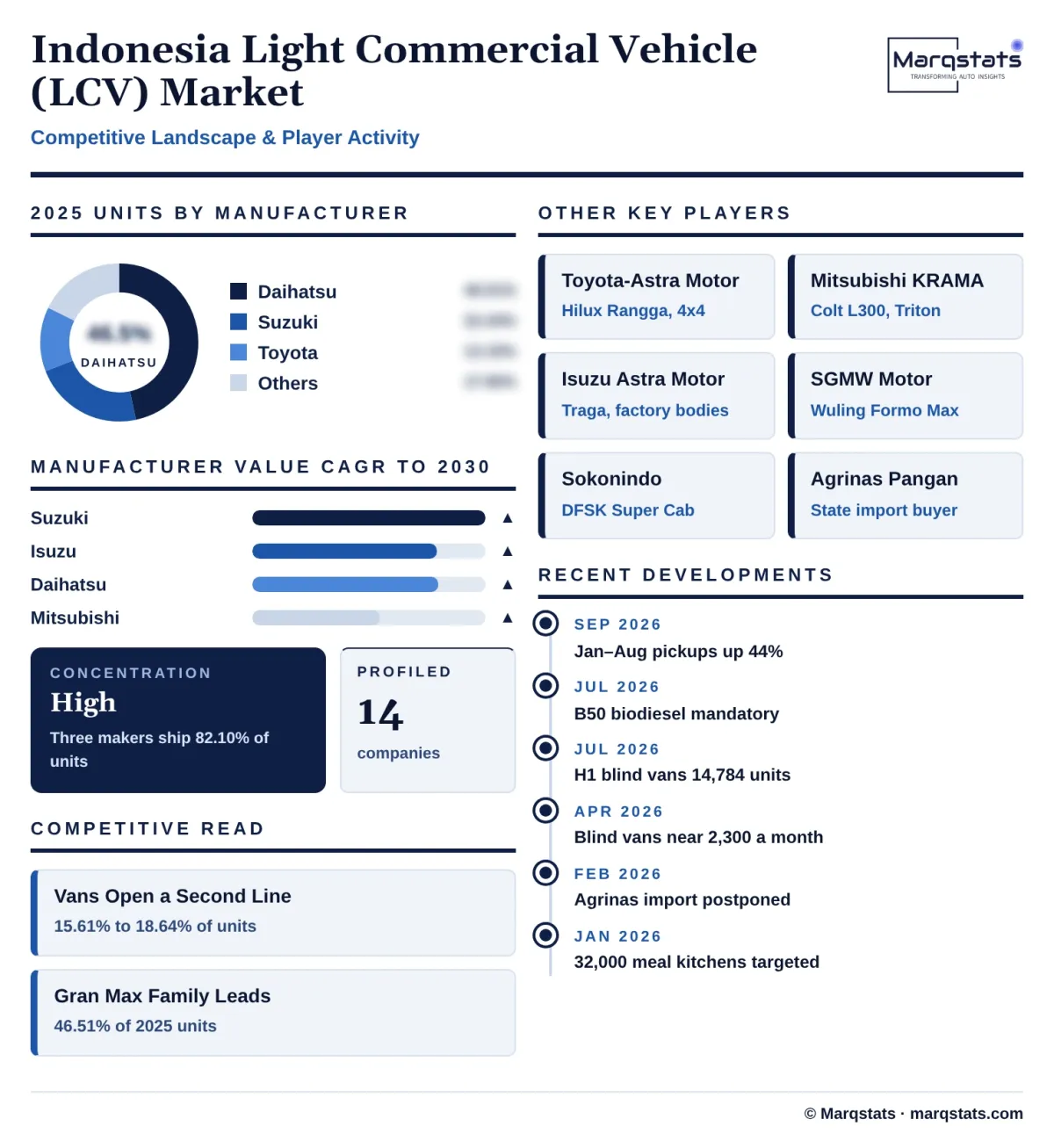
The market is highly concentrated. Daihatsu, Suzuki and Toyota delivered 82.10% of 2025 units: Daihatsu 46.51% through the Gran Max pickup and the blind van and minibus, Suzuki 22.44% and Toyota 13.15%. In pickups alone the Gran Max and Carry took 64.69% of 2025 units and 71.35% in January to August 2026, so the order is moving toward a tighter duopoly, while in vans a single maker holds about 92% of the semi-commercial segment.
Competition is on price, reach and fleet terms rather than product features. Small-pickup and van buyers compare list prices that differ by a few million rupiah, the nearest authorised workshop, parts cost and resale value. Medium and 4x4 buyers weigh payload, diesel durability, financing and the maker relationship with plantation, mining and logistics fleets. State buyers add a fourth test, bulk price, which is why Agrinas Pangan Nusantara went to Indian makers after talks with domestic makers did not agree on price.
Local assembly and distribution decide position. Daihatsu and Suzuki build pickups and vans at plants in Indonesia and sell through national dealer and workshop networks, which new entrants cannot copy quickly. Wuling and DFSK compete with lower prices and more equipment, and Chinese brands now hold a visible share of passenger wholesales, but together they held about 2.28% of 2025 light commercial units, and state-procured imports sit outside the series.
Companies Covered
Companies covered in the report include:
Recent Market Activity
Table of Contents
Coverage & Segmentation
The study covers the Indonesia light commercial vehicle market, with 2025 as the base year, 2021 – 2025 as the historical period and 2026 – 2030 as the forecast period. It covers new pickups and light vans of up to 5 tonnes gross vehicle weight wholesaled by manufacturers to dealers in Indonesia, segmented by vehicle type, manufacturer group and region across Java, Sumatra, Kalimantan, Sulawesi, Maluku and Papua, and Bali and Nusa Tenggara. Values are ex-factory values in US dollars, converted from rupiah at IDR 16,476.85 per US dollar, the 2025 average, and held constant through the forecast. The pickup line of 107,008 units and USD 1,069.86 million equals the Indonesia Pickup Truck Market.
Passenger cars, trucks above 5 tonnes, buses and microbuses, Toyota Hiace-type commuter vans, electric buses, trucks and vans, exports of about 20,326 commercial vehicles in 2025, pickups and trucks imported by state buyers outside the Gaikindo series, used vehicles, and bodies and aftermarket equipment are excluded. The pickup line is also reported by the Indonesia Pickup Truck Market and the above-5-tonne trucks by the Indonesia Truck Market, and neither should be added to this market; electric commercial vehicles are covered by the Indonesia Electric Commercial Vehicle Market page and passenger cars by the Indonesia Passenger Car Market page.