Market Snapshot
Middle bar: base-year value × (1 + CAGR), rounded to two decimals. This is a calculated illustration, not a separately researched annual estimate.
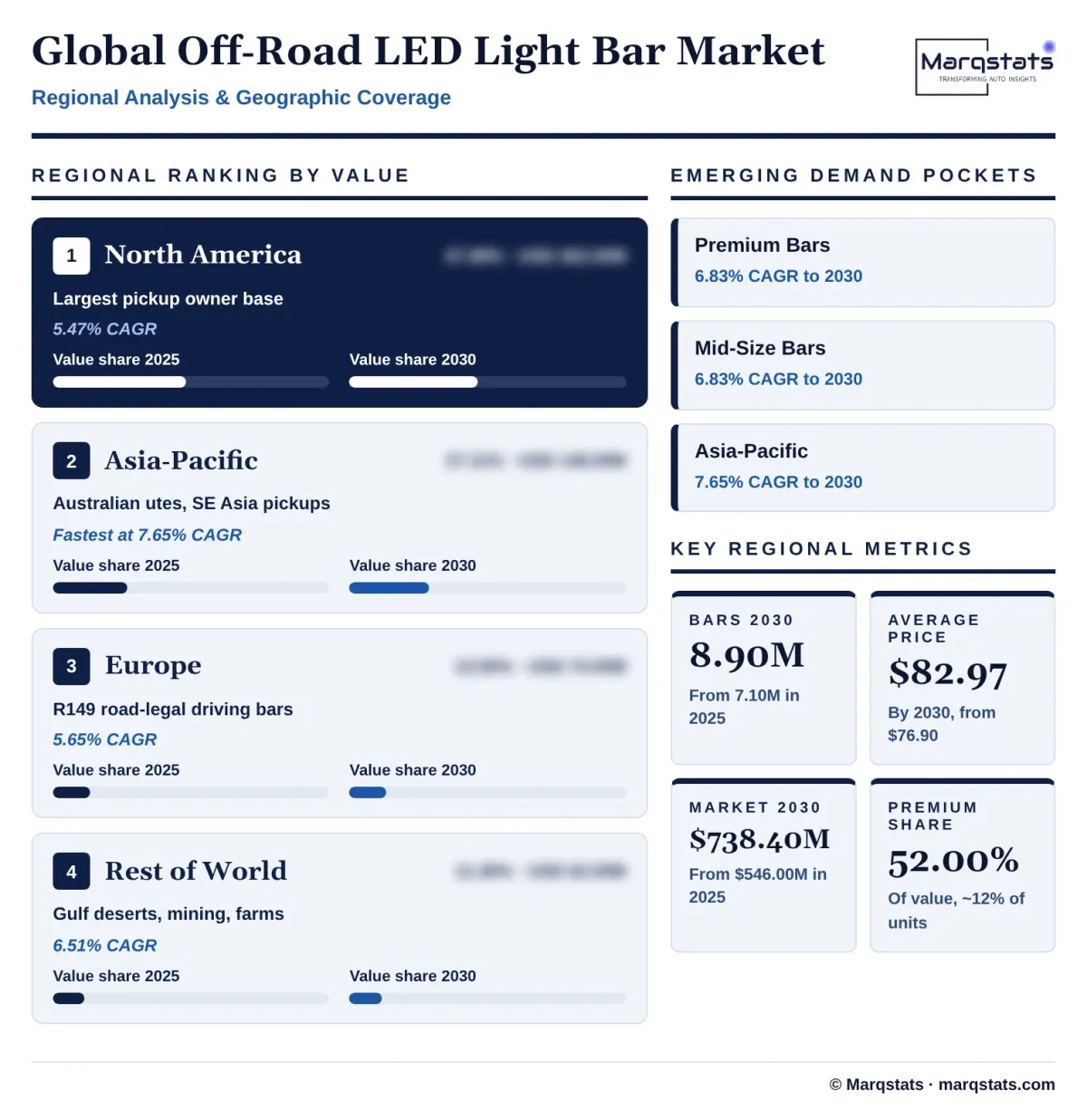
The global off-road LED light bar market size is estimated at USD 546.00 million in 2025 and is projected to reach USD 738.40 million by 2030, growing at a CAGR of 6.22% over 2026 – 2030. Annual shipments rise from about 7.10 million bars to 8.90 million, a 4.62% annual rate, while the average ex-factory price climbs from about USD 76.90 to USD 82.97 per bar as buyers trade up to engineered optics, dual-colour beams and vehicle-specific kits.
Marqstats defines the market as the ex-factory value of linear, multi-emitter LED auxiliary light bars sold for off-highway, 4x4, powersports and off-road work vehicle use, through aftermarket distributors, specialty retailers, online marketplaces and carmaker accessory programmes. Single round or square LED pods, work lamps, original equipment headlamps, emergency warning light bars, interior and accent strips, and installation labour are excluded.
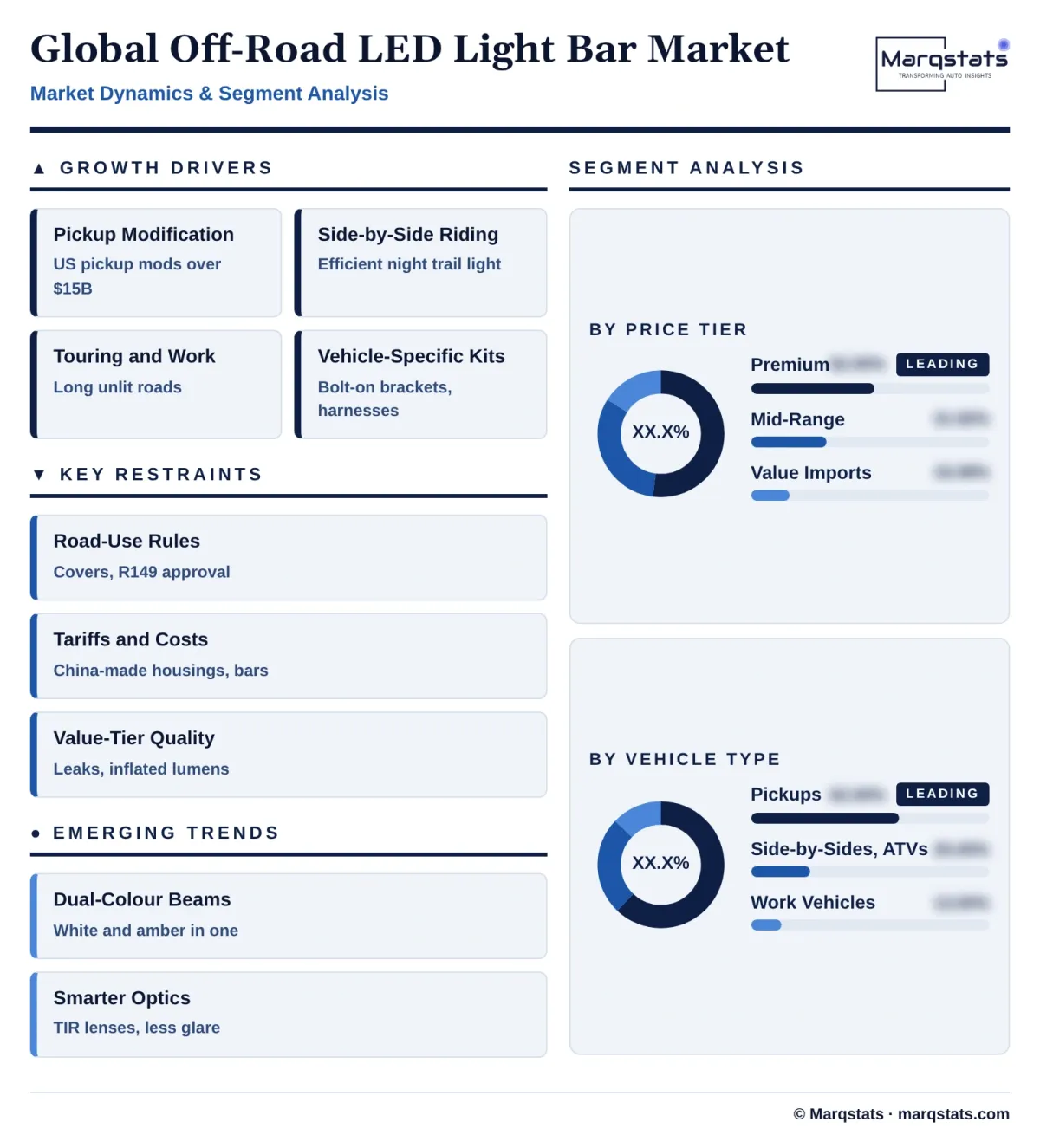
Premium engineered bars from specialist brands account for an estimated 52.00% of 2025 value but only about 12% of units. Pickups and 4x4 SUVs take 62.00% of value and North America 47.99%. The study segments the market by price tier, bar length, vehicle type and region.
Key Takeaways
Market Overview & Analysis
Report Summary
Marqstats sizes the off-road LED light bar market as the ex-factory value of linear auxiliary LED lights built for off-highway use. In 2025 about 7.10 million bars were shipped worldwide, worth an estimated USD 546.00 million at an average ex-factory price of about USD 76.90.
An off-road LED light bar combines an extruded aluminium housing that also acts as a heat sink, a metal-core circuit board carrying high-power LEDs, optics that shape the beam, a hard-coated polycarbonate lens, and seals and pressure vents rated to IP67, IP68 or IP69K. Engineered bars use injection-moulded total internal reflection optics or precision reflectors, thermal sensors that reduce current as temperature rises, and drivers protected against voltage spikes and reverse polarity. Value-tier bars use simpler reflectors, fewer thermal controls and lighter seals.
Buyers fit light bars to pickups, Jeeps and 4x4 SUVs for trail, touring and work use, to side-by-sides and all-terrain vehicles that run in the dark at low speed, and to tractors, mining utility vehicles and forestry machines that work at night. Bars are mounted in bumper and grille openings, on winch plates, bull bars and roof racks, and increasingly with vehicle-specific brackets and wiring kits that fit a single model without drilling.
The market grew from USD 455.00 million and about 6.05 million bars in 2021 to USD 488.00 million in 2022, when post-pandemic demand for outdoor recreation and new pickups was strong, then more slowly to USD 506.00 million in 2023 and USD 522.00 million in 2024 as dealer inventories normalised and higher interest rates weighed on vehicle purchases. Marqstats expects about 7.42 million bars worth USD 575.00 million in 2026.
Rules shape what can be used on public roads. In the United States, federal lighting standard FMVSS 108 has no category for auxiliary light bars, so state laws apply; California, for example, requires off-road lamps mounted above 42 inches to be covered on public roads. In Europe, lamps must be type-approved under UN Regulation 149 and installed under UN Regulation 48. Australian states apply ADR 13/00, under which a single light bar counts as one driving lamp and must be centred and wired to switch off with the high beam.
Specialist brands and value sellers serve different buyers. Specialist brands sell through 4x4 outfitters, powersports dealers and their own websites, test bars for water, dust and vibration, and back them with long warranties. Value sellers list bars on online marketplaces at a fraction of the price, using contract manufacturers in Guangdong and Zhejiang. Marqstats estimates about 58% of bars shipped in 2025 were value imports, but these earned only about 16% of market value.
Technology keeps changing what a light bar does. White and amber dual-colour optics, infrared lights for filming and night vision, chase lights for dusty convoys, built-in controllers and plug-in harnesses for factory upfitter switches turn a simple accessory into a lighting system, and each step adds value per bar.
Global Off-Road LED Light Bar Market Size and Forecast
The global off-road LED light bar market grows from USD 546.00 million in 2025 to USD 738.40 million in 2030, a CAGR of 6.22%. Marqstats expects shipments of about 7.75 million bars worth USD 609.00 million in 2027, 8.10 million worth USD 646.00 million in 2028 and 8.50 million worth USD 690.00 million in 2029, before reaching 8.90 million bars in 2030.
Prices per bar rise rather than fall. The average ex-factory price was about USD 75.21 in 2021 and USD 76.20 in 2024, reaches USD 76.90 in 2025 and rises to about USD 82.97 in 2030, a 1.53% annual increase. LED and circuit board costs keep falling, but buyers move towards engineered optics, dual white and amber beams, built-in controllers and vehicle-specific mounting kits, and tariffs raise landed costs for value-tier imports.
The forecast is built from vehicle demand. Marqstats estimates purchases from the parc of off-road-capable pickups and SUVs, side-by-side and all-terrain vehicle sales, and off-highway machine fleets in each region, then multiplies fitments by a share of buyers who add a light bar and by the number of bars per vehicle. Each region is then split into premium, mid-range and value tiers using brand pricing and channel checks.
Three indicators are tracked to monitor the forecast: pickup and SUV sales and accessory spending reported by SEMA and national bodies, results of listed suppliers such as Holley, Amotiv and ARB, and tariff and enforcement changes affecting imported bars and roof-mounted lighting.
Growth is steady rather than rapid. Unlike lighting categories linked to new regulation, light bars are a discretionary accessory, so demand follows vehicle sales, consumer confidence and outdoor recreation, and grows close to the rate of accessory spending.
The mix shifts towards higher-value products. Premium engineered bars rise from 52.00% to 53.49% of value, mid-size bars from 44.16% to 45.42%, and Asia-Pacific from 27.11% to 28.98%, while value imports fall from 16.08% to 15.36% and off-highway work vehicles from 13.00% to 12.19%.
Unit growth is fastest in value imports by count but slowest by value. Value-tier shipments rise from about 4.15 million to 5.08 million bars while their average price edges up from about USD 21 to USD 22, whereas premium shipments rise from about 0.85 million to 1.12 million bars at about USD 334 to USD 353 each.
Market Dynamics
Key Drivers
Five forces are lifting demand for off-road LED light bars across trucks, side-by-sides and work machines.
- Pickup and SUV modification. SEMA's 2026 Market Report puts US accessory and performance parts sales at USD 52.92 billion in 2025, with pickup products accounting for 30% and owners spending more than USD 15 billion modifying pickups, and auxiliary lighting is one of the most common first modifications.
- Side-by-side and all-terrain riding. Side-by-sides run at night on trails and farms, and their limited charging capacity favours efficient LED bars with high light output per watt.
- Touring and remote work. In Australia, Southern Africa and the Middle East, long night drives on unlit roads, and the risk of hitting animals, support demand for long-range driving bars on utes and 4x4 wagons.
- Vehicle-specific kits. Brackets, harnesses and switch integrations designed for a single model, such as the 2025 Toyota 4Runner, Ford Bronco and Jeep Wrangler, make installation easier and raise the value of each sale.
- Night work in agriculture, mining and construction. Off-highway machines and mine utility vehicles use durable bars rated to IP69K and vibration standards, replacing halogen work lamps.
- Rising interest in overlanding. Multi-day touring with camping equipment adds demand for driving, flood and camp lighting on the same vehicle.
Key Restraints
Four constraints hold back how fast off-road LED light bars sell and how much buyers pay.
- Road-use rules. Bars that are not approved under UN Regulation 149, SAE J581 or local rules can only be used off road, and states such as California require high-mounted off-road lamps to be covered on public roads, limiting the appeal of large roof bars.
- Glare complaints. Bright bars used on public roads blind other drivers, and enforcement campaigns can slow sales of roof-mounted bars.
- Tariffs and costs. Most aluminium housings, circuit boards and value-tier bars are made in China, and higher US tariffs raise landed costs and squeeze margins for importers.
- Quality problems in the value tier. Water ingress, solder fatigue and exaggerated lumen claims raise return rates for low-priced bars and can put buyers off the category.
- Discretionary spending. Light bars are optional, so weaker vehicle sales or consumer confidence quickly slow purchases, as seen in softer Australian reseller demand in 2025 and 2026.
Key Trends
Four shifts are changing how off-road LED light bars are designed, fitted and sold.
- Dual-colour beams. Bars and pods that switch between white and amber, such as Diode Dynamics' dual-colour lineup shown at SEMA 2025, give one light for clear nights and another for dust, fog and snow.
- Total internal reflection optics. Moulded optics put more light into the beam and less into glare than stamped reflectors, improving useful range at the same power.
- Integration with vehicle switches and data. Upfitter switch panels, multi-channel controllers and CAN-bus interfaces replace separate relays and dash switches, and turn bars on with the high beam automatically.
- Production outside China. Specialist brands assemble in the United States, Australia and Thailand, and value-tier suppliers are shifting assembly to Southeast Asia to reduce tariff exposure.
- Infrared and chase lights. New products such as infrared bars for night vision and rear chase bars for dusty convoys extend light bars beyond forward driving light.
Strategic Implications
- For specialist brands, value comes from engineering and fit. Vehicle-specific kits, replaceable lenses, dual-colour optics and road-legal certified versions support prices that value-tier imports cannot match.
- For value-tier suppliers, quality and compliance decide survival. Better seals, honest photometric data and tariff-resilient supply chains reduce returns and keep online marketplace listings competitive.
- For distributors and installers, kits beat bare bars. Selling a bar with brackets, wiring and switch integration raises the ticket and reduces comebacks.
- For carmakers, accessory programmes are an opening. Licensed or dealer-fitted light bars on off-road trims capture spending that otherwise goes to the aftermarket.
- For component suppliers, efficient emitters and drivers matter most. High-efficacy automotive LEDs, compact drivers with thermal control and durable vents determine performance and warranty cost.
- For investors, the premium tier is the profit pool. Specialist brands earn most of the value from a small share of units, so brand strength, dealer reach and engineering capability matter more than factory scale.
Market Segmentation
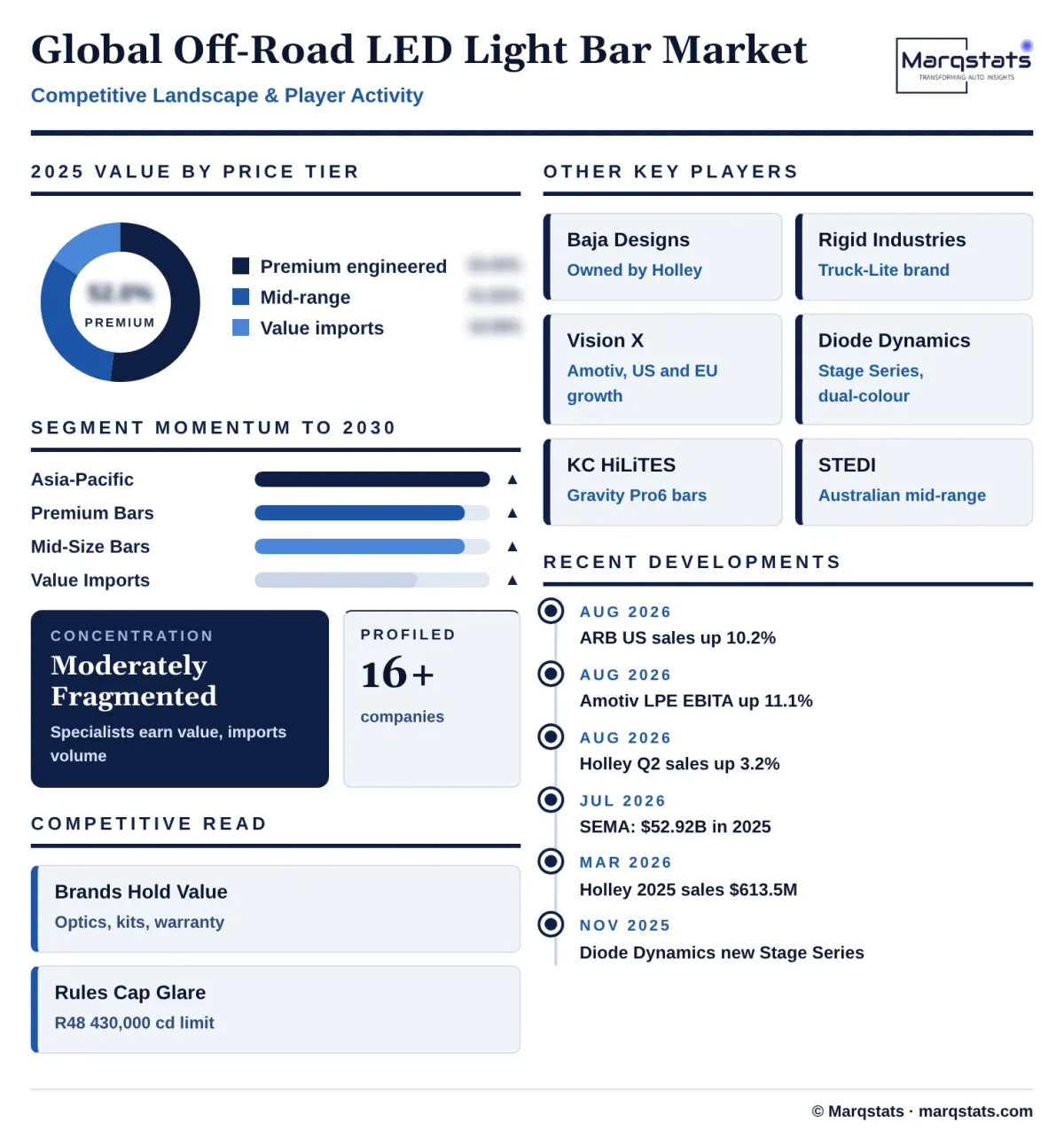
Bars from specialist brands selling at about USD 334 ex-factory account for 52.00% of 2025 value, USD 283.92 million, on about 0.85 million units, and grow at 6.83% a year to USD 395.00 million and 53.49% of the market by 2030. Baja Designs, Rigid Industries, KC HiLiTES, Diode Dynamics, Vision X, Lightforce, Lazer Lamps and J.W. Speaker compete on optics, durability, warranty and road-legal versions.
Branded mid-range bars selling at about USD 83 ex-factory account for 31.92% of 2025 value, USD 174.30 million, on about 2.10 million units, and grow at 5.70% a year to USD 230.00 million. Brands such as STEDI, Rough Country, Narva, Putco and ARB's lighting range lead this tier.
Low-priced bars sold mainly through online marketplaces at about USD 21 ex-factory account for 16.08% of 2025 value, USD 87.78 million, but about 4.15 million units, 58% of all bars, and grow at 5.26% a year to USD 113.40 million.
Compact bars account for 30.86% of 2025 value, USD 168.50 million, and grow at 5.48% a year to USD 220.00 million. They are used in fog-light pockets, on bull bar wings, on side-by-side front ends and in pairs on bumpers.
Mid-size bars are the largest segment, with 44.16% of 2025 value, USD 241.10 million, and the fastest growing length at 6.83% a year to USD 335.40 million, because they fit in bumpers, grilles and winch plates without adding glare or wind noise.
Full-size bars account for 24.98% of 2025 value, USD 136.40 million, and grow at 6.05% a year to USD 183.00 million, mainly on roof racks and windscreen mounts of Jeeps, Broncos, Land Cruisers and side-by-sides.
Pickups and 4x4 SUVs account for 62.00% of 2025 value, USD 338.50 million, and grow at 6.42% a year to USD 462.00 million, led by the Ford F-150 and Ranger, Toyota Tacoma, Hilux, 4Runner and Land Cruiser, Jeep Wrangler and Gladiator, and Ford Bronco.
Side-by-sides and all-terrain vehicles account for 25.00% of 2025 value, USD 136.50 million, and grow at 6.43% a year to USD 186.40 million, helped by model-specific kits for Polaris RZR and Can-Am Maverick vehicles.
Tractors, mining utility vehicles, forestry and construction machines account for 13.00% of 2025 value, USD 71.00 million, and grow at 4.86% a year to USD 90.00 million, with demand for IP69K sealing and resistance to heavy vibration.
By Geography
North America
North America is the largest market, with 47.99% of 2025 value, USD 262.00 million and about 3.10 million bars, rising to USD 342.00 million by 2030, a 5.47% CAGR. The region has the largest base of pickup owners, a strong side-by-side culture, and specialist brands that assemble locally, including Baja Designs, Rigid Industries, KC HiLiTES and Diode Dynamics. State lighting laws decide what can be used on public roads, and tariffs on Chinese-made bars raise landed costs for value-tier imports.
Asia-Pacific
Asia-Pacific accounts for 27.11% of 2025 value, USD 148.00 million and about 2.35 million bars, and grows fastest, at 7.65% a year, to USD 214.00 million by 2030. Australia is the largest buyer per vehicle, with long-range driving bars on utes and 4x4 wagons, and brands such as Lightforce, STEDI, Narva, Vision X and ARB. Southeast Asian pickup markets in Thailand, the Philippines and Indonesia are growing, and China is the main manufacturing base for housings, circuit boards and value-tier bars.
Europe
Europe accounts for 13.55% of 2025 value, USD 74.00 million and about 0.62 million bars, and grows at 5.65% a year to USD 97.40 million. Road use requires approval under UN Regulation 149 and installation within the UN Regulation 48 intensity limit, so road-legal bars from Lazer Lamps, HELLA, J.W. Speaker and others sell at higher prices. Demand is strongest in the Nordic and Baltic countries, where long winter nights and wildlife on rural roads favour approved driving bars, and in agriculture and forestry.
Rest of the World
The rest of the world accounts for 11.36% of 2025 value, USD 62.00 million and about 1.03 million bars, and grows at 6.51% a year to USD 85.00 million. Demand comes from desert driving in the Gulf states, mining and agriculture in Southern Africa and Latin America, and pickups such as the Toyota Hilux used on unpaved roads, where bars need to withstand heat, dust and washdowns.
How Competition Is Evolving
The off-road LED light bar market is moderately fragmented. A group of specialist brands with engineering, testing and dealer networks earns most of the value, while a long tail of online sellers using contract manufacturers in China supplies most of the units.
The leading specialists belong to larger groups. Baja Designs is owned by Holley, which reported 2025 net sales of USD 613.5 million. Rigid Industries has been part of Truck-Lite since 2015, and Truck-Lite has been backed by Genstar Capital since 2019. Vision X and Narva belong to Amotiv, whose Lighting, Power and Electrical segment reported revenue of A$315.9 million in its 2026 financial year. ARB sells its own lighting alongside bull bars and winches.
Global lighting companies compete in road-legal and work markets. FORVIA HELLA, J.W. Speaker, Grote and Lazer Lamps offer bars approved under UN Regulation 149 or SAE standards, and supply agricultural, mining and commercial vehicle customers.
Competition is shifting from raw brightness to complete systems. Brands that offer vehicle-specific kits, dual-colour optics, replaceable parts, controllers and certified road-legal versions defend prices, while value-tier sellers compete mainly on price and marketplace visibility.
Results of listed suppliers show a slow but steady market. Holley guided 2026 core net sales of USD 610 million to USD 640 million after reporting 2025 net sales of USD 613.5 million. Amotiv's lighting revenue rose 1% in its 2026 first half as Vision X growth in the United States and Europe offset softer Australian demand. ARB's 2026 sales fell 3.8% to A$702.0 million, but US sales rose 10.2%.
Manufacturing location is becoming a competitive factor. Several specialists assemble in the United States or Australia, ARB manufactures in Thailand, and value sellers rely on China, so tariffs and freight costs change relative prices across regions.
Companies Covered
Companies covered in the report include:
Recent Market Activity
Table of Contents
Coverage & Segmentation
The study covers the global off-road LED light bar market, with 2025 as the base year, 2021 – 2025 as the historical period and 2026 – 2030 as the forecast period. Values are in US dollars at ex-factory manufacturer prices, and volumes are annual shipments of light bars. The market is segmented by price tier, bar length, vehicle type and region. Australian dollar figures are converted at A$1 = USD 0.6451, the 2025 average.
Single LED pods, work lamps, original equipment headlamps, emergency warning light bars, interior and accent strips, wiring kits sold without a bar and installation labour are excluded. Light bars form part of the wider vehicle electrical and lighting category in the Marqstats Australia 4x4 Accessories and UAE Car Modification and Off-Road Accessories reports, so the figures should not be added to those totals. Segment and regional splits are Marqstats estimates built on supplier disclosures, vehicle and accessory sales data, and price benchmarks.