Market Snapshot
Middle bar: base-year value × (1 + CAGR), rounded to two decimals. This is a calculated illustration, not a separately researched annual estimate.
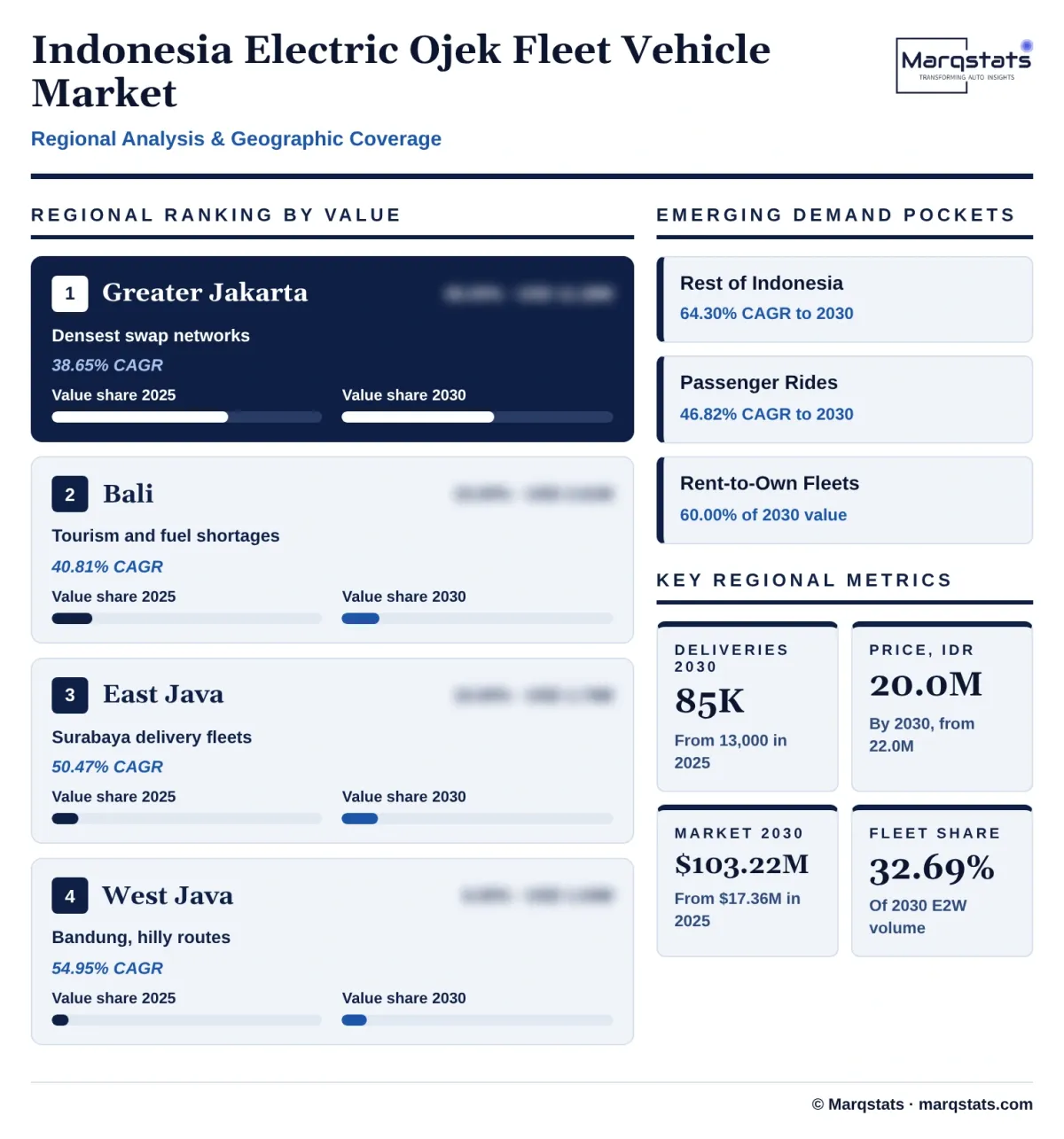
The Indonesia electric ojek fleet vehicle market size is estimated at USD 17.36 million in 2025 and is projected to reach USD 103.22 million by 2030, growing at a CAGR of 42.84% over 2026 – 2030. Annual deliveries of electric two-wheelers into ride-hailing and platform delivery fleets rise from about 13,000 units to 85,000, a 45.58% annual rate, while the average fleet acquisition price eases from about IDR 22.0 million to IDR 20.0 million per vehicle.
Marqstats defines the market as the value of new battery electric motorcycles and scooters registered and deployed each year for commercial ojek online work in Indonesia: passenger rides, food delivery and parcel delivery booked through apps such as Gojek, Grab, Maxim and inDrive, plus delivery fleets run for these platforms. It covers vehicles bought or leased by platform-linked fleet companies, rent-to-own schemes and individual riders who use the vehicle for platform work. Private commuter electric motorcycles, petrol motorcycles, three- and four-wheelers and battery swapping or subscription fees are excluded. Values are converted at IDR 16,470 per USD, the 2025 average rate.
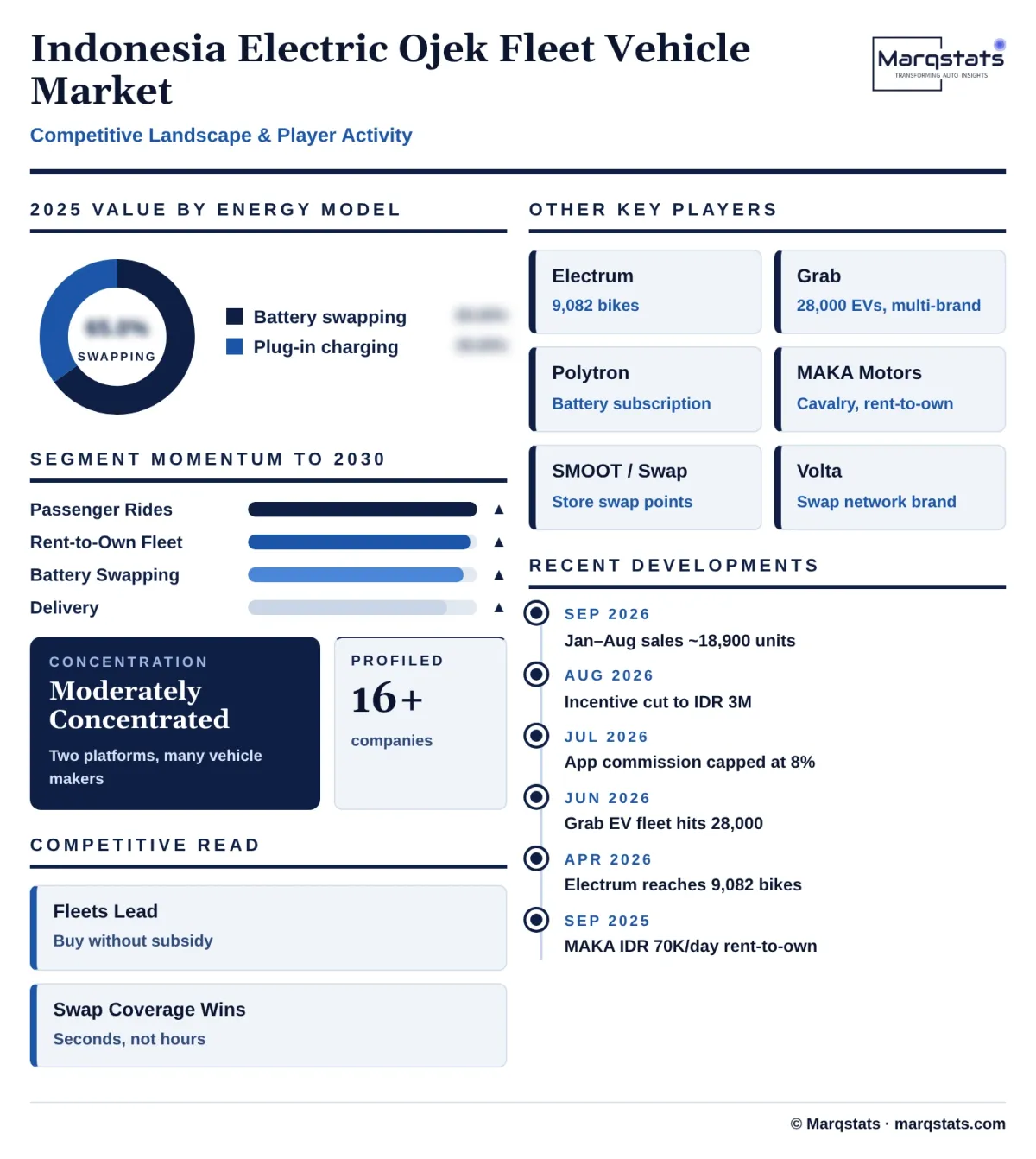
Food and parcel delivery accounts for an estimated 69.23% of 2025 value and battery swapping models for 65.00%. Greater Jakarta accounts for 65.00% of 2025 value. The study segments the market by acquisition model, energy model, service type and region.
Key Takeaways
Market Overview & Analysis
Report Summary
Marqstats sizes the Indonesia electric ojek fleet vehicle market as the value of new battery electric two-wheelers that enter commercial ojek online service each year. In 2025 about 13,000 such vehicles were deployed, worth an estimated IDR 286 billion or USD 17.36 million at an average fleet price of IDR 22.0 million. The figure matches the ride-hailing and fleet delivery segments of the Marqstats Indonesia electric two-wheeler study, which puts 2025 national registrations at 55,059 units; the two studies share the same base and should not be added together.
Ojek online is the largest commercial use of motorcycles in Indonesia. Millions of riders carry passengers, food and parcels through Gojek, Grab, Maxim, inDrive and ShopeeFood, typically covering 80 to 150 km a day, six or seven days a week. On a petrol scooter that mileage costs about IDR 22,000 a day in Pertalite fuel plus oil and servicing, so energy is a rider's largest daily expense after vehicle payments. An electric scooter on a swap subscription or home charging cuts that cost by roughly half or more, which is why riders and platforms adopt electric motorcycles faster than private commuters.
Three supply models serve the market. Vertically integrated platforms build vehicles and swap networks for their own riders, led by Electrum, the joint venture of GoTo and TBS Energi Utama that serves Gojek riders. Multi-brand platforms such as Grab work with vehicle makers, fleet leasing companies and swap operators rather than building their own vehicles. Independent riders buy or lease vehicles from brands such as Polytron, MAKA Motors, Volta, SMOOT, ALVA and Viar, often paying for the battery as a monthly subscription.
The market grew from about 1,500 vehicles in 2021, worth USD 2.23 million, to 2,600 in 2022, 7,800 in 2023 and 11,200 in 2024, worth USD 15.30 million, as Electrum started commercial operations, Grab expanded GrabBike Electric and the IDR 7 million purchase subsidy cut prices for eligible models. Growth slowed in 2025 to about 13,000 vehicles when the subsidy ended, but fleet deployments held up far better than retail sales.
Fleet buying is less sensitive to subsidies than retail buying. A rider earning from the vehicle every day measures cost per kilometre rather than sticker price, and platform rent-to-own schemes spread the purchase over daily payments. This explains why fleet deployments kept rising in 2025 and 2026 while national electric motorcycle sales fell.
Regulation shapes the market at several points. Every electric motorcycle needs a type-registration certificate from the Ministry of Transportation before it can be licensed, and the ministry's registration data are the main official count of sales. Purchase incentives have been tied to local content rules set by the Ministry of Industry, so only locally made models with enough domestic content qualify. Ride-hailing fares are set by the Ministry of Transportation by zone, and since July 2026 platform commissions are capped at 8%. Swap stations follow national standards for battery swap stations, but batteries from different operators remain incompatible.
The Indonesian government has set ambitious long-term targets for electric two-wheelers, but the installed base remains small. National registrations of 55,059 units in 2025 compare with annual motorcycle sales of more than six million, so electric models still account for about 1% of the market. Fleets are the part of the market where electric motorcycles already make clear economic sense, which is why they matter more to the transition than their volume suggests.
Indonesia Electric Ojek Fleet Vehicle Market Size and Forecast
The Indonesia electric ojek fleet vehicle market grows from USD 17.36 million in 2025 to USD 103.22 million in 2030, a CAGR of 42.84%. Marqstats expects deliveries of about 15,500 vehicles worth USD 20.23 million in 2026, 23,000 worth USD 29.33 million in 2027, 35,000 worth USD 43.78 million in 2028 and 55,000 worth USD 67.79 million in 2029, reaching 85,000 worth USD 103.22 million in 2030. In rupiah, the market grows from about IDR 286 billion to IDR 1,700 billion.
Growth in 2026 is modest because the retail market is stalled by subsidy uncertainty and fleet buyers are waiting to see whether eligible models will qualify for the new incentive. From 2027 Marqstats expects faster fleet additions as Grab pursues its target of tripling its electric fleet, Electrum adds swap stations and vehicles, and rent-to-own offers from MAKA Motors, Polytron and fleet leasing companies scale.
Prices ease slowly. The average fleet acquisition price falls from about IDR 24.5 million in 2021 to IDR 22.0 million in 2025 and IDR 20.0 million in 2030 as battery cells get cheaper and local assembly grows. Because the battery is often leased separately, the vehicle price paid by fleets falls less than battery costs. Volume therefore grows at 45.58% a year while value grows at 42.84%.
Rider economics drive adoption. Marqstats estimates a petrol scooter covering 100 km a day costs about IDR 22,000 in fuel and IDR 5,000 in oil and servicing, against about IDR 12,500 in swap or subscription fees and IDR 1,500 in servicing for an electric scooter, a saving of about IDR 13,000 a day or IDR 340,000 a month over 26 working days. Under a rent-to-own scheme the saving covers a large share of the daily vehicle payment, so riders can own the vehicle without a bank loan.
Marqstats tracks four indicators to monitor the forecast: the national incentive regulation and the models it covers, platform electric fleet disclosures from Grab and GoTo, swap station counts from Electrum and other operators, and monthly type-registration data from the Ministry of Transportation.
The mix of buyers changes over the forecast. Platform rent-to-own and managed fleets rise from 55.00% to 60.00% of value, battery swapping vehicles from 65.00% to 68.00%, and passenger ride-hailing from 30.77% to 35.29%. Greater Jakarta remains the largest region, but its share falls from 65.00% to 56.00% as East Java, West Java and the rest of Indonesia grow faster.
Market Dynamics
Key Drivers
Six forces are pushing Indonesia's ride-hailing and delivery riders from petrol motorcycles to electric two-wheelers.
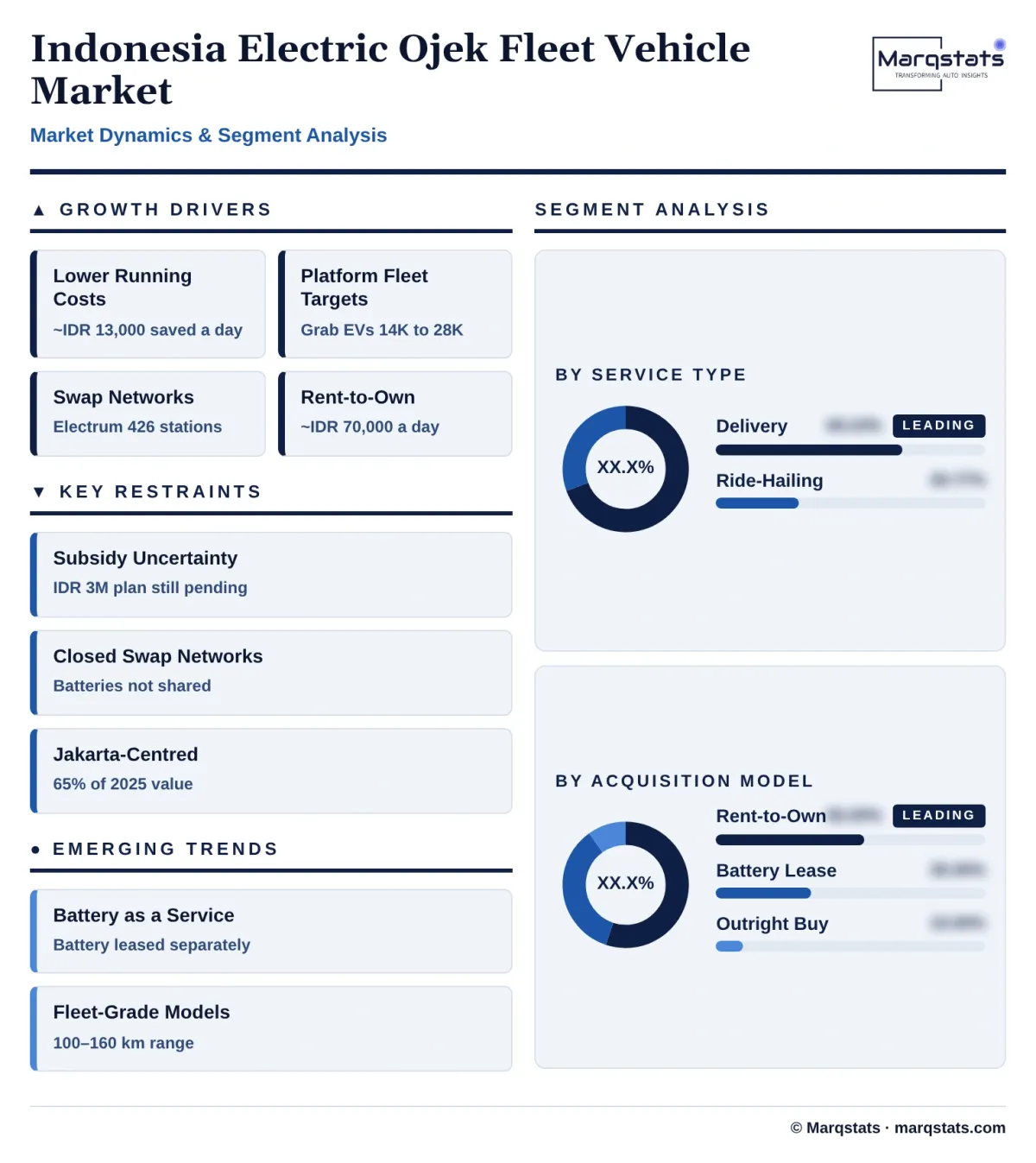
- Lower running costs. An electric scooter cuts a rider's daily energy and servicing cost by about half compared with a petrol scooter, a saving that matters more to a rider covering 100 km a day than to a commuter.
- Platform electric fleet targets. Grab reached 28,000 electric vehicles in Indonesia by May 2026, double the level of a year earlier, and plans to triple its electric fleet by the end of 2026, while Gojek riders use Electrum vehicles and swap stations.
- Battery swapping networks. Electrum ran 426 swap stations in March 2026, up from 310 a year earlier, and other operators run swap cabinets at convenience stores and fuel stations, removing the need for riders to stop for hours to charge.
- Rent-to-own finance. Daily-payment schemes such as MAKA Motors' IDR 70,000-a-day offer with free charging and servicing let riders acquire a vehicle without a down payment or bank loan.
- Lower app commissions. The Ministry of Transportation capped the commission platforms take from ojek riders at 8% from 1 July 2026, down from up to 20%, raising rider earnings and their ability to pay for a new vehicle.
- Rising fuel costs and shortages. Riders exposed to fuel price changes and, in Bali in 2026, local fuel shortages have a direct reason to switch to electric motorcycles.
Key Restraints
Five constraints slow the switch to electric ojek fleets.
- Subsidy uncertainty. The IDR 7 million purchase subsidy ended after 2024, and the replacement incentive, cut to IDR 3 million per unit in August 2026, still lacked its implementing regulation at the end of September, delaying purchases.
- Closed swap networks. Swap batteries from different operators are not interchangeable, so a rider is tied to one network and loses range outside its coverage area.
- Uneven coverage. Swap stations are concentrated in Greater Jakarta and Bali, limiting electric ojek use in other cities and on longer trips into suburbs.
- Rider income volatility. Gig earnings rise and fall with demand and app incentives, so daily rent-to-own payments carry default risk and require remote vehicle lock-out and recovery systems.
- Battery life questions. Riders and lenders have limited data on battery degradation and resale values for electric motorcycles used for high daily mileage, which raises financing costs.
Key Trends
Five shifts are changing how electric ojek vehicles are built, financed and powered.
- Battery as a service. Makers and fleets increasingly sell or lease the vehicle without the battery and charge riders a monthly or per-swap battery fee, lowering the entry price.
- Heavier-duty fleet models. Vehicles such as the MAKA Cavalry, Electrum H3 and H5 and Polytron Fox series are designed for higher daily mileage and carrying loads, with ranges of 100 to 160 km.
- Multi-brand platform sourcing. Grab works with several vehicle makers, leasing companies and swap operators rather than building its own vehicles, spreading risk across suppliers.
- Local assembly and content. Local content rules for incentives push makers to assemble in Indonesia and source more parts locally, supporting plants in Cikarang, Bekasi and Central Java.
- Telematics in every fleet vehicle. Fleet and rent-to-own vehicles carry connected units that track location, battery state and payments, and can lock the vehicle if a rider stops paying.
Strategic Implications
- For vehicle makers, fleet buyers are the most reliable customers. Models built for high mileage, with swappable or leased batteries and a daily-payment offer, win volume from platforms and leasing companies whether or not a subsidy is available.
- For ride-hailing platforms, electric fleets lower rider costs and improve retention. Partnerships that combine vehicles, swap access and financing in one package are the fastest way to add electric riders.
- For swap operators, coverage beyond Greater Jakarta is the next growth area. Networks that reach Surabaya, Bandung, Medan and Makassar, or that open to more than one vehicle brand, can capture riders that current networks do not serve.
- For lenders and leasing companies, rent-to-own is a large opportunity with real credit risk. Telematics, remote lock-out and recovery processes are needed to keep losses under control when rider income falls.
- For policymakers, fleet-targeted support may deliver more vehicles per rupiah than retail subsidies. Riders who cover 100 km a day save more fuel than commuters, so each subsidised fleet vehicle displaces more petrol.
- For investors, rider economics are the key assumption. A vehicle that covers 100 km a day for three years earns its cost back through fuel savings, so financing structures that match payments to daily earnings decide fleet returns as much as vehicle price does.
Market Segmentation
Vehicles supplied through platform-linked fleets and daily-payment rent-to-own schemes account for 55.00% of 2025 value, USD 9.55 million and about 7,150 vehicles, and grow at 45.34% a year to USD 61.93 million and 60.00% of the market by 2030. Electrum's fleet for Gojek riders, Grab's leasing partners and MAKA Motors' IDR 70,000-a-day rent-to-own scheme lead this segment.
Riders who buy the vehicle and lease or subscribe to the battery account for 35.00% of 2025 value, USD 6.07 million and about 4,550 vehicles, rising at 40.33% a year to USD 33.03 million and 32.00% of the market by 2030. Brands such as Polytron and ALVA offer battery subscription models that lower the purchase price.
Riders who buy the vehicle and battery outright account for 10.00% of 2025 value, USD 1.74 million and about 1,300 vehicles, and grow at 36.55% a year to USD 8.26 million and 8.00% of the market by 2030, as most riders prefer to spread the cost.
Vehicles that use swap stations account for 65.00% of 2025 value, USD 11.28 million and about 8,450 vehicles, and grow at 44.14% a year to USD 70.19 million and 68.00% of the market by 2030. Electrum, SMOOT with Swap Energi and Volta run the main networks, and a swap takes seconds rather than hours.
Vehicles with fixed or removable batteries charged from a socket account for 35.00% of 2025 value, USD 6.08 million and about 4,550 vehicles, and grow at 40.28% a year to USD 33.03 million and 32.00% of the market by 2030. They suit riders with home charging or lower daily mileage.
Vehicles used mainly for food and parcel delivery account for 69.23% of 2025 value, USD 12.02 million and about 9,000 vehicles, and grow at 40.92% a year to USD 66.79 million and 64.71% of the market by 2030. Delivery work covers the highest daily mileage, so savings on fuel are largest.
Vehicles used mainly for passenger bike-taxi rides account for 30.77% of 2025 value, USD 5.34 million and about 4,000 vehicles, and grow fastest, at 46.82% a year, to USD 36.43 million and 35.29% of the market by 2030 as GrabBike Electric and Gojek's electric options expand.
By Geography
Greater Jakarta
Greater Jakarta (Jabodetabek) is the largest market, with 65.00% of 2025 value, USD 11.28 million and about 8,450 vehicles, rising to USD 57.80 million by 2030, a 38.65% CAGR, while its share falls to 56.00%. Electrum's swap network, convenience-store swap points and the headquarters of Gojek and Grab make the capital region the centre of electric ojek use.
Bali
Bali accounts for 15.00% of 2025 value, USD 2.61 million, and grows at 40.81% a year to USD 14.45 million and 14.00% of the market by 2030. Tourism demand, provincial support for electric vehicles and swap points at convenience stores support adoption, and fuel shortages in 2026 pushed more riders to electric motorcycles.
East Java
East Java, centred on Surabaya, accounts for 10.00% of 2025 value, USD 1.74 million, and grows at 50.47% a year to USD 13.42 million and 13.00% of the market by 2030 as Grab and delivery fleets expand there.
West Java
West Java outside the capital region, centred on Bandung, accounts for 6.00% of 2025 value, USD 1.04 million, and grows at 54.95% a year to USD 9.29 million and 9.00% of the market by 2030. Hilly terrain favours higher-torque models such as the MAKA Cavalry.
Rest of Indonesia
The rest of Indonesia, including Yogyakarta, Medan and Makassar, accounts for 4.00% of 2025 value, USD 0.69 million, and grows fastest, at 64.30% a year, to USD 8.26 million and 8.00% of the market by 2030 as swap networks and dealers expand beyond Java and Bali.
How Competition Is Evolving
The Indonesia electric ojek fleet vehicle market is moderately concentrated. Demand comes mostly through two platforms, Grab and Gojek, while vehicles come from a wider group of makers and fleet companies. Electrum, the GoTo and TBS Energi Utama joint venture, had 9,082 motorcycles on the road in March 2026, up from about 5,100 a year earlier, and 426 swap stations, with sales and rental revenue rising to USD 3.2 million from USD 1.3 million.
Grab follows a multi-brand model. It reached 28,000 electric vehicles in Indonesia by May 2026, up from 14,000 a year earlier, across GrabBike Electric, GrabCar Electric and GrabExpress Electric, and plans to triple its electric fleet by the end of 2026. It works with vehicle makers, leasing companies and swap operators rather than building its own vehicles.
Vehicle makers compete for riders through price and financing. Polytron describes itself as Indonesia's leading electric motorcycle brand, MAKA Motors launched the Cavalry from its Cikarang plant in January 2025 and offers rent-to-own to ojek riders, and Volta, SMOOT, ALVA, Gesits, Viar, United and Selis supply other models. Astra Honda Motor, the leader in petrol motorcycles, sells electric models but has not yet built a large fleet business.
Consolidation among platforms is possible. Grab and GoTo have repeatedly denied being in merger talks, but the government has said a combination involving the sovereign fund Danantara is being pursued. No definitive agreement had been announced. Elsewhere in the region, Gojek left Vietnam on 16 September 2024, showing how quickly ride-hailing markets can consolidate.
Competition will be decided by swap coverage, financing and rider economics. Companies that combine reliable vehicles, wide swap access and affordable daily payments will win most fleet deliveries.
Energy companies also play a role. PLN and Pertamina host swap stations and charging points at their sites, Gogoro supplied swap technology for Electrum's early trials, and convenience store chains host swap points, so riders' access to energy depends on partnerships between vehicle makers, platforms and site owners.
Companies Covered
Companies covered in the report include:
Recent Market Activity
Table of Contents
Coverage & Segmentation
The study covers the Indonesia electric ojek fleet vehicle market, with 2025 as the base year, 2021 – 2025 as the historical period and 2026 – 2030 as the forecast period. Values are in US dollars at fleet acquisition prices, converted at IDR 16,470 per USD, the 2025 average rate held constant, and volumes are annual deliveries of new electric two-wheelers into commercial ojek service. The market is segmented by acquisition model, energy model, service type and region.
Private commuter electric motorcycles, petrol motorcycles, three- and four-wheelers, battery swap and subscription fees and charging infrastructure are excluded. The market equals the ride-hailing and fleet delivery segments of the Marqstats Indonesia electric two-wheeler study and must not be added to it. Segment and regional splits are Marqstats estimates built on type-registration data, platform and fleet disclosures, and vehicle price benchmarks.