Market Snapshot
The India two-wheeler engine oil market size is estimated at USD 1,285.37 million in 2025 and is projected to reach USD 1,709.58 million by 2030, growing at a CAGR of 5.87% over 2026 – 2030. Volume rises from 456.44 to 518.28 million litres, a 2.57% annual rate, so most growth comes from synthetic grades and higher prices per litre.
Marqstats defines the market as the net sales value, before goods and services tax, of finished crankcase engine oil for petrol motorcycles, scooters and mopeds consumed in India. It covers four-stroke and two-stroke oils sold as replacement fills through dealer workshops, independent mechanics, bazaar retailers, fuel stations and online stores, and the first fill supplied to two-wheeler plants. Gear, fork and chain oils, greases, brake fluid, coolant and oils for cars, trucks, tractors and three-wheelers are excluded.
Mineral engine oils account for 52.24% of 2025 value, motorcycles for 66.00% and independent workshops and bazaar retail for 62.89%. South India is the largest region at 31.00% of value, while full synthetic oils grow fastest at 13.26% a year and East and Northeast India is the fastest-growing region at 7.34%.
Key Takeaways
Market Overview & Analysis
Report Summary
Marqstats sizes the India two-wheeler engine oil market as the finished crankcase oil consumed by petrol motorcycles, scooters and mopeds in India. Value is measured at the blender and distributor level, net of goods and services tax, and covers every route by which oil reaches an engine: the first fill on the assembly line, the free and paid services at an authorised dealer, the independent mechanic and bazaar shop that handle most out-of-warranty oil changes, and the growing share bought in sealed packs online or at fuel stations.
India is the largest two-wheeler market in the world by units, and engine oil follows the fleet. SIAM reported domestic two-wheeler dispatches of 20.50 million units in calendar 2025, up 4.9%, made up of 12.48 million motorcycles, 7.52 million scooters and 0.49 million mopeds, plus record exports of 4,939,706 units, up 24%. In the financial year to March 2026, domestic dispatches reached 2.17 crore, up 10.7% and above the previous peak of FY2019, and exports reached 51.8 lakh units.
The demand base is much larger than annual sales. The live Marqstats India Automotive Lubricants Aftermarket report counts about 225 million active two-wheelers and 423.23 thousand tonnes of two-wheeler replacement lubricant in 2025. Marqstats estimates that about four million of those vehicles are electric, which leaves about 221 million petrol two-wheelers that need an oil change every few thousand kilometres. Engine oil makes up about 90% of two-wheeler lubricant tonnage, because a motorcycle uses the same sump oil for its engine, clutch and gearbox.
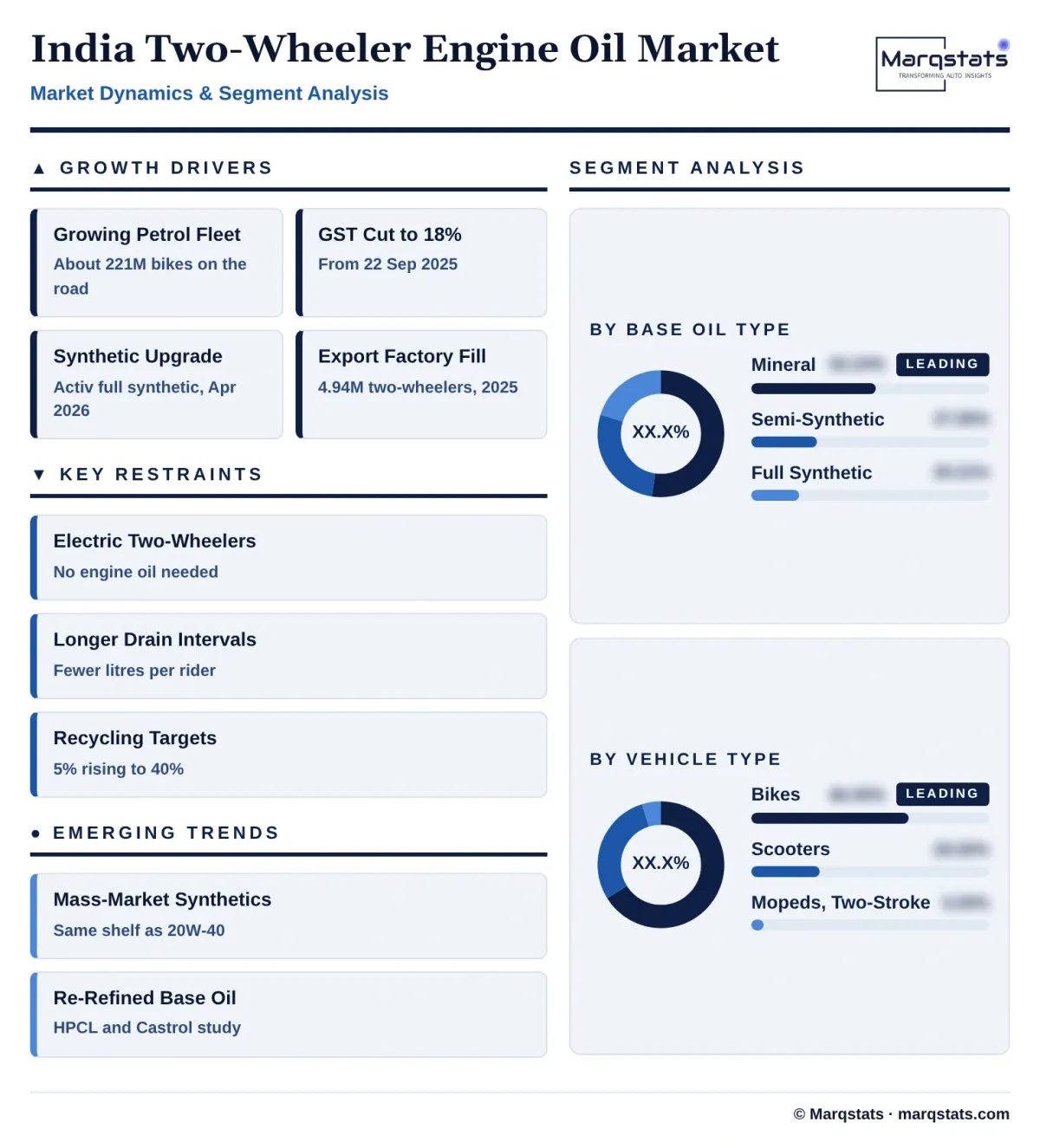
Policy pushed the fleet in both directions in 2025 and 2026. The Goods and Services Tax Council cut the rate on two-wheelers up to 350 cc from 28% to 18% from 22 September 2025, which lifted petrol two-wheeler sales in the second half of FY2026. At the same time the PM E-DRIVE scheme was extended for electric two-wheelers to 31 March 2028, at a lower INR 2,500 per kilowatt-hour capped at INR 5,000 a vehicle. On the supply side, the used-oil Extended Producer Responsibility rules in force since 1 April 2024 require every lubricant producer to secure recycling of a rising share of what it sells.
The market grew from an estimated USD 966.09 million in 2021, when about 410.00 million litres were sold, to USD 1,124.00 million in 2022 as base oil prices jumped, USD 1,194.48 million in 2023 and USD 1,239.26 million in 2024. It reached USD 1,285.37 million in 2025, equal to about INR 11,182.72 crore at the 2025 average rate of INR 87.00 per US dollar, on 456.44 million litres.
India Two-Wheeler Engine Oil Market Size and Forecast
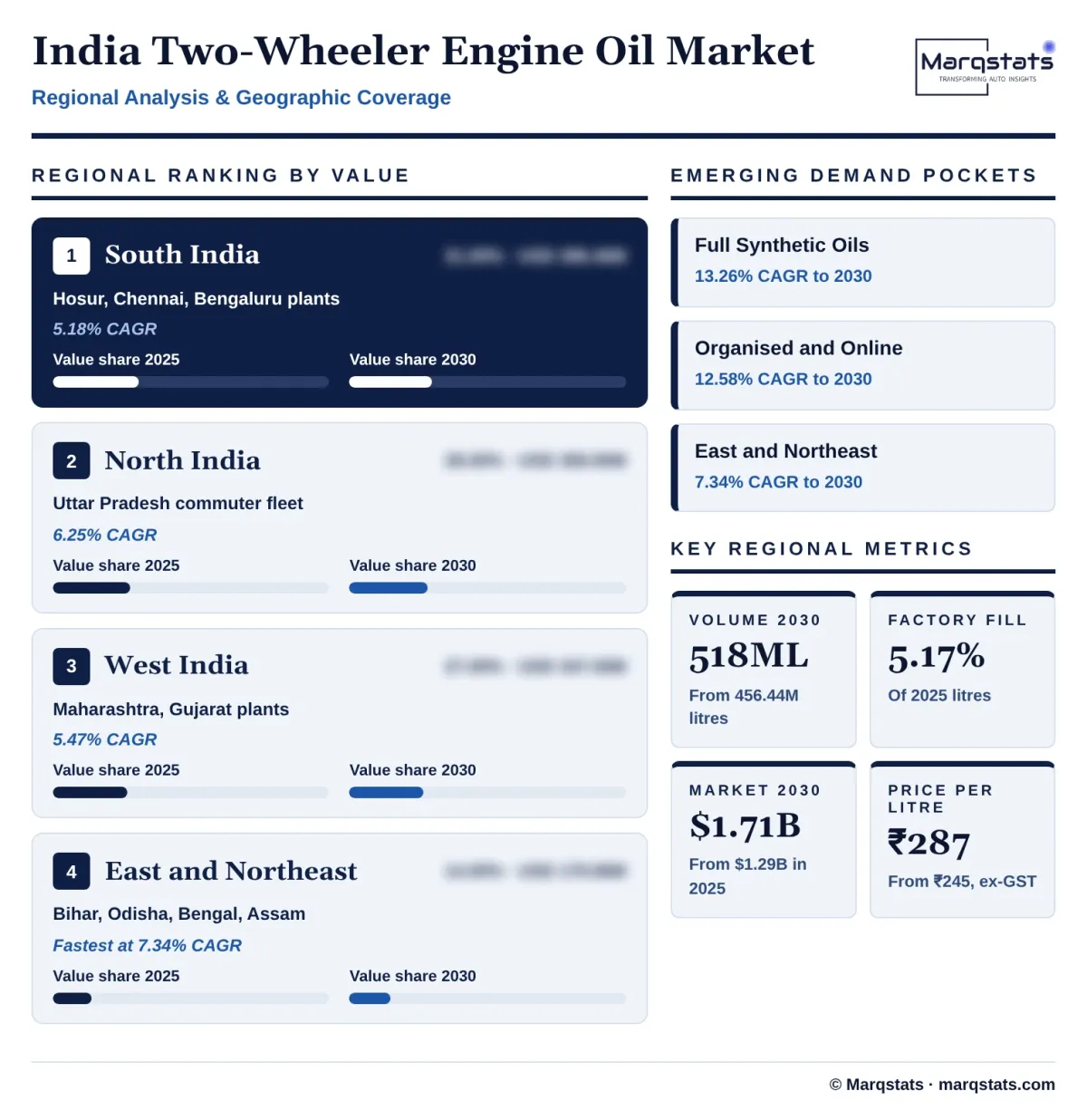
The India two-wheeler engine oil market grows from USD 1,285.37 million in 2025 to USD 1,709.58 million in 2030, a CAGR of 5.87%. Volume adds 2.57% a year, from 456.44 to 518.28 million litres, and the blended net price per litre adds 3.21% a year, from INR 245.00 to INR 286.98. Price and mix therefore deliver more than half of the growth, which is the opposite of the pattern before 2022 when new riders drove the market.
The 2025 volume is built from two blocks. Replacement oil is 432.85 million litres, which Marqstats derives as 90% of the 423.23 thousand tonnes of two-wheeler replacement lubricant on the live India Automotive Lubricants Aftermarket report, converted at 0.88 kilograms per litre. Factory fill is 23.59 million litres, from about 16.78 million motorcycles at 1.05 litres, 7.04 million petrol scooters at 0.80 litres and 0.51 million mopeds at 0.65 litres built for the domestic market and for export in 2025.
The value is built by base oil type. Marqstats estimates 292.12 million litres of mineral oil at a net INR 200 a litre, 114.11 million litres of semi-synthetic oil at INR 270 and 50.21 million litres of full synthetic oil at INR 450, before goods and services tax. The blended INR 245.00 a litre is consistent with the live lubricants aftermarket report, whose value of INR 46,942.50 crore on 1,650 million litres implies about INR 241 a litre once 18% tax is removed.
Replacement litres grow 2.58% a year, from 432.85 to 491.55 million litres, in line with the 2.69% annual growth in two-wheeler replacement tonnage on the live lubricants report. Marqstats expects the petrol fleet to grow from about 221 million to 259.80 million, with about 21 million petrol sales a year and 5.5% of the fleet scrapped each year, while oil per vehicle falls from about 1.96 to 1.89 litres a year as full synthetic oils and longer service intervals spread. Factory fill grows to 26.72 million litres on about 27.55 million petrol two-wheelers built in 2030.
The 2026 estimate is USD 1,360.37 million on 468.19 million litres. Marqstats tracks four indicators to monitor the forecast: SIAM monthly dispatches of petrol motorcycles and scooters after the September 2025 tax cut, VAHAN electric two-wheeler registrations under the extended PM E-DRIVE scheme, list prices and grade mix of the leading blenders after the April 2026 full synthetic launches, and base oil prices, which set the floor for the price of a one-litre pack.
Market Dynamics
Key Drivers
Five forces keep engine oil demand rising even as electric two-wheelers take a growing slice of new sales.
- The petrol fleet keeps growing. SIAM reported 20.50 million domestic two-wheeler dispatches in calendar 2025 and 2.17 crore in FY2026, and electric models were only 6.31% of 2025 retail sales, according to the Federation of Automobile Dealers Associations (FADA). Marqstats estimates the petrol fleet rises 17.56% to about 259.80 million by 2030, and every one of those vehicles needs two oil changes a year or more.
- The tax cut lifted sales. The Goods and Services Tax Council cut the rate on two-wheelers up to 350 cc from 28% to 18% from 22 September 2025, and SIAM reported a 26.4% rise in two-wheeler sales in January to March 2026. More new bikes means more factory fill now and more paid services from the second year of ownership.
- Riders are trading up to synthetic oil. Castrol added full synthetic 10W-30 and 5W-30 grades to its Activ range on 9 April 2026, sold through more than 150,000 outlets and on Amazon and Flipkart, and Gulf launched 11 fully synthetic Syntrac grades from 10W-30 to 20W-50 in December 2025. Each litre of full synthetic oil earns more than twice the net price of a mineral litre.
- Premium motorcycles need better oil. Royal Enfield sold a record of more than one million motorcycles in calendar 2025, and engines of 250 cc and above, such as the Aprilia RS 457, run on high-performance oils that Gulf supplies to Piaggio India under an exclusive partnership extended to 2032.
- Export production adds factory fill. SIAM reported two-wheeler exports of 4,939,706 units in calendar 2025, up 24%, and 51.8 lakh units in FY2026, up 23.4%. Every exported motorcycle or scooter leaves an Indian plant with an Indian-blended first fill, which Marqstats counts at about 5.02 million litres in 2025.
Key Restraints
Four constraints cap how fast litres and prices can rise.
- Electric two-wheelers need no engine oil. VAHAN recorded 1,342,248 electric two-wheeler registrations in calendar 2025, and the PM E-DRIVE scheme supports electric two-wheelers to 31 March 2028. Marqstats expects about 4.45 million electric sales a year by 2030, so each year a larger share of new two-wheelers never adds a litre to the market.
- Longer drain intervals cut litres. Full synthetic oils allow longer gaps between changes, and Marqstats estimates oil per petrol two-wheeler falls from about 1.96 to 1.89 litres a year by 2030. Blenders earn more per litre but sell fewer litres per rider, which caps volume growth at about 2.58% a year in the replacement trade.
- Base oil costs squeeze margins. Most base oil is imported or made by public sector refiners and is priced off crude, and the 2022 base oil spike shows how quickly costs can rise: Marqstats estimates the blended net price of two-wheeler oil rose from about INR 205 to INR 232 a litre that year. Bazaar buyers resist price rises on a one-litre pack, so margins fall before prices catch up.
- Recycling rules add cost. The Hazardous and Other Wastes (Management and Transboundary Movement) Second Amendment Rules, 2023, notified on 18 September 2023, require producers to secure recycling of 5% of 2022-23 sales in 2024-25, rising to 40% of 2027-28 sales in 2029-30, through certificates bought from registered recyclers. Smaller blenders without a collection network pay more per litre to comply.
Key Trends
Four shifts are changing what is poured into Indian two-wheeler engines and who sells it.
- Full synthetic oil moves to the mass market. Castrol now sells full synthetic 10W-30 and 5W-30 under its commuter Activ brand while keeping 20W-40, which puts synthetic oil on the same shelf as the mineral oil most riders buy.
- Re-refined base oil becomes a supply option. Hindustan Petroleum Corporation Limited and Castrol India signed a memorandum of understanding, reported on 27 January 2026, to examine a national system for collecting used oil and re-refining it into base oil, a step towards meeting the used-oil recycling targets with home-grown base stock.
- Oil reaches riders through new channels. Castrol sells Activ on Amazon and Flipkart and reaches about 40,000 rural outlets, and Marqstats expects organised retail, e-commerce and fuel station bays to grow from 5.50% to 7.50% of replacement litres by 2030.
- Ownership of the largest private blender is changing. bp agreed on 24 December 2025 to sell 65% of Castrol to Stonepeak at an enterprise value of USD 10.10 billion, which triggered an open offer for 26% of Castrol India at INR 194.04 a share and puts a financial investor in charge of the brand that leads in private two-wheeler oil.
Strategic Implications
- For blenders, the next five years reward mix more than volume. Volume grows only 2.57% a year, but full synthetic value grows 13.26% a year, so the brands that move a commuter from a mineral 20W-40 to a synthetic 10W-30 at the workshop counter capture most of the USD 424.21 million gain.
- For new entrants, the bazaar is a distribution contest, not a product contest. Independent workshops and bazaar retail hold 62.89% of value, and the leaders already reach about 150,000 outlets. An entrant does better by targeting premium motorcycle owners online, where the organised channel grows 12.58% a year, than by competing on price for mineral packs.
- For two-wheeler makers, the first fill is small but sets the brand. Factory fill is only 5.17% of litres, but a genuine oil tie-up, such as Gulf with Piaggio India to 2032, carries the oil brand into the dealer service network for the life of the warranty.
- For refiners and recyclers, the used-oil recycling targets create a feedstock market. A rise from 5% to 40% of sales over five years means producers must buy recycling certificates or build collection, and partnerships such as the Hindustan Petroleum and Castrol study position refiners to supply re-refined base oil.
- For investors, electric two-wheelers are a slow threat to litres, not a sudden one. Electric sales of about 4.45 million a year by 2030 still leave a growing petrol fleet of about 259.80 million, so demand for two-wheeler oil keeps rising through the forecast and the risk to value sits after 2030.
Market Segmentation
Mineral oils account for 52.24% of 2025 value, USD 671.54 million, and grow slowly, at 1.24% a year, to USD 714.14 million and 41.77% of the market. These are mainly 20W-40 and 20W-50 four-stroke oils sold in one-litre and 900 ml packs to commuter riders through bazaar shops and independent mechanics. Marqstats estimates 292.12 million litres in 2025 at a net INR 200 a litre, falling to 279.87 million litres by 2030 as riders trade up.
Semi-synthetic oils account for 27.55% of 2025 value, USD 354.13 million, and grow at 7.62% a year to USD 511.36 million and 29.91% of the market. They are the usual factory fill and dealer service grade for 100 cc to 160 cc motorcycles and scooters, often in 10W-30 and 10W-40, and Marqstats estimates 114.11 million litres in 2025 at a net INR 270 a litre.
Full synthetic oils account for 20.21% of 2025 value, USD 259.70 million, and grow fastest, at 13.26% a year, to USD 484.08 million and 28.32% of the market. Premium motorcycles above 250 cc started the segment, and the April 2026 Castrol Activ full synthetic grades and the December 2025 Gulf Syntrac range take it to a wider audience. Volume rises from 50.21 to 88.11 million litres, while the net price per litre rises only from INR 450 to INR 478 as competition grows.
Motorcycles account for 66.00% of 2025 value, USD 848.34 million, and grow at 5.71% a year to USD 1,119.77 million. A motorcycle holds about one litre of oil that lubricates the engine, wet clutch and gearbox together, which is why riders need a JASO MA or MA2 oil and why motorcycles use more oil per year than scooters. SIAM counted 12.48 million domestic motorcycle dispatches in calendar 2025 and 4.30 million exports, led by Hero MotoCorp Limited, Honda Motorcycle and Scooter India Private Limited, Bajaj Auto Limited, TVS Motor Company Limited and Royal Enfield.
Scooters account for 29.00% of 2025 value, USD 372.76 million, and grow fastest, at 6.94% a year, to USD 521.42 million and 30.50% of the market. Scooters with automatic gearboxes use a smaller sump and a JASO MB oil, and SIAM reported scooter dispatches up 12.7% to 7.52 million in calendar 2025 and up 18.5% in FY2026. Electric scooters take a rising share of new scooter sales, which limits growth in later years.
Mopeds and the remaining two-stroke fleet account for 5.00% of 2025 value, USD 64.27 million, and grow at 1.25% a year to USD 68.39 million. SIAM reported moped dispatches down 4.1% to 0.49 million in calendar 2025, and the TVS XL100 that dominates the segment uses a four-stroke engine; the two-stroke oil in this segment serves older scooters and motorcycles still running in small towns, a fleet that shrinks every year.
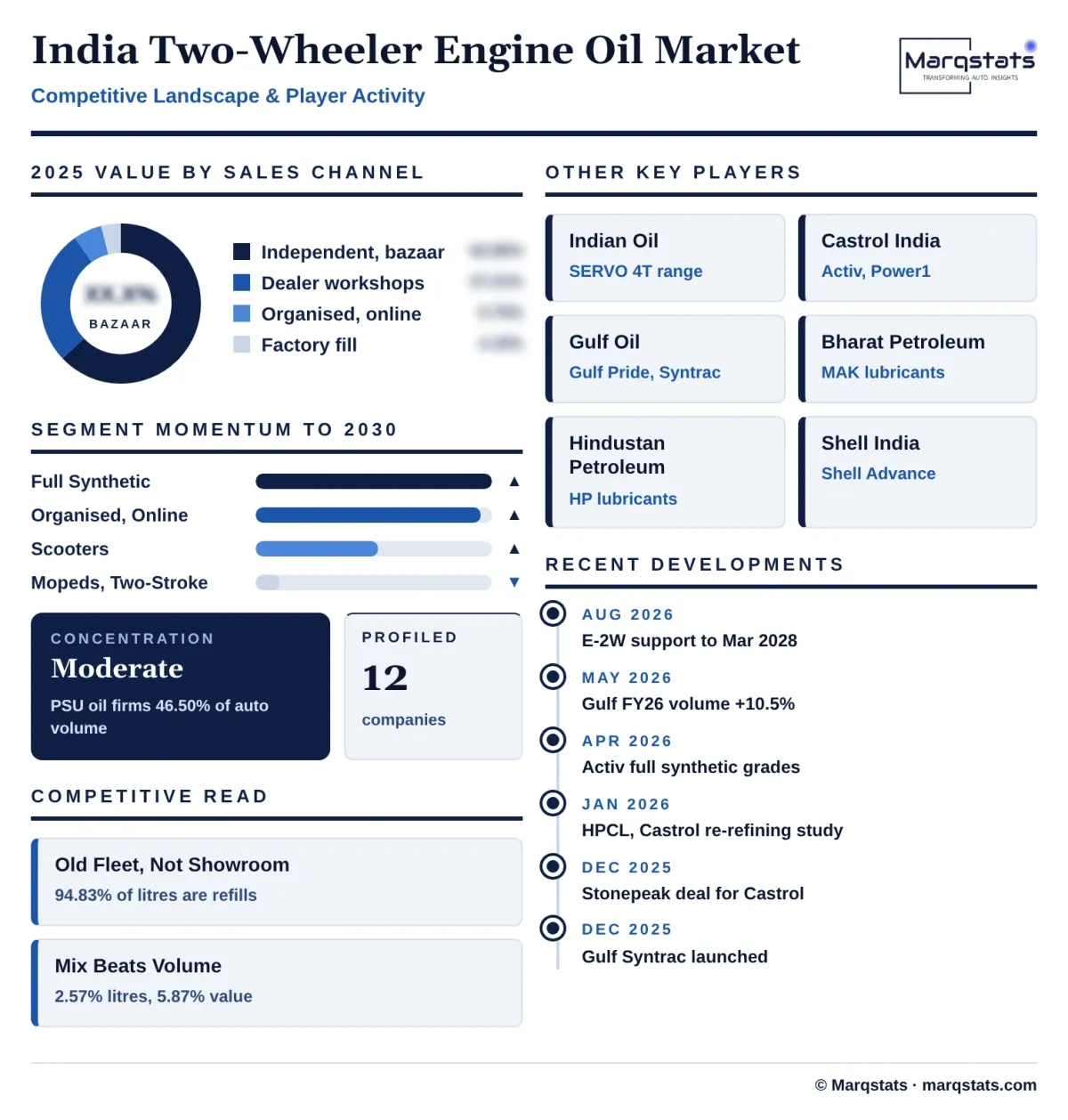
Independent mechanics and bazaar retailers account for 62.89% of 2025 value, USD 808.37 million, and grow at 4.85% a year to USD 1,024.38 million. Marqstats assigns them 67.50% of replacement litres in 2025, the same share the live lubricants aftermarket report gives the independent trade, because most riders leave the dealer network once the free services end.
Authorised dealer workshops account for 27.21% of 2025 value, USD 349.75 million, and grow at 6.58% a year to USD 481.08 million. Dealers carry the oil approved by the two-wheeler maker for free and paid services, and the record sales of FY2026 add millions of vehicles that stay in dealer service for their first two or three years.
Factory fill accounts for 4.15% of 2025 value, USD 53.34 million, and grows at 5.72% a year to USD 70.43 million. It is 23.59 million litres in 2025, 5.17% of volume, priced below retail because two-wheeler makers buy in bulk under multi-year supply contracts, as Gulf does with Piaggio India and other blenders do with the larger makers.
Organised retail, e-commerce and fuel station service bays account for 5.75% of 2025 value, USD 73.91 million, and grow fastest, at 12.58% a year, to USD 133.69 million. Riders of premium motorcycles buy branded full synthetic packs on Amazon and Flipkart, and the public sector oil companies sell their own brands at fuel station bays.
By Geography
South India
South India accounts for 31.00% of 2025 value, USD 398.46 million, and grows at 5.18% a year to USD 512.87 million. Tamil Nadu and Karnataka hold the Hosur, Chennai and Bengaluru plants of TVS Motor, Royal Enfield, Ather and Honda, which concentrates factory fill in the region, and dense scooter use in Bengaluru, Hyderabad and Chennai supports dealer service volume. Electric adoption is higher in the south, which slows growth in replacement oil.
North India
North India accounts for 28.00% of 2025 value, USD 359.90 million, and grows at 6.25% a year to USD 487.23 million. Uttar Pradesh is the largest two-wheeler state, and rural commuter motorcycles from Hero MotoCorp and Honda dominate the fleet. Hero and Honda plants in Haryana, Uttarakhand and Rajasthan add factory fill, and a high share of mineral 20W-40 in bazaar retail keeps the price per litre low.
West India
West India accounts for 27.00% of 2025 value, USD 347.05 million, and grows at 5.47% a year to USD 453.04 million. Maharashtra and Gujarat are large two-wheeler markets, the Bajaj Auto plants at Chakan and Waluj and the Honda and Hero plants in Gujarat add factory fill, and Castrol and Gulf run blending and research sites in the region, at Patalganga and Silvassa.
East and Northeast India
East and Northeast India accounts for 14.00% of 2025 value, USD 179.96 million, and grows fastest, at 7.34% a year, to USD 256.44 million and 15.00% of value. Two-wheeler ownership per household is still rising in Bihar, Odisha, West Bengal and Assam, the fleet is younger, and electric adoption outside cities is slower, so replacement oil grows faster than the national average.
How Competition Is Evolving
The market is moderately concentrated by owner group but fragmented at the counter. The live Marqstats India Automotive Lubricants Aftermarket report puts the three public sector oil companies, Indian Oil Corporation Limited, Bharat Petroleum Corporation Limited and Hindustan Petroleum Corporation Limited, at about 46.50% of all automotive replacement volume, and in two-wheeler oil they sell the SERVO, MAK and HP brands through fuel stations and bazaar distributors. Because no blender reports its two-wheeler oil volume separately, Marqstats reads competition by layer and by dated action rather than by brand share.
Castrol India Limited leads the private blenders. It reported revenue from operations of INR 5,722 crore for calendar 2025, up 7%, with volume up 8%, about 150,000 retail outlets including about 40,000 in rural areas, and over 750 Castrol Auto Service centres. Its Activ brand is the best-known two-wheeler oil in the bazaar, and in April 2026 it added full synthetic 10W-30 and 5W-30 grades. Ownership is changing: bp agreed in December 2025 to sell 65% of Castrol to Stonepeak, triggering an open offer for 26% of Castrol India.
Gulf Oil Lubricants India Limited is the fastest-growing listed rival. It reported FY2026 consolidated revenue of INR 4,056.04 crore, up 11.70%, and volume growth of 10.5%, with 14% in the March 2026 quarter, and holds tie-ups with more than 50 vehicle makers, including an exclusive two-wheeler partnership with Piaggio India to 2032. Its Syntrac launch at India Bike Week in December 2025 gives it a flagship above Gulf Pride for premium motorcycles.
Multinational and specialist brands compete for the premium rider. Shell India Markets Private Limited, ExxonMobil Lubricants Private Limited, Motul, TotalEnergies Marketing India Private Limited, Valvoline Cummins Private Limited and Veedol Corporation Limited, formerly Tide Water Oil Co. (India) Ltd, sell synthetic motorcycle oils through workshops, motorcycle clubs and online stores, while two-wheeler makers sell their own genuine oils through dealer workshops. Competition is moving from price per litre to grade mix, mechanic loyalty and online reach.
Companies Covered
Companies covered in the report include:
Recent Market Activity
Table of Contents
Coverage & Segmentation
The study covers the India two-wheeler engine oil market, with 2025 as the base year, 2021 – 2025 as the historical period and 2026 – 2030 as the forecast period. It measures finished four-stroke and two-stroke crankcase oil for petrol motorcycles, scooters and mopeds consumed in India, including replacement fills and the factory fill of two-wheelers built in India for domestic sale and export, segmented by base oil type, vehicle type, sales channel and region. Values are blender and distributor net sales before goods and services tax, converted at the 2025 average of INR 87.00 per US dollar, and volume is in million litres.
Gear, fork and chain oils, greases, brake fluid, coolant, electric two-wheeler fluids, and oils for cars, commercial vehicles, three-wheelers and tractors are excluded. The replacement volume is a slice of the two-wheeler tonnage on the live India Automotive Lubricants Aftermarket report, which counts replacement lubricant only and includes taxes, so the two values must not be added or compared directly. The live India Two-Wheeler Market report measures vehicle sales and is a different measure.