Market Snapshot
The global two-wheeler engine oil market size is estimated at USD 4,582.11 million in 2025 and is projected to reach USD 5,559.27 million by 2030, growing at a CAGR of 3.94% over 2026 – 2030. Volume rises from about 1,388.54 million litres to 1,518.91 million litres, a 1.81% annual rate, as synthetic grades lift value per litre.
Marqstats defines the market as the blender and wholesale selling value of finished crankcase engine oil used in internal combustion motorcycles, scooters and mopeds, covering four-stroke oils certified to JASO T 903 categories MA, MA1, MA2 and MB, two-stroke oils, service fill for the in-use fleet and factory first fill on new production. Gear, fork and chain lubricants, greases, coolants, fluids for electric two-wheelers, three-wheeler oils, workshop labour and retail taxes are excluded.
Mineral oils account for 41.20% of 2025 value, four-stroke oils for 95.72% and service fill through independent workshops and retail for 69.38%. India accounts for 28.05% of 2025 value and Asia-Pacific as a whole for 69.29%. The study segments the market by formulation, engine type, vehicle type, sales channel and region.
Key Takeaways
Market Overview & Analysis
Report Summary
Marqstats sizes the global two-wheeler engine oil market as the selling value, at blender and wholesale level, of finished crankcase oil used in internal combustion motorcycles, scooters and mopeds. In 2025 about 1,388.54 million litres were used, worth an estimated USD 4,582.11 million at an average of USD 3.30 a litre. Service fill for the in-use fleet accounts for about 95.26% of litres and factory first fill on new production for 4.74%.
Two-wheeler engine oil is a different product from car engine oil. Most motorcycles share one sump between the engine, the gearbox and a wet multi-plate clutch, so the oil must protect gears under high shear and still let the clutch grip. Friction modifiers that save fuel in a car engine make a wet clutch slip. The Japanese Automotive Standards Organization (JASO) therefore classifies four-stroke motorcycle oils under JASO T 903 into high-friction MA, MA1 and MA2 grades for wet clutches and low-friction MB grades for scooters with dry belt-drive transmissions. Two-stroke oils, which burn with the fuel, are classified separately under the FB, FC and FD grades.
Demand is set by the fleet more than by sales. A commuter motorcycle or scooter in India, Indonesia or Vietnam holds 0.8 to 1.2 litres of oil and is drained every 2,000 to 4,000 kilometres, so a bike ridden 8,000 to 12,000 kilometres a year takes two to three changes plus top-ups. A large touring motorcycle in Europe or the United States holds three to four litres but is often changed once a year. These patterns mean that the roughly 700 million active bikes, not the 68 million or so built each year, decide the size of the market.
The fleet is concentrated in Asia. The Indonesian National Police Traffic Corps (Korlantas Polri) counted about 140.9 million motorcycles among 168,275,423 registered vehicles in April 2025, Vietnam has about 73 million registered motorcycles, of which about 70 million run on petrol, and the Brazilian National Traffic Secretariat (Senatran) counted 28.2 million motorcycles at the end of 2024. India added 20,295,650 two-wheelers at retail in calendar 2025, according to the Federation of Automobile Dealers Associations (FADA). Registered fleets overstate the bikes in use, so Marqstats estimates active fleets from registrations, sales history and scrappage.
New-vehicle supply sets factory fill and the future fleet. The China Association of Automobile Manufacturers reported motorcycle production of 22.11 million in 2025, of which 13.37 million were exported, the Indonesian Motorcycle Industry Association (AISI) reported domestic sales of 6,412,769 and exports of 544,133 built-up units, and the Brazilian Association of Motorcycle Manufacturers (Abraciclo) reported production of 1.98 million and record registrations of 2.19 million. Honda Motor Co., Ltd. sold 22.101 million motorcycles in the year to March 2026 and plans 22.8 million in the following year. Marqstats estimates the market at USD 4,758.74 million in 2026.
Global Two-Wheeler Engine Oil Market Size and Forecast
The global two-wheeler engine oil market grows from USD 4,582.11 million in 2025 to USD 5,559.27 million in 2030, a CAGR of 3.94%. Marqstats expects USD 4,944.29 million in 2027, USD 5,139.27 million in 2028 and USD 5,344.09 million in 2029. Annual growth edges up from 3.85% in 2026 to 4.03% in 2030 as the synthetic share compounds.
The 2025 value is built bottom-up for ten markets. For each, Marqstats multiplies the active internal combustion fleet by annual service-fill litres per vehicle, adds factory fill on local production, and prices the litres by formulation. The world fleet comes to about 700 million active bikes using about 1,388.54 million litres. Service fill ranges from about 1.4 litres a vehicle a year in Europe, where bikes are ridden mainly for leisure, to 2.2 litres in Indonesia, where scooters do daily commuting and delivery work.
Prices separate the regions. Marqstats estimates blended blender selling prices of about USD 2.70 a litre in Indonesia, USD 2.82 in India, USD 3.33 in China, USD 3.95 in Latin America, USD 8.35 in Europe and USD 10.00 in North America. The low end is in line with the USD 2.20 to 2.80 a litre that Marqstats records for legacy mineral oils in its global automotive lubricants work, and the high end reflects synthetic grades selling at USD 5.50 to 8.50 a litre before the extra margin of branded motorcycle packs.
Mix, not volume, drives value. Volume grows 1.81% a year and the average value per litre 2.09% a year. Of the price gain, about 0.85 points a year comes from the shift in volume from mineral to semi-synthetic and synthetic oils and toward higher-priced markets, and about 1.24 points from underlying price increases. The semi-synthetic and synthetic share of litres rises from 45.26% to 53.33%.
The forecast nets fleet growth against electric substitution. Marqstats expects active fleets to grow about 4.50% a year in the Middle East and Africa and 4.00% in Latin America, and to shrink about 1.20% a year in China and 1.60% in Vietnam, where VinFast sold more than 406,000 electric motorcycles in 2025, up 473%. Longer drain intervals from synthetic oils trim litres per vehicle by about 0.5% a year in most markets.
Marqstats tracks four indicators to monitor the forecast: active fleet and scrappage data in India, Indonesia, Vietnam and Brazil; electric two-wheeler sales shares in China, India and Vietnam; the share of JASO MA2 and MB oils listed under the 2023 standard ahead of the April 2028 deadline; and blender price lists for 10W-30 and 10W-40 grades in the main Asian markets.
Market Dynamics
Key Drivers
Five forces keep two-wheeler engine oil growing in value even where litres stand still.
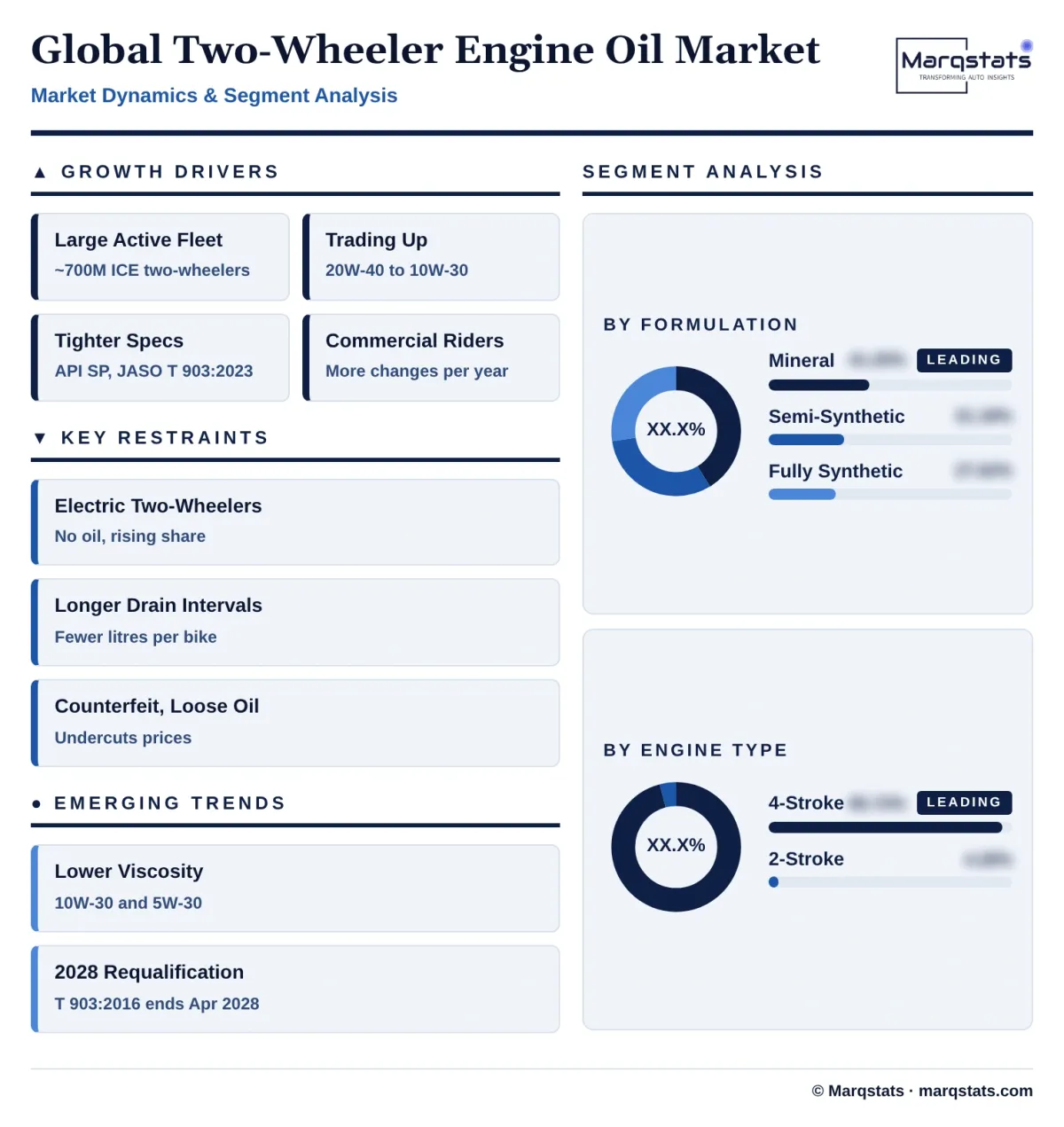
- A large fleet that keeps growing. About 700 million active internal combustion two-wheelers need two or three oil changes a year in Asia, and fleets keep growing in India, Indonesia, Latin America and Africa, where motorcycles are the cheapest motorised transport and the main tool for delivery and taxi work.
- Riders trade up to better oils. Workshops and brands in India, Indonesia and Latin America are moving customers from 20W-40 mineral oil to 10W-30 semi-synthetic and synthetic grades, and blenders such as Castrol, Shell and Motul push premium packs with PAO and ester base stocks that sell for more per litre.
- Engines need tighter oil specifications. Emission rules such as Euro 5 in the EU and Bharat Stage VI in India brought catalysts, fuel injection and on-board diagnostics to small engines, and JASO T 903:2023 added API SN PLUS and SP to the required quality levels, which favours better base oils and additive packages.
- Commercial use raises oil turnover. Delivery riders, motorcycle taxis and ride-hailing bikes in Jakarta, Ho Chi Minh City, Lagos, Sao Paulo and Indian cities cover far more kilometres than private commuters, so they need more oil changes a year and buy higher-specification oils to cut breakdowns.
- New production adds factory fill. Global motorcycle output of about 68 million units a year, including 22.11 million in China, about 25 million in India including exports and 1.98 million in Brazil, gives blenders contract volume with OEMs and puts their brand in the crankcase before the first service.
Key Restraints
Four constraints cap litre growth and squeeze blender margins.
- Electric two-wheelers take new sales. Electric bikes need no engine oil, and they already take a large share of sales in China and a fast-rising share in India and Vietnam, where VinFast sold more than 406,000 electric motorcycles in 2025. Marqstats estimates combined China and Vietnam demand falls by 16.30 million litres by 2030.
- Longer drain intervals cut litres. Synthetic oils and better engines allow longer intervals between changes, so each premium litre sold replaces part of a future change, offsetting some of the value gained from trading up.
- Counterfeit and loose oil erode prices. Fake branded packs and loose oil sold by the litre in bazaars and roadside workshops undercut legitimate blenders in South Asia, Southeast Asia and Africa and make price increases harder to pass on.
- Base oil and additive costs squeeze margins. Blenders buy Group II and Group III base oils and additive packages priced in dollars, so local currency weakness and refinery outages raise costs faster than workshops will accept higher prices.
Key Trends
Four shifts are changing what goes into a two-wheeler crankcase and who sells it.
- Lower viscosity grades. Small Asian engines are moving from 20W-40 and 20W-50 to 10W-30 and 10W-40, and some new scooters specify 5W-30 or thinner oils to cut friction and meet fuel economy targets.
- Requalification to JASO T 903:2023. Oils registered under the 2016 standard can stay on file only until 30 April 2028, so blenders are reformulating to the 2023 limits on phosphorus and evaporation loss and to the new friction test with the JAFRE-B23 reference oil.
- OEM genuine oils grow in dealer workshops. Honda, Yamaha, Hero MotoCorp, TVS and other makers sell their own branded oils through franchised service networks, often blended under contract by national oil companies or majors, and use them to keep customers in dealer workshops during the warranty period.
- Premium brands launch motorcycle-only ranges. Motul India brought the IPONE brand to India in May 2026, AMSOIL relaunched its 100% Synthetic Motorcycle Oil to API SP and JASO MA2 in May 2026, and Aisin launched JASO MA2 and MB oils in the Philippines in March 2026.
Strategic Implications
- For lubricant blenders, price per litre is the lever. With litres growing 1.81% a year, a blender that moves a mass-market customer from mineral 20W-40 to a semi-synthetic 10W-30 gains more than one that wins new litres, so portfolio upgrades and workshop programmes matter more than capacity.
- For national oil companies, the risk is in the fleet mix. Pertamina, Indian Oil, Sinopec and PETRONAS sell large volumes of mineral two-wheeler oil to commuter fleets, and those litres are the most exposed to electric substitution and to customers trading up to multinational premium brands.
- For two-wheeler makers, genuine oil is a service asset. OEM-branded oils sold through dealer workshops earn margin and keep owners in the network, but they need JASO MA2 and MB certification under the 2023 standard and secure blending contracts before April 2028.
- For additive and base oil suppliers, the requalification wave is a sales window. Reformulation to the 2023 phosphorus and evaporation limits and the shift to lower viscosity raise demand for Group III base oils, esters and newer anti-wear and friction chemistry.
- For investors, value tracks the fleet with a long lag. Electric two-wheelers reduce oil demand only as they replace bikes in use, so oil volumes fall years after the sales mix changes, and markets where fleets still grow, such as Indonesia, Brazil, Nigeria and India, carry the market through 2030.
Market Segmentation
Mineral oil accounts for 41.20% of 2025 value, USD 1,887.48 million, and grows at -0.02% a year to USD 1,885.93 million and 33.93% of the market by 2030. It is still 54.74% of 2025 litres, sold mainly as 20W-40 and 20W-50 grades to commuter fleets in South Asia, Southeast Asia and Africa, and its value stays flat as those riders trade up and electric bikes replace older petrol ones.
Semi-synthetic oil accounts for 31.18% of 2025 value, USD 1,428.87 million, and grows at 5.20% a year to USD 1,840.77 million and 33.11% of the market by 2030. Blends of mineral and synthetic base oils in 10W-30 and 10W-40 grades are the main upgrade path for mass-market riders in India, Indonesia, Vietnam and Latin America, and its share of litres rises from 30.04% to 33.72%.
Fully synthetic oil accounts for 27.62% of 2025 value, USD 1,265.76 million, and grows at 7.68% a year to USD 1,832.57 million and 32.96% of the market by 2030. It dominates Europe and North America, where large motorcycles use PAO and ester oils such as Motul 7100, Castrol Power1, Shell Advance Ultra and Mobil 1 Racing 4T, and it gains share in Asia through premium scooters and motorcycles above 150cc.
Four-stroke oil accounts for 95.72% of 2025 value, USD 4,385.91 million, and grows at 4.22% a year to USD 5,392.47 million and 97.00% of the market by 2030. Almost all motorcycles and scooters sold since emission rules phased out two-stroke engines use four-stroke oils certified to JASO T 903 MA, MA1, MA2 or MB.
Two-stroke oil accounts for 4.28% of 2025 value, USD 196.20 million, and grows at -3.19% a year to USD 166.80 million and 3.00% of the market by 2030. It serves older mopeds and motorcycles in Africa, South Asia and Southeast Asia and off-road and competition bikes in Europe and North America, and it shrinks as those fleets age out.
Oil for motorcycles accounts for 61.02% of 2025 value, USD 2,796.08 million, and grows at 3.53% a year to USD 3,326.07 million and 59.83% of the market by 2030. Wet-clutch commuter, sport and touring motorcycles need high-friction JASO MA and MA2 oils, and India, Latin America, Africa and Pakistan have motorcycle-heavy fleets.
Oil for scooters and mopeds accounts for 38.98% of 2025 value, USD 1,786.03 million, and grows at 4.57% a year to USD 2,233.20 million and 40.17% of the market by 2030. Scooters with belt-drive automatic transmissions and dry clutches use low-friction JASO MB oils, and they dominate Indonesia, Taiwan and Vietnam and are the fastest-growing type in India.
Service fill through independent workshops, retail stores, bazaar outlets and e-commerce accounts for 69.38% of 2025 value, USD 3,178.86 million, and grows at 3.58% a year to USD 3,789.37 million and 68.16% of the market by 2030. Most bikes outside the warranty period are serviced by roadside and neighbourhood mechanics, where multinational brands, national oil companies and local blenders compete on price and pack size.
Service fill in franchised dealer workshops accounts for 26.62% of 2025 value, USD 1,219.92 million, and grows at 4.93% a year to USD 1,551.42 million and 27.91% of the market by 2030. Dealer workshops mostly use OEM genuine oils, such as Honda, Yamalube, Hero and TVS oils, and their share grows as makers extend service packages and warranty-linked maintenance.
Factory first fill accounts for 4.00% of 2025 value, USD 183.33 million, and grows at 3.57% a year to USD 218.48 million and 3.93% of the market by 2030. It is about 4.74% of litres and is sold under supply contracts at lower prices than service fill, but it lets the blender place its oil in each new engine.
By Geography
India
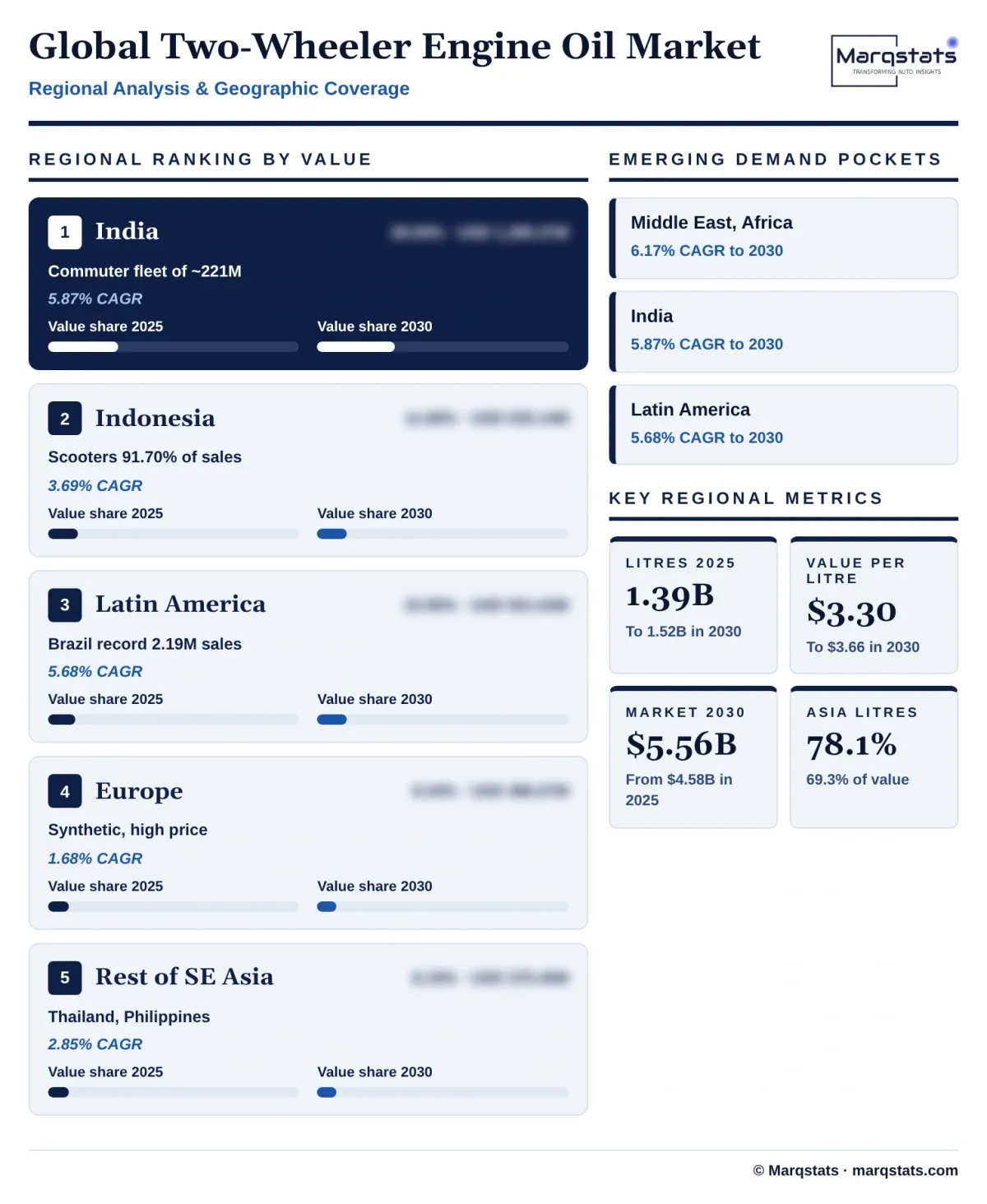
India is the largest market, with 28.05% of 2025 value, USD 1,285.37 million and about 456.44 million litres, rising to USD 1,709.58 million by 2030, a 5.87% CAGR. FADA counted 20,295,650 two-wheeler retail sales in 2025, up 7.24%, of which 1,279,951 were electric, and the Society of Indian Automobile Manufacturers (SIAM) reported 4,939,706 two-wheeler exports, up 24%, each filled with oil at the factory, and the cut in goods and services tax on two-wheelers up to 350cc from 28% to 18% from 22 September 2025 supported demand. The India figures are those of the Marqstats India Two-Wheeler Engine Oil study: Indian Oil, Hindustan Petroleum, Bharat Petroleum, Castrol India, Gulf Oil Lubricants India, Veedol and OEM genuine oils from Hero MotoCorp, Honda, TVS and Bajaj compete, and Castrol India reported record calendar 2025 revenue of INR 5,722 crore with volumes up 8%.
Indonesia
Indonesia accounts for 11.68% of 2025 value, USD 535.14 million and about 199.17 million litres, and grows at 3.69% a year to USD 641.58 million by 2030. It has the largest fleet outside India and China, about 140.9 million registered motorcycles in April 2025, and AISI reported 6,412,769 domestic sales in 2025, up 1.3%, with scooters at 91.70%. Low-friction JASO MB scooter oil therefore dominates, PT Pertamina Lubricants competes with Astra Honda, Yamaha, Federal, Shell and Castrol, and blended prices are among the lowest in the world at about USD 2.70 a litre.
Latin America
Latin America accounts for 10.95% of 2025 value, USD 501.63 million and about 127.40 million litres, and grows at 5.68% a year to USD 661.09 million by 2030. Brazil leads: Abraciclo reported production of 1.98 million motorcycles in 2025, up 13.3%, and record registrations of 2.19 million, up 17.1%, and expects 2.3 million in 2026. Colombia, Mexico, Argentina and Peru add large fleets used for delivery and commuting, and prices of about USD 3.95 a litre are higher than in Asia.
Europe
Europe accounts for 8.44% of 2025 value, USD 386.67 million and about 46.60 million litres, and grows at 1.68% a year to USD 420.25 million by 2030. It uses only 3.36% of world litres but sells mostly synthetic oils at about USD 8.35 a litre. The European Association of Motorcycle Manufacturers (ACEM) reported motorcycle registrations of 1,002,848 in Italy, Spain, France, Germany and the United Kingdom in 2025, down 12.9%, and moped registrations of 142,060 in six markets, down 20.7%, so the fleet barely grows and value rises through mix.
Rest of Southeast Asia
The rest of Southeast Asia, led by Thailand, the Philippines and Malaysia, accounts for 8.19% of 2025 value, USD 375.40 million and about 123.15 million litres, and grows at 2.85% a year to USD 432.02 million by 2030. Delivery and ride-hailing bikes in Bangkok and Manila raise oil turnover, and brands such as Aisin, which launched JASO MA2 and MB oils in the Philippines in March 2026, are entering a market led by Shell, Petron, Caltex, PETRONAS and OEM genuine oils.
China
China accounts for 7.77% of 2025 value, USD 356.07 million and about 110.00 million litres, and its value grows only 0.50% a year to USD 365.01 million by 2030 as litres fall 1.38% a year. China built 22.11 million motorcycles in 2025, mostly for export, so factory fill is a large share of its demand, but many cities restrict petrol motorcycles and electric two-wheelers take most urban sales. Sinopec Great Wall and PetroChina Kunlun compete with Shell, Castrol and Japanese genuine oils.
Rest of Asia-Pacific
The rest of Asia-Pacific, including Pakistan, Bangladesh, Taiwan, Japan, Nepal and Sri Lanka, accounts for 7.77% of 2025 value, USD 355.88 million and about 106.70 million litres, and grows at 3.25% a year to USD 417.58 million by 2030. Pakistan and Bangladesh add commuter motorcycles, Taiwan has a large scooter fleet, and Japan, home to Honda, Yamaha, Suzuki and Kawasaki and to the refiners ENEOS and Idemitsu, sets the JASO standards that motorcycle oils worldwide are certified against.
Middle East and Africa
The Middle East and Africa account for 7.39% of 2025 value, USD 338.71 million and about 111.80 million litres, and grow fastest, at 6.17% a year to USD 457.02 million by 2030. Motorcycle taxis in Nigeria, Kenya, Uganda and Tanzania, delivery fleets in the Gulf and large fleets in Iran, Egypt and Turkey drive demand, but mineral oils still make up most litres and loose and counterfeit oil is common.
Vietnam
Vietnam accounts for 5.83% of 2025 value, USD 267.24 million and about 89.14 million litres, and its value falls 0.30% a year to USD 263.20 million by 2030. It has about 73 million registered motorcycles, about 70 million of them petrol-powered, and the General Statistics Office estimated production of 3,423,500 motorcycles in 2025, but VinFast sold more than 406,000 electric motorcycles in 2025 and Hanoi began a phased restriction of petrol vehicles in selected central streets from 1 July 2026, so litres fall 2.09% a year.
North America
North America accounts for 3.93% of 2025 value, USD 180.00 million and about 18.15 million litres, and grows at 1.29% a year to USD 191.94 million by 2030. It is the highest-priced market, at about USD 10.00 a litre, because large-displacement V-twin and touring motorcycles use synthetic oils from Harley-Davidson, AMSOIL, Mobil 1 and others, but the Motorcycle Industry Council reported new motorcycle and scooter sales down 7.6% in 2025.
How Competition Is Evolving
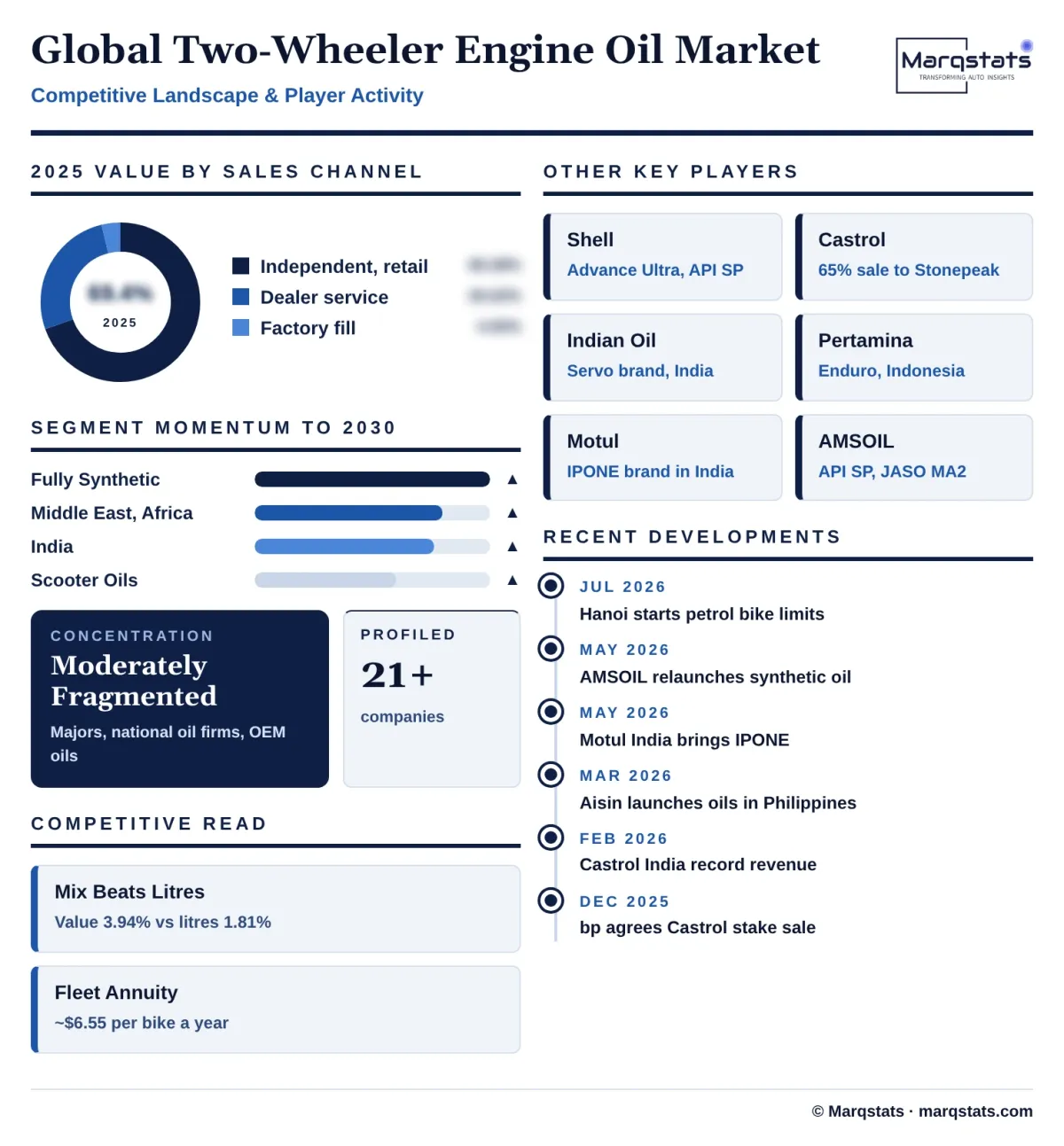
The global two-wheeler engine oil market is moderately fragmented. Five kinds of supplier compete: multinational oil companies such as Shell, Castrol, ExxonMobil, TotalEnergies and Chevron; national oil companies such as Indian Oil, Hindustan Petroleum, Bharat Petroleum, Pertamina, PETRONAS and Sinopec; Japanese refiners ENEOS and Idemitsu, which blend for Japanese motorcycle makers; specialists such as Motul, Liqui Moly and AMSOIL; and many regional blenders.
OEM genuine oils form a separate layer. Honda, Yamaha, Hero MotoCorp, TVS, Bajaj and Suzuki sell their own branded oils through franchised service networks, usually blended under contract by majors or national oil companies, and these oils lead dealer service and much of factory fill.
Ownership is changing at the top. BP p.l.c. agreed in December 2025 to sell 65% of Castrol to Stonepeak at an enterprise value of about USD 10.1 billion, keeping 35%, which will make Castrol a standalone lubricants company with financial owners.
Competition is decided by brand, workshop reach and specification. Suppliers that combine strong motorcycle brands, programmes for roadside mechanics, OEM approvals and timely JASO T 903:2023 certification will win the most value as riders trade up.
Companies Covered
Companies covered in the report include:
Recent Market Activity
Table of Contents
Coverage & Segmentation
The study covers the global two-wheeler engine oil market, with 2025 as the base year, 2021 – 2025 as the historical period and 2026 – 2030 as the forecast period. Values are in US dollars at blender and wholesale selling prices, before retail mark-up and taxes, and volumes are in litres. The market is segmented by formulation, engine type, vehicle type, sales channel and ten regional markets.
Gear, fork and chain lubricants, greases, coolants and brake fluids, fluids for electric two-wheelers, oils for three-wheelers, workshop labour and retail taxes are excluded. The India slice equals the Marqstats India Two-Wheeler Engine Oil study. The service-fill part of the market is a slice of the Marqstats Global and India Automotive Lubricants Aftermarket studies, which exclude factory fill, so the figures must not be added together. Splits are Marqstats estimates.